Quick summary
Multies are a tiny, easy to care for Tanganyikan cichlid ideal for beginners who can provide hard, alkaline water, a sandy substrate and plenty of shells, and they breed so readily that you’ll soon need a plan for the growing colony. Just note they aren’t a typical peaceful community fish, as they can be surprisingly feisty in defending their shells from tank mates.
🐠 Build a tank around this species
In this guide:
- Introduction
- Quick Stats
- Appearance
- Natural Habitat
- Tank Size and Setup
- Water Parameters
- Filtration and Equipment
- Diet and Feeding
- Behaviour and Temperament
- Tank Mates
- Breeding
- Common Diseases
- FAQs
Introduction
The Multifasciatus Shell Dweller, universally known among aquarists as simply “Multies,” holds the remarkable distinction of being one of the smallest cichlid species in the world. With adults barely reaching 5 cm in length, Neolamprologus multifasciatus packs an extraordinary amount of personality, intelligence and social complexity into a tiny body. Native to the sandy, shell-littered shores of Lake Tanganyika in East Africa, this diminutive cichlid has evolved an intimate relationship with the empty shells of the Neothauma tanganyicense snail, using them as homes, breeding sites and defensive fortresses.
What makes Multies so captivating is not their size or their colouration – both of which are modest by cichlid standards – but their behaviour. They are colonial fish that form bustling communities reminiscent of a miniature underwater city. Each individual claims one or more shells, excavates sand to position them precisely, and defends its patch with a tenacity that belies its tiny stature. Watching a colony of Multies go about their daily routines – shuffling sand, squabbling over prime shell real estate, courting mates and raising fry in plain sight – is one of the most rewarding spectacles in the freshwater hobby.
Their small size, relatively straightforward care requirements and prolific breeding habits make Multies an excellent entry point into the world of Tanganyikan cichlids. They are equally appealing to seasoned African cichlid enthusiasts and to newcomers looking for something far more engaging than the typical community fish. This guide covers everything you need to know to keep a thriving colony of Multifasciatus Shell Dwellers in your home aquarium.
Quick Stats
| Scientific name | Neolamprologus multifasciatus |
|---|---|
| Common names | Multies, Multi Shell Dweller, Dwarf Shell Dweller |
| Family | Cichlidae |
| Origin | Lake Tanganyika, East Africa |
| Adult size | 4.5 cm |
| Difficulty | Easy |
| Breeding difficulty | Easy |
| Temperature | 24–27 °C |
| pH | 7.5–9 |
| GH | 8–25 dGH |
| Minimum tank size | 40 L |
| Conservation status | Least Concern (IUCN, assessed 2025) |
Appearance
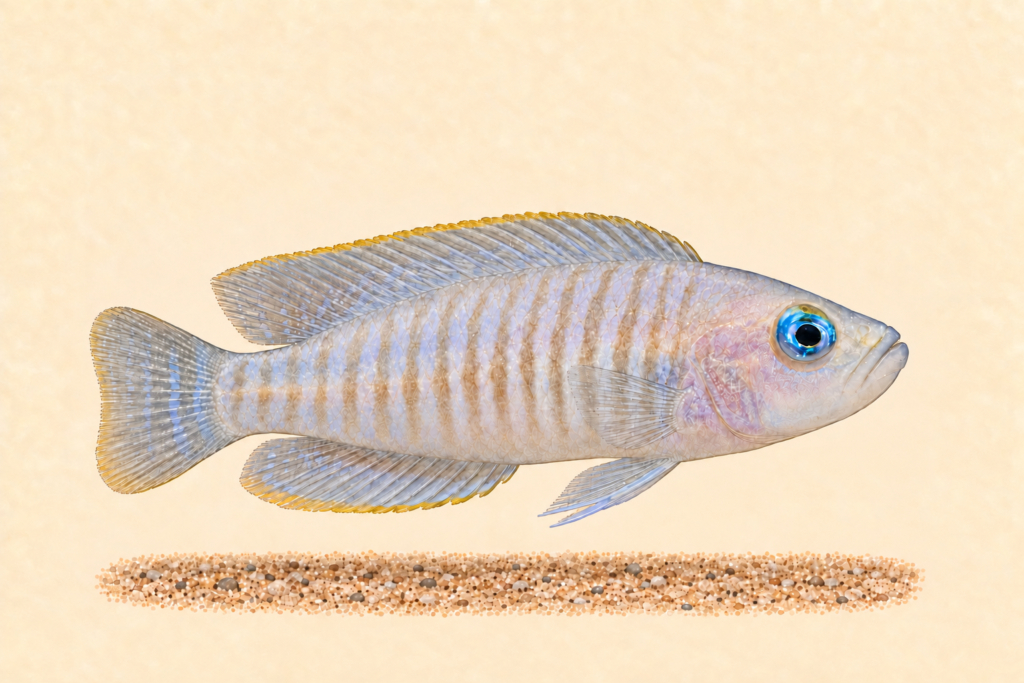
Neolamprologus multifasciatus is, at first glance, an unassuming fish. Its base body colour is a pale tan to silvery-beige, overlaid with a series of thin, dark vertical bars that run along the flanks from behind the gill cover to the base of the caudal fin. It is these multiple bars – “multifasciatus” literally meaning “many-banded” – that give the species its scientific name. Depending on the fish’s mood, lighting and background, these bars can appear quite bold and sharply defined or fade to a barely visible pattern. When stressed or submissive, the bars often intensify, while a dominant individual in full display may show a brighter overall body tone with subtler banding.
The fins are largely translucent with a faint yellowish or bluish sheen, and the dorsal fin may carry a thin, pale edging. Males tend to be slightly larger than females, reaching up to 5 cm, while females typically max out at around 2.5 to 3 cm. Sexual dimorphism is otherwise subtle; males may develop marginally longer fin extensions and a slightly more robust head profile as they mature, but reliably sexing young individuals is difficult without observing breeding behaviour.
The eyes are proportionally large, giving the fish an alert and intelligent expression that is entirely appropriate given the complexity of their social lives. The body shape is elongated and slightly compressed laterally, perfectly adapted for darting in and out of the narrow openings of snail shells. Overall, while Multies will never win awards for flamboyant colour, their understated elegance and the endless fascination of watching their behaviour more than compensate for any lack of visual pizzazz.
Natural Habitat
Lake Tanganyika is the second oldest, second largest and second deepest lake in the world. It is an ancient rift lake estimated to be between 9 and 12 million years old, and its immense age has fostered extraordinary levels of endemism among its fish fauna. The lake’s water is famously alkaline and hard, with a remarkably stable chemistry that has remained largely unchanged for millennia. Surface temperatures typically hover between 24 and 29 degrees Celsius, while the pH sits between 8.6 and 9.5 in most areas.
Neolamprologus multifasciatus is found along the sandy and muddy substrates of the lake’s littoral zone, at depths ranging from roughly 5 to 15 metres. Its habitat is characterised by vast expanses of open sand strewn with the empty shells of Neothauma tanganyicense, a large freshwater snail endemic to the lake. These shell beds can extend over enormous areas, and it is within these beds that Multies form their colonies. Each fish claims one or more shells, burying them partially in the sand and arranging them to its liking. The colonies can contain dozens to hundreds of individuals living in close proximity, with each fish fiercely defending its immediate shell territory while tolerating neighbours at a respectful distance.
The surrounding habitat is relatively barren – open sand with little in the way of rock formations or vegetation. This means that the shells themselves are the single most important environmental feature, providing shelter from predators, sites for spawning and a physical framework around which the entire social structure of the colony is organised. Understanding this habitat is key to replicating it successfully in the aquarium.
Tank Size and Setup
One of the great advantages of keeping Multies is that their diminutive size allows them to thrive in relatively modest aquaria. A tank of 40 litres is sufficient for a small starter group of 4 to 6 individuals, though a larger aquarium of 60 to 80 litres or more is recommended if you wish to observe the full range of colonial behaviour and allow the population to grow over time. Because Multies are colonial and breed readily, a tank that seems spacious at first can become crowded within a year, so planning for population growth from the outset is wise.
The tank footprint is more important than height. Multies are bottom dwellers that rarely venture far above the substrate, so a long, shallow tank with a large base area is ideal. A standard 60 cm or 80 cm tank works beautifully. Tall, narrow tanks are less suitable because they waste vertical space that the fish will not use.
The substrate should be fine sand, ideally a pale-coloured sand such as pool filter sand, coral sand or aragonite sand. Coral sand and aragonite have the added benefit of buffering the water towards the alkaline, hard conditions that Tanganyikan cichlids require. The sand layer should be at least 3 to 5 cm deep, as Multies are prolific diggers and will constantly rearrange sand around their shells. Gravel is not suitable; the fish cannot move gravel effectively and may injure themselves trying.
Shells are absolutely essential. Without them, Multies cannot exhibit their natural behaviour and will be perpetually stressed. Escargot shells (the type sold for cooking) are the most commonly used option in the hobby and are an excellent choice. They closely approximate the size and shape of Neothauma shells. Aim to provide at least two shells per fish initially, and scatter extras across the tank so that the colony has room to expand. Some aquarists provide a generous pile of 20 to 30 shells even for a small group, which allows the fish to choose preferred shells and reduces territorial conflict.
Beyond sand and shells, the aquascape can be kept very simple. A few pieces of rock or a small stack of stones at the back of the tank can provide visual interest and additional territorial markers, but heavy planting or complex rockwork is neither necessary nor particularly natural for this species. If you wish to include plants, hardy Tanganyikan-compatible species such as Anubias or Vallisneria can be used, but be prepared for the fish to uproot anything planted directly in the sand near their shells.
Water Parameters
Maintaining appropriate water chemistry is one of the most important aspects of keeping Multies healthy. As a Lake Tanganyika endemic, this species requires alkaline, hard water. Fortunately, many areas with naturally hard tap water can keep Multies with little or no modification. For aquarists with soft, acidic tap water, buffering with crushed coral, aragonite substrate or commercially available Tanganyikan salt mixes will be necessary.
| Temperature | 24 – 27 °C |
| pH | 7.5-9 |
| General hardness (GH) | 8-25 dGH |
| Ammonia | 0 ppm |
| Nitrite | 0 ppm |
| Nitrate | Below 20 ppm |
Stability is arguably more important than hitting a precise number within these ranges. Lake Tanganyika’s water chemistry is extraordinarily stable, and the fish that have evolved there are less tolerant of fluctuations than many other freshwater species. Avoid sudden changes to pH or hardness, and perform regular, moderate water changes rather than infrequent large ones. A weekly water change of 20 to 30 per cent is a sound routine. Always ensure that replacement water is temperature-matched and has been treated to remove chlorine and chloramine.
Multies are sensitive to elevated nitrate levels. While they can tolerate brief spikes, chronically high nitrate above 20 ppm can lead to stress, reduced breeding activity and increased susceptibility to disease. Keeping nitrate low through regular water changes, avoiding overfeeding and maintaining efficient filtration is essential.
Filtration and Equipment
Multies do not produce a particularly heavy bioload for their size, but clean, well-oxygenated water is non-negotiable for any Tanganyikan cichlid. A hang-on-back filter, internal filter or small canister filter rated for the tank’s volume will all work well. Sponge filters are another popular choice, particularly in breeding setups, as they provide gentle flow and eliminate any risk of fry being sucked into an intake.
If using a power filter with an exposed intake, fitting a fine sponge pre-filter over the intake tube is strongly recommended. Multies fry are tiny and can easily be drawn into unprotected intakes. Flow rate should be moderate; Multies do not come from high-current environments and excessive flow can stress them and make it difficult for the fish to maintain their shell territories.
A heater is necessary in most climates to maintain the temperature within the 24 to 27 degree Celsius range. An adjustable heater of appropriate wattage for the tank size is ideal. Use a separate thermometer to verify the heater’s accuracy, as built-in thermostats can drift over time.
Lighting requirements are undemanding. Multies have no specific lighting needs, so choose lighting based on your aesthetic preferences and the requirements of any live plants you may include. A standard LED fixture on a timer providing 8 to 10 hours of light per day is perfectly adequate. Avoid excessively bright lighting without cover, as this can make the fish feel exposed and less inclined to venture out of their shells.
An air pump with an airstone can be a beneficial addition, particularly in warmer climates or during summer months. The higher the water temperature, the lower its oxygen-carrying capacity, and Tanganyikan cichlids appreciate well-oxygenated water. Surface agitation from the filter output is often sufficient, but supplemental aeration provides an extra margin of safety.
Diet and Feeding
In the wild, Neolamprologus multifasciatus feeds primarily on tiny invertebrates, zooplankton and organic detritus found in and around the shell beds. In captivity, they are remarkably easy to feed and will accept a wide variety of foods.
A high-quality cichlid pellet or flake food formulated for small cichlids should form the staple of the diet. Look for foods with a good balance of protein and vegetable matter, and avoid those with excessive fillers or artificial colours. Because of the fish’s tiny mouth, choose micro pellets or crush larger pellets and flakes to an appropriate size. Spirulina-enriched foods are beneficial and can be offered regularly as part of a varied diet.
Supplement the staple diet with frozen or live foods such as baby brine shrimp, daphnia, cyclops and finely chopped bloodworm. These foods are excellent for conditioning breeding adults and for feeding growing fry. Live baby brine shrimp (Artemia nauplii) are particularly valuable as a first food for newly free-swimming fry, though the fry will also accept crushed dry foods surprisingly well.
Feed small amounts once or twice daily. Multies have small stomachs and benefit from frequent, modest meals rather than a single large feeding. Overfeeding is a common mistake and leads to degraded water quality, which is especially problematic in the alkaline, hard water these fish require. Any uneaten food should be removed promptly. In a well-established colony with fry of various ages, food tends to be consumed quickly, but vigilance against overfeeding remains important.
Behaviour and Temperament
The behaviour of Multies is, without exaggeration, the primary reason most people keep them. Despite their tiny size, they are highly intelligent, socially complex and endlessly entertaining to observe. Each individual has a recognisable personality, and the dynamics within a colony are as intricate as anything seen in much larger cichlid species.
Multies are colonial, meaning they naturally live in groups with overlapping territories. Each fish claims one or more shells and defends the immediate area around them. Dominant males typically hold the largest territories with multiple shells and may have several females nesting within their domain. Subordinate males occupy peripheral positions and may attempt to sneak matings when the dominant male is distracted. Females are fiercely protective of their chosen shell and the brood within it, and will aggressively repel any intruder – including much larger fish – that ventures too close.
Territorial disputes are frequent but rarely result in serious injury. Most conflicts are resolved through displays – flared fins, rapid lateral shaking and face-to-face standoffs. Actual physical contact is uncommon and usually brief. The most common behaviour you will observe is sand-moving: Multies spend an extraordinary amount of time picking up mouthfuls of sand and depositing them elsewhere, sculpting the terrain around their shells to their exact specifications. This is both functional (positioning shells, clearing entrances) and territorial (building sand walls to demarcate boundaries).
Multies are not shy once established. After an initial settling-in period, they become bold and will readily come to the front of the tank at feeding time. They quickly learn to associate their keeper with food and may even follow a finger along the glass. Their alertness and responsiveness give them a level of interactivity that is unusual in fish of this size.
It is worth noting that while Multies are generally peaceful toward non-competing species, they can be surprisingly fierce in defence of their shells. A brooding female will not hesitate to chase away a fish many times her size if it wanders too close. This behaviour is normal and healthy, but it does need to be considered when selecting tank mates.
Tank Mates
Multies are best kept in a species-only setup, particularly in smaller tanks. A colony on its own in a dedicated aquarium allows you to observe the full range of their social behaviour without interference or stress from other species. However, in larger tanks of 100 litres or more, carefully chosen tank mates can work well, provided they occupy different niches and do not compete for shells or substrate space. The ideal companions are mid-water or upper-water species that will not disturb the Multies’ territory on the bottom. Avoid any fish large enough to eat adult Multies or their fry, and avoid other substrate-dwelling species that might compete for shell resources.
Good tank mates
- Cyprichromis leptosoma – An open-water Tanganyikan cichlid that occupies the mid to upper water column and completely ignores shell dwellers on the bottom.
- Paracyprichromis nigripinnis – Another mid-water Tanganyikan species that stays well above the substrate and makes an elegant companion.
- Neolamprologus caudopunctatus – A small, relatively peaceful Tanganyikan cichlid that can coexist with Multies in larger tanks with sufficient territory.
- Golden Ornate Julie – A rock-dwelling Tanganyikan cichlid that occupies a different niche, sticking to rockwork rather than shell beds.
- Synodontis petricola – A small Tanganyikan catfish that is generally peaceful and tends to shelter among rocks rather than interfering with shell territories.
- Neolamprologus brichardi – The Fairy Cichlid can coexist in spacious tanks with distinct rock and shell zones, though monitoring is advised as colonies grow.
- Altolamprologus compressiceps – A slow-moving predator that typically ignores adult Multies, though it may prey on very small fry in the open.
- Xenotilapia flavipinnis – A sand-sifting cichlid that can work in very large tanks where both species have ample floor space.
Fish to avoid
- Cyphotilapia frontosa – Far too large and predatory; would easily consume adult Multies, let alone fry.
- Five Barred Cichlid – An aggressive, territorial species that would dominate and bully the much smaller Multies.
- White Spotted Cichlid – Highly territorial rock dwellers with aggressive temperaments unsuitable for a shell dweller community.
- Lamprologus ocellatus – Another shell dweller that will compete directly for the same resources, leading to intense territorial conflict.
- Neolamprologus similis – Closely related shell dweller that will hybridise with Multies and compete aggressively for shells.
- Lobochilotes labiatus – A large, powerful cichlid that would pose a serious predation risk to all but the largest Multies.
- Malawi Mbuna species – Require different water chemistry emphasis and are generally too boisterous and aggressive for a Multies tank.
- Oscar – An entirely incompatible species from South America that would rapidly consume every Multies in the tank.
Breeding
Breeding Neolamprologus multifasciatus is one of the easiest and most rewarding experiences available to the freshwater aquarist. Given appropriate conditions, a healthy colony will breed almost continuously without any special intervention from the keeper. Indeed, the challenge with Multies is not getting them to breed but rather managing the resulting population growth.
Multies are substrate-spawning cichlids that lay their eggs inside shells. A receptive female selects a shell – usually one she has already claimed and prepared – and deposits a small clutch of eggs on the inner surface. Clutch sizes are modest, typically ranging from 5 to 25 eggs depending on the female’s size and condition. The dominant male fertilises the eggs by releasing sperm near the shell opening, and from that point, the female assumes sole responsibility for guarding the brood.
The eggs hatch in approximately 2 to 3 days, and the fry remain inside the shell, feeding on their yolk sacs for a further 7 to 10 days before becoming free-swimming. Even after they emerge, the fry stay very close to the mother’s shell and retreat inside at the first sign of danger. The female is an attentive and ferocious guardian during this period and will attack anything that approaches her shell.
Free-swimming fry are tiny but are immediately capable of feeding on micro-foods. Crushed flake food, powdered fry food and live baby brine shrimp are all suitable first foods. In a well-established colony, infusoria and biofilm on shell surfaces also provide a natural food source for the youngest fry.
One of the most charming aspects of Multies breeding is that older offspring are often tolerated within the colony. Juvenile fish may remain near their parents’ territory for weeks or even months before dispersing to claim their own shells. This creates a multigenerational colony structure where fish of all ages coexist – a rare and fascinating sight in a home aquarium.
To encourage breeding, simply maintain stable water parameters, feed a varied diet and provide an abundance of shells. No special triggers such as temperature changes or water chemistry adjustments are required. If breeding does not occur within the first few weeks, patience is usually the only remedy needed. Ensure the group contains both males and females; starting with a group of six or more juveniles virtually guarantees a mix of sexes.
Population management is an important consideration. A prolific colony can quickly outgrow a small tank. Options for managing numbers include trading surplus fish to local fish shops, selling or giving them to fellow hobbyists, or setting up additional tanks. Some keepers maintain a single predatory tank mate – such as an Altolamprologus species – that naturally controls fry numbers by picking off the occasional straggler, though this approach is not without its detractors.
Common Diseases
Neolamprologus multifasciatus is a robust and hardy species when maintained in appropriate conditions. Most health problems in Multies can be traced back to poor water quality, incorrect water chemistry or inadequate diet rather than to any inherent vulnerability in the fish themselves.
Ich (white spot disease) is perhaps the most commonly encountered illness. It presents as small white spots on the fins and body, and affected fish may flash against surfaces and become lethargic. Ich is usually triggered by sudden temperature drops or the introduction of infected new stock. Treatment involves raising the water temperature to 28 to 30 degrees Celsius over 24 hours and adding aquarium salt at a rate of 1 to 2 teaspoons per 20 litres, or using a commercial ich medication. The hard, alkaline water preferred by Multies is generally well-suited to salt-based treatments.
Bacterial infections can occur, particularly in fish that have been stressed by poor water quality or aggression. Symptoms include fin rot, cloudy eyes, loss of appetite and reddened patches on the body. Improving water quality through increased water changes is the first and most important step. In severe cases, treatment with a broad-spectrum antibacterial medication may be necessary.
Bloat, sometimes referred to as Malawi bloat despite also affecting Tanganyikan species, is a potentially fatal condition characterised by abdominal swelling, loss of appetite and stringy white faeces. It is often associated with overfeeding, a diet too high in protein or poor water conditions. Prevention is far more effective than treatment; feed a balanced diet, avoid overfeeding and maintain pristine water quality. If caught early, Epsom salt baths and fasting may help, but advanced cases are often fatal.
Internal parasites can occasionally affect Multies, particularly wild-caught specimens or those obtained from sources with questionable quarantine practices. Symptoms include weight loss despite normal feeding, white or stringy faeces and a generally emaciated appearance. Treatment with an appropriate anti-parasitic medication, administered via medicated food, is usually effective.
As a general rule of prevention, quarantine all new fish before adding them to an established colony, maintain stable water chemistry, perform regular water changes and avoid overfeeding. A well-maintained Multies colony is remarkably disease-resistant and can thrive for many years with minimal health issues.
FAQs
How many Multies should I start with?
A group of 6 to 8 juveniles is the ideal starting point. This provides a high probability of obtaining both sexes and allows the fish to establish a natural social hierarchy. Starting with fewer than four fish can result in an unbalanced group, particularly if you end up with all one sex. Purchasing juveniles rather than adults is generally recommended, as young fish adapt more readily to a new environment and will establish their colony structure as they mature together.
What type of shells should I use for Multies?
Escargot shells, sold for culinary use, are the most popular and readily available option. They are the right size, shape and material for Multies to use comfortably. Ensure you purchase shells that have not been treated with any chemicals or preservatives – plain, cleaned shells from a food supplier are ideal. Boil them briefly before use to remove any residue. Some aquarists also use turbo shells or other similarly sized marine shells. Avoid painted, lacquered or artificially coloured shells, and ensure the opening is large enough for the fish to enter and exit freely.
Can Multies be kept with other shell-dwelling cichlids?
This is generally not recommended, especially in smaller tanks. Different shell-dwelling species will compete directly for the same resources – namely shells and substrate space – leading to heightened aggression and stress. There is also a risk of hybridisation between closely related species such as Neolamprologus multifasciatus and Neolamprologus similis. In very large tanks with clearly separated shell beds and ample space, some experienced keepers have successfully maintained mixed shell dweller communities, but this requires careful planning and monitoring.
How fast do Multies colonies grow?
Under good conditions, a colony can expand surprisingly quickly. A pair of Multies can produce a new clutch every 3 to 4 weeks, and with clutch sizes of 5 to 25 fry, a small starting group can become a colony of 30 to 50 fish within a year. Growth rate depends on factors such as tank size, food availability, water quality and predation pressure. In a species-only tank with no predators, the population can reach the tank’s carrying capacity within 12 to 18 months, at which point breeding typically slows as space becomes limited.
Do Multies need a sandy substrate, or can I use gravel?
Sand is strongly recommended and should be considered essential for Multies. A significant portion of their natural behaviour involves moving sand – excavating around shells, building defensive mounds and reshaping their territory. Gravel prevents them from performing these behaviours, can injure their mouths and gills during digging attempts, and does not allow shells to be properly embedded. Fine sand, whether play sand, pool filter sand, coral sand or aragonite, is the only appropriate substrate for this species.
Related Guides
- Neolamprologus similis – A closely related shell dweller often confused with Multies, with subtle differences in appearance and behaviour worth understanding.
- Lamprologus ocellatus – Another popular shell-dwelling cichlid from Lake Tanganyika, offering a comparison in temperament and care requirements.
- Golden Ornate Julie – A rock-dwelling Tanganyikan cichlid that makes an excellent companion species in larger mixed setups.
- Cyprichromis leptosoma – A mid-water Tanganyikan cichlid frequently kept alongside shell dwellers to add activity to the upper water column.
- Neolamprologus brichardi – The iconic Fairy Cichlid, another Tanganyikan species with fascinating colonial breeding behaviour.
- Synodontis petricola – A small Tanganyikan catfish commonly kept in Rift Lake community tanks, useful as a compatible bottom-dwelling companion in spacious setups.