Quick Summary
The Horned Nerite Snail is one of the most effective and visually striking algae grazers available for freshwater aquariums, and because its larvae cannot survive without brackish or marine water, there is zero risk of an unwanted population explosion in your tank. It is a good choice for beginners and experienced keepers alike, provided you maintain stable, clean water with adequate calcium for shell health.
🐠 Build a tank around this species
In this guide:
- Introduction
- Quick Stats
- Appearance
- Natural Habitat
- Tank Size and Setup
- Water Parameters
- Diet and Feeding
- Behaviour and Temperament
- Tank Mates
- Breeding
- Common Diseases
- FAQs
Introduction
The Horned Nerite Snail (Clithon corona) has earned a devoted following among freshwater aquarists for two very good reasons: it is a tireless algae eater, and it looks genuinely unusual. Where many snails carry smooth, dome-shaped shells, the Horned Nerite sports an array of thorn-like projections that give it a miniature, almost prehistoric appearance. These horns vary considerably between individuals – some carry just a few short bumps, while others bristle with long, curving spines that can extend several millimetres from the shell surface.
Native to coastal rivers, streams and estuaries across Southeast Asia and the wider Indo-Pacific region, Clithon corona occupies a fascinating ecological niche between fresh and salt water. In the wild, adult snails spend most of their time in freshwater or mildly brackish zones, grazing biofilm and algae from rocks and submerged wood. Reproduction, however, depends on access to brackish or fully marine conditions for larval development. This reproductive biology is enormously convenient for the home aquarist: you can keep Horned Nerites in a standard freshwater community tank without worrying about the snail population spiralling out of control, a concern that plagues keepers of many other freshwater snail species.
Despite their hardiness in general terms, Horned Nerites are slightly more sensitive than some of their nerite relatives – notably the Zebra Nerite (Neritina natalensis) – to poor water quality and, in particular, to copper-based medications. This is a genuine care consideration rather than a reason to avoid the species, but it does mean that prospective keepers should commit to regular water changes and careful medication choices. In return, you get a compact, peaceful, endlessly entertaining algae grazer that will keep your glass, rocks and hardscape remarkably clean.
Quick Stats
| Scientific name | Clithon corona |
|---|---|
| Common names | Horn Nerite, Bumble Bee Horn Snail, Sun Thorn Nerite, Thorn Nerite |
| Family | Neritidae |
| Origin | Southeast Asia and Indo-Pacific |
| Adult size | 2 cm |
| Lifespan | 1–2 years |
| Difficulty | Easy |
| Breeding difficulty | Advanced |
| Temperature | 22–28 °C |
| pH | 7–8.4 |
| GH | 8–18 dGH |
| KH | 5–12 dKH |
| Minimum tank size | 20 L |
| Conservation status | Not evaluated |
Appearance
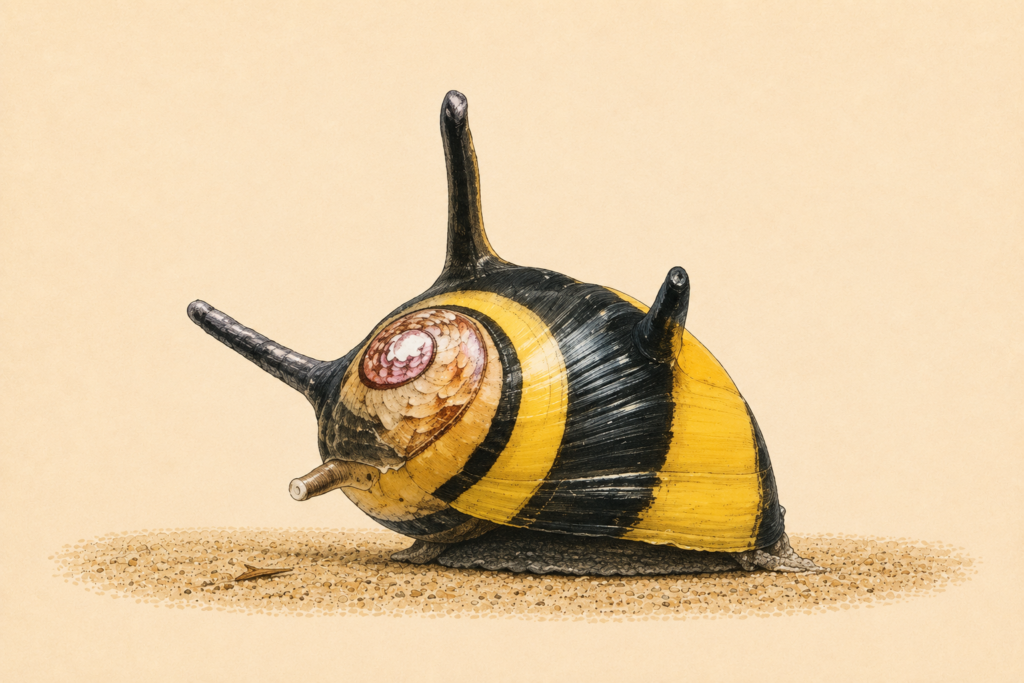
Clithon corona is a small snail, typically reaching only 1.5 to 2.5 centimetres across the widest point of its shell at maturity. Despite its modest size, it is immediately recognisable thanks to the horn-like protrusions that adorn its shell. These spines grow from ridges on the shell surface and can vary enormously in number, length and curvature. Some specimens have only a handful of short, blunt bumps; others carry a crown of long, sharply pointed horns that give the snail a striking, almost sea-urchin-like silhouette. The horns are made of the same calcium carbonate material as the rest of the shell and are not regenerated if broken, so handling should always be gentle.
Shell colour and pattern are equally variable. The base colour ranges from dark olive green through to golden yellow, tan, brown and near-black. Many individuals display a pattern of dark stripes, zigzags or spots over a lighter background, often reminiscent of the banding seen in other nerite species. The combination of colour pattern and horn structure means that no two Horned Nerites look quite the same, which adds to their appeal for hobbyists who enjoy natural variation.
The body of the snail itself – the foot, head and tentacles – is typically dark grey to black, though lighter grey and mottled forms are seen. The operculum, the small plate that seals the shell opening when the snail retreats, is a hard, semicircular structure that sits flush with the aperture, a characteristic shared across the nerite family.
Sexing Horned Nerites visually is not reliably possible. Males and females look essentially identical externally, and the only consistent way to determine sex is to observe breeding behaviour or to look for the small, white, sesame-seed-like egg capsules that females deposit on hard surfaces.
Natural Habitat
In the wild, Clithon corona inhabits the lower reaches of coastal rivers, streams and estuaries throughout Southeast Asia and the broader Indo-Pacific. Its range encompasses parts of Indonesia (Sulawesi, Java, Borneo and numerous smaller islands), the Philippines, Papua New Guinea, and sections of the coastline stretching from the Malay Peninsula through to the Pacific Islands. These are regions characterised by warm, mineral-rich water flowing over rocky or sandy substrates, often with significant tidal influence.
The typical habitat is a clear, moderately fast-flowing stream or river with a rocky bottom covered in biofilm and various forms of algae. Submerged wood, smooth boulders and cobbles provide the primary grazing surfaces. Water chemistry in these environments tends towards neutral to mildly alkaline, with moderate to high mineral content thanks to the limestone and volcanic geology common in the region. Temperatures are consistently warm year-round, generally between 24 and 28 degrees Celsius.
Crucially, these habitats often transition into brackish or fully saline conditions closer to the coast. This gradient is essential for the species’ reproductive cycle: adult snails live and graze in freshwater or mildly brackish zones, but their planktonic larvae are carried downstream into saltier water, where they develop before eventually migrating back upstream as tiny juveniles. This lifecycle means that Clithon corona is naturally adapted to tolerate a range of salinities, though adults are most commonly found in freshwater.
Understanding this natural habitat helps inform aquarium care. The species does best in water that is reasonably hard and alkaline, with good flow, stable parameters, and plenty of surfaces covered in algae or biofilm. Acidic, soft water – the kind preferred by many Amazonian fish species – is not ideal for Horned Nerites and can lead to shell erosion over time.
Tank Size and Setup
Horned Nerite Snails are small and produce a relatively low bioload, which means they can be housed in tanks as small as 20 litres. However, the limiting factor is not so much space as it is food: a snail needs enough algae-covered surface area to sustain itself. In a very small, very clean tank with minimal algae growth, a single Horned Nerite may struggle to find enough to eat. A good rule of thumb is one snail per 20 to 30 litres, adjusting upward if your tank has particularly generous algae growth and ample hard surfaces.
The ideal setup mimics the natural environment as closely as practical. A substrate of fine gravel, sand, or a mixture of both works well. Avoid sharp-edged substrates that could damage the snail’s foot as it moves. Rounded river pebbles, smooth stones and driftwood make excellent hardscape choices, providing both grazing surfaces and visual interest. Live plants are perfectly compatible with Horned Nerites; the snails will graze algae from leaf surfaces without damaging healthy plant tissue, making them a popular addition to planted aquariums.
A secure lid is essential. Like all nerite snails, Clithon corona is an accomplished escape artist and will readily climb above the waterline. Given the opportunity, it will leave the tank entirely, which almost always results in the snail drying out and dying. Any gaps around filter inlets, heater cables or tubing should be sealed. Even with a lid, you may find your Horned Nerites exploring the glass above the waterline; this is normal behaviour and not a cause for concern, provided they cannot actually exit the tank.
Moderate to strong water flow is appreciated, reflecting the species’ origins in flowing streams and rivers. A small powerhead or the output from a hang-on-back or canister filter can provide adequate current. Stagnant water should be avoided, both because the snails prefer flow and because still water tends to accumulate waste more readily, which can affect the snails’ health.
Lighting should be sufficient to promote some algae growth on surfaces, which serves as the snails’ primary food source. Standard aquarium lighting on a timer set to around eight to ten hours per day is usually adequate. If you find algae growth is insufficient to feed your snails, you may need to supplement their diet (see the Diet and Feeding section below).
Water Parameters
| Temperature | 22 – 28 C |
| pH | 7.0 – 8.4 |
| General hardness (GH) | 6 – 18 dGH |
| Carbonate hardness (KH) | 3 – 12 dKH |
| Ammonia | 0 ppm |
| Nitrite | 0 ppm |
| Nitrate | Below 20 ppm |
Stability is the single most important factor when it comes to water parameters for Horned Nerite Snails. Sudden swings in temperature, pH or hardness are far more dangerous than values that sit slightly outside the ideal range. If your tap water is naturally soft and acidic, you will need to buffer it to provide the mineral content these snails require. Crushed coral, limestone chips or a commercial remineralising product can be added to the filter or substrate to raise and stabilise GH and KH.
Calcium availability is critical for shell health. Without sufficient dissolved calcium, the shell will gradually erode, thin and pit, leaving the snail vulnerable to injury and infection. A GH of at least 6 dGH is the bare minimum, and values towards the higher end of the range are preferable. If your water is borderline, consider adding a cuttlebone fragment to the tank; it dissolves slowly and provides a steady source of calcium carbonate. Some keepers also use calcium-enriched foods or dedicated invertebrate mineral supplements.
Horned Nerites are more sensitive to copper than many fish species. Copper is a common ingredient in fish medications, particularly those used to treat ich (white spot disease) and various parasitic infections. Even trace amounts of copper can be lethal to invertebrates, including nerite snails. Always check the ingredients of any medication before adding it to a tank containing Horned Nerites, and if treatment with a copper-based product is unavoidable, remove the snails to a separate holding tank first. Copper can also be present in tap water that runs through copper pipes, so testing your source water with a copper test kit is a worthwhile precaution.
Weekly water changes of 20 to 30 per cent are recommended to keep nitrate levels low and maintain stable chemistry. Use a dechlorinator that is safe for invertebrates, and match the temperature and chemistry of the new water to the tank water as closely as possible to avoid shocking the snails.
Filtration and Equipment
Horned Nerite Snails do not have demanding filtration requirements beyond the basics of good aquarium husbandry. Any filter capable of handling the bioload of the tank and providing moderate water flow will be suitable. Hang-on-back filters, internal sponge filters and small canister filters all work well. Sponge filters are a particularly good choice for smaller tanks, as they provide gentle flow, excellent biological filtration and zero risk of trapping or injuring the snails.
If using a filter with an intake tube, fit a sponge pre-filter or a fine mesh cover over the intake. While adult Horned Nerites are generally too large to be sucked into a filter intake, small individuals or those weakened by poor health could potentially become trapped against the intake opening, especially in high-flow setups.
A heater is necessary in most situations unless the room temperature reliably stays within the 22 to 28 degrees Celsius range year-round. Choose a heater with a guard to prevent the snails from sitting directly on the heating element, which could cause burns. Alternatively, use an inline heater positioned in the filter return line, which eliminates the risk entirely.
An air pump is not strictly necessary if the filter provides adequate surface agitation, but additional aeration is never harmful and can be beneficial in warmer tanks where dissolved oxygen levels tend to be lower. Horned Nerites, like all aquatic snails, rely on dissolved oxygen and will suffer in hypoxic conditions.
As mentioned in the tank setup section, a well-fitting lid is an essential piece of equipment. It does not need to be elaborate – a simple sheet of acrylic or glass cut to fit, with small gaps for airline tubing and cables, is sufficient. The key is ensuring there are no openings large enough for a snail to squeeze through.
Diet and Feeding
The Horned Nerite Snail is first and foremost an algae grazer. In the aquarium, it will methodically work its way across every hard surface – glass, rocks, driftwood, equipment, even plant leaves – consuming green spot algae, green dust algae, brown diatoms and soft biofilm. It is remarkably efficient at this task, and a small group of Horned Nerites can keep even a moderately algae-prone tank looking pristine.
However, there are limits. Horned Nerites do not eat all types of algae. They are ineffective against hair algae, black beard algae (BBA) and most types of blue-green algae (cyanobacteria). They also struggle with heavily calcified green spot algae on very old, neglected surfaces. Their grazing is most effective against soft, newly established algae and biofilm.
In a well-maintained tank with limited algae growth, supplementary feeding is important to prevent starvation. Blanched vegetables such as courgette (zucchini), cucumber, spinach and lettuce can be offered, weighted down with a plant weight or a fork so they sink to the bottom. Algae wafers and sinking spirulina-based tablets are also readily accepted. Remove any uneaten fresh food within 24 hours to prevent water quality issues.
Horned Nerites are not aggressive feeders and will not compete effectively with fast-moving fish for food. If you keep them alongside bottom-dwelling fish that are enthusiastic eaters, such as certain loaches or catfish, ensure that food reaches the snails by placing it near their usual grazing spots, ideally after lights out when the fish are less active.
Calcium supplementation through the diet is beneficial. Foods enriched with calcium, or the addition of a small piece of cuttlebone to the tank, help support shell growth and repair. The cuttlebone will slowly dissolve, releasing calcium into the water column where the snails can absorb it through their foot and mantle tissue as well as through their food.
Behaviour and Temperament
Horned Nerite Snails are entirely peaceful. They pose no threat whatsoever to fish, shrimp, other snails, plants or any other tank inhabitants. Their sole interest is grazing, and they will spend the vast majority of their time slowly moving across surfaces, rasping algae and biofilm with their radula (a ribbon-like tongue covered in tiny teeth).
They are somewhat more active during the evening and night hours, though they can often be observed grazing during the day as well. It is common to find them exploring above the waterline, particularly along the glass near the surface or on the underside of the tank lid. This behaviour does not indicate a problem with water quality; it is simply part of their natural exploratory instinct. However, if all of your nerites are consistently clustered above the waterline, it may be worth checking your water parameters, as this can occasionally signal an issue.
One behaviour that catches many new keepers off guard is the tendency for Horned Nerites to “play dead.” A snail may wedge itself into a crevice or tuck into the corner of the tank and remain motionless for hours or even a day or two. This is perfectly normal. Before assuming a still snail is dead, gently lift it and smell the operculum opening. A live snail will retract and has no odour; a dead snail produces an unmistakable, pungent smell of decay. A dead snail should be removed immediately to avoid an ammonia spike.
Horned Nerites are not social in the way that schooling fish are, but they are perfectly content in groups and there is no aggression between individuals. Keeping two or three in a suitably sized tank provides better algae coverage and adds visual interest.
It is worth noting that Horned Nerites cannot right themselves easily if they fall onto their back on a flat surface. If you notice a snail upside down on the substrate, gently turn it over. Prolonged time on its back can lead to stress, exhaustion and eventual death, particularly if predatory or inquisitive fish begin to harass the exposed soft body.
Tank Mates
Horned Nerite Snails are compatible with the vast majority of peaceful freshwater community fish and invertebrates. Their small size and complete lack of aggression mean the main concern when choosing tank mates is ensuring that nothing in the tank will harass, crush or eat the snails. Fish that are known to eat snails, or that are large enough to swallow a Horned Nerite whole, must be avoided. Similarly, highly aggressive or territorial species that might repeatedly knock snails off surfaces can cause stress and shell damage.
Good tank mates
- Cherry Shrimp – Peaceful fellow algae grazers that share identical water parameter preferences and pose no threat to the snails.
- Amano Shrimp – Excellent algae-eating companions that complement the snails’ grazing habits without competition or aggression.
- Neon Tetra – Small, peaceful schooling fish that occupy the mid-water column and completely ignore bottom-dwelling snails.
- Harlequin Rasbora – Gentle shoaling fish that are an ideal community companion for any peaceful invertebrate.
- Corydoras Catfish – Peaceful bottom dwellers that coexist happily with nerite snails, though ensure enough food reaches both species.
- Otocinclus – Fellow algae grazers that share a similar temperament and dietary niche without outcompeting the snails.
- Zebra Nerite Snail – Another nerite species with identical care requirements, making them natural companions.
- Mystery Snail – A larger, equally peaceful snail species that coexists well, though it prefers slightly different food sources.
- Endler’s Livebearer – Tiny, peaceful, colourful fish that are far too small to bother a Horned Nerite.
Fish to avoid
- Clown Loach – Loaches are specialist snail predators that will systematically hunt and eat Horned Nerites.
- Yoyo Loach – Another loach species with a strong instinct to prey upon snails of all sizes.
- Assassin Snail – A predatory snail that specifically targets other snail species, including nerites.
- Oscar – A large, powerful cichlid that will readily crush and consume small snails.
- Green Spotted Puffer – Pufferfish actively seek out snails as a primary food source and will make short work of Horned Nerites.
- Convict Cichlid – Aggressive cichlids that may attack, dislodge and damage small snails, particularly during breeding.
- Common Goldfish – Large enough to swallow small nerites and may persistently mouth or harass them.
Breeding
Breeding Horned Nerite Snails in captivity is extremely challenging and, for all practical purposes, not achievable in a standard freshwater aquarium. This is because Clithon corona has a complex reproductive lifecycle that requires brackish or marine water for larval development.
In a freshwater tank, females will still mate and deposit eggs. These appear as small, hard, white, sesame-seed-shaped capsules laid individually on hard surfaces such as glass, rocks, driftwood and even the shells of other snails. The eggs are notoriously difficult to remove and can be unsightly if deposited on prominent surfaces. They will not hatch in freshwater, and they will eventually discolour and crumble away, though this can take several weeks to months. There is no way to prevent egg laying short of keeping only male snails, which is impractical given the difficulty of sexing the species.
For those interested in attempting to breed Clithon corona, the process involves maintaining a brackish water tank (specific gravity of approximately 1.005 to 1.015) in which the larvae can develop after hatching. The planktonic larvae are extremely small and have very specific dietary needs, likely requiring microscopic algae and phytoplankton. Survival rates are typically very low even under carefully managed conditions. Successful captive breeding has been reported only rarely and remains the province of dedicated specialists.
The practical upside of this reproductive biology for the average aquarist is significant: unlike pest snails such as Malaysian Trumpet Snails or Pond Snails, Horned Nerites will never overrun your tank. You will always have exactly as many as you introduced, which makes population management effortless.
Common Diseases
Horned Nerite Snails are generally robust, but they are susceptible to a handful of health issues, most of which are related to water quality or environmental conditions rather than infectious disease.
Shell erosion is the most common problem. This manifests as thinning, pitting or whitening of the shell surface, particularly near the apex (the oldest part of the shell). It is caused by insufficient calcium in the water, low pH, or both. Prevention is straightforward: maintain a GH of at least 6 dGH, keep the pH above 7.0, and provide supplementary calcium through cuttlebone, mineral blocks or calcium-enriched foods. Once erosion has occurred, it cannot be fully reversed, but further deterioration can be halted by correcting the water chemistry.
Mantle collapse is a less common but more serious condition in which the snail’s soft body begins to retract abnormally within the shell or the mantle tissue appears to pull away from the shell edge. This is usually a sign of severe environmental stress – extreme water parameter fluctuations, exposure to toxins, or prolonged poor conditions. The prognosis is poor once this condition is advanced.
Copper poisoning is a significant risk. Even low concentrations of copper – below the threshold that would harm most fish – can be lethal to Horned Nerites and other invertebrates. Sources of copper include medications containing copper sulphate or chelated copper, tap water running through copper pipes, and some plant fertilisers. Always verify that any product added to the tank is invertebrate-safe. If you suspect copper exposure, perform large, immediate water changes and add a chemical filtration medium that binds heavy metals, such as activated carbon or a dedicated copper-removing resin.
Parasites can occasionally affect nerite snails, though this is uncommon in captive-bred or well-quarantined individuals. Small white worms (nematodes or planaria) may sometimes be seen on the shell; these are typically free-living scavengers rather than true parasites of the snail, and they can be managed by improving tank hygiene and reducing excess food.
Perhaps the most frequent cause of death in Horned Nerites is simple starvation. In a very clean tank with minimal algae growth, a snail that is not offered supplementary food will slowly weaken and die. If you notice a snail becoming increasingly inactive and spending long periods retracted in its shell, consider whether it is getting enough to eat.
FAQs
Do Horned Nerite Snails breed in freshwater?
No. While females will lay eggs on hard surfaces in a freshwater tank, the larvae require brackish or marine water to survive and develop. The eggs will not produce viable offspring in a freshwater aquarium, so there is no risk of a snail population explosion. The eggs themselves are small, white and hard, and will eventually crumble away on their own, though they can be gently scraped off with a razor blade if their appearance bothers you.
Why is my Horned Nerite Snail’s shell turning white or looking damaged?
Shell erosion is almost always caused by water that is too soft, too acidic, or both. Horned Nerites need dissolved calcium to maintain their shells, and a GH below 6 dGH or a pH below 7.0 will gradually dissolve the shell material. To address this, raise your GH and KH using crushed coral, limestone or a commercial remineraliser, and add a piece of cuttlebone to the tank as a slow-release calcium source. The damage already done cannot be fully repaired, but correcting the water chemistry will prevent further deterioration.
Can I keep Horned Nerite Snails with live plants?
Absolutely. Horned Nerites are entirely plant-safe. They feed exclusively on algae, biofilm and decaying organic matter, and they will not eat healthy living plant tissue. In fact, they are beneficial in planted tanks because they graze algae from leaf surfaces, helping to keep plants clean and improving their access to light. They are one of the best invertebrates you can add to a planted aquarium.
How many Horned Nerite Snails can I keep in my tank?
A reasonable guideline is one snail per 20 to 30 litres of tank volume. The primary limiting factor is food availability rather than space. In a tank with abundant algae growth, you can keep more; in a very clean tank, fewer snails will be better served. Overstocking with nerites in a low-algae environment will lead to competition for food and potential starvation. Start with one or two, observe how quickly they clear the available algae, and adjust the number accordingly.
Is it true that Horned Nerite Snails are sensitive to copper?
Yes, this is a genuine and important consideration. Horned Nerites, like most invertebrates, are highly sensitive to copper. Copper-based medications commonly used to treat fish diseases such as ich can be lethal to these snails even at the doses recommended for fish. Always read medication labels carefully and choose invertebrate-safe treatments when your tank contains snails. If copper treatment is unavoidable, remove the snails to a separate, copper-free holding tank before dosing. It is also worth testing your tap water for copper if you have copper plumbing, as even low background levels can accumulate over time.
Related Guides
- Zebra Nerite Snail – A closely related and equally popular nerite species with similar care requirements, useful for comparison.
- Olive Nerite Snail – Another nerite variant commonly available in the trade, sharing the same inability to breed in freshwater.
- Mystery Snail – A larger freshwater snail with different care needs, helpful for keepers considering alternative snail species.
- Cherry Shrimp – A popular invertebrate companion that shares many water parameter preferences with Horned Nerites.
- Otocinclus – A small algae-eating fish that complements the grazing habits of nerite snails in a community setup.