Corydoras Catfish Care Guide — Tank Setup, Feeding and Breeding
Quick summary
Yes, the Corydoras Catfish (Corydoras paleatus) is an easy, hardy, and peaceful bottom-dweller that suits beginners and community tanks, provided you keep a group of six or more, use fine sand rather than sharp gravel, and maintain clean, well-cycled water. It’s also unusually tolerant of cooler temperatures, making it a flexible choice for those without a heated tropical setup.
🐠 Build a tank around this fish
In this guide:
- Introduction
- Quick Stats
- Appearance
- Varieties and Morphs
- Natural Habitat
- Tank Size and Setup
- Water Parameters
- Filtration and Equipment
- Diet and Feeding
- Behaviour and Temperament
- Tank Mates
- Breeding
- Common Diseases
- FAQs
Introduction
The Corydoras Catfish, scientifically known as Corydoras paleatus, is one of the most enduringly popular freshwater aquarium fish in the hobby. Often referred to as the Peppered Cory or Peppered Catfish, this charming bottom-dweller has been kept in home aquaria since the mid-nineteenth century, making it one of the earliest tropical fish species to be bred in captivity. Its combination of peaceful temperament, hardiness, and endearing behaviour has secured its place as a staple in community tanks around the world.
Native to the rivers and streams of South America, Corydoras paleatus belongs to the family Callichthyidae, a group of armoured catfishes characterised by overlapping bony plates rather than scales. These plates give the fish a distinctive, somewhat prehistoric appearance that adds visual interest to the lower levels of any aquarium. Unlike many catfish species that remain hidden during the day, Peppered Corys are active and sociable, frequently seen shuffling across the substrate in tight-knit groups, sifting through sand for morsels of food, and occasionally darting to the surface to gulp atmospheric air, a perfectly normal behaviour that sometimes alarms new fishkeepers but is in fact a supplementary respiration method unique to this family.
Whether you are a complete beginner setting up your first community tank or an experienced aquarist looking for a reliable and attractive bottom-dwelling species, Corydoras paleatus is an excellent choice. This guide covers everything you need to know to keep these delightful little catfish healthy, well-fed, and thriving for years to come.
Quick Stats
| Scientific name | Corydoras paleatus |
| Common names | Peppered Corydoras, Peppered Cory, Peppered Catfish, Blue Leopard Corydoras, Mottled Corydoras |
| Family | Callichthyidae |
| Origin | South America, Argentina, Brazil, Paraguay, Uruguay |
| Adult size | 5–7 cm (2–2.8 inches) |
| Lifespan | 5–8 years (occasionally longer) |
| Difficulty | Easy |
| Breeding difficulty | Easy |
| Temperature | 18–26 °C |
| pH range | 6.0–7.5 |
| General hardness (GH) | 2–15 dGH |
| Carbonate hardness (KH) | 1–10 dKH |
| Minimum tank size | 75 litres |
| Conservation status | Not Evaluated |
Appearance
Corydoras paleatus is a compact, robust catfish with the classic Corydoras body shape: a rounded, slightly flattened underside designed for life on the bottom and a gently arched dorsal profile. The body is covered in two rows of overlapping bony scutes rather than traditional scales, giving it a subtly ridged, armoured look. The base body colour is typically a pale olive to silvery-grey, overlaid with an irregular pattern of dark greenish-black blotches and spots that give the species its common name, Peppered Cory. This mottled patterning extends from the head across the flanks and onto the caudal fin, creating a distinctive marbled effect that varies from individual to individual.
The head is broad and somewhat flattened, with a pair of short, downward-pointing barbels on the upper jaw that the fish uses to probe the substrate for food. The eyes are relatively large and mobile, positioned high on the head, giving the fish a characteristically alert and expressive appearance. The dorsal fin is triangular and held erect, and the pectoral fins are equipped with a sharp, serrated spine on their leading edge, a defensive adaptation that fishkeepers should be aware of when netting these fish, as the spines can easily become entangled in fine mesh.
Sexual dimorphism is moderately apparent in mature specimens. Females tend to be noticeably larger and broader-bodied than males, especially when viewed from above. Males are generally slimmer and slightly smaller, and their dorsal fin is often more pointed compared with the rounder dorsal fin of the female. During breeding condition, the difference in girth becomes particularly pronounced as females fill with eggs.
Varieties and Morphs
Corydoras paleatus has been bred in captivity for well over a century, and during that time several distinctive captive-bred morphs have emerged. While the wild-type form remains the most commonly available, the following variants are regularly encountered in the aquarium trade.
The Albino Peppered Cory is the most widely available morph. It exhibits a pale pinkish-white to creamy-gold body with pink or red eyes, completely lacking the dark pigmentation of the wild type. These fish are identical in care requirements and behaviour to the standard form and are often sold simply as Albino Corydoras, though they should not be confused with albino forms of other Corydoras species.
The Longfin Peppered Cory is a selectively bred variety featuring elongated dorsal, pectoral, and caudal fins that trail elegantly as the fish moves. This morph is available in both wild-type colouration and albino, and it has become increasingly popular. While visually striking, the extended finnage can make these fish marginally more susceptible to fin damage, so they benefit from especially smooth substrate and gentle tankmates.
The Albino Longfin Peppered Cory combines both the albino and longfin traits, resulting in a pale-bodied fish with flowing, elongated fins. This double morph is considered particularly ornamental and commands slightly higher prices than either single-morph variant.
Natural Habitat
Corydoras paleatus is found across a broad range in south-eastern South America, with populations documented in southern Brazil, Uruguay, Paraguay, and Argentina. It is one of the more southerly-ranging members of its genus, which contributes to its notable tolerance of cooler water temperatures compared with many other tropical freshwater species. This adaptability is a key reason for its success in captivity.
In the wild, the Peppered Cory inhabits slow-moving rivers, streams, and tributaries, as well as ponds, marshes, and seasonally flooded areas. The substrate in these habitats typically consists of fine sand or mud, often overlaid with a layer of leaf litter and organic debris. The water is generally soft to moderately hard and slightly acidic to neutral, though populations have been found across a surprisingly wide range of water chemistries. Aquatic vegetation is often present along the margins, providing shelter and foraging opportunities, while submerged roots and fallen branches offer additional cover.
These fish are gregarious in nature and are invariably found in groups, sometimes numbering in the hundreds. They spend the majority of their time on or near the bottom, methodically sifting through the substrate in search of insect larvae, worms, small crustaceans, and organic detritus. The seasonal temperature fluctuations in their native range, with cooler winters and warmer summers, mean that Corydoras paleatus is well equipped to handle a broader temperature range than many tropical aquarium species, and it can even be kept in unheated indoor tanks in temperate climates.
Tank Size and Setup
A group of six Corydoras paleatus can be comfortably housed in a tank of at least 75 litres, though larger is always preferable. Because these fish are obligate shoalers, keeping them in groups of six or more is essential for their wellbeing; a solitary Cory or a pair will become stressed, reclusive, and prone to health problems. If you wish to keep a larger group, which is highly recommended as their natural behaviour becomes far more engaging, aim for a tank of 100 litres or more.
Substrate choice is arguably the single most important aspect of setting up a tank for Corydoras. These fish spend the vast majority of their time on the bottom, actively foraging by plunging their barbels into the substrate. Coarse or sharp gravel can abrade and damage their delicate barbels, leading to erosion, infection, and a diminished ability to feed. Fine, smooth sand is by far the best option, and watching a group of Corys burying their faces in sand and expelling it through their gills as they search for food is one of the genuine joys of keeping this species.
Décor should provide a mix of open foraging areas and sheltered hiding spots. Driftwood, smooth stones, and bogwood create natural-looking refuges, while live plants such as Java Fern, Anubias, Amazon Swords, and Vallisneria add cover and help maintain water quality. Peppered Corys are not plant-destructive, so you can use virtually any species of aquatic plant without concern. Floating plants can also be beneficial, as they diffuse overhead lighting and make the fish feel more secure.
Avoid overly bright lighting if possible. While Corydoras paleatus is not strictly nocturnal, it does tend to be most active in subdued light, and a tank with areas of shade will encourage more natural behaviour. A moderate amount of leaf litter, such as dried Indian Almond leaves, can replicate their natural habitat, provide tannins that mildly acidify the water, and serve as surfaces for biofilm growth that the fish will graze upon.
Water Parameters
| Temperature | 18–26 °C |
| pH | 6.0–7.5 |
| General hardness (GH) | 2–15 dGH |
| Carbonate hardness (KH) | 1–10 dKH |
| Ammonia | 0 ppm |
| Nitrite | 0 ppm |
| Nitrate | Below 20 ppm |
Corydoras paleatus is one of the more adaptable species in the hobby when it comes to water chemistry, tolerating a broad range of pH and hardness values. However, stability is always more important than chasing a specific number. Sudden fluctuations in temperature or chemistry are far more harmful than keeping the fish at a pH that is slightly outside the textbook ideal. Aim to keep conditions consistent through regular, moderate water changes of around 25–30 per cent weekly.
One of the most notable features of this species is its tolerance of cooler water. Coming from the subtropical regions of South America, it does not require the consistently warm temperatures that many tropical fish demand. In fact, keeping Peppered Corys at the upper end of their range for prolonged periods can shorten their lifespan. A temperature of 20–24 °C is ideal for long-term health, and in many temperate households, an unheated tank may suffice depending on ambient room temperature. If you do use a heater, set it to the lower end of the tropical range.
Pristine water quality is essential. Corydoras are scaleless fish (their bony scutes are not true scales) and are particularly sensitive to elevated ammonia and nitrite levels, as well as high nitrate concentrations. A fully cycled tank with effective biological filtration is a non-negotiable prerequisite before introducing these fish. Avoid adding them to newly set-up or uncycled aquaria.
Filtration and Equipment
A reliable filter that provides both mechanical and biological filtration is vital for a Corydoras tank. Internal power filters, hang-on-back filters, and canister filters are all suitable, provided they maintain good water turnover without creating excessively strong currents at the substrate level. Peppered Corys are not strong swimmers and prefer gentle to moderate flow; if your filter output is too powerful, use a spray bar or baffle to diffuse the current.
Sponge filters are another excellent option, particularly for breeding setups or smaller tanks. They provide gentle water movement, excellent biological filtration, and pose no risk of trapping or injuring the fish. An added benefit is that the sponge surface becomes colonised with microorganisms that Corydoras will happily graze upon.
A heater may or may not be necessary depending on your ambient room temperature and the other species in the tank. If you are keeping Corydoras paleatus in a species-only setup, you may find that room temperature is perfectly adequate for much of the year. If the tank houses tropical companions that require warmer conditions, set the heater to a compromise temperature of around 22–24 °C. Always use a separate thermometer to verify the heater’s accuracy.
Lighting should be moderate. Standard LED aquarium lights work well, and incorporating floating plants or shaded areas will ensure the fish have zones of reduced brightness where they feel comfortable. An air pump is not strictly required, but gentle aeration can be beneficial, particularly in warmer weather when dissolved oxygen levels may drop.
Diet and Feeding
Corydoras paleatus is an omnivorous scavenger with a hearty appetite. In the wild, it feeds primarily on insect larvae, small worms, microcrustaceans, and organic detritus found in and on the substrate. In captivity, it readily accepts a wide range of prepared, frozen, and live foods, making it one of the easiest species to feed.
A high-quality sinking pellet or wafer should form the staple of the diet. Products specifically formulated for bottom-dwelling catfish are ideal, as they sink quickly and maintain their shape long enough for the fish to find and consume them. Supplement this with regular offerings of frozen or live foods such as bloodworm, daphnia, brine shrimp, tubifex, and grindal worms. These protein-rich foods promote excellent colour, vitality, and breeding condition.
It is a common misconception that Corydoras will survive solely on leftover food that drifts down from mid-water and surface feeders. While they will certainly scavenge any uneaten food they encounter, relying on scraps alone will lead to malnutrition. Always ensure that targeted feedings reach the bottom of the tank. Feeding in the evening, shortly before or after lights-out, can be an effective strategy, as Corydoras tend to become more active during the twilight hours and will feed with particular enthusiasm at that time.
Avoid overfeeding, as uneaten food left on the substrate will quickly degrade water quality. Offer only as much food as the group can consume within a few minutes, and remove any excess after feeding. Feeding once or twice daily is sufficient for adult fish, while growing juveniles benefit from two to three smaller meals per day.
Behaviour and Temperament
Corydoras paleatus is a model community fish: peaceful, non-territorial, and entirely harmless to other species. It spends the vast majority of its time on or near the substrate, methodically foraging for food with its sensitive barbels. Groups display a strong shoaling instinct, and it is common to see them resting together in a tight cluster, swimming in unison across the tank floor, or foraging as a coordinated unit. This social behaviour is one of their most appealing traits, and keeping them in larger groups invariably brings out more natural and confident activity.
One behaviour that frequently startles new owners is their habit of dashing to the water surface to gulp a bubble of air before immediately returning to the bottom. This is not a sign of distress or poor water quality. Corydoras possess a modified intestine that allows them to absorb atmospheric oxygen, and they will perform this behaviour even in well-oxygenated water. However, if you notice them doing it constantly and frantically, it may indicate that dissolved oxygen levels are lower than ideal, and you should check your aeration and water quality.
Peppered Corys are most active during dawn and dusk but will also forage throughout the day, particularly once they feel settled in their environment. They are not aggressive feeders and can be outcompeted by faster or more assertive species during feeding time, so it is important to ensure food reaches them directly. Despite their armoured exterior and sharp pectoral spines, they are gentle fish that will not harm tankmates, eggs, or fry of other species, making them one of the safest additions to virtually any peaceful community setup.
Tank Mates
Good tank mates
- Neon Tetra, a classic community combination; these small, peaceful tetras occupy mid-water and pose no threat to bottom-dwelling Corys.
- Harlequin Rasbora, a gentle, shoaling species that shares similar water parameter preferences and temperament.
- Cherry Barb, a peaceful, colourful barb that stays small and will not compete with Corydoras for food or territory.
- Honey Gourami, a calm, slow-moving gourami that occupies the upper levels and is an ideal companion for the relaxed Cory.
- Otocinclus Catfish, a fellow peaceful bottom-dweller and algae grazer that coexists harmoniously without territorial disputes.
- Cardinal Tetra, similar in demeanour to Neons, these tetras add vibrant colour to the mid-water zone alongside foraging Corys below.
- Bristlenose Pleco, a mild-mannered algae eater that shares the lower tank level without aggression, provided adequate space and feeding.
- Ember Tetra, a tiny, peaceful nano tetra that thrives in similar conditions and is far too small to bother Corydoras.
- Kuhli Loach, another gentle bottom-dweller that enjoys similar substrate and hiding spots, with no competition issues.
- White Cloud Mountain Minnow, an excellent match for cooler-water setups, sharing the Peppered Cory’s preference for lower temperatures.
Fish to avoid
- Oscar, a large, predatory cichlid that will readily consume or injure small Corydoras.
- Tiger Barb, a notorious fin-nipper whose boisterous behaviour can stress peaceful bottom-dwellers.
- Jack Dempsey, an aggressive, territorial cichlid that poses a direct physical threat to small catfish.
- Red-Tail Catfish, a massive predatory catfish entirely unsuitable for community tanks with small species.
- Convict Cichlid, highly territorial during breeding, these cichlids will attack and injure Corydoras sharing the bottom zone.
- Green Terror, an aggressive New World cichlid that dominates the lower tank level and will harass or kill small catfish.
- Common Pleco, while not aggressive, it grows extremely large and produces excessive waste, making it a poor companion in modestly sized setups.
- African Cichlids (Mbuna), require vastly different water chemistry and are far too aggressive and territorial for peaceful Corydoras.
Breeding
Corydoras paleatus is one of the easiest Corydoras species to breed in captivity, and successful spawning can often occur in a well-maintained community tank without any special intervention. However, deliberate breeding efforts yield better results and higher survival rates for the fry. A separate breeding tank of 40–60 litres, set up with a bare bottom or a thin layer of fine sand, a sponge filter, and a few broad-leaved plants or flat stones as egg-deposition sites, is ideal.
To condition the adults for breeding, increase the proportion of protein-rich live and frozen foods such as bloodworm, daphnia, and brine shrimp in their diet for two to three weeks. Select a group consisting of at least two males and one female, a higher male-to-female ratio tends to improve fertilisation rates. Once the fish are in good condition, a large cool water change of around 30–50 per cent, using water that is several degrees cooler than the tank water, often triggers spawning behaviour. This simulates the onset of the rainy season in their natural habitat.
Spawning in Corydoras is a fascinating process. The male courts the female by actively pursuing her and vibrating against her side. When the female is receptive, the pair adopt the distinctive “T-position,” where the female presses her mouth against the male’s genital area. It is believed that sperm is passed to the female and directed to the eggs via her gills, though the precise mechanism remains a subject of scientific discussion. The female cups a small clutch of two to four adhesive eggs between her pelvic fins, then swims to a chosen surface, typically the aquarium glass, a broad leaf, or a flat stone, where she carefully attaches them. This process is repeated many times over several hours, resulting in a total clutch of 100 to 300 or more eggs scattered across multiple surfaces.
The eggs are relatively large, round, and pale with a slight amber tint. They are adhesive and will remain firmly attached to whatever surface the female has chosen. Unfertilised eggs turn white and opaque within 24 hours, while fertile eggs remain translucent. It is advisable to remove either the adults or the eggs after spawning, as the parents do not exhibit any parental care and will readily consume the eggs if given the opportunity. Many breeders use a credit card or razor blade to gently detach eggs from the glass and transfer them to a separate hatching container with an air stone for gentle circulation.
At a temperature of approximately 22–24 °C, the eggs hatch in four to six days. The newly hatched fry are tiny but relatively well-developed, carrying a substantial yolk sac that sustains them for the first one to two days. Once the yolk sac is absorbed, the fry should be fed infusoria, commercially available liquid fry food, or microworms, graduating to freshly hatched brine shrimp nauplii as they grow. Keep the rearing tank scrupulously clean with daily partial water changes, as fry are highly susceptible to fungal infections and bacterial disease. Growth is steady, and the young fish begin to resemble miniature adults within a few weeks.
Common Diseases
Corydoras paleatus is a hardy species, but like all aquarium fish it is susceptible to certain health issues, particularly when water quality is compromised or the fish is kept in suboptimal conditions. Prevention through good husbandry is always preferable to treatment.
Barbel erosion is one of the most frequently encountered problems in Corydoras. It occurs when the fish are kept on coarse, sharp, or dirty substrates that abrade the delicate barbels over time. The barbels may shorten, become ragged, or disappear entirely, severely impacting the fish’s ability to forage. Prevention is straightforward: always use fine, smooth sand and maintain a clean substrate through regular gravel vacuuming. In most cases, barbels will regenerate if the fish is moved to appropriate conditions, though severely eroded barbels may not fully recover.
White spot disease, or ich (caused by the parasite Ichthyophthirius multifiliis), can affect Corydoras, particularly after temperature fluctuations or the introduction of new, unquarantined fish. It presents as small white spots on the body and fins, accompanied by flashing (rubbing against surfaces) and lethargy. Treatment involves raising the temperature gradually to around 28 °C and adding aquarium salt or a proprietary ich medication. However, Corydoras are sensitive to many medications, particularly those containing copper and formalin, so always check that any treatment is labelled as safe for scaleless fish and use reduced dosages as recommended.
Bacterial infections can occur when fish are stressed, injured, or kept in poor water quality. Red patches on the body, frayed fins, lethargy, and loss of appetite are common signs. Maintaining excellent water quality is the single most effective prevention strategy. If infection does occur, broad-spectrum antibacterial treatments designed for sensitive species should be used with care.
Fungal infections, often appearing as white, cotton-like growths on the body or fins, are typically secondary infections that develop on existing wounds or in immunocompromised fish. Again, clean water and proper husbandry are the best defences. Anti-fungal treatments are available and generally well-tolerated by Corydoras when used at the recommended dose for scaleless species.
Internal parasites, while less visually obvious, can cause weight loss, lethargy, and a hollow-bellied appearance. Newly imported wild-caught fish are more likely to carry parasitic loads than captive-bred specimens. Quarantining new arrivals and treating with appropriate anti-parasitic medications can prevent the spread of such infections to established tank inhabitants.
FAQs
Why does my Corydoras keep swimming to the surface?
Corydoras paleatus, like all members of its family, possesses a specialised section of intestine that can absorb oxygen directly from swallowed air. Darting to the surface to gulp a bubble of air and then returning to the bottom is entirely normal behaviour and is not a cause for concern under normal circumstances. However, if you observe the fish doing this constantly or appearing frantic at the surface, it could indicate low dissolved oxygen levels, poor water quality, or gill irritation, and you should test your water parameters and check your aeration immediately.
How many Peppered Corys should I keep together?
A minimum group of six is strongly recommended, though larger groups of eight to twelve or more are preferable. Corydoras paleatus is a highly social species that relies on the security of numbers. Fish kept singly or in very small groups often become stressed, reclusive, and more susceptible to disease. In a suitably sized tank, a larger group will exhibit far more natural and confident behaviour, including active foraging, playful chasing, and synchronised resting.
Can Peppered Corydoras be kept in an unheated tank?
Yes, Corydoras paleatus is one of the few commonly available tropical aquarium species that can thrive in unheated tanks, provided the room temperature does not drop below approximately 16–18 °C for extended periods. This species originates from subtropical regions of South America and naturally experiences seasonal temperature fluctuations. In fact, keeping them at consistently high tropical temperatures can actually shorten their lifespan. A temperature range of 20–24 °C is ideal for long-term health and longevity.
Is gravel safe for Corydoras?
Coarse or sharp gravel is not recommended for Corydoras, as these fish constantly plunge their barbels into the substrate while foraging. Rough substrates can abrade and erode the barbels over time, leading to infection and a reduced ability to find food. Fine, smooth sand is the ideal substrate choice. If you prefer the look of gravel, choose a variety with very small, rounded, smooth grains, and keep it meticulously clean to minimise the risk of bacterial issues.
Will Corydoras paleatus clean my tank?
While Peppered Corys are enthusiastic scavengers and will consume uneaten food that reaches the substrate, they should not be regarded as a cleaning crew or a substitute for proper tank maintenance. They do not eat algae in any meaningful quantity, and they produce their own waste, which contributes to the tank’s bioload. Think of them as delightful fish that happen to forage on the bottom rather than as aquatic custodians. They require their own dedicated feedings and benefit from regular water changes and substrate cleaning just like any other species.
Related Guides
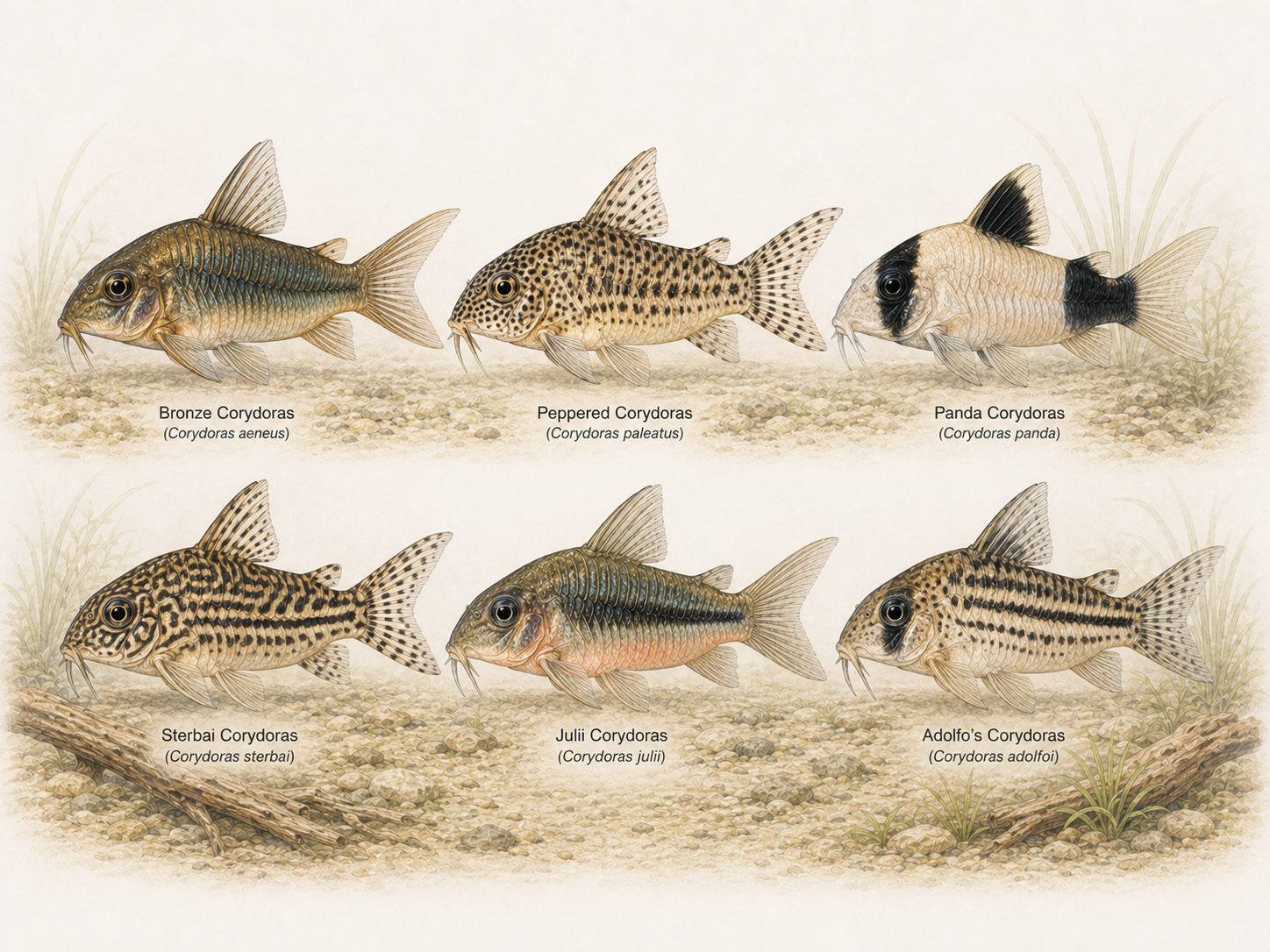
- Bronze Corydoras (Corydoras aeneus), the closest relative commonly kept in aquaria, sharing nearly identical care requirements and temperament.
- Panda Corydoras (Corydoras panda), another popular Cory species with slightly more demanding temperature needs but similar behaviour and compatibility.
- Julii Corydoras (Corydoras julii), a beautifully patterned species often confused with Corydoras trilineatus, ideal for those looking to expand their Corydoras collection.
- Otocinclus Catfish Care Guide, a fellow peaceful South American catfish that makes an excellent companion species in the same community tank.
- How to Set Up a Community Tank, a comprehensive guide for beginners planning a peaceful multi-species aquarium where Corydoras would thrive.
- Aquarium Substrate Guide, essential reading for understanding the importance of substrate choice, particularly for bottom-dwelling species like Corydoras.