Quick Summary
The Black Devil Snail is an elegant, low-maintenance freshwater snail that stays at manageable numbers because it very rarely breeds in captivity – making it an excellent choice for aquarists who want substrate-sifting clean-up help without the population explosions associated with other snail species.
🐠 Build a tank around this species
In this guide:
- Introduction
- Quick Stats
- Appearance
- Natural Habitat
- Tank Size and Setup
- Water Parameters
- Diet and Feeding
- Behaviour and Temperament
- Tank Mates
Introduction
The Black Devil Snail (Faunus ater), sometimes sold under the name Devil’s Thorn Snail, is a striking freshwater gastropod belonging to the family Pachychilidae. Native to rivers, streams, and brackish estuaries across Southeast Asia, it has steadily gained popularity in the fishkeeping hobby thanks to its dramatic dark colouration, peaceful temperament, and genuinely useful role as a substrate sifter and detritus consumer.
One of the most compelling reasons to consider this species is its reproductive behaviour – or, more accurately, its lack of it in typical home aquaria. Unlike the Malaysian Trumpet Snail (Melanoides tuberculata), which can rapidly multiply into the hundreds or thousands in a well-fed tank, the Black Devil Snail very rarely breeds successfully in standard freshwater conditions. This is believed to be because its larval stage requires brackish or even marine water to complete development. For hobbyists who appreciate the cleaning services a snail provides but dread uncontrollable population booms, Faunus ater offers a welcome alternative.
Despite being widely available in the trade, there is still relatively little scientific literature on Faunus ater compared to more commonly studied aquarium invertebrates. Much of what keepers know about its preferences has been gleaned from years of collective hobbyist experience. What is clear, however, is that this is a hardy, adaptable, and long-lived snail that rewards good care with years of quiet, industrious service in the aquarium.
Quick Stats
| Scientific name | Faunus ater |
|---|---|
| Common names | Devil's Thorn Snail, Giant Tower Cap Snail, Lava Snail |
| Family | Pachychilidae |
| Origin | Southeast Asia |
| Adult size | 7 cm |
| Lifespan | 2–3 years |
| Difficulty | Easy |
| Breeding difficulty | Advanced |
| Temperature | 22–28 °C |
| pH | 6.5–8 |
| GH | 8–18 dGH |
| KH | 5–12 dKH |
| Minimum tank size | 40 L |
| Conservation status | Not evaluated |
Appearance
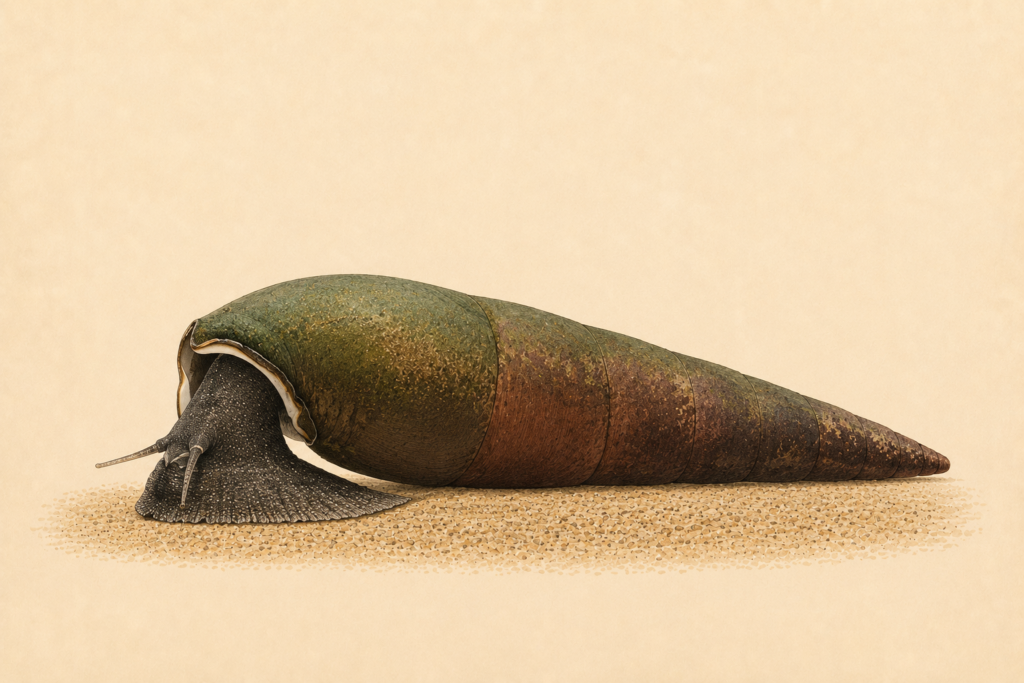
The Black Devil Snail is immediately recognisable thanks to its elongated, conical shell, which tapers to a sharp point at the apex – earning it the “thorn” part of its alternative common name. The shell is composed of numerous tightly coiled whorls, giving it a distinctive tower-like or drill-like silhouette that sets it apart from the rounder profiles of Nerite or Mystery Snails. In most specimens, the shell is a uniform dark brown to jet black, though some individuals show faint mahogany or chocolate undertones when viewed under strong lighting. Older specimens may develop minor erosion or pitting near the apex, which is normal and not usually a sign of poor health.
The body (foot) of the snail is typically dark grey to black, though some individuals have a slightly lighter, charcoal-coloured foot. The tentacles are slender and relatively long compared to many other aquarium snail species, and they are constantly in motion as the animal probes the substrate for food. The operculum – the hard, door-like plate that seals the shell opening when the snail retracts – is present and well developed, providing solid protection from would-be predators.
Adult specimens commonly reach 5 to 7 cm in shell length, though particularly well-fed individuals in spacious tanks have been reported at up to 9 cm. Males and females are not easily distinguished visually, and sexing them externally with any reliability is essentially impossible for the average hobbyist. Overall, the Black Devil Snail has a sleek, almost architectural beauty that makes it an eye-catching addition to any aquarium, particularly against lighter substrates or planted backgrounds where its dark form creates a bold contrast.
Natural Habitat
Faunus ater is found across a broad swathe of Southeast Asia, with confirmed populations in Indonesia (particularly Java, Sumatra, and Sulawesi), the Philippines, Thailand, Malaysia, and parts of Myanmar. It inhabits a range of freshwater and brackish environments, including lowland rivers, fast-flowing streams, tidal estuaries, and the lower reaches of rivers where fresh water meets the sea. This dual tolerance for both fresh and slightly saline conditions hints at its life cycle, which is thought to involve a larval stage that drifts into brackish or marine waters before the juvenile settles in freshwater habitats upstream.
In the wild, Black Devil Snails are typically found on sandy or muddy substrates, where they burrow partially beneath the surface to feed on organic detritus, biofilm, and decomposing plant material. They tend to favour areas with moderate to strong water flow and well-oxygenated conditions, often found clinging to rocks or wood near rapids or in riffle zones. The substrate in their native rivers is generally soft enough to allow burrowing, and this behaviour is a critical part of their feeding strategy – they sift through sand and fine gravel, consuming edible organic particles as they go.
Water chemistry in their native habitats varies but tends towards neutral to slightly alkaline pH values, with moderate hardness provided by dissolved minerals. Temperatures in lowland tropical rivers typically range from 24 to 28 degrees Celsius, though they may experience slightly cooler conditions in faster-flowing highland streams. Understanding this natural environment helps explain the species’ preferences in captivity: good water flow, a soft substrate suitable for burrowing, and stable, clean water conditions.
Tank Size and Setup
A single Black Devil Snail can be comfortably housed in a tank of 40 litres or more. For a small group of two to three, a tank of 60 litres or above is advisable. While these snails are not particularly active swimmers or territory holders, they do appreciate space to roam and burrow, and a larger tank provides a more stable water chemistry buffer – something that benefits all invertebrates.
Substrate choice is arguably the most important element of the setup for this species. Black Devil Snails are natural burrowers, and a soft, fine-grained substrate such as aquarium sand or very fine smooth gravel is essential. Coarse, sharp-edged substrates can damage the snail’s foot and make burrowing difficult or impossible, leading to stress and reduced feeding. A sand bed of at least 3 to 5 cm depth is ideal, giving the snails enough material to dig into comfortably. Pool filter sand and play sand (thoroughly rinsed) are popular and cost-effective choices among hobbyists.
Beyond substrate, provide a mix of hardscape elements such as driftwood, smooth river stones, and perhaps some terracotta or ceramic hides. Black Devil Snails will climb wood and rocks, especially at night, and appreciate having surfaces to graze biofilm from. Live plants are not at risk from these snails – they are not known to eat healthy plant tissue – so a planted tank is entirely compatible and even beneficial, as plants contribute to water quality and provide additional surfaces for biofilm growth.
A secure, tight-fitting lid is important. While Black Devil Snails are not as notorious for escaping as some species (such as certain Nerites or Apple Snails), they can and do climb above the waterline, particularly at night or if water quality deteriorates. Any gaps around filter intakes, heater cables, or airline tubing should be sealed or covered. Ensure there is a small gap of air between the water surface and the lid so that the snails are not in contact with a hot cover glass if they do climb.
Lighting is not a significant concern for the snails themselves, as they are primarily nocturnal or crepuscular. Standard aquarium lighting suitable for plants or general viewing is perfectly fine. If the tank receives no light at all, biofilm growth (a food source) may be reduced, so a moderate photoperiod of 8 to 10 hours is beneficial.
Water Parameters
The Black Devil Snail is a tolerant and adaptable species when it comes to water chemistry, which is one of the reasons it is rated as easy to keep. That said, like all invertebrates, it is sensitive to ammonia, nitrite, and high nitrate levels, and it is intolerant of copper, which is found in many fish medications and some tap water sources. Always check for copper content before using any treatment in a tank housing invertebrates.
| Temperature | 22 – 28 C |
| pH | 6.5 – 8.0 |
| General hardness (GH) | 5 – 15 dGH |
| Carbonate hardness (KH) | 3 – 12 dKH |
| Ammonia | 0 ppm |
| Nitrite | 0 ppm |
| Nitrate | Below 20 ppm |
A few points deserve special emphasis. First, mineral content matters for shell health. Very soft, acidic water can gradually erode the snail’s shell over time, leading to thinning, pitting, and eventual structural weakness. If your water is naturally very soft (below 5 dGH), consider supplementing with a remineraliser or adding a small amount of crushed coral or limestone to the filter. A KH above 3 dKH helps buffer pH and prevent dangerous swings.
Second, consistency is more important than hitting a specific number. Black Devil Snails tolerate a wide range of conditions, but rapid fluctuations in temperature, pH, or hardness can cause stress. When performing water changes, match the temperature and chemistry of the new water to the tank water as closely as possible. Weekly water changes of 15 to 25 per cent are a good standard practice.
Third, be cautious with medications. Many common aquarium treatments contain copper or other heavy metals that are lethal to invertebrates at concentrations that are harmless to fish. If you need to treat tank mates for disease, remove the snails to a separate holding container first, or use invertebrate-safe formulations where available.
Filtration and Equipment
Black Devil Snails appreciate clean, well-oxygenated water with moderate to strong flow, reflecting their natural habitat in rivers and streams. A filter that turns over the tank volume at least four to five times per hour is a reasonable starting point. Hang-on-back filters, internal power filters, and canister filters are all suitable. Sponge filters can work for smaller setups but may not provide the flow rates that these snails seem to prefer.
If using a filter with an exposed intake tube, cover it with a sponge pre-filter or fine mesh. While adult Black Devil Snails are too large to be drawn into most intakes, the pre-filter also serves the useful purpose of providing additional biological filtration surface area and trapping coarse debris before it reaches the main filter media.
An adjustable heater is recommended to maintain a stable temperature within the 22 to 28 degree Celsius range. Use a heater guard if the snails are likely to come into direct contact with the heater element, as prolonged contact with a hot surface could cause burns to the snail’s foot. In practice, most hobbyists find that their Black Devil Snails quickly learn to avoid heaters, but a guard is an inexpensive precaution.
An air stone or powerhead can be used to supplement oxygenation and create additional flow if your primary filter does not provide enough. This is particularly worthwhile in warmer tanks (above 26 degrees Celsius), where dissolved oxygen levels are naturally lower. Good surface agitation is the most efficient way to maximise gas exchange.
Diet and Feeding
In the wild, Faunus ater is a detritivore and biofilm grazer, spending its time sifting through substrate and scraping organic material from hard surfaces. In the aquarium, it fulfils much the same role, consuming uneaten fish food, decaying plant matter, algae, and biofilm. This makes it a genuinely useful member of the clean-up crew, particularly in community tanks where leftover food tends to accumulate in the substrate.
However, relying entirely on naturally occurring waste and biofilm is unlikely to provide adequate nutrition, especially in a clean, well-maintained tank or one with a low fish population. Supplemental feeding is recommended to keep your Black Devil Snails in good condition. Suitable supplemental foods include:
Sinking algae wafers are a convenient staple and are readily accepted. Blanched vegetables such as courgette (zucchini), spinach, cucumber, and kale provide additional variety and nutrition. Drop a piece into the tank in the evening (when the snails are most active) and remove any uneaten portion after 12 to 24 hours to prevent it from fouling the water. Calcium-enriched foods or supplements are beneficial for shell health. Some keepers add a small piece of cuttlebone to the tank, which slowly dissolves and provides a calcium source. Speciality invertebrate foods, such as shrimp pellets or snail-specific formulations, are also excellent choices.
Feed small amounts regularly rather than large quantities infrequently. A good rule of thumb is to offer supplemental food two to three times per week if the tank has a reasonable amount of natural biofilm and detritus, or daily in very clean tanks or those with few other inhabitants producing waste. Observe your snails – if they are constantly above the substrate line and seem to be searching for food on the glass or hardscape more than usual, they may not be getting enough to eat below the surface.
Black Devil Snails are not known to eat healthy, living aquarium plants. You can keep them confidently in planted tanks without fear of plant damage. They will, however, consume dead or dying leaves, which is beneficial for overall tank hygiene.
Behaviour and Temperament
The Black Devil Snail is one of the most peaceful invertebrates available in the hobby. It poses no threat whatsoever to fish, shrimp, other snails, or plants. Its entire existence in the aquarium revolves around slowly traversing the substrate, burrowing through sand, climbing hardscape, and grazing. It has no means of attacking or harming any tank mate and will simply retract into its shell and seal the operculum if harassed.
These snails are predominantly nocturnal or crepuscular. During the day, particularly in brightly lit tanks, they often bury themselves partially or fully in the substrate, with only the tip of the shell or the tips of their tentacles visible. As the lights dim in the evening, they become noticeably more active, emerging to explore the tank, climb driftwood and glass, and feed more openly. This pattern is entirely normal and should not be mistaken for illness or stress.
New Black Devil Snails may take several days to a week to acclimate after being introduced to a tank. During this period, they may remain buried in the substrate or tucked into a corner, showing little visible activity. Patience is key. As long as water parameters are suitable and the snail is not being harassed, it will eventually begin its normal routine of nocturnal exploration and feeding.
One behaviour that can alarm new keepers is the tendency to climb above the waterline, particularly at night. This is usually normal exploratory behaviour, but it can also indicate dissatisfaction with water quality. If a snail is persistently above the waterline, check your ammonia, nitrite, nitrate, and temperature readings. A sudden, simultaneous attempt by multiple snails to leave the water is a more urgent warning sign that something may be wrong with the water chemistry.
Black Devil Snails can be kept singly or in small groups. They are not social in the way that schooling fish are, but they show no aggression towards conspecifics and will happily share a tank. In groups, they tend to spread out across the substrate rather than clustering, which maximises their efficiency as substrate sifters.
Tank Mates
Choosing tank mates for the Black Devil Snail is straightforward because this species is so peaceful and undemanding. The main considerations are avoiding species that actively prey on snails or that are aggressive enough to harass them. Most community fish, peaceful bottom-dwellers, and other invertebrates are compatible. The snail’s hard shell and operculum provide good defence against mild curiosity from fish, but they cannot withstand a determined predator.
Good tank mates
- Neon Tetra – A peaceful, small-bodied schooling fish that occupies the mid-water column and completely ignores snails.
- Cherry Barb – A gentle, colourful barb that coexists happily with all invertebrates.
- Corydoras Catfish – Another peaceful bottom-dweller that shares the substrate without conflict; both species benefit from sandy substrates.
- Otocinclus – A small algae-eating catfish that poses no threat and shares similar water parameter preferences.
- Cherry Shrimp – Completely peaceful cohabitation; both species contribute to the clean-up crew.
- Amano Shrimp – Another excellent shrimp companion that ignores snails entirely and helps manage algae.
- Nerite Snail – A fellow snail species that occupies a slightly different niche (primarily glass and hardscape grazing) with no interspecific aggression.
- Kuhli Loach – A peaceful, burrowing loach that shares the sandy substrate without bothering snails.
- Harlequin Rasbora – A calm, mid-water schooling fish that makes an ideal community companion.
Fish to avoid
- Clown Loach – A well-known snail predator that will actively hunt and consume snails of all sizes.
- Yoyo Loach – Another loach species with a strong appetite for snails; will persistently attack even larger specimens.
- Assassin Snail – A predatory snail that specifically targets other snail species; housing them together is inadvisable.
- Green Spotted Puffer – Pufferfish have powerful beaks designed for crushing snail shells and will readily prey on Black Devil Snails.
- Oscar – A large, aggressive cichlid that may crush or consume snails and is generally incompatible with invertebrates.
- Goldfish – While not aggressive, larger goldfish may attempt to eat smaller snails, and their preferred cooler water temperatures are not ideal.
- Convict Cichlid – An aggressive cichlid, particularly when breeding, that will harass and potentially kill snails.
Breeding
Breeding the Black Devil Snail in captivity is extremely difficult, and successful home aquarium breeding reports are essentially nonexistent. This is, paradoxically, one of the species’ greatest selling points for many hobbyists – you get the benefits of a diligent substrate-sifting snail without the risk of waking up one morning to find hundreds of babies coating every surface of the tank.
The reason for this reproductive difficulty is believed to lie in the snail’s life cycle. Faunus ater is thought to have a larval stage that requires brackish or marine conditions to develop successfully. In the wild, adults living in freshwater rivers release larvae that are carried downstream into estuarine or coastal waters, where they develop before eventually migrating back upstream as juveniles. Replicating this complex life cycle in a home aquarium would require maintaining separate freshwater and brackish or marine environments and successfully managing the transition between them – a feat that has not been reliably documented.
Black Devil Snails are dioecious, meaning they have separate sexes, but as noted earlier, external sexing is not practical. Even in tanks containing both males and females, mating may occur but the resulting larvae are unlikely to survive in a purely freshwater environment. Some hobbyists have reported finding small egg capsules attached to hardscape, but these have not been observed to develop into viable juveniles under standard freshwater conditions.
If you are specifically interested in attempting to breed this species, you would likely need to experiment with gradually transitioning gravid females or newly released larvae into brackish water (specific gravity around 1.005 to 1.015) and providing appropriate planktonic food for the larval stage. This remains firmly in the realm of advanced experimental aquaculture rather than standard hobbyist practice. For the vast majority of keepers, breeding is simply not a realistic goal, and all specimens in the trade are wild-caught.
Common Diseases
Black Devil Snails are generally robust and disease-resistant compared to many aquarium fish. They do not suffer from the bacterial, viral, or parasitic diseases that commonly afflict freshwater fish, and their thick shells provide physical protection against many external threats. However, they are not immune to health problems, and most issues stem from environmental factors rather than infectious pathogens.
Shell erosion and pitting is the most common health concern. This manifests as white patches, thin spots, or small holes in the shell, typically starting near the older whorls at the apex. It is caused by prolonged exposure to water that is too soft or too acidic, which dissolves the calcium carbonate that makes up the shell. Prevention is straightforward: maintain a GH above 5 dGH, a KH above 3 dKH, and a pH above 6.5. Supplementing with calcium through cuttlebone, crushed coral, or calcium-enriched foods can help repair minor damage over time, though severe erosion is irreversible.
Copper poisoning is a serious and often fatal risk for all freshwater invertebrates, including Black Devil Snails. Copper can enter the aquarium through tap water (especially in homes with copper plumbing), fish medications, and some plant fertilisers. Symptoms include lethargy, failure to emerge from the shell, and eventually death. Always test your water source for copper and avoid any medications or additives that list copper among their ingredients when invertebrates are present in the tank.
Parasitic infections, while less common, can occur. Some wild-caught Black Devil Snails may carry parasitic trematode larvae (flukes), which use snails as intermediate hosts. These parasites are primarily a concern for the snail’s health and do not typically pose a risk to humans or fish in the aquarium, but heavily parasitised snails may be lethargic and fail to thrive. Quarantining new snails for two to four weeks before adding them to an established tank is a sensible precaution.
Stress from poor water quality – particularly elevated ammonia or nitrite levels – can cause a snail to remain retracted in its shell for extended periods and eventually weaken and die. Regular water testing and consistent maintenance are the best preventative measures. If a snail has not moved or emerged for several days, gently lift it and smell the opening. A strong, foul odour indicates the snail has died and should be removed immediately to prevent ammonia spikes.
FAQs
Will Black Devil Snails overrun my tank like Malaysian Trumpet Snails?
No. This is one of the key advantages of the Black Devil Snail over the Malaysian Trumpet Snail. Faunus ater very rarely, if ever, breeds successfully in a standard freshwater aquarium. Its larval stage is believed to require brackish or marine water to develop, so even if adults mate and produce eggs, the offspring are extremely unlikely to survive. You will have exactly as many Black Devil Snails as you choose to buy.
Why is my Black Devil Snail buried in the sand and not moving?
This is almost certainly normal behaviour. Black Devil Snails are naturally inclined to burrow into soft substrate during the day, emerging primarily at night to forage more openly. A newly introduced snail may also spend several days buried while it acclimates to its new environment. As long as your water parameters are within the recommended ranges and the snail periodically shows signs of movement (shifting position, extending tentacles), there is no cause for concern. If it remains completely motionless for more than three to four days, gently check on it and smell the shell opening to ensure it is still alive.
Do Black Devil Snails eat live plants?
No. Black Devil Snails are detritivores and biofilm grazers that feed on dead organic matter, algae, biofilm, and uneaten fish food. They do not consume healthy, living plant tissue. They are completely safe to keep in planted aquariums and will actually benefit the setup by consuming decaying leaves and organic debris that might otherwise decompose and affect water quality.
Can I keep Black Devil Snails in a brackish tank?
Yes, Black Devil Snails can tolerate mild brackish conditions, which reflects their natural occurrence in estuarine environments. They can generally handle a specific gravity of up to approximately 1.005 without issues. However, they do perfectly well in fully freshwater setups, and most hobbyists keep them in fresh water with no problems at all. If you maintain a low-end brackish tank for species such as Bumblebee Gobies or certain killifish, Black Devil Snails can be a suitable addition.
How can I tell if my Black Devil Snail is dead?
A living Black Devil Snail that is simply resting or hiding will retract tightly into its shell with the operculum sealed firmly shut. If you suspect a snail has died, gently lift it from the water and smell the shell opening. A dead snail decomposes quickly and produces an unmistakable, very strong foul odour. If there is no smell and the operculum is tightly closed, the snail is almost certainly alive and simply resting. A dead snail’s body may also begin to hang limply out of the shell. Remove any confirmed dead snails immediately, as the decomposition can cause a sharp ammonia spike, particularly in smaller tanks.
Related Guides
- Malaysian Trumpet Snail – A closely compared substrate-burrowing snail; understanding the differences helps you choose the right species for your tank.
- Nerite Snail – Another popular freshwater snail with limited breeding in fresh water, offering a different cleaning niche focused on glass and hardscape algae.
- Mystery Snail – A larger, more visible aquarium snail with different care requirements and easier breeding, useful for comparison.
- Assassin Snail – A predatory snail species to be aware of as an incompatible tank mate, but also relevant for hobbyists managing snail populations in other tanks.
- Cherry Shrimp – A popular invertebrate companion that shares many care requirements and pairs well with Black Devil Snails in community setups.