Quick summary
The Morse Knifefish is a quirky, sand-dwelling oddity best suited to experienced keepers who enjoy observing subtle nocturnal behaviour rather than flashy displays. If you can provide a soft sand substrate, dim lighting, and a calm community of gentle tankmates, this unusual little knifefish will reward you with fascinating burrowing habits and a personality all its own.
🐠 Build a tank around this species
- Introduction
- Quick stats
- Appearance
- Natural habitat
- Tank size and setup
- Water parameters
- Filtration and equipment
- Diet and feeding
- Behaviour and temperament
- Tank mates
- Breeding
- Common diseases and health
- Frequently asked questions
- Related guides
Introduction
If you have ever watched a fish vanish nose-first into the substrate and thought “I need one of those,” the Morse Knifefish (Gymnorhamphichthys hypostomus) is probably the species you are looking for. This slender, elongated knifefish belongs to the family Rhamphichthyidae and has earned its common name from the pattern of small dots and dashes running along its body, reminiscent of Morse code. It is one of the smaller members of the knifefish order Gymnotiformes, making it far more manageable in a home aquarium than some of its larger, more aggressive cousins.
People love this fish for its behaviour. During the day, the Morse Knifefish buries itself almost entirely in sand, leaving only its elongated snout poking above the surface. At dusk, it emerges and begins gliding backwards and forwards with the gentle undulation of its long anal fin, hunting for tiny invertebrates in the substrate. It is genuinely mesmerising to watch, and once you have seen one navigate its environment with those delicate electrical pulses, other bottom dwellers can start to feel a bit ordinary.
That said, this is not a beginner fish. The Morse Knifefish is sensitive to water quality swings, intolerant of sharp or coarse substrates, and largely nocturnal. It needs an aquarist who is comfortable maintaining stable, soft, acidic water and who does not mind that their star fish spends most of the daylight hours hidden. For intermediate to advanced keepers looking for something genuinely different, though, the Morse Knifefish is an absolute gem.
Quick stats
| Scientific name | Gymnorhamphichthys hypostomus |
| Family | Rhamphichthyidae |
| Origin | South America, Amazon and Orinoco river basins |
| Adult size | 20 to 25 cm (8 to 10 inches) |
| Lifespan | 8 to 12 years |
| Difficulty | Advanced |
| Breeding difficulty | Challenging |
| Temperature | 24 to 28 °C |
| pH range | 5.5 to 7.0 |
| Minimum tank size | 150 litres |
Appearance
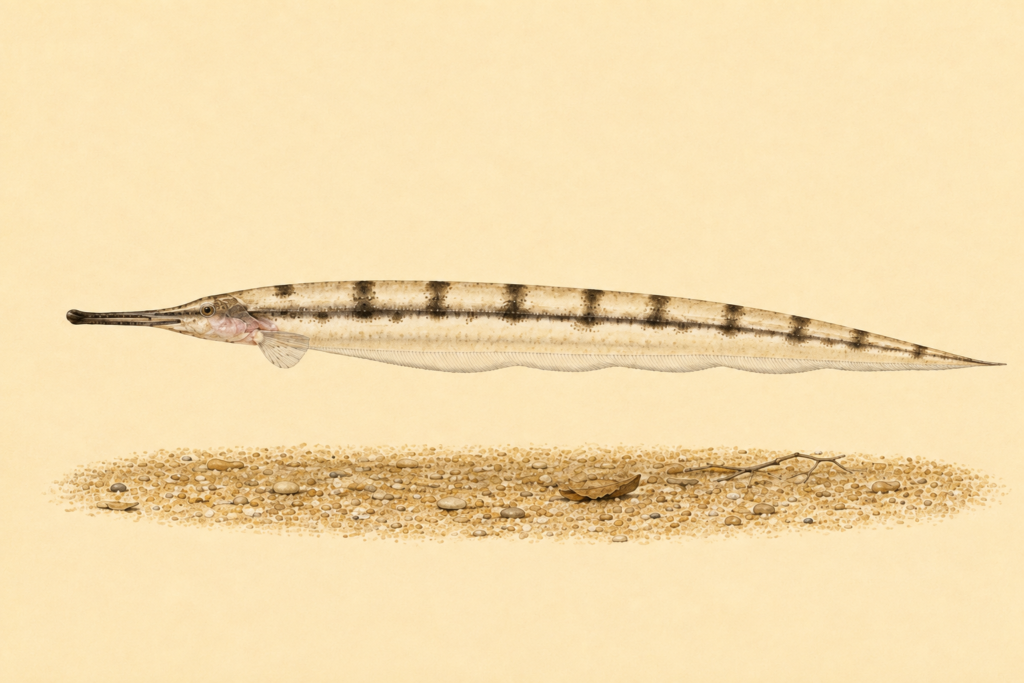
The Morse Knifefish is built for life in sand. Its body is extremely elongated and laterally compressed, tapering to a fine point at the tail. The head features a distinctively long, tubular snout that gives the fish a vaguely elephant-nose profile, although it is not related to the Mormyridae. The base colour ranges from pale sandy beige to light tan, overlaid with a series of small dark spots, short bars, and irregular markings along the flanks. These markings are where the common name comes from, as they genuinely do look like dots and dashes. The long anal fin runs nearly the entire length of the underside, and the fish lacks dorsal and pelvic fins entirely, which is typical for its family.
Sexing the Morse Knifefish visually is difficult. Mature females tend to be slightly fuller-bodied when viewed from above, especially when carrying eggs, but the difference is subtle. Males may have a marginally broader head, though this varies between individuals and is not reliable enough to use as the sole indicator. There are no significant colour variations between males and females, and geographic colour morphs are not well documented in the hobby. Overall, this is a fish whose beauty lies in its shape and behaviour rather than vivid colouration.
Natural habitat
The Morse Knifefish is found across a broad range of the Amazon and Orinoco river basins in countries including Brazil, Venezuela, Colombia, Peru, and Guyana. It inhabits slow-moving rivers, floodplain creeks, and shallow forest streams where the bottom is composed of fine sand or soft mud. The water in these habitats is typically warm, soft, and acidic, often stained dark brown with tannins from decomposing leaf litter. Light levels at the substrate are low, filtered through dense overhead canopy and tannin-rich water.
Understanding this habitat is essential for keeping the species successfully. The fine sand bottom is not optional. In the wild, the fish spends daylight hours buried with only its snout exposed, using the sand as both camouflage and protection from predators. Coarse gravel or sharp-edged substrates can injure the fish’s delicate skin and prevent it from exhibiting its natural burrowing behaviour, which leads to chronic stress. The soft, acidic water chemistry and dim lighting are equally important, as these fish have evolved for conditions that many tropical community setups do not provide out of the box.
Tank size and setup
A single Morse Knifefish needs a minimum of 150 litres, and if you plan to keep a small group of two or three, aim for at least 200 to 250 litres. A longer tank is preferable to a tall one, as these fish spend virtually all of their time at or in the substrate. A footprint of at least 100 cm by 40 cm gives them the horizontal space they need to forage at night.
Substrate is the most critical element. Use fine, smooth aquarium sand such as pool filter sand, ADA La Plata Sand, or CaribSea Super Naturals. The grain size should be small enough that the fish can push through it without abrasion. Avoid anything labelled “sharp” or “coarse.” A sand depth of at least 4 to 5 cm allows the fish to burrow comfortably.
Decorate with pieces of driftwood, such as Malaysian driftwood or mopani wood, and add dried Indian almond leaves (catappa leaves) or oak leaves on the substrate to release tannins and mimic the blackwater environment. Plants should be low-light species that will not mind the dim conditions. Good choices include Java Fern (Microsorum pteropus), Anubias barteri, Cryptocoryne wendtii, and floating plants like Amazon Frogbit (Limnobium laevigatum) or Salvinia natans to further diffuse overhead light. Attach Java Fern and Anubias to driftwood rather than planting them in the substrate, so your knifefish can burrow freely.
Lighting should be subdued. If you use an LED light for plant growth, consider running it on a dimmed setting or relying on floating plants to shade the tank. A moonlight setting or low-wattage blue LED can be a nice way to observe the fish’s evening activity without disturbing it. Water flow should be gentle, replicating the slow streams these fish call home. Avoid strong powerheads or high-output canister return nozzles pointed directly along the substrate.
Water parameters
| Parameter | Ideal range |
|---|---|
| Temperature | 24 to 28 °C |
| pH | 5.5 to 7.0 |
| General hardness (GH) | 1 to 8 dGH |
| Carbonate hardness (KH) | 1 to 4 dKH |
| Ammonia | 0 ppm |
| Nitrite | 0 ppm |
| Nitrate | Below 20 ppm |
The Morse Knifefish is sensitive to dissolved waste and does not tolerate ammonia or nitrite spikes at all. Regular water changes of 20 to 25 percent weekly are a good baseline, though in smaller setups or stocked tanks you may need to increase that. Because the species does best in soft, acidic water, consider using a mix of RO (reverse osmosis) water and dechlorinated tap water if your mains supply is hard or alkaline. Adding Indian almond leaves, alder cones, or peat filtration will help maintain a low pH naturally. Stability matters more than hitting a specific number, so once your parameters are within range, focus on keeping them there.
Filtration and equipment
A good canister filter is the best choice for a Morse Knifefish tank. Models like the Fluval 207 or Eheim Classic 350 offer reliable biological and mechanical filtration without excessive flow. Use a spray bar or lily pipe on the return to spread the output and reduce current strength at the substrate level. Sponge filters can work as supplementary filtration and are gentle on flow, but they may not provide enough biological capacity on their own in tanks over 150 litres.
A reliable heater is essential. An adjustable heater rated for your tank size, such as the Eheim Jager or Fluval M series, will keep the temperature stable in the 24 to 28 °C range. If your room temperature fluctuates a lot, consider using a heater guard to prevent the knifefish from resting against the glass tube and burning itself.
Invest in a quality water testing kit. The API Freshwater Master Test Kit is affordable and accurate for monitoring ammonia, nitrite, nitrate, and pH. For hardness, GH and KH test strips or liquid kits are widely available. Test weekly, especially in the first few months after setup, and any time you notice a change in the fish’s behaviour.
Diet and feeding
In the wild, the Morse Knifefish feeds on small benthic invertebrates, insect larvae, worms, and microcrustaceans that it finds by probing the sand with its elongated snout and detecting prey using weak electric fields. It is a carnivore through and through, and captive diet should reflect this.
The staple diet in the aquarium should be frozen or live foods. Bloodworms (chironomid larvae), tubifex worms, daphnia, brine shrimp, and small blackworms are all excellent choices. Live blackworms are particularly good because they burrow into the sand, encouraging the knifefish to forage naturally. Frozen foods from brands like Hikari, San Francisco Bay Brand, or Ocean Nutrition are convenient and nutritionally reliable.
Some keepers report success getting their Morse Knifefish to accept high-quality sinking pellets or wafers over time. Hikari Carnivore Pellets or Fluval Bug Bites (insect-based) are worth trying, though many individuals will stubbornly refuse anything that is not live or frozen. Do not rely solely on dried foods.
Feed once daily, in the evening or just after lights-out, when the fish is naturally active. Offer only as much food as the fish can consume in a few minutes. Overfeeding fouls the water quickly, and given this species’ sensitivity to water quality, restraint is important.
Behaviour and temperament
The Morse Knifefish is a peaceful, shy, and primarily nocturnal species. During the day it buries itself in the sand substrate, sometimes so completely that you would never know it was there. It may leave only its snout visible, or it may lie partially exposed along the bottom. This is completely normal and not a sign of illness or stress.
At dusk, the fish emerges and begins foraging. It moves by undulating its long anal fin, gliding smoothly forwards, backwards, and even hovering in place. The movement is distinctly different from most other fish and endlessly entertaining to watch. The Morse Knifefish uses weak electrical discharges to navigate and locate food in low-light conditions, a fascinating adaptation shared by many Gymnotiformes.
This species is generally tolerant of its own kind, though individuals may establish loose territories in the sand. In a tank with ample floor space and enough sand for everyone to burrow, small groups of two or three usually coexist without problems. Aggression toward conspecifics is rare and typically limited to mild chasing. They ignore fish that occupy different areas of the water column, which makes them surprisingly good community residents, as long as their tankmates are peaceful and not too boisterous.
Tank mates
Good tank mates
- Cardinal Tetra (Paracheirodon axelis), peaceful schooling fish that share similar soft, acidic water preferences.
- Rummy-nose Tetra (Hemigrammus rhodostomus), calm mid-water swimmers that will not bother a bottom-dwelling knifefish.
- Corydoras sterbai, gentle sand-sifting catfish that thrive in warm, soft water and rarely compete for the same hiding spots.
- Otocinclus (Otocinclus vittatus), tiny algae-eating catfish that stay out of the knifefish’s way entirely.
- Marbled Hatchetfish (Carnegiella strigata), surface dwellers that occupy a completely different zone in the tank.
- Beckford’s Pencilfish (Nannostomus beckfordi), small, calm fish well-suited to blackwater setups.
- Apistogramma cacatuoides, dwarf cichlids that can work if the tank is large enough, as they prefer caves over open sand.
Fish to avoid
- Tiger Barbs (Puntigrus tetraneura), notorious fin nippers that can harass slow-moving knifefish.
- Large cichlids such as Oscars or Jack Dempseys, too aggressive and will view the knifefish as food or competition.
- Other knifefish species such as the Black Ghost Knifefish (Apteronotus albifrons), significantly larger and potentially territorial toward a smaller relative.
- Large loaches like Clown Loaches (Chromobotia macracanthus), active bottom dwellers that can outcompete and stress a shy sand-burrower.
- Fast, aggressive feeders like Buenos Aires Tetras, will steal food before the nocturnal knifefish can find it.
- Crayfish or large shrimp, opportunistic predators that may attack the knifefish while it is buried and vulnerable.
Breeding
Breeding the Morse Knifefish in captivity is rarely accomplished and is considered challenging even by experienced aquarists. Very little has been documented about their reproductive behaviour in the wild, and captive spawning reports are scarce.
Sexing is difficult, as described in the appearance section. The best approach is to acquire a small group of juveniles and allow them to mature together, hoping for a natural pair to form. Conditioning should involve several weeks of high-quality live foods, particularly blackworms and bloodworms, alongside gradual softening of the water to a pH around 5.5 to 6.0 and a temperature near the upper end of their range, around 27 to 28 °C. Simulating the onset of the rainy season with slightly cooler, large water changes using very soft water may trigger spawning behaviour, as it does with many Amazonian species.
Spawning, when it occurs, is believed to take place at night. Eggs have been reported as adhesive and relatively small, deposited near the substrate or on flat surfaces. If you are fortunate enough to witness spawning, it is best to remove the adults or the eggs to a separate rearing tank to prevent predation. Fry are tiny and will need infusoria or commercially prepared liquid fry food for the first week or so, transitioning to freshly hatched baby brine shrimp (Artemia nauplii) as they grow. Keep the fry tank dimly lit with very gentle filtration, ideally a sponge filter, and perform small, frequent water changes with matching parameters.
Common diseases and health
Skin abrasions and infections
Because the Morse Knifefish burrows constantly, any rough or sharp substrate can cause skin damage that quickly becomes infected by bacteria or fungi. Symptoms include redness, white patches, or visible wounds on the body. Treatment involves correcting the substrate if necessary and dosing with a mild antibacterial such as Seachem Kanaplex or an antifungal like methylene blue. Prevention is always better, so get the substrate right from the start.
Ich (white spot disease)
Like most scaleless or small-scaled fish, the Morse Knifefish is particularly susceptible to ich (Ichthyophthirius multifiliis). White spots appear on the body and fins, and the fish may flash against the substrate. Treat with heat (raise the temperature gradually to 30 °C over 48 hours) combined with half-dose aquarium salt or a scaleless-fish-safe medication like Seachem ParaGuard. Avoid copper-based treatments, as knifefish are sensitive to copper.
Stress-related issues
Chronic stress from poor water quality, aggressive tankmates, or inadequate hiding opportunities can suppress the immune system and lead to a range of secondary infections. Signs of stress include refusing food, remaining buried for extended periods even at night, rapid breathing, and loss of colour. Address the root cause first, whether that means improving water quality, removing a bully, or adding more sand depth.
Always quarantine new fish for at least two to four weeks before adding them to your main display tank. A simple quarantine setup with a sponge filter, heater, and appropriate sand substrate is enough. This gives you time to observe the newcomer for signs of disease and treat if necessary without risking your established community.
Frequently asked questions
Can I keep a Morse Knifefish in gravel?
No, gravel is not suitable. The Morse Knifefish needs fine, smooth sand to burrow safely. Gravel can scratch and injure the fish’s skin, leading to infections. If your tank currently has gravel, switch to a quality aquarium sand before introducing this species.
Is the Morse Knifefish aggressive?
Not at all. This is one of the most peaceful knifefish you can keep. It spends its days buried in sand and its nights gently foraging along the bottom. It poses no threat to peaceful tankmates and generally ignores other fish entirely.
Will my Morse Knifefish eat shrimp?
Small shrimp like cherry shrimp may be eaten, especially at night when the knifefish is foraging. Larger Amano shrimp are usually safe, but there is always some risk. If you keep a dedicated shrimp colony, the Morse Knifefish is probably not the best addition to that tank.
Why is my Morse Knifefish always hiding?
This is normal behaviour. The Morse Knifefish is nocturnal and spends daylight hours buried in the sand. You will see it emerge and become active in the evening once the lights go off. If it stays hidden even at night and refuses food for more than a few days, check your water parameters and look for signs of stress or illness.
Can I keep more than one Morse Knifefish together?
Yes, they can be kept in small groups of two or three in a suitably sized tank with plenty of sand and floor space. They are not a strictly schooling species, but they generally tolerate each other well. Provide at least 50 additional litres of tank space per extra fish to avoid crowding at the substrate level.
Related guides
- Morse Knifefish breeding guide
- Morse Knifefish tank setup and equipment guide
- Morse Knifefish diet and feeding guide
- Best tank mates for Morse Knifefish
- Morse Knifefish diseases and health guide
- Why is my Morse Knifefish losing colour?
- Back to the fish species directory
- Beginner’s guide to cycling your tank