Quick summary
The Rummy Nose Tetra is a peaceful, stunning schooling fish best suited to intermediate keepers who can maintain stable, soft, acidic water, since it’s sensitive to poor conditions and needs groups of six or more (ideally ten-plus) to thrive. It’s not ideal for complete beginners, but with a properly cycled, well-planted tank of at least 75 litres, it makes a rewarding and visually spectacular addition to a community aquarium.
🐠 Build a tank around this species
In this guide:
- Introduction
- Quick Stats
- Appearance
- Natural Habitat
- Tank Size and Setup
- Water Parameters
- Filtration and Equipment
- Diet and Feeding
- Behaviour and Temperament
- Tank Mates
- Breeding
- Common Diseases
- FAQs
Introduction
The Rummy Nose Tetra is one of the most instantly recognisable and beloved freshwater fish in the aquarium hobby. Named for its vivid, blood-red face, this small characin has earned a devoted following among aquascapers and community tank enthusiasts alike. Its tight, synchronised schooling behaviour is arguably the most impressive of any tetra species, creating a mesmerising, flowing display that brings genuine life and movement to planted aquaria.
While often grouped under the single common name “Rummy Nose Tetra,” the fish most commonly sold under this label is Hemigrammus rhodostomus, originally described from the lower Amazon basin. It is worth noting that two closely related species, Hemigrammus bleheri and Petitella georgiae, are also frequently sold as Rummy Nose Tetras, and the three are often confused in the trade. This guide focuses on Hemigrammus rhodostomus specifically, though the care requirements for all three species are virtually identical in the home aquarium.
Beyond its striking appearance, the Rummy Nose Tetra serves as an excellent living indicator of water quality. When conditions are pristine and the fish is relaxed, the red colouration on its head is intense and sharply defined. Under stress, poor water quality, or illness, the red fades noticeably, giving the observant keeper an early visual warning that something may be amiss. This characteristic, combined with its peaceful disposition and manageable size, makes it a rewarding species for intermediate fishkeepers who are prepared to maintain stable, clean water conditions.
Quick Stats
| Scientific name | Hemigrammus rhodostomus |
|---|---|
| Common names | Red Nose Tetra, Firehead Tetra |
| Family | Characidae |
| Origin | South America, lower Amazon basin, Rio Negro, Orinoco basin |
| Adult size | 4.5 cm |
| Lifespan | 5–8 years |
| Difficulty | Intermediate |
| Breeding difficulty | Advanced |
| Temperature | 24–27 °C |
| pH | 5.5–7 |
| GH | 2–15 dGH |
| KH | 1–5 dKH |
| Minimum tank size | 75 L |
| Conservation status | Not evaluated |
Appearance
The Rummy Nose Tetra has a slender, torpedo-shaped body typical of many smaller characins. It reaches an adult length of approximately four to five centimetres, with females tending to be very slightly deeper-bodied than males, particularly when carrying eggs. The base body colour is a translucent silvery-green, sometimes with a faint olive hue along the dorsal surface, which allows the iridescent shimmer of the scales to catch the light beautifully against a planted backdrop.
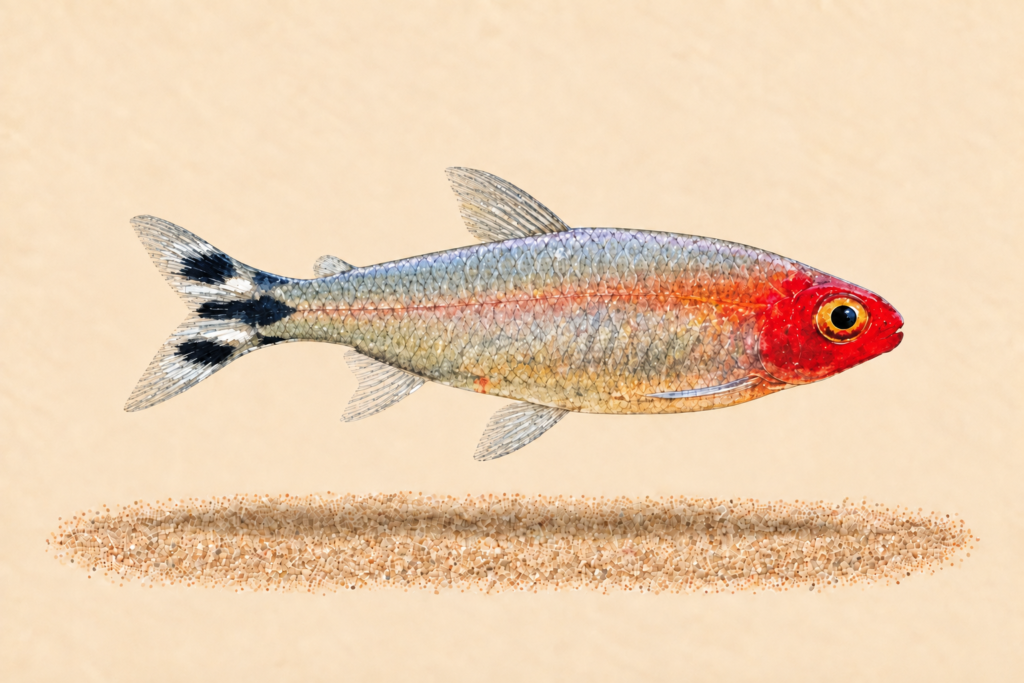
The defining feature of this species is, of course, the brilliant red pigmentation that covers the head and extends from the tip of the snout back across the gill covers. In healthy, well-settled specimens, this red is deep, rich, and sharply delineated, almost as if the fish has dipped its nose in crimson paint. The intensity of this colouration is directly influenced by the fish’s health, mood, and environmental conditions, making it one of the best visual barometers in the hobby.
The caudal fin provides the second major ornamental feature. It is adorned with bold black and white horizontal stripes, creating a distinctive checkerboard or barred pattern. This tail pattern is one of the key characteristics used to distinguish H. rhodostomus from its close relatives H. bleheri and P. georgiae. In H. rhodostomus, the red head colouration is generally more limited in extent compared to H. bleheri, where the red extends further back along the body past the gill covers. The remaining fins are largely transparent and unadorned. A faint, dark midlateral line may be visible along the flanks, though it is not always prominent.
Natural Habitat
Hemigrammus rhodostomus is native to the river systems of South America, with its primary range encompassing the lower Amazon basin and the Rio Negro drainage in Brazil, as well as parts of the Orinoco basin. These waterways are characterised by warm, soft, and acidic conditions, often heavily stained with tannins released by decaying organic matter on the forest floor.
In the wild, Rummy Nose Tetras inhabit slow-moving tributaries, flooded forest margins, and blackwater streams where the water is tea-coloured and the pH can drop as low as 4.5 during certain seasons. The substrate in these habitats is typically composed of fine sand covered by a thick layer of fallen leaves, branches, and other organic debris. Overhead canopy cover filters the sunlight, resulting in subdued, dappled lighting conditions. Aquatic vegetation may be sparse in the deepest blackwater zones, but marginal and emergent plants are common along the banks.
These fish form large shoals in the wild, moving together through the water column in tight formation as they forage for microorganisms, small invertebrates, and plant matter. The blackwater conditions that define their natural habitat are low in dissolved minerals and organic waste, which explains their sensitivity to nitrogenous compounds in captivity. Understanding and replicating elements of this environment, particularly the soft, acidic water chemistry and the dim, tannin-rich conditions, is key to keeping Rummy Nose Tetras in peak condition and colouration.
Tank Size and Setup
A minimum tank volume of 75 litres is recommended for a small group of Rummy Nose Tetras, though a larger aquarium of 100 litres or more is strongly preferred. These are active, mid-water schooling fish that benefit enormously from horizontal swimming space. A tank with a length of at least 60 centimetres is advisable, as it allows the shoal to display its natural coordinated movement patterns. In smaller or overly cramped enclosures, the fish will appear stressed, their schooling will be less cohesive, and their red head colouration will remain disappointingly pale.
When designing the layout, aim to replicate the shaded, tannin-rich blackwater environments these fish call home. A fine sand substrate in a dark colour works well, as it mimics the natural river bed and helps the fish feel secure while also making their colours appear more vivid by contrast. Adding dried Indian almond leaves, oak leaves, or alder cones to the tank will release tannins into the water, gently tinting it an amber hue and lowering the pH, both of which are highly beneficial for this species.
Planting should ideally provide areas of cover along the sides and back of the aquarium while leaving a generous open swimming corridor through the centre and front. Species such as Cryptocoryne, Microsorum (Java Fern), and Taxiphyllum (Java Moss) thrive in the softer, slightly acidic conditions preferred by Rummy Nose Tetras. Driftwood and bogwood are excellent hardscape choices, as they contribute additional tannins and create a naturalistic Amazonian aesthetic. Floating plants such as Amazon frogbit or red root floaters can be used to diffuse overhead lighting, replicating the dappled conditions found beneath the forest canopy.
Avoid stark, brightly lit, sparsely decorated setups. Rummy Nose Tetras are notably shy when they feel exposed, and will respond with washed-out colouration and nervous, erratic movement. A well-planted, dimly lit tank with plenty of visual barriers will bring out the best in these fish.
Water Parameters
Rummy Nose Tetras are more sensitive to water quality than many commonly kept community fish, and maintaining stable, pristine conditions is essential for their long-term health and vibrant colouration. They strongly prefer soft, acidic water that mirrors their blackwater origins, though captive-bred specimens are somewhat more tolerant of moderate conditions than wild-caught individuals.
| Temperature | 24–27 °C |
| pH | 5.5–7.0 |
| General hardness (GH) | 2–15 dGH |
| Carbonate hardness (KH) | 1–5 dKH |
| Ammonia | 0 ppm |
| Nitrite | 0 ppm |
| Nitrate | Below 20 ppm |
Consistency is arguably more important than hitting any single target value. Sudden swings in pH or temperature can cause significant stress, leading to faded colouration, suppressed immunity, and increased susceptibility to disease. When performing water changes, it is wise to ensure that the replacement water is closely matched in temperature and chemistry. In areas with hard, alkaline tap water, using reverse osmosis (RO) water remineralised with an appropriate GH buffer is often the most reliable way to achieve and maintain suitable conditions.
Weekly water changes of 20 to 30 per cent are recommended to keep nitrate levels low and water quality high. Rummy Nose Tetras are among the first fish in a community tank to show visible signs of deteriorating water quality through loss of their characteristic head colour, so regular testing with a reliable liquid test kit is strongly advised, especially during the first few months after establishing a new aquarium.
Filtration and Equipment
Effective biological filtration is non-negotiable for Rummy Nose Tetras. Given their sensitivity to ammonia and nitrite, the aquarium must be fully cycled before these fish are introduced. A canister filter or a quality hang-on-back filter rated for the tank volume, or preferably slightly above it, will provide the necessary biological and mechanical filtration capacity. Sponge filters can also work well, particularly in smaller setups or breeding tanks, and offer the advantage of gentle, even water flow without the risk of trapping small fish or fry.
Water movement should be moderate. While Rummy Nose Tetras are capable swimmers, they do not appreciate excessively strong currents. Positioning the filter outlet so that it creates a gentle flow across the length of the tank without producing turbulent dead zones is ideal. If necessary, a spray bar attachment or lily pipe can be used to diffuse the return flow.
A reliable heater with an adjustable thermostat is essential, as these tropical fish require stable temperatures within their preferred range. In tanks of 100 litres or more, using two smaller heaters rather than a single large unit can provide a useful safety margin against equipment failure. Lighting should be moderate to subdued, in keeping with the fish’s preference for dimly lit conditions. If the aquarium contains live plants that demand higher light levels, floating plants can be employed to create shaded areas where the tetras can retreat.
An air pump is not strictly necessary if the filter provides adequate surface agitation for gas exchange, but it can be a useful addition in warmer months when dissolved oxygen levels naturally drop. A tight-fitting lid or cover glass is recommended, as tetras can occasionally jump, particularly when startled.
Diet and Feeding
Rummy Nose Tetras are omnivorous and generally undemanding at feeding time, readily accepting a wide range of foods. A high-quality micro-pellet or flake food formulated for small tropical fish should form the staple of their diet. Look for products with whole fish or insect meal as the primary ingredient, rather than those padded with excessive grain or filler.
To maintain optimal health, colouration, and vitality, the staple diet should be regularly supplemented with live or frozen foods. Daphnia, baby brine shrimp (Artemia nauplii), cyclops, and micro-worms are all excellent choices that closely replicate the small invertebrates these fish would consume in the wild. Frozen bloodworm can also be offered as an occasional treat, though it should not form the bulk of the diet due to its relatively low nutritional diversity.
Feed small amounts once or twice daily, offering only what the fish can consume within two to three minutes. Overfeeding is a common cause of water quality deterioration, which Rummy Nose Tetras are particularly unforgiving of. If you notice uneaten food settling on the substrate, reduce portion sizes accordingly. Fasting the fish for one day per week is a practice favoured by some experienced keepers to support digestive health, though it is not strictly necessary.
Variety is the cornerstone of a good feeding regime. Rotating between two or three different staple foods and offering live or frozen supplements several times per week will ensure that the fish receive a broad spectrum of nutrients, which in turn supports their immune system and the intensity of their red head pigmentation.
Behaviour and Temperament
The Rummy Nose Tetra is a quintessential shoaling species and one of the tightest schoolers available in the freshwater hobby. When kept in adequate numbers and in a well-designed environment, a group of these fish will move through the water in remarkable unison, turning, accelerating, and pausing together as a single, fluid entity. This coordinated movement is one of the primary reasons the species is so highly prized by aquascapers and nature aquarium enthusiasts.
A minimum group of six is often cited, but the schooling behaviour becomes significantly more impressive and the fish noticeably more confident in groups of ten or more. In groups smaller than six, Rummy Nose Tetras tend to become stressed, skittish, and may hide excessively or display chronic colour loss. They are not a species that does well as a pair or trio; their social needs are genuinely best met in larger numbers.
In terms of temperament, these tetras are entirely peaceful. They show no aggression towards conspecifics or other species and spend their time in the mid-water column, rarely venturing to the substrate or the surface except at feeding time. They can be somewhat timid, especially when newly introduced to a tank, and may take several days to a couple of weeks to settle in and display their full colouration. During this acclimation period, keeping the lights dimmed and minimising disturbance around the tank will help them adjust.
Activity levels are moderate. They are not as frenetically active as some danio species, nor are they as sedate as many rasboras. Their movement is purposeful and coordinated, with the entire shoal often drifting gently through the open swimming space before pausing together among the plants. This calm yet dynamic behaviour makes them an ideal centrepiece schooling fish for nature-style aquascapes.
Tank Mates
Rummy Nose Tetras are ideal community fish, but their tank mates should be chosen with care to avoid pairing them with species that are too boisterous, aggressive, or large enough to view them as food. The best companions are other peaceful, similarly sized fish that share a preference for soft, acidic water conditions.
Good tank mates
- Cardinal Tetra, shares identical water chemistry preferences and occupies the same mid-water zone without conflict, creating a stunning multi-species display.
- Ember Tetra, a small, gentle tetra that thrives in the same warm, soft water conditions and adds a complementary splash of orange to the aquarium.
- Harlequin Rasbora, a peaceful, hardy shoaling fish that enjoys similar water parameters and coexists without any territorial behaviour.
- Corydoras sterbai, a bottom-dwelling catfish that tolerates the warmer temperatures preferred by Rummy Nose Tetras and poses no threat to mid-water companions.
- Otocinclus, a diminutive algae-eating catfish that is entirely peaceful and benefits from the same soft, clean water conditions.
- Kuhli Loach, a gentle, nocturnal bottom-dweller that occupies a completely different niche in the tank and shares a preference for soft substrates.
- Dwarf Gourami, a calm, surface-oriented labyrinth fish that generally ignores small tetras and appreciates similar water temperatures.
- Cherry Shrimp, adult shrimp coexist peacefully with Rummy Nose Tetras, though very small shrimplets may occasionally be predated upon.
- Bristlenose Pleco, a hardy, algae-eating catfish that keeps to the substrate and lower levels of the tank, well away from the tetras’ swimming zone.
- Celestial Pearl Danio, a small, peaceful micro fish that thrives in planted setups and will not compete aggressively for food or space.
Fish to avoid
- Oscar, a large, predatory cichlid that will readily consume any fish small enough to fit in its mouth, including Rummy Nose Tetras.
- Tiger Barb, a notorious fin-nipper that can harass and stress slower-moving, peaceful species like Rummy Nose Tetras.
- Jack Dempsey, an aggressive, territorial cichlid that is far too large and combative to house with small tetras.
- Convict Cichlid, a highly territorial species, especially when breeding, that will aggressively defend space and may injure or kill small tank mates.
- Red Tail Catfish, a massive predatory catfish that grows far too large and will consume any fish it can swallow.
- Green Terror, a large, aggressive South American cichlid that is wholly incompatible with small, peaceful schooling fish.
- African Rift Lake Cichlids, require hard, alkaline water that is fundamentally incompatible with the soft, acidic conditions Rummy Nose Tetras need.
- Flowerhorn, an extremely aggressive hybrid cichlid that is best kept alone and would view small tetras as food.
Breeding
Breeding Rummy Nose Tetras in captivity is achievable but presents a genuine challenge, placing it firmly in the difficult category for most hobbyists. Success requires careful attention to water chemistry, conditioning, and the provision of an appropriate spawning environment. Unlike some of the easier-to-breed tetras such as neon tetras or ember tetras, Rummy Nose Tetras are notably more demanding in their requirements for soft, acidic water to trigger spawning and ensure egg viability.
To begin, select a healthy group of adult fish and condition them on a varied diet rich in live and frozen foods for two to three weeks. Females in breeding condition will appear noticeably rounder when viewed from above due to the developing eggs. Males tend to be slimmer and may display slightly more intense colouration. Sexing can be difficult outside of breeding condition, as the differences are subtle.
A dedicated breeding tank of around 20 to 40 litres should be set up with very soft, acidic water, ideally with a GH of 1–2 dGH, a KH close to 0, and a pH between 5.5 and 6.5. Temperature should be at the upper end of their preferred range, around 27–28 °C. The tank should be dimly lit or even dark, as the eggs are light-sensitive. A clump of fine-leaved plants such as Java Moss or a synthetic spawning mop will provide a surface for the eggs to be deposited on. A bare bottom or a thin layer of marbles can be used to prevent the adults from consuming the eggs, which they will do readily if given the opportunity.
Introduce a conditioned pair or a small group into the breeding tank in the evening. Spawning, if it occurs, typically takes place in the early morning hours. The female will scatter adhesive eggs among the plant material, and the male will fertilise them as they are released. Once spawning is complete, the adults should be removed immediately to prevent egg predation.
The eggs are small and translucent, and they will hatch within approximately 24 to 36 hours at the recommended temperature. The fry are tiny and will initially subsist on their yolk sacs for a further two to three days before becoming free-swimming. At this point, they should be offered infusoria or commercially available liquid fry food, graduating to newly hatched brine shrimp nauplii as they grow large enough to accept them. Growth is slow, and it may take several weeks before the fry are large enough to be introduced to the main aquarium. Maintaining impeccable water quality in the fry tank is critical, as the young fish are even more sensitive to nitrogenous waste than the adults.
Common Diseases
Rummy Nose Tetras are not unusually prone to any species-specific diseases, but their sensitivity to water quality means they are often among the first fish in a community tank to show signs of stress-related illness. The fading of the red head pigmentation is the earliest and most reliable indicator that something is wrong, and any persistent colour loss should prompt immediate water testing and investigation.
Ich (white spot disease) is one of the most common ailments encountered, presenting as small white cysts on the body and fins. It is typically triggered by temperature fluctuations or stress from poor water conditions. Treatment with a gradual increase in temperature to around 30 °C, combined with a proprietary white spot remedy, is usually effective. However, care must be taken when medicating, as tetras can be sensitive to certain treatments, particularly those containing copper or malachite green at full strength. Always use medications at the recommended dose for sensitive species, or at half strength if the product label does not specify.
Fungal infections may appear as white, cotton-like growths on the body or fins, often following physical injury or in immunocompromised fish. These should be treated promptly with an appropriate antifungal medication. Bacterial infections, including fin rot and columnaris, can also occur, particularly in tanks with elevated nitrate levels or inconsistent maintenance routines. Maintaining a regular water change schedule and avoiding overcrowding are the most effective preventative measures.
Internal parasites can occasionally affect Rummy Nose Tetras, especially wild-caught specimens. Signs include loss of appetite, weight loss despite feeding, and white, stringy faeces. Antiparasitic foods or dedicated internal parasite treatments can be used, though prevention through quarantining new arrivals for two to four weeks before introducing them to the main display tank is always the preferred approach.
Neon tetra disease (Pleistophora hyphessobryconis), despite its name, can affect a range of characin species including Rummy Nose Tetras. It manifests as pale, irregular patches on the body, loss of colouration, difficulty swimming, and eventual wasting. Unfortunately, there is no effective cure, and affected fish should be removed and humanely euthanised to prevent transmission to other tank inhabitants.
FAQs
Why has my Rummy Nose Tetra lost its red colouration?
A loss of red head colour is almost always a sign of stress or suboptimal water conditions. The most common causes include elevated ammonia, nitrite, or nitrate levels, a pH or temperature that has drifted outside the preferred range, or recent disturbance such as a large water change with poorly matched replacement water. Newly purchased fish will also typically display faded colour for the first few days as they acclimate to their new environment. Test your water parameters, ensure conditions are stable and within range, and the colour should return within hours to days once the underlying issue is resolved.
How many Rummy Nose Tetras should I keep together?
A minimum of six is necessary to see any meaningful schooling behaviour, but groups of ten or more are strongly recommended. Larger groups are not only more visually spectacular but also result in calmer, more confident fish that display richer colouration and more natural behaviour. In a well-sized aquarium of 100 litres or more, a group of twelve to fifteen individuals makes for an outstanding centrepiece shoal.
Are Rummy Nose Tetras suitable for beginners?
They are rated as moderate rather than easy because they are less tolerant of fluctuating or poor water quality than many other popular community fish. A complete beginner who is still learning the basics of the nitrogen cycle and water chemistry would be better served starting with hardier species and graduating to Rummy Nose Tetras once they have gained experience and confidence in maintaining stable conditions. For fishkeepers with some prior experience and a well-established, cycled aquarium, they are a very manageable and rewarding species to keep.
What is the difference between Hemigrammus rhodostomus, Hemigrammus bleheri, and Petitella georgiae?
All three species are sold as Rummy Nose Tetras and look very similar. The most reliable way to distinguish them is by the extent of the red head colouration and subtle differences in the caudal fin pattern. H. bleheri has the most extensive red, which spreads well past the gill covers and partway along the body. H. rhodostomus has a more limited red patch that is largely confined to the head and gill area. P. georgiae has the least red of the three and a slightly different arrangement of the black markings on the tail. In practical terms, the care requirements for all three are essentially identical, and most aquarists will find that the species they receive may not always match the label at the shop.
Can Rummy Nose Tetras be kept in a planted tank with CO2 injection?
Yes, they are an excellent choice for planted aquaria and are in fact one of the most popular species in the aquascaping community for precisely this reason. However, care should be taken to ensure that CO2 injection does not cause excessive pH swings between the photoperiod and the dark period. A drop checker should be used to monitor CO2 levels, and the injection rate should be set so that the CO2 concentration does not exceed approximately 30 ppm, which is the generally accepted safe upper limit for most fish. Adequate surface agitation during the lights-off period will help prevent CO2 from accumulating to dangerous levels overnight.
Related Guides
- Cardinal Tetra Care Guide, another iconic South American tetra with very similar water chemistry requirements, making it a natural companion species.
- Neon Tetra Care Guide, a closely related and popular tetra species that shares many care considerations, useful for comparing difficulty levels.
- Ember Tetra Care Guide, a smaller tetra that thrives in similar soft, warm water conditions and makes an excellent complementary schooling species.
- Corydoras sterbai Care Guide, one of the best bottom-dwelling companions for Rummy Nose Tetras due to its tolerance of warmer water temperatures.
- Blackwater Aquarium Setup Guide, a comprehensive guide to creating the tannin-rich, soft-water environment in which Rummy Nose Tetras truly thrive.
- Freshwater Aquarium Cycling Guide, essential reading before introducing any sensitive species, covering the nitrogen cycle and how to establish stable biological filtration.