Quick summary
The Triangle Rabbit Snail is a peaceful, slow-moving freshwater snail from Sulawesi that makes a stunning and low-maintenance addition to warm, slightly alkaline aquariums. If you can provide stable tropical water parameters and a mature tank, this snail is a rewarding choice for intermediate keepers who want something unusual and beautiful.
🐠 Build a tank around this species
- Introduction
- Quick stats
- Appearance
- Natural habitat
- Tank size and setup
- Water parameters
- Filtration and equipment
- Diet and feeding
- Behaviour and temperament
- Tank mates
- Breeding
- Common diseases and health
- Frequently asked questions
- Related guides
Introduction
Rabbit snails have quietly become one of the most sought-after invertebrates in the freshwater hobby, and the Triangle Rabbit Snail (Tylomelania sinobartfeldi) is among the most visually distinctive of the bunch. Named for the strongly triangular ridges that run along its elongated, spiraling shell, this Sulawesi native stands out in any aquarium. It combines the slow, deliberate charm that rabbit snail fans adore with a shell geometry that genuinely looks like nothing else in the hobby.
People fall in love with these snails for a few reasons. They are peaceful, they rarely bother plants (though the occasional nibble is not unheard of), and they add a layer of movement and interest to the lower reaches of the tank that fish simply cannot replicate. Watching a Triangle Rabbit Snail glide across driftwood or methodically work through a patch of biofilm is oddly calming. They also have expressive faces, with a long, rabbit-like snout that gives the entire Tylomelania genus its common name.
That said, these snails are not quite beginner-level. They come from the ancient lakes of Sulawesi, which have very specific and stable water chemistry. Keeping them healthy means maintaining warm, moderately hard, slightly alkaline water with minimal fluctuations. If you already run a tropical community tank with stable parameters, or if you are willing to set up a dedicated Sulawesi biotope, the Triangle Rabbit Snail is a wonderful species to keep. It rewards patience and consistency with years of gentle, fascinating behavior.
Quick stats
| Scientific name | Tylomelania sinobartfeldi |
| Family | Pachychilidae |
| Origin | Lake Poso, Sulawesi, Indonesia |
| Adult size | 7 to 10 cm (shell length) |
| Lifespan | 3 to 5 years |
| Difficulty | Intermediate |
| Breeding difficulty | Moderate |
| Temperature | 26 to 30 °C |
| pH range | 7.5 to 8.5 |
| Minimum tank size | 40 litres |
Appearance
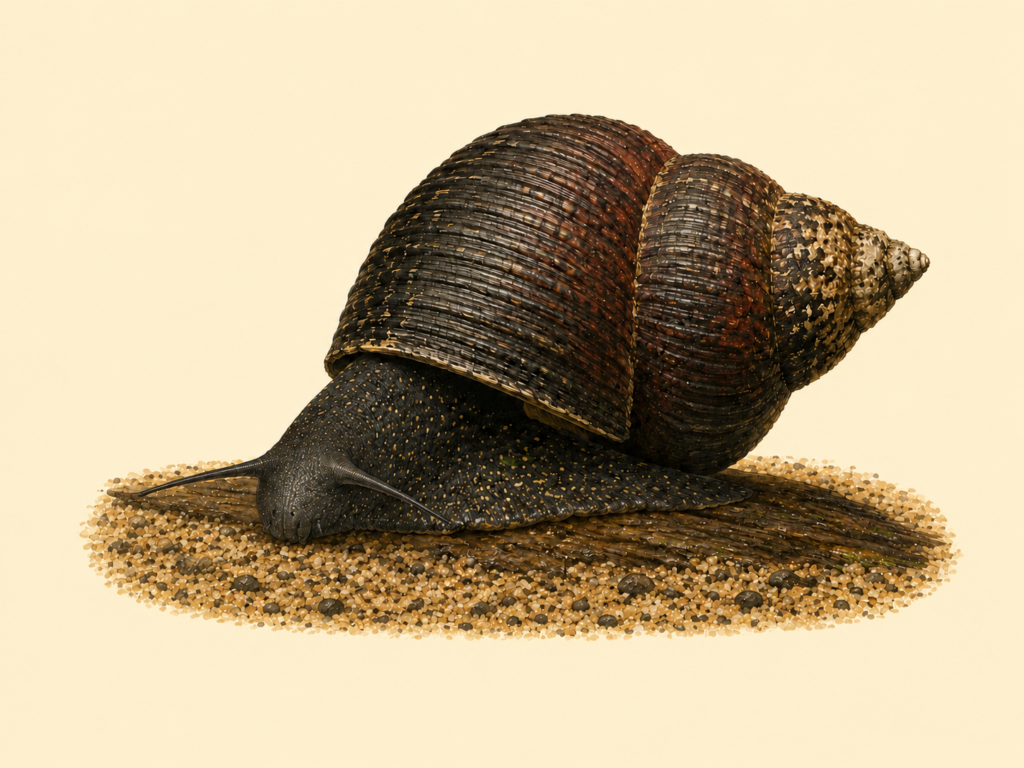
The defining feature of Tylomelania sinobartfeldi is its shell. Unlike the smoother or only lightly ridged shells of many other rabbit snail species, the Triangle Rabbit Snail carries a tall, conical shell with pronounced triangular or keel-like ridges spiraling around each whorl. These angular ridges give the shell an almost architectural quality, as though each whorl was carefully sculpted. Shell colour ranges from dark chocolate brown to nearly black, sometimes with lighter bands or a slightly weathered, mottled look on older individuals. The shell surface can accumulate a thin layer of biofilm or algae over time, which many keepers find adds to the natural aesthetic.
The snail’s soft body is typically dark grey to black, with a long, distinctive snout that tapers to a rounded tip. The foot is broad and muscular, often a slightly lighter shade than the head. Sexing Triangle Rabbit Snails externally is very difficult. Males and females look nearly identical to the naked eye. Some experienced keepers report subtle differences in body size or the shape of the foot, but reliable visual sexing is not practical. The most dependable way to confirm sex is simply to keep a small group and wait for breeding to occur.
Natural habitat
Tylomelania sinobartfeldi is endemic to Lake Poso on the Indonesian island of Sulawesi. Lake Poso is one of Sulawesi’s ancient tectonic lakes, estimated to be millions of years old. These lakes are famous among biologists for their extraordinary levels of endemism, meaning they harbour species found nowhere else on Earth. The Tylomelania genus has undergone a remarkable adaptive radiation within these lakes, producing dozens of species with wildly different shell shapes and body colours, all adapted to particular microhabitats within the lake system.
The waters of Lake Poso are warm year-round, typically between 27 and 30 °C, with a slightly alkaline pH and moderate hardness. The substrate in the snail’s natural range includes a mix of sand, mud, rocks, and fallen wood. The lake bottom receives plenty of organic detritus, including decomposing leaves and biofilm, which forms the bulk of the snail’s wild diet. Understanding this habitat is important because Triangle Rabbit Snails are sensitive to water chemistry swings and do not tolerate cold or acidic conditions well. Replicating the warmth, alkalinity, and gentle current of their native lake goes a long way toward keeping them healthy in captivity.
Tank size and setup
A single Triangle Rabbit Snail can be kept in a tank as small as 40 litres, but a group of three to five will be happier in 60 litres or more. These snails are not fast movers, but they do appreciate floor space to explore. A longer, shallower tank is preferable to a tall, narrow one since these are bottom-dwelling animals that rarely venture far above the substrate line.
Substrate choice matters. A fine sand, such as pool filter sand or CaribSea Super Naturals, is ideal. Rabbit snails like to burrow partially into the substrate, and coarse gravel can damage their soft foot. If you want to buffer pH and hardness upward, consider mixing in some crushed coral or aragonite sand, which will slowly dissolve and help maintain the alkaline conditions these snails prefer.
Decor should include pieces of driftwood, smooth river stones, and a few hiding spots such as coconut shells or ceramic caves. The snails will graze biofilm off wood and rocks, so these surfaces serve double duty as both shelter and feeding ground. Live plants are generally safe with Triangle Rabbit Snails, though very soft, delicate species may get sampled. Hardy plants like Java Fern (Microsorum pteropus), Anubias barteri, and Vallisneria spiralis are good choices. Floating plants such as Amazon Frogbit (Limnobium laevigatum) can help diffuse light, which these snails seem to appreciate.
Lighting can be moderate. These snails are not photosensitive in any extreme way, but very bright lighting without shaded areas may cause them to stay hidden during the day. Providing a mix of lit and shaded zones encourages more active daytime exploration. Water flow should be gentle to moderate. A slight current is fine and mimics their lake environment, but strong powerhead flow can stress them and make it harder for them to move around comfortably.
Water parameters
| Temperature | 26 to 30 °C |
| pH | 7.5 to 8.5 |
| General hardness (GH) | 4 to 12 dGH |
| Carbonate hardness (KH) | 3 to 10 dKH |
| Ammonia | 0 ppm |
| Nitrite | 0 ppm |
| Nitrate | Below 20 ppm |
Stability is the key word with Triangle Rabbit Snails. They come from an ancient lake with remarkably consistent water chemistry, and sudden parameter swings, especially in pH or temperature, can cause stress, inactivity, or shell erosion. Always acclimate new snails slowly using the drip method over at least an hour. Keep up with regular partial water changes of around 15 to 20 percent weekly, and test your water at least once a week to catch any drift before it becomes a problem. If your tap water is soft and acidic, you may need to use a remineraliser or buffer, such as Seachem Alkaline Buffer, to maintain the alkaline conditions these snails need.
Filtration and equipment
A sponge filter is an excellent choice for a rabbit snail tank. It provides gentle water movement, biological filtration, and a grazing surface all in one. For larger setups or community tanks, a hang-on-back filter like the AquaClear 30 or 50 works well, ideally with the outflow baffled slightly to reduce current. Internal canister-style filters are also fine as long as the intake is covered with a pre-filter sponge to prevent baby snails from being sucked in.
A reliable heater is essential. Because Triangle Rabbit Snails need consistently warm water, use a quality adjustable heater such as an Eheim Jager or Fluval M series, sized appropriately for your tank volume. In smaller tanks, consider a heater guard to prevent the snail from crawling onto the heater and burning its foot.
A liquid water testing kit, such as the API Freshwater Master Test Kit, is a worthwhile investment. Test strips can give a rough idea, but liquid tests are more accurate and more economical per test in the long run. You will also want a GH and KH test kit if you plan to keep these snails long-term, since hardness directly affects shell health.
Diet and feeding
In the wild, Triangle Rabbit Snails are detritivores and biofilm grazers. They spend their time slowly working across rocks, wood, and sediment, consuming decomposing plant matter, algae films, and microorganisms. In the aquarium, they are not fussy eaters, but they do benefit from a varied diet that mirrors this natural intake.
Offer blanched vegetables such as zucchini, cucumber, spinach, and kale two to three times per week. Simply drop a slice into the tank in the evening and remove any uneaten portion the next morning. Sinking wafers and pellets designed for bottom feeders are a great staple. Hikari Algae Wafers, Repashy Soilent Green, and Sera Catfish Chips are all well-received. For extra calcium, which is critical for shell growth and repair, offer occasional pieces of cuttlebone or use a calcium-enriched food like Snello (a homemade snail jelly made from a mix of fish food, calcium powder, and gelatin).
Feed once daily or every other day in small amounts. These snails have slow metabolisms, and overfeeding can foul the water quickly, especially in smaller tanks. Watch for uneaten food accumulating on the substrate and adjust portions accordingly. A healthy snail will spend most of its active time grazing, so if you see your snails constantly searching for food, you may be underfeeding slightly.
Behaviour and temperament
Triangle Rabbit Snails are among the most peaceful invertebrates you can keep. They show zero aggression toward tank mates, including other snails, shrimp, and fish. Their day-to-day existence consists of slow, purposeful movement across the substrate and decor, punctuated by periods of rest. They tend to be more active in the evening and at night, though well-settled individuals will often move about during the day as well, especially if the lighting is not too intense.
One endearing quirk is their tendency to “park” in a favourite spot for hours or even a day or two. New keepers sometimes worry their snail has died, but this is perfectly normal resting behaviour. If you are concerned, gently touch the foot. A living snail will retract slowly or begin to move. Another fun behaviour is their occasional habit of extending their snout upward as if sniffing the water. They are also known to burrow partway into the sand substrate, sometimes disappearing entirely for a day before resurfacing.
Triangle Rabbit Snails are not schooling animals, but they do seem calmer and more active when kept in small groups of three or more. Solitary individuals may spend more time hidden. In groups, you will often see snails following the same paths across the substrate, though this is likely coincidence rather than deliberate social behaviour.
Tank mates
Good tank mates
- Celestial Pearl Danio (Danio margaritatus) – tiny, peaceful, and prefers similar warm temperatures
- Endler’s Livebearer (Poecilia wingei) – small, non-aggressive, and active at the top of the tank
- Ember Tetra (Hyphessobrycon amandae) – calm schooling fish that won’t bother bottom-dwelling snails
- Otocinclus (Otocinclus vittatus) – peaceful algae grazers that share the same gentle temperament
- Cherry Shrimp (Neocaridina davidi) – harmless, colourful, and thrive in the same water conditions
- Kuhli Loach (Pangio kuhlii) – peaceful bottom dweller, though keep an eye on competition for food
- Other Tylomelania species – rabbit snails coexist peacefully with their own kind and related species
Fish to avoid
- Clown Loach (Chromobotia macracanthus) – known snail eaters that will harass or kill rabbit snails
- Yoyo Loach (Botia almorhae) – another loach species with a strong instinct to prey on snails
- Pea Puffer (Carinotetraodon travancoricus) – specialist snail predators, even small ones can damage rabbit snails
- Oscar (Astronotus ocellatus) – large, aggressive cichlid that will treat snails as food
- Green Spotted Puffer (Dichotomyctere nigroviridis) – aggressive snail crusher, completely incompatible
- Most large cichlids – species like Jack Dempseys and convicts will pester or eat snails
- Assassin Snail (Clea helena) – while they usually target smaller snails, they can harass juvenile rabbit snails
Breeding
Breeding Triangle Rabbit Snails is not difficult if conditions are right, but it is a slow process. Unlike many aquarium snails that lay dozens or hundreds of eggs at a time, rabbit snails are livebearers that produce just one (sometimes two) fully formed baby snails at a time. This means population explosions are not a concern, which is actually one of the reasons many keepers prefer them to pest snail species.
As mentioned, sexing is not easy externally. The simplest approach is to keep a group of five or more and let nature sort it out. Breeding is more likely in stable, warm water at the higher end of their temperature range (28 to 30 °C), with a varied diet rich in calcium. Well-fed snails in good conditions will breed without any special conditioning.
The female carries the developing embryo internally and eventually gives birth to a single baby snail, complete with a miniature version of the adult shell. The newborn is surprisingly large, often 5 to 8 mm in shell length, and is fully independent from the moment of birth. There is no parental care. Baby snails will immediately begin grazing on biofilm and can be fed the same foods as adults, crushed or broken into smaller pieces. Powdered foods like Bacter AE, which promotes biofilm growth, can help ensure the baby has enough microscopic food in its early days.
Expect a new baby roughly every four to six weeks from a healthy, mature female. Growth is slow, with juveniles taking eight to twelve months or more to reach full adult size.
Common diseases and health
Shell erosion and pitting
This is the most common issue with rabbit snails in captivity. The shell develops white, chalky patches or small pits, usually starting at the apex (the oldest part of the shell). The primary cause is water that is too soft or too acidic, which literally dissolves the calcium carbonate shell over time. Treatment involves correcting water parameters, ensuring GH and KH are adequate, and supplementing calcium through diet (cuttlebone, calcium-rich foods) and water chemistry (crushed coral in the filter or substrate). Existing damage will not heal, but new shell growth should be smooth and healthy once conditions improve.
Inactivity and retraction
A snail that stays retracted in its shell for more than a day or two, or that becomes unusually inactive, may be stressed by poor water quality, a sudden parameter change, or copper exposure. Copper is extremely toxic to invertebrates, even in trace amounts. Check your water conditioner and any medications you may be using. Products containing copper, such as some ich treatments, must never be used in a tank with snails. If you suspect copper contamination, perform large water changes immediately and add a copper-removing filter media like Seachem CupriSorb.
Parasites and hitchhikers
Imported rabbit snails can occasionally carry leeches or small parasitic worms on their shells or bodies. Inspect new arrivals carefully before adding them to your main tank. A brief salt dip (one tablespoon of aquarium salt per litre of tank water for five to ten minutes) can help remove external parasites, though snails are somewhat sensitive to salt, so do not exceed the recommended concentration or duration.
Quarantining new snails for two to four weeks in a separate container with matched water parameters is strongly recommended. This gives you time to observe for parasites, disease, or stress-related issues before introducing them to an established tank.
Frequently asked questions
Are Triangle Rabbit Snails safe with live plants?
Generally, yes. Triangle Rabbit Snails are primarily detritivores and prefer decaying plant matter, biofilm, and prepared foods over living plant tissue. However, very soft or delicate plants like dwarf hairgrass may occasionally get nibbled, especially if the snails are underfed. Hardy species like Java Fern, Anubias, and Vallisneria are almost never bothered.
How many Triangle Rabbit Snails can I keep in my tank?
A good rule of thumb is one snail per 15 to 20 litres of water, starting from a minimum of around 40 litres for a single individual. A 60-litre tank can comfortably house three to four snails. Because they produce very little waste relative to fish, bioload is rarely an issue, but they do need floor space to graze.
Will Triangle Rabbit Snails overpopulate my tank?
No. Unlike pest snails such as bladder snails or Malaysian trumpet snails, rabbit snails reproduce very slowly. Each female produces only one baby at a time, roughly every four to six weeks. Even with multiple breeding adults, population growth is gradual and easy to manage.
Why is my Triangle Rabbit Snail not moving?
Rabbit snails rest frequently and can remain still for a day or longer. This is normal. However, if a snail has been completely retracted and motionless for more than two to three days, check your water parameters, especially for ammonia, copper, or a pH drop. Gently touch the foot to see if it responds. An unpleasant smell from a retracted snail is a sign that the animal has died and should be removed immediately.
Do Triangle Rabbit Snails need a heater?
Yes. These snails come from tropical lakes and need water temperatures of 26 to 30 °C at all times. Room temperature in most homes is too cold for them, especially during winter. An adjustable aquarium heater is essential for long-term health.
Related guides
- Triangle Rabbit Snail breeding guide
- Triangle Rabbit Snail tank setup and equipment guide
- Triangle Rabbit Snail diet and feeding guide
- Best tank mates for Triangle Rabbit Snail
- Triangle Rabbit Snail diseases and health guide
- Why is my Triangle Rabbit Snail losing colour?
- Back to the fish species directory
- Beginner’s guide to cycling your tank