Quick summary
Pea Puffers are tiny, characterful freshwater fish best suited to intermediate keepers, not beginners, since they need live or frozen meaty foods (no flakes or pellets), pristine water quality, and a densely planted tank to manage territorial aggression. If you can commit to that feeding routine and tank setup, they make a rewarding, engaging pet with lots of personality.
🐠 Build a tank around this species
In this guide:
- Introduction
- Quick Stats
- Appearance
- Natural Habitat
- Tank Size and Setup
- Water Parameters
- Filtration and Equipment
- Diet and Feeding
- Behaviour and Temperament
- Tank Mates
- Breeding
- Common Diseases
- FAQs
Introduction
The Pea Puffer, scientifically known as Carinotetraodon travancoricus, is one of the most charismatic and endlessly entertaining freshwater fish available in the aquarium hobby. Despite its diminutive size, it is the smallest pufferfish in the world, this tiny predator packs an enormous personality into a body no larger than a garden pea. Native to the rivers and lakes of southwestern India, the Pea Puffer has earned a devoted following among aquarists who appreciate its inquisitive nature, independently moving eyes, and surprisingly complex behaviours.
Unlike many pufferfish species that require brackish or marine conditions, the Pea Puffer is an entirely freshwater species, making it far more accessible to the average hobbyist. However, accessibility should not be confused with simplicity. These fish have specific dietary requirements, can be territorial, and demand excellent water quality. They are not an ideal choice for a first aquarium, but they make a superb project for an intermediate fishkeeper looking for something a little different. Their intelligence is frequently remarked upon by owners, who report that their puffers learn to recognise them, beg for food, and even display distinct individual personalities.
It is worth noting that the wild populations of Carinotetraodon travancoricus face significant pressure from habitat loss and overcollection for the aquarium trade. The species is listed as Vulnerable on the IUCN Red List, and responsible keepers should ensure they source their fish from reputable suppliers, ideally those who support or participate in captive breeding programmes. By providing excellent care and, where possible, breeding these fish in captivity, hobbyists can play a meaningful role in reducing demand on wild stocks.
Quick Stats
| Scientific name | Carinotetraodon travancoricus |
|---|---|
| Common names | Dwarf Puffer, Indian Dwarf Puffer, Pygmy Puffer, Malabar Puffer, Dwarf Malabar Puffer, BB Puffer |
| Family | Tetraodontidae |
| Origin | Kerala and southern Karnataka, southwestern India |
| Adult size | 2.5 cm |
| Lifespan | 4–5 years |
| Difficulty | Intermediate |
| Breeding difficulty | Moderate |
| Temperature | 22–28 °C |
| pH | 6.5–8 |
| GH | 5–25 dGH |
| KH | 3–15 dKH |
| Minimum tank size | 30 L |
| Conservation status | Vulnerable (IUCN) |
Appearance
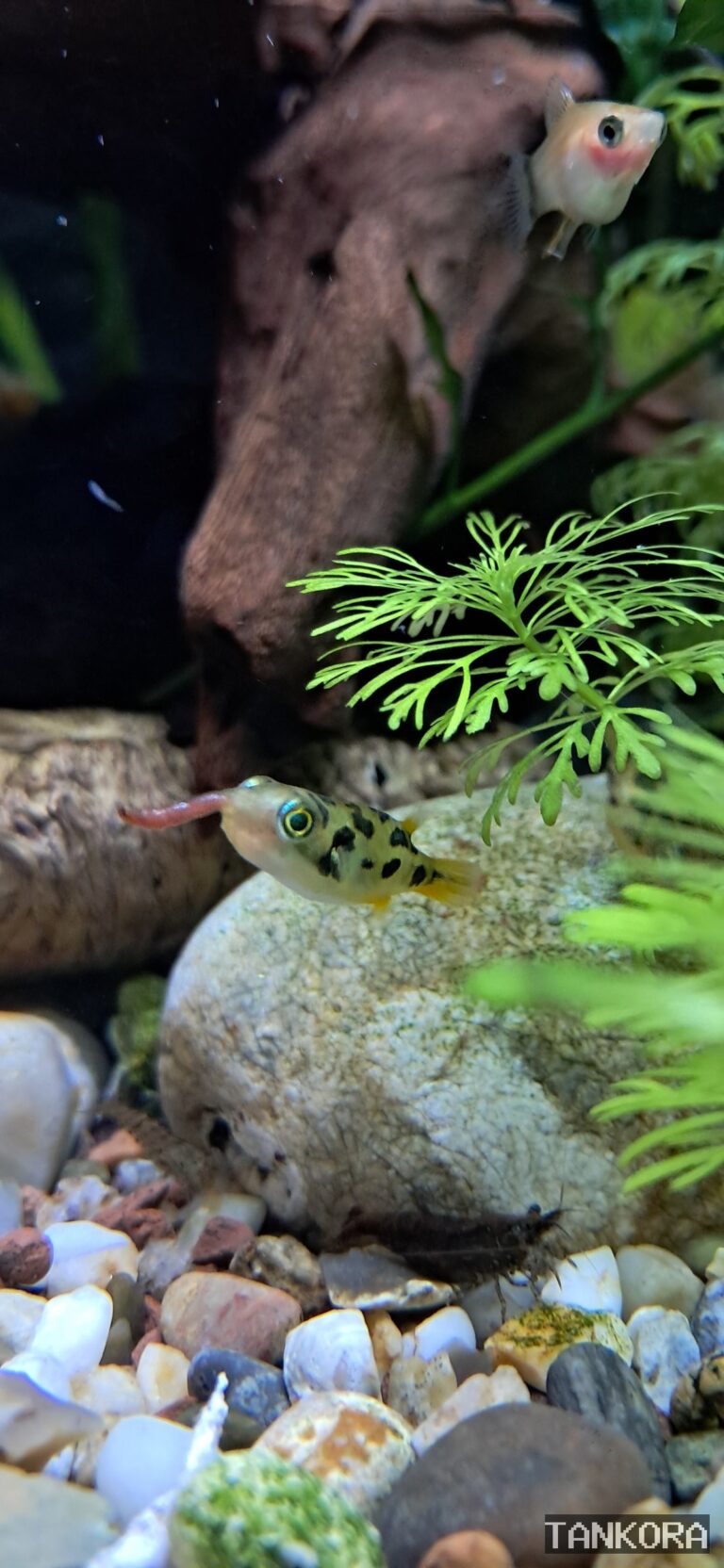
The Pea Puffer is a rotund, compact little fish with a shape that could charitably be described as a tiny, animated lemon. The body is rounded and slightly laterally compressed, lacking the pelvic fins found in most teleost fish, a characteristic shared with all members of the Tetraodontidae family. The dorsal and anal fins are set far back on the body, and propulsion comes primarily from rapid, helicopter-like sculling of the pectoral and caudal fins, giving the fish a distinctive hovering style of movement quite unlike typical aquarium species.
The base colouration is a golden to greenish-yellow, overlaid with a pattern of dark greenish-brown to black spots and irregular blotches across the dorsal surface and flanks. The belly is typically white or pale cream. This patterning can change noticeably depending on the fish’s mood, health, and environment, a stressed or sleeping Pea Puffer may appear considerably darker or paler than one that is alert and comfortable. The eyes are particularly striking: large, golden, and capable of moving independently of one another, much like a chameleon’s. This adaptation gives the fish excellent spatial awareness and contributes enormously to its expressive, characterful appearance.
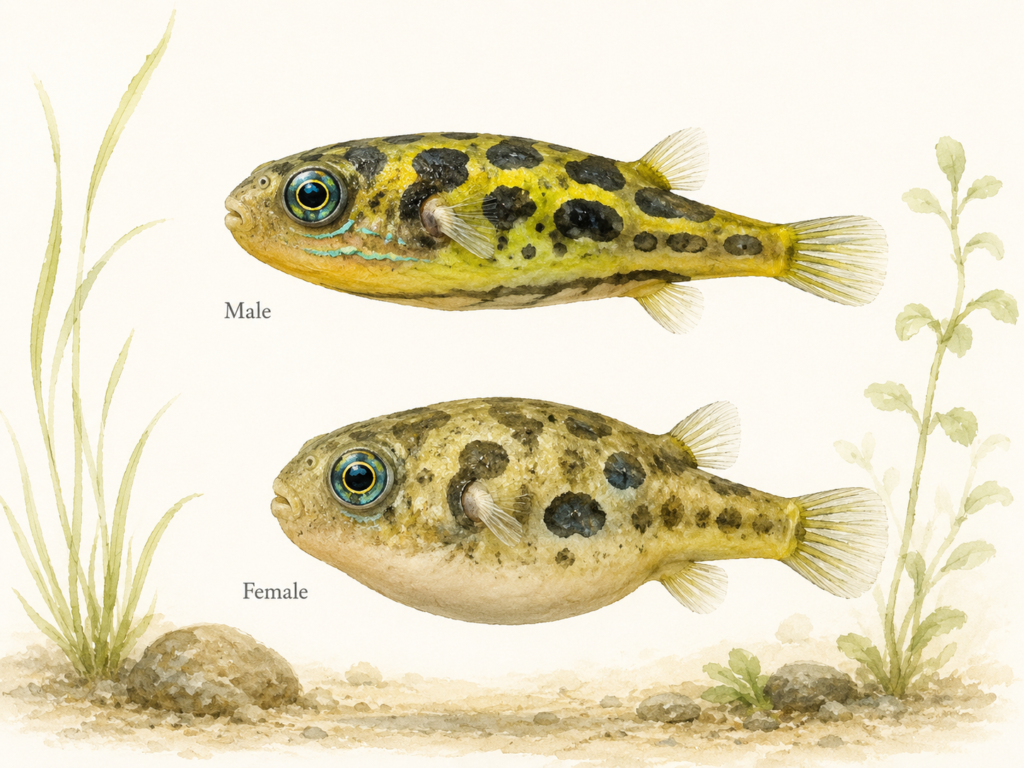
Sexual dimorphism is present but subtle and can be difficult to discern, especially in juveniles. Males tend to be slightly slimmer and often develop a dark ventral stripe or keel along the belly as they mature. They may also show more intense colouration and develop faint iridescent eye wrinkles or lines behind the eyes. Females are generally rounder, particularly when carrying eggs, and their spots tend to be more uniformly distributed. However, these differences are not always reliable, and even experienced keepers sometimes struggle to sex their fish with certainty until breeding behaviour is observed.
Natural Habitat
The Pea Puffer is endemic to a relatively restricted range in southwestern India, primarily within the state of Kerala and the adjacent parts of southern Karnataka. It inhabits the rivers, streams, backwaters, and associated lakes of the Western Ghats region, one of the world’s most biodiverse hotspots. The typical habitat consists of slow-moving to moderately flowing freshwater with abundant aquatic vegetation, submerged roots, and fallen leaf litter. These waterways often pass through dense tropical and subtropical forest, and the water is generally warm, slightly acidic to neutral, and relatively soft, though some populations occur in harder water conditions closer to the coast.
In the wild, Pea Puffers are found among dense growths of aquatic plants and algae, where they hunt for small invertebrates. The substrate in their native waters is typically sandy or composed of fine gravel, often covered with a layer of decomposing organic matter. The presence of abundant cover is crucial, as these small fish are vulnerable to predation and rely on vegetation and structure to establish territories and escape threats. Populations have been recorded in the Pamba River, Chalakudy River, and various tributaries and lakes within the Western Ghats drainage system.
Sadly, the wild habitat of the Pea Puffer is under considerable threat. Deforestation, dam construction, pollution from agricultural runoff, and the introduction of invasive species have all contributed to habitat degradation. Combined with significant collection pressure for the aquarium trade, millions of individuals have been exported over the past two decades, these factors have led to the species being classified as Vulnerable by the IUCN. This conservation context should inform every keeper’s approach to sourcing and caring for these fish.
Tank Size and Setup
A single Pea Puffer can be housed in a tank of around 30 litres, though a larger aquarium is always preferable and makes maintaining stable water quality considerably easier. For a small group, which is the most rewarding way to keep them, a minimum of 40–55 litres is recommended, with an additional 10–15 litres of capacity per additional puffer. These fish are territorial, and providing sufficient space is one of the most important factors in reducing aggression and stress within the group.
The aquascape should prioritise dense planting and abundant line-of-sight breaks. Live plants are strongly recommended, both because they replicate the natural habitat and because they provide the visual barriers that Pea Puffers need to establish and maintain individual territories without constant conflict. Excellent choices include Java Moss, Java Fern, Anubias species, Vallisneria, Cryptocoryne species, and floating plants such as Salvinia or Amazon Frogbit. Stem plants like Rotala, Hygrophila, and Limnophila are also valuable for creating dense thickets. The goal is to create an environment where any given fish cannot see every other fish at all times, this dramatically reduces territorial stress.
Hardscape elements such as driftwood, smooth stones, coconut shells, and small terracotta pots can be used to further break up sightlines and create caves and hiding spots. Avoid sharp or rough-edged decorations, as pufferfish lack scales and have delicate skin that is easily damaged. The substrate can be fine sand or smooth gravel; sand is generally preferred as it is more natural and easier to keep clean. A layer of dried leaf litter, such as Indian almond leaves or oak leaves, can be a beneficial addition, providing tannins that slightly acidify the water, promoting a more natural environment and supporting the growth of microorganisms that the puffers may graze upon.
Lighting should be moderate, suited to the needs of the plants rather than set to extremes. Pea Puffers do not have any special lighting requirements, but they tend to appear more comfortable and display brighter colouration in tanks that are not excessively brightly lit. A planted tank with a sensible photoperiod of eight to ten hours per day is ideal.
Water Parameters
Pea Puffers are reasonably adaptable when it comes to water chemistry, but they are sensitive to poor water quality. Maintaining pristine conditions with zero detectable ammonia and nitrite is non-negotiable, and nitrate levels should be kept low through regular water changes. They thrive in soft to moderately hard water with a slightly acidic to slightly alkaline pH, reflecting the range of conditions found across their native habitats in the Western Ghats.
| Temperature | 22–28 °C |
| pH | 6.5–8.0 |
| General hardness (GH) | 5–25 dGH |
| Carbonate hardness (KH) | 3–15 dKH |
| Ammonia | 0 ppm |
| Nitrite | 0 ppm |
| Nitrate | Below 20 ppm |
A temperature in the middle of the recommended range, around 24–26 °C, is generally considered the sweet spot for long-term health and activity. Consistency is more important than hitting a specific number; sudden fluctuations in temperature or pH can cause significant stress. Weekly water changes of 25–30% are advisable, and more frequent changes may be necessary in smaller or more heavily stocked tanks. Always treat replacement water with a dechlorinator and ensure it is temperature-matched before adding it to the aquarium.
Filtration and Equipment
Good filtration is essential for Pea Puffers, as they are messy eaters that produce a disproportionate amount of waste relative to their size. Their diet of meaty, protein-rich foods means that uneaten portions can foul the water quickly if not addressed. A filter rated for at least the volume of the tank, and ideally somewhat above it, is recommended. However, flow rate should be kept gentle, as Pea Puffers are not strong swimmers and will become stressed in a tank with powerful currents. Sponge filters are an excellent choice for smaller setups, providing effective biological filtration with minimal flow. Hang-on-back filters and small canister filters also work well, provided the outflow is baffled or diffused to prevent excessive water movement.
An adjustable heater is necessary to maintain a stable tropical temperature. Choose a reliable, thermostatically controlled heater appropriately sized for the aquarium, and consider using a separate thermometer to verify the temperature independently. In smaller tanks, heater malfunctions can cause rapid and dangerous temperature swings, so investing in a quality unit is worthwhile.
An air stone or gentle surface agitation from the filter outflow is usually sufficient to maintain adequate oxygenation. Pea Puffers do not have any unusual oxygen requirements, but well-oxygenated water supports the biological filtration that is so crucial to maintaining water quality. A tight-fitting lid or cover is advisable, not because Pea Puffers are prolific jumpers, but because it helps maintain stable humidity above the waterline, reduces evaporation, and prevents other household mishaps.
Diet and Feeding
Feeding is perhaps the most important, and most frequently misunderstood, aspect of Pea Puffer care. These fish are obligate carnivores with a strong preference for live and frozen invertebrate prey. They will not accept standard dried flake or pellet foods, and keepers who attempt to rely on these will inevitably end up with malnourished, unhappy fish. This dietary requirement must be understood and accepted before acquiring Pea Puffers.
The staple diet should consist of small live or frozen foods. Frozen bloodworms, brine shrimp, daphnia, and mosquito larvae are all readily accepted and widely available from aquarium retailers. Live foods such as small snails (particularly pest snails like Ramshorn and Malaysian Trumpet Snails), blackworms, grindal worms, and white worms are eagerly hunted and provide excellent enrichment as well as nutrition. Many experienced keepers maintain a separate snail breeding colony specifically to supply their puffers with a steady source of live prey.
Snails serve a dual purpose in the Pea Puffer diet. Beyond their nutritional value, the hard shells help to wear down the puffer’s continuously growing beak-like teeth. All pufferfish have a fused dental plate, the “four teeth” from which the order Tetraodontiformes gets its name, and without sufficiently hard foods to gnaw on, these teeth can become overgrown, eventually preventing the fish from eating and leading to starvation. Regularly offering small snails is one of the most effective ways to prevent this serious issue.
Feeding should be done once or twice daily, offering only as much food as the fish will consume within a few minutes. Pea Puffers are prone to obesity if overfed, and uneaten food will degrade water quality rapidly. Some keepers find it beneficial to implement a fasting day once a week, which can help prevent digestive issues and more closely mimics the natural pattern of food availability.
Behaviour and Temperament
Despite their tiny size, Pea Puffers possess one of the most engaging and complex behavioural repertoires of any freshwater aquarium fish. They are highly intelligent by fish standards, with excellent spatial memory and the ability to learn and recognise routines. Many keepers report that their puffers quickly learn to associate their owner’s approach with feeding time, swimming to the front of the glass and displaying what can only be described as begging behaviour. Each individual tends to develop its own distinct personality, with some being bold and outgoing while others remain more cautious and reserved.
Territorial aggression is the primary behavioural challenge associated with this species. Males, in particular, will establish and vigorously defend small territories within the aquarium, and in insufficiently planted or undersized tanks, this can lead to persistent harassment, fin nipping, and stress among subordinate individuals. Females are generally less aggressive but are not immune to territorial disputes. The key to managing this behaviour is providing ample space and dense planting to create multiple distinct territories with visual barriers between them. In a well-designed tank, aggression is typically limited to brief displays and chases that resolve quickly without injury.
Pea Puffers are also avid hunters and spend much of their active time patrolling their territory for snails, worms, and other small invertebrates. They investigate their environment constantly, poking into crevices, examining plant leaves, and scrutinising every new object with their independently moving eyes. This exploratory behaviour is a sign of a healthy, stimulated puffer and one of the primary joys of keeping the species. Conversely, a Pea Puffer that is lethargic, hiding constantly, or displaying persistently dark colouration may be stressed, ill, or being bullied and should be monitored closely.
It is worth noting that Pea Puffers are fin nippers by nature. This tendency is not limited to aggression towards conspecifics, they will also nip at the fins of slow-moving or long-finned tank mates, which significantly limits the range of species that can be safely housed alongside them.
Tank Mates
The question of tank mates for Pea Puffers is one that generates considerable debate in the hobby. The safest and most commonly recommended approach is to keep them in a species-only tank. This eliminates the risk of fin nipping and territorial aggression towards other species, and it allows the keeper to focus entirely on the puffers’ specific needs. However, many experienced aquarists have successfully maintained Pea Puffers in carefully chosen community setups, provided the tank is sufficiently large and densely planted.
Any potential tank mate must be fast enough to avoid nipping, lack long or flowing fins that might attract unwanted attention, and be tolerant of the same water parameters. Bottom-dwelling species that occupy a different zone of the tank tend to fare best. It is always essential to have a contingency plan and be prepared to separate species if aggression becomes problematic.
Good tank mates
- Otocinclus Catfish, these small, peaceful algae eaters occupy the bottom and sides of the tank and are generally too fast and unobtrusive to attract attention from puffers.
- Kuhli Loach, their nocturnal habits and tendency to hide among plant roots and substrate mean they rarely encounter puffers during active hours.
- Ember Tetra, small and quick, these short-finned tetras can coexist in a large, densely planted tank where they occupy the mid-water column.
- Celestial Pearl Danio, their diminutive size and speed allow them to evade nipping, though a well-planted tank with plenty of cover is essential.
- Pygmy Corydoras, as bottom-dwelling shoalers, they largely stay out of the puffers’ territory and their small size reduces the risk of confrontation.
- Amano Shrimp, large enough to avoid being eaten by adult puffers in most cases, and they provide useful cleaning services, though juveniles may be at risk.
- Nerite Snail, their hard opercula and shells generally protect them from puffer attacks, and they are excellent algae cleaners.
- Chilli Rasbora, these tiny, fast-moving fish can work in a spacious, heavily planted setup where the puffers have established territories.
Fish to avoid
- Betta Fish, their long, flowing fins make them an irresistible target for fin nipping, and their slow swimming speed leaves them unable to escape harassment.
- Guppy, the elaborate tail fins of male guppies will almost certainly be shredded by puffers within hours of introduction.
- Angelfish, far too large for a typical puffer tank, with trailing fins that invite nipping, and their slow, graceful movement makes them easy targets.
- Dwarf Gourami, their relatively slow pace, long ventral filaments, and tendency to occupy similar water levels create a recipe for persistent aggression from puffers.
- Cherry Shrimp, while occasionally kept with puffers, small shrimp are natural prey items and will be hunted relentlessly, especially juveniles and shrimplets.
- Mystery Snail, despite their size, puffers will target their antennae and exposed flesh, causing significant stress and injury over time.
- Endler’s Livebearer, similar to guppies, their colourful fins attract unwanted attention, and they are too slow to consistently evade a determined puffer.
- Siamese Fighting Fish, essentially the same concerns as with bettas; the combination of flowing fins and slow movement makes cohabitation inadvisable.
Breeding
Breeding Pea Puffers in captivity is achievable and has been accomplished by many dedicated hobbyists, though it requires some preparation and patience. Unlike many aquarium fish, puffers do not scatter eggs indiscriminately or engage in easily triggered spawning events. Successful breeding generally requires a well-conditioned pair or small group in a mature, densely planted aquarium with stable water conditions.
Conditioning for breeding involves feeding a varied, high-quality diet rich in live foods for several weeks prior to spawning attempts. Females in breeding condition will appear noticeably rounder as they fill with eggs. Males will intensify their territorial displays and may become more aggressive towards rival males. In a well-planted tank, courtship typically involves the male displaying to the female by hovering nearby, puffing up slightly, and leading her towards a chosen spawning site, which is usually a sheltered area among fine-leaved plants, java moss, or similar dense vegetation.
Spawning itself involves the female depositing small, nearly transparent eggs among the plants, often in very small clutches of just a few eggs at a time. The eggs are tiny, around one millimetre in diameter, and can be extremely difficult to spot. Neither parent provides any care for the eggs or fry, and in a community or group setting, the eggs and resulting fry are likely to be eaten unless steps are taken to protect them. Many breeders choose to carefully remove eggs to a separate rearing container with matching water parameters and gentle aeration.
The eggs typically hatch within approximately five days at around 25–27 °C, producing minuscule fry that are initially too small to accept most prepared foods. Infusoria, vinegar eels, and commercially available liquid fry foods are suitable first feeds. As the fry grow, they can be transitioned to freshly hatched baby brine shrimp and then to micro worms and finely chopped frozen foods. Growth is relatively slow, and the fry can take several months to reach a size where they can be safely introduced to the main tank. Providing pristine water quality in the rearing container is absolutely critical, as the fry are extremely sensitive to ammonia and nitrite.
Common Diseases
Pea Puffers are generally hardy fish when kept in appropriate conditions, but they are susceptible to several health issues that keepers should be aware of. Because they lack scales, relying instead on tough but permeable skin, they can be more sensitive to water quality issues and certain medications than scaled fish. This is an important consideration when treating any illness, always check that medications are safe for scaleless species before use, and consider using half-doses initially.
Ich (white spot disease) is one of the most common ailments encountered by Pea Puffer keepers. It presents as small white cysts on the body and fins and is typically triggered by stress, temperature fluctuations, or the introduction of infected fish. Treatment involves gradually raising the tank temperature to 28–30 °C and, if necessary, using a medication specifically labelled as safe for scaleless fish. Salt baths should be used with caution, as puffers are freshwater fish with no tolerance for sustained salinity.
Internal parasites are another concern, particularly in wild-caught specimens. Symptoms can include lethargy, loss of appetite, weight loss despite eating, and abnormal faeces (white, stringy, or trailing). A quarantine period of at least two to four weeks for all new arrivals, combined with prophylactic treatment with an appropriate anti-parasitic medication, is strongly recommended. Many experienced puffer keepers routinely treat new acquisitions with praziquantel or levamisole-based medications as a precautionary measure.
Overgrown teeth, as mentioned in the diet section, represent a potentially fatal condition unique to pufferfish. If the dental plates become too long, the fish will be unable to open its mouth or crush food effectively. Prevention through regular feeding of hard-shelled snails is the best approach. In severe cases, manual trimming of the teeth by a veterinarian experienced with fish is possible, but this is stressful and risky for such a small animal and should be considered a last resort.
Fungal infections can occasionally occur, particularly on damaged skin, and are typically treated with antifungal medications safe for scaleless fish. Maintaining excellent water quality and avoiding sharp decorations that could cause abrasions are the best preventive measures. Similarly, bacterial infections can arise secondary to injuries or in tanks with poor water conditions, presenting as redness, ulceration, or fin erosion. Broad-spectrum antibacterial treatments designed for aquarium use can be effective, but addressing the underlying cause, usually water quality, is essential for lasting resolution.
FAQs
Can Pea Puffers live in a community tank?
While it is possible to keep Pea Puffers with carefully selected tank mates in a sufficiently large and densely planted aquarium, a species-only setup is the safest and most commonly recommended approach. Pea Puffers are notorious fin nippers, and they can harass slow-moving or long-finned species relentlessly. If you do attempt a community setup, choose fast, short-finned species that occupy different areas of the tank, and always have a backup plan in case the arrangement does not work out. Monitor all fish closely during the first few weeks for signs of stress or injury.
Do Pea Puffers need to eat snails?
While snails are not the only food Pea Puffers will eat, they serve a critically important function in maintaining dental health. The hard shells help to wear down the puffer’s continuously growing beak, preventing overgrowth that could eventually prevent the fish from eating altogether. It is strongly recommended to include snails as a regular part of the diet, even if frozen foods form the primary staple. Many keepers maintain a separate tank or container for breeding pest snails such as Ramshorn or Bladder Snails specifically for this purpose.
How many Pea Puffers can I keep together?
A single Pea Puffer can be kept in a tank of around 30 litres, and a small group of three to five individuals does well in a tank of 55–75 litres, provided it is densely planted with abundant hiding spots and visual barriers. The general guideline is to allow approximately 10–15 litres per puffer, though more space is always better when managing territorial aggression. Keeping a single male with two or more females tends to produce less conflict than keeping multiple males together, though this is not always easy to arrange given the difficulty of sexing young fish.
Will Pea Puffers eat flake or pellet food?
No. Pea Puffers are obligate carnivores that will not accept standard dried foods such as flakes, pellets, or granules. Their diet must consist of live or frozen meaty foods including bloodworms, brine shrimp, daphnia, mosquito larvae, and small snails. Attempting to feed them dried foods will result in malnutrition and poor health. This dietary requirement is one of the most important factors to consider before deciding to keep this species, as it represents an ongoing commitment to sourcing appropriate food.
Are Pea Puffers poisonous?
Many pufferfish species produce tetrodotoxin, a potent neurotoxin, in their skin and organs. While Carinotetraodon travancoricus is believed to be capable of producing or sequestering toxins to some degree, the levels present in this tiny species are generally considered negligible and pose no practical risk to humans through normal aquarium handling. You should not, of course, eat your aquarium fish. The toxin is thought to be derived at least partly from dietary sources in the wild and may be reduced or absent in captive-bred specimens fed on standard aquarium foods.
Related Guides
- Figure Eight Puffer Care Guide, a slightly larger brackish puffer species for keepers interested in exploring other pufferfish options.
- Ramshorn Snail Care Guide, an essential resource for keepers looking to establish a feeder snail colony for their puffers.
- Otocinclus Catfish Care Guide, one of the most compatible tank mates for Pea Puffers, ideal for algae management in planted setups.
- Kuhli Loach Care Guide, another compatible bottom-dweller that can coexist peacefully with Pea Puffers in well-planted tanks.
- Java Moss Care Guide, an invaluable plant for Pea Puffer tanks, providing cover, territory markers, and potential spawning sites.