Quick summary
The Black Calvus Cichlid is a striking but slow-growing Lake Tanganyika species best suited to keepers who can maintain stable, hard, alkaline water and provide plenty of rocky hiding spots. It’s not ideal for beginners due to its specific water chemistry needs, slow maturation, and initially shy nature, but it rewards patient owners with fascinating cave-spawning behaviour.
🐠 Build a tank around this species
In this guide:
- Introduction
- Quick Stats
- Appearance
- Varieties and Morphs
- Natural Habitat
- Tank Size and Setup
- Water Parameters
- Filtration and Equipment
- Diet and Feeding
- Behaviour and Temperament
- Tank Mates
- Breeding
- Common Diseases
- FAQs
Introduction
The Black Calvus Cichlid (Altolamprologus calvus) is one of Lake Tanganyika’s most distinctive and sought-after species. With its dramatically compressed body, elongated snout, and strikingly dark colouration peppered with pearlescent spots, this cichlid commands attention in any aquarium. Often referred to simply as the “Calvus,” it belongs to the genus Altolamprologus, which contains three recognised species: Altolamprologus calvus, Altolamprologus compressiceps, and Altolamprologus fasciatus. Both share a remarkably laterally compressed body plan, an evolutionary adaptation that allows them to slip into narrow rock crevices in pursuit of prey or to escape predators.
First described by Poll in 1978, Altolamprologus calvus is endemic to Lake Tanganyika, occurring along the southern and south-western shoreline of this ancient African rift lake. The species name “calvus” derives from the Latin word for “bald,” referencing the notably scaleless head that distinguishes it from its close relative, A. compressiceps. In the wild, these fish inhabit rocky environments at moderate depths, weaving between boulders and rocky rubble to hunt small invertebrates and fry.
In the aquarium hobby, the Black Calvus has earned a loyal following among cichlid enthusiasts. While it is not a fish for beginners, owing to its relatively slow growth, specific water requirements, and sometimes shy disposition, it rewards patient keepers with a fascinating display of natural behaviour. The species is a cave spawner that exhibits intriguing parental care, and its predatory hunting style, where it wedges itself into tight spaces to ambush small prey, is captivating to observe. This guide covers everything you need to know to keep and breed this remarkable Tanganyikan cichlid successfully.
Quick Stats
| Scientific name | Altolamprologus calvus |
|---|---|
| Common names | Calvus Cichlid, Pearly Calvus, Black Pearly Calvus, Inkfin Calvus |
| Family | Cichlidae |
| Origin | Lake Tanganyika, Africa (Zambia, DR Congo) |
| Adult size | 13.5 cm |
| Difficulty | Intermediate |
| Breeding difficulty | Moderate |
| Temperature | 24–27 °C |
| pH | 7.5–9 |
| GH | 8–20 dGH |
| Minimum tank size | 304 L |
| Conservation status | Near Threatened (IUCN, assessed 2025) |
Appearance
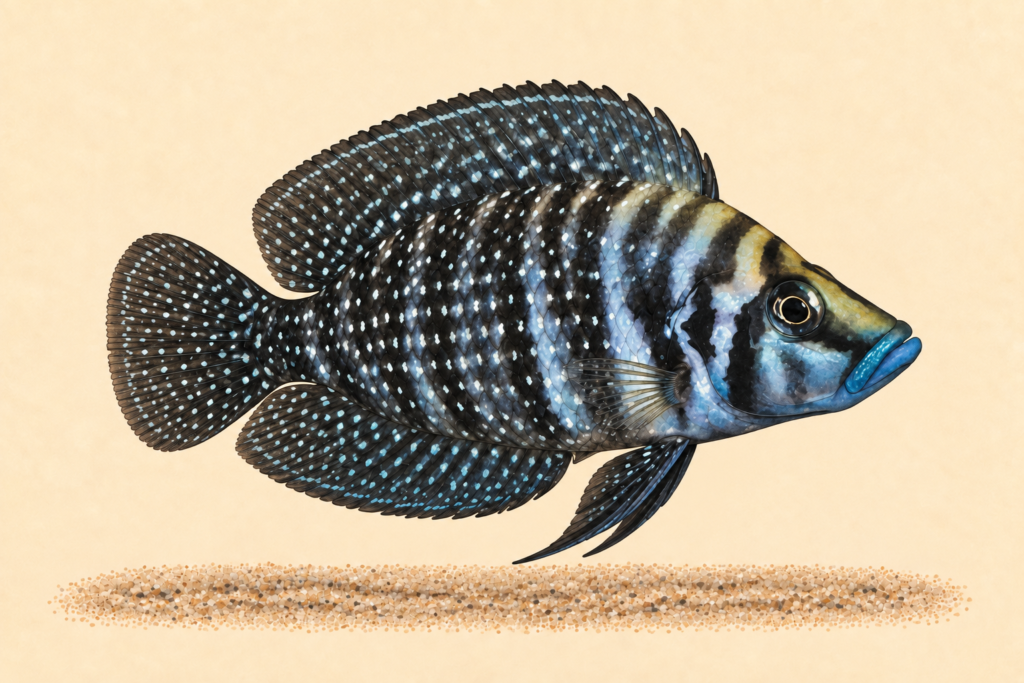
The Black Calvus Cichlid is an unmistakable fish. Its body is extremely laterally compressed, almost blade-like when viewed head-on, which is the hallmark of the Altolamprologus genus. The dorsal profile rises steeply from the snout to the beginning of the dorsal fin, giving the head a somewhat angular, triangular appearance. The mouth is relatively small and protrusible, positioned at the tip of an elongated snout, ideally suited for extracting small prey from rock crevices.
The most immediately obvious feature is the scaleless head, which appears smooth compared to the heavily scaled flanks. The scales on the body are large, thick, and somewhat rough, an armour-like adaptation that protects the fish as it squeezes through sharp-edged rocky fissures. In the black morph, the base colouration ranges from charcoal grey to deep, inky black. Scattered across the flanks are rows of small, brilliant white or pearlescent spots that become more pronounced with age and good husbandry. These spots can appear almost iridescent under appropriate lighting, creating a striking contrast against the dark body.
The dorsal fin is long and continuous, stretching almost the entire length of the back, and the caudal fin is rounded. All fins tend to be dark, sometimes edged in subtle lighter tones. Males are noticeably larger than females, reaching up to 15 cm in total length, while females typically remain around 8 to 10 cm. Males also tend to develop a slightly more robust body and a steeper forehead profile as they mature. Sexual dimorphism is otherwise subtle, which can make sexing younger specimens challenging.
One of the fascinating aspects of the Black Calvus’s appearance is how it changes with the fish’s mood and environment. When stressed or displaying submission, the dark pigmentation can fade to a washed-out grey. During courtship or territorial displays, the black intensifies and the pearlescent spots become more vivid, giving the fish a truly spectacular appearance.
Varieties and Morphs
While Altolamprologus calvus is a single species, several geographical variants are recognised in the aquarium trade, each collected from different localities around Lake Tanganyika. These variants differ primarily in colouration and the intensity or pattern of their pearlescent spotting.
The Black Calvus, sometimes sold as the “Inkfin Calvus” or “Black Pearly Calvus,” is the most popular and widely available morph. Originating from localities near Chaitika, Zaire (now Democratic Republic of the Congo), and surrounding areas, this variant displays the deep black base colouration with bright white spots that the species is best known for. It is often the variety that hobbyists think of first when the name “Calvus” is mentioned.
The White Calvus, sometimes referred to as the “White Pearly Calvus,” hails from different collection points and presents a dramatically different look. Rather than a dark base, these fish exhibit a pale silvery-white to light grey body with darker banding or mottling and the same pearlescent spot pattern. This variant is highly sought after and tends to command a higher price due to its relative rarity in the trade.
The Yellow Calvus is another geographical variant, originating from localities such as Nkamba Bay. These specimens display a warm yellowish or golden hue to the body, sometimes overlaid with subtle dark vertical barring and the characteristic spots. While less commonly available than the black morph, yellow Calvus are prized for their unique colouration.
It is worth noting that all these variants are the same species and require identical care. Hybridisation between morphs should be avoided in captive breeding programmes to preserve the genetic integrity of each geographical form. Responsible hobbyists take care to keep collection-point data with their breeding colonies and avoid mixing localities in the same breeding group.
Natural Habitat
Lake Tanganyika is the second oldest and second deepest freshwater lake in the world, stretching approximately 673 kilometres along the western arm of the East African Rift Valley. Its waters are famously alkaline and mineral-rich, with remarkable clarity in many areas. Altolamprologus calvus is found along the southern and south-western shoreline of the lake, primarily in Zambian and Congolese waters, at depths typically ranging from 5 to 30 metres.
The species inhabits the rocky littoral zone, an environment characterised by tumbled boulders, fractured rock faces, and extensive rubble fields. This rocky substrate creates an intricate network of caves, crevices, and narrow passageways that are central to the Calvus’s lifestyle. The laterally compressed body shape is a direct adaptation to this environment, enabling the fish to slip into spaces that would be inaccessible to broader-bodied competitors or predators.
In its natural habitat, the Calvus is a stealthy predator. It patrols rocky crevices in search of small crustaceans, insect larvae, and the fry of other cichlid species. Its hunting strategy involves slowly approaching a crevice containing potential prey and then inserting its narrow body and elongated snout to extract the meal. This ambush-style predation is one of the species’ most remarkable behavioural adaptations.
The water in Lake Tanganyika is consistently warm, highly oxygenated in the upper layers, and buffered to a high pH by dissolved minerals. There is very little fluctuation in water chemistry throughout the year, which means that A. calvus has evolved in an environment of exceptional stability. Replicating this stability in the aquarium is one of the keys to long-term success with this species.
Tank Size and Setup
A minimum tank size of 150 litres is recommended for a single pair or a small group of Black Calvus Cichlids, though a larger aquarium of 200 litres or more is preferable, particularly if you intend to house them alongside other Tanganyikan species. The tank should ideally have a footprint that prioritises length and depth over height, as Calvus are rock-dwelling fish that spend most of their time navigating horizontal territories among boulders rather than swimming in open water.
The aquascape should be designed to replicate the rocky littoral zone of Lake Tanganyika. Use a generous quantity of rocks, limestone, ocean rock, or Tanganyika-style stacked stone arrangements work well, to create caves, overhangs, and narrow crevices. The Calvus’s laterally compressed body allows it to enter surprisingly tight spaces, and providing these hiding spots is essential for the fish’s sense of security. Without adequate rockwork and shelter, Calvus can become chronically stressed, leading to poor colouration, suppressed feeding, and susceptibility to disease.
A sandy substrate is the most natural and practical choice. Fine-grain sand, whether aragonite-based (which can help buffer pH) or inert pool filter sand, allows the fish to forage naturally and prevents injury to their undersides. Avoid sharp gravel that could damage their scales as they rest near the bottom.
Live plants are not strictly necessary and are historically less common in Tanganyikan setups, but hardy species such as Anubias and Vallisneria can be included if desired. These plants tolerate the hard, alkaline water and can provide additional visual interest and some cover. Floating plants can be used to diffuse strong overhead lighting, which Calvus may find uncomfortable.
Ensure that all rockwork is stable and securely positioned. Calvus are not particularly strong diggers, but other Tanganyikan tankmates may be, and an unstable rock pile can cause serious harm. Using aquarium-safe silicone or egg crate light diffuser panels beneath heavy rocks can prevent accidents.
Water Parameters
| Temperature | 24–27 °C |
| pH | 7.5-9 |
| General hardness (GH) | 8-20 dGH |
| Ammonia | 0 ppm |
| Nitrite | 0 ppm |
| Nitrate | Below 20 ppm |
Maintaining stable water parameters is arguably the single most important aspect of keeping Black Calvus Cichlids healthy. Lake Tanganyika is one of the most chemically stable bodies of water on Earth, and its inhabitants have evolved with virtually no tolerance for rapid fluctuations. Sudden swings in pH, temperature, or hardness can be more damaging than parameters that are slightly outside the ideal range but remain consistent.
The high pH and hardness required by this species come naturally if you use a mineral-rich substrate or buffer your water with commercial Tanganyika salts. Many keepers use a combination of aragonite sand and limestone rockwork to passively maintain the appropriate chemistry. If your tap water is soft and acidic, you will need to use a dedicated Rift Lake buffer to raise and stabilise the pH and hardness before adding water to the aquarium.
Regular partial water changes of 20–30% weekly are recommended. Always ensure that replacement water is matched as closely as possible to the tank’s existing temperature and chemistry. Use a reliable liquid test kit to monitor ammonia, nitrite, nitrate, pH, and hardness on a regular basis, particularly in the first few months after setup.
Filtration and Equipment
Efficient biological and mechanical filtration is essential for any Lake Tanganyika setup. The high pH and hardness of the water mean that ammonia is more toxic at these levels compared to soft, acidic conditions, making effective biological filtration critically important. A canister filter rated for at least 1.5 to 2 times the tank’s volume in turnover per hour is a solid starting point. Brands offering robust biological media capacity are preferred.
Supplementary filtration in the form of a secondary internal filter or a sponge filter can provide additional biological capacity and water movement. Good water circulation is important, as Lake Tanganyika’s rocky shallows are well-oxygenated environments. An air pump with an airstone can be a useful addition to increase surface agitation and dissolved oxygen levels, particularly in warmer months or if the tank is densely stocked.
A reliable heater with a thermostat is necessary to maintain the temperature within the 24–27 °C range. In larger tanks, two heaters positioned at opposite ends can help ensure even heat distribution. Use a separate aquarium thermometer to verify the heater’s accuracy, as thermostat drift is a common issue with budget-priced heaters.
Lighting should be moderate. Black Calvus are not especially fond of intense, bright lighting and tend to retreat into rockwork when illumination is too strong. LED fixtures with adjustable intensity or a dimming function are ideal, allowing you to create a natural photoperiod with gradual sunrise and sunset transitions. This not only benefits the fish but also enhances the visual impact of their dark colouration and pearlescent spots.
A tight-fitting lid or cover glass is advisable, although Calvus are not habitual jumpers. The lid also serves to reduce evaporation, which can be significant in hard-water setups and lead to a gradual concentration of dissolved minerals between water changes.
Diet and Feeding
In the wild, the Black Calvus is primarily a micro-predator, feeding on small crustaceans, insect larvae, zooplankton, and the fry of other cichlid species. In the aquarium, replicating this diet is straightforward, and the species generally adapts well to a range of prepared and frozen foods, though initial acceptance can sometimes be slow with newly imported or wild-caught specimens.
A high-quality cichlid pellet designed for carnivorous or omnivorous species should form the dietary staple. Choose a pellet size appropriate to the fish’s mouth, small to medium pellets are usually best. Supplement this with regular offerings of frozen foods such as brine shrimp, mysis shrimp, cyclops, and daphnia. These frozen foods are excellent for maintaining condition, encouraging breeding behaviour, and providing variety.
Live foods can be offered occasionally as a treat and are particularly useful for conditioning breeding pairs. Newly hatched brine shrimp (Artemia nauplii) are invaluable for raising fry, while adult brine shrimp, blackworms, and small feeder shrimp can stimulate a feeding response in shy or newly acquired specimens. Avoid tubifex worms from dubious sources, as they can carry parasites.
Do not feed mammalian-based protein sources such as beefheart. While once popular in the cichlid hobby, these foods contain saturated fats that Tanganyikan cichlids struggle to metabolise, potentially leading to fatty liver disease and other health problems over time.
Feed small amounts once or twice daily, removing any uneaten food after a few minutes. Calvus are not aggressive feeders and tend to approach food cautiously, so ensure that faster tankmates are not monopolising the meal. Target feeding using tweezers or a pipette near the Calvus’s preferred hiding spots can be an effective strategy in community settings.
Behaviour and Temperament
The Black Calvus Cichlid is often described as a shy, slow-moving, and somewhat reclusive species, especially when compared to the more boisterous mbuna or haplochromine cichlids. However, this characterisation can be somewhat misleading. While Calvus are certainly not hyperactive swimmers, they are quietly territorial, keenly observant, and capable of surprising bursts of speed when pursuing prey or defending their chosen cave.
In the aquarium, Calvus spend much of their time hovering near or within rockwork, often tilting their laterally compressed bodies to peer into crevices. They are curious fish that quickly learn to recognise their keeper and will often emerge to the front of the tank at feeding time once they feel secure in their environment. Building this confidence typically takes several weeks, and patience is required with newly introduced specimens.
Conspecific aggression is generally moderate. Males can be territorial towards one another, particularly in smaller tanks, but disputes rarely escalate to the level of serious injury, largely because the species’ thick, armour-like scales provide effective protection. In a well-structured tank with multiple caves and sight-line breaks, several Calvus can coexist peacefully. A ratio of one male to two or three females tends to work well in breeding groups.
Towards other species, Calvus are generally peaceful but opportunistic. They will readily eat any fish or invertebrate small enough to fit into their mouth, including the fry of tankmates and small adult shrimp. This predatory behaviour is entirely natural and should be expected. However, they are not aggressive towards similarly sized fish and rarely initiate conflict with other Tanganyikan species beyond brief, ritualised displays.
One behavioural trait worth noting is the Calvus’s slow growth rate. Juvenile Calvus grow considerably more slowly than many other cichlid species, and it can take 18 months to two years for them to reach full adult size. This slow maturation requires patience and consistent, high-quality care over an extended period.
Tank Mates
The Black Calvus Cichlid is well-suited to a mixed Tanganyikan community aquarium, provided that tankmates are chosen carefully. The key considerations are temperament, size compatibility, and ecological niche. Ideal companions occupy different zones of the aquarium or utilise different microhabitats, thereby reducing competition and territorial overlap. Avoid housing Calvus with highly aggressive species that could bully them, or with very small fish that might be consumed. Shell-dwelling species make particularly good companions, as they occupy a completely different niche within the same rocky or sandy environment.
Good tank mates
- Multifasciatus Shell Dweller, these tiny shell-dwellers occupy the sandy substrate and shell beds, staying well out of the Calvus’s rocky territory.
- Neolamprologus brevis, another diminutive shell-dweller that coexists peacefully with Calvus, occupying a completely different niche.
- Julidochromis marlieri, a fellow rock-dwelling Tanganyikan cichlid of similar temperament and size; both species navigate rockwork without significant conflict.
- Cyprichromis leptosoma, these mid-water to upper-water schooling cichlids add movement and colour without competing for rock crevices.
- Neolamprologus leleupi, a brightly coloured rock-dweller that occupies similar zones but generally coexists well with Calvus in adequately sized tanks.
- Altolamprologus compressiceps, the Calvus’s closest relative, sharing similar care needs and temperament, though hybridisation must be avoided if breeding is planned.
- Synodontis petricola, a small Tanganyikan catfish that adds bottom-dwelling diversity and is well-adapted to the same water chemistry.
- Xenotilapia flavipinnis, a sand-sifting cichlid that occupies the open sandy areas, complementing the Calvus’s preference for rockwork.
Fish to avoid
- Tropheus moorii, highly aggressive and territorial herbivores that can dominate a tank and stress the more reserved Calvus.
- Cyphotilapia frontosa, while sometimes kept together, adult Frontosa are large enough to predate on or severely intimidate Calvus.
- Five Barred Cichlid, a highly aggressive and predatory species that will bully and potentially kill Calvus.
- Petrochromis trewavasae, an intensely territorial rock-grazer that defends large areas and can overwhelm the mild-mannered Calvus.
- Neon Tetra, far too small and suited to entirely different water chemistry; they would be consumed or suffer in Tanganyikan conditions.
- Mbuna Cichlids (Lake Malawi), Different water requirements and generally far too aggressive and boisterous for peaceful cohabitation with Calvus.
- Oscar Cichlid, a large, aggressive New World cichlid with incompatible water requirements and the potential to easily consume a Calvus.
- Cherry Shrimp, too small and will be treated as food; they also require soft, acidic water that is entirely incompatible with Tanganyikan setups.
Breeding
Breeding Black Calvus Cichlids is a rewarding but patience-demanding endeavour. The species is a cave spawner, and successful reproduction depends heavily on providing appropriate spawning sites, maintaining excellent water quality, and allowing the fish ample time to mature and form natural pair bonds.
Calvus reach sexual maturity relatively late compared to many other cichlids, typically at around 18 months to two years of age. The most reliable approach to obtaining a breeding pair is to purchase a group of six or more juveniles and allow them to grow up together, letting natural pair bonds form over time. Attempting to force-pair two adult specimens is less likely to succeed and may result in aggression.
The preferred spawning site is a narrow cave or crevice that the female can enter but the male cannot. This is a crucial element of their reproductive strategy. In the aquarium, this is most easily provided by placing large empty snail shells (such as Neothauma tanganyicense shells, or their readily available substitutes like escargot shells) near the rockwork, or by creating narrow cave openings using stacked flat rocks. The female enters the shell or cave and deposits her eggs on the inner wall, while the male fertilises them from outside the entrance by releasing sperm that is drawn in by the water current.
A typical spawn consists of 50 to 200 small, adhesive eggs. The female guards the eggs and resulting fry within the cave, rarely venturing out to feed during this period. Incubation takes approximately three to four days, and the fry become free-swimming after roughly one week. At this stage, the fry are tiny and require very fine foods such as newly hatched brine shrimp nauplii, commercially available liquid fry food, or finely crushed spirulina flakes.
Growth of the fry is slow, mirroring the species’ generally unhurried development. It can take several months for juvenile Calvus to reach even one or two centimetres in length. Maintaining impeccable water quality during this period is paramount, as the fry are particularly sensitive to poor conditions. Many breeders choose to remove the shell or cave containing the fry into a separate rearing tank to maximise survival rates, though some prefer to allow the female to raise the fry in the main tank, accepting that predation by tankmates will naturally thin the brood.
Conditioning breeding pairs with regular offerings of high-quality frozen and live foods, combined with consistent water parameters and a regular schedule of partial water changes, will encourage repeated spawning. A well-bonded pair can spawn every four to six weeks under optimal conditions.
Common Diseases
Black Calvus Cichlids are generally hardy fish when kept in appropriate conditions, but they are susceptible to the same range of diseases that affect other freshwater cichlids, particularly when water quality is compromised or stress levels are elevated.
Ich (White Spot Disease) is one of the most common ailments encountered in aquarium fish, including Calvus. It manifests as small white spots on the body and fins, accompanied by flashing (rubbing against surfaces) and respiratory distress. Raising the temperature to 30 °C and treating with a suitable ich medication formulated for sensitive species is the standard approach. Note that some ich treatments contain copper, which should be dosed carefully and according to the manufacturer’s instructions.
Bacterial infections, including fin rot and skin ulcers, can occur in tanks with poor water quality or when fish are injured through aggression or rough handling. These infections typically present as frayed fins, discoloured patches, or open sores. Improving water quality through increased water changes is the first line of defence, with antibiotic treatments used in more severe cases. Broad-spectrum antibacterials designed for freshwater use are generally effective.
Bloat, sometimes referred to as Malawi bloat despite also affecting Tanganyikan species, is a serious and often fatal condition. Symptoms include a swollen abdomen, loss of appetite, lethargy, and rapid breathing. The exact cause is debated, but it is thought to involve opportunistic internal infections exacerbated by poor diet (particularly the consumption of inappropriate fatty foods) and stress. Prevention through proper diet and water quality is far more effective than attempting to treat bloat once it develops.
Internal parasites, including worms and protozoan infections, can affect wild-caught or recently imported specimens. Quarantining new arrivals for a minimum of two to four weeks in a separate tank before introducing them to an established community is strongly recommended. During this quarantine period, prophylactic treatment with a broad-spectrum anti-parasitic medication can help eliminate any hitchhiking pathogens.
Fungal infections, recognisable as cotton-like white growths on the body or fins, occasionally occur, typically secondary to a wound or in immunocompromised fish. Antifungal medications are effective when administered promptly. Maintaining stable water parameters and minimising stress remain the most powerful preventive measures against virtually all diseases in this species.
FAQs
How fast do Black Calvus Cichlids grow?
Black Calvus Cichlids are notoriously slow growers. Juveniles may take 18 months to two years to reach full adult size, and growth during the first year can seem frustratingly slow compared to other cichlid species. Providing a varied, high-quality diet and maintaining excellent water conditions will help maximise growth rates, but patience is essential with this species. Attempting to accelerate growth through overfeeding is counterproductive and risks water quality problems.
Can I keep Black Calvus Cichlids with shell-dwellers?
Yes, shell-dwelling cichlids such as Neolamprologus multifasciatus and Neolamprologus brevis are among the best tankmates for Calvus. They occupy different microhabitats, shell-dwellers stay close to their shells on the sandy substrate while Calvus prefer rocky caves and crevices. However, be aware that Calvus may prey on very small shell-dweller fry if given the opportunity, which is a natural behaviour rather than a sign of incompatibility.
What is the difference between Altolamprologus calvus and Altolamprologus compressiceps?
The two species are closely related and share a similarly compressed body plan, but they can be distinguished by several features. A. calvus has a scaleless head (hence “calvus,” meaning bald), a more elongated snout, and a generally more angular head profile. A. compressiceps has scales extending onto the head, a slightly shorter snout, and a somewhat rounder head shape. Both species require identical care in the aquarium, and their behaviour and temperament are very similar.
Do Black Calvus Cichlids need to be kept in groups?
While Calvus do not form tight social groups in the way that schooling fish do, they can be kept in small groups provided the tank is large enough and has sufficient rockwork to allow individuals to establish their own territories. A group of one male and two to three females works well for breeding purposes. A single specimen can also be kept in a community Tanganyikan setup without any welfare concerns, as they are not a shoaling species that requires conspecific company.
Why is my Black Calvus hiding all the time?
Hiding is a natural behaviour for Black Calvus Cichlids, particularly newly introduced specimens or those in tanks with insufficient cover. If your Calvus is hiding excessively, first assess whether the tank provides enough rockwork and caves for the fish to feel secure. Bright overhead lighting can also exacerbate shyness, dimming the lights or adding floating plants may help. Overly aggressive tankmates can cause chronic hiding as well. With patience, good tank design, and compatible companions, most Calvus gradually gain confidence and spend increasing amounts of time in view.
Related Guides
- Altolamprologus compressiceps, the Calvus’s closest relative, sharing nearly identical care requirements and making an interesting comparison species.
- Julidochromis marlieri, a fellow rock-dwelling Tanganyikan cichlid that pairs exceptionally well with Calvus in community setups.
- Multifasciatus Shell Dweller, the smallest known cichlid species, and one of the best shell-dwelling companions for a Tanganyikan community tank.
- Cyprichromis leptosoma, a mid-water schooling species that adds activity and colour to the upper levels of a Tanganyikan biotope.
- Synodontis petricola, a small catfish native to Lake Tanganyika that thrives in the same water conditions as the Black Calvus.