Quick Summary
The Motoro Stingray is a stunning but exceptionally demanding freshwater species suited only to advanced or specialist keepers who can provide a very large, meticulously maintained aquarium with soft sand substrate, pristine water quality, and a genuine understanding of the risks posed by its venomous tail barb.
🐠 Build a tank around this species
Grows large. Read this before buying. The Motoro Stingray is usually sold as a small juvenile and is easy to keep at that size, but a healthy adult reaches around 100 cm. A juvenile will be happy in a standard tank for its first year or so. An adult needs something in the region of 1,500 litres, which in practice means a purpose-built plywood-and-glass tank rather than anything off the shelf. Decide now whether you will build for the adult, or have a realistic rehoming plan, because public aquaria and specialist keepers are often full. It is a superb fish for the keeper who plans for it and a sad one for everyone else.
In this guide:
- Introduction
- Quick Stats
- Appearance
- Natural Habitat
- Tank Size and Setup
- Water Parameters
- Diet and Feeding
- Behaviour and Temperament
- Tank Mates
- Breeding
Introduction
The Motoro Stingray (Potamotrygon motoro) is one of the most iconic and recognisable freshwater stingrays in the aquarium hobby. Native to the river systems of South America, it belongs to the family Potamotrygonidae, a group of rays that have evolved entirely for life in fresh water. With their dramatic disc-shaped bodies adorned with striking ocelli (eye-like spots), Motoros have captivated fishkeepers for decades. However, their beauty comes with an extraordinary level of responsibility. These are not fish for the casual hobbyist or even most experienced community tank keepers. They require enormous enclosures, impeccable water quality, specialised diets, and careful handling protocols due to the venomous barb on their tail.
Ownership of Potamotrygon species is restricted or outright prohibited in some regions and countries. Before purchasing a Motoro Stingray, it is essential that you check your local and national regulations. In some parts of the world, a licence or permit may be required. Beyond legality, prospective keepers should honestly assess whether they have the space, budget, and long-term commitment to house what will become a very large, long-lived animal. A Motoro Stingray is not an impulse purchase – it is a serious, multi-decade undertaking.
Safety warning: The Motoro Stingray possesses a venomous barb (or spine) at the base of its tail. A sting can cause extreme pain, tissue necrosis, secondary infection, and in rare cases may require hospital treatment. Never place your hands in the tank without knowing the ray’s exact position. Use long-handled tools for substrate cleaning and maintenance. If stung, immerse the wound in hot (not scalding) water immediately and seek medical attention.
Quick Stats
| Scientific name | Potamotrygon motoro |
|---|---|
| Common names | Ocellate River Stingray, Peacock-eye Stingray, South American Freshwater Stingray |
| Family | Potamotrygonidae |
| Origin | South America, Amazon, Orinoco, Parana and Paraguay basins |
| Adult size | 100 cm |
| Lifespan | 15–20 years |
| Difficulty | Advanced |
| Breeding difficulty | Advanced |
| Temperature | 26–30 °C |
| pH | 6–7 |
| GH | 1–8 dGH |
| KH | 1–5 dKH |
| Minimum tank size | 1500 L |
| Conservation status | Least Concern (IUCN, assessed 2025) |
Appearance
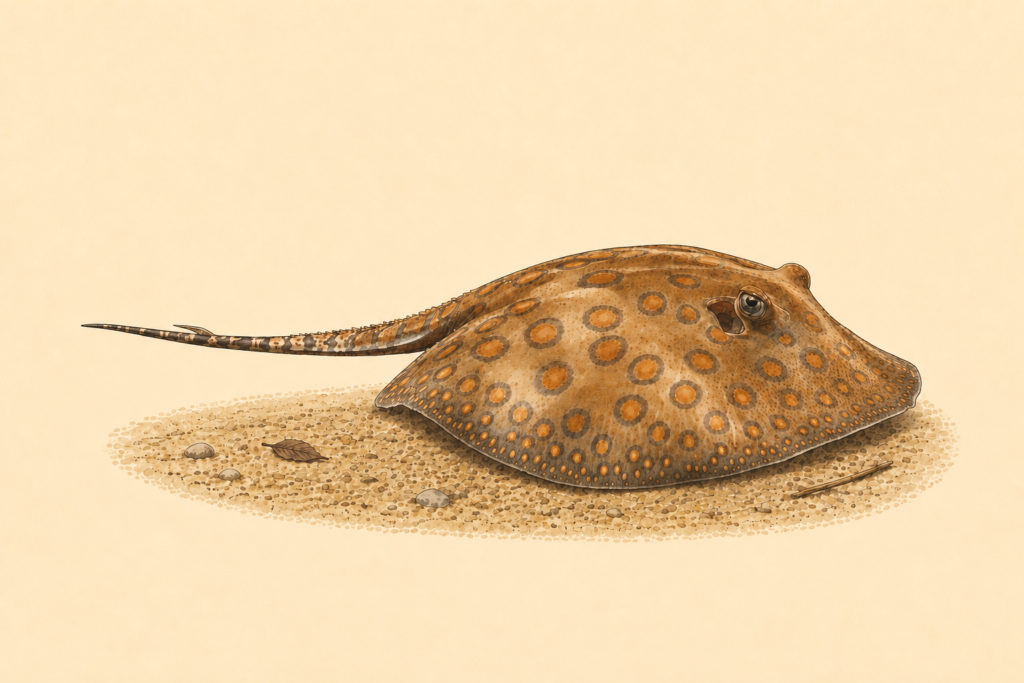
The Motoro Stingray has a broadly circular, dorsoventrally flattened disc that is typical of all freshwater stingrays. The dorsal (upper) surface is usually a warm brown, olive-brown, or dark tan base colour, overlaid with numerous bright orange or yellow-gold ocelli – round, eye-like spots each surrounded by a darker ring. The pattern is highly variable between individuals and can change subtly in intensity depending on the substrate colour, mood, and health of the animal. The ventral (underside) surface is creamy white and must remain in contact with the substrate for the ray to rest comfortably.
The eyes sit prominently on top of the disc, with spiracles (modified gill openings used for breathing while resting on the bottom) located just behind them. The mouth is on the underside, equipped with strong, flat crushing plates adapted for dealing with hard-shelled prey. The tail is whip-like and extends behind the disc, bearing one or occasionally two serrated venomous barbs roughly a third of the way along its length. These barbs are periodically shed and regrown, and a keeper should never assume the barb is absent simply because they cannot see it clearly.
Juveniles are sold at disc widths of around 10 to 15 cm but grow steadily. Females tend to be larger than males at maturity. Males can be identified by the presence of claspers – modified pelvic fins used in mating – which become visible as the animal matures.
Natural Habitat
Potamotrygon motoro is one of the most widely distributed freshwater stingray species, found across an enormous range that spans multiple major river systems in South America. It inhabits the Amazon basin, the Orinoco basin, and the Parana-Paraguay system, occurring in countries including Brazil, Colombia, Peru, Bolivia, Paraguay, Argentina, and Uruguay. This wide distribution means there is considerable variation in the habitats it occupies, from blackwater tributaries with extremely soft, acidic water to larger, more sediment-laden river channels.
In the wild, Motoro Stingrays are primarily found over sandy or muddy substrates in slow-moving or still waters. They favour the margins of rivers, oxbow lakes, floodplain lagoons, and sheltered bays where the current is gentle. During the wet season, they may move into seasonally flooded forest areas to forage. They are benthic animals, spending the majority of their time resting on or partially buried in soft substrate, using their excellent camouflage to ambush prey and avoid predators.
The water in their natural habitats is typically warm (26 to 30 C), soft (very low mineral content), and slightly acidic to neutral. Dissolved organic compounds from leaf litter and decaying vegetation often tint the water brown, creating the classic blackwater or tannin-stained conditions that many keepers try to replicate. Understanding these conditions is fundamental to keeping Motoro Stingrays healthy in captivity, as they are far less tolerant of hard, alkaline, or polluted water than most commonly kept tropical fish.
Tank Size and Setup
The single greatest challenge of keeping a Motoro Stingray is providing adequate space. This is a large, active, bottom-dwelling animal that needs a substantial footprint to move, forage, and turn comfortably. The minimum tank size for a single juvenile is approximately 1,500 litres, but an adult Motoro with a disc diameter approaching 50 cm will require a tank of 2,000 litres or more. Floor space is far more important than height for stingrays. A tank that is 200 cm long by 80 cm wide by 50 cm tall is more useful than a tall, narrow aquarium of the same volume. Many dedicated stingray keepers use custom-built tanks, fibreglass ponds, or repurposed stock tanks to achieve the necessary dimensions.
Substrate is critically important. Only fine, smooth, rounded sand should be used. Coarse gravel, sharp-edged sand, crushed coral, or bare glass bottoms are all unsuitable. Rough substrates will abrade and damage the ray’s delicate ventral skin, leading to bacterial infections, ulcers, and potentially fatal septicaemia. Play sand, pool filter sand, or purpose-sold aquarium sand with a fine, soft grain are all acceptable choices. The sand bed should be around 2 to 5 cm deep – deep enough for the ray to partially bury itself, but shallow enough to siphon effectively during maintenance.
Decoration should be minimal and carefully considered. Motoro Stingrays are powerful animals and will rearrange anything that is not firmly fixed. Rocks, if used, must be large, smooth, and securely placed directly on the base glass (not on the sand, where a burrowing ray could undermine them and cause a collapse). Driftwood can be used sparingly, but avoid pieces with sharp points or narrow crevices where the ray could become trapped. Plants are generally impractical in a stingray tank, as the ray’s constant movement and burrowing will uproot them. Floating plants or plants attached to heavy driftwood above the substrate are the only viable options.
Lighting should be subdued. Stingrays are naturally active at dawn, dusk, and during the night, and they can become stressed under intense, unrelenting light. A dimmer, timed lighting system with a gradual ramp-up and ramp-down period will help replicate a natural photoperiod. Tannin-stained water (achieved by adding Indian almond leaves, dried oak leaves, or a blackwater extract) also helps diffuse light and can improve the ray’s comfort and colouration.
Ensure that all heaters, filter intakes, and electrical cables are fully guarded or placed outside the tank. A stingray resting against an unguarded heater can suffer severe burns, and powerful filter intakes can trap the ray’s disc or tail. Inline heaters and external equipment are strongly recommended.
Water Parameters
| Temperature | 26 – 30 C |
| pH | 6.0 – 7.0 |
| General hardness (GH) | 1 – 8 dGH |
| Carbonate hardness (KH) | 1 – 5 dKH |
| Ammonia | 0 ppm |
| Nitrite | 0 ppm |
| Nitrate | Below 20 ppm |
Motoro Stingrays are extraordinarily sensitive to water quality. Any detectable ammonia or nitrite can be rapidly fatal. These rays produce a large biological load relative to most freshwater fish, and their sensitivity to nitrogenous waste compounds makes robust biological filtration and frequent water changes non-negotiable. Nitrate should be kept as low as possible – ideally below 10 ppm and never allowed to exceed 20 ppm. Chronic exposure to elevated nitrate levels leads to loss of appetite, lethargy, disc curling, and ultimately organ damage.
Temperature stability is critical. Motoros come from consistently warm waters and do not tolerate sudden drops or fluctuations. A reliable heater (ideally two, for redundancy) and a thermometer that is checked daily are essential. The pH should remain in the slightly acidic to neutral range. Hard, alkaline water is poorly tolerated and can lead to osmoregulatory stress. If your tap water is hard and alkaline, you will need to use reverse osmosis (RO) water, remineralised to a suitable softness, for water changes.
Water changes should be large and frequent. Many experienced stingray keepers perform 30 to 50 per cent water changes twice per week on heavily stocked systems, and at minimum once per week on lightly stocked tanks. Fresh replacement water must be temperature-matched, dechlorinated, and of a similar pH and hardness to the tank water. Sudden shifts in any parameter during a water change can cause acute stress or shock.
Filtration and Equipment
Filtration for a Motoro Stingray tank must be massively over-specified compared to a typical tropical community aquarium. The goal is twofold: provide excellent biological filtration capacity to handle the ray’s considerable waste output, and maintain high water turnover to prevent dead spots and keep dissolved waste moving towards the filter media. A target turnover rate of eight to ten times the tank volume per hour is a reasonable starting point.
Large external canister filters, sump systems, or custom-built wet/dry trickle filters are the most popular choices. Sump-based systems are particularly well suited to stingray keeping because they allow all equipment – heaters, probes, UV sterilisers, and media reactors – to be housed outside the display tank, reducing the risk of the ray interacting with (and being harmed by) electrical equipment. Sumps also increase total water volume, which adds stability.
UV sterilisation is a worthwhile addition. It helps control free-floating pathogens and can reduce the incidence of opportunistic bacterial infections, to which stingrays are prone. An appropriately sized UV unit plumbed into the return line from the sump or canister is ideal.
Aeration should be gentle but sufficient. Stingrays breathe via spiracles as well as their gills, and they are tolerant of moderate oxygen levels, but a well-oxygenated tank is always healthier. Avoid powerful airstones or wavemakers that create excessive surface agitation or currents directly over the sand bed, as this can stress a resting ray. Position flow outlets so that there are calm areas for the ray to rest and areas with gentle current for enrichment.
Invest in a quality water testing kit (liquid reagent kits are far more reliable than test strips) and test ammonia, nitrite, nitrate, pH, and temperature at least weekly. For a species this sensitive, knowing your water parameters is not optional – it is the foundation of responsible care.
Diet and Feeding
Motoro Stingrays are carnivorous predators with hearty appetites. In the wild, their diet consists primarily of aquatic invertebrates – insect larvae, crustaceans, snails, and small bivalves – supplemented by small fish and worms. In captivity, a varied, high-quality diet is essential for long-term health, strong growth, and vibrant colouration.
The staple diet for most captive Motoros is built around high-quality frozen foods: bloodworm, mysis shrimp, krill, prawn (shell-on pieces are excellent for dental health), mussel, cockle, and squid. Earthworms (nightcrawlers) are a superb and nutritious live food that most stingrays accept eagerly. Whitebait or other small whole fish can be offered occasionally, but oily fish such as mackerel should be used sparingly as they can foul the water quickly.
Live foods such as river shrimp, blackworms, and earthworms are excellent for enrichment and can help settle newly imported or nervous individuals that refuse frozen offerings. Feeder fish are best avoided due to the risk of parasite and disease transmission, and because they offer poor nutritional value relative to other options.
Juvenile stingrays should be fed two to three times daily in small portions. As the ray grows, feeding frequency can be reduced to once daily or every other day for adults, with the total quantity adjusted to maintain a healthy body condition. Overfeeding is a common mistake – it pollutes the water and can lead to fatty liver disease. A well-fed Motoro should have a smoothly rounded disc without protruding pelvic bones (a sign of emaciation) but should not appear bloated or excessively thick.
Some keepers supplement with vitamin and mineral preparations designed for carnivorous fish or reptiles, applied to food items before feeding. This can be beneficial, particularly for growing juveniles, but is not a substitute for dietary variety.
Behaviour and Temperament
Motoro Stingrays are intelligent, inquisitive animals that quickly learn to recognise their keeper and associate them with food. Many individuals will swim to the front of the tank when they see their owner approach, and some will accept food directly from the hand (though this practice is inherently risky given the venomous barb, and hand-feeding is generally not recommended). Their responsiveness and apparent personality are a large part of their appeal.
They are primarily crepuscular and nocturnal, being most active during the dimmer hours. During the day, they often rest on the sand, sometimes partially buried with only their eyes and spiracles visible. As they settle into captivity and become accustomed to the routine, many Motoros become more active during daylight hours, particularly around feeding time.
Motoros are generally not aggressive towards tank mates of appropriate size, but they are powerful predators. Any fish or invertebrate small enough to fit in the ray’s mouth will eventually be eaten. Males can become aggressive towards one another, particularly in confined spaces, and may inflict injuries with their barbs. If keeping multiple stingrays, the tank must be very large, and the keeper must be prepared to separate individuals if aggression occurs.
Stress behaviours to watch for include repeated disc curling (where the edges of the disc fold upwards), refusal to eat, rapid breathing, erratic swimming or “glass surfing” along the tank walls, and darkening or fading of colouration. Any of these signs should prompt an immediate check of water parameters and environmental conditions.
A reminder on safety: always know where the ray is before placing your hands or arms in the tank. Use long-handled tongs for feeding and long siphons for substrate cleaning. The tail barb is a defensive weapon – the ray will use it if it feels trapped, startled, or threatened. Stings are excruciatingly painful and can cause serious medical complications.
Tank Mates
Selecting tank mates for a Motoro Stingray requires careful consideration. Any companion species must be too large to be eaten, peaceful enough not to harass the ray, and tolerant of the same warm, soft, slightly acidic water conditions. Bottom-dwelling fish that compete directly for the same resting space on the substrate are best avoided, as they may be crushed or stung. Very aggressive or territorial cichlids, nippy species, and anything small enough to become prey are all unsuitable. The safest approach is often to keep the Motoro as the centrepiece of a species-only setup, but a number of robust, mid-to-upper-water fish can coexist successfully.
Good tank mates
- Silver Arowana – A large, surface-dwelling predator that occupies a completely different water column and thrives in similar soft, warm conditions.
- Common Pleco – A robust, armoured catfish that is generally too large and well-protected to be bothered by the ray, though very large plecos can occasionally irritate rays by trying to attach to their disc.
- Bichir (Polypterus spp.) – Hardy, armoured bottom-dwellers that coexist well with stingrays provided the tank is large enough for both to have resting space.
- Severum Cichlid – A relatively peaceful, deep-bodied cichlid that reaches a good size and tolerates soft, warm water well.
- Geophagus spp. – Eartheater cichlids are generally peaceful and suited to the same warm, soft water, though they should be monitored for competition over the sand bed.
- Silver Dollar – A large, peaceful, schooling characin that stays in the mid-water and poses no threat to, or from, the ray.
- Flagtail Prochilodus – A sizable, active mid-water fish from the same South American river systems, tolerant of the same water chemistry.
Fish to avoid
- Oscar – While sometimes kept with rays, Oscars can be territorial and aggressive, and may harass or bite the ray’s disc, leading to injury and stress.
- Red-bellied Piranha – A notorious fin and flesh nipper that can inflict serious damage to a stingray’s disc, especially in groups.
- Neon Tetra – Far too small; will be eaten immediately.
- Corydoras Catfish – Small bottom-dwellers that will be crushed or consumed; also possess sharp pectoral spines that could injure the ray internally if swallowed.
- African Cichlids (Rift Lake species) – Require hard, alkaline water that is fundamentally incompatible with the Motoro’s needs; many species are also highly territorial.
- Freshwater Crayfish – Their pincers can injure the ray’s soft ventral skin, and they will also be eaten once the ray is large enough.
- Tiger Barb – A nippy, small fish that may harass the ray and will ultimately become prey.
Breeding
Breeding Motoro Stingrays in captivity is achievable but challenging, and it requires a very large tank, a mature and compatible pair, and excellent water quality. Sexual maturity is typically reached at around two to three years of age, though this varies with growth rate and conditions. Males can be distinguished from females by the presence of claspers – elongated, finger-like extensions of the pelvic fins used to transfer sperm during mating.
Mating behaviour involves the male pursuing and biting the edges of the female’s disc to gain a grip for copulation. This can appear quite rough, and the female may sustain minor bite marks. If the female is not receptive or is significantly smaller than the male, she can be seriously stressed or injured, so pairing should be done cautiously. Providing ample space and visual barriers (such as large pieces of driftwood) allows the female to retreat if needed.
Potamotrygon motoro is an ovoviviparous species. After internal fertilisation, the embryos develop inside the female’s uterus, nourished initially by a yolk sac and later by a nutrient-rich uterine secretion called histotroph, sometimes described as “uterine milk.” The gestation period is approximately three to four months, though this can vary with temperature and the female’s condition.
Litter sizes are typically small, ranging from one to eight pups, with three to five being common. Newborn pups are miniature replicas of the adults, usually around 8 to 12 cm in disc diameter, and are fully independent from birth. They should be separated from the adults and raised in a dedicated nursery tank with impeccable water quality, fine sand substrate, and frequent small feedings of live and frozen foods such as bloodworm, chopped earthworm, and brine shrimp.
Breeding stingrays is a significant undertaking. The keeper must have a plan for rehoming the pups, as they grow quickly and each one will eventually require a very large tank. Irresponsible breeding without a clear plan for the offspring is a serious welfare concern.
Common Diseases
Motoro Stingrays are generally hardy animals when kept in optimal conditions, but their sensitivity to poor water quality means that disease outbreaks are often a direct consequence of inadequate husbandry. Prevention through meticulous water management is far more effective than treatment, as stingrays are scaleless and extremely sensitive to many common aquarium medications.
Do not use copper-based medications, potassium permanganate, or full-dose formalin in a tank containing stingrays. These substances are highly toxic, often fatally so, to elasmobranchs. Always consult a veterinarian experienced with elasmobranchs or a specialist stingray community before treating any illness.
Bacterial infections are the most common health issue. These often manifest as reddening, ulceration, or cloudy patches on the ventral skin, and are frequently caused by abrasion from rough substrates, poor water quality, or stress. Mild cases may respond to improved water conditions alone. More severe infections may require antibiotics administered under veterinary guidance.
Parasitic infections, including internal parasites such as nematodes and tapeworms, are common in wild-caught specimens. A veterinary faecal examination shortly after acquisition is advisable. Protozoan parasites can also affect the skin and gills, causing increased mucus production, scratching against surfaces, and respiratory distress.
“Death curl” is a term used in the stingray hobby to describe a condition where the edges of the disc curl permanently upwards. This is not a disease in itself but a symptom of severe systemic distress, often caused by ammonia or nitrite poisoning, extreme pH swings, or advanced organ failure. By the time death curl is observed, the prognosis is usually poor, and emergency water changes and parameter stabilisation are the only recourse.
Fungal infections can occur on damaged skin or in tanks with chronically poor water quality. They appear as white, cotton-like growths. Treatment should focus on correcting the underlying water quality issue and, if necessary, using a stingray-safe antifungal under veterinary supervision.
FAQs
How big does a Motoro Stingray get?
A fully grown Motoro Stingray can reach a disc diameter of around 50 cm, with a total length (including the tail) of up to 100 cm. Females are generally larger than males. Growth rate depends on diet, water quality, tank size, and genetics, but even in modest conditions, these rays grow substantially within their first couple of years. Prospective keepers must plan for the adult size from the outset, not just the size of the juvenile they are purchasing.
Is the Motoro Stingray venomous?
Yes. The Motoro Stingray has a serrated, venomous barb located on the upper surface of its tail. The venom can cause intense pain, significant tissue damage, and secondary bacterial infection. Stings to the extremities are the most common, but a sting to the chest or abdomen can be life-threatening. The barb is purely defensive – the ray will not actively “attack” – but accidental stings during tank maintenance are a real risk. Always use caution, know the ray’s position, and use long-handled tools when working in the tank.
Can I keep a Motoro Stingray in a standard aquarium?
No. Standard aquariums sold for tropical community fish are far too small for a Motoro Stingray. Even a juvenile requires a tank of at least 1,500 litres with a large footprint, and an adult needs 2,000 litres or more. Custom-built tanks, large fibreglass ponds, or dedicated indoor pond systems are the most practical housing options for this species. A tank that is too small will result in chronic stress, stunted growth, poor health, and a significantly shortened lifespan.
What should I do if I get stung by my stingray?
If stung, immediately immerse the wound in hot water (as hot as you can comfortably tolerate, around 45 C) for 30 to 90 minutes. The venom is protein-based and is denatured by heat, which can significantly reduce the pain. Clean the wound thoroughly, remove any visible barb fragments if possible, and seek medical attention promptly. Inform medical staff that the injury is from a freshwater stingray. Antibiotics may be prescribed to prevent secondary infection, and a tetanus booster may be recommended if yours is not up to date.
How often should I change the water in a Motoro Stingray tank?
Large, frequent water changes are essential. Most experienced stingray keepers recommend changing 30 to 50 per cent of the water at least once per week, and twice per week in heavily stocked systems. The replacement water must be dechlorinated, temperature-matched, and of similar pH and hardness to the existing tank water. Consistency is key – stingrays are far more sensitive to sudden parameter shifts than most tropical fish, and a poorly executed water change can be more harmful than a skipped one.
Related Guides
- Black Diamond Stingray (Potamotrygon leopoldi) – Another popular Potamotrygon species with similar care requirements but a distinctive black-and-white colour pattern.
- Silver Arowana – A common large-tank companion for Motoro Stingrays, with overlapping water parameter needs and a complementary use of space.
- Bichir (Polypterus spp.) – Hardy, prehistoric-looking bottom-dwellers that are frequently kept alongside freshwater stingrays in large setups.
- Geophagus Eartheater Cichlids – Peaceful South American cichlids that share the Motoro’s preference for warm, soft, sandy-bottomed environments.
- Freshwater Stingray General Care – A broader overview of Potamotrygonidae husbandry for keepers considering different species or wanting foundational knowledge before specialising.