Quick summary
Tiger Barbs are a hardy, easy-to-keep choice for beginners, but they must be kept in groups of six or more in at least a 75 litre tank to curb their fin-nipping tendencies. They pair best with fast, robust tank mates and are not suitable for peaceful, slow-moving, or long-finned fish like bettas, guppies, or angelfish.
🐠 Build a tank around this species
In this guide:
- Introduction
- Quick Stats
- Appearance
- Varieties and Morphs
- Natural Habitat
- Tank Size and Setup
- Water Parameters
- Filtration and Equipment
- Diet and Feeding
- Behaviour and Temperament
- Tank Mates
- Breeding
- Common Diseases
- FAQs
Introduction
The Tiger Barb is one of the most recognisable and enduringly popular freshwater aquarium fish in the hobby. With its bold black-and-gold striping, energetic schooling behaviour, and relatively straightforward care requirements, it has been a staple of community tanks since it first entered the ornamental trade in the 1930s. Originally described by Pieter Bleeker in 1855 under various synonyms, the species is now classified as Puntigrus tetrazona, having been moved from the broader Barbus and Puntius genera following taxonomic revisions.
Native to the islands of Sumatra and Borneo in Southeast Asia, the Tiger Barb thrives in warm, moderately acidic waters with gentle to moderate flow. In the aquarium it is a vigorous, fast-swimming fish that does best in groups of at least six, where its natural hierarchical behaviour can play out without causing undue stress to tank mates. This social dynamic is central to understanding the species: kept in insufficient numbers, Tiger Barbs can become notorious fin-nippers, but in a well-managed group they tend to direct their boisterous energy toward one another rather than at other inhabitants.
This guide covers everything you need to know to keep Tiger Barbs successfully, from tank dimensions and water chemistry to breeding, disease prevention, and compatible tank mates. Whether you are setting up your first tropical community tank or looking to add a dash of colour and movement to an established aquarium, the Tiger Barb is an excellent choice provided you respect its need for space, company, and a well-structured environment.
Quick Stats
| Scientific name | Puntigrus tetrazona |
|---|---|
| Common names | Sumatra Barb, Partbelt Barb |
| Family | Cyprinidae |
| Origin | Sumatra and Borneo, Indonesia |
| Adult size | 6 cm |
| Lifespan | 5–7 years |
| Difficulty | Easy |
| Breeding difficulty | Moderate |
| Temperature | 24–28 °C |
| pH | 6–7.5 |
| GH | 2–10 dGH |
| KH | 1–8 dKH |
| Minimum tank size | 75 L |
| Conservation status | Least Concern (IUCN, assessed 2020) |
Appearance
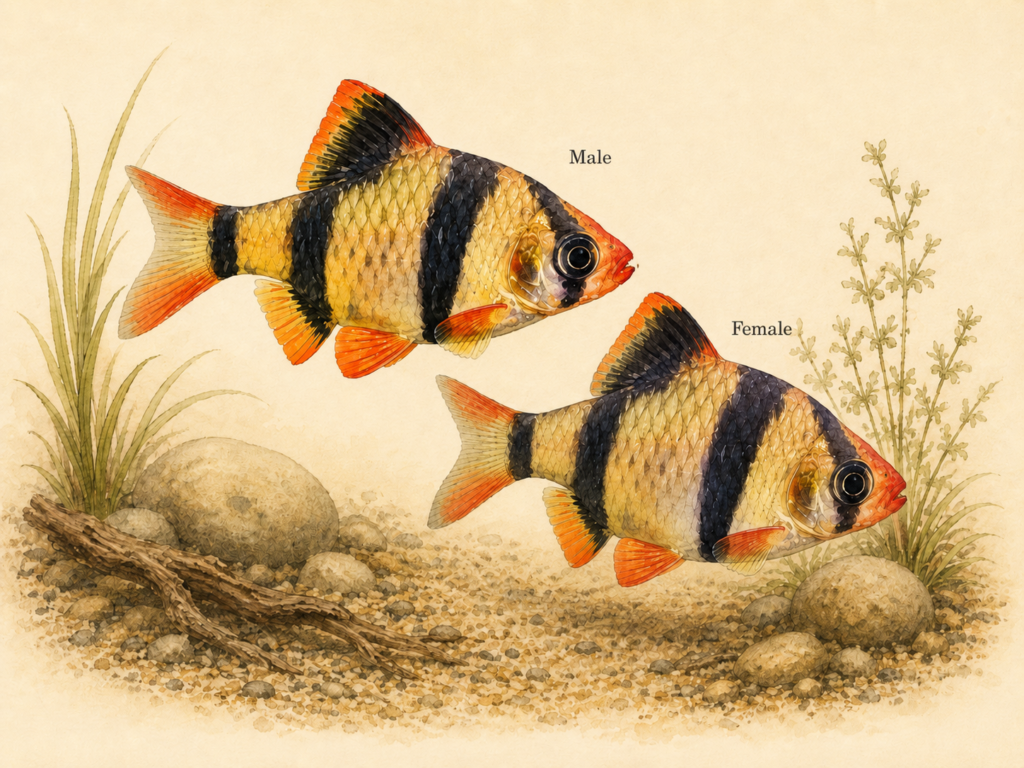
The Tiger Barb’s common name tells you almost everything you need to know about its appearance. The body is deep and laterally compressed, with a rounded profile that tapers to a forked caudal fin. Across a base colour that ranges from golden-yellow to warm orange, four prominent vertical black bands run from dorsal to ventral. The first band passes through the eye, the second sits just behind the pectoral fins, the third falls roughly at the midpoint of the body, and the fourth marks the base of the caudal peduncle. In healthy, well-conditioned specimens these bars are crisp and dark, contrasting sharply with the lighter ground colour.
The fins add further visual interest. The dorsal fin is edged in black and tipped with red or orange, while the pelvic and anal fins often show vivid red or orange hues, particularly in males. The snout and lips of dominant males may also develop a reddish flush. Overall body colouration intensifies during courtship and hierarchical displays, making a well-kept group a genuinely dynamic spectacle.
Sexual dimorphism is subtle but discernible once you know what to look for. Males tend to be slightly smaller and slimmer than females, with more intense colouration, especially in the fins and face. Females are rounder-bodied, particularly when gravid, and often show slightly less saturated colour. During spawning condition the difference in girth becomes quite obvious, as the female’s abdomen fills noticeably with eggs.
Varieties and Morphs
Decades of selective captive breeding have produced a range of colour morphs that sit alongside the wild-type Tiger Barb in the trade. These variants are the same species and require identical care, but they differ significantly in appearance and are frequently sold under distinct trade names.
The Green Tiger Barb, sometimes marketed as the Moss Green Barb, is one of the most widely available morphs. Its base colour shifts from gold to a deep, iridescent green or dark teal, with the black banding still visible but less contrasting against the darker body. Under good lighting the green sheen is striking, and this morph looks particularly effective when kept alongside wild-type fish. The Albino Tiger Barb lacks melanin, resulting in a pale cream to light yellow body with faint bands that appear whitish or very pale gold. The eyes are pinkish-red, as is typical of true albinos, and the fins often show a warm orange-red wash. Though less bold in colour than the wild type, albino specimens add variety to a mixed barb school.
The Gold Tiger Barb is a xanthic morph in which the dark banding is greatly reduced or absent, leaving a bright golden-yellow to orange body. It is sometimes confused with the albino form, but can be distinguished by its darker eyes and generally richer colour. Another increasingly popular variant is the GloFish Tiger Barb, a genetically modified line available in several fluorescent colours including electric green, starfire red, sunburst orange, galactic purple, and cosmic blue. These fish carry fluorescent protein genes originally derived from jellyfish or coral and glow vividly under blue or ultraviolet lighting. It should be noted that GloFish Tiger Barbs are legal to sell in some countries but prohibited in others, including much of the European Union and Australia, so availability varies by region.
Less commonly seen in the trade but still noteworthy is the Platinum Tiger Barb, a selectively bred morph with a silvery-white body and very faint or absent banding that gives the fish an almost ethereal look. All of these morphs can be freely mixed in the same group, and doing so creates a visually diverse school that retains the lively social behaviour the species is known for.
Natural Habitat
In the wild, Tiger Barbs are found primarily on the Indonesian islands of Sumatra and Borneo, where they inhabit clear to slightly turbid forest streams and tributaries. These waterways are typically shaded by dense riparian vegetation, with substrates composed of sand, gravel, and fallen leaf litter. The water is warm, soft, and mildly acidic, influenced by the decomposition of organic matter on the stream bed. Flow rates range from gentle to moderate, and the fish are most commonly encountered in areas where submerged roots, rocks, and aquatic plants provide both shelter and foraging opportunities.
The species has also been introduced, sometimes deliberately and sometimes as escapees from aquaculture, to waterways in Singapore, Australia, Suriname, Colombia, and parts of the United States. In several of these locations it has established self-sustaining feral populations, a testament to its adaptability. However, its native range centres on those Indonesian islands, and conditions there should serve as the primary reference point for aquarium husbandry.
Understanding the natural habitat helps explain several aspects of Tiger Barb behaviour in captivity. The preference for swimming in midwater, the responsiveness to current, and the attraction to shaded areas with dense planting all mirror the conditions the species has evolved to exploit. Replicating these elements in the aquarium goes a long way toward encouraging natural behaviour and reducing stress.
Tank Size and Setup
A minimum tank volume of 75 litres is recommended for a group of six Tiger Barbs, but a larger aquarium of 120 litres or more is preferable, especially if you plan to keep a larger group or house them alongside other species. Tiger Barbs are active, fast-swimming fish that use horizontal space extensively, so a tank with a footprint of at least 80 cm in length is ideal. Tall, narrow aquariums are less suitable because they limit the swimming area these fish need.
Aquascaping should strike a balance between open swimming space and areas of cover. A substrate of fine gravel or sand works well and mimics the natural stream bed. Planting the sides and back of the tank with hardy species such as Vallisneria, Java Fern, Anubias, and Cryptocoryne provides visual barriers and refuge without encroaching too heavily on the central swimming zone. Driftwood and smooth river stones make excellent hardscape elements and contribute to a naturalistic appearance. If you wish to replicate the leaf-litter habitat more closely, a scattering of dried Indian almond leaves or oak leaves on the substrate will release beneficial tannins that soften and slightly acidify the water, though this is an optional refinement rather than a necessity.
Tiger Barbs are not known for jumping with the same frequency as some other barb species, but a well-fitting lid is still advisable, particularly in tanks with strong lighting or during breeding activity when chasing intensifies. Background colouration on the rear glass, whether a dark film or simply the shadow of dense planting, helps the fish feel secure and brings out their colours more effectively than a brightly lit, bare-walled setup.
Water Parameters
Tiger Barbs are fairly tolerant of a range of water conditions, which is one reason they are considered beginner-friendly. That said, maintaining stable parameters within the species’ preferred range will always yield better colour, stronger immune function, and more natural behaviour than pushing the boundaries of what the fish can merely survive in.
| Temperature | 24–28 °C |
| pH | 6.0–7.5 |
| General hardness (GH) | 2–10 dGH |
| Carbonate hardness (KH) | 1–8 dKH |
| Ammonia | 0 ppm |
| Nitrite | 0 ppm |
| Nitrate | Below 20 ppm |
Consistency matters more than hitting an exact number. Sudden swings in temperature or pH are far more harmful than a reading that sits slightly outside the textbook ideal. When performing water changes, match the new water’s temperature and chemistry to the tank water as closely as possible. Weekly water changes of 25–30% are a good baseline for most setups, though the exact frequency and volume will depend on stocking density, filtration capacity, and feeding regime. Test your water regularly, especially in the first few months after setup, and adjust your maintenance schedule based on what the results tell you.
Filtration and Equipment
An efficient filter rated for at least the full volume of the tank is essential. Tiger Barbs produce a moderate bioload relative to their size, and in the groups recommended for this species the cumulative waste output can climb quickly. A hang-on-back filter or an internal power filter will work for smaller setups, but for tanks of 120 litres and above an external canister filter is generally the better choice, offering greater media capacity and quieter operation. Whichever type you use, ensure it provides adequate mechanical, biological, and chemical filtration stages.
Tiger Barbs appreciate a gentle to moderate current, which replicates the flowing streams they inhabit in the wild. Positioning the filter outlet to create a directional flow across the length of the tank encourages natural swimming behaviour and helps keep detritus moving toward the filter intake. Avoid excessively powerful flow that creates a washing-machine effect, as even these energetic swimmers will become stressed if they cannot find calmer zones to rest in.
A reliable heater with a thermostat is necessary to maintain the tropical temperatures this species requires. Choose a heater rated appropriately for your tank volume, as a rough guide, allow around 1 watt per litre, and position it near the filter outlet to promote even heat distribution. A separate thermometer, whether digital or glass, provides an independent check on the heater’s accuracy and is well worth the small investment.
Standard aquarium lighting on a timer set to provide 8–10 hours of light per day suits Tiger Barbs well and supports live plant growth if you have opted for a planted setup. The fish do not have specific lighting demands, but they show their best colours under moderate illumination with some shaded areas provided by floating or tall plants.
Diet and Feeding
Tiger Barbs are true omnivores with hearty appetites and very little pickiness. In the wild they feed on a mixture of small invertebrates, insect larvae, algae, plant matter, and organic detritus. In the aquarium this translates to an easy feeding regime built around a high-quality staple flake or micro-pellet food supplemented with regular offerings of live or frozen foods.
A good tropical community flake or granule should form the backbone of the diet. Choose a product with whole fish or insect meal as the primary ingredient rather than cereal fillers. Two to three times a week, supplement the staple with frozen or live foods such as bloodworm, daphnia, brine shrimp, or mosquito larvae. These protein-rich foods help maintain strong colouration and condition the fish for breeding. Blanched vegetables like courgette medallions, shelled peas, and spinach leaves offer useful plant-based nutrition and variety, and most Tiger Barbs will learn to accept them readily.
Feed two to three small meals per day rather than one large one. Each feeding should provide only as much food as the group can consume within two to three minutes. Overfeeding is the single most common husbandry mistake with this species and leads to water-quality problems far more quickly than underfeeding ever will. If you notice uneaten food sinking to the substrate, reduce the portion size at the next meal. A weekly fasting day, while not strictly necessary, can be beneficial for digestive health and helps prevent obesity, which is a genuine concern in well-fed barbs.
Behaviour and Temperament
Tiger Barbs are lively, curious, and highly social fish that spend much of their time in constant motion. They swim predominantly in the mid-water column, though they will readily explore all levels of the tank when feeding or investigating their surroundings. Their activity level is one of their greatest appeals, a group of Tiger Barbs brings genuine energy and dynamism to any aquarium.
Within the group, Tiger Barbs establish a loose but discernible hierarchy through frequent chasing, sparring, and fin-flaring displays. These interactions are normal and largely harmless, though they can look alarming to the uninitiated observer. Dominant males in particular will chase and nudge subordinates, and some minor fin damage may occur during especially vigorous bouts. Providing sufficient group size is the single most important factor in managing this behaviour. In groups of six or more, aggression is spread across multiple individuals and no single fish bears the brunt of constant harassment. Groups of eight to twelve are even better, and in a sufficiently large tank you can keep fifteen or more with excellent results.
The species’ reputation as a fin-nipper is well earned but also frequently overstated. Tiger Barbs are most likely to nip at slow-moving, long-finned tank mates when kept in insufficient numbers, when the tank is too small, or when they are bored and under-stimulated. In a properly sized group with adequate space and compatible companions, fin-nipping behaviour is greatly reduced, though it may never be eliminated entirely. Understanding this tendency is essential when selecting tank mates, a topic addressed in detail below.
Tank Mates
Choosing appropriate companions for Tiger Barbs requires an understanding of their boisterous nature. The ideal tank mate is a robust, similarly active fish that does not possess long, trailing fins and can hold its own without becoming either a target or an aggressor. Mid-water and bottom-dwelling species tend to work better than slow-moving surface dwellers, and fish of roughly similar size are generally preferable. Avoid pairing Tiger Barbs with anything shy, sedentary, or elaborately finned, as these qualities make a fish far more likely to be harassed.
Good tank mates
- Cherry Barb, a peaceful barb species that is fast enough to avoid occasional chasing and adds a lovely splash of red to the midwater zone.
- Rosy Barb, a robust, similarly sized barb that matches the Tiger Barb’s energy levels and thrives in the same water conditions.
- Corydoras Catfish, Bottom-dwelling and armoured, Corydoras occupy a different zone of the tank and are almost never bothered by barbs.
- Bristlenose Pleco, a hardy algae-eating catfish that stays near the substrate and is far too well-armoured to attract unwanted attention.
- Zebra Danio, an extremely fast and active schooling fish that can easily outpace any Tiger Barb and enjoys similar water parameters.
- Clown Loach, a bold, sociable bottom-dweller that grows large enough to ignore barb pestering entirely, though it requires a spacious tank.
- Rainbow Shark, a semi-aggressive bottom-dweller that establishes its own territory and is robust enough to coexist with Tiger Barbs in a suitably large aquarium.
- Black Skirt Tetra, a deep-bodied tetra with short fins that swims actively and is too quick and assertive to be bullied.
- Swordtail, an active livebearing fish with a sturdy build and enough speed to hold its own alongside boisterous barbs.
- Platy, a hardy, short-finned livebearer that occupies similar water parameters and is generally too robust to be targeted.
Fish to avoid
- Betta, Long, flowing fins and a slow swimming style make bettas irresistible targets for Tiger Barb nipping.
- Angelfish, Trailing pelvic fins and a relatively sedate manner make angelfish highly vulnerable to persistent harassment.
- Guppy, the elaborate tail fins of male guppies are a magnet for fin-nippers, and guppies lack the speed to escape.
- Pearl Gourami, Gentle, slow-moving, and equipped with long ventral filaments that Tiger Barbs will almost certainly target.
- Dwarf Gourami, too timid and slow to cope with the constant activity and occasional aggression of a barb group.
- Discus, Shy, slow, and extremely sensitive to stress, Discus are wholly incompatible with the frenetic energy of Tiger Barbs.
- Flowerhorn, a large, territorial, and highly aggressive cichlid that would pose a serious physical threat to small barbs.
- Endler’s Livebearer, very small and relatively slow, Endlers are likely to be chased relentlessly and may suffer serious stress or fin damage.
Breeding
Tiger Barbs are egg-scattering spawners that can be bred in captivity without too much difficulty, provided you set up the conditions correctly and separate the adults from the eggs promptly. In a community tank, spawning may occur spontaneously, but the eggs and fry will almost certainly be eaten by the adults or other inhabitants. Dedicated breeding setups yield far better results.
Begin by conditioning a selected pair or small group with frequent feedings of high-protein live and frozen foods for one to two weeks. This encourages egg development in females and intensifies male colouration and courtship behaviour. Meanwhile, prepare a separate breeding tank of around 40–60 litres. The water should be soft (4–6 dGH), slightly acidic (pH 6.0–6.5), and warmed to 26–28 °C. Furnish the bottom with a layer of glass marbles or a mesh grid raised slightly above the substrate; these allow the scattered eggs to fall through to safety, out of reach of the hungry parents.
Introduce the conditioned pair to the breeding tank in the evening. Spawning typically occurs the following morning and is preceded by vigorous chasing as the male drives the female around the tank. The female releases small batches of adhesive eggs among the marbles or mesh, and the male fertilises them immediately. A single spawning can produce between 200 and 700 eggs. Once spawning activity ceases, remove the adults without delay, as they will consume any eggs they can reach.
The eggs hatch within 36 to 48 hours at the recommended temperature, and the fry become free-swimming roughly five days after hatching. Initially they will feed on their yolk sacs, after which they require very fine foods such as infusoria, liquid fry food, or powdered spirulina. After a week or so the fry are large enough to accept newly hatched brine shrimp nauplii, which should form the basis of their diet until they are big enough for crushed flake food. Growth is moderately fast, and young Tiger Barbs begin to show their characteristic banding at around four to six weeks of age. They typically reach sexual maturity at six to eight weeks, though it is advisable to wait until they are at least three months old before using them for breeding.
Common Diseases
Tiger Barbs are generally hardy fish, but they are susceptible to the same diseases that affect most tropical freshwater species. The overwhelming majority of health problems in captive Tiger Barbs can be traced back to poor water quality, stress from inadequate group size or incompatible tank mates, or the introduction of pathogens from un-quarantined new arrivals.
Ich, or white spot disease, caused by the protozoan parasite Ichthyophthirius multifiliis, is the most commonly encountered illness. It presents as small white cysts on the body and fins, accompanied by flashing (rubbing against hard surfaces) and lethargy. Raising the water temperature gradually to 30 °C and treating with a proprietary white-spot remedy usually resolves infections within a week, though the entire tank must be treated to break the parasite’s lifecycle.
Fin rot, a bacterial infection that erodes the edges of the fins, is another frequent issue, particularly in tanks with poor water quality or after fin damage from nipping. Improving water conditions through more frequent changes is often sufficient to halt mild cases, but more advanced infections may require treatment with an antibacterial medication. Columnaris, sometimes called cotton-wool disease, is a bacterial condition that produces white or greyish patches on the body and mouth. It can progress rapidly and is best treated early with an appropriate antibacterial or antibiotic product.
Tiger Barbs are sometimes reported to be particularly susceptible to cottonmouth and velvet disease (Piscinoodinium), though this may reflect their popularity and high stocking numbers rather than any specific physiological vulnerability. Quarantining all new fish for a minimum of two weeks before adding them to an established tank is one of the most effective preventive measures available to any fishkeeper. Maintaining stable water parameters, avoiding overcrowding, providing a varied diet, and minimising sources of stress will keep the immune systems of your Tiger Barbs in robust condition and dramatically reduce the likelihood of disease outbreaks.
FAQs
How many Tiger Barbs should I keep together?
A minimum group of six is the widely accepted baseline, but eight to twelve is considerably better. In larger groups the natural hierarchical behaviour is distributed more evenly, reducing the chance that any single individual is singled out for persistent bullying. Larger groups also significantly reduce the tendency to nip at other species, because the barbs are more occupied with their own social dynamics. If your tank can accommodate it, aim for the higher end of this range.
Are Tiger Barbs aggressive?
Tiger Barbs are best described as boisterous and assertive rather than truly aggressive. They do not attack other fish with the intent to injure in the way that a territorial cichlid might, but they are persistent chasers and opportunistic fin-nippers, especially when kept in small numbers or with inappropriate tank mates. In a well-stocked group within a suitably sized tank, their energy is channelled into intraspecific sparring that rarely causes lasting harm.
Can Tiger Barbs live with shrimp?
Small ornamental shrimp such as Cherry Shrimp and Amano Shrimp are generally at risk in a Tiger Barb tank. Adult Amano Shrimp may fare better due to their larger size, but juvenile shrimp and smaller species will very likely be eaten or harassed. If you wish to keep shrimp, provide very dense planting and plenty of moss to give them hiding spots, and accept that some predation is probable. Larger shrimp species such as Bamboo Shrimp have a better chance of coexisting safely.
Do Tiger Barbs need a heater?
Yes. Tiger Barbs are tropical fish that require water temperatures in the range of 24–28 °C. In most temperate climates, maintaining this temperature without a heater is not feasible, particularly during cooler months. Even in warmer regions, a thermostatically controlled heater provides the stability that is critical to the health of these fish, preventing the temperature fluctuations that can stress their immune systems and trigger disease.
Why have my Tiger Barbs lost their colour?
Colour fading in Tiger Barbs almost always points to stress, poor water quality, an inadequate diet, or a combination of these factors. Check your water parameters, ensure the group size is sufficient, and review the diet to make sure it includes regular protein-rich supplements alongside the staple food. Illness and bullying from tank mates can also cause colour loss. Once the underlying cause is identified and corrected, colour typically returns within a few days to a couple of weeks.
Related Guides
- Cherry Barb Care Guide, a closely related and highly compatible barb species that makes an excellent companion for Tiger Barbs in a community setup.
- Rosy Barb Care Guide, another robust barb with similar care requirements, ideal for keepers who enjoy active, colourful schooling fish.
- Clown Loach Care Guide, a popular bottom-dwelling companion for barb tanks, though its eventual adult size demands a large aquarium.
- Zebra Danio Care Guide, a fast, hardy cyprinid that thrives alongside Tiger Barbs and shares many of the same water parameter preferences.
- Corydoras Catfish Care Guide, Peaceful bottom-dwellers that complement the midwater activity of Tiger Barbs and help keep the substrate clean.