Quick Summary
The Four-banded Tigerfish is a striking, large predatory species that demands a spacious tank, excellent filtration, and an experienced keeper – it is not suitable for beginners or standard community aquariums.
🐠 Build a tank around this species
In this guide:
- Introduction
- Quick Stats
- Appearance
- Natural Habitat
- Tank Size and Setup
- Water Parameters
- Diet and Feeding
- Behaviour and Temperament
Introduction
The Four-banded Tigerfish, Datnioides polota, is one of the most visually arresting predatory fish available to the freshwater and brackish aquarium hobby. Known also as the Silver Tiger Datnoid, this species belongs to the family Lobotidae (previously classified under Datnioididae) and is native to river systems stretching across South and Southeast Asia. Its bold, dark vertical bands set against a silvery or pale golden body give it an unmistakable appearance that has made it a prized centrepiece fish for large predator tanks.
However, the Four-banded Tigerfish is emphatically not a fish for casual fishkeepers. Adults routinely exceed 30 cm in captivity, and they require tanks of considerable volume, robust filtration, and a diet based on whole prey items. Wild-caught specimens in particular tend to fare much better in at least mildly brackish water over the long term, and even captive-bred individuals often show improved vigour and colouration when kept with a modest addition of marine salt. This guide covers everything you need to know to house, feed, and maintain Datnioides polota responsibly.
Quick Stats
| Scientific name | Datnioides polota |
|---|---|
| Common names | Silver Tiger Datnoid, Silver Tigerfish, Wide-bar Datnoid |
| Family | Lobotidae |
| Origin | South and Southeast Asia |
| Adult size | 35 cm |
| Lifespan | 10–15 years |
| Difficulty | Advanced |
| Breeding difficulty | Advanced |
| Temperature | 24–28 °C |
| pH | 7–8.5 |
| GH | 8–20 dGH |
| KH | 6–15 dKH |
| Minimum tank size | 600 L |
| Conservation status | Least Concern (IUCN) |
Appearance
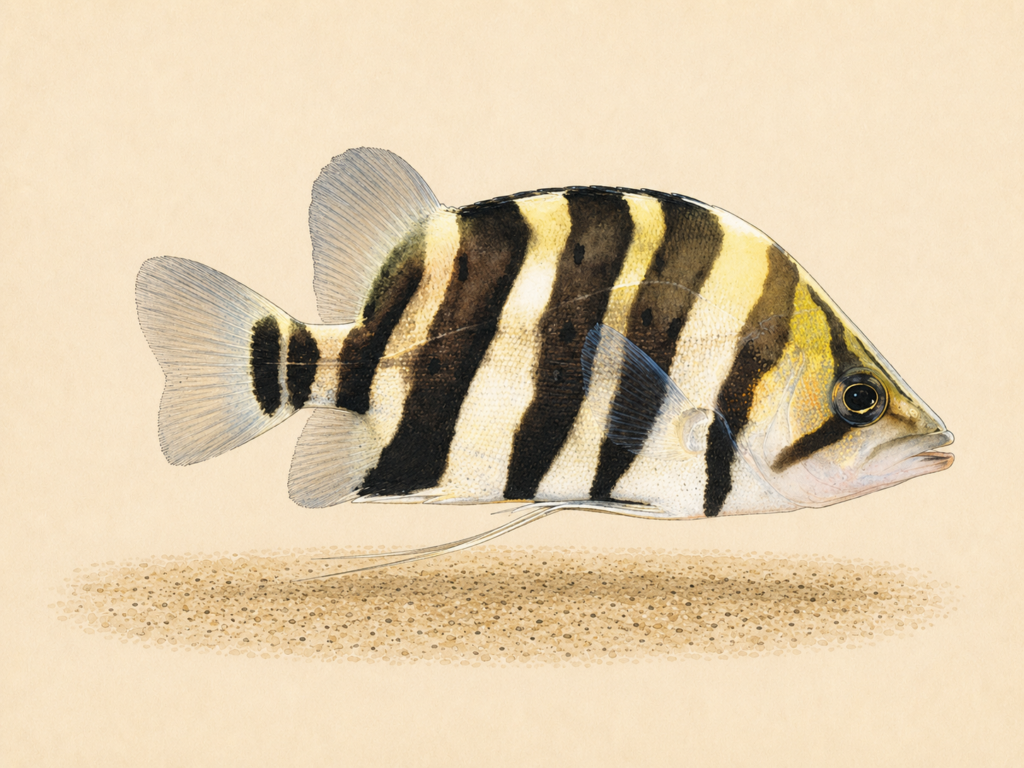
Datnioides polota is a laterally compressed, deep-bodied fish whose profile somewhat resembles that of a large cichlid or even a marine angelfish. The body is tall relative to its length, tapering to a moderately forked caudal fin. The dorsal fin is long and continuous, with stout anterior spines that give way to softer rays towards the rear. The anal fin mirrors the rear portion of the dorsal, creating a symmetrical silhouette when viewed from the side.
The base colour ranges from silver to pale gold, often appearing more silvery than some of its congeners – hence the common name “Silver Tiger Datnoid.” Superimposed on this base are four to five broad, dark brown to black vertical bands that run from the dorsal surface down to, or nearly to, the ventral margin. The exact width and intensity of these bands can vary between individuals and can also shift depending on mood, stress level, and background colour. When settled and healthy, the bands tend to be crisp and well-defined against a bright silver or light gold ground colour.
The head is relatively large, with a protrusible mouth well suited to ambush predation. The eyes are proportionally big, giving the fish excellent vision in murky or low-light conditions. Juvenile specimens often display slightly more contrast than adults, but even fully grown individuals remain strikingly patterned. There is minimal sexual dimorphism; males and females are very difficult to distinguish visually outside of spawning condition, where gravid females may appear slightly fuller in the belly.
Natural Habitat
The Four-banded Tigerfish occupies a wide geographic range across South and Southeast Asia, found in countries including India, Bangladesh, Myanmar, Thailand, Cambodia, Vietnam, and parts of the Indonesian archipelago. It inhabits a variety of waterways – from large, slow-moving rivers and their tributaries to tidal estuaries and mangrove-lined coastal zones. This broad habitat range is significant because it means D. polota naturally encounters both fully fresh and brackish water throughout its life cycle.
In many populations, juveniles and sub-adults are found in estuarine and lower river habitats where salinity fluctuates with the tides, while adults may move further upstream into fresher water or remain in brackish zones. The substrates in these habitats are typically silty or sandy, with submerged timber, root tangles, and rocky outcrops providing cover and ambush points. Water clarity is often moderate to low, and currents range from gentle to moderate. Vegetation may be sparse or absent in the main channel but present along margins. Understanding this natural environment is essential for replicating suitable conditions in captivity – particularly the importance of structure for hiding and the benefit of at least some salinity in the water.
Tank Size and Setup
A minimum tank volume of 600 litres is recommended for a single adult Four-banded Tigerfish, and larger is always better. This is a fish that can reach 30 to 40 cm in total length, and while it is not an endlessly active swimmer like some predators, it still requires ample space to turn comfortably, patrol its territory, and retreat when stressed. If you plan to keep more than one specimen or house it with other large tank mates, you should be thinking in terms of 1,000 litres or more.
Tank dimensions matter as much as raw volume. A tank that is at least 180 cm long and 60 cm wide (front to back) provides a reasonable footprint for an adult. Depth is less critical than length and width, but a minimum of 60 cm in height suits the tall body shape of this species.
When it comes to decor, the priority is providing secure hiding spots. Datnioides polota can be remarkably shy and skittish, especially when first introduced to a new tank. Large pieces of bogwood, stacked rockwork with cavities, and even PVC pipe sections concealed behind decor can serve as retreats. Without adequate cover, these fish will remain pale, stressed, and prone to dashing into the glass when startled, which can result in injury. As the fish settles in – a process that can take weeks to months – it will venture out more frequently, but permanent hiding places should always be available.
The substrate can be sand or fine gravel. Sand more closely mimics the silty and sandy bottoms found in their natural rivers and estuaries, and it is easier to keep clean with a gravel vacuum. Live plants are not essential and may be uprooted by a large, clumsy predator. If you wish to include plants, opt for robust species attached to decor – Anubias and Java Fern tied to driftwood are practical choices. In a brackish setup, salt-tolerant plants such as Java Fern and certain Vallisneria species can work, but keep expectations modest.
Lighting should be subdued or at least include shaded areas. These fish are more confident and display better colour under moderate light rather than intense illumination. A dimmer or floating plants to diffuse overhead light can make a meaningful difference to the fish’s behaviour.
Ensure the tank has a tight-fitting lid or cover. While D. polota is not renowned as a jumper compared to some predators, a startled individual can and will launch itself out of an open-topped tank.
Water Parameters
| Temperature | 24 – 28 C |
| pH | 7.0 – 8.5 |
| General hardness (GH) | 8 – 20 dGH |
| Carbonate hardness (KH) | 6 – 15 dKH |
| Ammonia | 0 ppm |
| Nitrite | 0 ppm |
| Nitrate | Below 20 ppm |
The most important nuance with Datnioides polota water chemistry is the question of salinity. Wild-caught specimens, in particular, benefit significantly from being kept in at least mildly brackish conditions – a specific gravity of around 1.005 to 1.010 is a sensible target. Even captive-bred fish often show better long-term health, appetite, and disease resistance when maintained with a low-level addition of marine salt. If you are keeping a wild-caught individual in purely fresh water, consider gradually introducing marine salt over a period of weeks to bring the specific gravity up to at least 1.003 to 1.005. Use a hydrometer or refractometer to monitor salinity accurately.
Note that “marine salt” here means a proper aquarium marine salt mix (which contains the full spectrum of trace elements and buffering compounds), not table salt or aquarium “tonic salt.” The buffering capacity of marine salt mixes also helps maintain a stable, slightly alkaline pH, which suits this species well.
Even if you choose to keep D. polota in fully fresh water – which is feasible, especially for captive-bred specimens – aim for moderately hard, slightly alkaline conditions. Soft, acidic water is not appropriate for this species and can contribute to stress, poor colouration, and heightened disease susceptibility. Maintain impeccable water quality at all times. As a large, protein-rich feeder, this fish produces a substantial bioload, and ammonia or nitrite spikes are a constant risk if filtration or water-change regimes are inadequate.
Filtration and Equipment
Robust filtration is non-negotiable for a fish of this size and feeding habit. A large external canister filter – or, ideally, two running in tandem – should be the backbone of the system. Aim for a combined turnover rate of at least eight to ten times the tank volume per hour. For a 600-litre tank, that means filters rated at roughly 5,000 to 6,000 litres per hour in total. This may sound excessive, but the biological and mechanical demands of a large predator tank are substantial.
Supplement the canister filters with additional mechanical and biological media. Coarse sponge pre-filters on canister intakes help protect the impellers and extend the interval between deep cleans. Biological media such as ceramic rings, sintered glass, or similar high-surface-area materials should fill the bulk of the canister chambers. A layer of fine filter floss or pad at the outlet stage polishes the water.
An appropriately sized aquarium heater – or, for very large tanks, two heaters placed at opposite ends – keeps the temperature stable. Use a heater guard to prevent the fish from resting against it and sustaining burns; large, sedentary predators are particularly prone to this. A reliable thermometer placed away from the heater gives you an accurate ambient reading.
If you are running a brackish setup, ensure all equipment is rated for salt water use. Standard stainless-steel components can corrode in brackish conditions, so opt for titanium heaters or heaters with plastic casings, and confirm that your filter impellers and seals are salt-tolerant.
An air stone or gentle powerhead can add surface agitation for gas exchange, but avoid creating excessively strong currents. D. polota is not a river-rapids species; moderate flow with some calmer zones suits it best.
Diet and Feeding
Datnioides polota is a strict predator that feeds primarily on small fish and crustaceans in the wild. In captivity, the diet should reflect this. Whole prey items form the foundation of a healthy feeding regime. Suitable live or frozen foods include river shrimp, prawns (shell on for smaller specimens, peeled for convenience with larger ones), whitebait, smelt, lance fish, and other appropriately sized whole fish.
Many keepers successfully wean their Four-banded Tigerfish onto dead, non-living food items, but this requires patience. Newly acquired specimens – especially wild-caught individuals – may refuse anything that is not alive and moving. The transition typically involves offering freshly killed prey on tongs or allowing it to drift in the current from a filter outlet, then gradually moving to thawed frozen items. Persistence pays off, and a specimen that accepts frozen food is far easier and cheaper to maintain long-term.
Some keepers have success with high-quality carnivore pellets (such as those designed for large cichlids or predatory fish), but pellet acceptance is far from guaranteed and should be viewed as a bonus rather than an expectation. If your fish does take pellets, they can form a useful supplementary part of the diet, but whole prey should still make up the majority of meals to ensure adequate nutrition and dental wear.
Avoid feeding exclusively with feeder fish from pet shops. Feeder fish are notorious vectors for parasites and bacterial infections, and a diet consisting solely of goldfish or rosy reds is nutritionally poor and high in thiaminase. If you use feeder fish at all, quarantine them for at least two weeks first and gut-load them with a quality flake or pellet before offering them. Better yet, culture your own livebearers in a separate tank where you can control health and nutrition.
Feed juveniles daily; sub-adults every other day; and adults two to three times per week. Overfeeding is a common mistake with predatory fish and leads to obesity, fatty liver disease, and deteriorating water quality. A healthy D. polota should have a slightly concave belly between meals – a persistently bloated appearance indicates overfeeding.
Behaviour and Temperament
The Four-banded Tigerfish is an ambush predator by nature, and its behaviour in the aquarium reflects this. It spends much of its time hovering motionless among cover – driftwood, rock overhangs, or plant thickets – waiting for prey to wander within striking distance. This sedentary style can be disconcerting for keepers accustomed to more active fish, but it is entirely normal. Bursts of rapid movement are reserved for feeding strikes and occasional territorial disputes.
New arrivals are often extremely shy and skittish. It is not uncommon for a newly introduced D. polota to hide behind decor for days or even weeks, refusing food and displaying washed-out, pale colouration. This is a stress response, and the best course of action is to minimise disturbance: keep the lights dim, avoid tapping on the glass, limit foot traffic past the tank, and offer food at the same time each day without hovering. Over time, the fish will gain confidence and begin to explore more openly. Some individuals settle within a few days; others take months. Patience is essential.
Conspecific aggression can be an issue. In the wild, these fish are loosely social, sometimes found in small groups, but in the confines of an aquarium, dominant individuals may bully subordinates, especially if space is limited. Keeping a group of three or more in a very large tank (1,000 litres minimum for a group) can help diffuse aggression, but be prepared to separate individuals if one is persistently harassed. Solo specimens do perfectly well on their own.
Towards other species, D. polota is generally peaceful provided the tank mate is too large to be swallowed. Any fish or invertebrate that fits in the tigerfish’s mouth will eventually be eaten – this is a certainty, not a risk. Beyond predation on small tank mates, the tigerfish is not aggressive or territorial towards similarly sized companions and can coexist with a range of robust, large-bodied species.
Tank Mates
Choosing tank mates for a Four-banded Tigerfish comes down to one fundamental rule: nothing small enough to be swallowed, and nothing aggressive enough to harass or injure the tigerfish. D. polota can be surprisingly timid around boisterous or aggressive tank mates, and chronic stress from bullying will suppress feeding and immune function. Ideal companions are large, robust, and peaceable fish that share similar water chemistry preferences – particularly if you are running a brackish setup, in which case tank mates must also tolerate salt.
Good tank mates
- Silver Arowana – A similarly sized, surface-dwelling predator that occupies a different water column level, reducing competition.
- Sailfin Pleco – A large, armoured catfish that is ignored by predators and helps with algae management in big tanks.
- Clown Knifefish – Another large, relatively peaceful predator that coexists well provided both have adequate hiding spots.
- Banded Leporinus – A robust, active mid-water fish large enough to avoid predation and generally non-aggressive.
- Giant Gourami – A large, docile companion that is far too big to be considered prey.
- Scat – An excellent choice for brackish setups, active, hardy, and too deep-bodied to be eaten once adult.
- Mono (Monodactylus argenteus) – Thrives in brackish conditions and is a robust, schooling companion for a brackish tigerfish tank.
- Common Plecostomus – Large, armoured, and generally left alone by predatory tank mates.
Fish to avoid
- Oscar – Can become belligerent and may harass a shy tigerfish, particularly during breeding condition.
- Red-bellied Piranha – Aggressive shoaling predator that poses a direct physical threat, especially in groups.
- Neon Tetra – Far too small; will be consumed almost immediately.
- Guppy – A bite-sized snack, not a tank mate.
- Flowerhorn Cichlid – Highly territorial and aggressive; will bully the tigerfish relentlessly.
- Jaguar Cichlid – Another large, aggressive cichlid that is likely to dominate and injure a D. polota.
- Convict Cichlid – Small enough to be eaten, and breeding pairs can harass much larger fish.
Breeding
Breeding Datnioides polota in captivity is exceptionally rare and has only been achieved under highly specialised conditions, if reliably at all in home aquaria. The overwhelming majority of specimens in the trade are wild-caught, with very limited captive breeding taking place at commercial facilities in Southeast Asia.
The primary obstacles to captive breeding are several. First, sexing this species is extremely difficult outside of spawning condition. There are no reliable external markers to distinguish males from females. Second, the fish require very large volumes of water – likely well in excess of what most home aquarists can provide – to form pairs and engage in courtship. Third, the environmental triggers for spawning in the wild are poorly understood but likely involve seasonal changes in water level, salinity, temperature, and possibly photoperiod that are difficult to replicate artificially.
What is known from the limited reports of spawning attempts suggests that the fish are substrate spawners or scatter eggs in sheltered areas. Parental care, if any, appears minimal. Eggs are small and adhesive. Fry would presumably require very small live foods such as rotifers or newly hatched brine shrimp in the first days of life, transitioning to larger prey as they grow.
For the hobbyist, the honest assessment is that breeding D. polota at home is not a realistic goal. If you do wish to attempt it, you would need a truly enormous system (several thousand litres), a group of adults, the ability to manipulate salinity and water chemistry gradually, and a great deal of patience and luck. Documenting any spawning activity would be a valuable contribution to the hobby and the scientific community.
Common Diseases
When kept in appropriate conditions with stable, clean water and a varied diet, Datnioides polota is a reasonably hardy fish. However, several health issues are seen with some regularity in captive specimens, often linked to suboptimal husbandry.
White spot disease (Ichthyophthirius multifiliis) and its brackish/marine equivalent Cryptocaryon irritans can affect tigerfish, particularly newly imported, stressed individuals. White spot presents as small white cysts on the fins and body. Treatment with raised temperature (to 30 C) and, in freshwater setups, the addition of salt (which may already be present in a brackish tank) is the first line of defence. Copper-based medications can be used but must be dosed carefully – follow manufacturer instructions precisely.
Bacterial infections, including fin rot and ulcerative lesions, often arise secondary to poor water quality or physical injury (such as colliding with glass when startled). Maintaining pristine water conditions is both preventive and therapeutic. Antibacterial treatments may be necessary in severe cases; consult a vet experienced with fish if lesions are deep or spreading.
Hole-in-the-head disease (HITH or HLLE – head and lateral line erosion) is occasionally reported in large predatory fish kept on monotonous diets or in water with chronically elevated nitrate levels. Small pits or erosions appear on the head and along the lateral line. Improving diet variety, reducing nitrate through more frequent water changes, and supplementing with vitamins (particularly vitamins A and C) can halt and sometimes reverse the condition.
Internal parasites are a concern with wild-caught specimens. A prophylactic course of an anti-parasitic treatment (such as praziquantel for tapeworms and flukes, or levamisole for nematodes) during quarantine is strongly recommended. Signs of internal parasites include weight loss despite a good appetite, white, stringy faeces, and a sunken belly.
Quarantine all new arrivals – including this species – in a separate tank for a minimum of four weeks before introducing them to your main display. This single practice prevents the majority of disease introductions.
FAQs
Can I keep a Four-banded Tigerfish in purely fresh water?
Yes, D. polota can survive in purely fresh water, and many captive-bred specimens do well in it. However, wild-caught individuals in particular benefit from at least mildly brackish conditions (specific gravity 1.003 to 1.010), which supports long-term health, improves disease resistance, and often brings out better colouration. If you start in fresh water, consider gradually adding marine salt to achieve a low brackish level.
How big does Datnioides polota actually get in an aquarium?
In a suitably large tank with good nutrition, expect an adult size of 30 to 35 cm. Some specimens may reach 40 cm, though this is less common in captivity. Growth rate is moderate; it typically takes several years to reach full adult size. Do not be misled by the small size of juveniles commonly sold at 8 to 10 cm – this fish will grow substantially.
Will a Four-banded Tigerfish eat my other fish?
Any fish or crustacean small enough to fit in a D. polota’s mouth is at risk of being eaten. This species is an obligate piscivore and predation is instinctive. Only house it with tank mates that are too large to be swallowed. As a rough guide, any companion less than half the body length of the tigerfish is potentially prey.
Why is my tigerfish so pale and hiding all the time?
Pale colouration and excessive hiding are classic signs of stress, which is extremely common in newly introduced specimens. Ensure the tank has adequate hiding spots, keep lighting subdued, minimise external disturbance, and maintain stable water parameters. With patience – sometimes weeks to months – the fish should gradually gain confidence and display its normal bold banding. Persistent paleness in a long-established fish may indicate chronic stress, disease, or unsuitable water chemistry.
What is the difference between Datnioides polota and Datnioides microlepis?
These are two distinct species that are sometimes confused in the trade. Datnioides microlepis, the Indonesian Tiger Datnoid, is typically a purely freshwater species with finer scales and a warmer golden-yellow base colour. D. polota (the Four-banded or Silver Tiger Datnoid) has a more silvery base colour, coarser scaling, and a stronger association with brackish habitats. D. microlepis also tends to command higher prices in the trade and is generally considered more challenging to source. Always confirm the species identification before purchase, as their care requirements differ somewhat.
Related Guides
- Indonesian Tiger Datnoid (Datnioides microlepis) – A closely related species with similar care requirements but a preference for purely freshwater conditions.
- Silver Arowana – Another large predatory fish commonly kept alongside datnoids in spacious predator tanks.
- Clown Knifefish – A compatible predatory species that shares many husbandry requirements with D. polota.
- Scat – An ideal brackish-water companion, relevant for keepers maintaining a brackish tigerfish setup.
- Giant Gourami – A large, peaceful tank mate option often housed with predatory species in very large aquariums.