Quick summary
The Guppy is an excellent choice for beginners thanks to its hardiness, tolerance of varied water conditions, and easy care and feeding requirements. Just be prepared for prolific, near-effortless breeding if you keep males and females together, so have a plan for managing fry numbers.
🐠 Build a tank around this species
In this guide:
- Introduction
- Quick Stats
- Appearance
- Varieties and Morphs
- Natural Habitat
- Tank Size and Setup
- Water Parameters
- Filtration and Equipment
- Diet and Feeding
- Behaviour and Temperament
- Tank Mates
- Breeding
- Common Diseases
- FAQs
Introduction
The Guppy, scientifically known as Poecilia reticulata, is arguably the most popular freshwater aquarium fish in the world. Beloved by beginners and experienced hobbyists alike, this small, vibrantly coloured livebearer has been a staple of the fishkeeping hobby for well over a century. Originally hailing from the warm waters of northern South America and the Caribbean, the guppy has been selectively bred into an astonishing array of colour forms and tail shapes, making it one of the most genetically diverse ornamental fish available today.
Part of the guppy’s enduring appeal lies in its remarkable hardiness and adaptability. It tolerates a wide range of water conditions, accepts virtually any food offered, and breeds with little to no intervention from the keeper. These qualities make it an ideal first fish for newcomers to the hobby, yet serious breeders can spend decades refining particular strains, striving for perfect finnage and colour expression in competitive shows. Whether kept in a simple desktop aquarium or a meticulously aquascaped community tank, the guppy brings constant movement, colour, and personality to any setup.
Beyond the aquarium, the guppy has also played a notable role in science. It has been the subject of extensive research in the fields of genetics, evolutionary biology, sexual selection, and ecology. Its rapid reproductive rate and pronounced sexual dimorphism make it an excellent model organism. In many tropical regions, guppies have been introduced deliberately as a means of mosquito control, though such introductions have sometimes led to ecological concerns. This care guide covers everything you need to know to keep guppies healthy, happy, and thriving in your home aquarium.
Quick Stats
| Scientific name | Poecilia reticulata |
|---|---|
| Common names | Fancy Guppy, Millions Fish, Rainbow Fish |
| Family | Poeciliidae |
| Origin | Venezuela, Trinidad and Tobago, Barbados, Guyana, Brazil |
| Adult size | 6 cm |
| Difficulty | Easy |
| Breeding difficulty | Easy |
| Temperature | 17–28 °C |
| pH | 7–8.5 |
| GH | 8–30 dGH |
| Minimum tank size | 45 L |
| Conservation status | Least Concern (IUCN, assessed 2020) |
Appearance
The guppy is a small, slender-bodied fish that exhibits some of the most pronounced sexual dimorphism of any freshwater species kept in the aquarium hobby. Males are the showpieces, displaying a dazzling range of colours including metallic blues, fiery reds, deep greens, electric yellows, purples, and multi-coloured patterns that can include spots, stripes, and iridescent patches. Their tails, depending on the strain, can be large and fan-shaped, sword-like, lyre-shaped, or rounded. The dorsal fin is often elongated and flowing, adding to the male’s ornamental appeal.
Females are noticeably larger than males but far more subdued in colouration. They are typically grey or olive with a silvery sheen, though some selectively bred strains produce females with modest colour in the fins and body. The female’s most distinctive feature is the gravid spot, a darkened area near the base of the anal fin that becomes more pronounced when she is carrying developing fry. Her fins are shorter and more rounded compared to those of the male.
The body shape of both sexes is streamlined and slightly laterally compressed. The mouth is small and upturned, reflecting the species’ tendency to feed at the surface. Males possess a modified anal fin called the gonopodium, a narrow, rod-like structure used to transfer sperm during mating. This feature is a reliable way to sex young fish even before full colouration develops. Wild-type guppies are considerably less flashy than their domesticated counterparts, typically displaying a base colour of grey or brown with irregular splashes of colour concentrated on the caudal fin and posterior body.
Varieties and Morphs
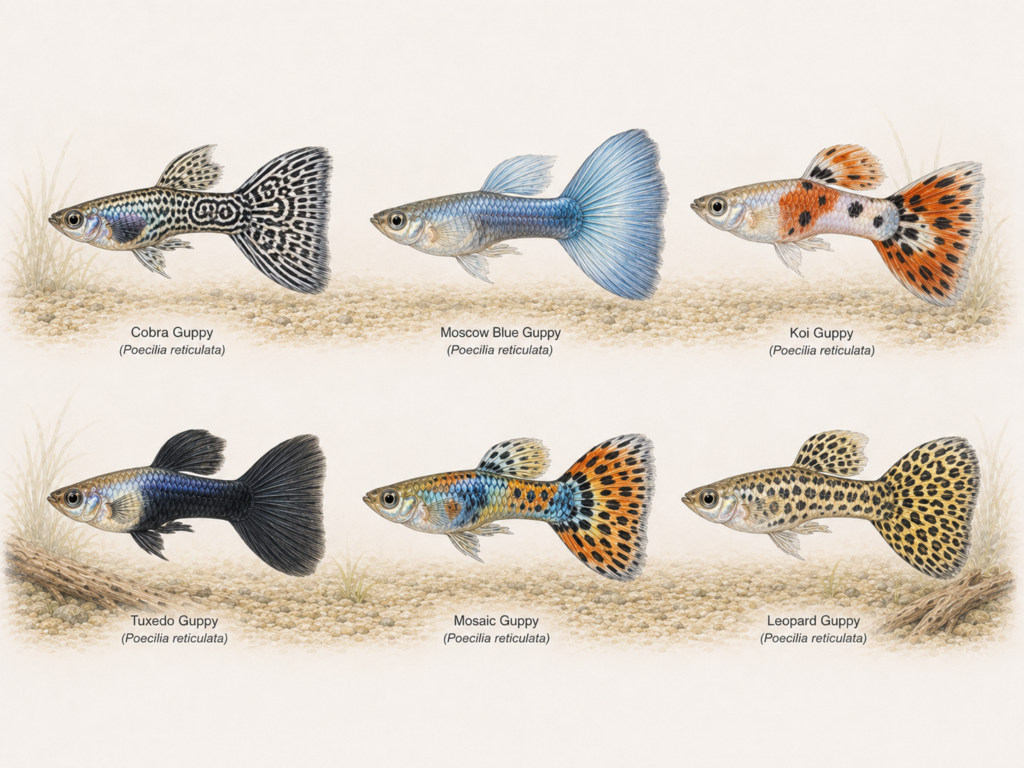
Few aquarium fish can rival the guppy in the sheer number of selectively bred varieties available. Over many decades of careful breeding, enthusiasts have developed an extraordinary range of colour and finnage combinations. Guppy varieties are typically classified by both tail shape and colour pattern, and many carry specific trade names. Below are some of the most notable and widely available varieties.
The Cobra Guppy is one of the most recognisable varieties, characterised by a striking rosette or snakeskin pattern across the body and fins. The pattern consists of chain-like markings that give the fish a textured, almost reptilian appearance. Cobras are available in many colour combinations, including red, green, and blue.
The Tuxedo Guppy features a distinctive two-toned body, with the rear half of the body being markedly darker than the front. This creates a contrast that is often likened to a formal suit, hence the name. Tuxedos come in numerous colour variants, with red and blue tuxedos being particularly popular.
The Moscow Guppy is prized for its deep, solid colouration that covers virtually the entire body and fins. Moscow Blues display a rich, uniform blue-purple hue, while Moscow Greens and Moscow Blacks are also highly sought after. These fish often have a metallic sheen that gives them a luxurious appearance under aquarium lighting.
The Endler-Guppy Hybrid, sometimes sold under various trade names, results from crossing Poecilia reticulata with the closely related Endler’s Livebearer (Poecilia wingei). These hybrids tend to be slightly smaller and often display intense neon colours. While purists in the Endler community frown upon hybridisation, these crosses are commonly available and can be very attractive.
The Dumbo Ear Guppy, also known as the Elephant Ear Guppy, is distinguished by its greatly enlarged pectoral fins, which fan out from the sides of the body like small wings or ears. These oversized pectoral fins are often brightly coloured, adding an extra dimension to the fish’s display. The trait can be combined with virtually any colour or tail pattern.
The Delta or Triangle Tail Guppy is defined by its broad, triangular caudal fin that fans out at roughly a 70-degree angle. This is one of the most classic fancy guppy tail shapes and serves as the basis for many show-quality strains. It is available in virtually every colour imaginable.
The Halfmoon Guppy takes the delta tail concept further, with a caudal fin that spreads to a full 180-degree arc, creating a dramatic half-circle silhouette. Maintaining this tail shape through selective breeding requires considerable effort, and high-quality halfmoons are prized among breeders.
The Sword Tail Guppy (not to be confused with the separate species Xiphophorus hellerii) features one or more elongated rays extending from the caudal fin. Top Swords have an extension on the upper edge, Bottom Swords on the lower, and Double Swords feature extensions on both edges, creating a lyre-like shape. These are elegant and popular forms.
The Albino Guppy lacks melanin pigmentation, resulting in a pale body with red or pink eyes. The underlying colours can still be visible, meaning albino variants of reds, blues, and yellows are all available. These fish can be somewhat more sensitive to bright lighting than pigmented varieties.
The Platinum Guppy displays a bright, uniform metallic white or silver colouration across the body. The reflective quality of the scales gives these fish a luminous appearance, and when combined with coloured tails, the contrast is particularly striking. Platinum is a popular base colour for many show strains.
Natural Habitat
In the wild, Poecilia reticulata is native to northeastern South America and several Caribbean islands, with its core range encompassing Venezuela, Trinidad and Tobago, Barbados, and parts of Guyana and northern Brazil. The species inhabits a remarkably diverse range of freshwater and slightly brackish environments, from clear mountain streams to turbid lowland pools, drainage ditches, and even mildly polluted waterways near human settlements.
Wild guppies are typically found in shallow, slow-moving or still waters where aquatic vegetation, algae, and fallen leaf litter provide cover from predators. In Trinidadian streams, guppies occupy pools and gentle runs, often in areas with gravel or sandy substrates. The presence or absence of predators in a given stream has been shown to influence guppy behaviour, body size, reproductive strategy, and even colouration, making Trinidadian guppy populations among the most studied in evolutionary biology.
Water conditions in their native habitat vary considerably but tend to be warm, with temperatures typically ranging from 23 to 28 °C. The pH can range from slightly acidic to moderately alkaline, and hardness varies depending on the local geology. This natural adaptability to varying conditions is a key reason why guppies thrive in such a wide range of aquarium setups. Human introductions, often for mosquito control purposes, have established feral guppy populations on every inhabited continent, a testament to the species’ extraordinary resilience and adaptability.
Tank Size and Setup
While guppies are small fish, they are active swimmers and do best with adequate space to explore and display their natural behaviours. A minimum tank size of 40 litres is recommended for a small group, though a larger aquarium of 60 to 80 litres or more is preferable, especially if you plan to keep a mixed-sex group where breeding will inevitably occur. Larger volumes also provide greater water stability, which benefits the fish even though they are relatively tolerant of fluctuations.
The aquarium should be well-planted, as live vegetation serves multiple purposes for guppies. Plants such as Java Moss, Hornwort, Java Fern, and Vallisneria provide cover for females seeking respite from persistent males, and they offer critical hiding spots for newborn fry. Floating plants like Salvinia or Amazon Frogbit are particularly beneficial, as guppies naturally gravitate towards the upper water column and fry instinctively seek shelter among surface vegetation.
The substrate can be gravel, sand, or a planted aquarium soil, depending on your aesthetic preference and whether you wish to grow rooted plants. A dark substrate can help to intensify the colours displayed by male guppies. Decorations such as driftwood and smooth stones add visual interest and provide additional cover, though dense ornamentation is not strictly necessary for this species. Ensure that any decorations are free of sharp edges that could tear the delicate, flowing fins of fancy male guppies.
A secure lid is essential. Guppies are surface-dwelling fish and can be surprisingly good jumpers, particularly when startled or when males chase females vigorously. A fitted lid or cover glass also helps to reduce evaporation and maintain stable water temperature. Moderate lighting suits guppies well, and a standard LED aquarium light on a timer set for 8 to 10 hours per day will support healthy plant growth without causing excessive algae.
Water Parameters
Guppies are notably adaptable when it comes to water chemistry, which is one of the reasons they are recommended so widely for beginners. They do, however, show a preference for moderately hard, slightly alkaline water. Very soft, acidic water is not ideal and can cause health issues over time, particularly problems with fin integrity and disease resistance. The following parameters represent the recommended range for long-term health and breeding success.
| Temperature | 17–28 °C |
| pH | 7.0–8.5 |
| General hardness (GH) | 8–30 dGH |
| Ammonia | 0 ppm |
| Nitrite | 0 ppm |
| Nitrate | Below 20 ppm |
Regular water testing is important, particularly in smaller aquariums where parameters can shift more quickly. Weekly water changes of 20 to 30 per cent are generally sufficient to maintain water quality, though tanks with higher stocking densities or active breeding populations may benefit from more frequent changes. If your tap water is very soft, as is common in many parts of the United Kingdom, consider using a mineral supplement or a small amount of crushed coral in the filter to raise the GH and KH to suitable levels. Guppies can tolerate a small amount of salt in the water, and some keepers add a teaspoon of aquarium salt per 20 litres as a general tonic, though this is not strictly necessary in a well-maintained tank and should be avoided if keeping salt-sensitive tank mates.
Filtration and Equipment
Guppies do not require powerful filtration, and in fact, excessively strong currents can stress them, particularly fancy males with large, flowing tails that create significant drag. A gentle sponge filter is an excellent choice for a guppy tank, as it provides effective biological filtration without creating a strong flow. Sponge filters are also safe for fry, which can be sucked into the intakes of more powerful filters. If using a hang-on-back or internal power filter, consider fitting a pre-filter sponge over the intake to protect small fish, and adjust the flow rate to its lowest setting or baffle the output.
A reliable heater is essential unless you live in a consistently warm climate where room temperatures remain within the guppy’s preferred range year-round. An adjustable heater rated appropriately for your tank volume, typically around 1 watt per litre, will allow you to maintain a stable temperature. A thermometer, preferably a digital one, should be used to monitor the tank temperature regularly, as heater malfunctions can go unnoticed without one.
An air pump connected to an air stone or the sponge filter provides beneficial surface agitation and gas exchange, helping to keep dissolved oxygen levels high. This is particularly important in warmer water, which holds less oxygen than cooler water. Standard aquarium lighting, as mentioned, is sufficient, and there is no need for specialist equipment. A timer for the lights helps to establish a consistent photoperiod, which supports the health of both fish and plants.
Diet and Feeding
Guppies are omnivores with a slight bias towards protein-rich foods, and they are among the least fussy eaters in the aquarium hobby. A high-quality flake food or micro-pellet formulated for tropical fish should form the foundation of their diet. Look for products that list whole fish or fish meal, spirulina, and other nutritious ingredients near the top of the ingredients list. Avoid foods heavy in fillers and cereal-based ingredients, as these offer poor nutritional value.
To promote vibrant colour, robust health, and successful breeding, supplement the staple diet with a variety of live, frozen, or freeze-dried foods. Daphnia, brine shrimp (Artemia), bloodworms, and mosquito larvae are all eagerly accepted and provide essential protein and fats. Freshly hatched brine shrimp nauplii are particularly valuable as a first food for newborn fry, though finely crushed flake food can also serve this purpose. Vegetable matter is important too; blanched spinach, shelled peas, and spirulina-based foods help to ensure a balanced diet and support digestive health.
Feed adult guppies two to three times daily, offering only as much as they can consume within two to three minutes per feeding. Overfeeding is a common mistake that leads to poor water quality, obesity, and associated health problems. Guppies are perpetually hungry and will always appear eager for food, so resist the temptation to overfeed. A periodic fasting day, once a week, can benefit digestive health, though this is optional. For fry, more frequent feedings of four to five times daily in small quantities will support their rapid growth.
Behaviour and Temperament
Guppies are peaceful, social fish that are happiest when kept in groups. They are active swimmers that tend to occupy the middle and upper levels of the aquarium, and males in particular are constantly on the move, displaying their colours to females and to one another. Male guppies can be mildly competitive, flaring their fins and posturing in the presence of rivals, but this behaviour rarely escalates to genuine aggression or physical harm.
One of the most notable aspects of guppy behaviour is the relentless pursuit of females by males. Males will chase females persistently, attempting to mate using their gonopodium. This can cause stress and exhaustion in females, particularly if they are significantly outnumbered. For this reason, it is strongly recommended to keep guppies in a ratio of at least two to three females for every male. This distributes the male attention more evenly and allows individual females periods of rest. Alternatively, an all-male tank can be kept purely for display purposes, eliminating the stress of mating pursuit entirely, though minor squabbling may increase without females to direct attention towards.
Guppies are not schooling fish in the strict sense, but they are loosely shoaling and will swim in the same general area of the tank. They are curious and will investigate new objects or foods with enthusiasm. Their boldness and tendency to swim in the open make them excellent display fish, as they rarely hide for extended periods. They are generally non-aggressive towards other species, making them well-suited to peaceful community setups.
Tank Mates
Guppies are among the most community-friendly fish available, but their small size, flowing fins, and surface-dwelling habits mean that tank mate selection still requires some thought. The ideal companions are similarly sized, peaceful species that will not nip fins or view guppies as prey.
Good tank mates
- Corydoras Catfish, these peaceful bottom-dwellers occupy a completely different zone of the tank and pose no threat to guppies or their fry.
- Neon Tetra, a calm, small-bodied schooling fish that shares similar water parameter requirements and coexists peacefully with guppies.
- Harlequin Rasbora, a gentle, undemanding shoaling fish that adds colour and movement without any aggressive tendencies.
- Cherry Shrimp, these colourful invertebrates help with algae control and are generally ignored by adult guppies, though very small shrimplets may occasionally be eaten.
- Otocinclus Catfish, Tiny, peaceful algae eaters that are completely non-aggressive and thrive in the same water conditions as guppies.
- Platy, a fellow livebearer with a similarly peaceful disposition and overlapping water parameter preferences, making them natural companions.
- Honey Gourami, one of the most peaceful gourami species, the Honey Gourami is calm enough to coexist with guppies without issue.
- Kuhli Loach, a shy, nocturnal bottom-dweller that is entirely peaceful and adds interest to the lower levels of the aquarium.
- Nerite Snail, Excellent algae-eating snails that are completely harmless to fish and help to keep the tank clean.
- Endler’s Livebearer, a close relative with similar care requirements, though keepers should be aware that the two species can interbreed freely.
Fish to avoid
- Tiger Barb, Notorious fin nippers that will relentlessly target the flowing tails of male guppies, causing stress and injury.
- Angelfish, Adult angelfish are large enough to eat guppies and will often do so, making them unsuitable companions despite their popularity.
- Oscar, a large, predatory cichlid that will readily consume guppies and any other fish small enough to fit in its mouth.
- Serpae Tetra, known for aggressive fin-nipping behaviour, particularly towards slow-moving fish with long fins like fancy guppies.
- Chinese Algae Eater, Becomes territorial and aggressive as it matures, and may harass or attach itself to the sides of slower-moving fish.
- Red Tail Shark, a territorial species that can bully smaller fish, particularly in tanks without sufficient space for it to establish territory.
- Bucktooth Tetra, a deceptively aggressive species that feeds on the scales and fins of other fish, making it entirely incompatible with guppies.
- Convict Cichlid, an aggressive cichlid, especially when breeding, that will harass and potentially kill small, peaceful species like guppies.
Breeding
Breeding guppies is famously straightforward, to the point where the greater challenge is often managing population growth rather than inducing reproduction. Guppies are livebearers, meaning that females give birth to free-swimming fry rather than laying eggs. If you keep males and females together in a well-maintained aquarium, breeding will almost certainly occur without any special intervention on your part.
Males court females with persistent displays, flashing their colours and performing a characteristic sigmoid display in which they curve their body into an S-shape in front of the female. Mating is achieved when the male uses his gonopodium to transfer a packet of sperm to the female. Remarkably, females can store sperm from a single mating for several months, producing multiple broods from one encounter. This means that even a female purchased alone from a shop may produce fry for some time after being separated from males.
The gestation period is typically 21 to 30 days, depending on water temperature. Warmer water generally shortens gestation. As the female nears the end of her pregnancy, her abdomen becomes noticeably swollen and the gravid spot darkens considerably. Some keepers use breeding traps or separate breeding tanks to protect fry, though these can stress the mother. A preferable approach is to provide abundant cover in the form of dense floating plants and fine-leaved vegetation, which gives newborn fry places to hide from adult fish, including their own parents, who will readily consume them if given the opportunity.
A typical brood ranges from 20 to 50 fry, though large, well-fed females can produce even more. The fry are tiny but fully formed and capable of swimming and feeding immediately after birth. Newly hatched brine shrimp, powdered fry food, or finely crushed flake food should be offered several times a day. Growth is rapid under good conditions, and the sex of the fry can usually be determined within four to six weeks, as males begin to develop colour and the gonopodium becomes visible. If you are breeding for specific colour or tail characteristics, it is important to separate the sexes before they reach sexual maturity at around three months of age, to prevent unplanned crossings.
Selective breeding of guppies is a deep and rewarding pursuit. Achieving consistency in a particular strain requires careful record-keeping, dedicated tank space for separate breeding lines, and a willingness to cull or rehome fish that do not meet the desired standard. Many guppy breeders specialise in a single variety and work to refine it over many generations.
Common Diseases
Despite their hardiness, guppies are susceptible to several common aquarium diseases, particularly when kept in suboptimal conditions or when newly purchased fish introduce pathogens to an established tank. Good husbandry practices, including regular water changes, proper diet, and avoiding overcrowding, are the best defences against disease.
Ich, also known as white spot disease, is caused by the protozoan parasite Ichthyophthirius multifiliis and is one of the most common ailments encountered by guppy keepers. Affected fish develop small, grain-of-salt-like white spots on their body and fins, and may exhibit flashing behaviour, rubbing against objects in an attempt to dislodge the parasites. Treatment involves raising the water temperature gradually to around 28–30 °C and administering a proprietary ich medication. Prompt action is important, as ich can be fatal if left untreated.
Fin rot is another frequently encountered condition, manifesting as fraying, discolouration, or progressive erosion of the fins. It is typically caused by bacterial infection, often triggered by poor water quality, physical damage, or stress. Fancy guppies with long, flowing fins are particularly vulnerable. Treatment involves improving water conditions through frequent water changes, and in more severe cases, using an antibacterial medication. Ensuring that the aquarium is free of sharp decorations that could damage fins is an important preventative measure.
Guppy disease, sometimes referred to as Tetrahymena or protozoan infection, is a condition particularly associated with guppies. Affected fish may develop a whitish film on the body, become lethargic, and lose condition rapidly. It can be difficult to treat in advanced stages, so early detection is crucial. Quarantining new fish for two to four weeks before adding them to an established tank is one of the most effective ways to prevent the introduction of this and other diseases.
Velvet disease, caused by the parasitic dinoflagellate Piscinoodinium, produces a fine, gold or rust-coloured dusting on the skin and fins. It can be more difficult to spot than ich and is highly contagious. Infected fish often clamp their fins, breathe rapidly, and lose their appetite. Treatment with copper-based medications is effective, though care must be taken to remove any invertebrates from the tank first, as copper is toxic to shrimp and snails. Maintaining consistent water quality and avoiding temperature fluctuations help to prevent outbreaks of velvet.
Internal parasites can occasionally affect guppies, particularly those sourced from mass breeding facilities. Signs include weight loss despite a good appetite, white or stringy faeces, and a generally emaciated appearance. Anti-parasitic foods or medications containing praziquantel or levamisole can be effective treatments. As with all diseases, prevention through quarantine and good water quality is preferable to treatment.
FAQs
How many guppies can I keep in a 40-litre tank?
A 40-litre aquarium can comfortably house a group of around five to six adult guppies. If keeping a mixed-sex group, aim for a ratio of one male to two or three females to reduce stress on the females from persistent male attention. Bear in mind that if breeding occurs, the fry population will grow quickly, so have a plan for managing numbers, whether through rehoming, separating fry, or keeping tank mates that will naturally consume some of the young.
Can I keep only male guppies together?
Yes, an all-male guppy tank is a popular option, particularly for keepers who want to enjoy the vibrant colours without dealing with constant breeding. Males may display to one another and engage in mild posturing, but serious aggression is uncommon. Keeping six or more males helps to diffuse any minor tensions. An all-male display tank can be a stunning setup, as every fish will be brightly coloured and constantly showing off.
Why are my guppies dying shortly after purchase?
Sudden losses after purchase are unfortunately common with guppies and are often attributed to the stress of transport, differences in water parameters between the shop and your home aquarium, or underlying health issues from mass breeding facilities. To minimise losses, acclimatise new fish slowly over at least 30 to 60 minutes, ensure your tank is fully cycled, and consider quarantining new arrivals for two to four weeks. Purchasing from reputable breeders rather than large chain stores can also improve the quality and hardiness of the fish you receive.
Do guppies need a heater?
In most UK households, a heater is necessary to maintain the warm, stable temperatures that guppies require. While they can survive temporary dips into the low twenties, sustained exposure to temperatures below 22 °C can suppress their immune system and make them more vulnerable to disease. A reliable, adjustable heater ensures consistent warmth regardless of seasonal fluctuations in room temperature, and is considered essential equipment for a guppy aquarium.
How can I tell if a female guppy is pregnant?
A pregnant female guppy will develop a noticeably swollen abdomen as the fry grow inside her. The gravid spot, a dark area located just above the anal fin, will become larger and darker as she approaches the end of gestation. In the final days before giving birth, the abdomen may appear slightly squared off when viewed from the side, and the female may become more reclusive, seeking out sheltered areas of the tank. Given that female guppies can store sperm and produce broods roughly every four weeks, a healthy adult female in a mixed-sex tank is almost always in some stage of pregnancy.
Related Guides
- Endler’s Livebearer Care Guide, a close relative of the guppy with similar care requirements, ideal for keepers who enjoy livebearers in smaller aquariums.
- Platy Care Guide, another popular and easy-to-keep livebearer that makes an excellent companion species for guppies in community tanks.
- Molly Care Guide, a larger member of the Poeciliidae family with overlapping care needs, suitable for keepers looking to expand their livebearer collection.
- Swordtail Care Guide, a striking livebearer that shares many care requirements with the guppy and adds variety to a peaceful community setup.
- How to Cycle an Aquarium, Essential reading for anyone setting up a new tank, ensuring a safe and stable environment before adding guppies or any other fish.
- Livebearer Breeding Guide, a comprehensive guide to breeding livebearing fish, covering techniques for raising healthy fry and managing population growth.