Quick summary
The Giant Gourami is an intelligent, interactive fish that can bond with its owner, but it can grow to 40-70 cm and needs at least 800 litres, so it’s only suitable for keepers who can commit to a very large, long-term setup. If you can’t provide that space, this is not the right fish for you.
🐠 Build a tank around this species
Grows large. Read this before buying. The Giant Gourami is usually sold as a small juvenile and is easy to keep at that size, but a healthy adult reaches around 50 cm. A juvenile will be happy in a standard tank for its first year or so. An adult needs a very large tank, six feet long or more, and the water changes to match. Decide now whether you will build for the adult, or have a realistic rehoming plan, because public aquaria and specialist keepers are often full. It is a superb fish for the keeper who plans for it and a sad one for everyone else.
In this guide:
- Introduction
- Quick Stats
- Appearance
- Varieties and Morphs
- Natural Habitat
- Tank Size and Setup
- Water Parameters
- Filtration and Equipment
- Diet and Feeding
- Behaviour and Temperament
- Tank Mates
- Breeding
- Common Diseases
- FAQs
Introduction
The Giant Gourami is one of the most impressive freshwater fish available in the aquarium hobby, and it is precisely that impressive stature that makes it both a rewarding and demanding species to keep. Reaching lengths that dwarf the vast majority of tropical community fish, Osphronemus goramy is not a species to be purchased on a whim. Yet for aquarists who can provide the space and long-term commitment it requires, the Giant Gourami offers something few other fish can: a genuinely interactive pet that recognises its keeper, accepts hand-feeding, and develops a personality that is often compared to that of a large cichlid or even a dog.
Native to the freshwater systems of Southeast Asia, the Giant Gourami has been cultivated for centuries, not only as an ornamental fish but also as an important food source. Its hardiness, adaptability, and willingness to eat almost anything contributed to its spread across tropical regions worldwide. In the aquarium trade, juveniles are commonly sold at a modest size, often no more than five to eight centimetres, which can mislead inexperienced buyers into thinking they are suitable for a standard community tank. Within a year or two, however, the reality of this fish’s adult proportions becomes abundantly clear. This guide will walk you through every aspect of Giant Gourami care, from appropriate tank dimensions and water chemistry to diet, breeding, and compatible tank mates, so that you can make an informed decision before welcoming one of these gentle giants into your home.
Quick Stats
| Scientific name | Osphronemus goramy |
|---|---|
| Common names | Common Gourami, True Gourami, Giant Red Tail Gourami, Kalui |
| Family | Osphronemidae |
| Origin | Southeast Asia (Java, Sumatra, Borneo, Malay Peninsula) |
| Adult size | 50 cm |
| Lifespan | 15–25 years |
| Difficulty | Intermediate |
| Breeding difficulty | Moderate |
| Temperature | 22–30 °C |
| pH | 6–8 |
| GH | 2–25 dGH |
| KH | 2–12 dKH |
| Minimum tank size | 800 L |
| Conservation status | Least Concern (IUCN) |
Appearance
Juvenile Giant Gouramis bear little resemblance to the adults they will become. Young fish display a pointed head, a flattened body with prominent vertical banding in shades of gold and dark brown, and a noticeably forked caudal fin. Their pelvic fins are elongated into the thread-like feelers characteristic of the gourami family, and these sensory appendages are used constantly to probe their surroundings. At this stage, they are sleek, attractive, and deceptively modest in size.
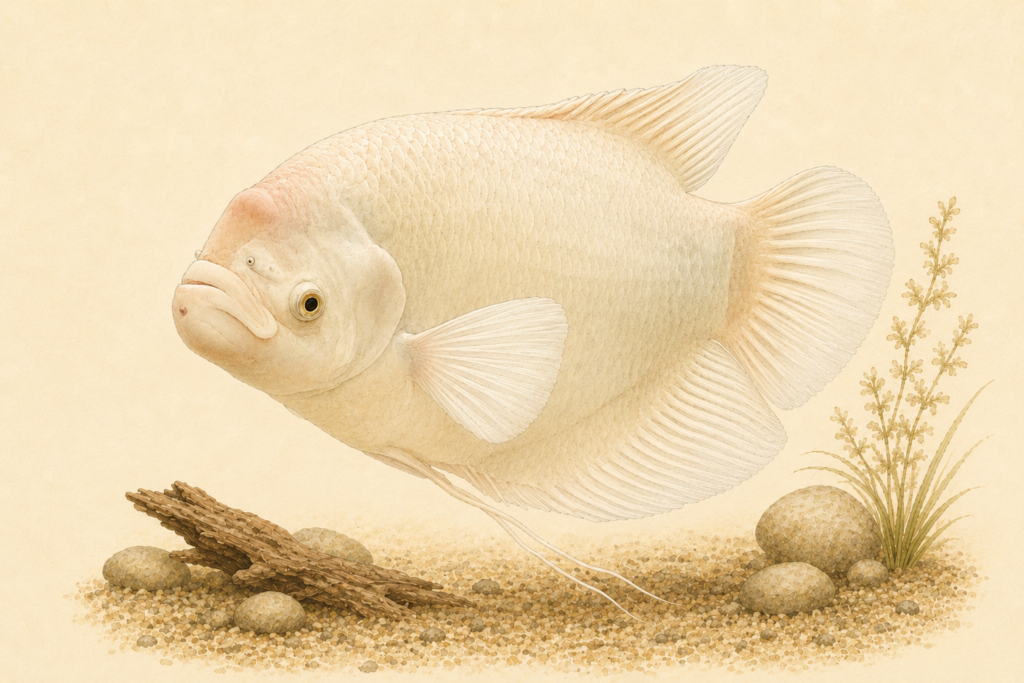
As the fish matures, the transformation is striking. The head grows proportionally larger and develops a distinctly blunt, squared-off profile. In mature males, a pronounced nuchal hump, a fleshy lump on the forehead, becomes a key distinguishing feature. The body deepens considerably, becoming thick and powerful. The juvenile banding gradually fades, replaced by a more uniform colouration that varies depending on the particular variety and the individual. Wild-type adults tend to settle into shades of pale gold, greyish-pink, or dusky grey, often with a slight bluish or greenish sheen along the flanks. The lips become notably thick and fleshy, giving the face an expressive, almost comical appearance that contributes to the species’ reputation for charisma.
Sexual dimorphism becomes apparent as the fish reach maturity. Males typically develop a larger nuchal hump, thicker lips, and slightly more pointed dorsal and anal fins. Their overall colouration may be darker, and during breeding condition, they can develop a deepened body colour with reddish or orange tones on the pectoral and caudal fins. Females tend to retain rounder, softer body proportions with less prominent head features, though reliable sexing is difficult in younger specimens.
Varieties and Morphs
Several colour morphs of the Giant Gourami have been established through selective breeding, particularly in Southeast Asian fish farms where the species has been cultivated for generations. The most common and widely available is the classic wild-type, sometimes sold simply as the Grey Giant Gourami or Common Giant Gourami, which exhibits the natural grey-to-gold colouration described above. This form remains the most robust and is often recommended for first-time keepers of the species.
The Albino Giant Gourami is perhaps the most popular captive-bred variant. It displays a pale pinkish-white body with red or pinkish eyes, and it can develop a warm peachy tone as it matures. This morph is widely bred and tends to be readily available. The Red Tail Giant Gourami is another sought-after form, characterised by a grey or silvery body contrasted with vivid reddish-orange markings on the tail and sometimes the fins, making for a striking display fish. A Black Giant Gourami variant also exists, showing a significantly darker overall pigmentation that ranges from deep charcoal to near-black, though truly melanistic specimens are less common in the trade.
The Golden Giant Gourami or Yellow Giant Gourami is a vibrant morph selectively bred for intense golden-yellow colouration across the entire body. These fish can be particularly eye-catching under good lighting and are a favourite among keepers who want a bold centrepiece. A less common but increasingly available variety is the Platinum Giant Gourami, which displays an almost entirely white or silvery body without the reddish tones of the albino, giving it a cleaner, more metallic appearance. It is worth noting that colour intensity in all morphs can be influenced by diet, water quality, stress levels, and lighting, so captive specimens do not always display their full potential until they are settled and well cared for.
Natural Habitat
Osphronemus goramy is native to the lowland freshwater systems of Southeast Asia, with its original range centred on the Indonesian islands of Java, Sumatra, and Borneo, as well as parts of the Malay Peninsula and mainland Indochina. Over centuries, it has been deliberately introduced into waterways across Thailand, Vietnam, the Philippines, India, Sri Lanka, and even parts of Australia and South America, primarily as a food fish. This widespread distribution is a testament to its adaptability.
In the wild, Giant Gouramis inhabit slow-moving or still bodies of water, including swamps, marshes, canals, lakes, and the sluggish backwaters of large rivers. They favour heavily vegetated areas with abundant aquatic plants, submerged roots, and overhanging vegetation that provides both food and shelter. These environments are typically warm, often slightly acidic to neutral, and rich in organic matter. The substrate is usually soft mud or silt, and the water may be stained to varying degrees by tannins from decomposing plant material.
Like all members of the suborder Anabantoidei, the Giant Gourami possesses a labyrinth organ, a specialised respiratory structure that allows it to breathe atmospheric air directly. This adaptation is invaluable in its native habitat, where dissolved oxygen levels can drop dramatically in warm, stagnant, or densely vegetated waters. In an aquarium setting, you will regularly observe the fish rising to the surface to gulp air, and it is essential that there is always a gap between the water surface and any cover or lid to allow this behaviour.
Tank Size and Setup
The single most critical consideration for anyone contemplating a Giant Gourami is tank size. This is a fish that routinely exceeds 40 centimetres in captivity and can approach 60 to 70 centimetres under ideal conditions. A minimum tank volume of 800 litres is recommended for a single adult, and this should be considered an absolute baseline rather than a generous allowance. Tanks of 1,000 to 1,500 litres or more are preferable, especially if you intend to keep the fish alongside tank mates. For a pair or a small group, you should be thinking in terms of 1,500 litres and upwards. The tank’s footprint, its length and width, matters as much as its total volume. A tank measuring at least 240 centimetres long and 60 centimetres wide is a sensible starting point for a single adult, as the fish needs room to turn comfortably and swim without restriction.
Aquascaping for Giant Gouramis requires a balance between providing interest and leaving ample open swimming space. Heavy driftwood, large rocks, and robust structures can be used to create visual barriers and territorial boundaries. Live plants are generally not practical with this species, as Giant Gouramis are enthusiastic herbivores that will consume or uproot most aquatic vegetation. If you wish to include plants for aesthetic reasons, opt for tough species like Anubias or Java Fern attached to hardscape, but accept that they may eventually be damaged or eaten. Artificial plants are an alternative, though they should be securely anchored.
A soft sand or fine gravel substrate is suitable. Avoid sharp-edged substrates, as the fish may mouth at the bottom when foraging. The tank should have a secure, well-fitted lid or cover, as Giant Gouramis are surprisingly powerful and can occasionally splash or push against loose-fitting covers. However, ensure there is always a gap of at least a few centimetres between the water surface and the lid to allow the fish to access atmospheric air via its labyrinth organ. Lighting can be moderate; the fish does not have specific lighting requirements, but a consistent photoperiod of around 10 to 12 hours helps maintain a natural rhythm.
Water Parameters
One of the Giant Gourami’s most appealing qualities for experienced fishkeepers is its remarkable tolerance of a wide range of water conditions. This adaptability is a product of its natural habitat and centuries of aquacultural propagation. Nevertheless, providing stable, clean water within the preferred range will ensure the best health, colouration, and longevity.
| Temperature | 22–30 °C |
| pH | 6.0–8.0 |
| General hardness (GH) | 2–25 dGH |
| Carbonate hardness (KH) | 2–12 dKH |
| Ammonia | 0 ppm |
| Nitrite | 0 ppm |
| Nitrate | Below 40 ppm |
A temperature in the range of 24–28 °C is ideal for everyday keeping, with the warmer end of the scale more appropriate if you are conditioning fish for breeding. A neutral to slightly acidic pH of around 6.5–7.5 suits most specimens well. While the species tolerates harder water, moderately soft to medium-hard water is closest to its natural conditions. Ammonia and nitrite must always be maintained at zero, and regular water changes are essential for managing nitrate levels, given the substantial bioload this large fish produces. Weekly water changes of 25–30% are a good starting point, though the exact frequency and volume will depend on your tank size, stocking level, and filtration capacity.
Filtration and Equipment
Filtration is of paramount importance when keeping a fish of this size and appetite. Giant Gouramis produce a considerable amount of waste, and their tanks require robust biological and mechanical filtration to maintain water quality. A large external canister filter rated for well above your tank’s volume, ideally turning the total volume over four to six times per hour, is the minimum standard. Many experienced keepers opt for a sump-based filtration system, which provides greater water volume, more media capacity, and easier maintenance access. Combining a sump with supplementary canister filters or powerheads is a common and effective approach.
Mechanical filtration media such as coarse and fine sponge pads will handle the significant particulate waste, while biological media, ceramic rings, sintered glass, or similar high-surface-area materials, should be present in abundance to support the nitrifying bacteria needed to process ammonia and nitrite. Chemical filtration with activated carbon can be used periodically to polish the water and remove odours, but it is not a substitute for adequate biological and mechanical filtration.
Water flow should be gentle to moderate. Giant Gouramis are not fast-water fish, and excessive current will stress them. Position filter outlets and returns to create a gentle circulation without producing strong directional flow. A quality aquarium heater rated for your tank’s volume, preferably with a guard to prevent the fish from damaging it, will maintain a stable temperature. An external inline heater installed on the filter return line is an excellent option, as it removes the risk of the fish coming into contact with the heating element entirely. Supplementary aeration from an air pump is not strictly necessary given the fish’s ability to breathe atmospheric air, but gentle surface agitation from the filter return will help with gas exchange and benefit other inhabitants of the tank.
Diet and Feeding
Giant Gouramis are true omnivores with a strong herbivorous leaning. In the wild, a significant proportion of their diet consists of aquatic plants, algae, and fallen fruit and vegetation, supplemented by insects, worms, small crustaceans, and other invertebrates. In captivity, they are spectacularly unfussy eaters, and one of the joys of keeping them is their enthusiasm at feeding time and their willingness to accept food directly from their keeper’s hand.
A well-rounded captive diet should have a plant-based foundation. Blanched vegetables such as peas, courgette, spinach, lettuce, and kale are eagerly consumed and should form a regular part of the menu. Many keepers supplement with slices of fruit including banana, melon, and apple as occasional treats. High-quality cichlid pellets or large-format sinking pellets with a good vegetable content make an excellent staple food, providing balanced nutrition in a convenient form. Spirulina-based flakes or wafers can also be offered.
Animal-based protein should be provided in moderation, perhaps two or three times per week. Suitable options include earthworms, prawns, mussels, and white fish fillets. Frozen or freeze-dried foods such as bloodworm, krill, and brine shrimp are also accepted, though for a fish of this size, larger food items are more practical and satisfying. Avoid feeding mammalian meat or excessively fatty foods, as these can cause digestive issues and contribute to fatty liver disease over time.
Feeding once or twice daily is appropriate for adults, with portion sizes that can be consumed within a few minutes. Juveniles benefit from more frequent feeding, three times daily, to support their rapid growth. Overfeeding is a common mistake, particularly given the fish’s apparent insatiability, and it can quickly degrade water quality. A fasting day once a week is a sensible practice for adult specimens.
Behaviour and Temperament
The Giant Gourami’s temperament is one of its most endearing qualities. Despite its imposing size, the species is generally placid, even gentle, and displays a level of intelligence and awareness that sets it apart from most tropical fish. Giant Gouramis are well known for recognising their owners, following movement outside the tank, and readily accepting food from the hand. Many keepers report that their fish will come to the front of the tank to greet them, a behaviour that reinforces the bond between fish and aquarist and makes them feel more like aquatic companions than mere display animals.
That said, Giant Gouramis are not without territorial instincts. Males in particular can become assertive, especially towards conspecifics or other large, slow-moving fish during maturity or breeding condition. Aggression is more likely to manifest as persistent chasing or lip-locking than outright violence, but in a confined space, sustained harassment can cause significant stress to subordinate fish. Providing a large tank with visual barriers and adequate space is the best way to mitigate aggression. In very large systems, small groups can coexist, though a single specimen or a confirmed pair is the most manageable arrangement for most home aquarists.
Giant Gouramis are relatively slow-moving fish that spend their time cruising around the tank, investigating the décor, and foraging. They are curious and will interact with new objects placed in their environment. They are also surprisingly sensitive to changes in their surroundings and may become shy or reclusive after a major rescape or disturbance, though they typically settle again within a few days. Nocturnal activity is minimal; they tend to rest during lights-out and become most active during feeding periods.
Tank Mates
Choosing compatible tank mates for a Giant Gourami requires careful thought. The ideal companion species should be large enough not to be consumed, robust enough to share space with a heavy-bodied fish, and temperamentally compatible, neither so aggressive as to bully the gourami nor so timid as to be overwhelmed by its presence. Small fish, including most standard community species such as tetras, rasboras, and small barbs, are not suitable, as they are likely to be eaten once the Giant Gourami reaches even moderate size. Similarly, very aggressive or territorial cichlids can provoke confrontations that may injure the gourami or lead to chronic stress.
Good tank mates
- Common Pleco, a similarly sized, bottom-dwelling catfish that occupies different water zones and is generally ignored by Giant Gouramis.
- Clown Loach, Active and sociable, Clown Loaches are too large and fast to be bothered by the gourami and add mid-level activity to the tank.
- Silver Dollar, a peaceful, schooling herbivore that thrives in groups and is too large and quick to be considered prey.
- Bala Shark, a fast-swimming, peaceful cyprinid that does well in large tanks and is compatible in both temperament and size.
- Tinfoil Barb, these large, robust barbs are active schooling fish that complement the gourami’s more sedate pace.
- Sailfin Pleco, another large pleco species that keeps to itself and helps with algae management without provoking the gourami.
- Severum, a relatively peaceful, large cichlid that generally coexists well with Giant Gouramis in spacious tanks.
- Iridescent Shark, Suitable only in very large systems, these catfish are peaceful and occupy similar space without conflict.
Fish to avoid
- Oscar, while similar in size, Oscars can be highly territorial and confrontational, leading to persistent aggression in all but the largest tanks.
- Red Devil Cichlid, an extremely aggressive cichlid that is likely to attack and injure the comparatively docile Giant Gourami.
- Jaguar Cichlid, a powerful and predatory cichlid whose aggressive temperament makes it a poor choice alongside a Giant Gourami.
- Neon Tetra, far too small to coexist with a Giant Gourami and will inevitably be consumed.
- Guppy, another small species that would quickly become food for a growing or adult Giant Gourami.
- Flowerhorn, Notoriously aggressive and territorial, Flowerhorns will frequently attack tank mates of any size.
- Arowana, while sometimes kept together in enormous systems, Arowanas are surface predators with very different requirements and can be aggressive or easily stressed.
- Convict Cichlid, Small enough to be eaten by a large gourami and aggressive enough to harass it in the meantime, making for a poor combination either way.
Breeding
Breeding Giant Gouramis in captivity is certainly achievable, though it requires a very large tank, ideally 1,500 litres or more, and a compatible pair. The species is a bubble-nest builder, and the male takes the primary role in nest construction and egg care. Breeding is most reliably triggered by simulating the onset of the rainy season: slightly lowering the water level and then gradually refilling with slightly cooler, softer water over a period of days can stimulate spawning behaviour, along with increasing the frequency and quality of food offered to both fish.
When ready to breed, the male selects a suitable nesting site, typically near the surface among floating vegetation, overhanging roots, or other structures. He constructs a large, often conspicuous bubble nest using air bubbles coated in mucus, sometimes incorporating plant matter to add structural integrity. The nest can be impressive in size, reflecting the scale of the fish itself. The male becomes noticeably more territorial during this period and may chase or display aggressively towards the female if she is not yet ready to spawn.
During spawning, the pair engages in an embrace beneath the nest, with the male wrapping his body around the female to stimulate the release of eggs. The female can produce several thousand eggs in a single spawning event. The buoyant eggs float up into the nest, where the male gathers and arranges them. After spawning is complete, the male assumes sole responsibility for guarding the nest, aerating the eggs, and replacing bubbles as needed. It is generally advisable to remove the female at this point, as the male may become aggressive towards her.
Eggs typically hatch within 24 to 48 hours, depending on temperature. The fry remain in the nest for a few days while they absorb their yolk sacs, after which they become free-swimming. At this stage, they can be fed infusoria, liquid fry food, or very finely powdered flake food, graduating to newly hatched brine shrimp and micro-worms as they grow. Fry growth is rapid given adequate food and clean water, and regular culling or separation may be needed to manage numbers and prevent overcrowding.
Common Diseases
Giant Gouramis are generally hardy fish with strong immune systems, particularly when kept in clean, well-maintained water. Their robust constitution is one of the reasons they have been so successfully farmed and distributed around the world. However, they are not immune to the diseases that affect tropical freshwater fish, and their large size can make treatment more challenging and costly than with smaller species.
Hole-in-the-head disease, also known as head and lateral line erosion (HLLE), is perhaps the most commonly reported condition in Giant Gouramis. It manifests as pitting or eroded lesions on the head and along the lateral line, and it is generally associated with poor water quality, nutritional deficiencies (particularly a lack of vitamins and minerals), or the presence of the flagellate parasite Hexamita. Improving water quality, enhancing the diet with varied, vitamin-rich foods, and treating with metronidazole if parasitic infection is suspected are the standard approaches.
White spot disease, or Ichthyophthirius multifiliis (Ich), can affect Giant Gouramis, particularly during periods of stress such as after transport, introduction to a new tank, or temperature fluctuations. The characteristic white spots on the body and fins are easy to identify, and treatment with elevated temperature (to around 30 °C) combined with a suitable Ich medication is usually effective. Be mindful that some medications, particularly those containing copper, should be used with caution in labyrinth fish.
Bacterial infections, including fin rot and ulcerations, can occur when water quality deteriorates or when the fish sustains physical injuries from aggression or rough décor. Maintaining pristine water conditions is both the best prevention and the first line of treatment. In severe cases, antibacterial medications or antibiotic treatments may be necessary. Internal parasites can also be a concern, particularly in wild-caught or pond-raised specimens, and periodic deworming with a broad-spectrum antiparasitic food or medication is a sensible precaution for newly acquired fish.
Obesity and fatty liver disease are underappreciated but significant health risks for Giant Gouramis in captivity. Their enthusiastic appetite and willingness to eat virtually anything can lead to overfeeding, and a diet too rich in protein or fat, combined with insufficient exercise in a small tank, can result in liver damage and reduced lifespan. Feeding a varied, predominantly plant-based diet in controlled portions is the best preventive measure.
FAQs
How fast do Giant Gouramis grow?
Giant Gouramis grow relatively quickly, particularly during their first two to three years. A juvenile purchased at five centimetres can reach 20 to 25 centimetres within the first year under good conditions, and 30 to 40 centimetres by the end of the second year. Growth rate is heavily influenced by diet, water quality, tank size, and genetics. In undersized tanks, growth may appear to slow, but the fish’s organs and skeletal structure can continue to develop, leading to health complications. It is essential to plan for the fish’s adult size from the outset rather than hoping to upgrade later.
Can a Giant Gourami live in a 200-litre tank?
No. A 200-litre tank is entirely inadequate for an adult Giant Gourami and will lead to stunted growth, chronic stress, poor water quality, and a dramatically shortened lifespan. While a very small juvenile might temporarily survive in such a tank, it is irresponsible to purchase this species without having a suitably large enclosure already in place or a concrete plan to provide one well before the fish outgrows its initial quarters. A minimum of 800 litres is recommended for a single adult, with larger volumes strongly preferred.
Do Giant Gouramis recognise their owners?
Yes, Giant Gouramis are widely reported to recognise their primary caregivers. They often respond to the approach of a familiar person by swimming to the front of the tank, following hand movements, and accepting food directly from the hand. They may also display wariness or shyness around unfamiliar people. This capacity for recognition, combined with their apparent curiosity and interactivity, is one of the key reasons they are so valued by dedicated fishkeepers.
Can you keep multiple Giant Gouramis together?
It is possible to keep multiple Giant Gouramis together, but it requires a very large tank, typically 1,500 litres or more, with ample space and visual barriers to reduce territorial disputes. Males can be particularly aggressive towards one another, especially during breeding season. A single male with one or more females is generally the most harmonious arrangement. In smaller tanks, keeping a solitary specimen is usually the safest and most practical option.
Are Giant Gouramis suitable for outdoor ponds?
In tropical and subtropical climates where water temperatures remain consistently above 20 °C year-round, Giant Gouramis can thrive in outdoor ponds and are in fact commonly kept this way in their native Southeast Asia. In temperate climates such as the United Kingdom, outdoor pond keeping is not feasible due to cold winter temperatures. The fish cannot tolerate prolonged exposure to water below approximately 18 °C and will suffer cold stress, immune suppression, and potentially death if temperatures drop further.
Related Guides
- Dwarf Gourami, a much smaller relative in the gourami family, offering an accessible introduction to labyrinth fish keeping.
- Pearl Gourami, another popular gourami species with similar labyrinth organ biology but far more manageable space requirements.
- Oscar, a similarly large and interactive species often compared to the Giant Gourami in terms of personality and keeper engagement.
- Common Pleco, a frequently recommended tank mate for Giant Gouramis, with its own specific care requirements worth understanding.
- Clown Loach, another large-growing species compatible with Giant Gouramis that benefits from group keeping in spacious tanks.
- Silver Dollar, a peaceful herbivorous companion species that shares dietary preferences with the Giant Gourami.