Quick Summary
The Polystictus Cory is a small, peaceful, beautifully speckled catfish that thrives in groups of six or more on a soft sand substrate. If you can provide stable, slightly soft water and a well-matured aquarium, this endearing bottom-dweller makes an excellent community fish for aquarists of all experience levels.
🐠 Build a tank around this species
In this guide:
- Introduction
- Quick Stats
- Appearance
- Natural Habitat
- Tank Size and Setup
- Water Parameters
- Diet and Feeding
- Behaviour and Temperament
Introduction
The Polystictus Cory (Hoplisoma polystictum) is a charming South American armoured catfish belonging to the family Callichthyidae. This species has long been a quiet favourite among dedicated cory enthusiasts, prized for its intricate pattern of fine spots that pepper the head and body – earning it the alternative common names Many-Spotted Cory and Fine Spotted Cory. While not as commonly encountered in the trade as some of its more famous relatives such as the Bronze Cory or Peppered Cory, the Polystictus Cory rewards the keeper who seeks it out with delightful social behaviour, robust health when its basic needs are met, and a subtly beautiful appearance that repays close observation.
You will frequently see this species listed under the name Corydoras polystictus in shops and online retailers. Following the major taxonomic revision of 2024, the genus Corydoras was split, and this species was moved into the genus Hoplisoma. The older name remains widely used in the hobby, and both names refer to the same fish. Throughout this guide, we use the current valid scientific name Hoplisoma polystictum, but be aware that searching for Corydoras polystictus will often yield more results when sourcing specimens.
Like all corydoras-type catfish, the Polystictus Cory is an obligate shoaling species that should be kept in groups. It is peaceful, undemanding once established, and makes an ideal bottom-dwelling companion for a wide range of small to medium community fish. Its care requirements follow the well-established principles for the broader cory group: soft sand substrate, clean well-oxygenated water, and a varied diet that reaches the aquarium floor.
Quick Stats
| Scientific name | Hoplisoma polystictum |
|---|---|
| Common names | Many-Spotted Cory, Fine Spotted Cory, Corydoras polystictus |
| Family | Callichthyidae |
| Origin | Upper Paraguay River basin, Brazil and Paraguay |
| Adult size | 4.5 cm |
| Lifespan | 5–8 years |
| Difficulty | Easy |
| Breeding difficulty | Moderate |
| Temperature | 22–26 °C |
| pH | 6–7.5 |
| GH | 2–12 dGH |
| KH | 1–8 dKH |
| Minimum tank size | 60 L |
| Conservation status | Least Concern (IUCN, assessed 2018) |
Appearance
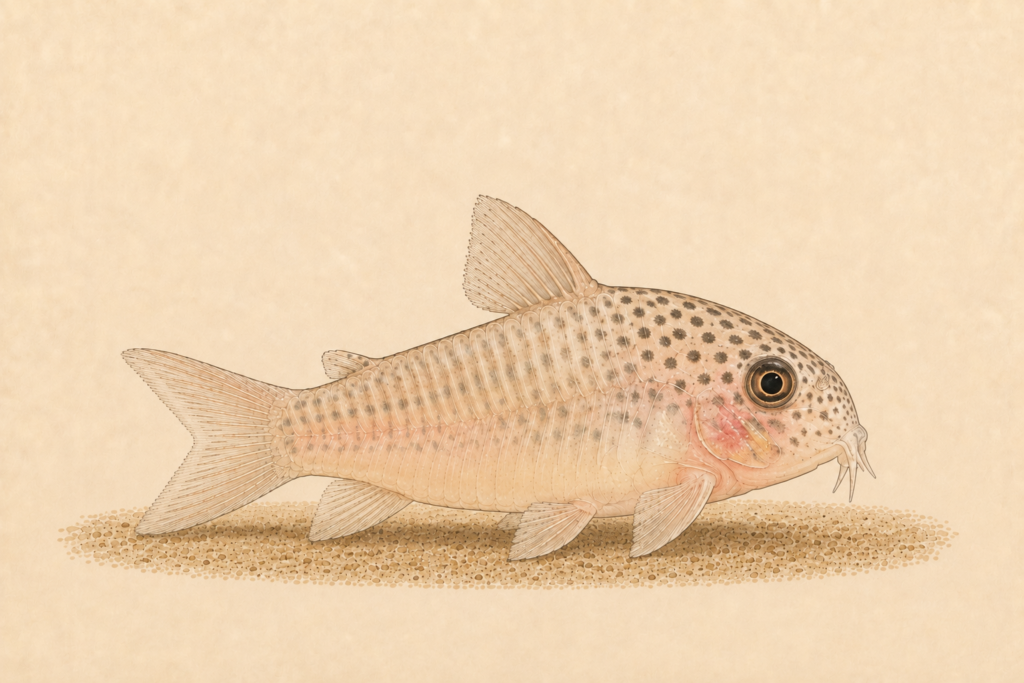
The Polystictus Cory is a compact, subtly attractive catfish that exemplifies the classic cory body plan. It has a short, deep body that is laterally compressed, with two rows of overlapping bony scutes running along each flank – the hallmark armour plating of the Callichthyidae. The head is rounded and slightly flattened ventrally, equipped with two pairs of short barbels around the mouth that the fish uses constantly to probe the substrate for food.
What sets this species apart from many of its relatives is the fine, dense speckling that covers much of the body. The base colour is a warm silvery-tan to pale gold, and across this ground colour lies a profusion of tiny dark brown to black spots. These spots are notably smaller and more numerous than those found on species such as the Spotted Cory (Hoplisoma ambiacum), giving the Polystictus Cory a finely peppered or stippled appearance that is best appreciated at close range. The spots extend across the head and onto the dorsal surface, and in good condition the overall effect is of a fish dusted with dark freckles.
The fins are largely translucent with a faint yellowish tint, and the dorsal and caudal fins may show rows of small dark spots that form broken bands. The eye is relatively large and dark, giving the fish an alert, inquisitive expression. Like other corydoras-type catfish, the dorsal fin features a stiff leading spine, as does each pectoral fin – these spines can lock into an erect position as a defence mechanism, so care should be taken when netting the fish to avoid entanglement.
Sexual dimorphism is subtle. Mature females tend to be slightly larger and fuller-bodied than males, particularly when viewed from above. Males are often a touch slimmer and may have slightly more pointed pectoral fins, though this difference is not always easy to discern without direct comparison of several specimens side by side. Both sexes display the characteristic fine spotting equally.
Natural Habitat
Hoplisoma polystictum originates from the upper Paraguay River basin in South America, with populations documented in both Brazil (Mato Grosso do Sul) and Paraguay. This region is characterised by a mosaic of habitats including slow-moving tributaries, seasonal floodplain pools, and marshy wetlands associated with the vast Pantanal ecosystem – one of the world’s largest tropical wetland areas.
In its native range, the Polystictus Cory inhabits shallow, slow-flowing or still waters with soft, sandy or muddy substrates. The water is typically warm, slightly acidic to neutral, and relatively soft. Fallen leaves, submerged roots, and aquatic vegetation provide cover and contribute tannins that lightly stain the water. The substrate is often a fine sand or silt, which the fish sifts through with its barbels in search of insect larvae, worms, and other small invertebrates.
Seasonal flooding plays an important role in the ecology of this region. During the wet season, water levels rise dramatically, expanding the available habitat and providing access to newly inundated areas rich in food. The dry season concentrates fish into smaller pools and channels, where water parameters can shift and dissolved oxygen may drop. This seasonal rhythm likely influences breeding behaviour, with spawning often triggered by changes in water temperature, conductivity, and flow associated with the onset of the rains.
Understanding this natural habitat helps inform captive care. The preference for soft substrates, gentle water movement, slightly acidic to neutral pH, and the presence of leaf litter and hiding places all translate directly into aquarium design choices that will help this species feel secure and display its natural behaviours.
Tank Size and Setup
A group of six Polystictus Corys can be comfortably housed in a tank of 60 litres or more. If you intend to keep a larger group – which is always preferable, as corys become noticeably more active and confident in bigger shoals – or wish to include other community species, a tank of 80 to 120 litres or larger is recommended. A rectangular tank with a generous footprint (floor area) is more important than height, as these are bottom-dwelling fish that spend the vast majority of their time on or near the substrate.
Substrate choice is critical for this species. A fine, smooth sand is the only truly appropriate option. Corys feed by plunging their barbels and mouths into the substrate, sifting mouthfuls of sand and expelling it through their gills to extract food particles. Coarse gravel, sharp-edged substrates, or rough materials can abrade and damage the delicate barbels, leading to erosion, infection, and a significant reduction in the fish’s quality of life. Play sand, pool filter sand, or purpose-sold aquarium sand in a natural colour all work well. A substrate depth of around 2 to 4 cm is sufficient.
Decor should provide a mix of open sandy areas for foraging and sheltered spots for resting and security. Pieces of driftwood, smooth stones, and caves or overhangs created from hardscape materials give the fish places to retreat. Live plants are beneficial and appreciated; species such as Java Fern, Anubias, Cryptocoryne, and Vallisneria are all suitable choices that tolerate the water parameters this species prefers. Floating plants can be used to diffuse overhead lighting, which helps the fish feel more secure – corys are often more active and visible in tanks that are not excessively brightly lit.
A scattering of dried Indian almond leaves or oak leaves on the substrate provides both a natural aesthetic and a source of tannins and biofilm that the fish will graze on. As the leaves decompose, they also support populations of microfauna that supplement the diet. Replace leaves as they break down, typically every few weeks.
Ensure the tank has a secure, well-fitting lid. Corys are capable of dashing to the surface to gulp atmospheric air – a normal behaviour related to their ability to perform intestinal respiration – and can occasionally leap out of open-topped tanks, particularly if startled.
Water Parameters
The Polystictus Cory is reasonably adaptable within its preferred range but does best in stable, clean conditions. Consistency is more important than hitting an exact number; avoid sudden swings in temperature, pH, or hardness. The table below summarises the recommended ranges for long-term care.
| Temperature | 22 – 26 C |
| pH | 6.0 – 7.5 |
| General hardness (GH) | 2 – 12 dGH |
| Carbonate hardness (KH) | 1 – 8 dKH |
| Ammonia | 0 ppm |
| Nitrite | 0 ppm |
| Nitrate | Below 20 ppm |
As with all corydoras-type catfish, the Polystictus Cory is sensitive to elevated nitrate levels and poor water quality in general. Regular partial water changes of 25 to 30 per cent weekly are strongly recommended. Use a dechlorinator when adding fresh water, and try to match the temperature and approximate chemistry of the replacement water to what is already in the tank to avoid shocking the fish.
The ideal water for this species is slightly soft and slightly acidic to neutral – around pH 6.5 to 7.0 with a GH of 4 to 8 dGH represents a comfortable sweet spot. However, captive-bred specimens often adapt well to moderately harder, slightly alkaline water provided it is kept clean and stable. Wild-caught fish, if encountered, may be more sensitive and benefit from softer, more acidic conditions.
Ammonia and nitrite must always be at zero. These compounds are toxic to all fish, and corys, being scaleless bottom-dwellers in close contact with the substrate where waste accumulates, can be among the first to show symptoms of poor water quality. If you detect any ammonia or nitrite, investigate immediately – the cause is usually overfeeding, overstocking, or a disruption to the biological filter.
Filtration and Equipment
Effective biological filtration is the cornerstone of successful cory keeping. Choose a filter rated for your tank size – or slightly above – that provides good biological capacity and gentle to moderate water movement. Corys come from slow-flowing or still waters and do not appreciate strong currents, particularly at the substrate level where they spend most of their time. If your filter output creates excessive flow, use a spray bar, lily pipe, or baffle to diffuse it.
Hang-on-back filters, internal power filters, and sponge filters are all suitable for tanks housing Polystictus Corys. Canister filters are excellent for larger setups. Sponge filters deserve a special mention: they provide gentle flow, excellent biological filtration, and no risk of trapping small fish or fry, making them particularly useful if you plan to breed your corys. An air-driven sponge filter also contributes to surface agitation, which aids gas exchange – important for a species that may occasionally gulp air at the surface.
A reliable heater is necessary to maintain the temperature within the recommended range. Use a heater with a built-in thermostat, and consider a separate thermometer to verify the actual water temperature. Position the heater near the filter outflow to help distribute heat evenly throughout the tank.
Lighting should be moderate. Very bright lighting can make corys more reclusive and may encourage excessive algae growth on the substrate. If you are growing live plants that require stronger light, use floating plants to create shaded areas at the bottom of the tank. A standard LED aquarium light on a timer set for 8 to 10 hours per day is usually appropriate.
An air pump with an airstone can be a beneficial addition, especially in warmer weather when dissolved oxygen levels may drop. The gentle bubbling also provides surface agitation and can encourage the corys’ natural behaviour of darting to the surface to gulp air, which they do even in well-oxygenated water as part of their normal respiratory physiology.
Diet and Feeding
The Polystictus Cory is an omnivore with a preference for small invertebrates and organic detritus in the wild. In the aquarium, it readily accepts a wide variety of prepared and live foods. A varied diet is the key to good health, strong colouration, and breeding condition.
High-quality sinking pellets or wafers designed for bottom-dwelling catfish should form the staple of the diet. These foods are formulated to sink quickly and hold together on the substrate long enough for the corys to find and consume them. Avoid relying on flake food alone, as much of it is intercepted by mid-water fish before it reaches the bottom, and what does settle tends to disintegrate quickly and foul the substrate.
Supplement the staple diet regularly with frozen or live foods. Bloodworm, daphnia, brine shrimp, tubifex, and mosquito larvae are all eagerly consumed. Live foods in particular seem to trigger heightened foraging activity and can be useful for conditioning fish for breeding. Frozen foods should be thawed before feeding. Offer these treats two to three times per week.
Blanched vegetables such as courgette (zucchini) slices, cucumber, and shelled peas can also be offered occasionally. While corys are not primarily herbivorous, they will nibble on softened vegetable matter and benefit from the fibre and micronutrients it provides. Remove any uneaten vegetable matter after a few hours to prevent it from decomposing and affecting water quality.
Feed once or twice daily, offering only as much food as the group can consume within a few minutes. It is easy to overfeed bottom-dwellers because uneaten food is less visible on the substrate than floating leftovers. Pay attention to the fish’s body condition: healthy corys should have gently rounded bellies without looking bloated or emaciated. If you notice food accumulating on the sand, reduce the portion size or frequency.
A common misconception is that corys can survive on leftover food from other fish. While they will certainly scavenge, they cannot be expected to thrive on scraps alone. They require their own targeted feeding, ideally after the aquarium lights have dimmed, when they are naturally most active.
Behaviour and Temperament
The Polystictus Cory is a peaceful, sociable catfish that displays the endearing behaviours common to the broader cory group. It is an obligate shoaling species and must be kept in groups of at least six. In smaller numbers, corys become stressed, reclusive, and more susceptible to illness. In groups of six or more, they form a tight-knit social unit, often resting together in a favourite spot during quieter periods and then foraging across the substrate in a coordinated, bustling group when active.
Foraging is the dominant behaviour. The fish move methodically across the sand, plunging their barbels into the substrate and rapidly sifting mouthfuls of sand in search of food particles. This constant probing gives the impression of busy, purposeful activity and is one of the most entertaining aspects of keeping corys. In a well-set-up tank with a fine sand substrate, you can observe the full repertoire of natural foraging behaviour.
Corys are well known for their habit of darting to the surface to gulp air. This behaviour – intestinal respiration – is entirely normal and not a sign of distress. The fish swallows a bubble of air at the surface and extracts oxygen from it in a specialised section of the intestine. Even in well-oxygenated tanks, you will see this behaviour periodically. However, if the entire group is constantly rushing to the surface to breathe, this may indicate low dissolved oxygen or poor water quality, and you should investigate.
The Polystictus Cory is most active during dawn, dusk, and night-time hours, though in a well-established aquarium with dim or moderate lighting, it will often be active throughout the day as well. Providing subdued lighting and plenty of cover encourages daytime activity. When resting, the group typically congregates under a piece of driftwood, inside a cave, or among dense plant growth.
This species is entirely non-aggressive. It poses no threat whatsoever to other fish, shrimp, or snails. Its only defence mechanism is the ability to lock its dorsal and pectoral spines erect, which makes it difficult for predators to swallow. This same mechanism means you should never net corys with a fine mesh net, as the spines can become hopelessly entangled. Use a plastic container or coarse mesh net instead.
Tank Mates
The Polystictus Cory’s peaceful, non-competitive nature makes it compatible with a wide range of small to medium community fish. The ideal tank mates are species that occupy the middle and upper water columns, leaving the bottom largely to the corys, and that share similar water parameter preferences. Avoid any species large enough to view the cory as prey, and avoid aggressive or territorial bottom-dwellers that might harass or outcompete the corys for food and space.
Good tank mates
- Cardinal Tetra – A classic mid-water companion that thrives in the same soft, slightly acidic water conditions.
- Ember Tetra – A tiny, peaceful tetra that occupies the mid-water zone and adds warm colour without competing for bottom space.
- Rummy-Nose Tetra – A tight-shoaling tetra that shares the cory’s preference for warm, soft water and gentle flow.
- Harlequin Rasbora – A gentle, undemanding rasbora well suited to the same water parameters and peaceful community setup.
- Pearl Gourami – A calm, slow-moving surface-to-mid-water dweller that coexists peacefully with bottom-dwelling corys.
- Otocinclus – A small algae-eating catfish that shares similar water preferences and poses no competitive threat.
- Kuhli Loach – A peaceful, nocturnal bottom-dweller that coexists well with corys provided there is ample floor space and hiding spots.
- Cherry Shrimp – Entirely safe with corys, which show no predatory interest in adult shrimp and largely ignore juveniles.
Fish to avoid
- Oscar – Far too large and predatory; would readily consume a small cory.
- Jack Dempsey – Aggressive and territorial, posing a serious risk of injury or death to small bottom-dwellers.
- Common Pleco – Grows extremely large and can become territorial over substrate space, outcompeting small corys.
- Red-Tail Catfish – A massive predatory catfish completely incompatible with any small community fish.
- Tiger Barb – Notorious fin-nipper that can harass slower bottom-dwellers, causing chronic stress.
- Convict Cichlid – Highly territorial, especially when breeding, and will aggressively attack corys that enter their defended area.
Breeding
Breeding the Polystictus Cory in captivity is achievable and follows the general pattern seen across the cory group. While not as frequently bred as some of the more common species, dedicated hobbyists have had success by replicating the environmental triggers associated with the onset of the rainy season in the fish’s native range.
Begin by conditioning a group of at least six adults (ideally with a higher ratio of males to females, such as two males per female) on a rich diet of live and frozen foods for several weeks. Bloodworm, daphnia, and brine shrimp are all excellent conditioning foods. Well-conditioned females will appear noticeably rounder when viewed from above.
To trigger spawning, perform a large (50 to 70 per cent) water change using water that is a few degrees cooler than the tank temperature and slightly softer if possible. This simulates the influx of cool rainwater that triggers breeding in the wild. Repeating this process over several days often prompts spawning behaviour. A drop in barometric pressure associated with stormy weather has also been anecdotally linked to spawning in many cory species.
Spawning typically follows the classic cory “T-position” ritual. The female cups her ventral fins to form a basket, into which she releases a small number of adhesive eggs. The male fertilises the eggs, and the female then carries them to a chosen surface – usually the glass, a broad leaf, or a smooth piece of decor – and presses them firmly into place. This process is repeated many times over the course of several hours, resulting in a total clutch that may number from 30 to over 100 eggs, deposited singly or in small clusters.
The eggs are small, round, and initially pale, darkening slightly as they develop. They typically hatch within three to five days at around 24 to 25 C. Fungus is the greatest threat to the eggs; adding a few drops of methylene blue to the water or using an antifungal treatment can help protect them. Many breeders choose to remove the eggs to a separate hatching container with gentle aeration and clean water to reduce the risk of predation by the adults or other tank inhabitants.
Newly hatched fry are tiny and will initially absorb their yolk sacs. Once free-swimming, they can be fed infusoria, powdered fry food, or commercially available liquid fry food. After a week or so, they are typically large enough to accept microworms and freshly hatched baby brine shrimp. Growth is steady but not rapid; with good feeding and regular small water changes, the fry will reach a recognisable cory shape within a few weeks and can be introduced to the main tank once large enough not to be consumed by other inhabitants.
Common Diseases
The Polystictus Cory is generally hardy when kept in appropriate conditions, but like all aquarium fish, it can be affected by a number of common ailments, particularly when water quality is compromised or the fish is stressed.
Barbel erosion is one of the most frequently encountered problems in corys. It is caused by keeping the fish on sharp or rough substrates (such as coarse gravel or crushed coral) or in tanks with persistently poor water quality. The barbels become shortened, reddened, and may develop secondary bacterial infections. Prevention is straightforward: always use fine, smooth sand and maintain excellent water quality. Mild cases often resolve once the underlying cause is corrected.
White spot disease (Ich), caused by the parasite Ichthyophthirius multifiliis, presents as small white spots on the body and fins. It is usually triggered by temperature fluctuations or stress from transport. Treatment involves gradually raising the temperature to 28 to 30 C (if the species tolerates it) and using a white spot remedy. Note that corys can be sensitive to some medications, particularly those containing copper or formalin. Always use treatments at half the recommended dose initially and monitor the fish closely, or choose medications specifically labelled as safe for scaleless fish.
Bacterial infections can manifest as reddened patches on the body, frayed fins, or open sores. These are almost always secondary to poor water quality, physical injury, or stress. Improving water conditions is the first and most important step; targeted antibiotic treatment may be necessary in severe cases.
Fungal infections appear as white, cottony growths on the body or fins. They often develop on wounds or areas of damaged skin. Antifungal medications are effective, but again, address the root cause – usually poor water quality or physical damage from unsuitable decor or substrate.
Internal parasites can occasionally affect wild-caught specimens, causing weight loss, lethargy, and stringy white faeces. If you suspect internal parasites, a course of anti-parasitic food or medication may be required. Quarantining new arrivals for two to four weeks before adding them to an established community is strongly recommended to prevent the introduction of parasites or other pathogens.
FAQs
Is the Polystictus Cory the same as Corydoras polystictus?
Yes. Following the 2024 taxonomic revision of the family Callichthyidae, this species was moved from the genus Corydoras to the genus Hoplisoma. Both names refer to the same fish. You will still see the older name Corydoras polystictus used widely in shops, online retailers, and older reference books. The care requirements are identical regardless of which name is used.
How many Polystictus Corys should I keep together?
A minimum of six is recommended, and more is always better. Corys are obligate shoaling fish that rely on the security of a group to feel safe and display natural behaviours. In groups smaller than six, they tend to be shy, stressed, and more prone to illness. A group of eight to twelve in an appropriately sized tank will reward you with far more confident, active, and entertaining fish.
Can I keep Polystictus Corys on gravel?
It is strongly advised against. Corys feed by sifting sand through their gills, and sharp or coarse gravel can damage their sensitive barbels, leading to erosion, infection, and chronic discomfort. Fine, smooth sand is the only substrate that allows this species to feed naturally and safely. If your tank currently has gravel, consider either replacing it entirely or creating a large sandy area specifically for the corys.
Why do my Polystictus Corys keep swimming to the surface?
Occasional dashes to the surface to gulp air are completely normal. Corys have the ability to extract oxygen from swallowed air in a specialised section of their intestine – a process called intestinal respiration. You will see this behaviour even in perfectly oxygenated tanks. However, if the fish are doing this constantly and seem frantic, it could indicate low dissolved oxygen levels, elevated ammonia or nitrite, or another water quality problem. Test your water immediately in such cases.
Are Polystictus Corys safe with shrimp?
Yes, adult shrimp such as Cherry Shrimp and Amano Shrimp are safe with Polystictus Corys. Corys are not predatory and show no interest in hunting shrimp. Very tiny newborn shrimp might occasionally be eaten if encountered, but this is opportunistic rather than deliberate predation, and in a well-planted tank with plenty of cover, shrimp colonies typically thrive alongside cory groups.
Related Guides
- Bronze Cory – One of the most commonly kept cory species, sharing very similar care requirements and an excellent starting point for cory beginners.
- Peppered Cory – Another popular and hardy cory species with overlapping care needs and compatible temperament.
- Panda Cory – A small, attractively marked cory that thrives in similar conditions and makes an excellent companion species.
- Pygmy Cory – A miniature cory species for nano tanks, demonstrating the diversity within the cory group and offering an alternative for smaller setups.
- Otocinclus – A peaceful algae-eating catfish that pairs well with corys in soft-water community tanks.