Quick Summary
The Red-Line Lizard Tetra is a peaceful, active shoaling characin best suited to intermediate fishkeepers who can provide a spacious, well-oxygenated tank with moderate current and soft, acidic water. It rewards the effort with constant, elegant movement and a striking red lateral stripe that few other tetras can match.
🐠 Build a tank around this species
In this guide:
- Introduction
- Quick Stats
- Appearance
- Natural Habitat
- Tank Size and Setup
- Water Parameters
- Diet and Feeding
- Behaviour and Temperament
- Tank Mates
- Breeding
Introduction
The Red-Line Lizard Tetra (Iguanodectes geisleri) is one of the more unusual characins available to freshwater aquarists. Unlike the deep-bodied tetras that dominate the hobby, this species is noticeably slender, elongated, and almost pike-like in profile – hence the common name’s reference to a “lizard.” It belongs to the family Iguanodectidae, a small group of streamlined South American characins that occupy fast-flowing waters in the Amazon basin. In the aquarium trade it is sometimes sold simply as Lizard Tetra or Red-Line Tetra, though it should not be confused with other red-striped species from unrelated genera.
What draws most hobbyists to this fish is the vivid red lateral stripe that runs along its flanks from behind the gill cover towards the caudal fin. Against a translucent, silvery body, the effect is elegant and eye-catching, especially when a group of eight or more fish swim together in synchronised formation. Red-Line Lizard Tetras are perpetual motion machines – they spend most of the day cruising in the mid-to-upper water column, rarely resting for long. This active nature is part of their charm but also dictates some of the husbandry requirements, particularly around tank length, water flow, and swimming space.
While not a difficult fish to keep, Iguanodectes geisleri is a step up from beginner-friendly species like Neon Tetras or Black Neons. It has a stronger preference for soft, acidic water, benefits from moderate current, and needs a longer aquarium than its modest adult size might suggest. For aquarists who already have some experience maintaining stable water chemistry and who want a lively, less commonly seen shoaler, the Red-Line Lizard Tetra is an excellent choice.
Quick Stats
| Scientific name | Iguanodectes geisleri |
|---|---|
| Common names | Lizard Tetra, Red-Line Tetra |
| Family | Iguanodectidae |
| Origin | Amazon basin, Brazil (Rio Negro, Rio Madeira) |
| Adult size | 5.5 cm |
| Difficulty | Intermediate |
| Breeding difficulty | Advanced |
| Temperature | 20–26 °C |
| pH | 5–7 |
| GH | 1–5 dGH |
| Minimum tank size | 150 L |
| Conservation status | Least Concern (IUCN, assessed 2020) |
Appearance
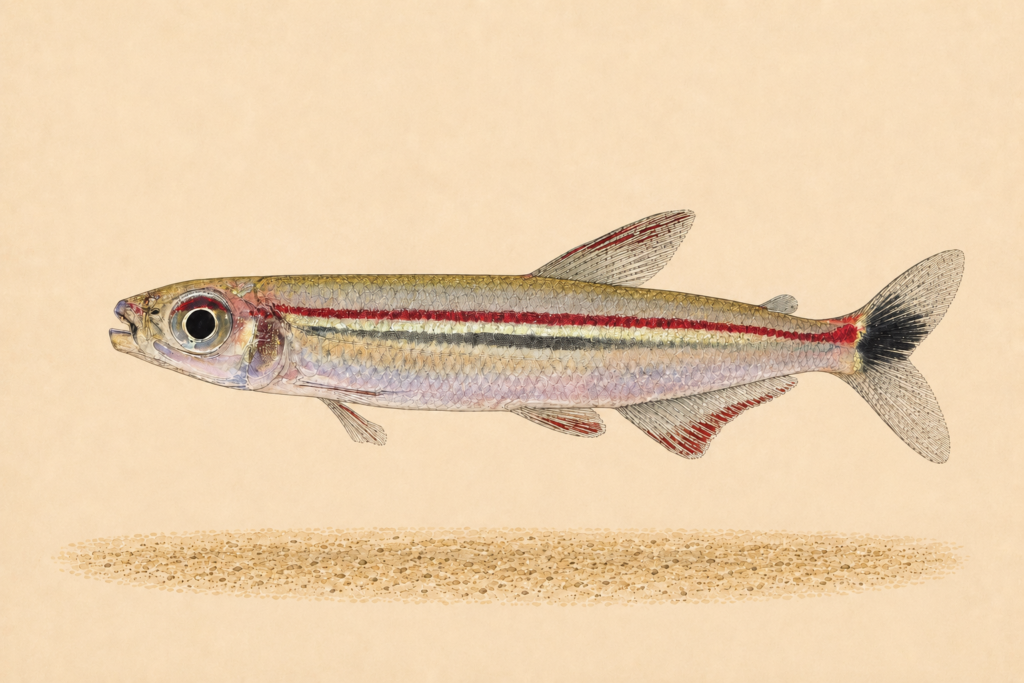
The first thing most people notice about the Red-Line Lizard Tetra is its body shape. Where many popular tetras are deep-bodied and laterally compressed, Iguanodectes geisleri is elongated and torpedo-shaped, with a narrow, slightly flattened profile that speaks to its preference for flowing water. The body tapers smoothly from a small head to a deeply forked caudal fin, giving the fish a streamlined silhouette that is quite distinct among community characins.
The base coloration is silvery to translucent, often with a faint olive or golden sheen along the dorsal surface. The signature feature is a bold, bright red lateral line that extends horizontally from just behind the operculum (gill plate) to the base of the tail. In healthy, well-conditioned specimens kept in soft, slightly tannin-stained water, this line can be remarkably vivid – almost neon in intensity. Below the red stripe there is sometimes a faint secondary line of darker pigment, giving a subtle two-toned striped effect.
The fins are largely transparent to lightly tinted. The caudal fin is deeply forked and may carry a faint reddish or yellowish wash, especially in mature males. The dorsal, anal, and pelvic fins are clear or slightly hyaline. The eyes are relatively large in proportion to the head, a trait common to many active, mid-water characins. There is an adipose fin present, as is typical of the order Characiformes.
Sexual dimorphism is not strongly pronounced. Mature females tend to be slightly fuller-bodied, particularly when carrying eggs, while males may show marginally more intense red coloration and a slimmer profile. However, distinguishing the sexes reliably outside of spawning condition can be challenging, and colour intensity varies considerably with diet, water chemistry, and overall health.
Under optimal conditions – soft, acidic water with some tannins, a dark substrate, and a varied diet – the red line becomes the centrepiece of the fish’s appearance. In hard, alkaline, or brightly lit conditions the colours tend to wash out, leaving the fish looking rather plain. This is worth bearing in mind when designing the aquascape.
Natural Habitat
Iguanodectes geisleri is found in the central Amazon basin, primarily in the Rio Negro and its tributaries, as well as parts of the Rio Madeira drainage in Brazil. These rivers are archetypal blackwater systems – slow to moderately flowing waterways heavily stained with tannins from decomposing leaf litter and submerged wood. The water is characteristically soft, acidic, and low in dissolved minerals, with a pH that can drop well below 5.0 in some locations during the dry season.
In its natural environment, the Red-Line Lizard Tetra inhabits areas of gentle to moderate current, typically in the mid-water column of forest streams, flooded forest margins, and smaller tributary channels. The substrate is usually sandy or composed of fine leaf litter, and the riparian vegetation provides dappled shade rather than total darkness. Submerged branches, root tangles, and fallen leaves create a complex habitat structure, though the fish themselves prefer the open water between these features rather than hiding within them.
These habitats are warm year-round, with temperatures generally ranging from 24 to 28 degrees Celsius. The water is nutrient-poor, and the dark tannin staining filters out much of the ambient light, creating subdued conditions. This low-light, low-mineral environment is key to understanding the species’ captive requirements. While Iguanodectes geisleri is somewhat adaptable, replicating at least some of these blackwater conditions in the aquarium will yield the best health, colour, and behaviour.
In the wild, Red-Line Lizard Tetras are found in loose shoals, often alongside other small characins, pencilfish, and dwarf cichlids. They feed on small invertebrates, insect larvae, and organic detritus that drifts in the current. Their streamlined body and active swimming style are well suited to life in flowing water, and they are noticeably more restless and active than many of the more sedate tetras that share their range.
Tank Size and Setup
Despite reaching only around 8 to 10 centimetres, the Red-Line Lizard Tetra’s active, horizontal swimming style means it needs more space than its size alone might suggest. A minimum tank size of 150 litres is recommended, with a strong emphasis on tank length rather than height – a tank at least 100 cm (roughly 40 inches) long is ideal. These fish spend the vast majority of their time cruising horizontally through the mid-to-upper water column, and a short, deep tank will frustrate this natural behaviour, potentially leading to stress and subdued coloration.
The aquascape should balance open swimming space with some visual complexity. Leave the central and front portions of the tank relatively uncluttered to provide a clear swimming lane. Along the back and sides, arrange pieces of driftwood and bogwood to create a natural framework. Driftwood serves a dual purpose here: it provides aesthetic structure and slowly releases tannins into the water, helping to soften and acidify it – exactly the conditions this species prefers. Smooth river stones or pebbles can be added for variety but are not essential.
A dark, fine-grained substrate – sand or fine gravel in brown, black, or natural tones – will show off the fish’s red lateral line to best effect. Light-coloured substrates tend to wash out the colours and can make the fish feel exposed. Live plants are welcome but should be chosen with care. Species that tolerate soft, acidic water and lower light levels work best: Java Fern, Anubias species, Cryptocorynes, and Vallisneria are all good options. Floating plants such as Amazon Frogbit or Salvinia can be used to diffuse overhead light, mimicking the dappled shade of the forest canopy. Avoid creating a densely planted jungle that eliminates open swimming space.
A secure lid or cover glass is recommended. While Red-Line Lizard Tetras are not notorious jumpers in the way that some surface-dwelling species are, their speed and active nature mean they can occasionally launch themselves out of the water if startled. This risk is highest in open-topped tanks with strong overhead lighting or if the fish are chased by aggressive tank mates.
Lighting should be moderate to subdued. The natural blackwater habitats of this species receive filtered, low-intensity light, and replicating this in the aquarium brings out the best colour. If brighter lighting is needed for plant growth, floating plants or tannin-stained water can reduce the effective light reaching the fish. Adding Indian almond leaves (Terminalia catappa) or alder cones to the tank is a simple and effective way to introduce tannins, lower pH, and provide a more naturalistic feel.
Water Parameters
| Temperature | 20-26 C |
| pH | 5.0-7.0 |
| General hardness (GH) | 1-5 dGH |
| Ammonia | 0 ppm |
| Nitrite | 0 ppm |
| Nitrate | Below 20 ppm |
The Red-Line Lizard Tetra is a soft-water species that does best when kept in acidic to neutral conditions. A pH between 5.5 and 6.5 is the sweet spot for optimal colour and health, though the fish can tolerate a range from about 5.0 to 7.0. General hardness should be kept low – ideally below 6 dGH, though values up to 8 dGH are usually tolerated without obvious ill effects. Carbonate hardness (KH) should also be low, between 1 and 4 dKH. Aquarists in areas with hard, alkaline tap water may need to use reverse osmosis (RO) water or a mix of RO and tap water to achieve suitable chemistry.
Stability is more important than hitting a precise number. Sudden swings in pH or hardness are far more harmful than keeping the fish at a slightly higher but consistent value. If your tap water sits at pH 7.0 and GH 6, the fish will likely adapt well, provided conditions remain steady. However, trying to maintain very low pH without adequate buffering can lead to dangerous crashes, so proceed with caution if targeting the lower end of the range.
Temperature should be maintained between 24 and 28 degrees Celsius. The mid-range – around 25 to 26 C – is a comfortable year-round target for most community setups. Water quality must be kept pristine: ammonia and nitrite must be at zero at all times, and nitrate should be kept below 20 ppm through regular water changes. A weekly water change of 20 to 30 per cent is a good baseline, though tanks with heavier stocking or feeding may need more frequent changes.
The addition of tannins – via driftwood, Indian almond leaves, or peat filtration – is highly beneficial. Tannins mimic the natural blackwater conditions of the species’ habitat, help to keep pH gently acidic, and are thought to have mild antibacterial and antifungal properties. The amber tint they produce in the water also reduces light penetration, which encourages bolder behaviour and richer coloration.
Filtration and Equipment
Filtration for the Red-Line Lizard Tetra should prioritise two things: excellent mechanical and biological filtration, and the creation of moderate water flow. These fish come from habitats with some current and are visibly more comfortable and active when a gentle to moderate flow runs through the tank. An external canister filter rated for the tank volume (or slightly above) is an excellent choice, as it provides strong filtration capacity and allows the outlet to be directed to create a linear current along the length of the tank. A spray bar positioned along the back wall is a particularly effective way to generate even flow without creating turbulent dead spots or excessive surface agitation.
If additional current is desired, a small circulation pump or powerhead can be added. Aim for a flow that is noticeable but not overwhelming – the fish should be able to swim comfortably against it without being blown around. Observe the fish’s behaviour after making any changes to flow; if they are constantly sheltering behind decor or struggling to maintain position, the current is too strong.
A reliable heater is essential for maintaining stable tropical temperatures. Choose a heater rated for the tank volume – as a general rule, 1 watt per litre is a reasonable starting point, though this varies with ambient room temperature. In larger tanks, two smaller heaters positioned at opposite ends provide more even heat distribution and offer redundancy in case one fails. A separate digital thermometer (rather than relying solely on the heater’s built-in thermostat) is recommended for accurate monitoring.
Lighting should be moderate. Standard LED aquarium lights with adjustable intensity work well; simply dim them or use a timer to provide a consistent photoperiod of around 8 to 10 hours per day. If the light is too bright, floating plants or tannin staining will naturally reduce intensity at the water surface.
An air pump is not strictly necessary if the filter provides adequate surface agitation for gas exchange. However, in warmer setups (above 27 C), dissolved oxygen levels drop, and supplementary aeration via a small air stone can be beneficial.
Diet and Feeding
The Red-Line Lizard Tetra is an omnivore with a slight preference for small invertebrates and insect-based foods. In the wild it feeds on tiny crustaceans, insect larvae, and organic detritus carried in the current. In captivity it is not a fussy eater, readily accepting a wide variety of prepared, frozen, and live foods.
A good-quality flake or micro-pellet food should form the staple diet. Choose products with high protein content and minimal fillers – those based on whole fish, insect meal, or crustacean ingredients are ideal. The food should be small enough for the fish’s relatively modest mouth; fine flakes or slow-sinking micro-granules are preferable to large pellets.
Supplement the staple diet regularly with frozen or live foods. Daphnia, baby brine shrimp, cyclops, mosquito larvae, and bloodworm are all eagerly taken and contribute to better colour, condition, and overall vitality. Offering these protein-rich foods two to three times per week is a good target. Live foods are particularly valuable for conditioning fish prior to breeding attempts, though frozen alternatives are perfectly adequate for day-to-day nutrition.
Feed small amounts two to three times daily rather than one large feeding. Red-Line Lizard Tetras are active fish with a fast metabolism, and multiple small meals mimic their natural grazing behaviour more closely than a single daily dump of food. Each feeding should be consumed within two to three minutes; remove any uneaten food promptly to prevent water quality issues.
Variety is the key to a balanced diet. Rotating between different brands and types of prepared food, supplemented with frozen and occasional live offerings, ensures the fish receive a full spectrum of nutrients. Spirulina-based flakes or blanched vegetable matter can be offered occasionally, though plant material makes up only a small proportion of the natural diet.
Behaviour and Temperament
The Red-Line Lizard Tetra is a peaceful, active shoaling fish. It spends the vast majority of its time in the mid-to-upper water column, cruising in loose formation with its shoal mates. The swimming style is notably more linear and purposeful than that of many popular tetras – rather than meandering or hovering, these fish tend to swim steadily in one direction, turn, and swim back, almost like tiny barracuda patrolling a reef. This behaviour is most evident when moderate current is present, as the fish appear to enjoy positioning themselves in the flow.
This species should be kept in groups of at least six, with eight or more being strongly preferred. In smaller numbers the fish tend to be skittish, pale, and prone to hiding. In a proper shoal they are bolder, display more vivid coloration, and exhibit the coordinated swimming behaviour that makes them so attractive. A shoal of ten or twelve Red-Line Lizard Tetras in a well-designed tank is a genuinely impressive sight.
Within the group there may be occasional, harmless sparring – brief chases or displays of dominance between males – but these interactions rarely escalate and do not result in physical damage. The fish are not fin nippers and pose no threat to long-finned or slow-moving tank mates, provided the tank is large enough to give everyone adequate space.
Red-Line Lizard Tetras can be somewhat shy when first introduced to a new aquarium, spending the first few days hiding among plants or driftwood. This is normal acclimation behaviour and typically resolves within a week as the fish settle in. Subdued lighting, tannin-stained water, and the presence of dither fish (other peaceful, active species already established in the tank) can speed up the adjustment process considerably.
These fish are diurnal and most active during the day. They tend to rest quietly near the surface or among plant cover at night and become active again shortly after the lights come on (or when ambient daylight increases). They are not known to be particularly sensitive to noise or vibration, but like all fish, they benefit from a stable, calm environment free of sudden disturbances.
Tank Mates
The Red-Line Lizard Tetra’s peaceful nature and preference for the mid-to-upper water column make it compatible with a wide range of similarly sized, non-aggressive community species. The best companions are those that share a preference for soft, acidic water and a calm temperament. Avoid anything large enough to eat them, anything aggressive or territorial enough to bully them, and anything that requires significantly different water parameters.
Good tank mates
- Cardinal Tetra – A classic soft-water companion that occupies a similar water column and thrives in identical conditions.
- Rummy-Nose Tetra – Another active shoaler from blackwater habitats that complements the Red-Line Lizard Tetra beautifully.
- Ember Tetra – A small, peaceful species that adds warm colour to the lower-mid water column without competing for space.
- Nannostomus Pencilfish – Quiet, slender fish from similar habitats that stay near the surface and pose no threat.
- Corydoras sterbai – A warm-water-tolerant bottom dweller that stays out of the Lizard Tetra’s preferred swimming zone.
- Apistogramma cacatuoides – A small dwarf cichlid that occupies the bottom of the tank and coexists well in soft, acidic setups.
- Otocinclus – Gentle algae grazers that share a preference for warm, soft water and stay near surfaces and the substrate.
- Harlequin Rasbora – A similarly peaceful mid-water shoaler that thrives in soft, acidic conditions.
- Kuhli Loach – A nocturnal bottom dweller that avoids all conflict and appreciates the same warm, soft water.
Fish to avoid
- Oscar – Far too large and predatory; would view Red-Line Lizard Tetras as food.
- Tiger Barb – Boisterous and prone to fin-nipping behaviour that would stress this species.
- Convict Cichlid – Aggressive and territorial, especially when breeding, and prefers harder, more alkaline water.
- African Rift Lake Cichlids – Entirely incompatible water parameters (hard, alkaline) and generally aggressive temperament.
- Red-Tail Shark – Territorial and increasingly aggressive with age, likely to harass mid-water shoalers.
- Green Terror – A large, aggressive cichlid that would dominate and endanger small tetras.
- Betta – While not necessarily aggressive towards Lizard Tetras, the Betta’s need for minimal current conflicts with this species’ preference for flow, making cohabitation impractical.
Breeding
Breeding the Red-Line Lizard Tetra in captivity is challenging and relatively rarely accomplished in home aquaria. There is limited documented information on successful captive breeding of Iguanodectes geisleri compared to more popular characins. However, the general approach follows patterns observed in related species and other soft-water egg-scattering tetras.
To condition potential breeders, separate a group of the healthiest, most vibrantly coloured individuals and feed them heavily on live and frozen foods – baby brine shrimp, daphnia, and mosquito larvae – for two to three weeks. Females in spawning condition will appear noticeably fuller in the belly, while males may display intensified red coloration along the lateral line.
A dedicated breeding tank is strongly recommended. A tank of around 60 to 80 litres, dimly lit, with very soft, acidic water (pH 5.5 to 6.0, GH below 3 dGH) and a temperature of 26 to 27 C provides suitable conditions. The bottom should be bare or covered with a layer of fine-leaved plants or spawning mops to catch the scattered eggs. A gentle sponge filter provides biological filtration without creating enough suction to trap eggs or fry.
Like many characins, Red-Line Lizard Tetras are believed to be egg scatterers that show no parental care. Eggs are released among fine-leaved vegetation or scattered freely, and the adults will eat them if given the opportunity. For this reason, remove the adults promptly after spawning is observed or suspected. The eggs are small and semi-transparent, and they typically hatch within 24 to 48 hours depending on temperature.
Newly hatched fry are tiny and will subsist on their yolk sacs for the first day or two before becoming free-swimming. Initial foods should be infusoria or liquid fry food, graduating to freshly hatched baby brine shrimp (Artemia nauplii) as the fry grow. Maintaining pristine water quality in the fry tank is critical – small, frequent water changes with carefully matched parameters are essential to prevent losses.
Growth can be slow, and the fry are delicate in the early weeks. Patience, meticulous water quality management, and a steady supply of appropriately sized live foods are the keys to success. Even experienced breeders may find the survival rate to be lower than with more commonly bred tetra species.
Common Diseases
The Red-Line Lizard Tetra is not particularly disease-prone when kept in clean, stable, appropriately soft water. Most health issues that arise are linked to poor water quality, incorrect parameters, or the stress of transport and acclimatisation. Newly imported specimens can be especially vulnerable, as wild-caught fish may arrive stressed, underfed, and exposed to pathogens during the supply chain.
Ich (white spot disease) is perhaps the most common ailment seen in newly acquired fish. It presents as small white cysts on the fins and body, and affected fish may flash (rub against surfaces) or clamp their fins. Ich is highly treatable if caught early – raising the temperature to 28 to 30 C and administering a proprietary white-spot treatment according to the manufacturer’s instructions usually resolves the issue within a week. Note that some ich medications contain copper, which should be used cautiously and at reduced doses in very soft water, as the lack of mineral buffering can make copper more toxic.
Bacterial infections – fin rot, ulcers, and columnaris – can occur in tanks with poor water quality or where fish are stressed. Symptoms include frayed or eroding fins, reddened patches on the skin, and lethargy. Improving water quality is always the first and most important step; targeted antibacterial treatments may be necessary in more advanced cases.
Fungal infections (saprolegnia and similar) occasionally appear, particularly on fish with existing wounds or in poorly maintained tanks. They present as cotton-like white growths on the body or fins. Antifungal medications are effective, but again, addressing the underlying cause – usually poor water quality or physical damage – is essential for long-term resolution.
Internal parasites are a possibility with wild-caught specimens. Signs include weight loss despite normal feeding, stringy or white faeces, and a generally emaciated appearance. Deworming treatments containing praziquantel or levamisole can be effective, but diagnosis can be difficult without microscopic examination. Quarantining all new arrivals for at least two to four weeks in a separate tank is the single best preventative measure against introducing parasites or disease into an established community.
Maintaining stable, soft, acidic water with low nitrate levels, feeding a varied and nutritious diet, and avoiding overcrowding or aggressive tank mates will prevent the vast majority of health problems. Prevention is always far more effective – and less stressful for the fish – than treatment.
FAQs
How many Red-Line Lizard Tetras should I keep together?
A minimum of six is necessary, but eight to twelve or more is strongly recommended. Larger groups result in bolder, more colourful fish that exhibit their natural shoaling behaviour far more convincingly. In groups of fewer than six, individuals tend to be pale, nervous, and prone to hiding, which defeats the purpose of keeping this naturally active and attractive species.
Can I keep Red-Line Lizard Tetras in hard, alkaline water?
They can survive in moderately hard water (up to around 8 dGH) at a neutral pH, but they will not thrive or display their best colour. If your tap water is significantly hard or alkaline – for example, above pH 7.5 or GH 10 – you will likely need to blend it with reverse osmosis water to bring parameters into a suitable range. Keeping them in hard, alkaline water long-term increases stress and susceptibility to disease.
Do Red-Line Lizard Tetras need a lot of current?
They appreciate moderate current more than most tetras, but they do not need a torrent. A gentle to moderate linear flow along the length of the tank, created by a canister filter spray bar or a small powerhead, is ideal. The fish should be able to swim comfortably against the current without being swept around. If they are constantly sheltering behind decor, the flow is too strong.
Are Red-Line Lizard Tetras good for a planted tank?
Yes, provided the planting does not eliminate open swimming space. They are entirely plant-safe and will not damage or uproot vegetation. Choose plants that tolerate soft, acidic water and lower light levels, such as Java Fern, Anubias, and Cryptocorynes. Leave the central area of the tank relatively clear for swimming and concentrate planting along the back and sides.
Why are my Red-Line Lizard Tetras losing their red colour?
Faded coloration is almost always a sign of stress or suboptimal conditions. The most common causes are water that is too hard or alkaline, excessively bright lighting, a lack of tannins in the water, a pale substrate, an insufficient group size, or a poor diet. Review each of these factors systematically. Introducing driftwood or Indian almond leaves, switching to a darker substrate, dimming the lights, and increasing the group size are the most effective steps for restoring vibrant colour.
Related Guides
- Cardinal Tetra Care Guide – Another iconic soft-water tetra that makes an ideal companion species in a blackwater community.
- Rummy-Nose Tetra Care Guide – A fellow active shoaler from similar South American habitats with comparable care requirements.
- Apistogramma cacatuoides Care Guide – A popular dwarf cichlid that pairs beautifully with soft-water tetras in a community setup.
- Corydoras sterbai Care Guide – A warm-water-tolerant catfish that complements mid-water shoa