Fairy Cichlid Care Guide — Tank Setup, Feeding and Breeding
Introduction
The Fairy Cichlid, known scientifically as Neolamprologus brichardi, is one of the most elegant and captivating cichlids to emerge from the rift lakes of Africa. First described by Max Poll in 1974 and named after the renowned fish collector Pierre Brichard, this species has become a firm favourite among aquarists who appreciate its graceful finnage, fascinating social behaviour, and relative ease of care. Hailing from the rocky shorelines of Lake Tanganyika, the Fairy Cichlid brings a touch of refined beauty to any freshwater aquarium that can meet its requirements.
What truly sets Neolamprologus brichardi apart from many other cichlids is its remarkable cooperative breeding behaviour. Unlike the majority of cichlid species, which aggressively drive away previous broods when new fry arrive, the Fairy Cichlid allows older offspring to remain within the family group. These older juveniles actively assist in defending subsequent broods, creating a complex social hierarchy rarely seen in the aquarium hobby. This behaviour alone makes them endlessly interesting to observe and study.
Despite originating from a very specific lacustrine environment, the Fairy Cichlid adapts well to aquarium life and is considered suitable for hobbyists with moderate experience. They are not as demanding as some of the more specialised Tanganyikan species, though they do require stable, alkaline water conditions and a thoughtfully arranged tank. This guide covers everything you need to know to keep and breed Neolamprologus brichardi successfully in the home aquarium.
Quick Stats
| Scientific name | Neolamprologus brichardi |
| Common names | Fairy Cichlid, Princess of Burundi, Lyretail Cichlid, Brichard’s Lamprologus |
| Family | Cichlidae |
| Origin | Lake Tanganyika, East Africa (Burundi, Democratic Republic of the Congo, Tanzania, Zambia) |
| Adult size | 8–10 cm |
| Lifespan | 8–10 years |
| Difficulty | Moderate |
| Breeding difficulty | Easy |
| Temperature | 24–27 °C |
| pH range | 7.8–9.0 |
| General hardness (GH) | 10–20 dGH |
| Carbonate hardness (KH) | 10–15 dKH |
| Minimum tank size | 150 litres |
| Conservation status | Least Concern (IUCN) |
Appearance
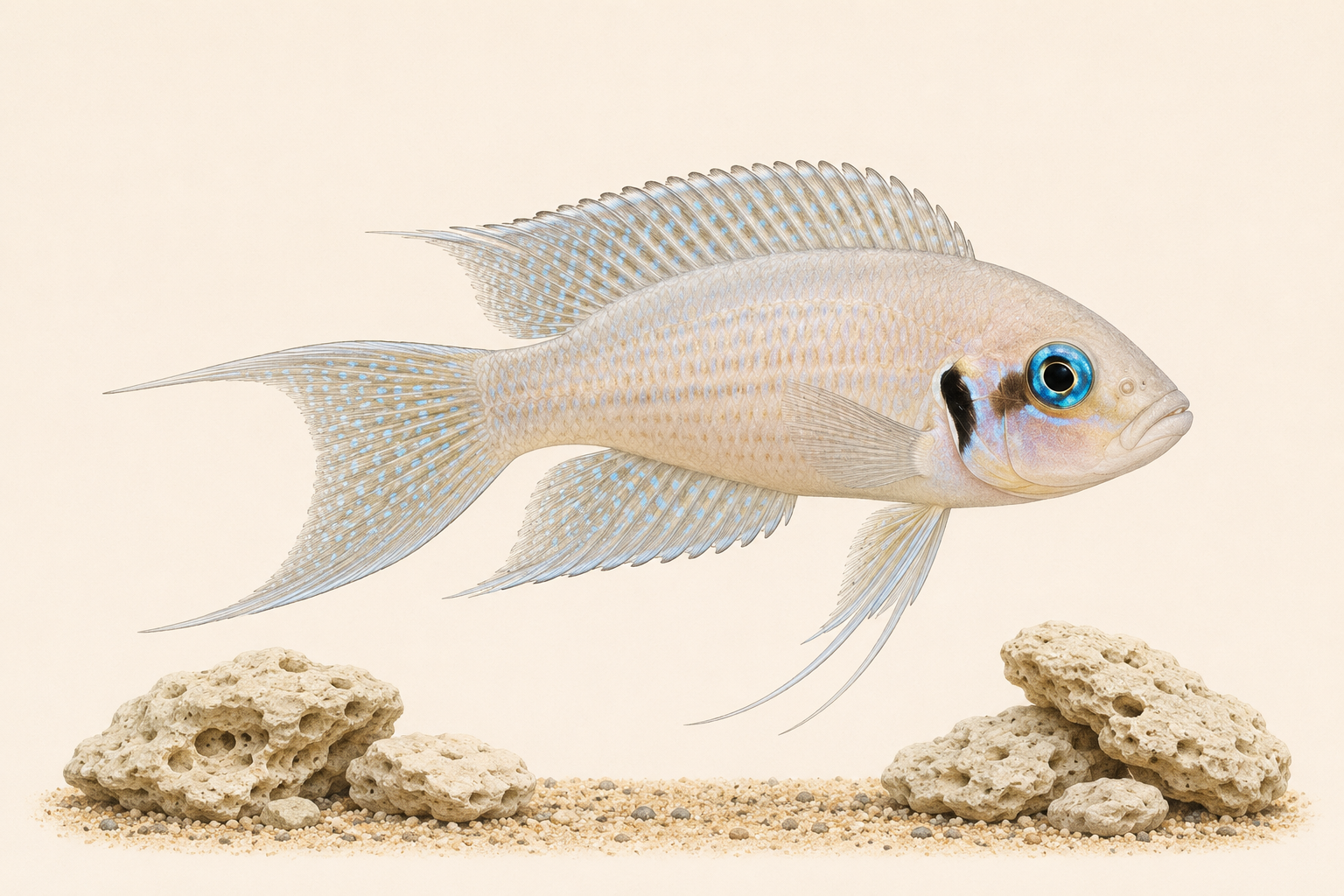
The Fairy Cichlid is an undeniably attractive fish, possessing an understated elegance that becomes more apparent the longer one observes it. The body is elongated and laterally compressed, with a base colour that ranges from creamy beige to a warm tan or light brown. A distinctive dark horizontal stripe runs from behind the eye towards the gill cover, and a bold black spot is present on the operculum, often bordered by a flash of golden or yellow pigment. This marking gives the fish a striking facial expression that adds to its appeal.
The fins are where Neolamprologus brichardi truly earns its common names. All unpaired fins — the dorsal, caudal, and anal — are adorned with elegant, trailing filamentous extensions that become more pronounced as the fish matures. The caudal fin develops a distinctive lyre shape, with the upper and lower lobes extending into long, wispy threads. The dorsal fin carries similar extensions along its posterior edge, and the anal fin is likewise elongated. These flowing finnage traits are responsible for the “Fairy” and “Lyretail” monikers and give the fish an almost ethereal quality as it glides through the water.
The body may exhibit a subtle bluish or lavender sheen under appropriate lighting, particularly along the flanks and around the head. The eyes are relatively large and expressive, adding to the fish’s alert and intelligent appearance. Sexual dimorphism is not pronounced in this species, making it difficult to distinguish males from females by appearance alone. Males tend to grow slightly larger, and mature males may develop somewhat longer fin extensions and a marginally more robust build, but these differences are often subtle and unreliable for sexing younger fish. The most dependable method of obtaining a breeding pair is to raise a group together and allow them to pair off naturally.
Varieties and Morphs
While Neolamprologus brichardi does not have a wide array of captive-bred colour morphs in the way that some Malawi cichlids do, several geographical variants and closely related forms are recognised in the hobby, each exhibiting subtle but noteworthy differences in coloration and pattern.
The most commonly encountered form in the trade is the standard type, sometimes labelled simply as “Brichardi,” which displays the classic beige body with the characteristic facial markings and lyre-shaped tail. The Magara variant is particularly sought after, originating from the Magara region of Burundi, and tends to exhibit a slightly warmer golden hue across the body with well-defined facial markings. The Kigoma variant, collected from near Kigoma in Tanzania, can appear somewhat paler with a more silvery cast to its body.
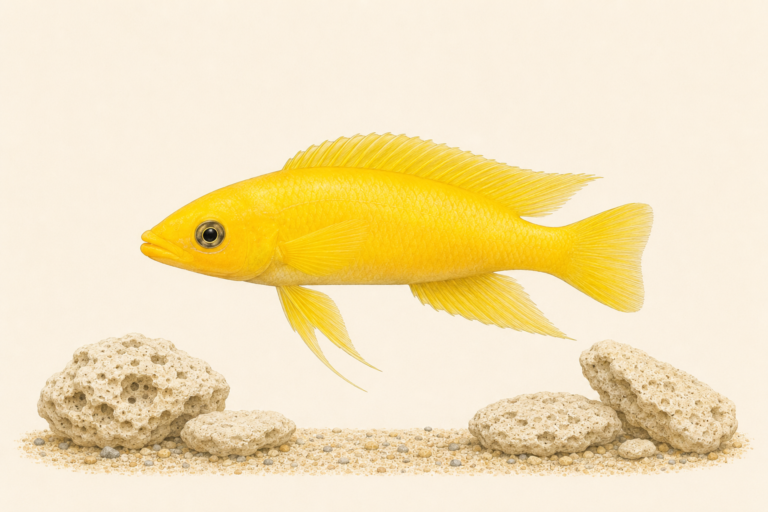
The Albino Brichardi is an established captive-bred morph that has gained some popularity. These fish lack the dark pigmentation seen in the wild form, displaying a pale cream to pinkish-white body with red eyes. While visually quite different from the standard form, they retain the same elegant finnage and behavioural traits. The Daffodil Cichlid, often sold as Neolamprologus pulcher or Neolamprologus brichardi “Daffodil,” is a closely related fish that displays a more pronounced yellow coloration, particularly on the head and fins. Its taxonomic status relative to N. brichardi has been the subject of ongoing debate, with some authorities considering it a colour variant and others treating it as a distinct population of the closely related N. pulcher.
It is worth noting that the taxonomic relationship between Neolamprologus brichardi and Neolamprologus pulcher remains somewhat contentious in ichthyological circles. Some researchers consider them to be the same species, while others maintain that they are distinct. In the aquarium trade, they are generally sold under separate names, with N. pulcher often displaying more yellow or golden tones. Hobbyists interested in maintaining pure geographical variants should purchase from reputable breeders who can provide locality data.
Natural Habitat
Neolamprologus brichardi is endemic to Lake Tanganyika, the second largest lake in Africa by volume and one of the oldest and deepest freshwater lakes on the planet. Lake Tanganyika stretches along the borders of Burundi, the Democratic Republic of the Congo, Tanzania, and Zambia, and its waters are renowned for their exceptional clarity, high mineral content, and remarkable stability in terms of chemistry and temperature.
In the wild, the Fairy Cichlid inhabits the rocky littoral zone of the lake, typically found at depths ranging from 2 to 25 metres. It favours areas where large boulders and rocky outcrops create a complex three-dimensional environment rich in crevices, caves, and overhangs. These rocky formations serve as both shelter from predators and as spawning sites. The substrate in their natural habitat is typically composed of rock, with pockets of sand between the larger formations. Vegetation is sparse to absent in the areas where this species is most commonly found, as the rocky shoreline does not support significant plant growth.
The waters of Lake Tanganyika are characteristically hard and alkaline, with a pH that generally falls between 8.6 and 9.5 and temperatures that remain remarkably stable between 24 and 29 °C year-round. The lake’s great depth acts as a thermal buffer, ensuring that temperature fluctuations are minimal. The water is exceptionally clear, with visibility often exceeding 20 metres, and dissolved oxygen levels are high in the upper layers where Neolamprologus brichardi resides. Understanding these natural conditions is essential for replicating a suitable environment in the aquarium.
In their natural habitat, Fairy Cichlids are often encountered in large aggregations that can number in the hundreds or even thousands. These colonies form extended family groups in which multiple generations coexist, with older fish helping to defend the territory and care for younger siblings. This cooperative social structure is one of the most studied examples of helper behaviour in fish and has made Neolamprologus brichardi a model species for behavioural ecologists.
Tank Size and Setup
A single pair of Neolamprologus brichardi can be housed in a tank of at least 150 litres, though a larger volume of 200 litres or more is strongly recommended, particularly if you intend to allow a colony to develop or wish to keep them alongside other species. As their colony grows — and it will grow, given this species’ prolific breeding habits — space becomes increasingly important. A 300-litre or larger aquarium is ideal for a thriving colony with multiple generations, and it provides enough room for subordinate fish to find refuge away from dominant individuals.
The aquascape should aim to replicate the rocky shoreline of Lake Tanganyika as closely as possible. Use a combination of large rocks, flat stones, and cobbles to create numerous caves, crevices, and overhangs throughout the tank. The fish will use these structures for shelter, territorial boundaries, and spawning sites. Stacking rocks securely is important — consider using aquarium-safe silicone to fix heavier pieces in place so that they cannot topple and injure the fish or crack the glass. Ensure that there are caves and hiding spots distributed across the entire tank, not just concentrated in one area, as this helps reduce aggression by giving subordinate fish escape routes.
The substrate should ideally be fine to medium-grade sand, which mimics the sandy patches found between rocky formations in the lake. Aragonite sand is a popular choice for Tanganyikan setups because it naturally buffers the water towards an alkaline pH. Gravel can also be used, though sand tends to look more natural and is easier for the fish to interact with. Live plants are not essential and are, in fact, somewhat atypical for a Tanganyikan biotope. However, if you wish to include greenery, hardy species such as Anubias and Java Fern attached to rocks can work well, as they tolerate the hard, alkaline water and do not require planting in the substrate.
Lighting should be moderate. The clarity of Lake Tanganyika allows substantial light penetration, but the rocky habitat provides ample shade. Avoid excessively bright illumination, which can cause the fish stress and wash out their subtle coloration. A standard LED fixture on a natural daylight cycle of around 10 to 12 hours works well. Background lighting that brings out the lavender and blue sheens on the body will enhance the visual appeal of these fish.
Water Parameters
Maintaining stable water chemistry is arguably the single most important aspect of keeping Neolamprologus brichardi successfully. As a species from Lake Tanganyika, it requires hard, alkaline water with minimal fluctuations. The stability of conditions is at least as important as hitting exact target numbers. Sudden shifts in pH or hardness can cause significant stress and increase susceptibility to disease.
| Temperature | 24–27 °C |
| pH | 7.8–9.0 |
| General hardness (GH) | 10–20 dGH |
| Carbonate hardness (KH) | 10–15 dKH |
| Ammonia | 0 ppm |
| Nitrite | 0 ppm |
| Nitrate | Below 20 ppm |
If your tap water is naturally soft and acidic, you will need to adjust it for Tanganyikan species. Commercially available Tanganyika buffer salts are the most reliable method, though using aragonite or crushed coral as a substrate or within your filter can provide a degree of natural buffering. Always test your water regularly with a reliable liquid test kit, paying close attention to pH, KH, and nitrate levels. Water changes should be performed consistently — typically 20 to 25 per cent weekly — using water that has been pre-treated and matched to the tank’s temperature and chemistry.
Filtration and Equipment
Neolamprologus brichardi originates from waters with excellent clarity and high dissolved oxygen levels, so robust filtration and good water movement are essential. A canister filter rated for at least one and a half times the tank volume is recommended. For a 200-litre setup, for instance, you would ideally select a filter rated for 300 litres or more. Canister filters provide excellent mechanical, biological, and chemical filtration, and their adjustable flow rates allow you to create gentle to moderate current, which these fish appreciate.
Biological filtration capacity is particularly important in a Tanganyikan setup because ammonia and nitrite are extremely toxic in alkaline water. The toxicity of ammonia increases significantly as pH rises, meaning that even trace amounts that might be tolerable in acidic conditions can be harmful or lethal at the pH levels required by these fish. Ensure that your filter media includes ample biological media such as ceramic rings, sintered glass, or bio-balls. Avoid cleaning all filter media at once, as this can crash the biological colony and lead to dangerous spikes in ammonia or nitrite.
A reliable heater with a thermostat is essential to maintain the stable temperatures these fish require. Choose a heater rated appropriately for your tank volume and consider using two smaller heaters rather than one large one. This provides a safety net — if one heater fails, the other continues to provide some warmth, and if one malfunctions and sticks in the “on” position, a single smaller heater is less likely to overheat the entire tank rapidly. Position heaters near areas of water flow to ensure even heat distribution.
An air stone or additional powerhead can be beneficial for supplementing oxygen levels, particularly in larger or heavily stocked setups. Good surface agitation is important for gas exchange, ensuring that oxygen enters the water and carbon dioxide is expelled efficiently. If your canister filter outlet already creates adequate surface movement, additional aeration equipment may not be necessary, but it does no harm and provides an extra margin of safety.
Diet and Feeding
In the wild, Neolamprologus brichardi is primarily a planktivore, feeding on tiny crustaceans, insect larvae, and other invertebrates that drift past or inhabit the biofilm on rocky surfaces. They also graze on algae to a minor extent, though animal matter forms the bulk of their natural diet. In the aquarium, they are not fussy eaters and will readily accept a wide range of prepared and live foods.
A high-quality cichlid pellet or flake designed for omnivorous or carnivorous species should form the staple of their diet. Choose a product with a good protein content and avoid foods that are excessively high in plant matter or fillers, as these do not reflect the species’ natural dietary preferences. Supplement the staple diet regularly with frozen or live foods such as brine shrimp, daphnia, cyclops, and mysis shrimp. These foods provide essential nutrients, promote natural foraging behaviour, and help bring the fish into breeding condition.
Feed small amounts two to three times daily rather than a single large meal. Neolamprologus brichardi has a relatively small stomach, and overfeeding can lead to water quality issues, particularly a rise in nitrate levels. Observe the fish during feeding to ensure that all individuals in the group are getting their share. Dominant fish may monopolise food sources, so distributing food across multiple areas of the tank can help ensure subordinate fish receive adequate nutrition. Remove any uneaten food after a few minutes to prevent it from decomposing and polluting the water.
Avoid feeding mammalian proteins such as beefheart, as these contain fats that Tanganyikan cichlids cannot metabolise efficiently and can lead to digestive problems and fatty deposits around the internal organs. Tubifex worms should also be avoided unless freeze-dried or from a very reputable source, as live tubifex can carry parasites and harmful bacteria.
Behaviour and Temperament
The behaviour of Neolamprologus brichardi is one of its most compelling features and a primary reason for its enduring popularity in the hobby. These are intelligent, socially complex fish that exhibit a range of fascinating behaviours, from cooperative breeding to intricate territorial displays. Observing a colony of Fairy Cichlids going about their daily activities is genuinely engaging and provides endless hours of interest.
Within their colony, a strict social hierarchy is maintained. A dominant pair typically claims the best spawning cave and surrounding territory, with subordinate fish occupying less desirable positions. Older juveniles from previous spawns are tolerated within the family group and actively participate in defending the territory against intruders. This helper behaviour is relatively rare among fish and has been the subject of extensive scientific research. Helpers gain experience in parental care, benefit from the protection of the group, and may eventually inherit the breeding territory.
While they are considered relatively peaceful by cichlid standards, it would be misleading to describe Neolamprologus brichardi as a docile community fish. They can be surprisingly aggressive in defence of their territory and offspring, and a breeding pair will vigorously chase away any fish that ventures too close to their cave. In a confined aquarium, this aggression can become problematic if tank mates have nowhere to retreat. As the colony grows and multiple breeding pairs establish territories, aggression can escalate significantly. In a small tank, a well-established colony can effectively dominate the entire space, making life very difficult for other inhabitants.
It is also worth noting that while they are generally sociable within their own species group, they can be remarkably intolerant of other Neolamprologus species or fish that resemble them closely. Mixing different Neolamprologus brichardi variants or closely related species such as Neolamprologus pulcher in the same tank is generally inadvisable, as hybridisation and heightened aggression are likely outcomes.
Tank Mates
Choosing appropriate tank mates for Neolamprologus brichardi requires careful consideration of the species’ territorial nature and the likelihood that a breeding colony will develop. The best companions are other Lake Tanganyika species that occupy different niches within the aquarium, thus minimising direct competition for space and resources. Avoid mixing them with fish from different African rift lakes, as water parameter requirements may overlap but behavioural incompatibilities can arise, and hybridisation is a concern with closely related species.
Good tank mates
- Cyprichromis leptosoma — These open-water schooling cichlids occupy the mid to upper water column and rarely compete for territory with rock-dwelling species.
- Paracyprichromis nigripinnis — A peaceful, cave-adjacent schooler that tends to hover near rocky walls without claiming territories, reducing conflict.
- Julidochromis ornatus — This small rock-dwelling cichlid can coexist in a sufficiently large tank with enough caves for both species to establish separate territories.
- Altolamprologus calvus — A slow-moving predator of small invertebrates that generally minds its own business and is too laterally compressed to compete for the same cave types.
- Altolamprologus compressiceps — Similar to A. calvus in its peaceful disposition and preference for tight crevices that brichardi typically do not use.
- Synodontis petricola — A small, peaceful catfish endemic to Lake Tanganyika that scavenges for food and generally avoids confrontation with cichlids.
- Xenotilapia flavipinnis — A sand-dwelling cichlid that occupies a completely different niche, sifting the substrate for food well away from rocky territories.
- Neolamprologus leleupi — Though also a rock dweller, this species can coexist in large tanks with ample cave structures, as it typically claims smaller, more secluded hiding spots.
Fish to avoid
- Neolamprologus pulcher — Too closely related and will likely hybridise or engage in constant territorial warfare with N. brichardi.
- Tropheus duboisi — A highly territorial herbivore that requires very different social management and can create intense aggression issues in a mixed tank.
- Tropheus moorii — Extremely aggressive and territorial, this species dominates rockwork and will bully smaller Neolamprologus relentlessly.
- Cyphotilapia frontosa — While generally placid, this large predator will readily consume smaller fish including juvenile and even adult brichardi.
- Neon Tetra — A soft-water species with completely incompatible water chemistry requirements that would not survive in Tanganyikan conditions.
- Mbuna cichlids — Despite similar water hardness, Malawi mbuna are too aggressive, occupy the same niche, and should never be mixed with Tanganyikan species.
- Convict Cichlid — A Central American species with different water requirements and an extremely aggressive breeding temperament that would clash with brichardi.
- Oscar — Far too large, too messy, and from an entirely different habitat; Oscars would view Fairy Cichlids as potential food.
Breeding
Neolamprologus brichardi is one of the easiest cichlids to breed in captivity, and most keepers find that breeding occurs almost spontaneously once a compatible pair forms and conditions are suitable. The challenge is not so much in getting them to spawn but in managing the resulting colony, as prolific breeding can quickly lead to overstocking if left unchecked.
To obtain a breeding pair, the simplest approach is to purchase a group of six to eight juveniles and raise them together. As they mature, pairs will form naturally. Once a pair has established itself, the remaining fish may be tolerated as helpers or may need to be removed if aggression becomes excessive. A bonded pair will claim a cave or sheltered crevice as their spawning site and begin defending the surrounding area with increasing vigour.
Spawning takes place inside the chosen cave, where the female deposits between 100 and 200 small, adhesive eggs on the cave ceiling or walls. The eggs are typically cream to pale yellow in colour. The female assumes primary responsibility for fanning and guarding the eggs, while the male patrols the perimeter of the territory and drives off any fish that approach. The eggs hatch in approximately three days at 25 °C, and the resulting larvae remain attached to the spawning surface by their yolk sacs for a further five to seven days before becoming free-swimming.
Once the fry become free-swimming, they begin to venture out of the cave under the watchful eyes of both parents and any helpers present from previous broods. The fry are tiny but can immediately accept finely crushed flake food, powdered fry food, or freshly hatched baby brine shrimp. Growth is steady but not rapid, and it typically takes around eight to ten months for juveniles to reach sexual maturity.
The cooperative breeding system means that as subsequent spawns occur, older juveniles remain in the group and assist with territorial defence and fry-guarding duties. This can lead to a rapidly expanding colony in a relatively short time. Aquarists should plan for this eventuality by having a strategy for rehoming excess fish, whether through local fish clubs, online forums, or arrangements with local aquarium shops. Allowing the colony to grow unchecked in a limited space will eventually lead to water quality problems, heightened aggression, and poor health outcomes for the fish.
Common Diseases
Neolamprologus brichardi is a generally hardy species when kept in appropriate conditions, but it is not immune to disease. The vast majority of health problems in this species can be traced back to poor water quality, unstable parameters, or inadequate diet. Prevention through excellent husbandry is always preferable to treatment.
Ich, or white spot disease, caused by the protozoan parasite Ichthyophthirius multifiliis, is one of the most commonly encountered ailments. It presents as small white spots scattered across the body and fins, and affected fish may flash against rocks or display rapid gill movements. Ich is highly treatable if caught early. Raising the temperature gradually to 30 °C and adding aquarium salt at a concentration of 2 to 3 grams per litre can be effective, though commercial ich treatments are also available. It is important to treat the entire tank, not just affected individuals, as the parasite has a free-swimming stage that infects all fish.
Bloat, sometimes referred to as Malawi bloat despite affecting Tanganyikan species as well, is a serious condition characterised by abdominal swelling, loss of appetite, lethargy, and sometimes trailing white faeces. The exact cause is debated but is generally associated with dietary issues, internal parasites, or bacterial infections. Treatment involves isolating the affected fish, withholding food for several days, and administering metronidazole-based medication. Prevention involves feeding a varied, appropriate diet and maintaining impeccable water quality.
Bacterial and fungal infections can occur, particularly following physical injuries sustained during territorial disputes. Open wounds, frayed fins, or white cottony growths on the body should be treated promptly with an appropriate antibacterial or antifungal medication. Maintaining clean water with low nitrate levels greatly reduces the likelihood of secondary infections taking hold.
Gill flukes and other external parasites can occasionally affect this species, causing symptoms such as rapid breathing, flashing, and lethargy. Praziquantel-based treatments are generally effective against these parasites. As with all diseases, quarantining new fish for a minimum of two to four weeks before introducing them to an established tank is a vital preventative measure that should never be skipped.
FAQs
How many Neolamprologus brichardi should I keep together?
Starting with a group of six to eight juveniles is the best approach, as this allows natural pair formation. Once a dominant pair has established itself, you can choose to remove the remaining fish or allow a colony to develop. A single pair can be kept successfully, but a group dynamic is more natural and allows you to observe their fascinating cooperative breeding behaviour. Be mindful that the colony will grow rapidly once breeding begins, so ensure you have a plan for managing population growth.
Can I keep Fairy Cichlids in a community tank with non-Tanganyikan species?
This is generally not recommended. Neolamprologus brichardi requires hard, alkaline water that is unsuitable for the majority of commonly kept tropical fish, which tend to prefer soft, neutral to slightly acidic conditions. Mixing species from different rift lakes is also inadvisable due to behavioural incompatibilities and the risk of hybridisation with related species. For the best results, maintain a dedicated Tanganyikan biotope aquarium with carefully selected species that share the same environmental requirements.
Why are my Neolamprologus brichardi so aggressive?
Aggression typically escalates when a pair is breeding and defending a spawning site. In smaller tanks, this can become a serious problem because subordinate fish and tank mates have limited space to retreat. The solution is to provide a larger tank with abundant rockwork and hiding spots, ensuring that there are clearly defined territories and escape routes. If aggression is directed consistently at a single individual, it may be necessary to remove either the aggressor or the victim to prevent injury or death.
How can I tell the difference between male and female Fairy Cichlids?
Sexual dimorphism in this species is subtle and often unreliable, particularly in younger fish. Males tend to be slightly larger than females and may develop marginally longer fin extensions and a more robust body shape. Some experienced keepers report that males have a slightly steeper forehead profile. However, the most reliable method of obtaining a breeding pair is simply to raise a group together and allow them to pair naturally, rather than attempting to sex them visually.
What should I do with excess fry?
Given the prolific breeding nature of this species, managing fry numbers is a practical concern that every keeper must address. Options include rehoming juveniles to local aquarium shops, selling or trading them through fish-keeping clubs and online forums, or setting up additional tanks to house growing colonies. Some keepers allow natural population control to occur by housing the colony with mild predators such as Altolamprologus species, which may consume some fry without threatening the adults. Responsible management is essential to avoid overcrowding and the health problems it brings.
Related Guides
- Neolamprologus pulcher Care Guide — A closely related species with similar care requirements and cooperative breeding behaviour, often considered a colour variant of N. brichardi.
- Julidochromis ornatus Care Guide — Another popular rock-dwelling Tanganyikan cichlid that makes a suitable companion for N. brichardi in appropriately sized aquaria.
- Lake Tanganyika Biotope Setup Guide — A comprehensive guide to creating an authentic Tanganyikan environment, covering water chemistry, aquascaping, and species selection.
- Altolamprologus calvus Care Guide — An elegant Tanganyikan predator that coexists well with Fairy Cichlids and adds visual interest to a rocky biotope setup.
- Synodontis petricola Care Guide — A charming Tanganyikan catfish that serves as an excellent bottom-dwelling companion for many lamprologine cichlids.