Quick summary
The Crimson Loach is best suited to intermediate to experienced fishkeepers who can maintain clean, cool, well-oxygenated, fast-flowing water and are willing to keep a group of four to six in a spacious, well-decorated tank. It’s not ideal for beginners or standard warm community tanks, since it needs strict water quality, moderate to strong current, and plenty of hiding spots to manage its territorial nature.
🐠 Build a tank around this species
In this guide:
- Introduction
- Quick Stats
- Appearance
- Natural Habitat
- Tank Size and Setup
- Water Parameters
- Filtration and Equipment
- Diet and Feeding
- Behaviour and Temperament
- Tank Mates
- Breeding
- Common Diseases
- FAQs
Introduction
The Crimson Loach, traded under the provisional name Schistura sp. “crimson,” is one of the more visually striking members of the vast Schistura genus. This small, stream-dwelling loach has earned a devoted following among hobbyists who appreciate its vivid colouration and lively personality. Although it remains formally undescribed at the time of writing, the Crimson Loach has become increasingly available through specialist dealers, particularly those importing wild-caught freshwater fish from mainland Southeast Asia.
Schistura is one of the largest genera of freshwater fish in the world, containing well over 300 described species and numerous undescribed forms that circulate in the aquarium trade under informal designations. The Crimson Loach belongs to the family Nemacheilidae, commonly referred to as the stone loaches or river loaches, a group characterised by their elongated bodies, subterminal mouths equipped with barbels, and a strong preference for fast-flowing, oxygen-rich water. Understanding these fundamental ecological requirements is the key to keeping this species successfully in captivity.
Despite its undeniable beauty, the Crimson Loach is not a fish for every aquarist. It demands clean, well-oxygenated water with moderate to strong flow, and it can display territorial behaviour that must be managed through thoughtful aquascaping and appropriate stocking. This guide will walk you through everything you need to know to provide an excellent home for this remarkable little loach, from tank design and water chemistry to diet, breeding prospects, and compatible tank mates.
Quick Stats
| Scientific name | Schistura sp. “crimson” |
|---|---|
| Common names | Crimson Stone Loach, Red Schistura |
| Family | Nemacheilidae |
| Origin | Southeast Asia (likely Myanmar or Thailand) |
| Adult size | 6 cm |
| Lifespan | 4–6 years |
| Difficulty | Intermediate |
| Breeding difficulty | Advanced |
| Temperature | 20–25 °C |
| pH | 6.5–7.5 |
| GH | 2–12 dGH |
| KH | 2–8 dKH |
| Minimum tank size | 75 L |
| Conservation status | Not Evaluated |
Appearance
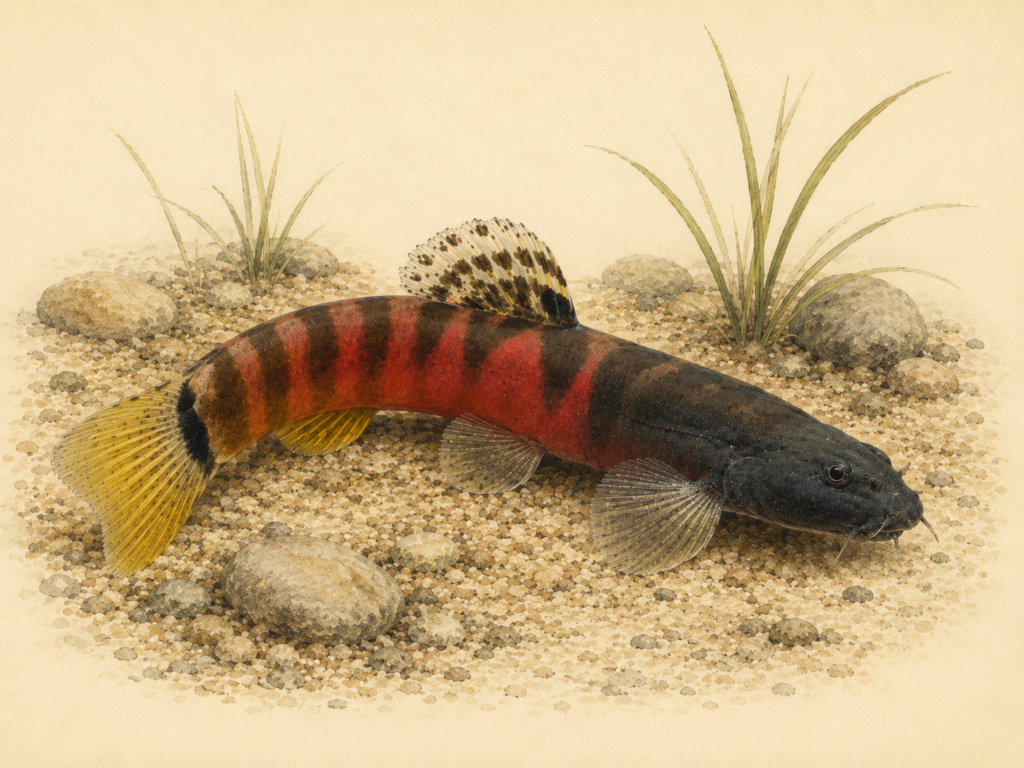
The Crimson Loach is a small, slender fish with the classic elongated body plan typical of the Schistura genus. Adults typically reach between five and seven centimetres in total length, with females sometimes appearing marginally fuller-bodied than males when in breeding condition. The body is cylindrical in cross-section, tapering to a slightly compressed caudal peduncle, and the head is gently flattened with a subterminal mouth flanked by three pairs of short barbels used to detect food particles among the substrate.
The defining feature of this species is, of course, its colouration. The base body colour ranges from a warm cream to pale gold, overlaid with bold bands or saddle-like markings in deep crimson to brick red. These bands typically extend from the dorsal surface partway down the flanks, and their intensity can vary depending on the individual’s mood, health, and environmental conditions. In well-maintained aquaria with appropriate water quality and a natural-toned substrate, the red pigmentation intensifies considerably, creating a truly eye-catching display. The fins are generally translucent to pale with subtle reddish tinting, particularly in the caudal fin, which may show faint barring.
Sexual dimorphism in Schistura species is often subtle. In the Crimson Loach, mature males tend to be slightly slimmer and may exhibit marginally more vivid colouration, though this is not always a reliable indicator. Some keepers report that males develop a slightly more pronounced suborbital flap, a small fleshy structure beneath the eye that is characteristic of several Schistura species and is thought to play a role in territorial signalling. Females in spawning condition will appear noticeably plumper when viewed from above.
Natural Habitat
While the precise collection locality of the Crimson Loach remains somewhat obscured by the commercial supply chain, the species is believed to originate from hill streams and headwater tributaries in mainland Southeast Asia, most likely in Myanmar or northern Thailand. These regions are hotspots of Schistura diversity, with new species still being described on a regular basis from the Salween, Irrawaddy, Mekong, and Chao Phraya drainage systems.
In the wild, the Crimson Loach almost certainly inhabits shallow, fast-flowing streams with substrates composed of gravel, cobbles, and boulders, interspersed with patches of sand and accumulations of leaf litter. The water in these habitats is typically clear, well-oxygenated, and relatively cool by tropical standards, with temperatures often sitting in the low to mid twenties Celsius. The pH tends to be circumneutral, and hardness varies depending on the local geology but is generally soft to moderately hard.
These streams are characterised by their high dissolved oxygen content, driven by turbulent flow over rocky substrates and seasonal spate conditions during the monsoon. The riparian vegetation provides shade, helping to keep water temperatures stable, and the submerged leaf litter and biofilm-covered surfaces offer rich foraging grounds for small invertebrates, which form the bulk of the Crimson Loach’s natural diet. Understanding these environmental conditions is essential for replicating a suitable captive habitat.
Tank Size and Setup
A single Crimson Loach can technically be housed in a tank as small as 60 litres, but a minimum of 75 litres is recommended for a small group, and larger is always preferable. Because this species is best kept in groups of at least four to six individuals to spread territorial aggression, a tank in the range of 90 to 120 litres or more will give you the best results. Tanks with a larger footprint are more suitable than tall, narrow designs, as the Crimson Loach is a bottom-dwelling species that benefits from ample horizontal space to establish territories and forage.
The substrate should consist of a mixture of fine gravel and smooth sand, ideally in natural tones that complement the fish’s colouration. Avoid sharp or coarse substrates, as loaches spend considerable time resting on and sifting through the bottom material, and rough edges can damage their delicate barbels. Scatter smooth, rounded pebbles and cobblestones across the substrate to create a naturalistic streambed appearance. Larger rocks and flat stones can be arranged to form caves, overhangs, and crevices, which are absolutely essential for this species. Each individual will seek out its own preferred shelter, and a shortage of hiding spots is one of the most common causes of excessive aggression in Schistura tanks.
Driftwood and bogwood can be incorporated both for aesthetic purposes and to create additional visual barriers that break up lines of sight. Hardy plants such as Anubias, Java fern, and Bucephalandra can be attached to rocks and wood, where they will thrive in the moderate to strong flow that the Crimson Loach requires. Rooted plants may struggle in the high-flow environment unless planted in sheltered areas behind rock formations. A thin scattering of dried leaf litter, such as Indian almond or oak leaves, can be added to provide supplementary cover and encourage the growth of biofilm and microfauna, though in high-flow setups the leaves may need to be weighted down or placed in calmer zones.
Lighting should be moderate rather than intense. In the wild, these streams are often shaded by overhanging vegetation, and excessively bright lighting can cause the fish to become shy and reclusive. A period of eight to ten hours of light per day is sufficient, and the use of floating plants or a canopy of overhanging branches can help diffuse the light naturally.
Water Parameters
Maintaining stable, high-quality water is the single most important aspect of Crimson Loach care. This species is adapted to clean, well-oxygenated hillstream environments and will not tolerate poor water quality or stagnant conditions. Aim for the following parameters and monitor them regularly with a reliable test kit.
| Temperature | 20–25 °C |
| pH | 6.5–7.5 |
| General hardness (GH) | 2–12 dGH |
| Carbonate hardness (KH) | 2–8 dKH |
| Ammonia | 0 ppm |
| Nitrite | 0 ppm |
| Nitrate | Below 20 ppm |
Temperature deserves particular attention. The Crimson Loach is not a tropical fish in the strictest sense and will suffer at temperatures persistently above 26 °C. During warm summer months, you may need to take measures to keep the tank cool, such as increasing surface agitation, using a fan directed across the water surface, or investing in an aquarium chiller if you live in a warm climate. Conversely, temperatures below 18 °C should be avoided. A stable temperature in the low twenties is ideal for long-term health.
Weekly water changes of 25 to 30 per cent are strongly recommended, and more frequent changes may be necessary in smaller or more heavily stocked tanks. Always match the temperature and chemistry of replacement water to the tank to avoid shocking the fish. The Crimson Loach is sensitive to sudden fluctuations in water chemistry, so consistency is paramount.
Filtration and Equipment
Robust filtration is non-negotiable for the Crimson Loach. This species requires high oxygen levels and appreciates a noticeable current in the aquarium. An external canister filter rated for a tank somewhat larger than the one you are using is a sound choice, as it will provide excellent mechanical and biological filtration while generating sufficient turnover to keep the water well-oxygenated. Aim for a flow rate of at least eight to ten times the tank volume per hour. For example, a 100-litre tank should ideally have a filter turnover of 800 to 1,000 litres per hour.
Supplementary powerheads or wavemakers can be used to create additional flow and ensure there are no stagnant areas in the tank. Positioning the filter outlet along the length of the tank or using a spray bar will help distribute current more evenly. Some keepers create a dedicated high-flow zone at one end of the tank and a calmer area at the other, allowing the fish to choose their preferred microhabitat at any given time.
An air pump with an airstone or sponge filter can provide supplementary aeration, though in a well-designed setup with strong surface agitation from the main filter, this may not be strictly necessary. If you are keeping the tank in a warm room or during summer heat, additional aeration becomes more important, as warm water holds less dissolved oxygen.
A heater may or may not be required depending on your ambient room temperature. If your home stays consistently above 20 °C, you may not need one, but for most UK fishkeepers, a reliable heater set to around 22–23 °C is advisable during the cooler months. Choose a heater with an accurate thermostat and consider using a heater guard to prevent the loaches from resting against it and sustaining burns.
Diet and Feeding
The Crimson Loach is an opportunistic omnivore with a strong preference for small invertebrates and other meaty foods. In the wild, its diet consists primarily of insect larvae, small crustaceans, worms, and biofilm grazed from rock surfaces. In captivity, replicating this varied diet is straightforward and essential for maintaining good health and vivid colouration.
A high-quality sinking pellet or wafer designed for bottom-dwelling fish should form the staple of the diet. Look for products with a high protein content and avoid those padded out with excessive grain or filler. Supplement this regularly with frozen or live foods such as bloodworm, daphnia, brine shrimp, tubifex, and mosquito larvae. Live foods are particularly beneficial, as they stimulate natural foraging behaviour and are eagerly accepted. Blanched vegetables such as courgette, spinach, or cucumber can be offered occasionally and may be nibbled at, though the Crimson Loach is far more carnivorous than herbivorous in its dietary preferences.
Feed once or twice daily in small amounts that the fish can consume within a few minutes. Overfeeding is a common mistake with bottom-dwelling species, as uneaten food can quickly foul the water in high-flow tanks where it gets pushed into crevices and is difficult to remove. Observe your fish during feeding to ensure all individuals are getting their share, as more dominant specimens may monopolise food sources. Scattering food across multiple locations in the tank can help mitigate this.
Behaviour and Temperament
The Crimson Loach is an active, inquisitive, and undeniably characterful fish. It spends much of its time exploring the substrate, investigating crevices, and perching on rocks with its pectoral fins splayed out in a manner that many keepers find endearing. It is primarily a benthic species, rarely venturing far from the bottom or lower third of the water column, though occasional dashes to mid-water during feeding are not uncommon.
Territorial behaviour is a defining trait of most Schistura species, and the Crimson Loach is no exception. Individuals will establish and defend favoured resting spots, particularly caves and crevices beneath rocks. This territoriality is most pronounced between conspecifics and can escalate to persistent chasing and nipping if the tank is too small or lacks sufficient hiding places. The aggression is rarely lethal in a well-designed setup, but stressed, subordinate individuals may become pale, refuse food, and hide constantly if they are unable to find a territory of their own.
The best approach to managing this behaviour is to keep a group of at least four to six individuals in a tank with an abundance of caves and visual barriers. In a properly aquascaped environment, aggression is distributed among the group rather than focused on a single victim, and a natural hierarchy establishes itself with relatively little drama. Solitary specimens can become excessively shy, or conversely may redirect their territorial instincts towards other bottom-dwelling species in the tank.
The Crimson Loach is largely diurnal, showing peak activity during the daytime, though it may also be active during the twilight hours. It is not a nocturnal species in the way that many other loaches are, which makes it a rewarding fish to observe. That said, newly introduced specimens may be somewhat retiring until they acclimatise to their new surroundings, which can take a week or two.
Tank Mates
Choosing appropriate tank mates for the Crimson Loach requires careful consideration of both the loach’s territorial nature and its environmental requirements. Ideal companions are species that occupy the middle and upper water column, tolerate moderate to strong flow, and prefer similar temperature and water chemistry ranges. Avoid slow-moving, long-finned species that may be harassed, as well as very large or aggressive fish that could intimidate or prey upon the loaches.
Good tank mates
- White Cloud Mountain Minnow, a hardy, cool-water species that occupies the upper water column and thrives in similar temperatures and flow conditions.
- Celestial Pearl Danio, a small, peaceful cyprinid that prefers cooler water and stays primarily in the mid-water zone, well away from loach territories.
- Zebra Danio, an active, robust schooling fish that enjoys strong currents and is too fast to be bothered by territorial loaches.
- Cherry Barb, a peaceful, adaptable barb that occupies the middle water column and tolerates a wide range of conditions overlapping with the Crimson Loach’s needs.
- Odessa Barb, a colourful and active mid-water species that appreciates good flow and is robust enough to coexist comfortably with Schistura loaches.
- Hillstream Loach (Sewellia spp.), a fellow rheophilic species that shares similar environmental requirements and generally occupies different microhabitats on the substrate.
- Kuhli Loach, a nocturnal, non-territorial bottom-dweller that is typically active at different times, reducing competition, though provide ample hiding spots for both species.
- Bristlenose Pleco, a robust, algae-eating catfish that is generally too armoured and placid to be troubled by minor territorial squabbles from Schistura.
- Stiphodon Goby, a small, rheophilic goby that thrives in identical high-flow, oxygen-rich conditions and generally coexists peacefully with Schistura species.
Fish to avoid
- Siamese Fighting Fish (Betta splendens), requires still, warm water that is entirely incompatible with the Crimson Loach’s needs, and its flowing fins invite nipping.
- Fancy Goldfish, far too large, messy, and slow-moving for a Schistura tank, with incompatible temperature and space requirements.
- Discus, demands warm, still, soft water and is far too sensitive and slow to cohabit with active, territorial loaches.
- Oscar, a large, predatory cichlid that would readily consume small loaches and requires a completely different environment.
- Angelfish, prefers warmer, calmer water and its tall, slow-moving profile makes it a poor match for a fast-flowing Schistura setup.
- Guppy, the flowing finnage of male guppies can attract unwanted attention from territorial loaches, and guppies prefer calmer, warmer conditions.
- Dwarf Gourami, a slow-moving, labyrinth-breathing fish that prefers still water with surface access and is poorly suited to high-flow environments.
- Red-Tailed Black Shark, an intensely territorial bottom-dweller that would compete aggressively with Schistura loaches for the same spaces and resources.
Breeding
Breeding the Crimson Loach in captivity is a challenging endeavour and has been accomplished only rarely in the home aquarium. Like many Schistura species, this fish is not a cooperative spawner in the way that many popular aquarium fish are, and triggering reproductive behaviour typically requires careful manipulation of environmental conditions to simulate natural seasonal cues.
In the wild, Schistura species are believed to spawn during or shortly after the monsoon season, when water levels rise, temperatures drop slightly, and flow increases. To attempt breeding in captivity, start with a well-conditioned group of at least six individuals housed in a spacious tank with excellent water quality. Condition the fish heavily with live and frozen foods for several weeks to bring them into peak breeding condition. Females should appear noticeably plumper when viewed from above.
Simulating a rainy season can be achieved through a combination of slightly cooler water changes, increased flow, and a modified photoperiod. Some breeders report success with performing larger-than-usual water changes of 40 to 50 per cent using slightly cooler water, gradually lowering the temperature by two to three degrees over the course of a week before allowing it to return to normal. Increasing the flow rate and adding fresh oxygenation may also help trigger spawning behaviour.
When ready to spawn, males typically become more intensely coloured and display increased territorial aggression, attempting to lure females into their chosen cave or crevice. Spawning itself likely takes place within a sheltered spot, with eggs deposited on the undersides of rocks or within narrow gaps. Parental care is minimal to non-existent in Schistura, so the eggs and fry are at risk of predation from the adults and other tank mates. If spawning is observed, removing the adults or transferring the eggs to a separate rearing tank with gentle aeration and matching water parameters gives the fry the best chance of survival.
The eggs are small and adhesive, hatching in approximately 48 to 72 hours at around 22 °C. The fry are tiny and will initially feed on their yolk sacs before requiring infusoria or commercially available liquid fry food, graduating to freshly hatched brine shrimp nauplii as they grow. Raising the fry requires meticulous attention to water quality, as they are extremely sensitive to ammonia and nitrite.
Common Diseases
The Crimson Loach is generally a robust fish when kept in optimal conditions, but like all aquarium species, it is susceptible to certain health issues, particularly when water quality deteriorates or the fish is stressed. Prevention through excellent husbandry is always preferable to treatment, and many common ailments can be avoided entirely with consistent water changes, appropriate stocking levels, and a varied diet.
White spot disease, caused by the protozoan parasite Ichthyophthirius multifiliis, is one of the most frequently encountered illnesses in freshwater aquaria. It presents as small white cysts on the body and fins and is often triggered by temperature fluctuations or the introduction of new, unquarantined fish. Treatment with a proprietary white spot remedy is usually effective, but be aware that loaches can be sensitive to certain medications, particularly those containing copper or formalin. Always use treatments at half the recommended dose initially and observe the fish closely for adverse reactions, scaling up only if necessary.
Bacterial infections, including fin rot and skin ulcers, can occur in tanks with poor water quality or following physical injuries sustained during territorial skirmishes. Maintaining pristine water conditions is the first line of defence, and mild cases will often resolve with improved husbandry alone. More severe infections may require treatment with an appropriate antibacterial medication.
Skinny disease, a general term for wasting conditions often associated with internal parasites, is occasionally seen in wild-caught loaches. Newly imported specimens should be quarantined and observed for signs of weight loss despite eating, sunken bellies, or stringy white faeces, which may indicate internal parasites such as nematodes or cestodes. A veterinary-grade anti-parasitic treatment administered during quarantine can address these issues before the fish joins the main display tank.
Barbel erosion is another condition to watch for. It typically results from being kept on rough or sharp substrates or in water with elevated nitrate levels. The barbels become shortened, reddened, or worn down, impairing the fish’s ability to forage effectively. Providing a smooth, fine-grained substrate and maintaining low nitrate levels will prevent this condition.
FAQs
How many Crimson Loaches should I keep together?
A group of at least four to six is recommended. Keeping Crimson Loaches in smaller numbers can result in one dominant individual persistently bullying a single subordinate, whereas in a larger group, aggression is distributed more evenly and a stable social hierarchy can form. Ensure the tank has ample hiding spots and caves to allow each individual to establish its own territory.
Can I keep Crimson Loaches in a tropical community tank at 26–28 °C?
This is not advisable. The Crimson Loach is a subtropical to cool-tropical species that prefers temperatures in the range of 20–25 °C. Persistently elevated temperatures above 26 °C can lead to reduced oxygen availability, increased metabolic stress, and a shortened lifespan. Choose tank mates that share a preference for cooler conditions rather than attempting to keep the loach at the higher end of the typical tropical range.
Will Crimson Loaches eat my shrimp?
It is possible. While Crimson Loaches are not specialist predators of shrimp, they are opportunistic feeders and may prey on small or juvenile shrimp if given the chance. Adult Amano shrimp are generally large enough to be safe, but smaller species such as cherry shrimp or crystal red shrimp may be at risk, particularly their young. If you wish to keep both, provide dense planting and ample cover for the shrimp to retreat to.
Do Crimson Loaches need a sand substrate?
A sand substrate is not strictly essential, but it is beneficial. A mixture of fine, smooth gravel and sand works well, providing a natural-looking streambed that allows the loaches to forage comfortably without damaging their barbels. Avoid coarse, sharp-edged substrates at all costs, as these can cause barbel erosion and skin abrasions over time.
Why is my Crimson Loach hiding all the time?
Newly introduced Crimson Loaches often hide extensively while they acclimatise to their new environment, and this behaviour may persist for a week or two. If the hiding continues beyond this period, consider whether the fish is being bullied by a dominant conspecific or another tank mate, whether the tank has adequate numbers of hiding spots, or whether the lighting is too intense. Subdued lighting and plenty of cover generally encourage bolder behaviour over time.
Related Guides
- Hillstream Loach Care Guide, another rheophilic species with very similar tank requirements, making it a natural companion to the Crimson Loach.
- Kuhli Loach Care Guide, a popular alternative loach species with contrasting behaviour and care needs, useful for comparison.
- Zebra Loach Care Guide, a related Nemacheilidae species with overlapping environmental requirements and a similar care approach.
- Setting Up a Hillstream Aquarium, a comprehensive guide to creating the high-flow, oxygen-rich environment that Schistura loaches and other rheophilic species require.
- White Cloud Mountain Minnow Care Guide, an ideal cool-water tank mate whose care guide covers overlapping water parameter and temperature requirements.