Quick Summary
Agassiz’s Corydoras is a hardy, peaceful bottom-dweller ideally suited to community aquariums. If you can provide soft substrate, stable water quality, and a group of at least six, this undemanding species is an excellent choice for beginners and experienced fishkeepers alike.
🐠 Build a tank around this species
In this guide:
- Introduction
- Quick Stats
- Appearance
- Natural Habitat
- Tank Size and Setup
- Water Parameters
- Diet and Feeding
- Behaviour and Temperament
- Tank Mates
- Breeding
Introduction
Agassiz’s Corydoras (Brochis agassizii) is a classic catfish that has been a staple in the freshwater aquarium hobby for decades. Named after the renowned naturalist Louis Agassiz, this species belongs to the genus Brochis, which was confirmed as the valid placement in the 2024 taxonomic revision. While many hobbyists still refer to it under the broader “Corydoras” umbrella, Brochis species are distinguished by their higher dorsal-fin ray count and slightly more robust build compared to true Corydoras.
This species has earned its popularity through a winning combination of traits: it is peaceful, sociable, hardy, and endlessly entertaining to watch as it rummages along the tank floor. Unlike many catfish that hide away during the day, Agassiz’s Corydoras is an active daytime forager, meaning you will see plenty of its engaging behaviour during normal viewing hours. Its willingness to eat a variety of foods and its tolerance of a reasonable range of water conditions make it a forgiving species for newcomers to the hobby.
In community aquariums, Agassiz’s Corydoras fills the important ecological niche of a bottom-dwelling scavenger, helping to clean up uneaten food that drifts to the substrate. However, it is a common misconception that these fish can survive solely on leftovers. They require a dedicated feeding regime, just like any other aquarium inhabitant. When kept in appropriate groups and given the right environment, Agassiz’s Corydoras can live for several years and may even reward attentive keepers with spawning behaviour.
Quick Stats
| Scientific name | Corydoras agassizii |
|---|---|
| Common names | Agassiz's Cory, Spot-fin Brochis |
| Family | Callichthyidae |
| Origin | South America, upper Amazon basin (Peru, western Brazil) |
| Adult size | 6.5 cm |
| Lifespan | 5–8 years |
| Difficulty | Easy |
| Breeding difficulty | Moderate |
| Temperature | 22–26 °C |
| pH | 6–7.5 |
| GH | 2–10 dGH |
| KH | 1–5 dKH |
| Minimum tank size | 80 L |
| Conservation status | Least Concern (IUCN, assessed 2020) |
Appearance
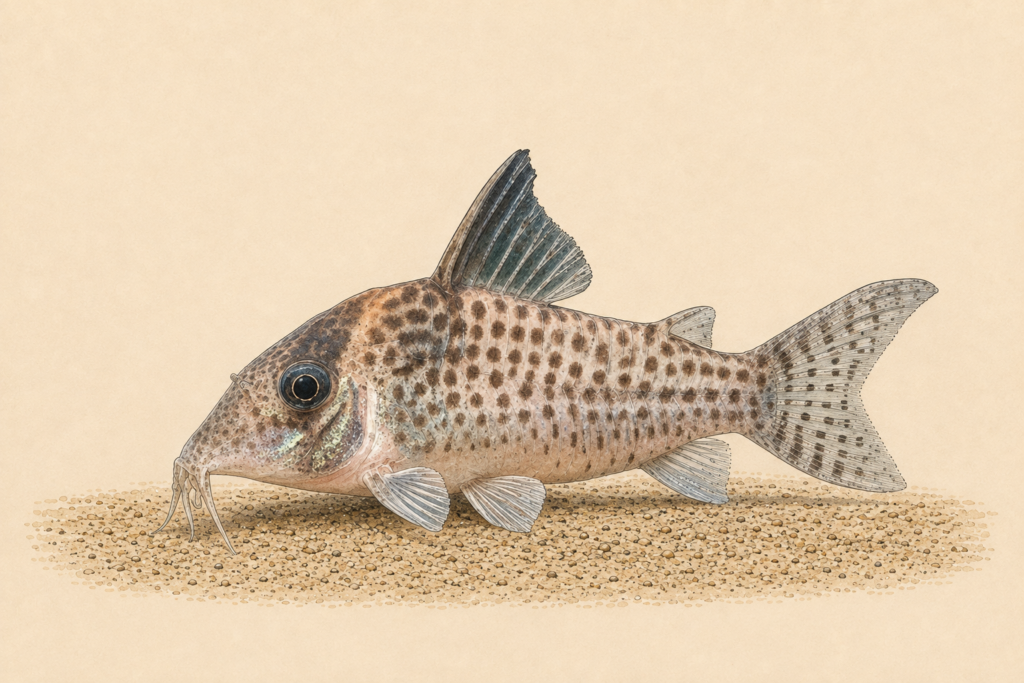
Agassiz’s Corydoras has the characteristic Brochis body shape – somewhat deeper-bodied and more compact than the typical Corydoras, with a slightly arched dorsal profile. The body is encased in two rows of overlapping bony plates (scutes) rather than scales, giving it a subtly armoured appearance that is typical of the Callichthyidae family. This armour provides the fish with a degree of protection against predators in the wild, though in the aquarium it simply adds to the species’ distinctive look.
The base colouration is an olive to greenish-brown along the dorsal surface, transitioning to a lighter, creamy or pale yellow underside. A greenish iridescent sheen is often visible along the flanks when the fish catches the light at certain angles, which is one of the features that sets Brochis apart from many Corydoras species. The fins are generally transparent to slightly yellowish, and the dorsal fin may display faint spotting or darker pigmentation along the rays.
The head is relatively blunt with a downward-facing mouth flanked by two pairs of barbels. These barbels are sensory organs used to detect food particles in the substrate, and their health is a good indicator of overall husbandry quality – eroded or shortened barbels typically signal that the substrate is too rough or that water quality is poor. The eyes are proportionally large and mobile, giving the fish an alert, inquisitive expression.
One of the key distinguishing features of Brochis species, including B. agassizii, is the higher dorsal-fin ray count compared to Corydoras. While most Corydoras have around seven or eight dorsal-fin rays, Brochis species typically possess ten or more. This gives the dorsal fin a slightly broader, more sail-like appearance when erect, which is most easily observed when the fish is startled or displaying to conspecifics.
Sexual dimorphism is subtle but discernible in mature specimens. Females tend to be slightly larger and noticeably rounder when viewed from above, particularly when carrying eggs. Males are typically slimmer and marginally smaller. These differences become most apparent in well-conditioned adult fish.
Natural Habitat
Agassiz’s Corydoras originates from the upper Amazon basin in South America, with populations recorded primarily in Peru and western Brazil. It inhabits slow-moving tributaries, flooded forest areas, and shallow marginal zones of larger rivers where the current is gentle and the substrate is composed of fine sand, mud, and leaf litter.
The waters in its natural range are typically warm, soft, and slightly acidic, stained to varying degrees by tannins released from decaying plant matter. These so-called blackwater and clearwater environments are characterised by relatively low mineral content and a pH that often sits below neutral. The substrate in these habitats is invariably soft – fine sand or silty mud overlaid with decomposing leaves, fallen branches, and other organic debris.
In the wild, Agassiz’s Corydoras is found in groups, often alongside other small catfish and characin species. The fish spend most of their time foraging along the bottom, using their sensitive barbels to probe the substrate for insect larvae, small worms, crustaceans, and other invertebrates. They also consume plant detritus and biofilm. The dense cover provided by submerged roots, fallen wood, and leaf litter offers protection from predators and creates the shaded, sheltered conditions the species prefers.
Seasonal flooding plays a significant role in the ecology of these habitats. During the wet season, water levels rise dramatically, inundating surrounding forest and vastly expanding the available habitat. This seasonal cycle influences breeding behaviour and food availability, with the flush of fresh, cooler water associated with the rains often serving as a spawning trigger for many species in the region, including Brochis.
Tank Size and Setup
A minimum tank size of 80 litres is recommended for a group of six Agassiz’s Corydoras. This provides adequate floor space for foraging and socialising. Because these fish are bottom-dwellers, the footprint of the tank is more important than its height. A longer, shallower tank is preferable to a tall, narrow one. For larger groups or community setups, aim for 120 litres or more to ensure everyone has enough room.
Substrate choice is critical for this species. Fine, smooth sand is the ideal substrate. Agassiz’s Corydoras spends much of its time plunging its face into the substrate to sift for food, and rough or sharp gravel can damage its delicate barbels, leading to erosion, bacterial infections, and reduced ability to find food. Play sand, pool filter sand, or purpose-made aquarium sand in a natural tone all work well. Avoid coarse gravel, crushed coral, or any substrate with jagged edges.
Provide plenty of cover in the form of driftwood, smooth rocks, and live or artificial plants. Agassiz’s Corydoras appreciates shaded resting spots where it can retreat when it feels exposed. Pieces of bogwood arranged to create overhangs and small caves are ideal. Dense plantings of low-growing species such as Cryptocoryne, Anubias, or Java fern along the sides and back of the tank create a natural-looking environment while leaving open sandy areas in the foreground for foraging – this combination of cover and open space mirrors the fish’s natural habitat.
A scattering of dried Indian almond leaves or other botanicals on the substrate adds an authentic touch and releases beneficial tannins into the water, softening it slightly and giving it a natural amber tint. The leaves also encourage the growth of biofilm and microorganisms, providing an additional food source for the fish. Replace the leaves as they decompose, typically every few weeks.
Lighting should be moderate rather than intense. Agassiz’s Corydoras comes from shaded habitats and tends to be more active and relaxed under subdued lighting. Floating plants such as Amazon frogbit or water lettuce can be used to diffuse overhead light and create dappled shade across the tank floor.
Ensure the tank has a secure lid or tight-fitting cover. Like all corydoras-type catfish, Agassiz’s Corydoras is capable of gulping air at the surface – a perfectly normal behaviour related to intestinal respiration. However, fish that dash to the surface can occasionally leap, especially if startled, so a cover prevents accidental escapes.
Water Parameters
Agassiz’s Corydoras is adaptable within a reasonable range of water chemistry, but it does best in soft to moderately hard, slightly acidic to neutral water. Consistency is more important than hitting an exact number – avoid sudden swings in temperature or pH, as these can stress the fish and compromise its immune system.
| Temperature | 22-26 C |
| pH | 6.0-7.5 |
| General hardness (GH) | 2-15 dGH |
| Carbonate hardness (KH) | 1-10 dKH |
| Ammonia | 0 ppm |
| Nitrite | 0 ppm |
| Nitrate | Below 20 ppm |
Weekly water changes of 25-30% are recommended to keep nitrate levels low and maintain overall water quality. When performing water changes, match the temperature of the replacement water closely to the tank water. Some keepers find that a slightly cooler water change (a degree or two below tank temperature) can stimulate natural behaviours and even encourage spawning, mimicking the influx of cooler rainwater that occurs in the species’ native habitat.
Agassiz’s Corydoras is sensitive to elevated ammonia and nitrite levels, as are most fish, but it can be particularly susceptible to issues caused by poor substrate hygiene. Detritus that accumulates in the substrate can release harmful compounds, so regular gentle vacuuming of the sand surface during water changes is good practice. Be careful not to disturb the sand too deeply, as this can release pockets of anaerobic gas in poorly maintained tanks.
Filtration and Equipment
A reliable filter that provides gentle to moderate flow is ideal for Agassiz’s Corydoras. These fish inhabit slow-moving waters in the wild and do not appreciate strong currents, particularly along the tank floor where they spend most of their time. Hang-on-back filters, internal filters, or small canister filters all work well for tanks in the 80-150 litre range. Sponge filters are another excellent option, especially in breeding setups, as they provide biological filtration without creating excessive flow and pose no risk of trapping fry.
If your filter produces a strong output, consider using a spray bar, lily pipe, or flow diffuser to spread the current more evenly and reduce its intensity at substrate level. Positioning the filter outlet so that it agitates the surface without creating a strong downward current across the bottom of the tank strikes the right balance between oxygenation and calm foraging conditions.
A heater rated appropriately for your tank volume is essential to maintain a stable temperature within the 22-26 C range. An external or in-line heater is preferable if available, as it removes the risk of the fish resting against a submersible heater and sustaining burns – though a heater guard can achieve the same protection at lower cost.
An air pump and airstone can be a useful addition, not because Agassiz’s Corydoras requires exceptionally high dissolved oxygen levels, but because the gentle surface agitation improves gas exchange and the rising bubbles create a subtle current that many corydoras-type catfish seem to enjoy interacting with. This is entirely optional if your filter already provides adequate surface movement.
A thermometer – ideally a digital probe or a reliable glass stick-on type – should be used to monitor temperature continuously. Temperature stability is important for this species, and catching a heater malfunction early can prevent stress-related illness.
Diet and Feeding
Agassiz’s Corydoras is an omnivore with a preference for meaty foods, though it readily accepts a wide variety of prepared, frozen, and live offerings. A varied diet is key to maintaining good health, vibrant colouration, and strong condition for potential breeding.
A high-quality sinking pellet or wafer designed for bottom-dwelling fish should form the staple of the diet. These foods are formulated to sink quickly and hold together on the substrate, making them accessible to bottom-feeders without fouling the water. Look for products with whole fish meal, shrimp meal, or insect larvae listed among the first few ingredients, and avoid those padded with excessive fillers or grain.
Supplement the staple diet with frozen or live foods several times a week. Bloodworm, daphnia, brine shrimp, tubifex worms, and mosquito larvae are all eagerly accepted and provide essential proteins and fats. Live foods in particular stimulate natural foraging behaviour and can help condition fish for breeding. If live foods are unavailable, frozen alternatives are an excellent substitute and carry a lower risk of introducing parasites.
Blanched vegetables such as courgette (zucchini) medallions, cucumber slices, or shelled peas can be offered occasionally as a source of fibre and plant-based nutrients. Most Agassiz’s Corydoras will nibble at these, though they tend to prefer animal-based foods. Remove any uneaten vegetable matter after a few hours to prevent it from decomposing and affecting water quality.
Do not rely on leftover food from other tank inhabitants to feed these fish. This is one of the most persistent myths in fishkeeping and leads to underfed, malnourished catfish. Agassiz’s Corydoras should receive targeted feedings that reach the substrate, ideally at the same times each day. Feeding once or twice daily in amounts the group can consume within a few minutes is a good routine.
Observe the fish’s barbels and body condition regularly. Healthy, well-fed Agassiz’s Corydoras should have full-length, intact barbels and a gently rounded belly. Sunken bellies or shortened barbels are signs of underfeeding or poor substrate conditions respectively.
Behaviour and Temperament
Agassiz’s Corydoras is a thoroughly peaceful, sociable species that poses no threat to any tank mate. It spends the vast majority of its time at or near the substrate, methodically working its way across the sand in search of food. The foraging behaviour is endlessly entertaining – the fish plunges its snout into the sand, rapidly expelling mouthfuls of substrate through its gills as it filters out edible particles.
This species must be kept in groups of at least six. It is a shoaling fish that relies on the presence of conspecifics for security and normal behaviour. Solitary or pair-kept individuals are visibly stressed – they tend to hide constantly, eat poorly, and are far more susceptible to disease. In a properly sized group, the fish are bolder, more active, and display a wider repertoire of natural behaviours, including the characteristic synchronised “dance” where the group moves together across the tank in a loose formation.
One of the most distinctive behaviours of all corydoras-type catfish is intestinal respiration – the fish will periodically dart to the water surface, gulp a mouthful of air, and then return to the bottom. This is completely normal and is an adaptation to the low-oxygen environments the species encounters in the wild. It is not a sign of poor water quality unless it occurs with unusual frequency, in which case oxygen levels and water quality should be checked.
Agassiz’s Corydoras is primarily diurnal, meaning it is most active during the day, though it may also forage during the evening and into the early night hours. It tends to rest in shaded spots or under cover during the middle of the day and again at night, often huddling together with other members of its group in a characteristic pile.
Aggression is essentially nonexistent in this species. It does not establish territories, does not compete aggressively for food (though it will jostle gently at feeding time), and does not nip fins. This makes it one of the most reliably peaceful fish available in the hobby and a superb addition to virtually any community aquarium that meets its basic environmental needs.
Tank Mates
Agassiz’s Corydoras is one of the most versatile community fish available. Its peaceful nature, bottom-dwelling habits, and lack of aggression mean it can be housed with a wide range of similarly tempered species. The ideal tank mates are small to medium-sized, peaceful fish that occupy the middle and upper water column, leaving the bottom largely to the corydoras. Avoid anything large enough to eat them, aggressive enough to harass them, or boisterous enough to outcompete them for food at the substrate level.
Good tank mates
- Cardinal Tetra – A classic pairing; cardinal tetras occupy the mid-water column and share a preference for soft, acidic conditions.
- Ember Tetra – Tiny, gentle, and colourful, ember tetras add warmth to the upper levels without any risk of conflict.
- Harlequin Rasbora – Peaceful, hardy rasboras that thrive in similar water parameters and stay in the mid-water zone.
- Cherry Barb – A calm barb species that coexists beautifully with bottom-dwellers and enjoys similar temperatures.
- Dwarf Gourami – A quiet surface-to-mid-water species that leaves bottom-dwellers entirely alone.
- Otocinclus Catfish – Another peaceful algae-grazing catfish that occupies slightly different microhabitats on glass and plant surfaces.
- Kuhli Loach – Although also a bottom-dweller, kuhli loaches are docile and tend to occupy different hiding spots without competition.
- Amano Shrimp – Excellent invertebrate tank mates that help with algae control and are too large for corydoras to bother.
Fish to avoid
- Oscar – Far too large and predatory; an oscar will readily eat Agassiz’s Corydoras.
- Tiger Barb – Boisterous fin-nippers that can stress and harass peaceful bottom-dwellers.
- Red-tail Catfish – A massive predatory catfish completely incompatible with any small species.
- African Cichlids – Most African cichlids require hard, alkaline water and exhibit territorial aggression unsuitable for corydoras.
- Green Terror – Highly aggressive and territorial; will injure or kill small bottom-dwellers.
- Common Pleco – Not aggressive but grows extremely large and produces copious waste, overwhelming tanks suited to small corydoras.
Breeding
Breeding Agassiz’s Corydoras in captivity is achievable for hobbyists with some experience, though it requires more deliberate effort than keeping the species itself. A separate breeding tank of around 40-60 litres is recommended, furnished with fine sand, a gentle sponge filter, and a few broad-leaved plants or smooth surfaces on which eggs can be deposited.
Begin by conditioning a group of at least two males and one female (a ratio of two males per female is often recommended for corydoras-type catfish) with a diet rich in live and frozen foods for two to three weeks. Bloodworm, daphnia, and brine shrimp are particularly effective conditioning foods. Well-conditioned females will become noticeably plumper as they develop eggs.
Spawning can often be triggered by performing a large, slightly cooler water change – replacing 30-50% of the tank water with dechlorinated water that is two to three degrees cooler than the current tank temperature. This simulates the influx of cool rainwater that precedes the breeding season in the species’ native habitat. A drop in barometric pressure, which sometimes coincides with stormy weather, can also stimulate spawning activity.
The spawning behaviour of corydoras-type catfish follows a characteristic pattern. The female initiates the process by becoming visibly restless, swimming actively around the tank with one or more males in close pursuit. Eventually, the female adopts the distinctive “T-position” with a male, pressing her mouth against his genital area. It is believed she takes in sperm at this point, which passes through her digestive tract and fertilises the eggs as she releases them into a pouch formed by her pelvic fins. She then carries the small clutch of adhesive eggs to a chosen surface – typically a plant leaf, the tank glass, or a smooth piece of decor – and presses them firmly into place. This cycle repeats numerous times over several hours until the female has deposited her full clutch, which may number anywhere from 50 to over 200 eggs depending on her size and condition.
The eggs are small, spherical, and slightly adhesive. They are typically pale to off-white in colour. Fertilised eggs will remain firm and may darken slightly as the embryos develop, while infertile eggs tend to turn white and fuzzy with fungus within a day or two. If fungus is a concern, a few drops of methylene blue added to the breeding tank water can help prevent its spread to healthy eggs.
At a temperature of around 24-25 C, the eggs typically hatch in three to five days. The newly hatched fry are tiny and will initially survive on their yolk sacs for a day or two before becoming free-swimming and requiring their first foods. Infusoria, commercially prepared liquid fry food, and microworms are suitable first foods. After a week or so, the fry can graduate to freshly hatched baby brine shrimp, which is an excellent growth food. Crushed high-quality flake or finely powdered fry food can supplement the diet as the young fish grow.
Maintain excellent water quality in the fry tank with gentle sponge filtration and frequent small water changes. The fry are sensitive to water quality fluctuations and ammonia spikes, so diligent maintenance during the first few weeks is essential. Growth is steady, and the young fish will begin to resemble miniature adults within a few weeks, reaching a sellable or tradeable size at around two to three months.
Common Diseases
Agassiz’s Corydoras is a hardy species, but like all freshwater fish it can be affected by a number of common diseases, particularly when water quality is poor or the fish is stressed by inappropriate conditions.
Barbel erosion is one of the most frequently seen issues in corydoras-type catfish. This is not a disease in itself but rather a symptom of keeping the fish on rough or sharp substrate, or in water with chronically elevated nitrate or ammonia levels. The barbels gradually shorten and may become reddened or inflamed. Prevention is straightforward: use fine, smooth sand as the substrate and maintain good water quality. If caught early, barbels can partially regenerate once the underlying cause is addressed.
White spot disease (Ichthyophthirius multifiliis, commonly known as ich) is a parasitic infection that presents as small white cysts on the body and fins. It is highly contagious and often introduced by new, unquarantined fish. Treatment typically involves raising the temperature gradually to 28-30 C and adding aquarium salt at a low concentration – however, corydoras-type catfish are sensitive to salt and copper-based medications, so always use half the recommended dose and monitor the fish closely. Heat treatment alone is often effective for mild cases.
Fin rot, caused by opportunistic bacterial infections, can occur when water quality deteriorates or the fish sustains a physical injury. It manifests as frayed, discoloured, or receding fin edges. Improving water quality through increased water changes is usually sufficient to halt mild cases, while more advanced infections may require treatment with a broad-spectrum antibacterial medication safe for scaleless fish.
Internal parasites can occasionally affect wild-caught specimens. Symptoms include weight loss despite a good appetite, white or stringy faeces, and lethargy. Antiparasitic medications containing levamisole or praziquantel are generally effective, but treatment should be carried out in a quarantine tank to avoid disrupting the biological filter in the main aquarium.
Red blotch disease, sometimes seen in corydoras, presents as reddened patches on the belly or body. Its exact cause is debated, but it is most often associated with bacterial infection secondary to stress or poor water conditions. Treatment involves improving water quality, reducing stress factors, and, if necessary, using an appropriate antibacterial treatment.
The best disease prevention strategy for Agassiz’s Corydoras is straightforward good husbandry: maintain clean water, provide an appropriate substrate, feed a varied diet, keep the fish in a suitably sized group, and quarantine all new additions before introducing them to an established tank.
FAQs
How many Agassiz’s Corydoras should I keep together?
A minimum group of six is strongly recommended, and larger groups of eight to ten or more are even better. Agassiz’s Corydoras is a shoaling species that feels insecure and stressed when kept alone or in very small numbers. In a proper group, the fish are visibly more active, confident, and display a fuller range of natural behaviours. A larger group also makes for a more impressive visual display as the fish move together across the tank floor.
Can I keep Agassiz’s Corydoras on gravel?
Fine, smooth sand is strongly preferred. Coarse or sharp gravel can damage the fish’s sensitive barbels, which are used constantly to probe the substrate for food. Over time, rough substrate leads to barbel erosion, reducing the fish’s ability to feed naturally and potentially causing secondary bacterial infections. If you currently have gravel and want to keep corydoras, consider either replacing it with sand or adding a generous layer of fine sand over the gravel in the areas where the fish will forage most.
Why does my Agassiz’s Corydoras keep darting to the surface?
This is almost certainly intestinal respiration, a completely normal behaviour for all corydoras and Brochis species. These fish have evolved the ability to gulp atmospheric air and absorb oxygen through a specialised section of their intestine, supplementing their gill respiration. This adaptation allows them to survive in the low-oxygen waters they inhabit in the wild. If the behaviour is occasional and the fish otherwise appears healthy, there is no cause for concern. However, if the fish is darting to the surface very frequently – every few seconds rather than every few minutes – it may indicate low dissolved oxygen levels in the tank, and you should check your aeration and water quality.
Is Agassiz’s Corydoras the same as the Emerald Brochis?
No, they are different species. The Emerald Brochis (Brochis splendens) is a larger, more robust species with a more vivid metallic green colouration. While both belong to the genus Brochis and share many care requirements, Agassiz’s Corydoras (Brochis agassizii) is generally smaller and less intensely coloured. The two species can be kept in similar setups, but they are distinct and should not be confused when purchasing. Always check the scientific name to be sure of what you are buying.
Will Agassiz’s Corydoras eat my shrimp?
Adult Agassiz’s Corydoras are generally safe with adult shrimp such as Amano shrimp, cherry shrimp, and other popular ornamental species. They are not predatory and their mouths are not well-suited to catching fast-moving invertebrates. However, very small shrimplets may occasionally be eaten if they happen to be in the path of a foraging corydoras, simply because the fish will consume anything small enough to fit in its mouth. If you are breeding shrimp and want to maximise shrimplet survival, dense plant cover and mosses will provide refuges that significantly reduce predation risk.
Related Guides
- Bronze Corydoras – Another classic, beginner-friendly corydoras species with very similar care requirements and temperament.
- Emerald Brochis – A closely related Brochis species that is larger and more vividly coloured, ideal for keepers who want a bolder centrepiece bottom-dweller.
- Panda Corydoras – A popular small corydoras with distinctive markings that thrives in similar community setups.
- Sterbai Corydoras – A warm-water corydoras species well-suited to aquariums at the upper end of the tropical temperature range.