Quick summary
Dwarf Gouramis are colourful, peaceful fish suited to well-planted community tanks of 40 litres or more, but they require stable water quality and careful attention when buying, since commercially bred stock is prone to the incurable Dwarf Gourami Iridovirus. They are a good fit for hobbyists willing to quarantine new fish and maintain consistent water parameters, rather than complete beginners looking for a low-maintenance species.
🐠 Build a tank around this species
In this guide:
- Introduction
- Quick Stats
- Appearance
- Varieties and Morphs
- Natural Habitat
- Tank Size and Setup
- Water Parameters
- Filtration and Equipment
- Diet and Feeding
- Behaviour and Temperament
- Tank Mates
- Breeding
- Common Diseases
- FAQs
Introduction
The Dwarf Gourami is one of the most recognisable and beloved freshwater fish in the aquarium hobby. With its striking iridescent colouration, peaceful disposition, and manageable size, it has been a staple of community tanks for decades. Originally hailing from the slow-moving waters of South Asia, this small labyrinth fish brings both beauty and personality to a well-maintained aquarium.
Despite its popularity, the Dwarf Gourami is not always the easiest fish to keep healthy in the long term. In recent years, commercially bred specimens have become increasingly susceptible to a viral disease known as Dwarf Gourami Iridovirus (DGIV), which has given the species a somewhat mixed reputation among experienced fishkeepers. However, with careful sourcing, proper husbandry, and an appropriate tank environment, Dwarf Gouramis can thrive and reward their keepers with years of enjoyment. This guide covers everything you need to know to give these charming fish the best possible care.
Quick Stats
| Scientific name | Trichogaster lalius |
|---|---|
| Common names | Flame Gourami, Powder Blue Gourami, Neon Blue Gourami, Red Dwarf Gourami, Sunset Gourami, Rainbow Gourami |
| Family | Osphronemidae |
| Origin | India, Pakistan, Bangladesh |
| Adult size | 9 cm |
| Lifespan | 4–6 years |
| Difficulty | Intermediate |
| Breeding difficulty | Moderate |
| Temperature | 22–28 °C |
| pH | 6–7.5 |
| GH | 4–10 dGH |
| KH | 4–8 dKH |
| Minimum tank size | 40 L |
| Conservation status | Least Concern (IUCN) |
Appearance
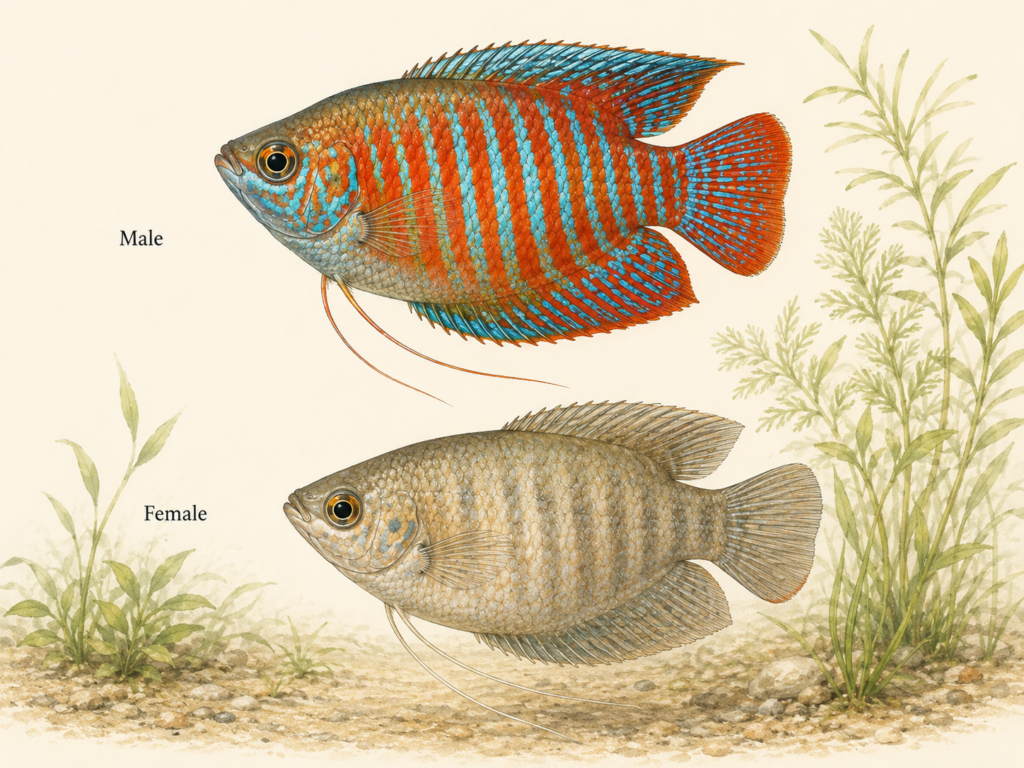
The wild-type Dwarf Gourami is a genuinely spectacular fish. Males display a vivid pattern of alternating vertical stripes in turquoise blue and fiery red-orange that extends across the entire body and into the fins. These colours have an iridescent quality, shifting and shimmering as the fish moves through the water. The dorsal fin is edged in brilliant orange, while the anal fin carries the same striped pattern as the body, tapering elegantly towards the tail. The ventral fins are characteristically modified into long, thread-like filaments that the fish uses as tactile sensors, constantly probing and feeling its surroundings.
Females are considerably less colourful, displaying a silvery-grey body with faint blue or pale orange vertical banding. They are also slightly smaller and have a rounder body profile. This pronounced sexual dimorphism makes sexing adult Dwarf Gouramis straightforward, even for beginners. Juvenile fish of both sexes tend to resemble females, with full male colouration developing as they mature.
The body shape is laterally compressed and oval, typical of gourami species. The mouth is small and slightly upturned, reflecting the fish’s habit of feeding at the surface. At full maturity, males typically reach around 7–8 cm in total length, while females remain closer to 6 cm.
Varieties and Morphs
The Dwarf Gourami has been selectively bred into a number of distinct colour morphs, many of which are widely available in the aquarium trade. While these variants differ considerably in appearance, their care requirements are identical to those of the wild-type form.
The Powder Blue Dwarf Gourami, sometimes sold as the Coral Blue or simply Blue Dwarf Gourami, is one of the most popular variants. Males of this morph display an almost entirely solid iridescent blue body with only minimal red or orange markings, typically limited to the rear portion of the body and the edges of the fins. The effect is striking and understated compared to the wild type.
The Flame Dwarf Gourami, also known as the Red Dwarf Gourami or Fire Dwarf Gourami, is essentially the opposite of the powder blue in emphasis. These fish display a predominantly red-orange body with reduced blue colouration, giving them a warm, fiery appearance that stands out beautifully against green planted backgrounds.
The Neon Blue Dwarf Gourami is a variant that retains the striped pattern of the wild type but with intensified, more vivid blue colouration that appears almost electric under aquarium lighting. The contrast between the blue and red stripes is enhanced compared to wild-caught specimens.
The Sunset Dwarf Gourami, sometimes called the Robin Dwarf Gourami, features a gradient of warm colours ranging from pale yellow on the belly to deep orange-red along the back and dorsal region. Blue colouration is largely absent, replaced by golden and amber tones.
The Royal Blue Dwarf Gourami is another blue-dominant variant that retains more of the striped patterning than the powder blue morph. The stripes are visible but appear as alternating bands of deep blue and slightly lighter metallic blue, with only traces of red.
It is worth noting that virtually all Dwarf Gouramis available in shops are commercially bred, primarily from large-scale facilities in Southeast Asia. Wild-caught specimens are uncommon in the trade but are occasionally available from specialist importers.
Natural Habitat
The Dwarf Gourami is native to the freshwater systems of South Asia, with its range spanning across northern India, Pakistan, and Bangladesh. It is particularly associated with the Ganges, Brahmaputra, and Indus river basins, where it inhabits a wide variety of slow-moving and still-water environments.
In the wild, these fish are most commonly found in densely vegetated areas such as rice paddies, irrigation channels, sluggish streams, ponds, and the heavily vegetated margins of larger rivers. The water in these habitats is typically warm, soft to moderately hard, and often stained with tannins from decomposing organic matter. Aquatic vegetation is abundant, providing cover, foraging opportunities, and nesting sites. The substrate in these environments tends to be silty or muddy, with fallen leaves and other organic debris creating a complex microhabitat.
As a labyrinth fish, the Dwarf Gourami possesses a specialised organ that allows it to breathe atmospheric air directly. This adaptation is crucial in its natural habitat, where dissolved oxygen levels can drop significantly in warm, stagnant water. You will frequently observe Dwarf Gouramis rising to the surface to gulp air, which is a perfectly normal and healthy behaviour.
The species has also been introduced to various locations outside its native range, including parts of the United States, Colombia, and Singapore, where feral populations have become established.
Tank Size and Setup
A single Dwarf Gourami or a pair can be comfortably housed in a tank of at least 40 litres, though a larger aquarium of 60 litres or more is preferable and allows for a more stable environment. If you plan to keep a small group or house them in a community setting with other species, aim for 80 litres or above. Dwarf Gouramis are not particularly active swimmers in terms of horizontal distance, but they do appreciate having space to establish small territories and retreat from potential stressors.
The ideal setup mimics the densely planted, slow-moving waters of their natural habitat. Live plants are strongly recommended, and species such as Vallisneria, Java Fern, Anubias, Amazon Sword, and various stem plants all work well. Floating plants are particularly valuable, as they provide shade, reduce the fish’s sense of exposure, and offer anchoring points for bubble nests during breeding. Good options include Amazon Frogbit, Water Lettuce, Salvinia, and Red Root Floaters.
The substrate can be fine gravel or sand, with darker colours tending to bring out the best colouration in the fish. Driftwood and smooth stones provide additional cover and visual barriers, which are important for reducing stress, particularly if more than one male is present. Avoid sharp decorations that could damage the fish’s delicate fins or thread-like ventral filaments.
Dwarf Gouramis can be somewhat timid, especially when first introduced to a new aquarium. Providing ample hiding spots and visual breaks in the form of dense planting and hardscape will help them settle in more quickly. A well-planted tank with areas of open swimming space and areas of dense cover strikes the ideal balance.
Lighting should be moderate. Excessively bright lighting without the mitigating effect of floating plants can make Dwarf Gouramis feel exposed and stressed, leading to washed-out colours and skittish behaviour.
Water Parameters
Maintaining stable water parameters is one of the most important aspects of Dwarf Gourami care. While these fish are reasonably adaptable, they are sensitive to poor water quality and sudden fluctuations, which can trigger stress and disease. The following ranges represent the ideal conditions for long-term health.
| Temperature | 22–28 °C |
| pH | 6.0–7.5 |
| General hardness (GH) | 4–10 dGH |
| Carbonate hardness (KH) | 4–8 dKH |
| Ammonia | 0 ppm |
| Nitrite | 0 ppm |
| Nitrate | Below 20 ppm |
A temperature around 24–26 °C is optimal for everyday keeping, while slightly warmer temperatures towards 28 °C can be used to encourage breeding behaviour. It is essential that ammonia and nitrite remain at zero at all times, as even trace amounts can compromise the immune system of these fish and make them vulnerable to infection. Regular water changes of 20–30% per week are strongly recommended to keep nitrate levels low and maintain overall water quality.
Dwarf Gouramis generally prefer soft to moderately hard, slightly acidic to neutral water. If your tap water is particularly hard or alkaline, consider using a blend of tap water and RO (reverse osmosis) water to bring parameters into the preferred range. Indian Almond Leaves or other sources of tannins can also be added to soften the water slightly and provide a more natural environment, with the added benefit of mild antibacterial properties.
Filtration and Equipment
Given that Dwarf Gouramis naturally inhabit slow-moving or still waters, filtration should provide effective biological and mechanical cleaning without creating excessive current. A gentle sponge filter is an excellent choice for smaller tanks, as it provides robust biological filtration while producing minimal water flow. In larger setups, a hang-on-back filter or small canister filter with an adjustable flow rate works well, ideally with the outlet directed against the glass or fitted with a spray bar to diffuse the current.
Strong currents will stress Dwarf Gouramis, hinder their ability to build bubble nests, and force them to expend unnecessary energy. If you notice your fish constantly being pushed around or struggling to swim comfortably, the flow is too strong and should be reduced.
A heater is essential for maintaining the stable tropical temperatures that these fish require. Choose a reliable, thermostatically controlled heater rated appropriately for your tank volume. In colder climates or rooms with significant temperature fluctuations, a heater guard can prevent the fish from resting against the heater and sustaining burns.
Because Dwarf Gouramis are labyrinth breathers and need regular access to the surface, ensure there is always a gap between the water surface and any aquarium lid. A tight-fitting lid is nonetheless recommended, as Dwarf Gouramis are capable of jumping, particularly when startled. The lid also serves the important function of keeping the air above the water surface warm and humid. Cold draughts across the water surface can cause temperature differentials between the air the fish breathes and the water it lives in, potentially leading to respiratory problems.
Standard aquarium lighting suitable for plant growth is perfectly adequate. If your setup does not include live plants, a simple LED light on a timer providing 8–10 hours of illumination per day will suffice.
Diet and Feeding
Dwarf Gouramis are omnivorous and generally undemanding when it comes to food. In the wild, they feed on small insects, insect larvae, algae, and other organic matter found at or near the water surface. In captivity, a varied diet is the key to maintaining vibrant colour, robust health, and strong immune function.
A high-quality micro-pellet or small flake food formulated for tropical fish should form the staple of the diet. Look for products that list whole fish meal, shrimp, or similar protein sources as the primary ingredients, with minimal fillers. Supplement this base diet regularly with frozen or live foods such as bloodworm, daphnia, brine shrimp, and mosquito larvae. These protein-rich foods are eagerly accepted and help to condition the fish, particularly important if you are planning to breed them.
Blanched vegetables such as courgette, spinach, or peas can be offered occasionally to provide variety and additional fibre. Dwarf Gouramis will also happily graze on soft algae growth within the tank and may nibble on biofilm that forms on driftwood and plant surfaces.
Feed once or twice daily, offering only as much food as the fish can consume within two to three minutes. Dwarf Gouramis have relatively small stomachs and are prone to digestive issues if overfed. Uneaten food should be removed promptly to prevent it from decomposing and degrading water quality. An occasional fasting day once per week can be beneficial for digestion.
Behaviour and Temperament
The Dwarf Gourami is generally a peaceful and somewhat shy fish. It tends to occupy the upper and middle levels of the aquarium, frequently hovering among plants or beneath floating vegetation. You will regularly see it rise to the surface to take gulps of air through its labyrinth organ, which is entirely normal behaviour. Its elongated ventral fins are used as sensory appendages, and it is fascinating to watch as the fish gently probes its surroundings, testing plants, substrate, and even other fish with these delicate filaments.
While peaceful towards other species, male Dwarf Gouramis can be territorial and occasionally aggressive towards one another, particularly in smaller tanks without sufficient visual barriers. In most community setups, it is best to keep only a single male unless the aquarium is large enough (100 litres or more) with ample plant cover to break up sight lines and allow each male to establish a territory without constant confrontation. Even then, some individuals are simply more aggressive than others, and close monitoring is advisable.
The relationship between males and females can also be complicated. Males may harass females, particularly during breeding attempts or in tanks that are too small. If keeping a male and female together, ensure there is plenty of cover for the female to retreat to. Keeping one male with two or three females can help to spread any attention more evenly and reduce pressure on a single individual.
Dwarf Gouramis are intelligent fish that quickly learn to recognise their keeper and may approach the front of the tank at feeding time. They are generally curious but easily startled by sudden movements or loud noises near the tank, so placing the aquarium in a relatively calm area of the home is beneficial.
Tank Mates
Dwarf Gouramis are well suited to peaceful community aquariums with similarly sized, non-aggressive tank mates. The key is to avoid species that are significantly larger, boisterous, or fin-nipping, as these can cause chronic stress in Dwarf Gouramis. Equally, it is generally advisable to avoid housing Dwarf Gouramis with other gourami species of similar size, as territorial disputes can arise.
Good tank mates
- Harlequin Rasbora, a gentle, shoaling species that occupies the mid-water column and poses no threat to gouramis.
- Neon Tetra, Small, peaceful, and visually complementary, these classic community fish stay out of the gourami’s way.
- Cardinal Tetra, Similar in temperament and requirements to the Neon Tetra and equally compatible.
- Corydoras Catfish, Peaceful bottom-dwellers that occupy a completely different zone of the aquarium, avoiding any territorial overlap.
- Kuhli Loach, a shy, nocturnal bottom-dweller that coexists well with Dwarf Gouramis and adds interest to the lower levels of the tank.
- Ember Tetra, Tiny, calm, and beautifully coloured, these tetras make excellent companions in a planted community setup.
- Cherry Barb, a peaceful barb species that lacks the fin-nipping tendencies of its more boisterous relatives.
- Otocinclus, a small, algae-eating catfish that is entirely peaceful and helps to keep the tank clean.
- Amano Shrimp, Hardy, algae-eating shrimp that are too large for Dwarf Gouramis to predate and cohabit peacefully.
- Bristlenose Pleco, a compact plecostomus that stays small enough for most community tanks and keeps to itself on the bottom.
Fish to avoid
- Tiger Barb, a notorious fin-nipper that will relentlessly target the long ventral filaments and flowing fins of Dwarf Gouramis.
- Betta Fish, another labyrinth fish with territorial instincts; housing the two together frequently leads to aggression from one or both parties.
- Oscar, far too large and predatory; a Dwarf Gourami would be viewed as food by an adult Oscar.
- Convict Cichlid, Aggressive and territorial, especially during breeding, and likely to bully or injure a Dwarf Gourami.
- Chinese Algae Eater, Becomes increasingly aggressive with age and has a tendency to latch onto the sides of slow-moving fish.
- Red Tail Shark, highly territorial towards fish that enter its domain, which can lead to constant chasing and stress.
- Paradise Fish, a closely related gourami species that is significantly more aggressive and will dominate or attack Dwarf Gouramis.
- Green Terror, a large, aggressive cichlid entirely unsuitable for cohabitation with small, peaceful species.
Breeding
Breeding Dwarf Gouramis in captivity is a rewarding experience and is achievable for hobbyists with moderate experience. Like other members of the Osphronemidae family, the Dwarf Gourami is a bubble nest builder, and the male takes the primary role in both nest construction and fry care.
To condition a pair for breeding, increase the proportion of high-protein foods in their diet for two to three weeks prior to the breeding attempt. Live or frozen foods such as bloodworm, daphnia, and brine shrimp are particularly effective for bringing the fish into breeding condition. Gradually raising the water temperature to around 27–28 °C and slightly lowering the water level to approximately 15–20 cm can also help to trigger spawning behaviour.
The male will begin constructing a bubble nest at the water surface, often incorporating plant material, especially floating plant roots or leaves, into the structure. This nest can be surprisingly large and intricate. Once the nest is complete, the male will display to the female with intensified colours, flared fins, and a characteristic sideways shimmy. If the female is receptive, the pair will embrace beneath the nest in a spawning clasp, during which the female releases eggs that the male fertilises and then carefully collects in his mouth, depositing them into the bubble nest.
A single spawning event can produce several hundred eggs. Once spawning is complete, the female should ideally be removed, as the male may become aggressively protective of the nest and injure her. The male will diligently guard and maintain the nest, retrieving any eggs that fall and repairing bubbles as needed.
The eggs typically hatch within 24–36 hours, and the fry become free-swimming two to three days later. At this point, the male should also be removed to prevent him from consuming the fry. The newly free-swimming fry are extremely small and require very fine foods such as infusoria or commercially available liquid fry food for the first week or so. After this initial period, they can be transitioned to freshly hatched baby brine shrimp and then gradually onto finely crushed flake food as they grow.
Maintain excellent water quality in the fry tank with gentle sponge filtration and frequent, small water changes. The development of the labyrinth organ occurs during the first few weeks of life, so ensuring the air above the water surface is warm and humid by keeping the tank tightly covered is critically important during this period.
Common Diseases
The Dwarf Gourami is unfortunately susceptible to several diseases, the most significant of which is Dwarf Gourami Iridovirus (DGIV), also known as Dwarf Gourami Disease. This is a systemic viral infection that is highly prevalent in commercially bred stocks, particularly those originating from mass-production facilities in Southeast Asia. Symptoms include loss of colour, lethargy, fin erosion, abdominal swelling, open sores, and a general failure to thrive. There is currently no cure for DGIV, and affected fish typically decline over a period of weeks to months. The best defence is prevention through sourcing fish from reputable breeders and retailers, quarantining all new arrivals for at least two to four weeks, and maintaining impeccable water quality.
Bacterial infections are another common concern, often manifesting as fin rot, body ulcers, or cloudy eyes. These infections are almost always secondary to stress, poor water quality, or injury. Maintaining clean water and a low-stress environment is the most effective prevention. If bacterial infections do occur, they can often be treated with broad-spectrum antibacterial medications, though identifying and correcting the underlying cause is essential.
Ich (white spot disease), caused by the parasite Ichthyophthirius multifiliis, presents as small white spots resembling grains of salt across the body and fins. Dwarf Gouramis are no more or less susceptible to ich than most other tropical fish, and the condition responds well to treatment with elevated temperature (around 30 °C) combined with a commercially available ich medication.
Velvet disease, caused by the parasitic dinoflagellate Piscinoodinium pillulare, produces a fine, dusty, gold or rust-coloured coating on the skin. It is more difficult to spot than ich in its early stages and can progress rapidly if untreated. Dimming the lights and looking at the fish from an angle with a torch can help with early detection. Treatment involves darkness (the parasite is partly photosynthetic), elevated temperature, and copper-based medications, though care must be taken with dosing in soft water.
Maintaining stable water parameters, providing a nutritious and varied diet, minimising stress through appropriate tank setup and compatible tank mates, and quarantining new arrivals are the cornerstones of disease prevention for this species.
FAQs
Can I keep two male Dwarf Gouramis together?
It is generally not advisable to keep two male Dwarf Gouramis in the same tank unless the aquarium is spacious (100 litres or larger) and heavily planted with numerous visual barriers. In smaller tanks, males will almost inevitably engage in territorial aggression, which can lead to stress, injuries, and a decline in health for the subordinate individual. If you wish to keep multiple Dwarf Gouramis, a single male with two or three females is a more harmonious arrangement.
Why is my Dwarf Gourami hiding all the time?
Excessive hiding is typically a sign of stress. Common causes include overly bright lighting without sufficient shade from floating plants, aggressive or boisterous tank mates, a tank that is too bare and lacks adequate cover, poor water quality, or illness. Newly introduced Dwarf Gouramis may also hide for the first few days as they acclimate to their new environment, which is normal. If hiding persists beyond a week, investigate the environmental factors and check your water parameters.
Do Dwarf Gouramis need to be kept in pairs?
No, Dwarf Gouramis are not shoaling fish and do not require the company of their own kind. A single specimen will do perfectly well on its own in a community aquarium and will often display more confident behaviour without the pressure of conspecific competition. If you do keep them in groups, ensure the tank is large enough and the male-to-female ratio is appropriate.
How can I tell the difference between a male and female Dwarf Gourami?
Sexing adult Dwarf Gouramis is straightforward. Males are more brightly coloured, with vivid blue and red-orange patterning, pointed dorsal fins, and a slimmer body profile. Females are smaller, display a muted silvery-grey colouration with only faint hints of colour, and have a rounder body shape with a more rounded dorsal fin. In colour morphs such as the powder blue or flame, the same principles apply, with males always being noticeably more vibrant.
What is Dwarf Gourami Iridovirus and how can I avoid it?
Dwarf Gourami Iridovirus (DGIV) is a viral disease that primarily affects Dwarf Gouramis and is widespread in commercially bred stocks. It causes progressive organ failure and has no known cure. To minimise the risk, purchase fish from reputable, ideally locally bred sources rather than mass-imported stock. Always quarantine new arrivals for a minimum of two to four weeks in a separate tank before introducing them to your main aquarium. Choosing specimens that are active, eating well, and displaying strong colouration at the point of purchase also helps, as lethargic or pale fish may already be compromised.
Related Guides
- Honey Gourami Care Guide, a closely related and similarly sized gourami species that makes an excellent alternative for those seeking a hardier labyrinth fish.
- Pearl Gourami Care Guide, a larger but equally peaceful gourami that thrives in similar planted setups and is often considered one of the most beautiful species in the family.
- Betta Fish Care Guide, another popular labyrinth fish with overlapping care requirements and useful comparisons for those interested in anabantoid species.
- Harlequin Rasbora Care Guide, one of the best tank mates for Dwarf Gouramis, originating from similar soft, acidic water conditions in Asia.
- Planted Tank Setup Guide, Essential reading for creating the densely vegetated environment that Dwarf Gouramis thrive in.