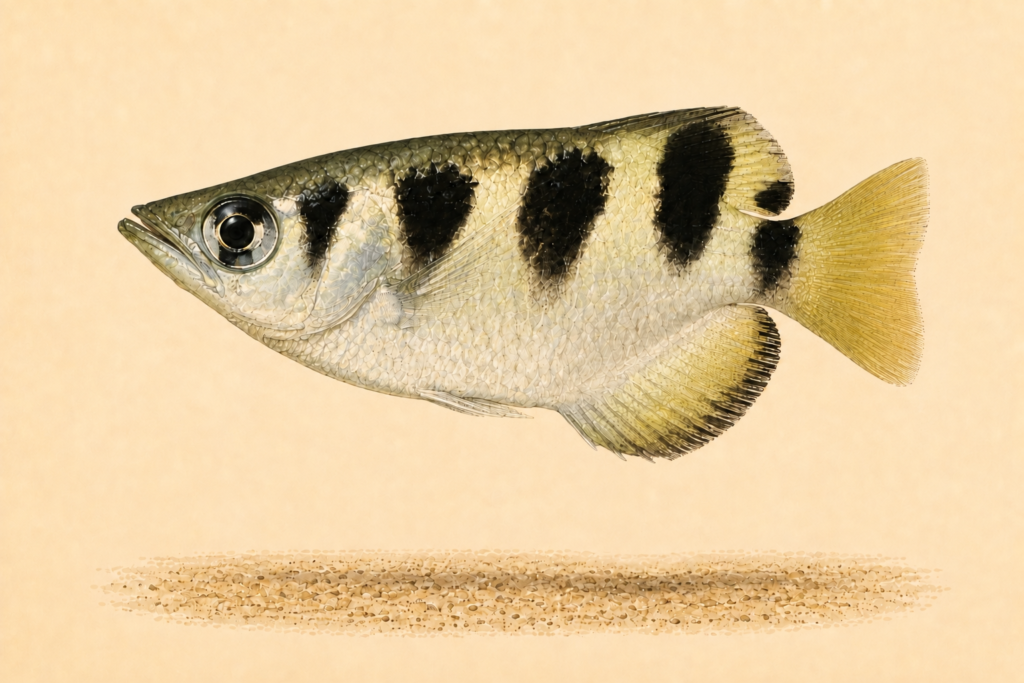
Quick Summary
The Banded Archerfish is a fascinating, intelligent brackish-water predator famous for spitting jets of water at insects above the surface. It is best suited to experienced fishkeepers who can provide a large, covered brackish aquarium with generous airspace above the waterline – this is not a beginner’s fish, nor is it a true freshwater species despite sometimes being sold as one.
🐠 Build a tank around this species
In this guide:
- Introduction
- Quick Stats
- Appearance
- Natural Habitat
- Tank Size and Setup
- Water Parameters
- Diet and Feeding
- Behaviour and Temperament
- Tank Mates
- Breeding
Introduction
Few freshwater or brackish fish capture the imagination quite like the Banded Archerfish (Toxotes jaculatrix). Renowned for its extraordinary ability to shoot precisely aimed jets of water from its mouth to knock insects off overhanging branches and leaves, this species has been the subject of scientific study, nature documentaries, and no small amount of fishkeeper admiration for decades. The shooting behaviour is not merely instinctive – research has shown that archerfish learn to compensate for the refraction of light at the water’s surface, adjusting their aim with remarkable accuracy, and they can even learn by watching other archerfish shoot. They are, by any reasonable measure, among the most intelligent bony fish kept in the aquarium hobby.
Despite regularly appearing in shops labelled as a freshwater tropical, the Banded Archerfish is fundamentally a brackish to estuarine species. While juveniles are often found in lower-salinity waters and can survive in fresh water for a period, long-term health and normal lifespan require brackish conditions. Keeping them permanently in pure fresh water typically leads to a gradual decline in condition, increased disease susceptibility, and a significantly shortened life. This is one of the most important points any prospective keeper needs to understand from the outset.
Archerfish are active, surface-dwelling predators that naturally patrol the upper water column, scanning for prey above the waterline. They are powerful jumpers and accomplished spitters. This means the aquarium setup has unique requirements: a very secure, heavy lid to prevent escapes, and a substantial gap between the water surface and the lid to allow the fish to exhibit its natural hunting behaviour. When these needs are met, the Banded Archerfish rewards its keeper with a level of interaction and personality that is genuinely rare among fish. They are known to recognise individual human faces and will often approach their regular feeder while ignoring strangers – a trait confirmed by university research.
Quick Stats
| Scientific name | Toxotes jaculatrix |
|---|---|
| Common names | Archer Fish, Spinning Archerfish |
| Family | Toxotidae |
| Origin | Indo-Pacific: India, Southeast Asia, northern Australia, Melanesia |
| Adult size | 25 cm |
| Lifespan | 8–12 years |
| Difficulty | Advanced |
| Breeding difficulty | Advanced |
| Temperature | 25–30 °C |
| pH | 7–8.5 |
| GH | 10–25 dGH |
| KH | 8–20 dKH |
| Minimum tank size | 450 L |
| Conservation status | Least Concern (IUCN) |
Appearance
The Banded Archerfish has a laterally compressed, roughly wedge-shaped body that is deeper towards the front and tapers towards the tail. The dorsal profile is relatively flat, while the ventral profile curves more noticeably – a body shape that allows the fish to cruise just below the surface with its upward-facing mouth perfectly positioned to spit at prey above. The mouth itself is large and somewhat protrusible, with a groove in the palate that forms the tube through which water is expelled. The lower jaw protrudes slightly beyond the upper, giving the fish a purposeful, determined expression when viewed head-on.
The base body colour is a bright silver to silvery-white, sometimes with a faint golden or greenish sheen depending on lighting conditions and diet. The most distinctive feature is a series of bold, dark (black to very dark brown) vertical bands or wedge-shaped bars running down the flanks. Typically there are four to six of these bands, with the first passing through or near the eye and the rearmost sitting near the base of the caudal peduncle. These bands are broader at the dorsal edge and narrow as they reach the belly, giving them a triangular or wedge-like appearance. In healthy specimens kept under good conditions, the contrast between the silver body and the dark bars is striking. The fins are largely transparent to lightly tinted, with the dorsal fin set far back on the body near the tail – a characteristic of the family Toxotidae.
Juveniles tend to show more prominent banding, and the bars may break up slightly or become less sharply defined in very large, older adults. There is no reliable external sexual dimorphism; males and females look essentially identical, which is one of the many challenges associated with breeding this species. Healthy archerfish have bright, alert eyes and a robust body condition. Fish kept in suboptimal freshwater conditions often show a washed-out, pale appearance with less distinct banding, and may develop a slightly pinched look behind the head.
Natural Habitat
Toxotes jaculatrix is found across a vast range spanning the Indo-Pacific region, from the coastal waters of India and Sri Lanka through Southeast Asia (including Thailand, Malaysia, Indonesia, the Philippines, and Myanmar) to northern Australia and parts of Melanesia. Throughout this range, the species is strongly associated with mangrove forests, estuarine habitats, tidal creeks, and the lower reaches of rivers where fresh water meets the sea. These are brackish environments where salinity fluctuates with the tides, typically ranging from around 5 to 15 parts per thousand (roughly one-quarter to one-half marine strength), though they may occasionally venture into near-marine conditions or temporarily into fresher upstream waters.
The mangrove habitats where archerfish thrive are characterised by overhanging vegetation, tangled root systems, muddy or silty substrates, and warm, relatively shallow water. The overhanging vegetation is central to the archerfish’s feeding ecology – insects, spiders, and other small invertebrates resting on leaves and branches above the water become targets for the fish’s famous spitting behaviour. The water in these environments is typically warm (26-30 C), alkaline (pH 7.5-8.5), and moderately to highly hard. Tidal flows mean the water is well-oxygenated and regularly flushed, keeping dissolved waste levels low.
Understanding this natural habitat is essential for replicating appropriate conditions in captivity. The brackish salinity, hard alkaline water, warm temperatures, overhanging surfaces, and open surface area are all features that should be reflected in the aquarium setup. Attempting to keep Banded Archerfish in soft, acidic freshwater ignores the fundamental ecology of the species and will invariably compromise their health over time.
Tank Size and Setup
The Banded Archerfish is an active, moderately large, social predator, and the tank must reflect this. A minimum of 450 litres is recommended for a small group of four to six juveniles, but a tank of 600 litres or more is strongly preferred as the fish grow towards adult size. Because archerfish are primarily surface dwellers, the footprint of the tank matters more than extreme depth. A long, wide tank is far more useful than a tall, narrow one. A minimum length of 150 cm is advisable, and 180 cm or more is better for adults. Tank depth (front to back) should be at least 50 cm.
One of the most critical and unique aspects of the archerfish tank is the space above the waterline. The water level should be dropped 15-25 cm below the rim of the tank to give the fish room to spit. Some keepers go further, using paludarium-style setups or custom tanks with higher glass panels to provide 30 cm or more of airspace. This allows the fish to exhibit natural hunting behaviour and dramatically improves their quality of life. Overhanging branches, driftwood, or robust trailing plants positioned above the waterline give the archerfish targets to aim at during feeding, which is one of the great joys of keeping the species.
A heavy, tightly fitting lid is absolutely essential. Archerfish are powerful jumpers, and an uncovered or loosely fitting lid will result in fish on the floor. Glass lids are preferable to mesh, as they retain humidity above the water surface, which helps prevent the fish’s eyes from drying when they rise to spit. Ensure there are no gaps large enough for the fish to force through.
The substrate can be sand (fine silica sand or coral sand) or fine gravel. Coral sand or crushed coral is a practical choice because it gently buffers the pH upwards and contributes to the hard, alkaline water chemistry these fish need. Decor should include some robust driftwood or mangrove wood, but the tank should not be heavily planted or cluttered. The open swimming space in the upper half of the tank is far more important than complex aquascaping. If you wish to include plants, choose hardy brackish-tolerant species such as Java Fern (Microsorum pteropus), Anubias species, or mangrove propagules. Many soft-water aquarium plants will not tolerate the brackish conditions required.
Lighting should be moderate to bright, partly to support any plants but also because archerfish naturally inhabit sun-drenched tropical waters. A standard LED aquarium light on a timer providing 8-10 hours of light per day is appropriate.
Water Parameters
Toxotes jaculatrix requires brackish water for long-term health. While juveniles are sometimes found in lower-salinity or even near-freshwater conditions in the wild, and the species can survive temporarily in fresh water, maintaining them permanently without salt leads to chronic stress, weakened immune function, and a shortened lifespan. A specific gravity of 1.005-1.015 (roughly 8-20 grams of marine salt per litre) is the target range for long-term maintenance. Many experienced keepers maintain their archerfish at around SG 1.005-1.010 and find this to be a good balance that also widens the range of compatible tank mates. Use a quality marine salt mix rather than aquarium “tonic salt” or table salt, as marine salt provides the full spectrum of trace elements and buffers that mimic natural estuarine water chemistry.
| Temperature | 25-30 C |
| pH | 7.0-8.5 |
| General hardness (GH) | 10-25 dGH |
| Carbonate hardness (KH) | 8-20 dKH |
| Ammonia | 0 ppm |
| Nitrite | 0 ppm |
| Nitrate | Below 20 ppm |
Stability is important. While archerfish are adapted to some degree of salinity fluctuation in the wild, sudden large swings in specific gravity, pH, or temperature should be avoided. When performing water changes (25-30% weekly is a good target), pre-mix the replacement water to match the salinity and temperature of the tank before adding it. A refractometer or hydrometer is essential equipment for monitoring specific gravity accurately. Test pH, ammonia, nitrite, and nitrate regularly, particularly in the first few months after setting up the tank or after any changes to stocking.
Filtration and Equipment
Archerfish produce a moderate to high bioload, particularly as they grow, and they are messy eaters of protein-rich foods. Robust biological and mechanical filtration is essential. A large external canister filter rated for the tank volume (or ideally somewhat above it) is the standard choice. If keeping a group in a tank of 600 litres or more, running two canister filters or supplementing with an internal powerhead can help ensure adequate water turnover and oxygenation. Aim for a total turnover of at least six to eight times the tank volume per hour.
Because archerfish are surface dwellers, moderate surface agitation is beneficial for gas exchange, but avoid creating excessively turbulent flow that makes it difficult for the fish to hold station at the surface. Positioning the filter outlet to create a gentle, broad current across the surface works well. An air pump with a diffuser stone at one end of the tank can supplement oxygenation if needed, particularly in warm weather when dissolved oxygen levels drop.
A reliable heater (or two smaller heaters for redundancy in larger tanks) set to 26-28 C is standard. Choose a heater with a protective guard, as large archerfish can occasionally damage unprotected glass heaters. A thermometer – ideally a digital one with an external probe – allows you to monitor temperature at a glance.
Given the brackish conditions, be aware that salt water is more corrosive than fresh water over time. Check equipment regularly for signs of corrosion, particularly metal fittings, impeller shafts, and heater seals. Choose equipment rated for brackish or marine use where possible. Filter media does not need to be anything exotic – standard ceramic biomedia, coarse sponge for mechanical filtration, and fine filter floss or pads for polishing are all appropriate. Chemical filtration with activated carbon can be used periodically to maintain water clarity, but is not strictly necessary on a permanent basis.
Diet and Feeding
In the wild, the Banded Archerfish is a carnivorous predator feeding primarily on insects and other small invertebrates, both those knocked into the water by spitting and those taken from the surface film or just below it. The diet in captivity should reflect this predatory, insectivorous nature.
The best staple foods are live or frozen insects and invertebrates. Crickets (appropriately sized), mealworms, waxworms, fruit flies, and small locusts are all excellent choices. These can be offered by hand, placed on a branch or leaf overhanging the water (to encourage natural spitting behaviour), or simply dropped onto the water surface. Frozen bloodworm, brine shrimp, mysis shrimp, and krill are also readily accepted and provide good nutritional variety. Many archerfish can be trained to accept high-quality floating pellets or sticks designed for predatory fish, which is convenient for everyday feeding, though a diet based solely on dry food is not ideal.
Feed juveniles twice daily in small amounts. Adults can be fed once daily or every other day, depending on the quantity offered. Archerfish are enthusiastic, aggressive feeders and will consume food quickly at the surface. Remove any uneaten food promptly to prevent water quality deterioration, particularly with protein-rich items like insects and shrimp.
Encouraging natural spitting behaviour is one of the most rewarding aspects of keeping archerfish. Position a branch or piece of driftwood so that it extends a few centimetres above the water surface and place live insects on it. The fish will quickly learn to target prey items in this way, and the accuracy of their shots is genuinely impressive. Some keepers even use small magnets or clips to attach food items to the inside of the lid or to overhanging fixtures. This kind of enrichment is highly beneficial for the fish’s mental stimulation, and archerfish in barren tanks with no opportunity to spit often seem less active and engaged.
Avoid feeder fish as a regular dietary component. While archerfish may take small fish opportunistically, feeder fish are nutritionally poor, carry disease risks, and are unnecessary when a varied invertebrate-based diet is provided. Occasional treats such as small prawns, whitebait, or pieces of mussel or cockle can be offered for variety.
Behaviour and Temperament
Banded Archerfish are active, alert, and remarkably intelligent. They spend the majority of their time patrolling the upper water column, typically within 10-15 cm of the surface, constantly scanning above the waterline for potential prey. Their eyes are large and forward-facing (for a fish), giving them excellent binocular vision and depth perception – essential for accurately judging the position of targets above the water and compensating for the refraction of light at the air-water interface.
One of the most notable behavioural traits of archerfish, confirmed by research at the University of Oxford and elsewhere, is their ability to recognise individual human faces. Keepers frequently report that their archerfish will approach the front of the tank and beg for food when their regular feeder is present, while ignoring or even retreating from unfamiliar people. This level of individual recognition is exceedingly rare among fish and speaks to the cognitive sophistication of the species.
In terms of social behaviour, archerfish are loosely social and are best kept in groups of four to six individuals. Solitary fish can become withdrawn and stressed, while pairs sometimes result in one individual bullying the other. In groups, a loose hierarchy may develop, and the dominant fish will typically feed first, but aggression is generally mild and rarely results in injury provided the tank is large enough and food is distributed widely. That said, there can be occasional chasing and displays of dominance, particularly at feeding time.
Archerfish are not aggressive towards other species in the conventional sense, but they are predators. Any tank mate small enough to fit into an archerfish’s mouth is at risk of being eaten. Their mouths are larger than they first appear, and a 20 cm archerfish can easily consume surprisingly large prey fish. This must be factored into tank mate selection.
They are also powerful jumpers. In the wild, archerfish sometimes leap out of the water to snatch insects directly from overhanging vegetation rather than bothering to spit. This behaviour persists in captivity, and an unsecured lid will inevitably result in losses. Archerfish that are startled are particularly prone to jumping, so position the tank away from doors, high-traffic areas, and sources of sudden loud noise or vibration.
Tank Mates
Choosing tank mates for the Banded Archerfish requires careful thought about three factors: tolerance of brackish water, size (must be too large to be eaten), and temperament (must not be so aggressive as to harass the archerfish or outcompete them for food at the surface). The brackish requirement immediately rules out the vast majority of common tropical freshwater community fish. Focus on species that naturally inhabit brackish or estuarine environments, or those with a proven track record of thriving in low to moderate brackish conditions.
Good tank mates
- Mono Argenteus (Monodactylus argenteus) – A classic brackish companion of similar size and temperament that occupies the mid-water column, complementing the archerfish’s surface preference.
- Scat (Scatophagus argus) – A robust, hardy brackish species that stays in the middle and lower water levels and is too large and tough to be bothered by archerfish.
- Colombian Shark Catfish (Ariopsis seemanni) – A brackish-tolerant catfish that occupies the bottom of the tank and grows large enough to coexist peacefully, though it does eventually need near-marine conditions.
- Targetfish (Terapon jarbua) – A naturally brackish species found in the same mangrove habitats as archerfish, robust and of compatible size.
- Orange Chromide (Pseudetroplus maculatus) – A smaller brackish-tolerant cichlid that generally stays in the lower levels of the tank and is peaceful enough to coexist at moderate brackish salinities.
- Sailfin Molly (Poecilia latipinna) – Thrives in brackish water and is large enough (as adults) to avoid predation in most cases, though very small juveniles may be at risk.
- Green Chromide (Etroplus suratensis) – A larger brackish cichlid from the same Indo-Pacific region, peaceful enough for a large tank with archerfish.
- Knight Goby (Stigmatogobius sadanundio) – A peaceful bottom-dwelling brackish goby that stays well out of the archerfish’s way.
Fish to avoid
- Neon Tetra (Paracheirodon innesi) – Far too small and will be eaten immediately; also requires soft, acidic freshwater completely incompatible with archerfish needs.
- Guppy (Poecilia reticulata) – While guppies tolerate some salt, they are small enough to be readily consumed by adult archerfish.
- Oscar (Astronotus ocellatus) – A purely freshwater species that cannot tolerate brackish conditions and is also likely to bully archerfish.
- Tiger Barb (Puntigrus tetrazona) – A freshwater species intolerant of brackish conditions and small enough to be eaten by larger archerfish.
- Red-Tail Catfish (Phractocephalus hemioliopterus) – A massive freshwater predator that would eventually eat the archerfish and is completely unsuitable in every respect.
- Figure Eight Pufferfish (Dichotomyctere ocellatus) – While brackish, pufferfish are fin-nippers and can cause serious damage to archerfish with their powerful beaks.
Breeding
Breeding the Banded Archerfish in captivity is extremely challenging and has been achieved only very rarely in the hobby. The species is classified as an expert-level breeding project, and most archerfish available in the trade are wild-caught. There are several reasons why captive breeding is so difficult.
Firstly, there is no reliable way to sex Banded Archerfish externally. Males and females look essentially identical in size, shape, colouration, and finnage. Some breeders have reported that females may appear slightly fuller-bodied when gravid, but this is subtle and unreliable. The only certain method of obtaining a breeding pair is to raise a group of six or more juveniles together and hope that natural pair formation occurs.
Secondly, the spawning triggers in the wild are poorly understood. It is believed that archerfish may spawn in deeper, more saline water – possibly near-marine conditions – and that the larvae or fry may develop in open water before moving into estuarine habitats as they grow. Replicating this transition in captivity is logistically complex. Some reports suggest that gradually increasing salinity, raising the temperature slightly, and providing an abundance of live food may help condition adults for spawning, but consistent, repeatable protocols have not been established in the hobby.
Archerfish are believed to be egg-scatterers, releasing eggs and sperm into the water column. The eggs are small and the fry are tiny, requiring infusoria or similarly minute first foods. Rearing the fry through the earliest stages is one of the greatest challenges. If you are seriously interested in attempting to breed archerfish, connecting with specialist brackish fish forums and academic researchers working on the species is strongly recommended.
For the vast majority of keepers, breeding is not a realistic goal, and the focus should be on providing the best possible long-term care for wild-caught or commercially sourced individuals.
Common Diseases
Banded Archerfish kept in proper brackish conditions with good water quality are reasonably hardy fish. The brackish environment itself provides some protection against many common freshwater pathogens, as numerous parasites and bacteria that plague freshwater fish do not tolerate elevated salinity. However, archerfish are not immune to disease, and problems tend to arise most commonly when they are kept in unsuitable freshwater conditions or when water quality deteriorates.
White spot disease (Ichthyophthirius multifiliis, or “ich”) can affect archerfish, particularly those recently imported or subjected to temperature fluctuations. In brackish water, ich is less common than in fresh water, but it can still occur at lower salinities. Raising the salinity slightly (if within the safe range) and increasing the temperature to 30 C can help manage outbreaks. Proprietary ich treatments can be used, but check that they are safe for brackish species and follow the manufacturer’s instructions carefully.
Bacterial infections, including fin rot and ulcerations, can occur in fish stressed by poor water quality, overcrowding, or inappropriate water chemistry. These present as frayed or eroding fins, reddened patches on the body, or open sores. Improving water quality is the first and most important response. Antibiotic treatments may be necessary in severe cases, but prevention through good husbandry is far more effective than cure.
Archerfish kept permanently in fresh water often develop a general malaise characterised by loss of colour, reduced appetite, lethargy, and increased susceptibility to opportunistic infections. This is not a specific disease but rather a chronic stress response to inappropriate water chemistry. The remedy is to provide the brackish conditions the species requires. Fish that have been kept in fresh water for extended periods may take several weeks to fully recover when transitioned to brackish water, and the transition should be done gradually over the course of a week or two to avoid osmotic shock.
Intestinal parasites, particularly nematodes, can be present in wild-caught specimens. A prophylactic deworming treatment upon acquisition is a precaution that some experienced keepers routinely take. Consult a veterinarian experienced with fish or a specialist aquatic retailer for appropriate antiparasitic medications.
FAQs
Can Banded Archerfish be kept in pure freshwater?
While Banded Archerfish can survive in fresh water for periods, they should not be kept in it permanently. Toxotes jaculatrix is a brackish/estuarine species, and long-term freshwater maintenance leads to chronic stress, weakened immunity, faded colouration, and a significantly shortened lifespan. A specific gravity of 1.005-1.010 using a quality marine salt mix is recommended for long-term health. If you have purchased an archerfish being kept in fresh water at a shop, transition it gradually to brackish conditions over one to two weeks.
How far can archerfish spit, and will they do it in captivity?
In the wild, Banded Archerfish can accurately hit targets up to 1.5 metres above the water surface, though most shots are made at closer range (30-60 cm). In captivity, they will absolutely spit if given the opportunity – the behaviour is innate and does not need to be taught. However, they do need targets to aim at and sufficient airspace above the water. Providing overhanging branches with live insects such as crickets or fruit flies placed on them will reliably elicit spitting behaviour. Without targets and airspace, the behaviour may be suppressed, which is a welfare concern as it deprives the fish of a core natural behaviour.
How many archerfish should I keep together?
Banded Archerfish are loosely social and do best in groups of four to six. Keeping a single archerfish can result in a withdrawn, stressed fish, while keeping just two may lead to one bullying the other. A group allows for natural social dynamics and spreads any low-level aggression across multiple individuals. A group of this size requires a tank of at least 450-600 litres, and larger is always better.
Do archerfish really recognise their owners?
Yes, there is strong scientific evidence that archerfish can distinguish between individual human faces. Research published in the journal Scientific Reports demonstrated that archerfish could be trained to select a specific human face from a lineup, and they retained this ability even when faces were presented in a standardised format to eliminate non-facial cues. In practical terms, many keepers report that their archerfish actively approach and beg for food when they see their regular carer, while displaying avoidance or indifference towards unfamiliar people. This is a genuinely remarkable cognitive ability for a fish.
What salt should I use for a brackish archerfish tank?
Always use a proper marine salt mix, such as those sold for marine and reef aquariums (e.g., Instant Ocean, Red Sea Salt, or similar brands). These products dissolve to provide the correct balance of sodium chloride along with magnesium, calcium, potassium, carbonates, and trace elements that replicate natural seawater chemistry. Do not use aquarium “tonic salt,” rock salt, or table salt, as these are pure or near-pure sodium chloride and lack the buffering minerals and trace elements needed for a healthy brackish environment. Mix the salt with dechlorinated water to the desired specific gravity before adding it to the tank during water changes.
Related Guides
- Mono Argenteus Care Guide – One of the best brackish tank mates for archerfish, with similar water requirements and compatible temperament.
- Scat Care Guide – Another classic brackish species that pairs well with archerfish in large tanks.
- Sailfin Molly Care Guide – A hardy livebearer that thrives in the same brackish conditions as archerfish.
- Orange Chromide Care Guide – A colourful brackish cichlid from South Asia that makes a good mid-level companion.
- Largescale Archerfish (Toxotes chatareus) Care Guide – A closely related archerfish species sometimes confused with the Banded Archerfish, with slightly different care requirements.