Quick Summary
The Checkered Rainbowfish is a hardy, peaceful shoaling species from northern Australia that rewards patient keepers with stunning iridescent colours and an active, engaging presence – an excellent choice for beginners and experienced aquarists alike, provided you can offer a tank of at least 200 litres with plenty of open swimming space.
🐠 Build a tank around this species
In this guide:
- Introduction
- Quick Stats
- Appearance
- Natural Habitat
- Tank Size and Setup
- Water Parameters
- Diet and Feeding
- Behaviour and Temperament
Introduction
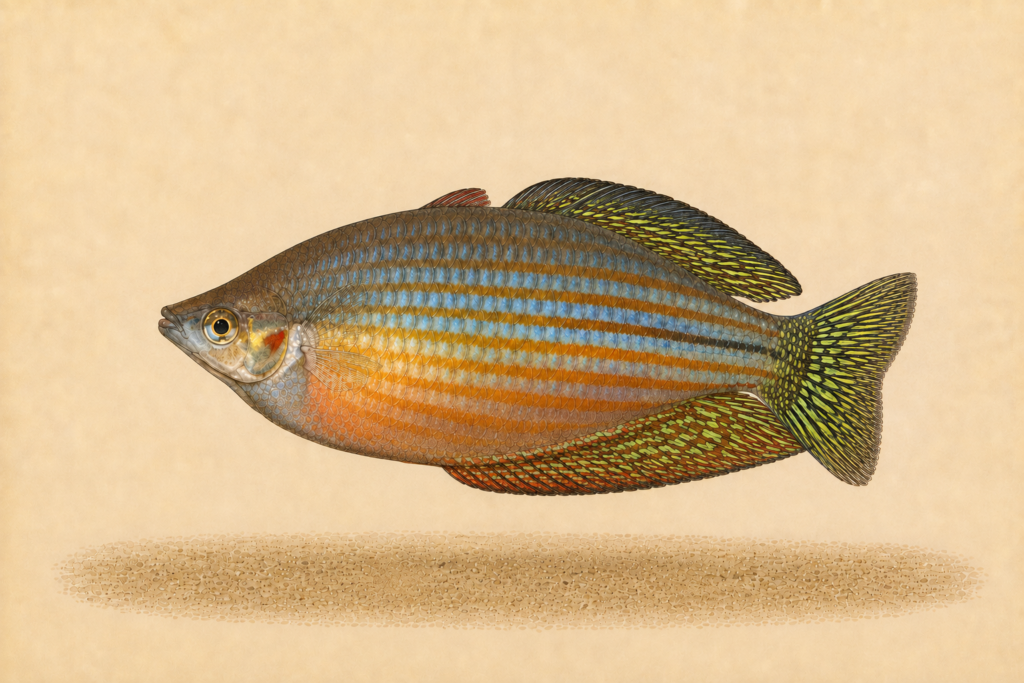
The Checkered Rainbowfish (Melanotaenia splendida inornata) is a recognised subspecies of the widespread Eastern Rainbowfish complex, native to the rivers and billabongs of northern Australia. Also traded under the names Chequered Rainbowfish and Adelaide River Rainbowfish, this fish has earned a loyal following among rainbowfish enthusiasts for its distinctive scale patterning, robust health, and lively disposition. While it may arrive in shops looking rather plain – a common trait shared by many rainbowfish – given time, good water quality, and appropriate lighting, mature specimens develop a breathtaking combination of silver, gold, green, and orange hues overlaid with a characteristic hatched or checkered pattern along the flanks.
As a shoaling species, the Checkered Rainbowfish is at its best when kept in groups of six or more. Males in particular will display more vivid colours and engage in harmless sparring when they have conspecifics to interact with. Their active swimming behaviour and peaceful nature make them superb community tank residents, and their tolerance of a relatively wide range of water parameters means they are forgiving of the minor fluctuations that sometimes challenge newer hobbyists.
This guide covers everything you need to know to keep and breed Checkered Rainbowfish successfully, from tank setup and water chemistry to diet, compatible tank mates, and common health concerns.
Quick Stats
| Scientific name | Melanotaenia splendida inornata |
|---|---|
| Common names | Chequered Rainbowfish, Adelaide River Rainbowfish |
| Family | Melanotaeniidae |
| Origin | Northern Australia (Northern Territory) |
| Adult size | 13 cm |
| Lifespan | 5–8 years |
| Difficulty | Easy |
| Breeding difficulty | Moderate |
| Temperature | 24–30 °C |
| pH | 6.5–8 |
| GH | 5–15 dGH |
| KH | 4–10 dKH |
| Minimum tank size | 150 L |
| Conservation status | Least Concern (IUCN) |
Appearance
Juvenile Checkered Rainbowfish are somewhat unremarkable at first glance – a trait that has led many aquarists to overlook them in shop tanks. Young fish present as silvery-olive with only faint hints of the patterning and colour that will develop with maturity. This is perfectly normal for rainbowfish, and patience is well rewarded. By around 8-12 months of age, and especially under quality lighting and in clean water, the full beauty of this subspecies becomes apparent.
The body shape is typical of the Melanotaenia genus: laterally compressed with a deep, oval profile, a relatively small head, and two dorsal fins (the first shorter and the second longer and more prominent). The mouth is slightly upturned, reflecting the species’ tendency to feed at or near the surface. Adult males are deeper-bodied and more intensely coloured than females.
The defining feature of the Checkered Rainbowfish is the distinctive hatched or checkered pattern that develops along the mid-body and flanks. Each scale is edged with a darker outline, creating a reticulated or net-like effect that is especially visible under side-lighting. The base colour of mature males can range from silvery-green to golden-olive, often with a warm orange or reddish-orange wash developing along the lower half of the body and into the unpaired fins. A dark mid-lateral stripe is usually present, though it can be more or less pronounced depending on mood and condition. The dorsal, anal, and caudal fins can develop orange to reddish edges, and in peak display condition, males may flash bright yellow or gold on the operculum (gill cover).
Females are slimmer, less deep-bodied, and carry a more subdued version of the same colour palette, typically appearing more silver-green with less intense orange and a less prominent checkered pattern. Both sexes have relatively large, expressive eyes.
Colour intensity is strongly influenced by environment. Fish kept in dimly lit tanks with pale substrates will appear washed out. Those maintained over a dark substrate, with moderate to strong lighting and a backdrop of green plants, will display their full range of iridescence. Diet also plays a role, with carotenoid-rich foods helping to intensify orange and red tones.
Natural Habitat
Melanotaenia splendida inornata is found across the river systems of the Top End of Australia’s Northern Territory, with the Adelaide River and its tributaries being among the most well-known collection localities. This region experiences a distinctly tropical monsoonal climate, with a pronounced wet season (roughly November to April) and a dry season (May to October). Water conditions in these habitats can vary dramatically between the two seasons.
During the wet season, rivers swell and flood across vast floodplains, providing access to shallow, vegetation-rich billabongs and temporary pools. The water at this time tends to be relatively soft, slightly acidic to neutral, and often turbid from runoff. During the dry season, fish become concentrated in shrinking pools and permanent river channels where the water is typically clearer, warmer, and may become moderately hard due to evaporation and contact with limestone or mineral-rich substrates.
The habitats where Checkered Rainbowfish are found are diverse: slow-moving river stretches with sandy or muddy bottoms, paperbark-fringed billabongs, clear rocky creeks, and vegetated lagoons. Aquatic vegetation such as Vallisneria, Nymphaea (waterlilies), and various emergent grasses provide cover and foraging opportunities. Submerged root systems and fallen branches offer additional structure. The presence of pandanus palms, paperbarks (Melaleuca), and eucalypts along the banks provides dappled shade and a source of leaf litter and terrestrial insects that fall onto the water surface.
Water temperatures in these habitats can range from around 22 C in the cooler dry season nights to well over 32 C in shallow sun-exposed pools during the wet season. This thermal tolerance is one of the reasons the Checkered Rainbowfish is considered such a robust aquarium species. In the wild, they share their habitat with other rainbowfish species, blue-eyes (Pseudomugil), gudgeons (Mogurnda and Hypseleotris), archer fish, and various native catfish.
Tank Size and Setup
The Checkered Rainbowfish is an active swimmer that uses the full length of an aquarium. A minimum tank size of 200 litres is recommended for a group of six, with larger tanks being preferable – a 300-litre tank measuring 120 cm or more in length is ideal and allows for a larger shoal and more dynamic social interactions. Tank length is more important than height for this species; a long, shallow aquarium is preferable to a tall, narrow one.
Open swimming space is essential. Resist the temptation to fill the entire tank with hardscape and dense planting. Instead, aim for a layout that concentrates decor around the sides and back of the tank, leaving a generous central and front area for the fish to swim freely. This open space is where you will see the most impressive display behaviour, particularly when males spar and flash their colours at one another in the morning light.
A dark substrate – black sand, dark gravel, or a fine natural river sand – will help bring out the best colours in this fish. Lighter substrates tend to wash out their hues and can make even mature specimens appear pale. Driftwood, river rocks, and root wood placed along the rear and sides of the tank provide a naturalistic aesthetic and offer some visual barriers that help reduce any mild chasing.
Live plants are beneficial both aesthetically and functionally. Hardy species such as Vallisneria, Java Fern (Microsorum pteropus), Anubias, and Amazon Sword (Echinodorus) work well and can tolerate the slightly alkaline conditions this species often prefers. Fine-leaved plants like Java Moss (Taxiphyllum barbieri) or spawning mops are particularly useful if you intend to breed. Floating plants can be used to diffuse lighting and provide cover, but leave enough open surface for the fish to feed and display.
A secure lid or cover glass is important. Rainbowfish are known jumpers, particularly when startled or during boisterous display behaviour. Even a small gap can be an escape route for a determined fish.
Lighting should be moderate to bright. Good-quality LED lighting that brings out iridescent colours is ideal. The checkered pattern and metallic sheen of this subspecies are most visible under crisp, slightly cool-toned lighting, though warm-toned lights will enhance the orange and gold hues. A photoperiod of 8-10 hours per day is appropriate.
Water Parameters
One of the great advantages of the Checkered Rainbowfish is its tolerance of a broad range of water chemistry. This makes it suitable for aquarists in most parts of the UK and elsewhere, regardless of whether their tap water is soft or moderately hard. That said, stable conditions are always preferable to conditions that fluctuate widely, so aim for consistency within the ranges given below.
| Temperature | 24-30 C |
| pH | 6.5-8.0 |
| General hardness (GH) | 5-15 dGH |
| Carbonate hardness (KH) | 4-10 dKH |
| Ammonia | 0 ppm |
| Nitrite | 0 ppm |
| Nitrate | Below 20 ppm |
Regular water changes are the single most effective way to maintain good water quality and keep your rainbowfish healthy and colourful. A weekly change of 25-30% is a good baseline. In heavily stocked tanks or those without live plants, more frequent or larger changes may be necessary to keep nitrate levels in check. Always treat replacement water with a quality dechlorinator and try to match the temperature of the new water to the tank water to avoid thermal shock.
While this subspecies can tolerate temperatures up to 30 C and sometimes slightly above, a range of 25-28 C is optimal for long-term health and colour development. Prolonged exposure to very high temperatures can increase metabolic rate and shorten lifespan, so if you live in a warm climate or keep the tank in a heated room, consider whether additional cooling measures might be needed during summer months.
Filtration and Equipment
Robust filtration is important for any active, medium-sized fish that produces a moderate bioload. An external canister filter rated for the full volume of your tank (or slightly above) is the best option. Canister filters provide excellent biological, mechanical, and chemical filtration, and the outlet can be positioned to create a gentle current along the length of the tank – something that Checkered Rainbowfish appreciate, as they enjoy swimming into a mild flow.
If a canister filter is not available, a large internal power filter or a hang-on-back filter can work for smaller setups, though these are generally less efficient for tanks of 200 litres and above. Sponge filters can supplement the main filtration and provide additional biological capacity, but they are unlikely to be sufficient as the sole filter for a group of rainbowfish in a tank of this size.
Flow rate should be moderate. These fish come from a range of habitats, including slow-moving billabongs and gently flowing rivers, so they do not need powerful currents. However, they do appreciate some water movement, and a gentle flow across the length of the tank encourages natural swimming behaviour and helps distribute heat and oxygen evenly.
A reliable heater is necessary unless you live in a consistently warm climate. A heater rated at approximately 1 watt per litre is a useful rule of thumb. For tanks above 200 litres, consider using two smaller heaters placed at opposite ends of the tank rather than one large unit – this provides redundancy if one fails and helps maintain a more even temperature throughout the tank.
An air pump and airstone are not strictly necessary if your filter provides adequate surface agitation, but they can be beneficial during warmer weather when dissolved oxygen levels may drop. Good oxygenation is particularly important for active species like rainbowfish.
Diet and Feeding
Checkered Rainbowfish are omnivores with a slight bias towards small invertebrates and insects in the wild. In the aquarium, they are enthusiastic and unfussy feeders that will accept a wide variety of foods. A varied diet is the key to vibrant colour, good health, and breeding condition.
A high-quality flake or micro-pellet food designed for tropical fish should form the staple of the diet. Look for products that list whole fish meal, spirulina, and astaxanthin or other carotenoid pigments among the ingredients, as these will help support colour development. Rainbowfish feed primarily at the surface and in the mid-water column, so floating flakes or slow-sinking micro-pellets are ideal.
Supplement the staple diet regularly with live or frozen foods. Daphnia, brine shrimp (Artemia), mosquito larvae, bloodworm, and cyclops are all excellent choices and will be consumed with gusto. Live foods in particular seem to trigger display behaviour and can be useful for conditioning fish for breeding. Frozen foods are a convenient and safe alternative and should be thawed in a small amount of tank water before adding.
Vegetable matter should also be offered occasionally. Blanched spinach, spirulina-based foods, and algae wafers (broken into small pieces) provide additional nutrients and fibre. In the wild, these fish consume some algae and plant material, so a diet that includes a vegetable component is more complete than one based solely on protein.
Feed two to three times daily, offering only what the fish can consume within two to three minutes. Overfeeding is a common cause of poor water quality, and rainbowfish will eagerly overeat if given the chance. On one day per week, consider fasting the fish entirely or offering only a very small feeding – this can aid digestion and mirrors the natural variability of food availability in the wild.
Behaviour and Temperament
The Checkered Rainbowfish is a peaceful, active, and social species that spends the majority of its time in the upper and middle water columns. It is a true shoaling fish that should always be kept in groups of six or more, with larger groups being preferable. In groups of fewer than six, individuals may become shy, stressed, or prone to minor aggression, and they will not display their full range of natural behaviours.
One of the most captivating aspects of rainbowfish behaviour is the morning display. Males will face off against one another, flaring their fins and intensifying their colours in a ritualised sparring display that rarely results in any physical harm. This behaviour is most pronounced in the first hour or two after the lights come on, and it is during these displays that the fish are at their most colourful. Keeping multiple males in the group encourages this behaviour and produces a far more visually engaging tank than keeping a single male with several females.
A ratio of roughly equal numbers of males and females works well, though a slight female bias can reduce any persistent chasing of individual females by amorous males. Males are not aggressive towards females in any harmful way, but persistent attention from a single male can stress a lone female.
Checkered Rainbowfish are fast, agile swimmers and can be somewhat boisterous during feeding time. This is not aggression but simply the exuberance of an active species. Their speed and surface-feeding habit mean that slower, more timid species may miss out on food if housed together, so tank mate selection should take this into account.
They are not territorial and do not guard a particular area of the tank. They range freely across the full length and width of the aquarium. Providing open swimming lanes is therefore more important than creating territorial boundaries. Some visual breaks in the form of tall plants or driftwood can help diffuse any minor squabbles, but extensive compartmentalisation of the tank is unnecessary and counterproductive.
This subspecies is generally not prone to fin-nipping, making it compatible with most community species. However, very long-finned or slow-moving fish may find the constant activity of a rainbowfish shoal stressful, so consider your fish choices carefully.
Tank Mates
The Checkered Rainbowfish is one of the more accommodating community species available. Its peaceful temperament, preference for the upper and mid-water column, and tolerance of a wide range of water parameters make it compatible with many popular aquarium fish. The main considerations are to avoid species small enough to be accidentally ingested, species that are overly aggressive or territorial, and very slow or long-finned species that might be stressed by the rainbowfish’s active nature.
Good tank mates
- Boeseman’s Rainbowfish – A fellow rainbowfish of similar size and temperament, creating a stunning multi-species rainbow display.
- Turquoise Rainbowfish – Another Melanotaenia species that shares identical care requirements and coexists peacefully.
- Bristlenose Pleco – A peaceful bottom-dweller that occupies a completely different zone and helps control algae.
- Corydoras sterbai – A heat-tolerant Corydoras species well suited to the warmer temperatures this rainbowfish prefers.
- Kuhli Loach – A gentle bottom-dwelling loach that stays out of the rainbowfish’s way and adds interest to the lower tank levels.
- Cherry Barb – A peaceful, similarly sized barb that occupies the mid-water column without causing conflict.
- Rummy-Nose Tetra – A tight-schooling tetra that complements the rainbowfish’s activity in the upper water column.
- Blue-Eye Forktail Rainbowfish – A small Pseudomugil species that naturally co-occurs with Melanotaenia in Australian waterways.
Fish to avoid
- Oscar – A large, predatory cichlid that would view adult rainbowfish as potential prey.
- Betta – The rainbowfish’s fast, boisterous swimming style would stress a slow-moving Betta, and long fins invite nipping.
- Green Terror – An aggressive, territorial cichlid that would bully and potentially injure rainbowfish.
- Red-Bellied Piranha – An obvious predatory threat incompatible with any peaceful community fish.
- Neon Tetra – While not aggressive, adult Checkered Rainbowfish may be large enough to consume very small Neon Tetras.
- Flowerhorn – A large, highly aggressive hybrid cichlid unsuitable for any community aquarium.
Breeding
Breeding Checkered Rainbowfish in captivity is achievable for aquarists with moderate experience and is one of the more rewarding aspects of keeping this subspecies. Like other Melanotaenia species, they are egg scatterers that spawn continuously over an extended period rather than in a single, well-defined event.
To condition fish for breeding, increase the proportion of high-quality live and frozen foods in the diet for two to three weeks. Daphnia, brine shrimp, and mosquito larvae are particularly effective. Slightly raising the water temperature to around 27-28 C and performing a large water change with slightly cooler water can help simulate the onset of the wet season and trigger spawning behaviour.
Spawning typically occurs in the early morning, shortly after the lights come on. The male will intensify his colours and perform vigorous displays in front of the female, swimming alongside her with fins fully extended. If the female is receptive, the pair will move side by side into fine-leaved plants or a spawning mop, where the female deposits a small number of relatively large, adhesive eggs. The eggs are attached to the plant material by fine threads. A female may deposit only a few eggs each day, but spawning can continue daily for weeks, resulting in a substantial total over time.
The eggs are somewhat vulnerable to fungus and predation. Adult rainbowfish will eat their own eggs and fry if given the opportunity, so a dedicated breeding setup is strongly recommended. A separate breeding tank of 60-80 litres, furnished with several spawning mops or dense clumps of Java Moss, is ideal. The spawning mops can be checked daily and transferred to a hatching tank or container with gentle aeration and matching water parameters.
Eggs typically hatch in 7-10 days at 26-28 C. The fry are very small but are free-swimming from the moment they hatch. Initial foods should include infusoria, liquid fry food, or very finely powdered dry food. Within a week, the fry are usually large enough to accept freshly hatched brine shrimp nauplii, which is the single best food for promoting rapid, healthy growth. Regular small water changes in the fry tank are essential to maintain water quality, as fry are particularly sensitive to ammonia and nitrite.
Growth is steady but not fast. Juvenile rainbowfish may take six months or more to begin developing adult colouration, and full colour potential may not be reached until 12-18 months of age. Patience is essential, and the gradual transformation from a plain silvery juvenile to a vibrantly coloured adult is one of the great pleasures of keeping and breeding this species.
Common Diseases
The Checkered Rainbowfish is a robust species that is not particularly susceptible to any disease unique to rainbowfish. However, like all freshwater fish, it can be affected by common aquarium ailments, particularly when water quality is poor or the fish are stressed.
White spot disease (Ichthyophthirius multifiliis) is one of the most frequently encountered illnesses in freshwater aquaria. It presents as small white cysts on the body and fins, often accompanied by flashing (rubbing against surfaces) and lethargy. Treatment involves raising the temperature gradually to 28-30 C (well within this species’ comfort range) and using a proprietary white spot treatment containing malachite green or formalin. Caught early, ich is highly treatable.
Bacterial infections, including fin rot and columnaris, can occur when fish are stressed or injured. Symptoms include frayed or eroding fins, white or grey patches on the body, and lethargy. Maintaining excellent water quality is the best prevention. Treatment with a broad-spectrum antibacterial medication is usually effective if begun promptly.
Fungal infections may appear as cotton-wool-like growths on the body or fins, often secondary to a wound or bacterial infection. Anti-fungal treatments are widely available and generally effective. Ensuring good water quality and removing any sharp decorations that could cause injury are important preventive measures.
Internal parasites can occasionally affect rainbowfish, particularly wild-caught specimens or those from less reputable sources. Symptoms may include weight loss despite a good appetite, bloating, or stringy white faeces. Treatment with a suitable anti-parasitic medication is recommended if internal parasites are suspected.
One condition that is sometimes reported in rainbowfish is “wasting disease” or Mycobacteriosis, caused by Mycobacterium species. This is a chronic, slow-progressing bacterial infection that can be difficult to diagnose and treat. Affected fish gradually lose weight, develop a hollow-bellied or pinched appearance, and may develop spinal deformities. Unfortunately, there is no reliable cure, and affected fish should be isolated to prevent transmission. Maintaining excellent water quality, avoiding overcrowding, and sourcing fish from reputable breeders are the best preventive strategies.
Quarantining all new fish for a minimum of two to four weeks before introducing them to an established community tank is a simple but highly effective way to reduce the risk of introducing disease. During quarantine, observe the fish closely for any signs of illness and treat as needed before they join the main display.
FAQs
Why are my Checkered Rainbowfish so pale?
Pale colouration is very common in newly purchased rainbowfish and juveniles. Rainbowfish take many months to develop their full adult colours, and stress from transport and a new environment can cause temporary colour loss even in mature fish. To encourage the best colour, use a dark substrate, provide moderate to bright lighting, feed a varied diet including carotenoid-rich foods, and keep the fish in a group of six or more so that males are stimulated to display. Patience is key – many rainbowfish keepers report a dramatic improvement in colour over the first three to six months.
Can I keep Checkered Rainbowfish in a planted tank?
Absolutely. Checkered Rainbowfish are well suited to planted aquaria. They do not typically eat or uproot plants, and the green backdrop of a planted tank enhances their colours beautifully. Choose robust plant species such as Vallisneria, Java Fern, and Anubias, and leave ample open swimming space in the centre and front of the tank. Fine-leaved plants also serve as natural spawning sites if breeding occurs.
How many Checkered Rainbowfish should I keep together?
A minimum of six is recommended, and larger groups are better. In groups of fewer than six, individuals tend to be more timid, less colourful, and may display mild aggression or stress behaviours. A group of eight to twelve in a suitably sized tank (300 litres or more) will produce the most natural and visually impressive shoaling and display behaviour.
Do Checkered Rainbowfish jump?
Yes, rainbowfish are known jumpers, and the Checkered Rainbowfish is no exception. They may jump when startled, during vigorous display behaviour, or simply during exuberant swimming. A well-fitting lid or cover glass is strongly recommended. Even small gaps around filter intakes or heater cables should be minimised, as a determined rainbowfish can find surprisingly small openings.
Can Checkered Rainbowfish be kept with shrimp?
Adult Checkered Rainbowfish are large enough to prey on smaller shrimp species such as Cherry Shrimp (Neocaridina davidi), particularly juveniles and shrimplets. Larger shrimp species such as Amano Shrimp (Caridina multidentata) are generally safe with adult rainbowfish due to their size. If you wish to maintain a breeding colony of small shrimp, it is best to keep them in a separate tank or provide extremely dense plant cover to give the shrimp adequate hiding places.
Related Guides
- Boeseman’s Rainbowfish Care Guide – A popular Melanotaenia species with similar care requirements, often kept alongside Checkered Rainbowfish in community setups.
- Turquoise Rainbowfish Care Guide – Another large Australian rainbowfish subspecies within the Melanotaenia splendida complex.
- Eastern Rainbowfish Care Guide – The nominate form of Melanotaenia splendida, closely related and sharing many care requirements.
- Blue-Eye Forktail Rainbowfish Care Guide – A smaller Australian rainbowfish ideal for those wanting to create a biotope-inspired setup.
- Bristlenose Pleco Care Guide – An excellent bottom-dwelling companion for rainbowfish, covering algae control and compatible care.