Quick summary
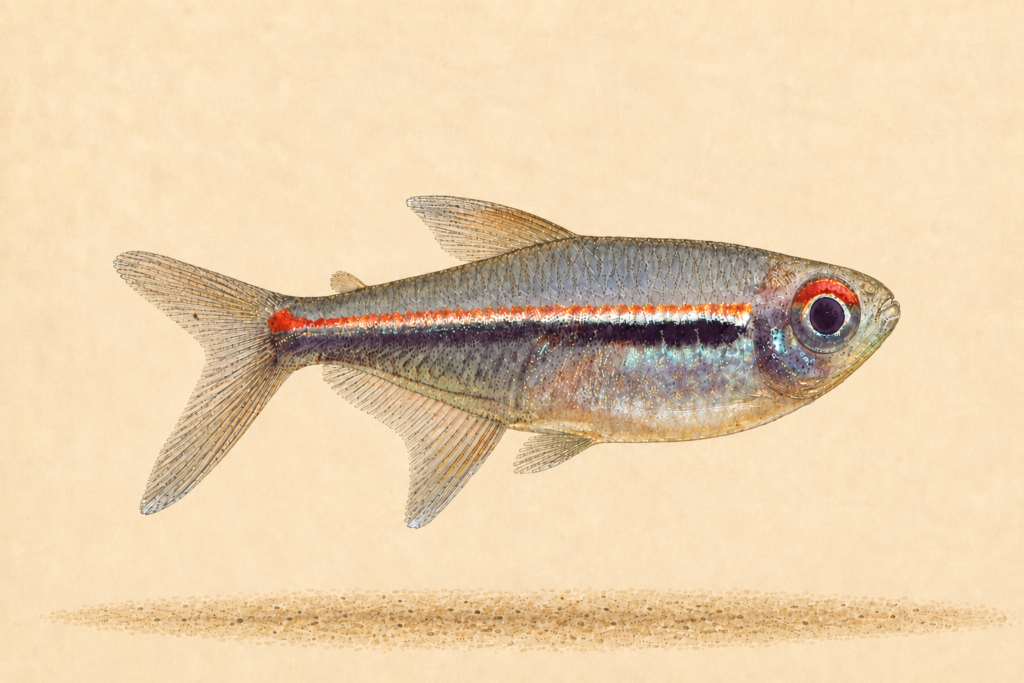
The Flag Tetra is a small freshwater fish with a single dark stripe running unbroken along each side from a shoulder spot to the base of the tail.
🐠 Build a tank around this species
- Introduction
- Quick Stats
- Appearance
- Varieties and Morphs
- Natural Habitat
- Tank Size and Setup
- Water Parameters
- Filtration and Equipment
- Diet and Feeding
- Behaviour and Temperament
- Tank Mates
- Breeding
- Common Diseases
- FAQs
- Related Guides
Introduction
The Flag Tetra is a freshwater fish native to South America. The species was first described in 1894, and it is still listed as a valid species today. Its conservation status is listed as Least Concern, assessed by the IUCN in 2021.
Quick Stats
| Scientific name | Hyphessobrycon heterorhabdus |
|---|---|
| Common names | Flag Tetra, Belgian Flag Tetra |
| Family | Acestrorhamphidae (formerly Characidae) |
| Origin | South America: lower Amazon River basin (eastern Pará to the rio Curuá-Una basin and rio Cupari drainage, Tapajós River basin), Brazil |
| Adult size | 3.5 cm |
| Difficulty | Easy |
| Breeding difficulty | Advanced |
| Temperature | 20–26 °C |
| pH | 5.5–7.5 |
| GH | 1–12 dGH |
| Minimum tank size | 72 L |
| Conservation status | Least Concern (IUCN, assessed 2021) |
Appearance
Adults reach up to 3.5 cm, not counting the tail fin. Each fish carries just one shoulder spot. No yellow or orange markings appear in the fins. Body depth is the giveaway in mature fish, with females deeper than males and also a touch larger.
Varieties and Morphs
We do not yet have reliable variety information for the Flag Tetra.
Natural Habitat
Specimens of this fish have been collected in the Tapajós, from its mouth up as far as Jacareacanga. Its range may be narrower than has been assumed, confined to coastal drainages and tributaries in eastern Pará and Maranhão in Brazil and ending upstream at the Tapajós.
Tank Size and Setup
We recommend a tank of at least 72 litres. Two layouts may suit this fish best: sand with driftwood roots and branches, or a thickly planted tank.
Water Parameters
| Temperature | 20 to 26 °C |
| pH | 5.5 to 7.5 |
| General hardness (GH) | 1 to 12 dGH |
| Ammonia | 0 ppm |
| Nitrite | 0 ppm |
| Nitrate | Below 10 ppm |
Aim for a temperature of 20 to 26 °C and a pH of 5.5 to 7.5. Water hardness can run from 1 to 12 dGH.
Filtration and Equipment
We recommend a filter that turns the water over four to five times an hour for a tank of at least 72 litres, and a heater to hold the temperature within 20 to 26 degrees Celsius.
Diet and Feeding
The Flag Tetra is likely an omnivore in nature, feeding on small invertebrates, worms, crustaceans, filamentous algae, plant matter and fallen fruit. Dried foods alone may keep the fish going, but live or frozen bloodworm, mosquito larvae and water fleas make the menu more varied, and that suits it better.
Behaviour and Temperament
The Flag Tetra is very peaceful, which makes it a good choice for a community tank that has been planned with care. Keep a group of at least 8 to 10 fish, with both sexes included. Adding other schooling fish helps them feel secure, and the bigger group makes a more natural-looking display.
Tank Mates
Flag Tetras are well suited to a peaceful community of similarly-sized, soft-water species. The ideal tank mates share their preference for subdued lighting, acidic to neutral pH, and a calm environment. Avoid pairing them with large, aggressive, or highly active species that may outcompete them for food or cause stress.
Good tank mates
- Cardinal Tetra, a classic soft-water companion that shares nearly identical water requirements
- Rummy-nose Tetra, another peaceful Amazon shoaling species that thrives in warm, soft, acidic conditions
- Ember Tetra, a tiny, gentle species ideal for sharing a blackwater-style setup
- Beckford’s Pencilfish, a calm surface-to-mid-water dweller from similar South American habitats
- Pygmy Corydoras, a small, peaceful bottom-dweller that will not compete for mid-water territory
- Sterbai Corydoras, a warm-water-tolerant Corydoras that works well in softer setups
- Cockatoo Dwarf Cichlid, a small, generally peaceful dwarf cichlid for the lower levels of the tank
- Otocinclus, a gentle algae-grazer that prefers similar soft-water conditions
- Kuhli Loach, a nocturnal, non-competitive bottom-dweller suitable for community tanks
- Chocolate Gourami, a soft-water specialist that makes a quiet, interesting companion in a well-maintained setup
Fish to avoid
- Tiger Barb, a known fin-nipper with boisterous behaviour that would stress Flag Tetras
- Buenos Aires Tetra, too large and active, and may bully smaller tetras
- Convict Cichlid, aggressive and territorial, especially when breeding
- Oscar, a large predatory cichlid that would eat Flag Tetras
- African Rift Lake Cichlids, incompatible water chemistry and aggressive temperament
- Common Pleco, grows far too large and produces excessive waste for a small soft-water setup
- Chinese Algae Eater, becomes aggressive and territorial with age
- Red-tail Shark, territorial and likely to harass small, timid tetras
- Flowerhorn, a large, aggressive hybrid cichlid entirely unsuitable as a companion
- Green Spotted Puffer, a brackish-water fin-nipper with incompatible requirements.
Breeding
The Flag Tetra scatters its eggs freely and gives them no parental care. Raising a larger number of fry takes a more controlled approach than waiting for them to appear on their own. Add an air stone or an air-powered sponge filter so the breeding tank gets oxygen and moving water. Start the fry on tiny dry food rated 5 to 50 micron, then add baby brine shrimp and microworm as they grow big enough to take them.
Common Diseases
The Flag Tetra can be affected by white spot and by general bacterial infections.
FAQs
How big does a Flag Tetra get?
An adult reaches about 3.5 cm, not counting the tail fin.
How many Flag Tetras should I keep together?
Keep at least 8 to 10 together, with males and females both in the group. Other schooling fish in the tank help them feel secure.
What do Flag Tetras eat?
Dried food can keep Flag Tetras going, though live or frozen bloodworm and mosquito larvae give a more varied diet that suits them better.
How can I tell male and female Flag Tetras apart?
Beside a mature female, a male has a shallower body and is a little smaller.
Related Guides
- Cardinal Tetra
- Neon Tetra
- Ember Tetra
- Rummy-nose Tetra
- Black Neon Tetra
- Lemon Tetra
- Beckford’s Pencilfish
- Cockatoo Dwarf Cichlid.