Quick Summary
The Freshwater Moray Eel is a striking, serpentine predator best suited to experienced aquarists who can provide a large, escape-proof tank with brackish conditions. Despite its common name, this species does best with the addition of marine salt, and its demanding care requirements, predatory nature, and escape artistry make it a poor choice for beginners or standard community aquariums.
🐠 Build a tank around this species
Grows large. Read this before buying. The Freshwater Moray Eel is usually sold as a small juvenile and is easy to keep at that size, but a healthy adult reaches around 75 cm. A juvenile will be happy in a standard tank for its first year or so. An adult needs a very large tank, six feet long or more, and the water changes to match. Decide now whether you will build for the adult, or have a realistic rehoming plan, because public aquaria and specialist keepers are often full. It is a superb fish for the keeper who plans for it and a sad one for everyone else.
In this guide:
- Introduction
- Quick Stats
- Appearance
- Natural Habitat
- Tank Size and Setup
- Water Parameters
- Diet and Feeding
- Behaviour and Temperament
- Tank Mates
- Breeding
Introduction
The Freshwater Moray Eel, Gymnothorax polyuranodon, is one of the very few true morays (family Muraenidae) that can survive in freshwater for extended periods. It is occasionally sold in the aquarium trade under names such as the Freshwater Moray, Spotted Freshwater Moray, or White-cheeked Moray, and its appearance in shops often leads to impulse purchases by hobbyists who are unprepared for the considerable demands this animal places on its keeper. Make no mistake: this is a large, powerful, predatory eel that requires specialist knowledge, a carefully designed enclosure, and an understanding of brackish water chemistry to thrive in captivity.
A common misconception perpetuated by some retailers is that this species is perfectly happy in a standard freshwater tropical setup indefinitely. While juveniles and sub-adults can indeed survive in pure freshwater for months or even a few years, long-term health is significantly improved when the eel is kept in at least mildly brackish conditions (a specific gravity of around 1.005 to 1.010). Prolonged maintenance in zero-salinity water often leads to skin problems, fungal infections, loss of appetite, and a shortened lifespan. Responsible keepers should plan from the outset to provide some degree of salinity.
Native to the estuarine and lower-river habitats of the Indo-Pacific region, G. polyuranodon naturally moves between freshwater, brackish, and occasionally fully marine environments. In the wild, it hunts fish, crustaceans, and other small animals primarily at night, retreating into rock crevices and submerged timber during the day. This secretive, nocturnal lifestyle must be replicated in the aquarium if the eel is to feel secure and display natural behaviours.
This guide covers everything you need to know to keep a Freshwater Moray Eel responsibly, from tank dimensions and escape prevention to diet, compatible tank mates, and the realistic challenges you should expect. If you are willing to invest the time, space, and resources this species demands, it can be a genuinely rewarding and fascinating aquarium inhabitant that will live for well over a decade.
Quick Stats
| Scientific name | Gymnothorax polyuranodon |
|---|---|
| Common names | Freshwater Moray Eel, Spotted Freshwater Moray, White-cheeked Moray |
| Family | Muraenidae |
| Origin | Indo-Pacific coastal rivers and estuaries, India to northern Australia |
| Adult size | 75 cm |
| Lifespan | 10–15 years |
| Difficulty | Advanced |
| Breeding difficulty | Advanced |
| Temperature | 24–28 °C |
| pH | 7.5–8.5 |
| GH | 10–25 dGH |
| KH | 8–15 dKH |
| Minimum tank size | 350 L |
| Conservation status | Least Concern (IUCN) |
Appearance
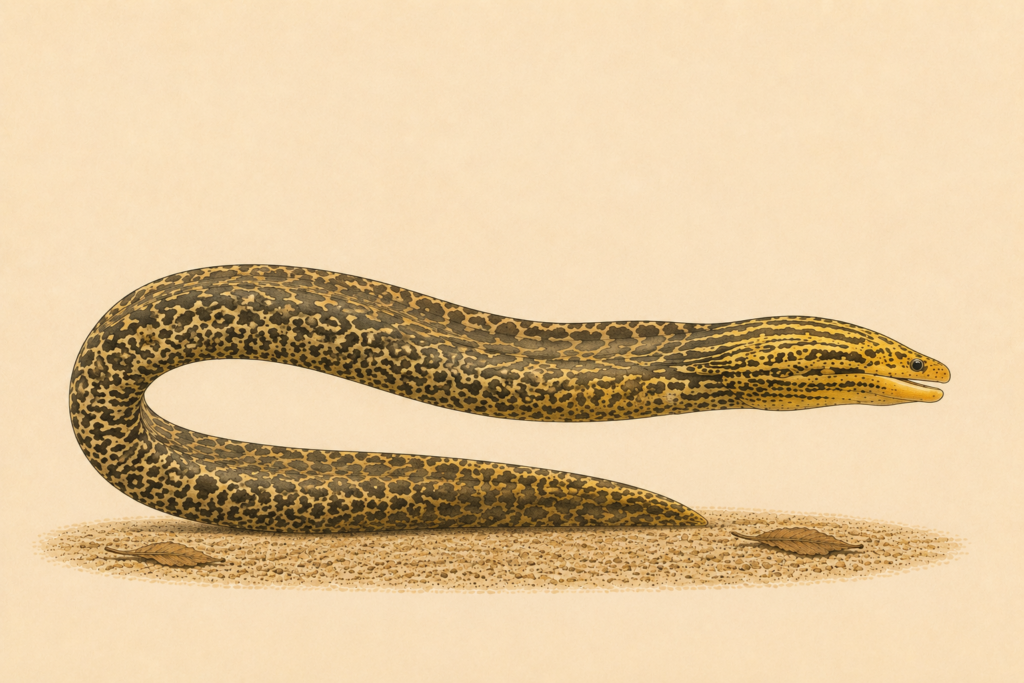
Gymnothorax polyuranodon has the classic moray body plan: a long, muscular, laterally compressed body that lacks pelvic and pectoral fins entirely. The dorsal fin is reduced to a low, continuous ridge running along the back and merging with the caudal and anal fins to form a single, ribbon-like fringe around the posterior half of the animal. The skin is thick, leathery, and coated in a protective mucus layer rather than bearing traditional scales.
Colouration is variable but typically consists of a dark brown to olive-brown base overlaid with a pattern of pale cream, white, or yellowish spots that become more numerous and defined along the flanks and belly. Some individuals display a faint banding pattern, particularly as juveniles, while others are more uniformly spotted. The head is relatively small and tapered, with a pronounced, slightly upturned snout. The jaws are lined with sharp, backward-pointing teeth designed for gripping slippery prey, and the eel often holds its mouth slightly agape – this is a normal breathing behaviour, not a sign of aggression, as morays pump water over their gills in this manner.
The eyes are small and bead-like, reflecting the species’ reliance on an acute sense of smell rather than vision when hunting. Two prominent tubular anterior nostrils are visible near the tip of the snout, and these serve as the eel’s primary sensory organs for detecting food. The white or pale patch on the cheek area gives rise to the “white-cheeked” common name seen in some markets. Overall, the Freshwater Moray Eel is an imposing and visually striking animal, and its almost serpentine movements through rockwork and caves make it one of the more dramatic species available to advanced hobbyists.
Natural Habitat
In the wild, Gymnothorax polyuranodon inhabits a wide range of coastal and estuarine environments across the Indo-Pacific. Its range extends from rivers in India and Sri Lanka, through coastal drainages of Myanmar, Thailand, Malaysia, Indonesia, and the Philippines, eastward to Papua New Guinea and the rivers of tropical northern Australia. This broad distribution reflects the species’ remarkable euryhalinity – its ability to tolerate a wide range of salinities.
The eel is most commonly encountered in the lower reaches of rivers where they meet the sea, in brackish mangrove creeks, tidal lagoons, and estuarine mud flats. Juveniles and sub-adults sometimes venture considerable distances upstream into purely fresh water, which is likely how they end up in the freshwater aquarium trade, but the adult population is generally associated with habitats that have at least some marine influence. The substrate in these environments is typically muddy or silty, often overlain with fallen timber, tangled root systems, and rocky rubble that provides abundant hiding spots.
Water in these habitats tends to be warm (24-30 C), hard, and alkaline, with pH values typically above 7.5. The tidal influence means that salinity fluctuates throughout the day, sometimes quite dramatically. This dynamic environment has shaped G. polyuranodon into a robust and adaptable species, but it also means that maintaining the eel in static, zero-salinity freshwater long-term is not truly replicating its natural conditions. For this reason, the addition of marine salt to achieve at least a mild brackish specific gravity (SG 1.005-1.010) is strongly recommended for long-term captive care.
The species is nocturnal, spending the daylight hours wedged tightly into crevices between rocks, inside hollow logs, or buried in soft substrate with only the head protruding. At dusk, the eel emerges to hunt, using its extraordinary sense of smell to locate prey in murky, low-visibility water. This crepuscular and nocturnal activity pattern should be expected in the aquarium as well.
Tank Size and Setup
A minimum aquarium volume of 350 litres is necessary for a single adult Freshwater Moray Eel, and larger is always better. An ideal enclosure for a full-grown specimen would be in the region of 450-600 litres. The tank footprint matters more than height; a long, wide aquarium (at least 150 cm x 50 cm) gives the eel room to move and provides adequate floor space for the numerous hiding places it requires. Very tall, narrow tanks are unsuitable.
Escape prevention is the single most critical aspect of the tank setup. Freshwater Moray Eels are notorious escape artists and will exploit any gap, however small, in the aquarium lid. They are incredibly strong for their size and can push aside lightweight covers, squeeze through openings designed for filter pipes or airline tubing, and even slither up internal overflow pipes. A heavy, tightly fitting glass or acrylic lid is essential. Every hole, gap, and cut-out must be sealed with foam, mesh, or silicone. Many experienced keepers use weighted glass lids combined with aquarium-safe mesh or egg crate material. If you find your eel on the floor, it has likely been out of water for some time, and survival is not guaranteed. Prevention is far easier than cure.
The interior of the tank should be aquascaped to provide abundant cover. PVC pipes of a suitable diameter (large enough for the eel to enter and turn around in), stacked rockwork with caves and overhangs, large pieces of bogwood, and ceramic or terracotta tubes all make excellent shelters. Aim to provide at least two or three separate hiding spots so the eel can choose its preferred refuge. Avoid sharp-edged rocks or decorations, as the eel’s skin, while tough, can be abraded during its nightly explorations.
Substrate choice should lean towards fine sand or smooth, rounded gravel. Morays sometimes bury themselves partially in the substrate, and coarse or jagged material can cause skin damage. A sand bed of 3-5 cm depth works well. Live plants are largely unnecessary and will not survive well in brackish conditions, but hardy species such as Java Fern (attached to hardscape above the substrate) can be used if desired at lower salinities.
Lighting should be subdued. The eel is nocturnal and will remain hidden if the tank is brightly lit throughout the day. A dim, blue-spectrum moonlight mode or a low-intensity LED on a timer that provides a clear day-night cycle will encourage the eel to emerge during the evening hours, making it far more visible and interesting to observe.
Water Parameters
| Temperature | 24-28 C |
| pH | 7.5-8.5 |
| General hardness (GH) | 10-25 dGH |
| Carbonate hardness (KH) | 8-15 dKH |
| Ammonia | 0 ppm |
| Nitrite | 0 ppm |
| Nitrate | Below 20 ppm |
As discussed throughout this guide, while G. polyuranodon can tolerate pure freshwater, a specific gravity of 1.005 to 1.010 (approximately 8-15 grams of marine salt per litre) is recommended for long-term health. Use a quality marine salt mix rather than common table salt or aquarium “tonic salt,” as marine salt contains the full complement of trace elements and buffering minerals the eel benefits from. A hydrometer or refractometer is essential for measuring specific gravity accurately.
The addition of marine salt also has the practical benefit of naturally buffering pH and hardness upward, which aligns well with the eel’s preference for alkaline, hard water. Water changes of 20-25% weekly are advisable, and replacement water must be pre-mixed to the same salinity and temperature before being added to the tank. Sudden swings in salinity, even downward, can stress the eel.
Ammonia and nitrite must be maintained at zero at all times. Morays are large, messy predators that produce a significant bioload, and their protein-rich diet generates substantial nitrogenous waste. A mature, robust biological filter is non-negotiable. Nitrate should ideally be kept below 20 ppm through regular water changes and efficient filtration.
Filtration and Equipment
Given the substantial bioload produced by a large predatory eel, oversized filtration is a must. A canister filter rated for at least 1.5 to 2 times the actual tank volume is a good starting point. Many keepers of large morays use a sump-based filtration system, which has the added advantage of increasing total water volume and providing space for additional biological media, protein skimmers, and heaters away from the eel. If using a sump, the overflow and return plumbing must be completely eel-proofed with mesh screens, as the eel will readily enter pipework.
Biological filtration capacity is the primary concern. Generous quantities of high-surface-area media such as sintered glass, ceramic rings, or bio-balls should be employed. Chemical filtration with activated carbon can help manage odour and discolouration, though it will need regular replacement in a brackish setup. A protein skimmer, while more commonly associated with marine aquaria, can be beneficial at the higher end of the brackish range (SG 1.008 and above) for removing dissolved organic compounds before they break down into ammonia.
Heaters must be protected from the eel. An inline heater installed on the canister filter return, or a heater placed inside a sump, is far safer than an in-tank glass heater, which the eel can easily break or dislodge. If an in-tank heater must be used, protect it with a heater guard. Two smaller heaters are preferable to one large one, providing redundancy in the event of a failure.
Water flow should be moderate. The eel does not inhabit fast-flowing rapids in the wild, but gentle to moderate current helps with oxygenation and waste distribution. Aim for a turnover rate of approximately 8-10 times the tank volume per hour across all filtration and circulation combined.
Diet and Feeding
Gymnothorax polyuranodon is an obligate predator. In the wild, its diet consists primarily of fish, crustaceans, and other small aquatic animals. In captivity, the goal is to replicate this protein-rich diet using a variety of high-quality foods.
The staple diet should consist of whole or chunked fish and shellfish. Suitable options include lance fish, whitebait, prawns (shell-on for calcium), mussel, squid, and cockle. These can be purchased frozen from fishmongers or specialist aquarium food suppliers. Thaw food in a small amount of tank water before offering it; never microwave or use hot water, as this destroys nutrients. Variety is important – feeding the same single food item repeatedly can lead to nutritional deficiencies.
Many keepers find that freshly imported Freshwater Moray Eels initially refuse dead food and will only accept live prey. Live river shrimp, ghost shrimp, or small feeder fish can be used to initiate feeding, but the long-term goal should always be to wean the eel onto frozen or fresh (dead) foods. Feeding live feeder fish carries a significant risk of introducing parasites and disease and should be minimised. To wean the eel, try offering thawed food on long aquarium tongs or forceps, waving it gently near the eel’s hiding spot at dusk when the animal is most active. Patience is key; the transition can take weeks.
Feed juveniles every two to three days; adults can be fed two to three times per week. Morays have relatively slow metabolisms for their size, and overfeeding leads to obesity, poor water quality, and fatty liver disease. A good rule of thumb is to offer a portion roughly the size of the eel’s head at each feeding. Remove any uneaten food after 15-20 minutes to prevent water quality deterioration.
Supplementation with a quality fish vitamin soak (such as those designed for marine fish) once or twice a week is beneficial, particularly if the diet is limited in variety. Soaking food in a vitamin supplement for 10-15 minutes before feeding helps ensure the eel receives adequate levels of vitamins A, D, and E as well as essential fatty acids.
Never hand-feed a moray eel. Their eyesight is poor, and they strike at anything that smells of food near their mouth. A moray bite is painful, prone to infection (due to bacteria in the mucus and backward-pointing teeth), and can require medical attention. Always use long tongs or forceps.
Behaviour and Temperament
The Freshwater Moray Eel is a solitary, nocturnal predator. During daylight hours, it will typically remain hidden in its chosen cave, crevice, or pipe, with only the head – and sometimes not even that – visible. This behaviour is entirely normal and should not be interpreted as a sign of illness or unhappiness. As evening approaches and the lights dim, the eel will begin to emerge, patrolling the tank with a sinuous, almost hypnotic swimming motion, actively investigating every crevice and corner with its sensitive nostrils.
Despite their fearsome reputation, Freshwater Moray Eels are not aggressive towards their keepers in the usual sense. They do not chase hands or attack unprovoked. However, they will bite if they feel threatened, cornered, or if they mistake a finger for food. Their bites are not venomous, but the combination of numerous sharp, recurved teeth and a powerful jaw can cause deep lacerations. Handling should be avoided entirely.
Morays can become surprisingly tame over time, learning to associate their keeper with food. Many long-term keepers report that their eel will emerge from hiding when it senses their approach, particularly at feeding time. This learned behaviour can be very rewarding, but it also reinforces the need for tongs – an eager moray lunging at a food-scented hand is a recipe for injury.
Towards tank mates, the eel is a straightforward predator. Any fish or invertebrate small enough to fit in its mouth will eventually be eaten. This is not aggression; it is simply the eel doing what evolution has designed it to do. Conversely, the eel is generally indifferent to fish too large to swallow, provided those fish do not harass it.
Keeping multiple Freshwater Moray Eels together is possible in a sufficiently large tank (600 litres or more for a pair), and they are not typically aggressive towards conspecifics. However, each individual needs its own hiding spots, and feeding must be managed carefully to prevent one eel from monopolising all the food or biting another during the feeding frenzy.
Tank Mates
Selecting tank mates for a Freshwater Moray Eel is one of the more challenging aspects of keeping this species. The eel will eat any fish small enough to swallow, and it hunts most actively at night when many diurnal fish are sleeping and vulnerable. Suitable companions must be too large to be consumed, robust enough to tolerate brackish conditions, and not so aggressive or territorial that they harass the eel. The safest approach by far is a species-only tank, but compatible tank mates do exist for those who want a more dynamic display.
Good tank mates
- Green Chromide – A robust brackish-water cichlid large enough to avoid predation and tolerant of the same salinity range.
- Orange Chromide – Another brackish-tolerant cichlid that does well in similar water conditions, though smaller individuals may be at risk.
- Colombian Shark Catfish – A large, active brackish catfish that occupies different tank levels and is far too big to be eaten by the eel.
- Scat – A classic brackish-water species that grows large enough to coexist safely and thrives in the same pH and salinity range.
- Mono Argenteus – A sizeable, fast-swimming brackish species that generally ignores bottom-dwelling tank mates like morays.
- Archerfish – Surface-dwelling brackish fish that stay well away from the eel’s territory and grow to a reasonable size.
- Targetfish – A large, peaceful brackish species that coexists well with morays in appropriately sized tanks.
Fish to avoid
- Neon Tetra – Far too small; would be consumed instantly and cannot tolerate brackish water.
- Guppy – Tiny, slow-moving live food from the eel’s perspective, and unsuitable for brackish conditions.
- Cherry Shrimp – Crustaceans are a natural prey item and would be eaten immediately.
- Amano Shrimp – Same issue as all small shrimp; morays are specialist crustacean predators.
- Oscar – A large, aggressive freshwater cichlid that cannot tolerate brackish water and may attack the eel.
- Tiger Barb – Too small, a known fin-nipper, and intolerant of brackish conditions.
- Flowerhorn – Highly aggressive cichlid that would likely attack the eel and is unsuitable for brackish setups.
- Red-tail Catfish – Grows far too large for any reasonable home aquarium and would eventually outcompete or consume the eel.
Breeding
Breeding the Freshwater Moray Eel in captivity has not been reliably documented in the home aquarium hobby. All specimens available in the aquarium trade are wild-caught. This is unsurprising when one considers the reproductive biology of moray eels in general: they are believed to be pelagic spawners, releasing eggs and sperm into open water where the fertilised eggs drift in ocean currents. The resulting leptocephalus larvae are tiny, transparent, leaf-shaped creatures that undergo a prolonged planktonic phase, drifting in the sea for months before metamorphosing into juvenile eels and settling into coastal or estuarine habitats.
Replicating this reproductive cycle in captivity would require conditions far beyond the scope of a typical home aquarium, including large volumes of marine-quality water, the ability to rear microscopic planktonic larvae on specialised live foods, and an understanding of the environmental triggers (likely involving photoperiod, temperature, lunar cycles, and salinity changes) that prompt spawning. Even public aquaria with vastly greater resources have not, to date, achieved consistent captive breeding of most moray species.
Sexing Freshwater Moray Eels externally is also extremely difficult. There are no reliable external differences between males and females that a hobbyist could use to identify a breeding pair. Some anecdotal reports suggest that mature females may be slightly heavier-bodied than males of the same length, but this is not a dependable indicator.
For these reasons, breeding is rated as Expert difficulty and is realistically not a goal for home aquarists. Conservation of wild populations and responsible sourcing of wild-caught specimens from sustainable fisheries remain the most important considerations for the hobby.
Common Diseases
Freshwater Moray Eels are generally hardy animals when kept in appropriate conditions, but they are susceptible to a number of health issues, particularly when maintained in suboptimal water quality or pure freshwater long-term.
Fungal infections are one of the most commonly reported problems. These typically manifest as white, cotton-like patches on the skin, fins, or around the mouth. They are almost always secondary to poor water quality, skin abrasion from rough decor, or the osmotic stress of being kept in pure freshwater. Treatment involves correcting the underlying cause (improving water quality, adding salt, removing sharp objects) and, if necessary, applying an antifungal medication. Note that morays are scaleless fish and are sensitive to many common medications; always use treatments at half the recommended dose unless the product is specifically labelled as safe for scaleless fish.
Bacterial infections can also occur, presenting as reddened skin, ulceration, cloudy eyes, or lethargy. Again, these are typically opportunistic infections arising from environmental stress. Maintaining stable, clean, mildly brackish water is the best prevention. Antibiotic treatment may be necessary for severe cases, but diagnosis and treatment are best guided by a veterinarian experienced with fish.
Parasites, including skin flukes and intestinal worms, can be introduced with wild-caught specimens or through live feeder fish. Quarantining new eels in a separate, appropriately set-up tank for at least four weeks before introducing them to a display aquarium is good practice. Freshwater dips (brief immersion in dechlorinated freshwater) are sometimes used to dislodge external parasites on marine morays, but since G. polyuranodon already tolerates freshwater, this technique is less effective. Praziquantel-based treatments are generally well tolerated by morays for internal and external parasites.
Refusal to feed is a common issue with newly acquired specimens and can persist for weeks or even months. If the eel appears otherwise healthy (no visible lesions, normal breathing rate, responsive when disturbed), patience and offering a variety of live and dead foods at dusk is usually the best approach. Chronic anorexia in a previously feeding eel, however, may indicate disease, water quality issues, or stress from tank mates.
Physical injuries from escape attempts are sadly common. An eel that has been out of water for any length of time may suffer from desiccation, abrasions, and stress. If found alive, return the eel to the tank immediately, add a dose of a stress-coat product, and ensure the lid is properly secured. Monitor closely for secondary infections in the following days.
FAQs
Can a Freshwater Moray Eel live in pure freshwater permanently?
While Gymnothorax polyuranodon can survive in pure freshwater for extended periods, it is not ideal for long-term health. Eels kept in zero-salinity water are significantly more prone to fungal infections, skin problems, and a reduced lifespan. Best practice is to maintain the eel in at least mildly brackish water with a specific gravity of 1.005 to 1.010. Think of its freshwater tolerance as a survival adaptation rather than a preference.
How do I stop my Freshwater Moray Eel from escaping?
A heavy, tightly fitting lid is essential. Glass or acrylic lids are preferable to lightweight plastic covers, which the eel can push aside. Every opening in the lid – for filter pipes, heater cables, airline tubing – must be sealed with aquarium-safe foam, mesh, or cut-to-fit plastic. Egg crate light diffuser material can be cut to size and placed under the main lid as an additional barrier. Weighting the lid with heavy objects is a common and effective precaution. Check the seal regularly, as even small gaps can be exploited over time.
What size tank does a Freshwater Moray Eel need?
A minimum of 350 litres is recommended for a single adult, with 450-600 litres being preferable. The tank should prioritise floor space and length over height, with a footprint of at least 150 cm x 50 cm. Larger tanks provide more stable water parameters, more room for hiding spots, and a greater buffer against the significant bioload this species produces.
Is the Freshwater Moray Eel venomous?
No, Gymnothorax polyuranodon is not venomous. However, its bite can be extremely painful and is prone to bacterial infection due to the bacteria present in its mouth and mucus. The backward-curving teeth are designed to grip prey and can cause deep, ragged wounds that are difficult to clean. If bitten, wash the wound thoroughly, apply antiseptic, and seek medical advice, particularly if signs of infection develop.
Will a Freshwater Moray Eel eat my other fish?
Yes, if those fish are small enough to be swallowed. The eel is an opportunistic nocturnal predator and will consume any fish or crustacean it can physically fit into its mouth. Tank mates must be too large to be eaten and tolerant of brackish conditions. Small community fish, shrimp, and snails are not safe with a moray eel under any circumstances.
Related Guides
- Colombian Shark Catfish Care Guide – A large brackish-water catfish that makes a compatible tank mate for the Freshwater Moray Eel.
- Scat Care Guide – Another classic brackish-water species that thrives in similar conditions to G. polyuranodon.
- Green Chromide Care Guide – A hardy brackish cichlid often kept alongside large predatory brackish species.
- Mono Argenteus Care Guide – A popular brackish species that shares water parameter requirements with the Freshwater Moray.
- Archerfish Care Guide – A fascinating brackish-water surface dweller suitable for inclusion in a large moray eel display.