Quick Summary
The Indian Glass Fish is a peaceful, translucent shoaling species that does well in a planted community tank when kept in groups of six or more. It is moderately easy to keep but can be shy if housed in too small a group or with boisterous tank mates, making it best suited to fishkeepers who have at least a little experience with tropical freshwater setups.
🐠 Build a tank around this species
In this guide:
- Introduction
- Quick Stats
- Appearance
- Natural Habitat
- Tank Size and Setup
- Water Parameters
- Diet and Feeding
- Tank Mates
Introduction
The Indian Glass Fish (Parambassis ranga) is one of the freshwater hobby’s most visually distinctive species. Its body is so translucent that the skeleton, swim bladder and internal organs are clearly visible through the skin, giving the fish an almost ethereal, glass-like quality under aquarium lighting. Found across a wide swathe of South and Southeast Asia, this small ambassid has been part of the ornamental fish trade for decades, yet it remains widely misunderstood. Many beginners assume it is fragile or requires brackish water, but healthy, undyed specimens are surprisingly robust when given the right conditions.
An important welfare note: some shops sell brightly coloured “disco” or “painted” glassfish. These fish have been injected with fluorescent dye using a hypodermic needle, a process that causes significant stress, increases susceptibility to infection and shortens the animal’s life. The dye fades over time and offers no benefit to the fish whatsoever. This practice is widely condemned by aquarist societies and veterinary bodies. Always purchase undyed, naturally translucent specimens. If a glass fish displays bands or patches of vivid neon pink, green, blue or purple, it has almost certainly been dyed. By refusing to buy dyed fish, you help reduce demand for a cruel and unnecessary practice.
In the right setup – a well-planted aquarium with gentle to moderate current, stable water chemistry and a group of at least six individuals – the Indian Glass Fish rewards its keeper with fascinating behaviour. Males develop a beautiful golden-amber edging to their fins during breeding condition, and the shoal will constantly interact, displaying and jostling for position among plant thickets. This guide covers everything you need to keep Parambassis ranga healthy and thriving in a home aquarium.
Quick Stats
| Scientific name | Parambassis ranga |
|---|---|
| Common names | Indian Glassy Fish, Indian Glassfish, Glass Perch, Disco Fish (dyed, avoid), Painted Glassfish (dyed, avoid) |
| Family | Ambassidae |
| Origin | South and Southeast Asia |
| Adult size | 7 cm |
| Lifespan | 3–5 years |
| Difficulty | Intermediate |
| Breeding difficulty | Moderate |
| Temperature | 20–30 °C |
| pH | 6.5–8 |
| GH | 5–20 dGH |
| KH | 4–15 dKH |
| Minimum tank size | 80 L |
| Conservation status | Least Concern (IUCN) |
Appearance
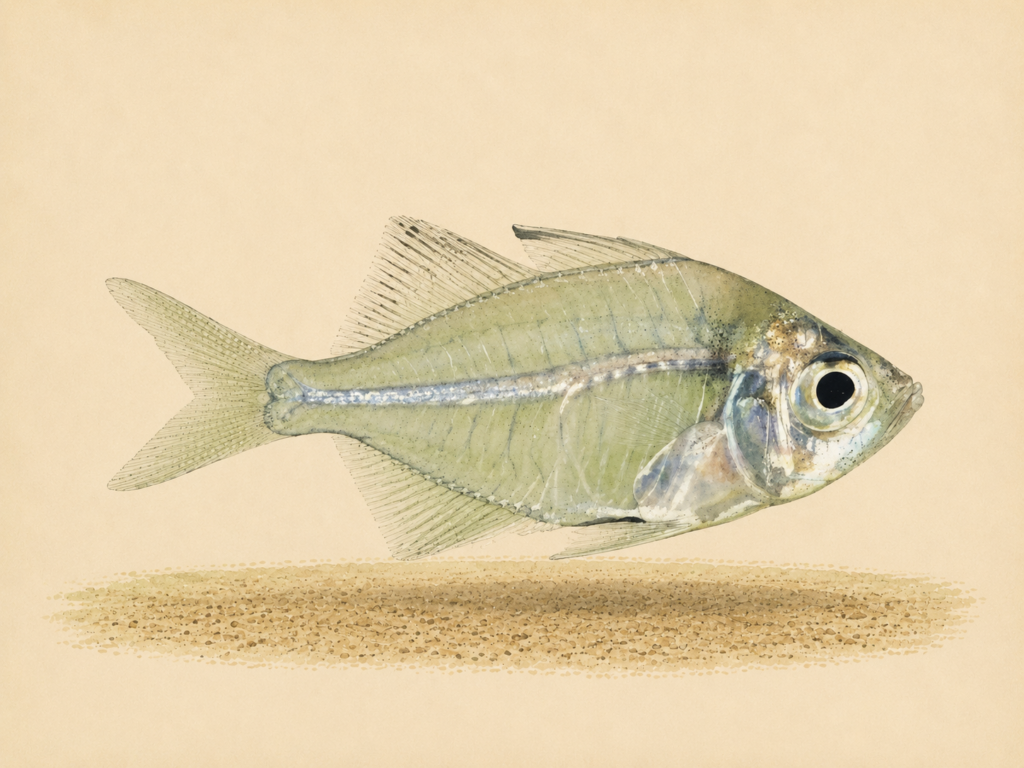
The defining feature of Parambassis ranga is its remarkable transparency. The body is deep and laterally compressed – somewhat diamond-shaped in profile – with a high dorsal arch that gives it a passing resemblance to small freshwater perches. The skin and underlying tissues contain almost no pigment, which means light passes straight through the body. Under good aquarium lighting the vertebral column, ribs, skull and swim bladder are all clearly visible. The internal organs are concentrated in a silvery mass just behind and below the head, and even the beating of the heart can sometimes be observed in well-lit conditions.
In healthy, undyed specimens the body has a faint yellowish or amber tint, and the edges of the dorsal and anal fins may show a subtle iridescent blue or violet sheen. Males in breeding condition develop a noticeably deeper golden to amber colour along the fin margins, particularly on the second dorsal fin and the anal fin, and the body may take on a slightly warmer golden hue overall. Females tend to remain paler and slightly more translucent. Both sexes have large, reflective eyes with a dark pupil.
The dorsal fin is divided into two sections: a spiny anterior portion and a soft-rayed posterior portion. The anal fin is similarly supported by a few short spines at its leading edge. The caudal fin is forked and largely transparent. Adult fish in peak condition are genuinely stunning under planted-tank LED lighting, where the interplay of light through the body creates an almost holographic effect.
Juvenile fish are even more transparent than adults and can be surprisingly difficult to spot in a densely planted aquarium until they grow and develop a little more colouration. Growth is moderate; most fish reach their full adult size of around 6 to 8 centimetres within 12 to 18 months.
Natural Habitat
Parambassis ranga is found across a broad geographic range spanning the Indian subcontinent and parts of mainland Southeast Asia. Recorded localities include river systems in India, Bangladesh, Nepal, Pakistan, Myanmar and Thailand. Within this range the species occupies a variety of freshwater habitats, from slow-moving rivers and streams to standing water bodies such as ponds, irrigation channels, floodplain pools and rice paddies.
The common thread linking most collection sites is the presence of abundant aquatic vegetation and relatively warm, still to gently flowing water. Glass fish are frequently found among submerged plants, overhanging roots and marginal vegetation that provides cover from predators. The substrates in these habitats are typically silty or sandy, and the water may range from clear to moderately turbid depending on the season. During the monsoon, many populations experience significant fluctuations in water level and flow, which plays a role in triggering breeding behaviour.
Water chemistry across the natural range is variable. Some populations inhabit soft, slightly acidic water, while others are found in harder, more alkaline conditions. There is a persistent myth in the aquarium hobby that Indian Glass Fish require brackish water. While some ambassid relatives are euryhaline, Parambassis ranga is a purely freshwater species and does not need or benefit from the addition of salt. This misconception likely arose from confusion with other members of the family and has led to unnecessary dosing that can actually stress the fish.
The species’ IUCN conservation status is Least Concern, reflecting its wide distribution and apparently stable wild populations. It is collected in large numbers for the aquarium trade, particularly in India and Bangladesh, but wild stocks do not appear to be significantly threatened at present.
Tank Size and Setup
A group of six Indian Glass Fish can be housed in a tank of 80 litres or more, though a larger aquarium of 120 litres or above is preferable if you wish to keep a bigger shoal or house them in a community setting. These fish are active swimmers that make use of the mid-water column, so a tank with a reasonable front-to-back depth and some horizontal swimming space is more important than extreme height.
Planting is arguably the single most important aspect of the setup. In the wild, Parambassis ranga is almost always associated with dense vegetation, and it behaves far more confidently in a planted tank than in a sparsely decorated one. Use a mixture of stem plants such as Vallisneria, Hygrophila and Rotala to create thickets along the sides and rear of the aquarium, leaving an open swimming area towards the front. Floating plants like Salvinia or Amazon Frogbit help diffuse overhead light and add to the fish’s sense of security. Broadleaf plants such as Cryptocoryne or Java Fern can fill out the lower levels. Driftwood and smooth stones are welcome additions but are less critical than the plant cover itself.
The substrate can be fine gravel, sand or a planted-tank soil. Indian Glass Fish do not interact much with the substrate, so choose whatever best supports your plant growth. A dark substrate will show off the fish’s translucent bodies particularly well, as the contrast makes the glass-like effect more dramatic.
Lighting should be moderate. Bright planted-tank LEDs are fine provided there is sufficient surface cover from floating plants to prevent the fish feeling exposed. A timer set to give 8 to 10 hours of light per day suits both the fish and the plants. Avoid leaving lights on for excessively long periods, as this encourages algae and can stress the fish.
A tight-fitting lid or cover glass is advisable. While Indian Glass Fish are not especially prone to jumping, startled individuals can leap, and an open-top setup in a busy household carries some risk.
Water Parameters
Parambassis ranga is adaptable across a reasonably broad range of water chemistry, which is one of the reasons it can be a straightforward species to maintain once you understand its basic needs. The key is stability rather than hitting a precise number. Avoid sudden swings in temperature or pH, and ensure ammonia and nitrite are always at zero in a mature, cycled aquarium.
| Temperature | 20-30 C |
| pH | 6.5-8.0 |
| General hardness (GH) | 5-20 dGH |
| Carbonate hardness (KH) | 4-15 dKH |
| Ammonia | 0 ppm |
| Nitrite | 0 ppm |
| Nitrate | Below 20 ppm |
Most UK tap water, once dechlorinated, falls comfortably within this range. If your local supply is extremely soft or extremely hard you may wish to adjust, but the majority of fishkeepers will find their glass fish settle in without any water chemistry modification. Aim for a temperature around 24-26 C for general maintenance, which suits most community tank mates as well.
Weekly water changes of 20-30% are recommended to keep nitrate levels low and maintain stable conditions. Use a liquid test kit to monitor ammonia, nitrite, nitrate and pH regularly, especially in the first few months after setting up the tank. Consistency is far more important than perfection – a stable pH of 7.5 is better than one that swings between 6.8 and 7.2 every few days.
To reiterate an earlier point: do not add salt to the aquarium. Parambassis ranga is a freshwater fish and does not need or benefit from brackish conditions. The persistent brackish myth in older aquarium literature is incorrect for this species.
Filtration and Equipment
A standard internal or external filter rated for the tank’s volume is sufficient for a group of Indian Glass Fish. These are not heavy waste producers, so an oversized filter is unnecessary unless the tank also houses messier species. What matters more than raw filtration capacity is the quality of the flow pattern. In the wild, Parambassis ranga inhabits areas with gentle to moderate current, so aim for a flow rate that creates some water movement without turning the aquarium into a whitewater torrent. If your filter outlet produces a strong jet, use a spray bar or lily pipe to diffuse it across the tank’s width.
Sponge filters are a perfectly viable option for a dedicated glass fish tank, particularly if you are also raising fry. They provide gentle flow, excellent biological filtration and pose no risk of trapping small fish. For larger community setups, a canister filter or hang-on-back filter gives more flexibility in terms of media capacity and flow adjustment.
A reliable heater is essential unless you live in a climate where room temperature consistently stays within the species’ comfort range. A heater rated at approximately 1 watt per litre is a good rule of thumb. Place it near the filter outlet so that warmed water is distributed evenly. Use a separate thermometer to verify the heater’s accuracy – the built-in thermostats on budget heaters can drift over time.
An air pump is optional but can be beneficial for supplementing oxygenation, especially in warmer weather when dissolved oxygen levels drop. If using an air stone, place it towards one end of the tank so the fish can choose whether to swim in the area of turbulence or retreat to calmer water among the plants.
Diet and Feeding
Indian Glass Fish are primarily micro-predators in the wild, feeding on small invertebrates, insect larvae, zooplankton and tiny crustaceans. In the aquarium, they can sometimes be reluctant to accept dry foods initially, particularly if they are wild-caught. With patience, most specimens can be weaned onto high-quality flake or micro-pellet foods, but a varied diet that includes live or frozen foods is strongly recommended for long-term health and colour.
The best staple foods for Parambassis ranga in captivity include frozen or live bloodworm, daphnia, brine shrimp (Artemia), cyclops and mosquito larvae. These closely replicate the invertebrate prey they would eat in the wild and are eagerly accepted by almost all individuals. Frozen foods are convenient, widely available and carry less risk of introducing parasites than live foods, though occasional live feeding is excellent for stimulating natural hunting behaviour and conditioning fish for breeding.
High-quality micro pellets or crushed flake food can form a secondary part of the diet once the fish have learned to accept them. Choose a product designed for small tropical omnivores or carnivores, with a high protein content and minimal filler. Soak dry foods briefly before offering them to help prevent digestive issues and to make them sink into the mid-water column where glass fish prefer to feed.
Feed small amounts twice daily rather than one large meal. Glass fish have small stomachs and benefit from frequent, modest portions. Remove any uneaten food after a few minutes to prevent water quality deterioration. A varied rotation – for example, frozen bloodworm one day, daphnia the next, and a small amount of micro pellet on the third – keeps the diet balanced and maintains the fish’s interest.
Newly purchased fish that refuse dry food should not be starved into compliance. Offer live or frozen foods to get them eating confidently, then gradually introduce prepared foods alongside the familiar items over a period of weeks.
Behaviour and Temperament
Parambassis ranga is a peaceful, shoaling species that must be kept in a group. A minimum of six individuals is necessary, but eight to twelve is preferable. In too small a group – or worse, kept singly – glass fish become extremely shy, refuse food, lose colour and spend most of their time hiding. In a properly sized shoal they are far bolder, spending the majority of the day swimming in loose formation in the mid-water column, investigating their surroundings and interacting with one another.
Males are mildly territorial towards each other, particularly when in breeding condition. This manifests as brief fin-flaring displays and short chases, but rarely results in any physical damage. Having enough plant cover and space allows subordinate males to break line of sight and retreat, which keeps aggression at manageable levels. In a well-planted tank these interactions are entertaining to watch rather than a cause for concern.
Towards other species, Indian Glass Fish are almost entirely non-aggressive. They ignore fish that are too large to eat and are themselves too small to bother most community tank mates. Their main vulnerability is that they can be outcompeted for food by faster, bolder species. In a community tank, ensure that some food reaches the glass fish rather than being snapped up by more assertive feeders. Target feeding with a pipette or turkey baster can help.
Glass fish are diurnal and most active during daylight hours. They appreciate a regular light/dark cycle and may be more skittish if lights are switched on abruptly in a dark room. Using a timer with a gradual ramp-up period, or switching on the room light before the aquarium light, helps reduce stress.
Tank Mates
The Indian Glass Fish’s peaceful temperament and preference for mid-water swimming make it compatible with a wide range of similarly sized, non-aggressive community species. The ideal tank mates are calm, not overly boisterous and will not outcompete the glass fish for food. Avoid large, predatory or highly territorial species, and steer clear of notorious fin-nippers. Because Parambassis ranga can be a timid feeder, very fast or assertive species that dominate feeding time are also poor choices.
Good tank mates
- Harlequin Rasbora – A similarly peaceful, mid-water shoaling fish that thrives in planted tanks and shares comparable water parameter requirements.
- Kuhli Loach – A gentle bottom-dweller that occupies a different zone of the tank and poses no threat to glass fish.
- Cherry Barb – Calm, colourful and compatible in terms of size, temperament and water conditions.
- Honey Gourami – A quiet, slow-moving surface-to-mid-water species that makes an excellent centrepiece without bullying smaller companions.
- Panda Corydoras – Peaceful bottom-dwelling catfish that help clean up uneaten food without competing with glass fish for mid-water meals.
- Ember Tetra – Tiny, non-aggressive and beautifully coloured; their warm orange tones contrast nicely with the glass fish’s transparency.
- Amano Shrimp – Useful algae grazers that are too large for adult glass fish to eat and entirely peaceful.
- Celestial Pearl Danio – A small, calm species that shares a preference for planted setups with moderate flow.
Fish to avoid
- Tiger Barb – Boisterous and prone to fin-nipping, which will stress the timid glass fish and may cause physical injury.
- Oscar – A large, predatory cichlid that would view Indian Glass Fish as food.
- Convict Cichlid – Highly territorial, especially when breeding, and far too aggressive for glass fish.
- Red-Tailed Black Shark – Territorial towards bottom and mid-water fish, and fast enough to chase glass fish relentlessly.
- Chinese Algae Eater – Becomes aggressive and may attach to the flanks of slow-moving tank mates as it matures.
- Flowerhorn – A large, extremely aggressive hybrid cichlid wholly incompatible with small peaceful species.
Breeding
Breeding Indian Glass Fish in captivity is achievable but requires some preparation. They are egg scatterers that show no parental care, so a separate breeding tank or careful planning is needed to protect eggs and fry from being eaten by adults or other tank inhabitants.
To condition a breeding group, increase the proportion of live and frozen foods in the diet for two to three weeks. Bloodworm, daphnia and brine shrimp are all excellent conditioning foods. Select the healthiest, most colourful males – those showing the strongest amber edging on the fins – and pair them with plump, gravid females. Females carrying eggs will appear noticeably fuller in the belly when viewed from above.
The breeding tank should be around 40 to 60 litres, filled to a depth of 15 to 20 centimetres, and densely planted with fine-leaved plants such as Java Moss, Cabomba or spawning mops. These provide surfaces for the adhesive eggs to attach to and make it harder for the adults to consume them immediately after spawning. Water temperature should be raised to 26-28 C, and a partial water change with slightly cooler water can help simulate the onset of the monsoon season, which is a natural spawning trigger.
Spawning typically occurs in the morning. The male displays vigorously to the female, spreading his fins and intensifying his golden colouration. If receptive, the female joins the male among the fine-leaved plants, and eggs are released and fertilised in small batches. A single spawning may produce 100 to 200 or more tiny, transparent eggs.
Remove the adults after spawning to prevent egg predation. The eggs hatch within 24 to 48 hours at breeding temperatures, and the tiny fry become free-swimming a day or two later. Initial food should be infusoria or commercially available liquid fry food, transitioning to freshly hatched brine shrimp nauplii once the fry are large enough to accept them. Growth is slow in the first few weeks, and maintaining excellent water quality in the fry tank is critical. Small, frequent water changes with aged, temperature-matched water help keep conditions stable.
Fry are extremely small and transparent, making them difficult to see and easy to accidentally siphon out during maintenance. Use airline tubing rather than a standard gravel vacuum for water changes, and always check the waste water before discarding it.
Common Diseases
Indian Glass Fish are reasonably hardy when kept in clean, stable conditions, but they can be susceptible to the same range of common freshwater diseases as other tropical species. Maintaining excellent water quality and a varied diet is the single best preventive measure.
White spot disease (Ichthyophthirius multifiliis), commonly known as ich, is perhaps the most frequently encountered problem. It presents as small white cysts on the fins and body, and affected fish may flash (rub against surfaces) and become lethargic. Ich is highly treatable if caught early. Raise the temperature gradually to 28-30 C and treat with a proprietary white spot remedy following the manufacturer’s instructions. Parambassis ranga tolerates the standard treatment protocols well.
Bacterial infections can arise from poor water quality or physical injury. Symptoms include reddened areas on the body or fins, frayed fins, loss of appetite and lethargy. Improving water quality through increased water changes is the first step; in persistent cases, a broad-spectrum antibacterial treatment may be needed.
Fungal infections appear as white, cotton-wool-like growths on the body or fins, often secondary to an existing wound or stress. Treat with an antifungal medication and address the underlying cause – typically poor water quality or aggression from tank mates.
Dyed fish are significantly more prone to disease. The injection process damages tissue, weakens the immune system and creates entry points for infection. Dyed glass fish frequently develop chronic infections, lymphocystis and organ damage, and they tend to have much shorter lifespans than undyed specimens. This is yet another reason to avoid purchasing dyed fish under any circumstances.
Intestinal parasites can occasionally affect wild-caught specimens. Signs include weight loss despite eating, white or stringy faeces and a generally emaciated appearance. Antiparasitic foods or medications designed for internal parasites can be effective, but accurate diagnosis is important – consult a specialist aquatic veterinarian if you are unsure.
FAQs
Do Indian Glass Fish need brackish water?
No. This is a common myth that persists from outdated aquarium literature. Parambassis ranga is a freshwater species throughout its natural range. Adding salt to the aquarium is unnecessary and may actually cause stress. Keep them in standard freshwater conditions within the parameter ranges described in this guide.
How can I tell if a glass fish has been dyed?
Dyed glass fish display unnatural bands or patches of vivid fluorescent colour – typically neon pink, green, blue or purple – on their otherwise translucent bodies. Undyed, healthy specimens are clear to faintly golden-amber with subtle iridescence on the fins. If the fish looks like it has been highlighted with a marker pen, it has been dyed. Always refuse to purchase these fish.
Why are my glass fish hiding all the time?
The most common reason is that the group is too small. Indian Glass Fish are obligate shoalers and become extremely shy when kept in groups of fewer than six. Insufficient plant cover, overly bright lighting without surface shade, or the presence of boisterous or aggressive tank mates can also cause persistent hiding. Increase the group size, add more plants and floating cover, and review your tank mate choices.
Can I keep Indian Glass Fish with shrimp?
Adult glass fish are generally safe with adult Amano shrimp and larger cherry shrimp, but they may prey on very small shrimp species and newly born shrimplets. If you are breeding dwarf shrimp, the glass fish will likely eat some of the offspring. Dense plant cover gives shrimplets their best chance of survival in a shared tank.
How long do Indian Glass Fish live?
In well-maintained aquarium conditions, undyed Indian Glass Fish typically live for three to five years. Dyed specimens, unfortunately, often have significantly reduced lifespans due to the damage caused by the injection process. Providing stable water quality, a varied diet and a stress-free environment gives your fish the best chance of reaching the upper end of their natural lifespan.
Related Guides
- Honey Gourami Care Guide – An excellent centrepiece species for a glass fish community tank, sharing similar water requirements and a calm temperament.
- Cherry Barb Care Guide – Another peaceful, hardy species from South Asia that pairs well with glass fish in a planted setup.
- Harlequin Rasbora Care Guide – A popular shoaling species that complements Indian Glass Fish beautifully in mid-water community tanks.
- Kuhli Loach Care Guide – A gentle bottom-dweller that makes an ideal lower-level companion for a glass fish aquarium.
- Ember Tetra Care Guide – A tiny, colourful tetra whose warm tones contrast strikingly with the glass fish’s translucent body.