Quick summary
The Honey Gourami is an easy, peaceful fish well suited to beginners, thriving in a planted 40-litre-plus tank with calm tank mates and stable, warm water. It is shy at first but easy to care for overall, making it a great gentle centrepiece for a quiet community aquarium.
🐠 Build a tank around this species
In this guide:
- Introduction
- Quick Stats
- Appearance
- Varieties and Morphs
- Natural Habitat
- Tank Size and Setup
- Water Parameters
- Filtration and Equipment
- Diet and Feeding
- Behaviour and Temperament
- Tank Mates
- Breeding
- Common Diseases
- FAQs
Introduction
The Honey Gourami is one of the most endearing and gentle freshwater fish available to aquarists. Small, peaceful, and draped in warm amber tones, it has earned a devoted following among both beginners seeking an easy-going centrepiece fish and experienced keepers who appreciate its subtle beauty and fascinating labyrinth-organ breathing. Despite its modest size, rarely exceeding five centimetres, the Honey Gourami possesses a quiet charisma that belies its stature, and a well-kept pair or small group can become the focal point of a thoughtfully planted aquarium.
Originally described by Hamilton in 1822 as Trichopodus chuna, this species has endured a somewhat turbulent taxonomic history. It has been placed in the genera Colisa, Polyacanthus, and most recently Trichogaster, where it is now generally accepted. Confusion in the hobby also arises because the common name “Honey Gourami” is occasionally applied to colour morphs of the closely related Dwarf Gourami (Trichogaster lalius), so verifying the scientific name before purchase is always worthwhile.
This guide covers everything you need to know to keep Honey Gouramis healthy and thriving, from water parameters and tank setup to diet, breeding, disease prevention, and compatible tank mates.
Quick Stats
| Scientific name | Trichogaster chuna |
|---|---|
| Common names | Honey Dwarf Gourami, Sunset Honey Gourami, Red Honey Gourami |
| Family | Osphronemidae |
| Origin | India and Bangladesh (Ganges and Brahmaputra basins) |
| Adult size | 5 cm |
| Lifespan | 4–8 years |
| Difficulty | Easy |
| Breeding difficulty | Moderate |
| Temperature | 22–28 °C |
| pH | 6–7.5 |
| GH | 4–15 dGH |
| KH | 2–10 dKH |
| Minimum tank size | 40 L |
| Conservation status | Least Concern (IUCN) |
Appearance
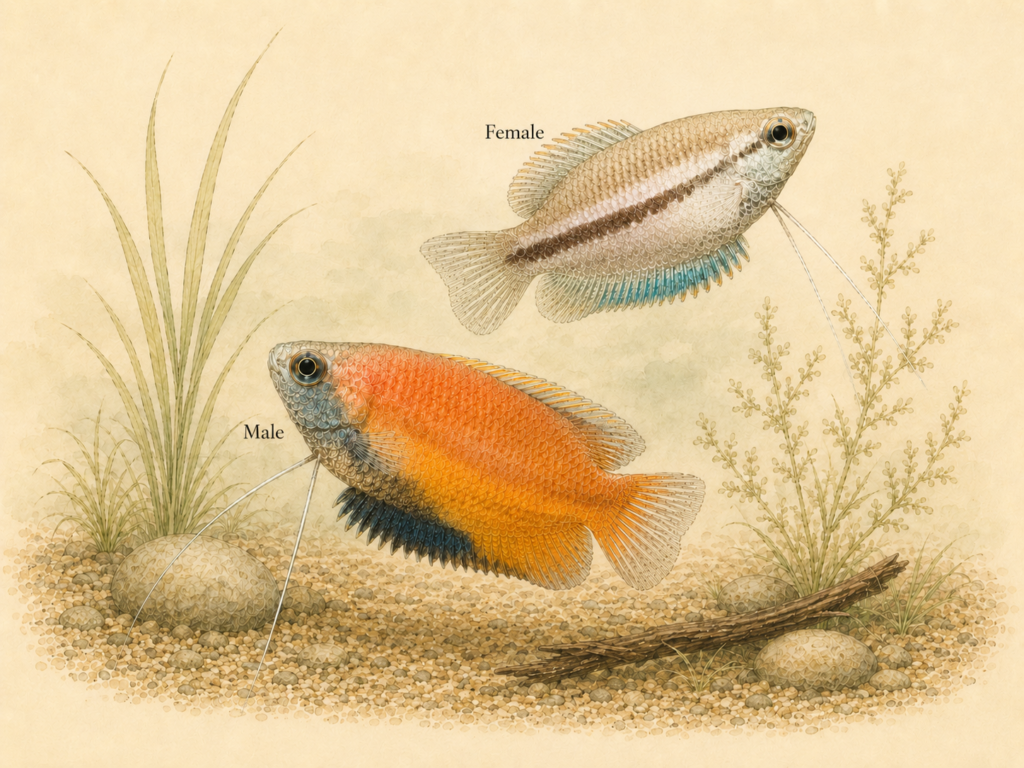
In its wild form the Honey Gourami displays a rather understated palette compared to many of its captive-bred variants. Males are typically a warm honey-gold across the flanks, with a narrow dark-brown to black lateral stripe running from the snout through the eye and fading towards the caudal peduncle. During courtship and breeding, males undergo a dramatic colour change: the throat and ventral region darken to a deep navy or jet black, while the dorsal fin develops a bright lemon-yellow margin. This breeding dress is striking and quite unmistakable.
Females and non-breeding males are considerably more subdued, showing a silvery or pale beige body with a more prominent lateral stripe. Their fins lack the vivid edging seen in courting males, and the body remains largely uniform in tone. Both sexes possess the characteristic elongated pelvic fins, sometimes called “feelers,” which are typical of gouramis and are used to explore their surroundings and interact socially. The dorsal fin of the male tends to be slightly more pointed than the rounded dorsal of the female, which is a useful sexing aid outside of breeding condition.
The body is laterally compressed and ovoid, with a relatively small upturned mouth adapted for feeding at the surface. Like all anabantoids, the Honey Gourami possesses a labyrinth organ, a specialised respiratory structure located in a suprabranchial chamber above the gills, that allows it to breathe atmospheric air. This adaptation is essential in its natural habitat, where dissolved oxygen can be extremely low.
Varieties and Morphs
Several selectively bred colour forms of the Honey Gourami are widely available in the aquarium trade, and it is worth noting that these morphs are sometimes more commonly stocked than the wild-type form. The most popular is the Sunset Honey Gourami, sometimes sold simply as “Red Honey Gourami.” This variant has been line-bred to intensify the orange and red tones across the entire body, producing a vivid, almost uniform sunset-orange colouration in both sexes. It is arguably the most recognisable form in pet shops and is frequently the fish people picture when they think of a Honey Gourami.
The Gold Honey Gourami is another common variant, selected for a brighter, more saturated golden-yellow body that lacks much of the brownish striping seen in wild specimens. In some markets it is marketed under the name “Golden Honey Gourami” and can be difficult to distinguish from the Sunset morph under shop lighting, though the Gold form tends towards a purer yellow rather than deep orange.
A less commonly encountered variety is the Red-Flame Honey Gourami, which pushes the red pigmentation even further than the Sunset morph, producing a deep reddish-orange body with contrasting lighter fins. Care requirements for all captive-bred morphs are identical to the wild type, and they can be freely mixed in the same tank without any compatibility issues. It is important, however, not to confuse these morphs with similarly named colour forms of Trichogaster lalius, the Dwarf Gourami, which is a separate species with somewhat different care needs and a notably higher susceptibility to Dwarf Gourami Iridovirus (DGIV).
Natural Habitat
The Honey Gourami is native to the floodplains and lowland river systems of the Indian subcontinent, primarily the Ganges and Brahmaputra river basins spanning northeastern India and Bangladesh. It inhabits slow-moving or still waters, paddy fields, oxbow lakes, seasonal pools, vegetated ditches, and the margins of larger rivers where current is minimal. These habitats are typically shallow, warm, and heavily vegetated, with dense stands of emergent and submerged plants providing cover and foraging opportunities.
Water in these environments is often tea-coloured from tannins leached by decaying plant matter, with a slightly acidic to neutral pH and low to moderate hardness. Dissolved oxygen levels can drop precipitously, particularly during the dry season when water bodies shrink and temperatures climb. It is precisely these oxygen-poor conditions that have driven the evolution of the labyrinth organ, enabling Honey Gouramis to supplement gill respiration with gulps of atmospheric air taken at the surface.
Understanding this natural habitat is key to providing appropriate aquarium conditions. The species thrives in tanks that replicate the warmth, gentle flow, abundant vegetation, and soft lighting of its native waters. Bare or sparsely decorated tanks with strong current and bright overhead lighting will leave a Honey Gourami feeling exposed and stressed, which often manifests as washed-out colouration and reclusive behaviour.
Tank Size and Setup
A single Honey Gourami or a pair can be comfortably housed in a tank of at least 40 litres, though a tank of 60 litres or more is strongly recommended if you plan to keep a small group or a community. Larger volumes also provide greater stability in water parameters, which benefits this somewhat sensitive species. Tanks with a generous horizontal footprint are preferable to tall, narrow designs, as Honey Gouramis spend much of their time in the upper and middle water column and appreciate lateral swimming space.
Dense planting is perhaps the single most important element of the setup. Live plants such as Vallisneria, Java Fern, Cryptocoryne species, and floating plants like Amazon Frogbit or Salvinia serve multiple purposes: they diffuse light, provide cover, reduce stress, and offer surfaces for biofilm grazing. Floating plants are particularly valuable because they create shaded areas at the surface where the gourami feels secure and, during breeding, provide anchoring points for bubble nests. Aim for a mixture of rooted background plants, midground species, and a partial cover of floating vegetation, leaving some open water for swimming.
A dark substrate, fine gravel or a nutrient-rich aquasoil, will show off the fish’s colours to their best advantage and more closely replicate the murky bottoms of its natural habitat. Hardscape in the form of bogwood and smooth stones adds visual interest and creates additional refuge. Indian almond leaves or other botanicals can be scattered across the substrate to release tannins, gently lowering pH and lending a naturalistic tint to the water that Honey Gouramis seem to appreciate.
It is essential that the tank has a tight-fitting lid or cover glass with minimal gap between the water surface and the cover. The labyrinth organ requires the fish to breathe air that is close to the ambient water temperature; if the air above the surface is significantly cooler, the gourami can suffer damage to the labyrinth organ or develop respiratory issues. A well-sealed lid also prevents jumping, which, although uncommon in this species, does occasionally occur when fish are startled.
Water Parameters
| Temperature | 22–28 °C |
| pH | 6.0–7.5 |
| General hardness (GH) | 4–15 dGH |
| Carbonate hardness (KH) | 2–10 dKH |
| Ammonia | 0 ppm |
| Nitrite | 0 ppm |
| Nitrate | Below 20 ppm |
Honey Gouramis are fairly tolerant of a range of water conditions once established, but they do best in soft to moderately hard, slightly acidic to neutral water. A temperature of 24–26 °C represents the comfortable midpoint for everyday keeping. Stability matters more than hitting a specific number; avoid sudden swings in pH or temperature, as these can trigger stress and disease. Perform weekly water changes of 20–30 per cent, ensuring that replacement water is dechlorinated and temperature-matched before adding it to the tank.
Ammonia and nitrite must always register at zero in a properly cycled aquarium. Nitrate should be kept below 20 ppm through a combination of regular water changes and the uptake provided by live plants. Elevated nitrate levels over prolonged periods can suppress the immune system and contribute to chronic health problems. If your tap water is particularly hard or alkaline, consider blending it with reverse-osmosis water or using remineralised RO water to achieve the softer, more acidic conditions this species prefers.
Filtration and Equipment
Because the Honey Gourami originates from still and slow-moving waters, filtration should be effective without generating strong currents. A sponge filter is an excellent choice for smaller setups: it provides gentle biological and mechanical filtration, creates minimal surface agitation, and is safe for fry if you intend to breed. In larger or community tanks, a hang-on-back filter or a small canister filter can be used, but the outflow should be baffled or directed against the glass to dissipate the current. If the fish are consistently seen struggling against flow or hiding behind décor to avoid it, the current is too strong.
A reliable heater is essential, ideally one with a built-in thermostat rated for the tank’s volume. Place it near the filter outflow for even heat distribution and check the temperature with an independent thermometer rather than relying solely on the heater’s dial. In tropical or warm climates where room temperature consistently exceeds 24 °C, a heater may not be necessary for much of the year, but having one available for cooler nights or seasonal temperature drops is prudent.
Lighting should be moderate. If you are growing live plants, choose a light that meets the plants’ requirements but consider using floating vegetation or tall background plants to create shaded areas. Honey Gouramis display their richest colouration under subdued lighting and can appear pale and stressed under very bright, unshaded fixtures. A standard photoperiod of eight to ten hours per day suits both the fish and most common aquarium plants.
Diet and Feeding
Honey Gouramis are omnivorous and have small mouths, so food items should be appropriately sized. In the wild they feed on small insects, insect larvae, zooplankton, and algae growing on submerged surfaces. In the aquarium they readily accept high-quality micro pellets or small-grade flake food as a staple diet. Look for products with whole fish or invertebrate meal listed as the primary ingredient and avoid foods that are predominantly cereal-based filler.
Supplementing the staple diet with live or frozen foods will enhance colouration, promote breeding condition, and provide enrichment. Daphnia, baby brine shrimp, micro worms, cyclops, and finely chopped bloodworm are all eagerly taken. Freeze-dried options can be used occasionally but should be pre-soaked briefly to prevent digestive issues. Blanched vegetable matter such as tiny pieces of courgette, spinach, or a small amount of spirulina-based food can be offered once or twice a week to round out the diet.
Feed small amounts once or twice daily, offering only what the fish can consume within two to three minutes. Honey Gouramis are not aggressive feeders and can be outcompeted at mealtimes by faster or larger tank mates. If this is a concern, try feeding at multiple locations in the tank simultaneously, or use a feeding ring to concentrate food near the gourami’s preferred area. Overfeeding should be carefully avoided, as uneaten food degrades water quality quickly in the small tanks often used for this species.
Behaviour and Temperament
The Honey Gourami is among the most peaceable of all aquarium fish. It is shy, gentle, and rarely shows any aggression toward other species. Males may occasionally display to one another, flaring their fins, darkening their ventral colouration, and circling, but these confrontations are largely ritualistic and almost never result in physical harm. In tanks with ample cover and broken sight lines, even male-to-male interactions tend to be brief and inconsequential.
This species is naturally cautious and may spend the first few days after introduction hiding amongst plants or behind décor. Given time and a calm environment, it will gradually become bolder, eventually spending much of the day exploring the upper and middle levels of the tank, probing surfaces with its sensitive pelvic-fin feelers, and rising to the surface to take gulps of air. This air-breathing behaviour is entirely normal and should not be mistaken for a sign of oxygen deprivation unless it becomes frantic and continuous.
Honey Gouramis are not shoaling fish in the strict sense, but they are sociable and appear more relaxed and more colourful when kept with conspecifics. A group of one male and two or three females works well, as it distributes any mild male attention and allows for natural social interaction. Keeping multiple males together is feasible in tanks of 80 litres or more with dense planting, though some hierarchical posturing should be expected. Solitary specimens can thrive but may remain somewhat reclusive, particularly in larger community tanks where they can feel overwhelmed by more boisterous inhabitants.
Tank Mates
Choosing appropriate tank mates for the Honey Gourami requires an understanding of its gentle disposition. This fish will not compete aggressively for food, will not defend itself against fin-nippers, and can be severely stressed by fast-moving or boisterous species. Ideal companions are similarly sized, peaceful fish that occupy different areas of the tank or share the same calm temperament. Bottom-dwellers and small schooling species from soft-water habitats make the best choices. Avoid any fish known for aggression, territorial behaviour, or nipping at the flowing fins of slow-moving species.
Good tank mates
- Ember Tetra, a tiny, peaceful schooling fish that occupies the middle water column and complements the gourami’s warm colour palette beautifully.
- Harlequin Rasbora, a calm, soft-water species that schools tightly and poses no threat to a Honey Gourami.
- Pygmy Corydoras, a diminutive bottom-dweller that adds activity to the lower levels of the tank without causing stress.
- Bronze Corydoras, another peaceful bottom-feeder that thrives in similar water conditions and helps clean up uneaten food.
- Kuhli Loach, a shy, nocturnal loach that stays near the substrate and coexists effortlessly with surface-oriented gouramis.
- Cherry Shrimp, colourful invertebrates that generally coexist well with adult Honey Gouramis, though very small shrimplets may occasionally be eaten.
- Celestial Pearl Danio, a small, gentle species from similar slow-water habitats that shares the gourami’s preference for planted tanks.
- Otocinclus, a peaceful algae grazer that stays on surfaces and glass, rarely interacting with mid-water fish.
- Chili Rasbora, one of the smallest rasboras, perfectly suited to the calm, planted environments Honey Gouramis prefer.
- Nerite Snail, an excellent algae-eating snail that is entirely compatible and adds useful maintenance to the tank.
Fish to avoid
- Tiger Barb, a notorious fin-nipper that will harass the slow-moving gourami relentlessly.
- Chinese Algae Eater, becomes increasingly territorial and aggressive as it matures, posing a serious threat to gentle tank mates.
- Convict Cichlid, a highly territorial cichlid that will intimidate and potentially injure a Honey Gourami.
- Red-Tail Shark, aggressively territorial towards bottom and mid-level fish, creating constant stress in smaller tanks.
- Dwarf Gourami, despite being a close relative, males can be aggressive toward Honey Gouramis, and the species carries a high risk of DGIV that may cross-infect.
- Giant Gourami, far too large and boisterous; would view a Honey Gourami as potential food.
- Green Terror, a large, aggressive New World cichlid wholly incompatible with small, peaceful anabantoids.
- Buenos Aires Tetra, an active and sometimes nippy tetra that can bully slower species and destroy live plants.
Breeding
Breeding Honey Gouramis is a rewarding experience and is achievable for aquarists with moderate experience. Like most gouramis, the male constructs a bubble nest at the water’s surface, typically anchored among floating plants or beneath a broad leaf. Conditioning the pair on high-protein live or frozen foods for one to two weeks prior to a breeding attempt will improve results. A slight increase in temperature to around 27–28 °C and a modest drop in water level, to around 15–20 centimetres, can help simulate the shallow floodplain conditions that trigger spawning in the wild.
The male’s courtship display is unmistakable. He darkens dramatically, with the throat turning deep black or navy blue and the body intensifying to a rich honey-gold. He will display to the female with spread fins, swimming beneath the nest in an exaggerated, undulating fashion. When the female is receptive, she approaches the nest and the pair engages in a spawning embrace beneath it. The male wraps his body around the female, and eggs are released and fertilised simultaneously. The eggs float upwards into the nest, and any that sink are carefully collected by the male and placed into the bubbles. A single spawning can produce anywhere from 20 to over 300 eggs depending on the female’s size and condition.
After spawning, the female should be removed to prevent the male from directing aggression towards her, as he becomes highly protective of the nest. The male tends the eggs diligently, repairing the nest and guarding against intruders. Eggs typically hatch within 24 to 36 hours, and the fry become free-swimming two to three days later. At this point the male can also be removed, as his parental instincts may wane and he might begin to eat the fry.
Free-swimming fry are extremely small and require infusoria or commercially available liquid fry food for the first few days. After approximately a week they can graduate to freshly hatched baby brine shrimp and microworms. Growth is steady but not rapid; expect the fry to take three to four months to reach a size at which they can be safely housed with adult fish. Maintain excellent water quality in the rearing tank with very gentle filtration, an air-driven sponge filter is ideal, and perform small, frequent water changes to prevent the build-up of waste.
Common Diseases
Honey Gouramis are generally hardier than their close relative the Dwarf Gourami, but they are not immune to disease. Stress from poor water quality, aggressive tank mates, or inadequate diet is the primary driver of illness in this species. Maintaining stable parameters and a calm environment is the most effective preventative measure.
White spot disease, also known as Ich, caused by the protozoan Ichthyophthirius multifiliis, is one of the most common ailments. It presents as small white cysts across the body and fins and is typically triggered by temperature fluctuations or the introduction of infected fish. Treatment involves gradually raising the temperature to 28–30 °C and dosing with a white-spot medication following the manufacturer’s instructions. Honey Gouramis are generally tolerant of standard Ich treatments, but avoid malachite green at full strength, as some anabantoids can be sensitive to it; use half-doses where possible.
Velvet disease, caused by the dinoflagellate Piscinoodinium pillulare, produces a fine gold or rust-coloured dusting on the skin and can be difficult to detect against the gourami’s naturally warm-toned body. Affected fish often clamp their fins, scratch against surfaces, and lose appetite. Treatment typically involves dimming the lights, raising temperature slightly, and using a copper-based medication.
Bacterial infections, including fin rot, mouth fungus (columnaris), and general septicaemia, can occur when water quality deteriorates. Symptoms include fraying fins, cotton-like growths around the mouth, reddened patches on the body, or listless behaviour. Address the root cause by improving water quality immediately, then treat with an appropriate antibacterial medication.
While Honey Gouramis are not known to be susceptible to Dwarf Gourami Iridovirus (DGIV) to the same degree as Trichogaster lalius, there are occasional reports of cross-infection, particularly when the two species are housed together or sourced from the same breeding facility. Purchasing Honey Gouramis from reputable breeders who keep them separate from Dwarf Gouramis reduces this risk. Quarantining all new arrivals for at least two weeks before adding them to the main tank is strongly advisable.
FAQs
How many Honey Gouramis can I keep together?
In a 40-litre tank you can comfortably keep a single specimen or a pair (one male and one female). For a small group of one male and two to three females, aim for at least 60 litres. Larger tanks of 80 litres or more can support multiple males, provided there is dense planting and ample sight-line breaks to minimise territorial disputes. Always ensure the ratio of females to males is higher to prevent any single female from bearing the brunt of male attention.
Can Honey Gouramis live with Betta fish?
This combination is generally best avoided. Both species are anabantoids that occupy the upper water column and breathe air at the surface, which increases the likelihood of confrontation. Male Bettas in particular may view the gourami as a rival and act aggressively. While individual temperaments vary and some keepers report success, the risk of stress and injury to the Honey Gourami is high enough that it is not a pairing most experienced aquarists would recommend.
Why is my Honey Gourami hiding all the time?
Newly introduced Honey Gouramis commonly hide for several days or even a week as they acclimatise to their new surroundings. This is normal behaviour for a naturally timid species. If hiding persists beyond the initial settling-in period, check for stressors: aggressive or overly active tank mates, inadequate plant cover, excessively bright lighting, or poor water quality can all cause prolonged seclusion. Adding more floating plants, reducing light intensity, or removing boisterous companions often resolves the issue.
Is the Honey Gourami the same as the Dwarf Gourami?
No. The Honey Gourami (Trichogaster chuna) and the Dwarf Gourami (Trichogaster lalius) are distinct species, though they belong to the same genus and share a similar geographic range. The Dwarf Gourami is somewhat larger, more colourful in its wild form, and unfortunately highly susceptible to Dwarf Gourami Iridovirus. Confusingly, some shops sell orange or gold colour morphs of T. lalius under names like “Honey Dwarf Gourami,” so always check the scientific name to be certain of what you are purchasing.
Do Honey Gouramis need a heater?
In most climates, yes. Honey Gouramis require a stable temperature between 22 and 28 °C, and in temperate regions indoor temperatures can easily fall below this range, particularly at night or during winter months. Even if your room feels warm during the day, a reliable heater with a thermostat ensures consistency around the clock. Temperature fluctuations are a common trigger for Ich and other stress-related illnesses, so a heater is a worthwhile investment for the health of your fish.
Related Guides
- Dwarf Gourami Care Guide, a closely related species often confused with the Honey Gourami; compare their care requirements and disease susceptibility.
- Pearl Gourami Care Guide, another peaceful gourami species suitable for community tanks, offering a larger but equally gentle alternative.
- Sparkling Gourami Care Guide, a micro gourami with similar care needs and an enchanting ability to produce audible croaking sounds.
- Ember Tetra Care Guide, one of the best small schooling companions for Honey Gouramis in a planted community setup.
- Kuhli Loach Care Guide, a popular peaceful bottom-dweller that pairs well with Honey Gouramis in soft-water aquariums.