Quick Summary
The Indian Hifin Barb is a peaceful, small shoaling species ideally suited to planted nano and community tanks, making it a rewarding choice for aquarists who can provide stable, soft-water conditions and keep them in groups of at least six.
🐠 Build a tank around this species
In this guide:
- Introduction
- Quick Stats
- Appearance
- Natural Habitat
- Tank Size and Setup
- Water Parameters
- Diet and Feeding
- Behaviour and Temperament
- Tank Mates
- Breeding
Introduction
The Indian Hifin Barb (Oreichthys cosuatis) is one of those delightful freshwater species that can transform a modest planted aquarium into something genuinely captivating. Native to slow-moving streams and pools across India, Bangladesh, Thailand, and Myanmar, this diminutive cyprinid has been quietly winning fans in the fishkeeping hobby for its combination of peaceful temperament, manageable size, and – most strikingly – the remarkably tall, sail-like dorsal fin that mature males develop, particularly during courtship displays. It is from this dramatic finnage that the species earns its evocative common name.
Despite being relatively under-represented in the mainstream aquarium trade compared to more familiar barbs such as Cherry Barbs or Tiger Barbs, the Indian Hifin Barb is well worth seeking out. It occupies a sweet spot for hobbyists: small enough for nano aquariums yet robust enough for community setups, peaceful yet active, and visually understated until a dominant male raises that extraordinary dorsal fin, at which point it becomes one of the most eye-catching small fish in the hobby.
This guide covers everything you need to know to keep Oreichthys cosuatis successfully, from tank setup and water chemistry through to breeding and disease prevention. Whether you are considering this species for the first time or looking to refine your existing care, the information below draws on established husbandry practices and the species’ natural ecology to help you provide the best possible environment.
Quick Stats
| Scientific name | Oreichthys cosuatis |
|---|---|
| Common names | Hi-Fin Barb, Cosuatis Barb |
| Family | Cyprinidae |
| Origin | India, Bangladesh, Thailand, and Myanmar |
| Adult size | 4.5 cm |
| Lifespan | 3–5 years |
| Difficulty | Intermediate |
| Breeding difficulty | Moderate |
| Temperature | 20–26 °C |
| pH | 6–7.5 |
| GH | 2–12 dGH |
| KH | 1–8 dKH |
| Minimum tank size | 55 L |
| Conservation status | Least Concern (IUCN) |
Appearance
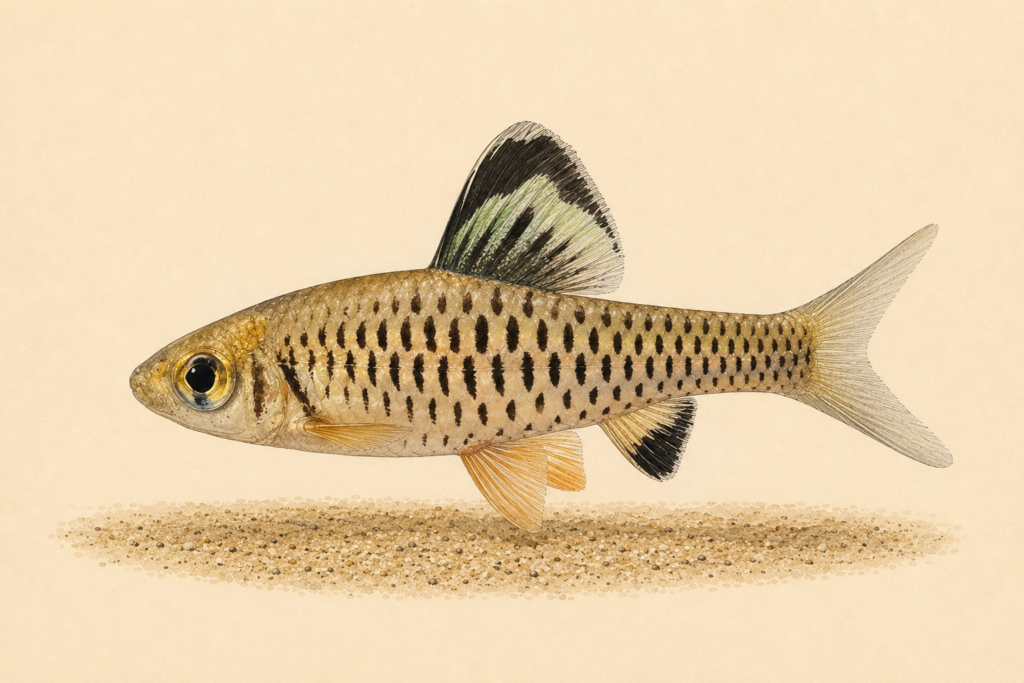
At first glance, the Indian Hifin Barb might appear relatively plain – a small, laterally compressed fish with an olive-gold to silvery base colouration. However, closer observation reveals a subtle beauty. The body carries a faint greenish-gold iridescence that catches the light as the fish moves through planted areas, and a distinct dark spot sits at the base of the caudal peduncle, a useful identifying feature that separates it from several visually similar small barbs. The scales are well defined, lending a slightly textured appearance to the flanks, and there may be faint vertical barring or mottled patterning along the body depending on the fish’s mood and environment.
The true spectacle, however, belongs to the males. As they mature – typically from around three to four months of age – the dorsal fin begins to elongate significantly, eventually developing into a tall, sail-like structure that can be nearly as tall as the body is deep. When a male is in full display, flaring this extended dorsal fin before a rival or a potential mate, the effect is genuinely impressive for such a small fish. The dorsal fin itself often displays darker pigmentation, sometimes with reddish or orange tinting towards the base and a darker band or edging further out, creating an eye-catching contrast against the lighter body.
Females are noticeably smaller-finned, with a standard-proportioned dorsal fin that lacks the dramatic extension seen in males. They tend to be slightly more rounded in the body, particularly when gravid, and their overall colouration is somewhat more muted. Distinguishing the sexes becomes straightforward once the fish have matured, as the difference in dorsal fin height is unmistakable.
Juvenile fish of both sexes look quite similar, with modest fins and a slightly more washed-out colouration that intensifies as they grow. Providing a dark substrate and plenty of vegetation will help bring out the best colour in this species, as they tend to look pale and stressed against bare or brightly lit setups.
Natural Habitat
Oreichthys cosuatis originates from freshwater habitats in West Bengal, in the eastern part of India, where it is found in tributaries, pools, and slow-moving waterways associated with the broader Ganges river basin. These environments tend to be characterised by relatively shallow water, often with a sandy or muddy substrate and significant amounts of submerged and marginal vegetation. Fallen leaves, root tangles, and overhanging bankside plants contribute to a complex, shaded environment that provides both foraging opportunities and shelter from predators.
The water in these habitats is typically soft to moderately hard and slightly acidic to neutral, influenced by seasonal monsoon rains that can cause fluctuations in water level, flow rate, and chemistry throughout the year. During the dry season, the fish may be concentrated in residual pools with relatively still water, dense plant cover, and substrates enriched with decomposing organic matter. This seasonal variability means the species is reasonably adaptable, but it consistently gravitates towards calm, well-vegetated areas rather than fast-flowing, open water.
Understanding this natural environment is key to successful captive husbandry. The Indian Hifin Barb feels most at home in a planted aquarium with subdued lighting, plenty of cover, and gentle water flow – conditions that closely replicate its native habitat. Leaf litter can be added to the aquarium to further mimic natural conditions and to provide a source of beneficial tannins, although this is by no means essential.
Tank Size and Setup
A minimum tank size of 60 litres is recommended for a group of six Indian Hifin Barbs. This provides sufficient swimming space for their active but not frenetic movement patterns, and enough footprint to create distinct planted zones and open swimming areas. If you plan to keep a larger group – which is always preferable with shoaling species – or wish to house them alongside tank mates, consider scaling up to 80-100 litres or more.
The aquascape should prioritise dense planting, particularly towards the back and sides of the tank, with open areas towards the front for swimming and display. Fine-leaved plants such as Java Moss, Cabomba, Rotala, and Vallisneria work well, providing both visual complexity and functional cover. Floating plants are also beneficial, as they diffuse overhead light and create the dappled, shaded conditions that bring out the best colouration and most natural behaviour in this species.
Substrate choice is relatively flexible, but a dark, fine-grained sand or small-grain gravel is ideal. Dark substrates help the fish feel secure and encourage more vivid colouration, while fine grains are gentler on the fish should they forage near the bottom. Pieces of driftwood, small branches, and leaf litter (Indian Almond leaves or dried oak leaves) can be added to provide additional cover and to tint the water with mild tannins, replicating the slightly tea-stained conditions of their native habitat.
Ensure the tank has a secure lid or cover, as small barbs can occasionally jump, particularly if startled. This is especially relevant during the first few days after introduction, when the fish are still settling in and are more prone to startle responses.
Lighting should be moderate rather than intense. If you are growing light-demanding plants, use floating plants or tall stem plants to create shaded zones where the barbs can retreat. Excessively bright, unshaded tanks tend to make this species appear washed out and nervous.
Water Parameters
The Indian Hifin Barb is reasonably adaptable in terms of water chemistry, but it thrives best in soft to moderately hard, slightly acidic to neutral water. Stability is more important than hitting an exact number, so focus on maintaining consistent conditions rather than chasing a precise pH or hardness value.
| Temperature | 20-26 C |
| pH | 6.0-7.5 |
| General hardness (GH) | 2-12 dGH |
| Carbonate hardness (KH) | 1-8 dKH |
| Ammonia | 0 ppm |
| Nitrite | 0 ppm |
| Nitrate | Below 20 ppm |
Regular water changes of 20-30% weekly are recommended to keep nitrate levels low and maintain overall water quality. If your tap water is particularly hard or alkaline, consider mixing it with reverse osmosis (RO) water to bring the hardness down into the preferred range. Indian Almond leaves or alder cones can be used to gently lower pH and add tannins, although these are supplementary measures rather than primary water chemistry adjustments.
The temperature range of 20-26 C is notable because it extends lower than many tropical community fish. This makes the Indian Hifin Barb a good candidate for unheated or subtropically maintained tanks in warmer climates or well-heated homes, although a reliable heater set to around 22-24 C is a sensible precaution in most situations. Avoid temperatures consistently above 27 C, as this species does not handle prolonged warmth well and may become stressed or susceptible to illness.
Filtration and Equipment
Filtration for the Indian Hifin Barb should be efficient but gentle. This species naturally inhabits slow-moving or still water, so a powerful filter that generates strong currents is inappropriate and will cause stress, particularly for males attempting to display their elongated dorsal fins. A sponge filter is an excellent choice for a dedicated species tank or nano setup, as it provides reliable biological filtration with minimal flow and is safe for fry should you attempt to breed the fish.
For larger community tanks, a small hang-on-back (HOB) filter or a compact internal canister filter will work well, provided the outflow is baffled or directed against the glass to diffuse the current. Some aquarists fit a spray bar to spread the outflow across a wider area, reducing localised turbulence. The key goal is to ensure adequate biological and mechanical filtration without creating a current that the fish have to fight against constantly.
An adjustable heater rated for the tank volume is recommended to maintain temperatures in the 22-24 C range. Heaters with external temperature controllers or thermostatic guards offer the most precise control. Always use a separate thermometer to verify the heater’s accuracy, as built-in thermostats can drift over time.
Lighting should be moderate. Standard LED units designed for planted tanks are perfectly suitable, but consider using a timer to provide a consistent photoperiod of 8-10 hours daily. As noted earlier, floating plants are a simple and effective way to reduce light intensity at the water surface and create the subdued conditions this species prefers.
An air pump is not strictly necessary if you are using a sponge filter (which provides aeration as a byproduct), but it can be beneficial in warmer months when dissolved oxygen levels may drop. Keep flow from airstones gentle to avoid excessive surface agitation.
Diet and Feeding
The Indian Hifin Barb is an omnivore that is not at all fussy about food, making it straightforward to feed in captivity. In the wild, it feeds on small invertebrates, algae, plant matter, and organic detritus, so a varied captive diet that mirrors this range will keep the fish in the best condition.
A high-quality micro-pellet or small crushed flake food should form the staple diet. Choose products formulated for small tropical or community fish, with a good balance of protein and plant-based ingredients. Feed once or twice daily, offering only as much food as the group can consume within two to three minutes. Overfeeding is a common cause of water quality problems in nano tanks, so restraint is important.
Supplement the staple diet regularly with live or frozen foods such as Daphnia, baby brine shrimp (Artemia nauplii), Cyclops, micro worms, and bloodworms (chopped if necessary for smaller individuals). These protein-rich foods are especially valuable for conditioning adult fish for breeding and for promoting the full development of the males’ dorsal fin. Live foods also encourage natural foraging behaviour, which is beneficial for the fish’s overall welfare and activity levels.
Blanched vegetables such as courgette (zucchini), spinach, or shelled peas can be offered occasionally to provide fibre and plant-based nutrition, although the fish may take some time to accept these if they are not accustomed to them. Spirulina-based foods or algae wafers crumbled into small pieces are another useful plant-based supplement.
Avoid feeding large or hard food items that the fish cannot easily consume. Their mouths are small, and oversized foods will simply be ignored, sinking to the bottom and fouling the water.
Behaviour and Temperament
The Indian Hifin Barb is a peaceful, sociable species that is best kept in groups of at least six individuals, with larger groups of eight to twelve being preferable if tank space allows. In a suitably sized group, the fish form a loose shoal, spending much of their time moving together through planted areas or hovering in mid-water. They are not as tightly schooling as some smaller tetras, but they clearly draw confidence from the presence of conspecifics, and solitary or pair-kept individuals tend to be visibly more nervous and less colourful.
Males are the more conspicuous sex, not only because of their enlarged dorsal fins but also because of their display behaviour. A dominant male will frequently raise and spread his dorsal fin in a slow, deliberate display, either to assert status over rival males or to court nearby females. These displays are fascinating to watch and are one of the main reasons hobbyists are drawn to this species. Aggression between males is very mild – limited to fin flaring and short chases – and rarely results in physical damage, especially in a well-planted tank with plenty of visual barriers.
Towards other species, the Indian Hifin Barb is almost universally non-aggressive. It will not nip fins, chase, or bully tank mates, and it generally ignores fish of other species unless they are large enough to be perceived as a threat, in which case the barbs will simply retreat into cover. This makes them excellent community residents, although their small size and gentle disposition mean they should not be housed with boisterous, aggressive, or substantially larger fish that could intimidate or outcompete them for food.
Activity levels are moderate. They are not constantly racing around the tank like Danios, nor are they sedentary bottom-dwellers. Instead, they occupy the lower to middle water column for most of the day, alternating between gentle swimming, foraging along the substrate and plant surfaces, and stationary hovering. They tend to be most active during feeding times and in the early morning and evening, with quieter periods during the brightest part of the photoperiod, particularly if the tank lacks shade.
Tank Mates
The Indian Hifin Barb’s peaceful nature and small size make it compatible with a wide range of similarly tempered community species. The ideal tank mates are those that share a preference for calm water, soft-to-moderate hardness, and a planted environment. Avoid anything large enough to eat the barb, anything overtly aggressive or territorial, and anything so hyperactive that it would stress these relatively calm fish.
Good tank mates
- Cherry Barb – A similarly sized, peaceful barb that shares comparable water parameter preferences and thrives in planted setups.
- Ember Tetra – A tiny, peaceful shoaling tetra that occupies mid-water, complementing the Hifin Barb beautifully without competition.
- Chilli Rasbora – Another diminutive, calm species ideal for nano planted tanks, with overlapping water chemistry needs.
- Pygmy Corydoras – A gentle bottom-dwelling catfish that scavenges peacefully and stays small enough to share nano setups.
- Otocinclus – A peaceful algae-eating catfish that occupies different feeding niches and poses no threat to the barbs.
- Celestial Pearl Danio – A small, calm danio with similar habitat preferences, creating a colourful and harmonious community.
- Kuhli Loach – A non-aggressive, bottom-dwelling loach that is active mostly at night, minimising any interaction with the barbs.
- Amano Shrimp – A hardy, algae-eating shrimp that coexists peacefully and helps maintain a clean planted tank.
Fish to avoid
- Tiger Barb – A notorious fin-nipper that would target the Hifin Barb’s elongated dorsal fin relentlessly.
- Convict Cichlid – Far too aggressive and territorial, and would likely kill or severely stress the barbs.
- Oscar – A large predatory cichlid that would view the Indian Hifin Barb as food.
- Red Tail Shark – Highly territorial towards bottom and mid-water dwellers, creating constant stress in a shared tank.
- Giant Danio – Too large and active, outcompeting the barbs for food and causing stress with its boisterous swimming.
- African Cichlids – Require hard, alkaline water incompatible with the Hifin Barb’s needs, and most species are far too aggressive.
Breeding
Breeding the Indian Hifin Barb in captivity is achievable and can be a rewarding project for hobbyists with some experience. The species is an egg-scattering spawner that shows no parental care, meaning that eggs and fry must be protected from the adults to ensure survival.
To condition a breeding group, separate the sexes for one to two weeks and feed generously with high-protein live and frozen foods such as Daphnia, baby brine shrimp, and micro worms. This dietary enrichment encourages the females to develop eggs and brings both sexes into peak reproductive condition. Males will intensify their dorsal fin displays as they come into breeding readiness.
A dedicated breeding tank of 20-30 litres is ideal. Set it up with soft, slightly acidic water (pH 6.0-6.5, GH 2-6 dGH) at around 24-25 C. Provide spawning mops, fine-leaved plants such as Java Moss, or a mesh grid over the bottom of the tank to allow eggs to fall through and out of reach of the adults. Lighting should be dim, and filtration should be provided by a gentle air-driven sponge filter to avoid drawing in eggs or fry.
Introduce a conditioned pair or a small group (two males to three or four females is a common ratio) into the breeding tank in the evening. Spawning typically occurs the following morning, with the male displaying intensely to the female, raising his dorsal fin and circling her. The female scatters adhesive eggs among fine-leaved plants or spawning mops, and the male fertilises them as they are released. A single spawning event may produce anywhere from 50 to over 100 eggs, depending on the size and condition of the female.
Remove the adults promptly after spawning, as they will readily consume their own eggs if given the opportunity. The eggs are small and semi-transparent, and they typically hatch within 24-48 hours at 24-25 C. The fry are tiny and initially survive on their yolk sacs for the first day or two before becoming free-swimming and requiring their first external food.
Infusoria, commercially available liquid fry food, or very finely powdered dry food should be offered initially. After a few days, the fry will be large enough to accept freshly hatched baby brine shrimp, which is the single best food for promoting rapid, healthy growth. Maintain excellent water quality in the fry tank with small, frequent water changes, being careful not to disturb or suck up the tiny fry during siphoning.
Growth is relatively steady, and the fry will begin to show recognisable adult features within four to six weeks. Sexual dimorphism becomes apparent as males begin to develop their characteristic extended dorsal fin, usually from around three months of age.
Common Diseases
The Indian Hifin Barb is not especially prone to species-specific diseases, but like all freshwater fish, it is susceptible to common ailments when water quality is poor, the diet is inadequate, or the fish is stressed by inappropriate tank conditions or aggressive tank mates.
Ichthyophthirius multifiliis, commonly known as white spot disease or ich, is perhaps the most frequently encountered illness. It presents as small white cysts on the body and fins, accompanied by flashing (rubbing against surfaces), clamped fins, and lethargy. Treatment involves raising the temperature gradually to 28 C (if tank mates tolerate it) and administering a proprietary white spot medication. Early detection and treatment are important, as the disease can spread rapidly in a confined aquarium.
Fin rot is another potential issue, particularly if water quality is allowed to deteriorate or if the fish’s fins have been damaged by nipping tank mates. The elongated dorsal fin of males can be especially vulnerable. Symptoms include frayed, discoloured, or receding fin edges. Treatment involves addressing the root cause – typically improving water quality through water changes and removing any fin-nipping species – and using antibacterial medication if the condition is advanced.
Fungal infections may occur on wounds or areas of damaged tissue, appearing as white or grey cottony growths. Antifungal treatments are widely available and effective when used promptly. Maintaining clean water and avoiding overcrowding are the best preventive measures.
Internal parasites can occasionally affect wild-caught or poorly quarantined fish, presenting as weight loss, bloating, or white, stringy faeces despite normal feeding. Antiparasitic foods or medications can be used to treat affected individuals, and quarantining new arrivals for two to four weeks before adding them to a display tank is strongly recommended as a preventive step.
Overall, the best defence against disease in the Indian Hifin Barb is proactive husbandry: stable water parameters, regular water changes, a varied diet, appropriate stocking levels, and careful quarantine procedures for new additions.
FAQs
How many Indian Hifin Barbs should I keep together?
A minimum group of six is recommended, but eight to twelve is preferable if your tank size allows. Larger groups produce more natural behaviour, including the impressive dorsal fin displays by males, and individual fish are noticeably more confident and colourful when kept in appropriate numbers. Solitary or pair-kept individuals tend to be timid and stressed.
Can Indian Hifin Barbs live in an unheated tank?
Potentially, yes. Their tolerance of temperatures down to 20 C means they can be kept without a heater in consistently warm rooms or in subtropical climates. However, if your room temperature drops below 20 C at night or during winter, a heater is essential to prevent dangerous temperature fluctuations. A thermostatically controlled heater set to 22-24 C is the safest approach for most hobbyists.
Do all Indian Hifin Barbs develop the tall dorsal fin?
No. Only males develop the characteristically elongated, sail-like dorsal fin, and even among males, the degree of development varies with age, condition, and social standing. Well-fed, mature males in good health and with opportunities to display will develop the most impressive fins. Females retain a standard-sized dorsal fin throughout their lives.
Are Indian Hifin Barbs fin nippers?
No. Unlike some barb species that are notorious for fin nipping, the Indian Hifin Barb is a genuinely peaceful fish that does not target the fins of other species. They are safe to keep with long-finned tank mates, although it is worth noting that the Hifin Barb’s own elongated dorsal fin may be targeted by other fin-nipping species, so choose tank mates carefully.
How can I tell males from females?
The most obvious difference is the dorsal fin. Mature males have a dramatically elongated, tall dorsal fin that they raise during displays, whereas females have a normally proportioned dorsal fin. Females also tend to be slightly more rounded in body shape, particularly when carrying eggs, while males are often a touch more slender and may show slightly more intense colouration, especially during courtship.
Related Guides
- Cherry Barb Care Guide – Another peaceful small barb with similar care requirements, making an excellent companion species.
- Celestial Pearl Danio Care Guide – A popular nano fish that shares the Hifin Barb’s preference for planted, soft-water environments.
- Ember Tetra Care Guide – A tiny, colourful tetra well suited to the same calm, planted community setups as the Indian Hifin Barb.
- Pygmy Corydoras Care Guide – An ideal bottom-dwelling companion for nano barb tanks, with overlapping water parameter needs.
- Kuhli Loach Care Guide – A peaceful, nocturnal loach that complements small barbs in community planted aquariums.