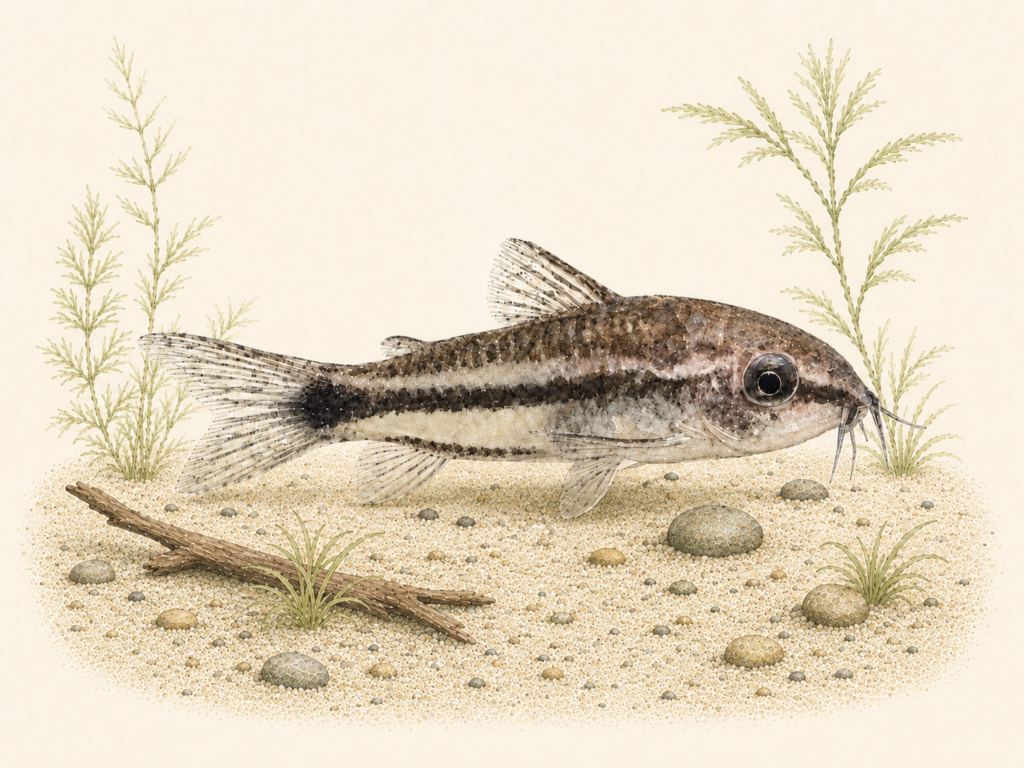
Quick summary
The Pygmy Corydoras is an easy-to-keep, peaceful nano fish ideal for planted tanks of 40 litres or more, but it must be kept in shoals of at least eight to ten to thrive and feel secure. It’s a great fit for beginners with soft, slightly acidic water and a fine sand substrate, though breeding them takes a bit more effort and care.
🐠 Build a tank around this species
In this guide:
- Introduction
- Quick Stats
- Appearance
- Varieties and Morphs
- Natural Habitat
- Tank Size and Setup
- Water Parameters
- Filtration and Equipment
- Diet and Feeding
- Behaviour and Temperament
- Tank Mates
- Breeding
- Common Diseases
- FAQs
Introduction
The Pygmy Corydoras (Corydoras pygmaeus) is one of the smallest members of the vast Corydoras genus and has earned a devoted following among nano-tank enthusiasts and aquascapers alike. Hailing from the slow-moving tributaries of the Madeira River basin in Brazil, this diminutive catfish rarely exceeds 2.5 centimetres in length, yet it packs an extraordinary amount of character into its tiny frame. Unlike many of its bottom-dwelling cousins, the Pygmy Corydoras spends a remarkable amount of time hovering in the mid-water column, forming shimmering shoals that dart and glide through planted aquariums with captivating coordination.
First described by Knaack in 1966, Corydoras pygmaeus quickly became a staple of the freshwater hobby owing to its peaceful disposition, hardiness relative to its size, and suitability for smaller aquariums. It is frequently confused with two other miniature Corydoras species, Corydoras habrosus and Corydoras hastatus, but each has distinct markings, body shapes, and behavioural tendencies that set them apart. The Pygmy Corydoras is distinguished by a prominent dark lateral stripe running from the snout to the caudal peduncle, a slimmer body profile, and its characteristic mid-water schooling behaviour.
Whether you are setting up your first nano community or looking to add a lively, sociable species to a well-planted layout, the Pygmy Corydoras is an outstanding choice. This guide covers everything you need to know about keeping, feeding, breeding, and troubleshooting common issues with this endearing little catfish.
Quick Stats
| Scientific name | Corydoras pygmaeus |
|---|---|
| Common names | Pygmy Catfish, Pygmy Cory, Albino Pygmy Corydoras |
| Family | Callichthyidae |
| Origin | Madeira River basin, Brazil |
| Adult size | 2.25 cm |
| Lifespan | 3–4 years |
| Difficulty | Easy |
| Breeding difficulty | Moderate |
| Temperature | 22–26 °C |
| pH | 6–7.5 |
| GH | 2–15 dGH |
| KH | 1–10 dKH |
| Minimum tank size | 40 L |
| Conservation status | Least Concern (IUCN, assessed 2020) |
Appearance
Corydoras pygmaeus possesses the classic Corydoras body plan, a compressed, somewhat torpedo-shaped profile with a flattened ventral surface and an arched dorsal line, but everything is scaled down to miniature proportions. Adults typically reach between 2 and 2.5 centimetres in total length, with females tending to be marginally larger and noticeably rounder when viewed from above, particularly when carrying eggs.
The base colouration is a silvery-grey to pale olive, overlaid with a bold, dark lateral stripe that extends from the tip of the snout, passes through the eye, and runs unbroken along the flanks to the base of the caudal fin. This stripe is the species’ most immediately recognisable feature and is bordered above and below by thin, lighter margins that give it a crisply defined look. A second, thinner dark line often runs along the ventral edge of the body, though this can be subtle depending on the individual and its condition. The fins are largely transparent with only the faintest hint of colour, and the caudal fin may display a small dark spot at its base.
Like all Corydoras, the Pygmy Cory has two rows of overlapping bony plates (scutes) instead of conventional scales, providing a degree of armour. It also sports a pair of short barbels on the upper jaw, which it uses to sift through fine substrate in search of food. The pectoral and dorsal fin spines are sharp and mildly venomous, a defence mechanism common across the family, so care should be taken when netting these fish to avoid snagging their spines in mesh.
Sexual dimorphism is relatively subtle. Females are generally broader and deeper-bodied than males, a difference that becomes especially pronounced when females are gravid. Males tend to be slimmer and very slightly smaller. When viewed from above, the contrast in body width between the sexes is usually the most reliable way to distinguish them.
Varieties and Morphs

While the wild-type Pygmy Corydoras remains by far the most commonly traded form, a small number of captive-bred variants have appeared in the hobby in recent years. The most notable of these is the Albino Pygmy Corydoras, which lacks the dark pigmentation of the wild type and instead displays a pale, creamy-white to golden body with pinkish-red eyes. This morph retains the same body shape and behaviour as the standard form but offers a strikingly different aesthetic. Albino Pygmy Corydoras are selectively bred in commercial aquaculture facilities, primarily in Southeast Asia, and are increasingly available through specialist retailers and online suppliers. They can be kept alongside wild-type Pygmy Corydoras without any compatibility issues, and the two forms will readily school together.
It is worth noting that the Albino Pygmy Corydoras is sometimes confused with albino forms of other small Corydoras species, particularly Corydoras hastatus. Buyers should verify the species identification carefully, as the behavioural and size differences between these species, though minor, do exist. Beyond the albino morph, no other widely established colour variants of Corydoras pygmaeus are currently available in the mainstream trade, though occasional reports of leucistic or unusually pale individuals surface from time to time. These should not be confused with distinct morphs and are more likely the result of natural genetic variation or stress-related pigment changes.
Natural Habitat
Corydoras pygmaeus is native to the Madeira River basin in Brazil, one of the major tributaries of the Amazon system. It inhabits slow-moving streams, tributaries, and flooded marginal zones where the water is typically soft, slightly acidic to neutral, and stained to varying degrees by tannins leaching from decomposing leaf litter and submerged wood. These environments are characterised by sandy or muddy substrates littered with fallen leaves, branches, and root tangles, all of which provide shelter and foraging opportunities for small fish.
In the wild, Pygmy Corydoras are found in large aggregations numbering in the hundreds or even thousands. They tend to occupy the lower and middle portions of the water column, moving between the substrate and open water far more frequently than larger Corydoras species, which are more strictly benthic. The surrounding vegetation is often dense, with overhanging riparian plants filtering the light and creating a dappled, shaded environment. Water flow is gentle, and temperatures in their native range typically sit between 22 and 26 degrees Celsius year-round, with pH values commonly falling between 6.0 and 7.0.
Understanding these natural conditions is key to replicating a comfortable environment in captivity. The species’ preference for soft, slightly acidic water, low to moderate flow, abundant cover, and the company of its own kind should inform every aspect of tank design and husbandry.
Tank Size and Setup
A minimum aquarium volume of 40 litres is recommended for a small group of Pygmy Corydoras, though a tank of 60 litres or more is preferable, particularly if you intend to keep them in a community setting or maintain a larger shoal. Because these fish are highly social and should always be kept in groups of at least eight to ten individuals, ideally more, the additional space afforded by a slightly larger tank allows for more natural behaviour, better water quality stability, and reduced stress.
Substrate choice is an important consideration. A fine sand substrate is ideal, as it allows the fish to exhibit their natural foraging behaviour without risk of damage to their delicate barbels. Coarse or sharp-edged gravels should be avoided entirely, as they can abrade the barbels and lead to bacterial infections. If you prefer a planted substrate that contains a nutrient-rich underlayer, capping it with a generous layer of fine sand will provide the best of both worlds.
The aquascape should include plenty of cover in the form of live plants, driftwood, and leaf litter. Dense plantings of species such as Java Fern, Anubias, Cryptocoryne, and various mosses provide shelter and help replicate the shaded conditions of the species’ natural habitat. Floating plants are particularly beneficial, as they diffuse overhead lighting and create the subdued environment in which Pygmy Corydoras feel most secure. Dried Indian almond leaves or oak leaves scattered across the substrate add a naturalistic touch and release beneficial tannins as they decompose, gently acidifying the water and providing a surface for biofilm growth that the fish will graze upon.
Open swimming space in the mid-water column is equally important. Unlike many larger Corydoras that spend almost all their time on the bottom, Pygmy Corydoras frequently hover and school in mid-water, so the tank should not be so densely planted that free swimming areas are eliminated. A layout that balances planted margins and hardscape features with an open central area works very well for this species.
Water Parameters
Pygmy Corydoras are reasonably adaptable within their preferred range, but they thrive best in stable, well-maintained water that reflects the soft, slightly acidic to neutral conditions of their native habitat. Consistency is more important than hitting a precise number, so aim to keep parameters within the ranges below and avoid sudden swings in temperature, pH, or hardness.
| Temperature | 22–26 °C |
| pH | 6.0–7.5 |
| General hardness (GH) | 2–15 dGH |
| Carbonate hardness (KH) | 1–10 dKH |
| Ammonia | 0 ppm |
| Nitrite | 0 ppm |
| Nitrate | Below 20 ppm |
Regular partial water changes of around 20–25 per cent weekly are essential for maintaining low nitrate levels and replenishing trace minerals. When performing water changes, match the temperature and chemistry of the replacement water as closely as possible to the tank water, as sudden shifts can stress these small fish and potentially trigger illness. Using a good-quality dechlorinator is, of course, non-negotiable. If your tap water is very hard or alkaline, blending it with reverse osmosis (RO) water or using a remineralisation product designed for soft-water species can help you achieve more suitable conditions.
Filtration and Equipment
Given their small size and preference for gentle water movement, Pygmy Corydoras are best served by a filter that provides efficient biological and mechanical filtration without creating excessive current. Sponge filters are an excellent choice, particularly in breeding setups, as they offer superb biological filtration, produce a very gentle flow, and pose no risk of trapping tiny fry. Air-driven sponge filters also provide beneficial surface agitation for gas exchange without creating the turbulent conditions that can exhaust small, lightweight fish.
Small hang-on-back filters and internal power filters can also work well, provided the flow rate is adjustable or can be baffled. If you notice your Pygmy Corydoras being pushed around by the current or clustering in dead spots behind hardscape, the flow is almost certainly too strong. Adding a pre-filter sponge over the intake is advisable regardless of filter type, as it prevents the fish, and especially any fry, from being sucked into the mechanism.
A reliable heater with a thermostat is necessary to maintain a stable temperature within the 22–26 °C range. In smaller tanks, a heater with a lower wattage rating (25–50 watts for a 40–60 litre tank) will provide more gradual, even heating. A thermometer placed at the opposite end of the tank from the heater allows you to verify that the temperature is consistent throughout the aquarium.
Lighting should be moderate. If you are growing live plants, choose a light that meets their needs but consider floating plants or tannin-stained water to reduce the intensity reaching the lower levels of the tank. Pygmy Corydoras are noticeably more active and confident under subdued lighting conditions. A standard day-night cycle of eight to ten hours of light per day is appropriate.
Diet and Feeding
In the wild, Pygmy Corydoras are omnivorous micro-predators and detritivores, feeding on tiny invertebrates, insect larvae, biofilm, and organic detritus found on the substrate and among leaf litter. In captivity, they accept a wide variety of foods, but their small mouth size means that all offerings must be appropriately sized.
A high-quality micro-pellet or crushed flake food can form the staple of their diet. Look for products specifically formulated for small bottom-dwelling fish or nano species, as these tend to sink readily and are sized appropriately. Supplement this base diet regularly with small frozen or live foods such as baby brine shrimp (Artemia nauplii), micro-worms, grindal worms, daphnia, and cyclops. These protein-rich foods are enthusiastically accepted and play an important role in conditioning the fish for breeding and maintaining overall vitality.
Feeding should be carried out once or twice daily in small quantities. Pygmy Corydoras have small stomachs and cannot consume large amounts in a single sitting, so it is far better to offer modest portions that are eaten within a few minutes than to dump in a large feed that fouls the water. Because these fish mid-water feed as well as forage on the substrate, a combination of sinking foods and foods that disperse through the water column works best. Avoid relying solely on algae wafers or large sinking tablets designed for bigger catfish, as Pygmy Corydoras will struggle to break these apart.
Biofilm that naturally develops on driftwood, leaves, and plant surfaces provides an important supplementary food source, particularly for fry and juveniles. Maintaining a mature tank with leaf litter and well-established hardscape surfaces will ensure a steady supply of this natural grazing material.
Behaviour and Temperament
The Pygmy Corydoras is one of the most endearing freshwater fish to observe. Peaceful, inquisitive, and irrepressibly social, it spends its day alternating between bouts of energetic mid-water schooling and brief forays to the substrate to sift through the sand for morsels of food. This dual-zone behaviour, mid-water hovering combined with bottom foraging, sets it apart from most other Corydoras species and is one of its most charming characteristics.
Schooling is central to this species’ wellbeing. In groups of fewer than six, Pygmy Corydoras often become shy, reclusive, and stressed, spending most of their time hiding among plants or behind hardscape. In groups of ten or more, however, they transform into bold, confident little fish that spend much of the day out in the open, moving as a cohesive shoal that rises and falls through the water column in beautiful synchrony. The larger the group, the more natural and impressive the behaviour becomes, so keeping fifteen to twenty or more in a suitably sized tank is highly rewarding.
Like all Corydoras, the Pygmy Cory is an obligate air breather. You will regularly observe individuals darting to the surface to gulp a bubble of atmospheric air, which is then absorbed through the highly vascularised wall of the hindgut. This behaviour is entirely normal and should not be mistaken for a sign of oxygen deprivation, although excessively frequent surface trips in the entire group may indicate poor water quality or insufficient dissolved oxygen levels.
Aggression is essentially non-existent in this species. Pygmy Corydoras are wholly peaceful towards all tank mates and pose no threat to even the smallest invertebrates. Their primary defence mechanisms are their bony scute armour and mildly venomous fin spines, which deter would-be predators. They are, however, vulnerable to predation themselves due to their tiny size, so tank mate selection must take this into account.
Tank Mates
Choosing appropriate companions for Pygmy Corydoras requires careful consideration of size, temperament, and activity level. Any fish large enough to fit a Pygmy Cory in its mouth should be considered a predator, and overly boisterous or aggressive species can stress these diminutive catfish into hiding permanently. The ideal tank mates are small, peaceful species that occupy similar or complementary zones in the water column and thrive under the same water parameters. Dwarf shrimp and small snails also make excellent companions and will not compete for food or territory.
Good tank mates
- Ember Tetra, a tiny, peaceful tetra that shares the same preference for soft, warm water and makes a visually stunning companion.
- Chili Rasbora, another nano species with a gentle temperament and overlapping water parameter requirements.
- Celestial Pearl Danio, a calm micro-fish that occupies the mid to upper water column, leaving the lower levels to the Corydoras.
- Green Neon Tetra, a soft-water species that schools peacefully alongside Pygmy Corydoras without competing for space.
- Otocinclus, a small, algae-eating catfish that is entirely non-aggressive and shares similar environmental preferences.
- Cherry Shrimp, Hardy dwarf shrimp that coexist perfectly with Pygmy Corydoras, adding colour and a useful clean-up presence.
- Amano Shrimp, Peaceful and industrious algae eaters that are too large to be bothered by the Corydoras and vice versa.
- Sparkling Gourami, a small, quiet labyrinth fish well-suited to the calm, planted setups that Pygmy Corydoras enjoy.
- Nerite Snail, Excellent algae-grazing snails that pose absolutely no threat and help maintain a clean tank.
- Harlequin Rasbora, a gentle, modestly sized schooling fish compatible in both temperament and water chemistry.
Fish to avoid
- Angelfish, Large enough to prey on adult Pygmy Corydoras and far too imposing for a nano setup.
- Oscar, a large, predatory cichlid that would view Pygmy Corydoras as food.
- Tiger Barb, an active, nippy species whose boisterous nature would stress and harass these tiny catfish.
- Convict Cichlid, Territorial and aggressive, especially when breeding, and entirely incompatible with small, peaceful species.
- Betta, while some individual Bettas are tolerant, many are too aggressive or territorial for reliable cohabitation with fish this small.
- African Leaf Fish, a stealthy ambush predator perfectly capable of consuming Pygmy Corydoras whole.
- Red Tail Shark, Territorial and assertive, this species will dominate the bottom of the tank and intimidate small catfish.
- Dwarf Pea Puffer, despite its small size, this species is a fin-nipper with a confrontational personality that can injure Pygmy Corydoras.
Breeding
Breeding Pygmy Corydoras in captivity is an achievable and rewarding endeavour, though it requires a little more attention to detail than keeping them alone. With a well-conditioned group, appropriate water conditions, and a bit of patience, spawning events can become a regular occurrence.
Begin by establishing a group of at least eight to twelve healthy adults in a mature, well-planted tank. Sex the fish by observing body shape from above, females are noticeably wider and deeper-bodied than males. A ratio of roughly two males to every female tends to produce the best results. Condition the group with frequent feedings of high-quality live and frozen foods such as baby brine shrimp, micro-worms, and daphnia for two to three weeks prior to attempting to trigger spawning.
Spawning is most reliably induced by simulating the onset of the rainy season, which in practice means performing a large, cool water change of around 30–50 per cent using water that is two to three degrees cooler than the tank temperature. A slight drop in barometric pressure can also coincide with spawning activity, and many breeders report success after performing cool water changes on overcast or rainy days. Lowering the water hardness slightly and increasing aeration can further encourage breeding behaviour.
When ready to spawn, the female will become visibly plumper with eggs, and males will begin to actively pursue her, nudging her flanks. The classic Corydoras T-position mating posture is adopted, in which the female clasps the male’s ventral area between her pectoral fins while he releases sperm. She then deposits a small number of adhesive eggs, typically one to four at a time, on plant leaves, aquarium glass, or hardscape surfaces. The total clutch size is usually between 30 and 50 eggs per spawning event, though this varies with the female’s size and condition.
The eggs are small, round, and translucent to pale white. They hatch in approximately three to five days at 24–25 °C. Neither parent provides any care after spawning, and in a community tank the eggs and fry are vulnerable to predation, including from the parents themselves. If you wish to maximise fry survival, carefully remove the eggs to a separate rearing container with matching water parameters and gentle aeration. Adding a few drops of methylene blue to the rearing water can help prevent fungal growth on unfertilised or damaged eggs.
The newly hatched fry are extremely tiny and will initially subsist on their yolk sacs for the first one to two days. Once free-swimming, they should be offered infusoria, powdered fry food, or commercially available liquid fry feeds. Within a week, they will be large enough to accept freshly hatched baby brine shrimp and micro-worms. Growth is steady but slow, and it typically takes around three to four months for the fry to reach a size where they can be safely reintroduced to the main tank.
Common Diseases
Pygmy Corydoras are generally hardy fish when maintained in clean, stable conditions, but their small size means that illness can progress rapidly if not caught early. Prevention through good husbandry, regular water changes, appropriate stocking levels, a varied diet, and careful quarantine of new additions, is always preferable to treatment.
Ich (white spot disease) is one of the most frequently encountered ailments and presents as small white cysts on the body and fins. It is typically triggered by temperature fluctuations or the introduction of infected fish. Treatment involves gradually raising the water temperature to 28–30 °C and, if necessary, adding a half-dose of a malachite green or formalin-based medication. Corydoras are sensitive to many common aquarium medications, particularly those containing copper or potassium permanganate, so always use treatments at reduced dosages and follow product instructions for scaleless or sensitive species carefully.
Barbel erosion is another common issue, usually caused by keeping these fish on rough or dirty substrates. Damaged barbels can become infected with bacteria, leading to redness, swelling, and progressive deterioration. Ensuring a fine sand substrate and maintaining excellent water quality are the best preventive measures. If infection occurs, improving water conditions and treating with a broad-spectrum antibacterial medication formulated for sensitive species is normally effective.
Columnar is disease (caused by Flavobacterium columnare) can affect stressed or immunocompromised Pygmy Corydoras, manifesting as white or greyish patches on the body, frayed fins, and lethargy. This bacterial infection requires prompt treatment with antibiotics or antimicrobial agents appropriate for Corydoras. Internal parasites, while less common in captive-bred stock, can occasionally cause weight loss and lethargy in wild-caught specimens. A quarantine period of at least two weeks for all new fish, with prophylactic anti-parasitic treatment if indicated, is strongly recommended.
Stress is arguably the single biggest predisposing factor for disease in this species. Keeping Pygmy Corydoras in groups that are too small, exposing them to aggressive tank mates, maintaining them in unsuitable water conditions, or subjecting them to sudden environmental changes will all compromise their immune system and leave them vulnerable to opportunistic infections.
FAQs
How many Pygmy Corydoras should I keep together?
Pygmy Corydoras are obligate shoaling fish and should be kept in groups of at least eight to ten, with larger groups of fifteen or more being highly recommended. In small numbers, they become stressed, reclusive, and prone to illness. In a properly sized group, they display their full repertoire of natural behaviours, including their characteristic mid-water schooling, and are noticeably bolder, healthier, and more active.
What is the difference between Corydoras pygmaeus, Corydoras habrosus, and Corydoras hastatus?
These three species are often collectively referred to as the “dwarf Corydoras” and are frequently confused with one another. Corydoras pygmaeus has a prominent dark lateral stripe and a slender body, and it spends much of its time in mid-water. Corydoras habrosus (the Salt and Pepper Cory) is slightly stockier with a mottled, blotched pattern and tends to stay closer to the substrate. Corydoras hastatus has a conspicuous dark spot at the base of the caudal fin and schools in mid-water even more persistently than pygmaeus. Each has its own appeal, and all three can be kept in similar conditions.
Can Pygmy Corydoras live in a tank without sand?
While they can technically survive on smooth, rounded gravel, a fine sand substrate is strongly recommended. Sand allows them to forage naturally by sifting material through their gills and protects their sensitive barbels from abrasion. Sharp or coarse substrates can damage the barbels, leading to bacterial infections and reduced feeding ability. If sand is not feasible for your setup, at the very least ensure the substrate is extremely smooth and kept scrupulously clean.
Do Pygmy Corydoras eat algae?
Pygmy Corydoras are not true algae eaters. While they will graze on biofilm, a thin layer of microorganisms, bacteria, and organic matter that develops on surfaces, they do not consume significant quantities of filamentous or encrusting algae. They should not be purchased as a solution to algae problems. Their diet should be based on high-quality micro-pellets, crushed flakes, and protein-rich live or frozen foods such as baby brine shrimp and micro-worms.
Are Pygmy Corydoras suitable for a planted nano tank?
Absolutely. Pygmy Corydoras are among the best fish for planted nano aquariums of 40 litres and above. They do not uproot plants, they appreciate the cover and subdued lighting that dense planting provides, and their tiny bioload makes them an excellent fit for smaller volumes. They also add a dynamic element to the mid-water zone that many other nano species cannot match. Just be sure to maintain the group size at a minimum of eight to ten and keep up with regular maintenance to preserve water quality.
Related Guides
- Corydoras habrosus Care Guide, a closely related dwarf Corydoras species with a mottled pattern and a more substrate-oriented lifestyle.
- Corydoras hastatus Care Guide, the third member of the dwarf Corydoras trio, known for its distinctive tail spot and persistent mid-water schooling.
- Bronze Corydoras Care Guide, a larger, hardy Corydoras species that makes an excellent introduction to the genus for beginners.
- Ember Tetra Care Guide, one of the best nano tank companions for Pygmy Corydoras, sharing similar water requirements and a peaceful nature.
- Nano Tank Setup Guide, a comprehensive guide to planning, equipping, and stocking freshwater nano aquariums for species like the Pygmy Corydoras.
- Otocinclus Care Guide, another small, peaceful catfish that pairs well with Pygmy Corydoras in planted community setups.