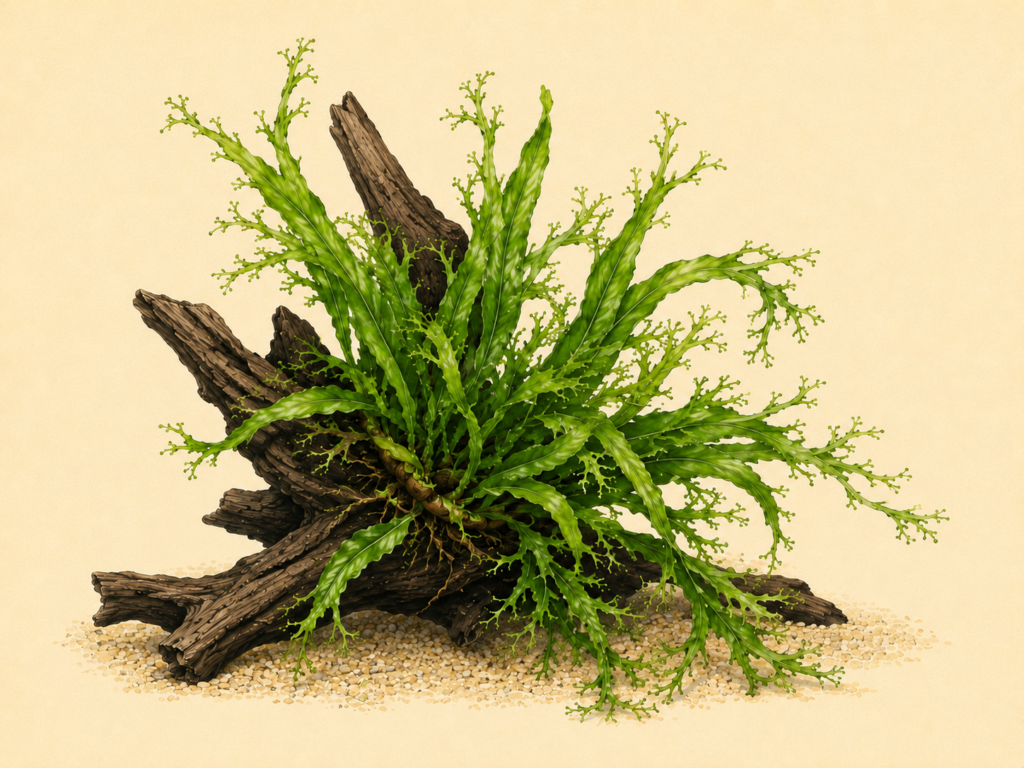
Quick Summary
Java Fern Windelov is an easy, slow-growing epiphytic fern that thrives in low to moderate light without CO2 injection, making it an excellent choice for beginners and low-tech setups alike. It is not suitable for ponds but adapts to a wide range of freshwater aquarium conditions.
In this guide:
- Quick Stats
- Appearance
- Growth Form and Feeding
- Growing Conditions
- Planting and Placement
- Propagation
- Common Problems
Introduction
Java Fern Windelov is one of the most distinctive and beginner-friendly aquarium plants available in the freshwater hobby. A named cultivar of the standard Java Fern, it is immediately recognisable by its beautifully branching, frilly leaf tips that give it a delicate, almost lace-like appearance quite unlike the plain, lance-shaped leaves of the original species. It is an excellent choice for aquarists of all experience levels, thriving in a remarkably wide range of water conditions and requiring very little specialist care.
The current accepted scientific name for this plant is Leptochilus pteropus ‘Windelov’, following a formal reclassification of the genus. However, hobbyists and retailers overwhelmingly continue to use the older synonym Microsorum pteropus ‘Windelov’, and you will encounter this name far more frequently on shop labels, online listings, and in older aquarium literature. Both names refer to exactly the same plant, so do not be confused if you see either used – they are interchangeable in practice, though Leptochilus pteropus is the taxonomically current designation.
The cultivar name ‘Windelov’ honours Tropica founder Holger Windelov, and the plant was originally selected and propagated by the renowned Danish aquatic plant nursery. It has since become one of the most popular epiphytic ferns in the planted aquarium hobby worldwide, prized for its hardiness, its tolerance of low-light conditions, and its unique ornamental leaf structure. Like all Java Fern varieties, it is a rhizome plant that attaches itself to hardscape rather than rooting into substrate, making it exceptionally versatile in aquascaping.
Quick Stats
| Scientific name | Leptochilus pteropus 'Windelov' |
|---|---|
| Common names | Java Fern Windelov, Windelov Fern, Lace Java Fern |
| Family | Polypodiaceae |
| Origin | Southeast Asia (cultivar; parent species native to Thailand, Malaysia, Indonesia, the Philippines, and surrounding regions) |
| Placement | Midground / Background |
| Growth form | Rhizome / Fern |
| Growth rate | Slow |
| Ease of growth | Easy |
| Height | 15–30 cm |
| Width | 12–20 cm |
| Propagation method | Rhizome division, adventitious plantlets on leaves |
| Feeding method | Water column feeder |
| Pond suitable | No |
| Available as | Potted, Invitro, Attached to wood/rock |
Appearance
Java Fern Windelov’s most striking feature is its elaborately forked and branching leaf tips. Each mature leaf terminates in a cluster of fine, finger-like divisions that fan outward, creating a frilly, almost antler-like silhouette. This is in stark contrast to the standard Java Fern, whose leaves come to a single, smooth, pointed tip. The branching structure gives the Windelov cultivar a significantly more textured and ornamental look, and a mature specimen with multiple leaves creates a wonderfully dense, intricate display.
The leaves themselves are leathery in texture, with a slightly rough surface and a prominent midrib running their length. They emerge from a thick, creeping rhizome – a horizontal, root-like stem that serves as the plant’s central growing structure. Thin, wiry, dark brown roots extend from the underside of the rhizome and are used to anchor the plant to surfaces rather than to absorb nutrients from substrate. These roots will cling tenaciously to driftwood, rock, and other hardscape over time.
Leaf colour is typically a rich, medium green, though this can vary noticeably depending on lighting conditions. Under low light, the leaves tend to be a deeper, darker green. Under moderate to high light, the foliage takes on a brighter, more vivid green tone, and new growth may appear slightly lighter before darkening with maturity. These variations in colour intensity are a completely natural response to light levels and are not a sign of ill health, nor do they indicate a different variety. The plant will simply adjust its pigmentation to optimise photosynthesis under prevailing conditions.
Young leaves unfurl from the tip of the rhizome and are initially narrow and pale, gradually broadening and developing their characteristic forked tips as they mature. It is worth noting that very young or juvenile leaves may not yet show pronounced branching at the tips – this becomes more defined as the leaf reaches full size. In a healthy, established specimen, the overall impression is of an elegant, bushy cluster of finely divided foliage, quite unlike most other aquatic plants.
One feature that commonly causes alarm among new keepers is the appearance of small dark brown or black bumps on the undersides or tips of mature leaves. These are not a disease. They are adventitious plantlets – tiny baby plants forming directly on the parent leaf, complete with their own miniature leaves and roots. This is the plant’s primary natural method of reproduction and is a sign of a healthy, mature specimen. The bumps may initially look like spots of decay or a fungal infection, but close inspection will reveal the beginnings of tiny fronds and root threads emerging from each one.
Growth Form and Feeding
Java Fern Windelov is an epiphytic fern, meaning it naturally grows attached to surfaces such as rocks, driftwood, and tree roots rather than rooted into soil or sediment. In the aquarium, it is grown in the same manner – attached to hardscape elements using cotton thread, fishing line, or cyanoacrylate super glue until its own roots grip the surface firmly enough to hold the plant in place. This makes it extremely versatile for aquascaping, as it can be positioned at virtually any height or angle within the tank.
The rhizome must never be buried in substrate. This is the single most critical care rule for all Java Fern varieties, including the Windelov cultivar. The rhizome is the thick, horizontal stem from which both leaves and roots emerge. If it is covered by gravel, sand, or soil, it will be deprived of water flow and will begin to rot, eventually killing the plant. The roots can extend into substrate without issue – it is specifically the rhizome itself that must remain exposed and in contact with the water column.
As a water column feeder, Java Fern Windelov absorbs nutrients primarily through its leaves rather than through its root system. The roots serve almost exclusively as anchoring structures. This means the plant does not require a nutrient-rich substrate at all, and will grow perfectly well on bare wood or stone in a tank with an inert gravel or sand bottom. Regular dosing of a liquid all-in-one fertiliser is the best way to ensure the plant receives sufficient micronutrients and macronutrients. Because it feeds through its foliage, good water circulation around the plant is beneficial to ensure nutrient-rich water reaches all leaf surfaces.
This feeding method also makes Java Fern Windelov an ideal companion for tanks where substrate choice is dictated by other inhabitants – for example, tanks with sand-sifting fish, or setups using large-grain gravel that would be unsuitable for root-feeding plants. The plant is genuinely indifferent to what lies on the tank floor.
Varieties
Java Fern Windelov is itself a cultivar – a named variety selected for its distinctive leaf tips – within the broader Java Fern species. Understanding where it sits among the other well-known Java Fern varieties helps clarify what makes it special and avoids confusion when shopping.
The standard Java Fern (Leptochilus pteropus, often sold simply as “Java Fern”) has broad, lance-shaped leaves that taper to a single, smooth point. It is the most commonly available form and can grow considerably larger than the Windelov cultivar, with individual leaves sometimes exceeding 30 cm in length. Its care requirements are identical to the Windelov variety, but its visual character is quite different – bold and structural rather than fine and textured.
Java Fern ‘Narrow Leaf’ (Leptochilus pteropus ‘Narrow’) features much thinner, more elongated leaves that give it a grassy, flowing appearance, particularly in current. The leaves are typically narrower than even the individual frond segments of the Windelov form. It creates a very different visual effect – wispy and linear rather than bushy and branching.
Java Fern ‘Trident’ (Leptochilus pteropus ‘Trident’) has leaves that fork into several narrow, prong-like lobes, somewhat reminiscent of a trident or Neptune’s fork. It is sometimes confused with the Windelov variety, but the distinction is clear on close inspection: Trident leaves split into a relatively small number of long, defined lobes running much of the leaf’s length, while Windelov leaves branch only at the very tips into a dense cluster of much shorter, finer divisions.
Java Fern ‘Petite’ or ‘Mini’ is a dwarf form that stays significantly smaller than all the above, rarely exceeding 10 cm in height. Its leaves are miniaturised versions of the standard form’s shape. It is sometimes used as a foreground or lower midground plant, unlike the larger varieties.
All of these varieties share the same fundamental care requirements: epiphytic attachment to hardscape, water column feeding, no burial of the rhizome, and tolerance of low light. They differ primarily in leaf shape, size, and visual effect, making them complementary choices within the same aquascape.
Natural Habitat
The parent species of Java Fern Windelov is native to tropical Southeast Asia, where it is found across a broad geographical range including Thailand, Malaysia, Indonesia, the Philippines, southern China, and parts of India. It grows naturally along the margins of rivers and streams, typically attached to rocks, boulders, submerged tree roots, and fallen logs in areas with moderate to strong water flow.
In its native habitats, Java Fern often grows in partially shaded conditions beneath the forest canopy, receiving dappled or indirect light filtered through overhanging vegetation. It is frequently found in areas that experience seasonal water level fluctuations, meaning it may grow submerged for part of the year and emersed (above the waterline) during drier periods. This adaptability to both submerged and emersed growth partly explains the plant’s remarkable tolerance of varied conditions in the aquarium.
The waters in which wild Java Fern populations thrive are typically soft to moderately hard, slightly acidic to neutral in pH, and warm. However, the species has been documented across such a wide range of habitats – from slow-moving lowland streams to faster-flowing rocky rivers – that it encounters significant variation in water chemistry naturally. This broad ecological tolerance translates directly into its performance in aquaria, where it adapts readily to most freshwater conditions.
It is worth noting that the ‘Windelov’ cultivar itself is not a wild-collected form. It was developed in cultivation, selected for its distinctive forked leaf tips, and propagated commercially. You would not find this exact leaf form growing wild in Southeast Asian waterways. However, its care requirements and ecological tolerances are inherited directly from the parent species.
Growing Conditions
| CO2 requirement | Not required |
| Lighting | Low / Medium (0.25 – 0.5 W/L approx.) |
| Substrate | Inert substrate with root tabs OK (substrate type is largely irrelevant as this plant attaches to hardscape) |
| Temperature | 20 – 28 °C |
| pH | 5.5 – 8.0 |
| General hardness (GH) | 3 – 15 dGH |
| Carbonate hardness (KH) | 2 – 12 dKH |
| Fertiliser needs | A regular liquid all-in-one fertiliser providing micronutrients (especially iron and manganese) supports healthy leaf colour and growth. Potassium supplementation is beneficial, as deficiency can cause pinhole deterioration in leaves. Nitrate and phosphate at standard planted tank levels (10 – 25 mg/L NO3, 1 – 2 mg/L PO4) are sufficient. High-dose fertilisation is unnecessary and will not significantly accelerate growth due to the plant’s inherently slow metabolism. |
Java Fern Windelov is genuinely one of the most undemanding aquarium plants regarding growing conditions. It performs well under low light, does not require CO2 injection, and tolerates an exceptionally wide range of water chemistry. This makes it suitable for virtually any tropical freshwater setup, from bare-bones community tanks to heavily planted aquascapes.
While CO2 injection is not required, providing it at moderate levels will improve the growth rate noticeably – though “improved growth rate” for Java Fern still means slow compared to most stem plants. Similarly, moderate lighting will produce slightly faster, more compact growth and better leaf colour than very low light, but the plant will survive and grow under minimal illumination. Very high light should be used with some caution, as it can encourage algae growth on the plant’s slow-growing leaves before the fern can outcompete it. If running high light, CO2 injection becomes more important to maintain the balance between light intensity and the plant’s growth capacity.
Planting and Placement
Because Java Fern Windelov is an epiphyte, “planting” it is quite different from the process for most aquarium plants. Do not bury the rhizome in the substrate. Instead, attach the plant to a piece of driftwood, a rock, or another hardscape element. There are several effective methods for doing this.
Cotton thread or dark-coloured sewing thread can be wrapped around the rhizome and the hardscape to hold the plant in place. Within a few weeks, the plant’s roots will begin to grip the surface, and the thread will eventually rot away naturally, leaving the plant self-attached. Fishing line (monofilament) works in the same way but does not degrade, so it may need to be cut away later once the plant is anchored – or simply left in place, as it becomes invisible once overgrown.
Cyanoacrylate super glue (the gel variety is easiest to use) is another popular method. Apply a small dab of gel super glue to the rhizome or to the hardscape surface, press the plant into position, and hold briefly. The glue cures almost instantly on contact with water and is aquarium-safe once set. This is often the quickest and most precise method, particularly for positioning smaller pieces or for placing the plant in awkward spots.
If you purchase the plant already attached to wood or rock, you can simply place the entire assembly into your tank – no further attachment work is necessary.
In terms of placement, Java Fern Windelov works best in the midground or background of the aquascape, depending on tank size. In smaller aquaria (under 60 litres), a mature specimen may fill a significant portion of the tank and is best positioned towards the rear or sides. In larger setups, it works beautifully as a midground focal point, particularly when attached to a prominent piece of driftwood. Multiple small pieces can be attached at intervals along a branching piece of wood to create a very natural, established look.
The plant’s frilly leaf tips create a wonderful softening effect against angular hardscape, and it pairs particularly well with dark-coloured lava rock and weathered driftwood. Consider placing it where gentle water flow will move the leaves slightly, as this both aids nutrient uptake and creates an attractive, naturalistic motion in the tank.
Growth Rate and Trimming
Java Fern Windelov is a slow-growing plant. New leaves emerge from the growing tip of the rhizome at a rate of perhaps one to two per month under typical conditions, and each leaf takes several weeks to reach its full size and develop its characteristic forked tips. This slow growth is entirely normal for the species and should not be taken as a sign of a problem. Even with CO2 injection and good fertilisation, this is not a plant that will fill a tank quickly.
The slow growth rate has both advantages and disadvantages. On the positive side, the plant requires very little trimming and maintenance once established. You will not need to perform weekly pruning sessions as you might with fast-growing stem plants. On the negative side, the slow leaf turnover means that algae can sometimes establish itself on older leaves before they are naturally replaced, particularly in tanks with high light or excess nutrients.
Trimming is straightforward. Remove any individual leaves that have become damaged, heavily algae-covered, or that are turning brown and deteriorating. Cut or carefully pull the leaf away from the rhizome as close to the base as possible. If the rhizome itself has grown longer than desired, it can be divided (see Propagation below). There is no need to trim the roots, even if they appear long and unruly – they are not harming anything and will eventually attach to nearby surfaces.
Old, mature leaves will naturally develop dark spots and bumps as adventitious plantlets begin to form. Do not trim these leaves prematurely unless they are in poor condition, as the plantlets need time to develop their own leaves and roots before being separated. Once a plantlet has produced several small leaves of its own and visible root threads (typically 3 – 5 cm in size), it can be gently detached and attached elsewhere, or allowed to break free naturally.
Propagation
Java Fern Windelov propagates readily through two main methods, both of which occur naturally without intervention from the aquarist.
The most common method is through adventitious plantlets. As mentioned, mature leaves develop small dark bumps or spots – typically on the leaf tips or undersides – from which tiny new plants grow. Each plantlet develops its own miniature leaves and roots while still attached to the parent leaf. Once a plantlet has grown to around 3 – 5 cm and has several leaves and visible roots, it can be carefully separated from the parent leaf and attached to a new piece of hardscape. Alternatively, you can simply leave the plantlets to develop until they detach naturally, at which point they may float freely until they find a surface to anchor onto, or they can be collected and placed where you wish.
Some aquarists accelerate this process by leaving old, deteriorating leaves floating in the tank rather than discarding them, as the decaying leaf tissue often stimulates plantlet development. This works well but can look untidy.
The second method is rhizome division. If the rhizome has grown long enough to have multiple growing points or clusters of leaves, it can be cut into sections using a sharp, clean blade. Each section should ideally have at least three to four healthy leaves and a portion of rhizome at least 3 cm long. The separated sections can then be attached to hardscape as you would a new plant. Both pieces will continue to grow independently. This is the faster way to create multiple established-looking plants from a single large specimen.
Java Fern Windelov cannot be meaningfully propagated from leaf cuttings alone (without a portion of rhizome), nor from root cuttings. The rhizome or the natural plantlet mechanism are the only viable propagation routes.
Common Problems
Melting: One of the most frequently reported issues with Java Fern Windelov, particularly in newly purchased plants, is “melting” – a process where existing leaves turn brown, become translucent, and disintegrate over a period of days to weeks. This looks alarming and is often interpreted as plant death, but it is usually a normal adjustment response. Plants grown emersed (above water) in nurseries – which is standard commercial practice, particularly for potted and tissue culture specimens – develop leaves adapted to aerial conditions. When submerged in your aquarium, these emersed-grown leaves are no longer optimal, and the plant sheds them while growing new, truly submersed foliage adapted to underwater life. Similarly, plants transferred from one tank to another with significantly different water chemistry or lighting may shed old leaves as they acclimatise. As long as the rhizome remains firm and green (not mushy or black), the plant is alive and will recover. Be patient, maintain stable conditions, and new growth should emerge from the rhizome tip within a few weeks. Remove melting leaves as they decay to prevent them fouling the water.
Rhizome rot: If the rhizome itself turns soft, mushy, and dark brown or black, this is a genuine and often fatal problem. The most common cause is burying the rhizome in substrate, which restricts water flow and promotes anaerobic decay. It can also be caused by physical damage or poor water quality. If only part of the rhizome is affected, you may be able to save the plant by cutting away the rotted section with a clean blade and reattaching the healthy remainder. Ensure the rhizome is fully exposed to water flow going forward.
Algae on leaves: Because Java Fern Windelov grows slowly, its leaves are vulnerable to algae colonisation, particularly green spot algae, black beard algae (BBA), and staghorn algae. This is most problematic in tanks with high lighting relative to nutrient levels and CO2, or in tanks with poor maintenance. Reducing the lighting period, ensuring balanced fertilisation, improving CO2 if available, and introducing algae-eating tank mates can all help. Badly affected leaves can be removed entirely.
Brown or transparent leaves: Beyond initial melting, ongoing leaf deterioration can indicate genuine nutrient deficiency. Potassium deficiency often manifests as small pinholes that gradually enlarge and cause leaves to look tattered. Iron deficiency can cause new leaves to grow pale or yellowish rather than green. Address these with appropriate liquid fertiliser dosing.
Black spots mistaken for disease: As discussed in the Appearance section, dark bumps on mature leaves are almost always adventitious plantlets forming, not disease. Inspect them closely – if you can see tiny leaf or root structures emerging, they are baby plants. True disease in Java Fern is uncommon; bacterial or fungal issues are rare and usually only occur in tanks with very poor water quality.
Very slow or no growth: While Java Fern Windelov is inherently slow, a complete absence of new leaves over several months may indicate insufficient nutrients in the water column, extremely low light, or temperatures outside the preferred range. Check and adjust conditions accordingly, bearing in mind that even under ideal conditions, growth is measured in weeks and months, not days.
Tank Mates
Java Fern Windelov is compatible with the vast majority of freshwater community fish and invertebrates. Its tough, leathery leaves are unpalatable to most herbivorous and omnivorous fish, giving it a significant advantage over softer-leaved plants in tanks with plant-nibblers. The intricate, branching leaf tips provide excellent shelter for fry and small shrimp, making it a particularly valuable plant in breeding setups and shrimp tanks. Because it is attached to hardscape rather than rooted in substrate, it is also resistant to disruption by bottom-dwelling fish that like to dig.
Good tank mates
- Neon Tetra – Peaceful, small schooling fish that will not damage the plant and benefit from the shelter its leaves provide.
- Cherry Shrimp – Thrive among the intricate leaf tips, grazing biofilm and algae from leaf surfaces, which benefits both shrimp and plant.
- Amano Shrimp – Excellent algae eaters that help keep Java Fern leaves clean without causing any damage to the plant.
- Corydoras Catfish – Peaceful bottom dwellers that ignore the plant entirely and pose no risk of uprooting since the fern is attached to hardscape.
- Otocinclus – Gentle algae grazers that will clean leaf surfaces without damaging the plant tissue.
- Betta Fish – The broad, textured leaves provide resting spots, and bettas will not eat or harm the plant.
- Kuhli Loach – Peaceful and nocturnal, these loaches enjoy hiding among the rhizome and root structures.
- Harlequin Rasbora – Calm schooling fish that complement the plant visually and behaviourally.
Fish and inverts to avoid
- Common Goldfish – While they may not eat Java Fern’s tough leaves readily, their large size, messy feeding habits, and preference for cooler water make them a poor match.
- Silver Dollar – A highly herbivorous species that will persistently attempt to eat virtually any plant, including tough-leaved varieties.
- Buenos Aires Tetra – Known for being destructive to plants, these tetras will damage even tough-leaved species over time.
- Common Pleco – Large plecos can physically damage or dislodge plants from hardscape with their bulk and rasping feeding behaviour.
- Texas Cichlid – Aggressive diggers and plant destroyers that will uproot or tear apart aquarium plants, including dislodging epiphytes from hardscape.
FAQs
Can I plant Java Fern Windelov in the substrate?
No. The rhizome – the thick horizontal stem from which the leaves and roots grow – must remain above the substrate and exposed to water flow. Burying it will cause rot and kill the plant. You can, however, wedge the plant between rocks or into crevices in hardscape, provided the rhizome is not smothered. The roots themselves can extend into substrate without harm; it is specifically the rhizome that must stay uncovered.
What are the black spots on my Java Fern Windelov’s leaves?
In the vast majority of cases, small dark brown or black bumps on the leaves of a mature Java Fern Windelov are adventitious plantlets – baby plants forming naturally on the parent leaf. If you look closely, you should be able to see tiny leaf and root structures beginning to emerge. This is not a disease and is a sign of a healthy, mature plant reproducing naturally. Simply leave them to develop, or gently detach them once they have grown to around 3 – 5 cm and reattach them elsewhere in your tank.
Why are the leaves on my new Java Fern Windelov turning brown and dissolving?
This is most likely melting, a common and usually temporary process where the plant sheds its old leaves – typically those grown in emersed (above water) conditions at the nursery – while adjusting to fully submerged life in your aquarium. As long as the rhizome is still firm and green, the plant should recover and produce new submerged-adapted growth. Remove decaying leaves to keep the tank clean, be patient, and avoid making drastic changes to water conditions while the plant is acclimatising.
Does Java Fern Windelov need CO2 injection?
No. Java Fern Windelov grows perfectly well without supplemental CO2. It is one of the most commonly recommended plants for low-tech, non-CO2 setups. Adding CO2 will modestly increase its growth rate and may improve overall leaf health and colour, but it is far from necessary. The plant’s naturally slow growth means even without CO2, it will develop into a healthy, attractive specimen given enough time.
How long does it take for Java Fern Windelov to attach to driftwood?
Under normal conditions, the plant’s roots will begin gripping the surface of driftwood or rock within three to six weeks of being tied or glued in place. A truly firm, self-sustaining attachment typically develops over two to three months. The speed depends on the plant’s health, light levels, nutrient availability, and the texture of the surface – rough, porous surfaces like lava rock allow faster attachment than very smooth stone. Once firmly attached, the plant is remarkably secure and will not easily detach.
Related Guides
- Java Fern (Standard) – The parent species of the Windelov cultivar, sharing identical care requirements but with plain, lance-shaped leaves.
- Java Fern ‘Trident’ – Another popular Java Fern cultivar with forked leaves, offering a different but complementary visual effect to the Windelov variety.
- Anubias Nana – Another hardy, slow-growing epiphytic plant that pairs exceptionally well with Java Fern Windelov in low-tech setups.
- Java Moss – A beginner-friendly moss that complements Java Fern on hardscape, filling in gaps and softening the base of driftwood arrangements.
- Bolbitis Heudelotii (African Water Fern) – Another epiphytic aquarium fern with similar care requirements but a distinctly different leaf shape and texture.