Quick summary
Bettas are hardy, colourful, and easy to care for once basic needs are met, making them a good fit for beginners willing to provide a filtered, heated tank of at least 20 litres rather than a bare bowl. Just be aware that males are highly territorial and cannot be housed with other males or brightly coloured, long-finned fish.
🐠 Build a tank around this species
In this guide:
- Introduction
- Quick Stats
- Appearance
- Varieties and Morphs
- Natural Habitat
- Tank Size and Setup
- Water Parameters
- Filtration and Equipment
- Diet and Feeding
- Behaviour and Temperament
- Tank Mates
- Breeding
- Common Diseases
- FAQs
Introduction
The Betta fish, known scientifically as Betta splendens, is arguably the most recognisable freshwater aquarium fish in the world. Revered for its extraordinary finnage, vivid colouration, and unmistakable personality, this small labyrinth fish has captivated hobbyists for well over a century. Originally bred for fighting in Southeast Asia, a practice that earned it the common name Siamese Fighting Fish, the species has since been selectively bred into hundreds of ornamental varieties that bear little resemblance to their wild ancestors.
Despite their widespread availability and reputation as a beginner fish, Bettas deserve far more care and consideration than they typically receive. The persistent myth that they thrive in tiny, unfiltered bowls has caused untold suffering. In reality, Betta splendens is a complex animal with specific needs regarding water temperature, quality, and environmental enrichment. When these needs are met, a Betta will reward its keeper with vibrant colour, interactive behaviour, and a lifespan that can stretch to five years or beyond.
This guide covers everything you need to know to provide excellent care for your Betta, from tank setup and water parameters to diet, breeding, and disease prevention. Whether you are a first-time fishkeeper or a seasoned aquarist adding a Betta to a community tank, the information below will help you give this remarkable fish the life it deserves.
Quick Stats
| Scientific name | Betta splendens |
|---|---|
| Common names | Siamese Fighting Fish, Betta Fish |
| Family | Osphronemidae |
| Origin | Thailand, Cambodia, Laos, Vietnam, Myanmar |
| Adult size | 7 cm |
| Lifespan | 3–5 years |
| Difficulty | Easy |
| Breeding difficulty | Moderate |
| Temperature | 24–30 °C |
| pH | 6–8 |
| GH | 1–15 dGH |
| KH | 2–8 dKH |
| Minimum tank size | 45 L |
| Conservation status | Vulnerable (IUCN) |
Appearance
Wild Betta splendens are comparatively modest fish, typically displaying short fins and muted brown, green, or red-brown colouration. Males are slightly larger and more colourful than females, with marginally longer fins, but they look nothing like the spectacular ornamental strains found in pet shops today. Selective breeding spanning generations has transformed this species into one of the most visually diverse freshwater fish on the planet.
Domesticated male Bettas are characterised by dramatically elongated fins that can flow like silk through the water. Their bodies are streamlined and torpedo-shaped, measuring around 6 to 7 centimetres from nose to tail base. Fins, however, can add several centimetres to the overall length, particularly in long-finned varieties. The ventral fins are slender and elongated, the anal fin extends beneath the body, and the dorsal fin rises prominently from the back. Male Bettas possess a visible beard, an opercular membrane beneath the gill covers, which they flare outward during displays of aggression or courtship.
Females are generally smaller, with shorter fins and a more rounded belly. They tend to display less intense colouration than males, though selectively bred females can still be strikingly colourful. A distinguishing feature of females is the ovipositor, a small white spot visible near the ventral fins, which indicates the egg tube.
One of the most remarkable aspects of Betta appearance is their iridescence. Specialised cells called iridocytes produce structural colours that shift depending on the angle of light, giving many Bettas a metallic or shimmering quality. This, combined with pigment-based colours from chromatophores, allows for an astonishing range of hues spanning red, blue, green, purple, orange, yellow, white, and black, often on the same fish.
Varieties and Morphs
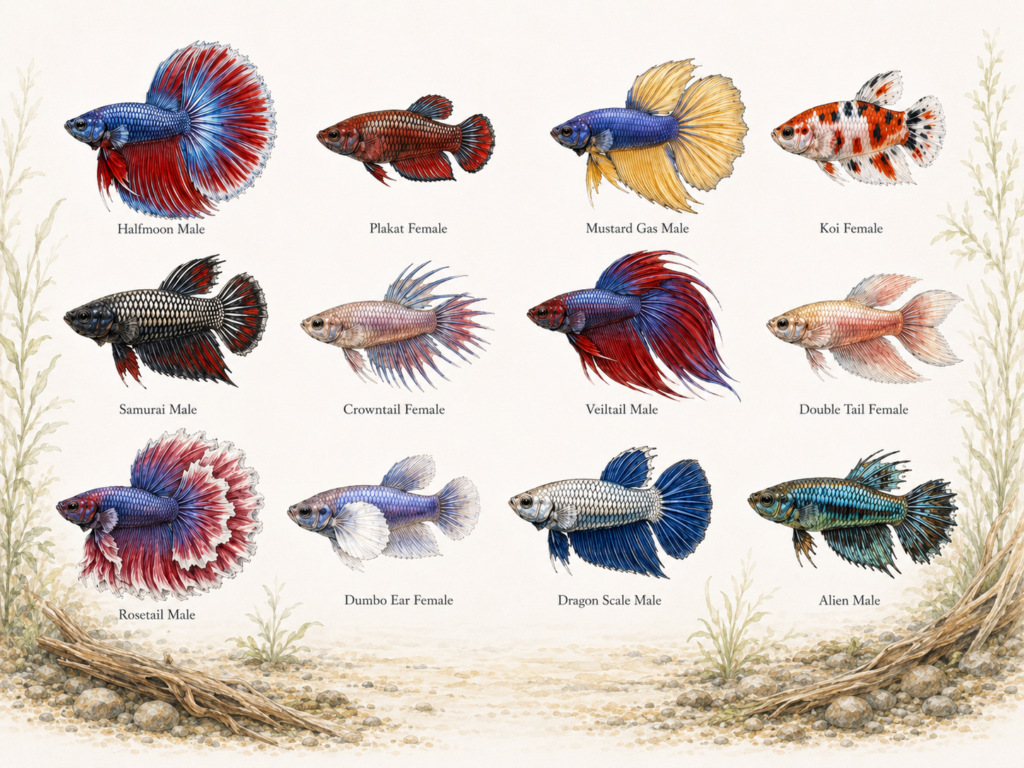
Few aquarium fish can match the sheer number of captive-bred varieties found in Betta splendens. These varieties are classified by both tail type and colour pattern, and new forms continue to emerge as breeders push the boundaries of selective breeding. Below are some of the most notable and widely traded varieties.
The Halfmoon Betta is one of the most popular tail types, characterised by a caudal fin that spreads a full 180 degrees when flared, creating a striking D-shaped or half-moon silhouette. These fish are prized in shows and command premium prices for symmetrical, well-structured finnage.
The Crowntail Betta features dramatically reduced webbing between the fin rays, giving the tail, dorsal, and anal fins a spiky, crown-like appearance. This variety is widely available and highly recognisable, with the degree of ray extension varying between individuals.
The Veiltail Betta is the most commonly sold variety and is often what people picture when they think of a Betta. It has long, flowing, asymmetrical fins that droop downward. While less valued in competitive breeding circles, the Veiltail remains a beautiful and hardy fish.
The Plakat Betta is a short-finned variety that most closely resembles the wild form. Plakats are more agile swimmers, less prone to fin damage, and often display particularly intense colouration. They are increasingly popular with experienced keepers who appreciate their vigour and natural proportions.
The Double Tail Betta possesses a genetically split caudal fin that creates two distinct lobes, giving the fish the appearance of having two tails. These fish also tend to have a broader dorsal fin than other varieties. The double tail gene can bring health complications, including a shorter body and swim bladder issues.
The Rosetail and Feathertail Bettas are extreme extensions of the Halfmoon type, with excessive branching of the fin rays that creates a ruffled, rose-petal effect. While visually dramatic, these heavy fins can impede swimming and make the fish more susceptible to fin damage and fatigue.
The Dumbo or Elephant Ear Betta is named for its extraordinarily enlarged pectoral fins, which fan out like elephant ears as the fish swims. This feature can appear across multiple tail types and colour patterns.
The Koi Betta displays a marbled colour pattern reminiscent of Japanese koi carp, typically combining red, white, and black in irregular patches. The marbling gene means these fish can change colour throughout their lives, making each individual somewhat unpredictable.
The Mustard Gas Betta is a bicolour variety with a dark blue or green body contrasted by vivid yellow or orange fins. The name is a trade term rather than a formal classification, but it describes a consistently popular colour combination.
The Galaxy Koi or Nemo Koi Betta is a more recent development combining koi-patterned bodies with iridescent scaling. These fish display a complex patchwork of colours including orange, black, blue, and white, and they have become extremely popular in the ornamental Betta market.
Natural Habitat
Betta splendens originates from the lowland regions of mainland Southeast Asia, with the heart of its native range centred on Thailand, particularly the Chao Phraya and Mekong river basins. Wild populations also occur in Cambodia, Laos, Vietnam, and parts of Myanmar. The species has additionally been introduced to various tropical and subtropical regions around the world through the aquarium trade.
In the wild, Bettas inhabit slow-moving or still bodies of water, including rice paddies, shallow ponds, marshes, floodplains, and roadside ditches. These environments are often heavily vegetated, with dense growths of aquatic and marginal plants providing cover and foraging opportunities. The water is frequently warm, soft, and slightly acidic, stained brown by tannins leaching from decaying organic matter. Depth can vary dramatically with the seasons, during the wet season, Bettas may occupy expansive flooded areas, while in the dry season they can be found in surprisingly small, shallow pools.
It is this seasonal exposure to oxygen-poor, stagnant water that drove the evolution of the labyrinth organ, a specialised respiratory structure that allows Bettas to breathe atmospheric air directly from the surface. This adaptation is critical to the species’ survival in its native habitat, but it has also, unfortunately, been used to justify keeping Bettas in inadequate conditions in captivity. The ability to survive in poor water does not mean the fish thrives in it.
Wild Betta splendens is currently listed as Vulnerable on the IUCN Red List. Habitat loss from agricultural expansion, urbanisation, and pollution threatens natural populations, as does hybridisation with released domestic Bettas, which can dilute the wild gene pool.
Tank Size and Setup
A single Betta should be housed in a tank of at least 20 litres, though 30 to 40 litres is preferable and allows for a more stable environment with greater scope for aquascaping. Larger tanks of 60 litres or more are ideal if you intend to keep your Betta in a community setting. The persistent idea that Bettas can live happily in a vase, jar, or tiny unheated bowl is a harmful myth that leads to shortened lifespans and chronic stress.
When setting up a Betta tank, aim to replicate the calm, densely planted environments they inhabit in the wild. Live plants are strongly recommended, as they improve water quality, provide hiding spots, and create a more naturalistic aesthetic. Excellent choices include Java Fern, Anubias species, Amazon Sword, Cryptocoryne species, and floating plants such as Salvinia or Amazon Frogbit. Floating plants are particularly beneficial because they diffuse overhead light, which helps Bettas feel secure, and they provide resting spots near the surface where the fish can breathe air comfortably.
The substrate can be fine gravel or sand; either works well. Avoid sharp or rough substrates that could damage delicate fins. Include driftwood, smooth rocks, or purpose-made aquarium caves to create visual barriers and shelter. Bettas appreciate having places to explore and retreat to, and a well-structured tank reduces stress significantly.
Water flow should be kept gentle. Bettas are not strong swimmers, especially long-finned varieties, and powerful currents will exhaust them and cause stress. If your filter output is too strong, baffle it with a sponge or redirect it against the tank wall. The surface should have relatively calm areas to allow the fish easy access to atmospheric air.
A secure lid or cover is essential. Bettas are capable jumpers and will leap from open-top tanks, particularly when startled or in pursuit of insects near the surface. Ensure any lid allows for adequate air exchange above the waterline, as Bettas need access to humid air to use their labyrinth organ effectively.
Water Parameters
Maintaining stable, clean water is the single most important factor in Betta health. While Bettas are adaptable to a range of water conditions, consistency matters far more than hitting a specific number. Sudden fluctuations in temperature or pH are far more damaging than water that sits slightly outside the ideal range. The table below outlines the recommended parameters.
| Temperature | 24–30 °C |
| pH | 6.0–8.0 |
| General hardness (GH) | 1–15 dGH |
| Carbonate hardness (KH) | 2–8 dKH |
| Ammonia | 0 ppm |
| Nitrite | 0 ppm |
| Nitrate | Below 20 ppm |
Temperature stability is critical. Bettas are tropical fish and must be kept in heated tanks unless your room temperature consistently sits within the 24–28 °C range. Cold water suppresses their immune system, reduces appetite, and makes them lethargic. An adjustable heater with a thermostat is the best option, as it allows you to fine-tune the temperature.
Perform regular water changes of 20–25% weekly to keep nitrate levels low and remove dissolved organic waste. Always treat replacement water with a quality dechlorinator and ensure it matches the tank temperature before adding it. Test your water parameters regularly using a reliable liquid test kit, particularly during the first few months of a new tank’s life as the nitrogen cycle establishes itself.
Indian almond leaves (Terminalia catappa) or other sources of botanical tannins can be added to the water. These release humic acids and tannins that gently lower pH, soften the water, and have mild antibacterial and antifungal properties. Many Betta keepers find that their fish display better colouration and more relaxed behaviour in tannin-stained water, which more closely mimics their natural habitat.
Filtration and Equipment
Every Betta tank needs a filter. Even though their labyrinth organ allows them to breathe air from the surface, Bettas still produce waste that breaks down into toxic ammonia and nitrite. A filter provides the biological filtration necessary to convert these harmful compounds into less toxic nitrate through the nitrogen cycle.
Sponge filters are an excellent choice for Betta tanks. They provide gentle flow, ample biological filtration, and pose no risk of trapping delicate fins. They are also inexpensive, easy to maintain, and particularly well suited to smaller tanks. Internal power filters and hang-on-back filters can also work, but you may need to reduce the flow rate by adjusting the output, adding a pre-filter sponge over the intake, or baffling the outflow.
A reliable, adjustable heater is essential unless you live in a consistently warm climate. For tanks of 20 to 40 litres, a small 25 to 50 watt heater is usually sufficient. Always pair the heater with a separate thermometer to verify the temperature, as built-in thermostats can occasionally be inaccurate. Place the heater near the filter outflow to help distribute heat evenly throughout the tank.
Lighting should be moderate. Bettas do not require intense light, and excessively bright illumination can cause stress, particularly in tanks without sufficient plant cover or floating vegetation. A standard LED aquarium light on a timer set to 8 to 10 hours per day works well, supporting live plant growth while providing a natural day-night cycle. Bettas benefit from a consistent photoperiod and should not be exposed to light around the clock.
An air pump is not strictly necessary if you are using a sponge filter, as the filter itself provides surface agitation. If the tank has no filter-driven surface movement, a very gentle air stone can help with gas exchange, but avoid creating strong currents or excessive turbulence.
Diet and Feeding
Betta splendens is a carnivorous species with a diet that should reflect its insectivorous nature. In the wild, Bettas feed primarily on small invertebrates, insect larvae, and zooplankton found at or near the water surface. Their upward-facing mouths are specifically adapted for surface feeding. Providing a varied, protein-rich diet is one of the most effective ways to maintain vibrant colouration, strong finnage, and overall health.
A high-quality Betta-specific pellet should form the foundation of the diet. Look for pellets that list whole fish or insect meal as the first ingredient, with a protein content of 40% or higher and minimal fillers such as wheat or soy. Pellets are preferable to flakes for Bettas, as they are less likely to foul the water and are easier for the fish to consume at the surface.
Supplement the staple pellet diet with frozen or live foods two to three times per week. Excellent options include bloodworms, daphnia, brine shrimp, and mosquito larvae. These foods provide essential nutrients, stimulate natural foraging behaviour, and are eagerly accepted by virtually all Bettas. Freeze-dried versions of these foods can also be offered occasionally, but they should be pre-soaked in tank water before feeding to prevent digestive issues caused by expansion in the stomach.
Feed your Betta small amounts once or twice daily, offering only what the fish can consume within two to three minutes. A Betta’s stomach is roughly the size of its eye, so overfeeding is a common mistake that leads to bloating, constipation, and water quality problems. Many experienced keepers implement a fasting day once per week to allow the digestive system to clear, which can help prevent bloating and swim bladder issues.
Behaviour and Temperament
Bettas are among the most personable freshwater fish available to the hobbyist. They are curious, intelligent, and quickly learn to recognise their keeper, often swimming to the front of the tank in anticipation of food. Many Bettas can be trained to follow a finger, swim through hoops, or perform other simple tricks, which speaks to their surprising cognitive ability for a fish of their size.
The species is, however, famous for its aggression, specifically, male-to-male aggression. In the wild and in captivity, male Bettas are fiercely territorial toward other males of their species. When two males encounter each other, they engage in elaborate displays involving gill flaring, fin spreading, and intensified colouration. If neither backs down, these displays escalate into physical combat that can result in severe injury or death. For this reason, male Bettas must never be housed together in the same tank unless it is exceptionally large and densely planted, and even then it is strongly discouraged.
Male Bettas can also display aggression toward other fish that have long, flowing fins or bright colours, as these may be mistaken for rival males. This means careful consideration must be given to tank mate selection, which is discussed in detail below.
Female Bettas are generally less aggressive than males, though they are by no means peaceful. Groups of females, sometimes called sororities, can be kept together in sufficiently large, well-planted tanks of 80 litres or more, but this requires careful monitoring. Sorority tanks need at least five or six females to spread aggression, abundant hiding places, and a contingency plan in case a dominant female bullies others. Sororities are not recommended for beginners, as they can collapse into serious aggression without warning.
Bettas are surface-oriented fish and spend much of their time in the upper third of the water column. They frequently rest on broad leaves, filter intakes, or other surfaces near the top of the tank. This resting behaviour is entirely normal and should not be mistaken for illness. Betta hammocks, small suction-cup-mounted leaves, are a popular accessory that caters to this natural preference.
Tank Mates
While Bettas are often kept as solitary fish, they can coexist with carefully chosen tank mates in an appropriately sized aquarium. The key principles are to avoid fish that are brightly coloured, long-finned, nippy, or overly boisterous. Tank mates should occupy different areas of the water column where possible, and the tank must be large enough, ideally 40 litres or more, to provide adequate space and territory for all inhabitants. Always have a backup plan in case your individual Betta proves too aggressive for community life, as temperament varies between individuals.
Good tank mates
- Harlequin Rasbora, a peaceful, mid-water schooling fish that is too fast to be bothered by a Betta and lacks the finnage or colour to trigger aggression.
- Ember Tetra, a tiny, unobtrusive tetra that occupies the mid-water zone and is far too small and subdued to be perceived as a rival.
- Pygmy Corydoras, a diminutive bottom-dwelling catfish that stays well out of a Betta’s territory and helps keep the substrate clean.
- Kuhli Loach, a shy, nocturnal bottom-dweller that rarely interacts with a Betta and appreciates the same warm, soft water conditions.
- Nerite Snail, an excellent algae-eating snail that is completely ignored by Bettas and helps maintain tank cleanliness without contributing significantly to the bioload.
- Amano Shrimp, a hardy, larger shrimp species that is generally too big for a Betta to eat and serves as an effective algae and detritus cleaner.
- Celestial Pearl Danio, a small, peaceful nano fish that tends to stay in the lower to mid-water levels and coexists well in planted Betta tanks.
- Otocinclus Catfish, a gentle, algae-grazing catfish that sticks to surfaces and the lower tank regions, posing no threat or provocation to a Betta.
Fish to avoid
- Male Guppy, their bright colours and flowing tails closely resemble a rival male Betta, almost guaranteeing aggression and fin nipping from the Betta.
- Tiger Barb, a notorious fin nipper that will relentlessly harass a Betta, shredding its delicate fins and causing chronic stress.
- Chinese Algae Eater, Becomes aggressive and territorial as it matures and has a tendency to latch onto and damage the sides of slow-moving fish.
- Angelfish, a semi-aggressive cichlid that occupies a similar area of the water column and can bully or be bullied by a Betta, depending on temperament.
- Paradise Fish, a closely related labyrinth fish with territorial and aggressive tendencies that will inevitably clash with a Betta.
- Red-Tail Shark, highly territorial, especially at the bottom of the tank, and will chase and stress any fish that enters its domain, including Bettas.
- Dwarf Gourami, another labyrinth fish that shares the same surface territory as Bettas, frequently leading to territorial disputes and aggression.
- Convict Cichlid, a pugnacious cichlid that is far too aggressive and robust to be housed safely with a Betta.
Breeding
Breeding Betta splendens is a fascinating process that showcases some of the most remarkable parental behaviour found in freshwater fish. While it is not particularly difficult to trigger spawning, raising the fry successfully requires preparation, patience, and a separate breeding setup. Prospective breeders should also consider what they will do with potentially hundreds of offspring, many of which will need to be individually housed as they mature.
Begin by conditioning a healthy, mature pair with high-protein foods such as live or frozen bloodworms, daphnia, and brine shrimp for one to two weeks before introducing them. Choose a male and female that are both in excellent health, ideally between 4 and 12 months of age. The breeding tank should be 20 to 40 litres, shallow (filled to approximately 12–15 cm), gently heated to 26–28 °C, and equipped with floating plants or a piece of polystyrene to serve as an anchor for the bubble nest. Filtration should be minimal, an air-driven sponge filter on its lowest setting, or no filter at all during spawning and the first days of fry development.
Introduce the female in a clear container or behind a divider within the breeding tank so the pair can see each other without making physical contact. The male will typically begin building a bubble nest at the surface within a day or two, a raft of saliva-coated air bubbles that will hold the eggs. Once the nest is substantial and the female displays vertical breeding bars on her body and appears receptive, release her into the tank.
The spawning embrace is captivating to observe. The male wraps his body around the female in a series of nuptial clasps, during which she releases eggs and he fertilises them simultaneously. After each embrace, the male collects the sinking eggs in his mouth and carefully places them into the bubble nest. This process repeats over several hours, with clutch sizes ranging from 30 to over 500 eggs depending on the maturity and condition of the pair.
Once spawning is complete, remove the female immediately, as the male will become highly protective of the nest and may attack her. The male tends the nest diligently, retrieving any fallen eggs and blowing fresh bubbles to maintain the structure. Eggs typically hatch within 24 to 48 hours, and the fry become free-swimming two to three days after hatching. At this point, remove the male as well.
Free-swimming fry are extremely small and require infusoria or liquid fry food for the first few days, transitioning to newly hatched brine shrimp (Artemia nauplii) and micro-worms as they grow. Maintain the water level low initially and raise it gradually over the following weeks. Keep the tank covered to ensure warm, humid air above the water surface, which is critical for the proper development of the fry’s labyrinth organs. As the fry grow and males begin to show aggression toward each other, they will need to be separated into individual containers, a logistically demanding but necessary step.
Common Diseases
Betta splendens is susceptible to a range of diseases, many of which are directly linked to poor water quality, inadequate temperature, overfeeding, or stress. Maintaining optimal water conditions and a balanced diet is the most effective form of disease prevention.
Fin rot is perhaps the most frequently encountered Betta ailment. It manifests as fraying, discolouration, or progressive erosion of the fin edges. Mild cases are typically caused by bacterial infection secondary to poor water quality and can often be resolved with consistent water changes and the addition of Indian almond leaves. More advanced cases may require treatment with antibacterial medications. It is important to distinguish fin rot from fin biting, a stress-related behaviour in which the Betta chews its own fins.
Ich, or white spot disease, caused by the parasite Ichthyophthirius multifiliis, presents as small white cysts resembling grains of salt on the body and fins. Affected fish often clamp their fins and rub against surfaces. Treatment involves raising the temperature gradually to 28–30 °C to accelerate the parasite’s life cycle, combined with aquarium salt or a proprietary ich medication.
Velvet disease, caused by the parasitic dinoflagellate Piscinoodinium, produces a fine, gold or rust-coloured dusting on the skin that is sometimes easier to see under torchlight. It is highly contagious and can be fatal if untreated. Treatment typically involves dimming the lights (the parasite is partly photosynthetic), raising the temperature, and using a copper-based medication.
Swim bladder disorder is common in Bettas, particularly those that are overfed or given a diet lacking in variety. Symptoms include difficulty maintaining buoyancy, the fish may float at the surface, sink to the bottom, or swim at an unusual angle. Fasting the fish for two to three days and then offering a small amount of daphnia, which acts as a mild laxative, often resolves the issue. Persistent swim bladder problems may indicate a more serious underlying condition.
Dropsy is a symptom rather than a disease in itself, characterised by severe abdominal swelling and raised scales that give the fish a pinecone-like appearance when viewed from above. It usually indicates organ failure, often caused by a bacterial infection of the kidneys. Dropsy carries a very poor prognosis, and by the time scales are visibly raised, the condition is often terminal. Epsom salt baths and broad-spectrum antibiotics may be attempted, but euthanasia should be considered if the fish is suffering and not responding to treatment.
Columnaris, sometimes called cotton wool disease, is a bacterial infection that produces white or grey patches on the body, mouth, or fins, sometimes accompanied by a cottony growth. It can progress rapidly and is often triggered by stress or poor water quality. Treatment involves antibacterial medications and immediate attention to water parameters.
FAQs
Can a Betta live in a bowl without a filter or heater?
While a Betta can survive temporarily in such conditions due to its labyrinth organ, it will not thrive. Unfiltered, unheated bowls lead to rapid ammonia accumulation and temperature fluctuations that suppress the immune system and shorten the fish’s lifespan dramatically. A filtered, heated tank of at least 20 litres is the minimum for responsible Betta keeping.
How can I tell if my Betta is male or female?
Males are typically larger with longer, more elaborate fins and more vivid colouration. They also possess a more prominent opercular membrane (beard) visible beneath the gill covers. Females are generally smaller, with shorter fins, a slightly rounder body, and a visible ovipositor, a small white egg spot located between the ventral and anal fins. In some heavily bred ornamental strains, the differences can be less obvious, particularly in young fish.
Why is my Betta making bubbles at the surface?
Your Betta is building a bubble nest, which is a completely natural behaviour for healthy, mature males. It is a sign of reproductive readiness and general well-being, not an indication that the fish requires a mate. Males will build bubble nests regardless of whether a female is present, and it is generally considered a positive sign of good health and environmental comfort.
How often should I change the water in my Betta tank?
In a filtered and cycled tank of 20 litres or more, a weekly water change of 20–25% is generally sufficient to maintain good water quality. Smaller or unfiltered setups require more frequent changes, potentially 50% every two to three days, though upgrading to a properly filtered tank is always the better long-term solution. Always match the temperature and treat replacement water with a dechlorinator before adding it.
Can I keep two male Bettas together if the tank is large enough?
No. Male Betta splendens are fundamentally incompatible with one another regardless of tank size. Even in very large aquariums, males will seek each other out and fight, often to the death or until one is severely injured. There is no reliable method to safely house two males in the same tank, and the stress alone can be fatal even if physical confrontation is somehow minimised.
Related Guides
- Dwarf Gourami Care Guide, a fellow labyrinth fish with similar care requirements, useful for comparison if you are deciding between the two species.
- Harlequin Rasbora Care Guide, one of the