Jumbo Cyprichromis Care Guide — Tank Setup, Feeding and Breeding
Quick summary
Jumbo Cyprichromis are peaceful, stunning shoaling cichlids best suited to keepers who can provide a large tank of at least 300 litres, stable hard alkaline water, and a group of 10 or more fish, rather than a small tank or a lone pair. If you can meet those space and water chemistry demands, they are a moderately challenging but rewarding choice with fascinating mouthbrooding behaviour.
🐠 Build a tank around this fish
In this guide:
- Introduction
- Quick Stats
- Appearance
- Varieties and Morphs
- Natural Habitat
- Tank Size and Setup
- Water Parameters
- Filtration and Equipment
- Diet and Feeding
- Behaviour and Temperament
- Tank Mates
- Breeding
- Common Diseases
- FAQs
Introduction
The Jumbo Cyprichromis, sold under the provisional name Cyprichromis sp. “Leptosoma Jumbo,” is one of the most elegant and captivating open-water cichlids found in Lake Tanganyika. As its trade name suggests, this fish is the larger-bodied relative of the well-known Cyprichromis leptosoma, reaching a noticeably greater adult size while retaining the same streamlined, sardine-like silhouette that makes the genus so distinctive. In a well-maintained aquarium, a shoal of these fish moving in unison through the mid-water column is a genuinely breathtaking sight, males flashing vivid blues, yellows, or purples as they jostle for position, while the more subdued females weave calmly among them.
Despite their striking beauty, Jumbo Cyprichromis remain somewhat underappreciated outside dedicated Tanganyikan cichlid circles. This is partly because they require a different approach to many other African cichlids. They are shoaling, open-water fish that need space, stable water chemistry, and the company of their own kind to thrive. They are not the sort of cichlid you can keep as a lone pair in a small tank. However, for aquarists willing to meet their needs, they reward the effort with exceptional colour, fascinating breeding behaviour, males are maternal mouthbrooders that court females in mid-water, and a peaceful disposition that makes them outstanding members of a Tanganyikan community aquarium.
This guide covers everything you need to know to keep and breed Jumbo Cyprichromis successfully, from tank dimensions and water chemistry to diet, compatible species, and the remarkable courtship display that sets this genus apart from almost every other cichlid in the hobby.
Quick Stats
| Scientific name | Cyprichromis sp. “Leptosoma Jumbo” |
| Common names | Jumbo Cyprichromis, Jumbo Leptosoma, Cyprichromis Jumbo, Giant Cyprichromis |
| Family | Cichlidae |
| Origin | Lake Tanganyika, East Africa (Democratic Republic of the Congo, Tanzania, Zambia, Burundi) |
| Adult size | 12–14 cm (males); 10–12 cm (females) |
| Lifespan | 8–10 years |
| Difficulty | Moderate |
| Breeding difficulty | Moderate |
| Temperature | 24–27 °C |
| pH range | 7.8–9.0 |
| General hardness (GH) | 10–20 dGH |
| Carbonate hardness (KH) | 10–18 dKH |
| Minimum tank size | 300 litres |
| Conservation status | Not Evaluated |
Appearance
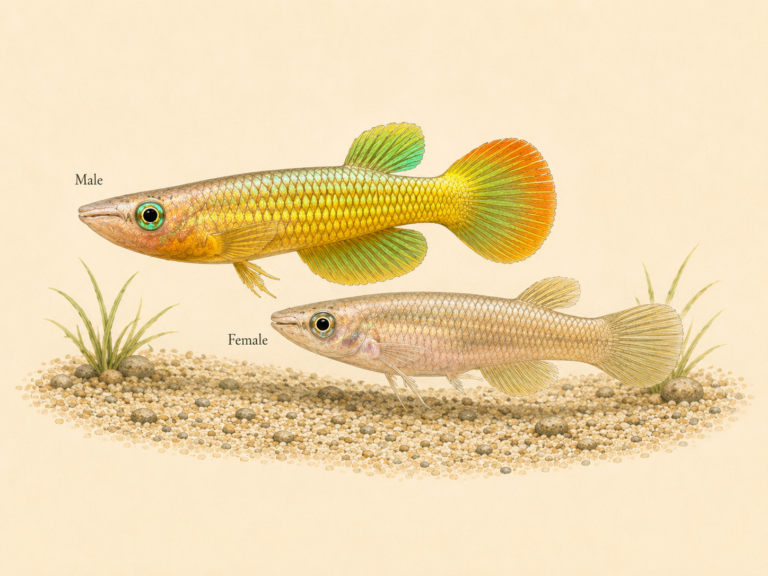
At first glance, Jumbo Cyprichromis might be mistaken for a marine fish. The body is slender, laterally compressed, and deeply forked at the tail, a classic pelagic shape built for sustained swimming in open water rather than darting between rocks. Males are the showpieces, developing intense and variable coloration that depends heavily on their geographic origin. The body may be a shimmering steely blue, lavender, or deep violet, while the tail fin is typically either bright yellow or vivid blue, a trait so consistent across populations that hobbyists often refer to variants as “yellow tail” or “blue tail.” Unpaired fins can carry electric blue edging, and the flanks sometimes exhibit a subtle iridescent sheen that shifts with the light.
Females, by contrast, are considerably more modest in dress. They tend to be a uniform silvery-beige or light tan, sometimes with a faint golden wash. This sexual dimorphism becomes apparent as the fish mature, usually from around six to eight centimetres in length. Juveniles of both sexes look much like the adult females, making sexing young fish a challenge until they begin to colour up.
Compared to the standard Cyprichromis leptosoma, the Jumbo form is noticeably more robust. Males regularly reach 12 to 14 centimetres in total length, with females only slightly smaller, whereas typical C. leptosoma populations rarely exceed 10 centimetres. The head is proportionally a touch broader, and the overall impression is of a heftier, more imposing fish, though still unmistakably a Cyprichromis in shape and movement.
Varieties and Morphs
The genus Cyprichromis is famous for its enormous geographic variation, and the Jumbo complex is no exception. Because populations around Lake Tanganyika are often isolated by stretches of sandy substrate or deep water, individual collection points have developed distinct colour patterns. In the aquarium trade, these are typically sold under their locality name, and keeping locality variants separate is strongly encouraged to prevent hybridisation.
Cyprichromis sp. “Leptosoma Jumbo” Kapampa is arguably the most sought-after variant. Males display a rich blue body overlaid with violet highlights and a striking yellow tail, creating an exceptionally vivid contrast. This variant originates from the Congolese coastline and commands a premium in the hobby.
The Kitumba variant is another popular Congolese population, known for its deep blue-purple body and blue caudal fin. Males of this form often appear almost entirely blue in strong lighting, making them a dramatic addition to a Tanganyikan display tank.
Cyprichromis sp. “Leptosoma Jumbo” Kigoma is a Tanzanian population that tends to exhibit a somewhat lighter body blue with a yellow tail. It is widely available and is often the first Jumbo Cyprichromis that new keepers encounter.
The Isanga and Mpimbwe variants from the Tanzanian coast are also regularly seen, with males showing varying degrees of blue and purple body coloration and either yellow or blue tails. These populations can be subtly different from one another, and experienced keepers prize them for their regional distinctiveness.
Less commonly encountered are populations from the Zambian coast, such as the Kalambo variant, which tends toward slightly more muted coloration but retains the characteristic Jumbo size and body shape. Regardless of variant, it is essential to purchase fish from a reputable source that can confirm the collection locality, as mixed or unlabelled stock risks the loss of genetically distinct populations.
Natural Habitat
Lake Tanganyika is the second oldest and second deepest freshwater lake on Earth, a vast body of water stretching nearly 700 kilometres along the western edge of the East African Rift. Its waters are warm, highly alkaline, extremely hard, and remarkably stable, conditions that change very little from season to season. It is this stability, more than any single parameter, that defines the environment Jumbo Cyprichromis have evolved to inhabit.
Within the lake, Jumbo Cyprichromis occupy the open water column above rocky substrates and steep underwater slopes, typically at depths between 5 and 35 metres. They are true pelagic cichlids, spending almost their entire lives in mid-water rather than associating closely with the substrate. Large shoals of dozens to hundreds of individuals cruise above the rocks, feeding on zooplankton that drifts in the water column. The rocky habitat below provides visual reference points and retreat zones, but the fish themselves are rarely seen resting on or among the rocks.
The water in their natural range is characteristically clear, with visibility often exceeding 15 metres. Temperatures at their preferred depth range from roughly 24 to 27 degrees Celsius, the pH sits between 8.5 and 9.2, and the water is both very hard and well-buffered. There is virtually no vegetation in the rocky littoral zone, and the substrate is typically composed of boulders, cobbles, and compacted sediment. Understanding this habitat is key to replicating it in captivity: Jumbo Cyprichromis need open swimming space, hard alkaline water, and the reassurance of rocky structures below them, even if they rarely touch them.
Tank Size and Setup
A minimum tank volume of 300 litres is recommended for a group of Jumbo Cyprichromis, but larger is emphatically better. Because these are active, open-water shoaling fish, the length and depth of the aquarium matter more than the raw volume. A tank measuring at least 120 centimetres long, 50 centimetres wide, and 50 centimetres tall should be considered the practical starting point. Tanks of 150 centimetres or longer are ideal, as they allow the shoal to swim freely and males to establish their temporary territories without excessive conflict.
The aquascape should reflect the fish’s natural environment. Build a rock wall or stack along the back and one or both ends of the tank, using inert rocks such as ocean rock, limestone, or lava rock. This provides visual barriers, retreat zones for subordinate fish, and a naturalistic backdrop. Leave the centre and front of the tank as open water, this is the space your Cyprichromis will actually use. Resist the temptation to fill the tank with elaborate rock formations; too much structure reduces the swimming room these pelagic fish need. A sandy substrate of fine aragonite or silica sand completes the look and helps buffer the water toward the alkaline end of the spectrum.
Plants are not a natural part of the Jumbo Cyprichromis’s habitat and are generally unnecessary in the tank. If you wish to include them for aesthetic purposes, choose hardy species tolerant of hard, alkaline water, Anubias and Java fern attached to rocks are reasonable options, though neither is representative of the Lake Tanganyika biotope.
Jumbo Cyprichromis should be kept in groups of at least 10 to 15 individuals, with a ratio of one male to every two or three females. In larger tanks of 450 litres or more, groups of 20 or more fish create a more natural dynamic, and males will display far more intensely when they have both rivals and an audience. Keeping too few fish leads to excessive aggression directed at a small number of individuals, which can cause stress, colour loss, and even death in severe cases.
Water Parameters
Stable, hard, alkaline water is non-negotiable for Jumbo Cyprichromis. These fish have evolved in one of the most chemically consistent bodies of water on the planet, and they are poorly adapted to sudden shifts in pH, hardness, or temperature. Getting the numbers right from the outset, and keeping them there, is one of the most important aspects of their care.
| Temperature | 24–27 °C |
| pH | 7.8–9.0 |
| General hardness (GH) | 10–20 dGH |
| Carbonate hardness (KH) | 10–18 dKH |
| Ammonia | 0 ppm |
| Nitrite | 0 ppm |
| Nitrate | Below 20 ppm |
If your tap water is naturally soft or acidic, you will need to remineralise it using a Tanganyika buffer salt mix or a combination of marine salt and bicarbonate of soda. Many keepers find that a purpose-made Rift Lake salt mix is the simplest approach. Consistency is paramount: mix replacement water to match tank conditions precisely before adding it during water changes. Even small pH swings can stress Cyprichromis and leave them vulnerable to disease. Regular water changes of 20 to 30 per cent weekly help keep nitrate levels low and maintain mineral balance.
Filtration and Equipment
Efficient biological filtration is essential. The alkaline, warm conditions that suit Tanganyikan cichlids also accelerate the toxicity of ammonia, meaning even modest spikes can be dangerous. A large external canister filter rated for at least 1.5 times the tank volume is the standard recommendation. If budget and space allow, running two filters provides both redundancy and additional biological capacity. Sponge filters can serve as supplementary filtration but are unlikely to provide sufficient flow and media capacity as the sole filter on a tank of 300 litres or more.
Jumbo Cyprichromis appreciate moderate water flow that mimics the gentle currents of their natural habitat. Position filter outlets or a separate wavemaker to create a broad, gentle current across the length of the tank. Avoid directing a strong jet at one spot, as this can create dead zones elsewhere and stress fish that are caught in the blast.
A reliable heater, or ideally two heaters of half the required wattage for redundancy, is important for maintaining the stable temperature these fish demand. An inline heater connected to the canister filter is an elegant solution that also removes the risk of fish burning themselves on an internal unit. A thermometer placed at the opposite end of the tank from the heater helps confirm even heat distribution.
Lighting should be moderate to strong. Jumbo Cyprichromis are not light-shy, and good lighting brings out the best of their iridescent colours. LED units with a colour temperature between 6500K and 10000K are popular choices, and a gentle dawn-to-dusk ramp helps reduce startling. An air pump is not strictly necessary if surface agitation from the filter is adequate to maintain dissolved oxygen levels, but supplementary aeration does no harm and provides a safety margin.
Diet and Feeding
In the wild, Jumbo Cyprichromis feed almost exclusively on zooplankton, tiny crustaceans and other invertebrates suspended in the water column. Their upturned mouth and slender body are perfectly adapted to picking off individual prey items as they swim. Replicating this diet in captivity is straightforward and critical to their long-term health.
A high-quality cichlid flake or small-pellet food formulated for planktivorous species should form the staple diet. Look for products with a high proportion of marine proteins such as krill, spirulina, and fish meal, and avoid foods heavy in terrestrial plant fillers or excessive fat. The pellets or flakes should be small enough to be taken comfortably in mid-water; large, sinking pellets are poorly suited to a fish that feeds in the water column.
Supplement the staple with regular offerings of frozen or live foods. Cyclops, baby brine shrimp, daphnia, and mysis shrimp are all excellent choices and closely approximate the natural diet. These foods also help condition breeding fish and encourage spawning behaviour. Avoid bloodworm and tubifex as regular fare, as these can cause digestive problems, particularly bloat, in Tanganyikan cichlids, which have relatively short intestinal tracts adapted to a high-protein, low-bulk diet.
Feed two to three times daily in small amounts that the fish can consume within a minute or two. Jumbo Cyprichromis are mid-water feeders, so delivering food where the current disperses it through the water column, rather than allowing it to sink to the substrate, ensures all members of the shoal get a fair share. Overfeeding is a common pitfall; uneaten food decays quickly in warm, alkaline water and can rapidly degrade water quality.
Behaviour and Temperament
Jumbo Cyprichromis are among the most peaceful cichlids in the hobby. Aggression is almost entirely confined to male-to-male displays within the species, and even these are typically ritualised and non-damaging. Dominant males establish small, temporary territories in mid-water, essentially a column of space above a particular rock or landmark, from which they display to passing females. Subordinate males hover nearby, maintaining their own less prominent positions and waiting for an opportunity to display. There is pushing, flaring, and colour-flashing, but actual physical combat resulting in injury is rare, provided the group is large enough to distribute social pressure.
The shoaling instinct of these fish is strong, and it defines their behaviour in the aquarium. A well-settled group moves through the tank in a loose but coordinated formation, with males breaking away periodically to display before rejoining the shoal. This constant, flowing motion is one of the great pleasures of keeping the species. Fish kept in groups that are too small often become nervous, hide excessively, or lose colour, as they lack the safety-in-numbers dynamic that underpins their confidence.
Jumbo Cyprichromis are not aggressive toward other species. They occupy the open-water niche and show little interest in the rocks, substrate, or caves that most other Tanganyikan cichlids defend. This makes them outstanding dither fish for a community Tanganyikan setup, where their calm, visible presence encourages shyer bottom-dwelling species to come out into the open. They can, however, be easily intimidated by overly boisterous or aggressive tank mates, and care should be taken to pair them only with species of a compatible temperament.
Tank Mates
Choosing companions for Jumbo Cyprichromis is largely a matter of respecting the niche-partitioning that occurs naturally on Lake Tanganyika’s rocky shores. The ideal tank mates are species that occupy a different zone of the aquarium, bottom-dwellers, rock-dwellers, or shell-dwellers, and that are not aggressive enough to terrorise the Cyprichromis in open water. Avoid mixing different geographic populations of Cyprichromis, and never house Jumbo Cyprichromis alongside the standard-sized C. leptosoma, as hybridisation is a real risk.
Good tank mates
- Julidochromis marlieri, a rock-dwelling cichlid that stays close to the substrate and poses no threat to mid-water Cyprichromis.
- Neolamprologus brichardi, the Fairy Cichlid occupies rocky crevices and generally ignores open-water species, making it a natural companion.
- Altolamprologus calvus, a slow-moving, laterally compressed predator of small invertebrates in rocks; too sluggish to bother Cyprichromis.
- Altolamprologus compressiceps, Similar in habits to A. calvus and equally compatible, occupying the rock zone exclusively.
- Multifasciatus Shell Dweller, Tiny shell-dwellers that remain on the substrate and add life to the lower levels of the aquarium.
- Lamprologus ocellatus, another shell-dwelling species that stays firmly on the bottom, leaving the mid-water column to the Cyprichromis.
- Xenotilapia flavipinnis, a sand-sifting cichlid that occupies the substrate zone and coexists peacefully with open-water species.
- Paracyprichromis nigripinnis, a closely related open-water species that swims along rock faces; compatible if sufficient space is provided.
Fish to avoid
- Cyphotilapia frontosa, Large, predatory, and capable of swallowing adult Cyprichromis; a serious threat despite its often placid demeanour.
- White Spotted Cichlid, highly territorial and aggressive herbivores that dominate all areas of the tank and stress open-water species.
- Tropheus moorii, similarly aggressive and territorial to T. duboisi, with constant chasing that can overwhelm Cyprichromis.
- Five Barred Cichlid, a large, aggressive piscivore that will hunt and consume smaller tank mates.
- Lepidiolamprologus elongatus, a dedicated fish predator that targets slender, mid-water species like Cyprichromis.
- Mbuna cichlids (Lake Malawi), Entirely incompatible due to different water chemistry preferences, aggressive temperament, and hybridisation risk in mixed-rift setups.
- Petrochromis trewavasae, Extremely aggressive, territorial algae grazers that dominate rockwork and bully open-water species.
- Boulengerochromis microlepis, the largest cichlid in the world; a voracious predator entirely unsuitable for community tanks with Cyprichromis.
Breeding
Breeding Jumbo Cyprichromis in captivity is a realistic goal for dedicated hobbyists, and observing the courtship and spawning behaviour is one of the highlights of keeping this species. Cyprichromis are maternal mouthbrooders, meaning the female incubates the fertilised eggs in her buccal cavity until the fry are free-swimming. However, the mechanics of spawning are unique among cichlids and worth understanding in detail.
When a male is ready to breed, he selects a position in the water column, typically above a prominent rock, and begins displaying intensely. His colours deepen, his fins spread, and he performs a quivering, lateral display aimed at attracting a nearby female. If a female is receptive, the pair engages in a remarkable mid-water spawning ritual. The female releases one or a few eggs at a time, which she immediately catches in her mouth before they sink. The male then presents his genital papilla, and the female mouths at it, taking in sperm to fertilise the eggs already in her buccal cavity. This process is repeated until the full clutch, typically 5 to 15 eggs in Jumbo Cyprichromis, has been laid and fertilised.
The entire spawning event takes place in open water, with no substrate or surface involved. This is unusual among cichlids and is part of what makes Cyprichromis so fascinating to breeders. After spawning, the female retreats to a quieter part of the tank and begins her incubation. She will carry the eggs and developing fry for approximately three to four weeks, during which time she eats little or nothing. Her buccal cavity becomes visibly distended as the fry grow, and experienced keepers can identify holding females by their swollen throat and reduced feeding behaviour.
To maximise fry survival, many breeders strip the female, gently opening her mouth to release the fry, at around 18 to 21 days. The fry can then be raised in a separate grow-out tank, where they are fed freshly hatched baby brine shrimp, microworms, and crushed flake food. Alternatively, if the main tank has sufficient hiding spots and the community is not too predatory, some fry may survive without intervention, though attrition will be high. Jumbo Cyprichromis fry are relatively large at release, measuring around 10 to 12 millimetres, which gives them a reasonable head start.
Conditioning breeding fish with regular feedings of high-quality frozen foods such as cyclops and mysis shrimp, combined with consistent water quality and a stable social group, significantly increases spawning frequency. In a well-maintained colony, females may spawn every four to six weeks, providing a steady supply of fry for the dedicated breeder.
Common Diseases
Jumbo Cyprichromis are reasonably hardy fish when their environmental requirements are met, but they are susceptible to several conditions that keepers should be aware of. Many health problems in this species can be traced back to water quality issues, particularly in tanks where pH, hardness, or temperature fluctuate or where nitrate is allowed to climb.
Bloat, sometimes referred to as Malawi bloat despite affecting Tanganyikan species as well, is the most feared disease among African cichlid keepers. It manifests as abdominal swelling, loss of appetite, lethargy, and trailing white faeces. The exact cause is debated, but it is associated with poor diet, particularly foods high in fat or inappropriate protein sources, stress, and deteriorating water quality. Affected fish should be isolated immediately, and treatment with metronidazole is the most commonly recommended approach. Prevention through diet and husbandry is far more effective than cure.
Ich, or white spot disease, caused by the protozoan Ichthyophthirius multifiliis, can affect Cyprichromis, particularly newly imported or stressed fish. The characteristic white spots on the body and fins are unmistakable. Raising the temperature to 28–30 °C and treating with a salt-based or malachite green remedy is usually effective, though care must be taken with copper-based medications, which can be harsh on cichlids at higher pH levels.
Bacterial infections, including fin rot and septicaemia, may occur in fish stressed by aggression, poor water quality, or overcrowding. Symptoms include frayed fins, reddened patches on the body, and lethargy. Broad-spectrum antibacterial treatments are appropriate, but identifying and correcting the underlying stressor is essential to prevent recurrence.
Internal parasites, particularly intestinal worms and flagellates, can be introduced via live foods or newly acquired fish. A preventative course of antiparasitic medication during quarantine is good practice for any new Tanganyikan cichlid. Quarantine all new arrivals for at least two to four weeks before introducing them to an established colony, as this single step prevents the majority of disease introductions.
FAQs
How many Jumbo Cyprichromis should I keep together?
A minimum group of 10 to 15 is recommended, with a ratio of roughly one male to every two or three females. Larger groups of 20 or more are preferable in tanks of 450 litres and above, as they distribute aggression more evenly and produce far more natural shoaling behaviour. Keeping fewer than eight fish typically results in excessive bullying of subordinate individuals and a noticeable loss of colour and confidence across the group.
Can I keep Jumbo Cyprichromis with standard Cyprichromis leptosoma?
This is strongly discouraged. While the two forms are closely related and broadly similar in behaviour, they will readily hybridise in captivity. The resulting offspring are of no conservation or hobbyist value and dilute the genetic integrity of both populations. If you wish to keep multiple Cyprichromis species, choose forms that are less closely related, such as Cyprichromis microlepidotus, and even then only in very large tanks where territorial overlap is minimised.
Why are my Jumbo Cyprichromis hiding and not showing colour?
The most common causes are insufficient group size, overly aggressive tank mates, inadequate swimming space, or unstable water parameters. Jumbo Cyprichromis are shoaling fish that gain confidence from numbers; a group that is too small will be perpetually nervous. Check that no tank mate is dominating the open water, verify that the tank is long enough to provide genuine swimming room, and test your water to ensure pH, hardness, and temperature are stable and within the recommended range. Improving any of these factors usually produces a rapid improvement in behaviour and coloration.
Do Jumbo Cyprichromis need a sand substrate?
While a sand substrate is the most natural choice and helps replicate their Lake Tanganyika habitat, Jumbo Cyprichromis spend almost no time on the bottom of the tank and are not sand-sifters. Fine aragonite sand is popular because it also contributes to buffering the water toward the alkaline range these fish prefer. A bare-bottom tank is technically functional but aesthetically poor and provides no buffering benefit. Gravel is acceptable provided it is inert and does not lower pH.
How long does a female Jumbo Cyprichromis hold her fry?
Females typically hold the developing eggs and fry in their buccal cavity for three to four weeks, depending on water temperature. At 26 °C, most females release fully developed, free-swimming fry at around 21 to 25 days. During this period, the female eats very little and should not be harassed by tank mates. If you intend to strip the fry for separate rearing, most breeders do so between 18 and 21 days, when the fry are developed enough to survive outside the mother’s mouth but early enough to minimise her fasting period.
Related Guides
- Cyprichromis leptosoma Care Guide, the closely related standard-sized Cyprichromis, sharing similar care requirements but differing in adult size and certain colour forms.
- Paracyprichromis nigripinnis Care Guide, a compatible open-water Tanganyikan cichlid often kept alongside Jumbo Cyprichromis in larger community setups.
- Multifasciatus Shell Dweller, a popular shell-dwelling species that makes an excellent bottom-dwelling companion in a Tanganyikan biotope.
- Lake Tanganyika Biotope Aquarium Guide, a comprehensive overview of recreating the Lake Tanganyika environment, covering water chemistry, aquascaping, and species selection.
- Julidochromis marlieri Care Guide, a rock-dwelling Tanganyikan cichlid that pairs beautifully with Cyprichromis in a mixed community aquarium.