Quick summary
The Ninja Woodcat suits patient aquarists who can provide soft, acidic, tannin-stained water with plenty of driftwood hiding spots, but it is a strictly nocturnal fish that hides all day and only comes out after lights off. It’s moderately difficult to keep, kept best in groups of four to six, and not ideal if you want a fish that’s visible and active during the day.
🐠 Build a tank around this species
In this guide:
- Introduction
- Quick Stats
- Appearance
- Natural Habitat
- Tank Size and Setup
- Water Parameters
- Filtration and Equipment
- Diet and Feeding
- Behaviour and Temperament
- Tank Mates
- Breeding
- Common Diseases
- FAQs
Introduction
The Ninja Woodcat (Tatia musaica) is a small, beautifully patterned driftwood catfish belonging to the family Auchenipteridae. Native to South America, this nocturnal species has earned its evocative common name thanks to its exceptional camouflage and secretive behaviour. During the day, the Ninja Woodcat hides motionless among tangles of driftwood, roots, and leaf litter, its intricate mosaic-like patterning rendering it virtually invisible against the bark and organic debris of its chosen refuge. Come nightfall, it emerges with surprising agility to hunt small invertebrates and forage along the substrate.
First described scientifically in 2004 by Royero-Leon, this species quickly caught the attention of dedicated catfish enthusiasts. It remains relatively uncommon in the general aquarium trade, but those who have kept it often regard the Ninja Woodcat as one of the most rewarding small catfish available. Its compact size, peaceful disposition, and fascinating behaviour make it well suited to community aquaria, provided its specific needs for dim lighting, ample hiding places, and stable water quality are met.
Despite its elusive nature, the Ninja Woodcat is not especially difficult to maintain once settled into an appropriate environment. However, prospective keepers should be prepared for the fact that this is not a fish they will see swimming openly during daylight hours. Observing the Ninja Woodcat requires patience, a red-spectrum night-viewing light, or a willingness to sit quietly by the tank after the main lights have been switched off. For aquarists who appreciate the quieter, more cryptic side of fishkeeping, Tatia musaica is an absolute gem.
Quick Stats
| Scientific name | Tatia musaica |
|---|---|
| Common names | Mosaic Woodcat, Mosaic Tatia |
| Family | Auchenipteridae |
| Origin | Orinoco River basin, Venezuela |
| Adult size | 5 cm |
| Lifespan | 5–8 years |
| Difficulty | Intermediate |
| Breeding difficulty | Advanced |
| Temperature | 24–28 °C |
| pH | 5.5–7 |
| GH | 2–12 dGH |
| KH | 1–6 dKH |
| Minimum tank size | 60 L |
| Conservation status | Not Evaluated |
Appearance
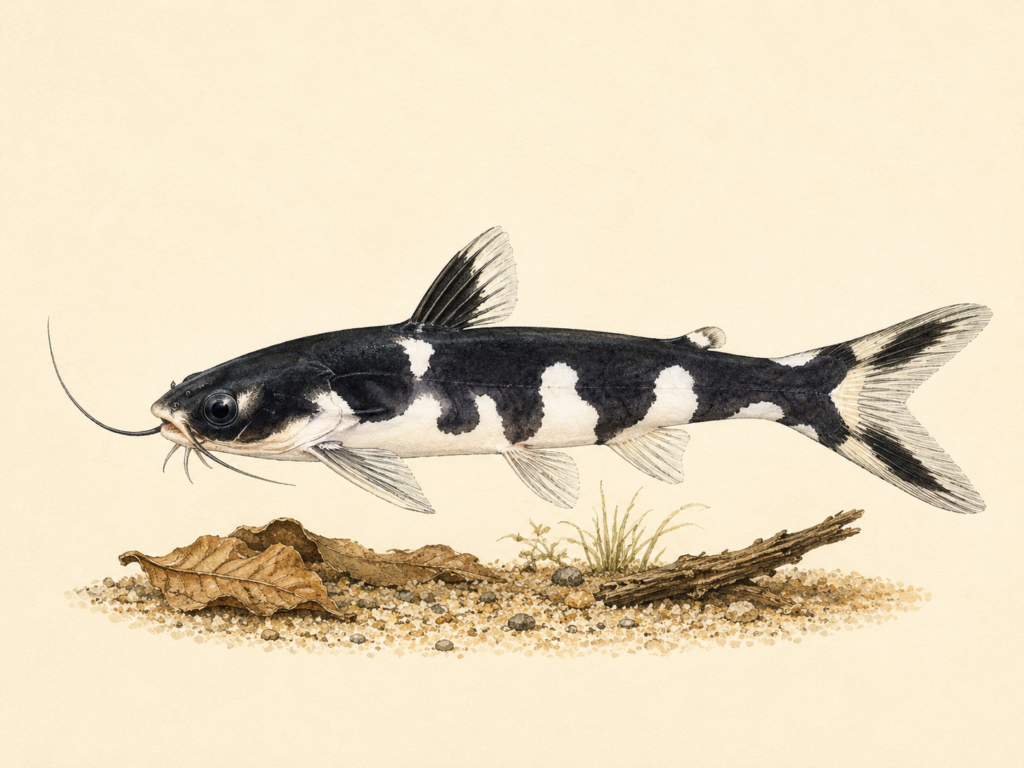
The Ninja Woodcat is a strikingly beautiful small catfish whose appearance fully justifies its species name, musaica, meaning “mosaic.” The body is compact and somewhat torpedo-shaped, with a slightly flattened ventral profile and a broad, rounded head typical of the Auchenipteridae. The base body colour ranges from cream to pale tan, overlaid with a complex network of dark brown to almost black irregular markings that create a mosaic or jigsaw-puzzle pattern. This intricate camouflage is remarkably effective against driftwood, bark, and leaf litter, breaking up the fish’s outline completely.
The fins share the same mosaic patterning, with dark blotches and bands extending across the pectoral, dorsal, caudal, and anal fins. The caudal fin is moderately forked, and the pectoral fins bear sturdy, serrated spines – a characteristic feature of auchenipterid catfish. Care should be taken when netting Ninja Woodcats, as these spines can become entangled in fine mesh nets. The eyes are relatively large for a catfish, reflecting the species’ nocturnal lifestyle and reliance on vision in low-light conditions.
Sexual dimorphism becomes apparent in mature specimens. Males develop a modified anal fin that functions as an intromittent organ (a gonopodium-like structure), which is used during internal fertilisation – a reproductive strategy unusual among catfish but characteristic of the Auchenipteridae. Males also tend to be slightly more slender than females, while gravid females display a noticeably rounder belly when viewed from above. Overall adult size typically reaches 4 to 5 centimetres in standard length, making this one of the smaller members of the genus Tatia.
The intensity of the mosaic patterning can vary between individuals, with some specimens displaying bolder, higher-contrast markings than others. Stress, poor water quality, or inappropriate lighting can cause the colours to fade or become washed out. In optimal conditions, with tannin-stained water and subdued lighting, the contrast between the pale base colour and dark patterning is at its most vivid and attractive.
Natural Habitat
Tatia musaica is found in the Orinoco River basin in Venezuela, where it inhabits slow-moving tributaries, streams, and backwater areas characterised by soft, acidic water. These habitats are typically heavily shaded by dense riparian vegetation and overhanging tree canopy, resulting in dim light conditions even during the daytime. The water is often stained a dark amber to tea colour by tannins leaching from decomposing leaves, wood, and other organic matter.
The substrate in these environments is generally composed of fine sand overlaid with a deep layer of leaf litter, fallen branches, and submerged root systems. It is within this tangled matrix of wood and organic debris that the Ninja Woodcat spends its daylight hours, wedged tightly into crevices and hollows where its mosaic camouflage provides exceptional concealment from predators. The fish often rest in small groups within the same piece of driftwood or root structure, suggesting a degree of social tolerance among conspecifics.
Water flow in these habitats tends to be gentle to moderate. The dissolved mineral content is low, with general hardness often below 5 dGH and pH values ranging from mildly to strongly acidic. Temperatures remain relatively stable year-round in the tropical range of 24 to 28 degrees Celsius. These environmental parameters should be replicated as closely as possible in captivity to ensure the long-term health and wellbeing of this species.
The Orinoco basin is one of the most biodiverse freshwater ecosystems on Earth, and the Ninja Woodcat shares its habitat with a vast array of other fish species, including various tetras, dwarf cichlids, Corydoras catfish, and other small auchenipterids. Understanding this ecological context helps aquarists select appropriate tank mates and create a naturalistic biotope setup that closely mirrors the species’ wild environment.
Tank Size and Setup
A minimum tank size of 60 litres is recommended for a small group of Ninja Woodcats. As these are sociable fish that are best kept in groups of four to six individuals, a larger tank of 80 to 100 litres is preferable to provide adequate hiding places for all specimens without territorial disputes over prime refuges. The tank dimensions are more important than raw volume; a standard rectangular aquarium with a good footprint (at least 60 cm in length) is ideal, as this provides ample floor space and horizontal swimming room.
The aquascape should be designed with the Ninja Woodcat’s natural habitat firmly in mind. Driftwood is the single most important element of the setup. Multiple pieces of branching driftwood, bogwood, or mopani wood should be arranged to create an interlocking network of crevices, tunnels, and hollows. The fish will wedge themselves into surprisingly tight gaps during the day, so providing a variety of differently sized spaces is essential. Commercially available catfish caves, bamboo tubes, and PVC pipe sections can supplement natural driftwood, though they are less aesthetically pleasing.
The substrate should consist of fine sand, ideally in a natural tan or brown shade. Avoid sharp-edged gravel or substrates that could damage the fish’s barbels as it forages along the bottom at night. A generous layer of dried leaf litter – Indian almond leaves (Terminalia catappa), oak leaves, or beech leaves – should be scattered across the substrate. These leaves serve multiple purposes: they release beneficial tannins that soften and acidify the water, they provide additional hiding spots, and they support the growth of microorganisms that supplement the fish’s diet.
Lighting should be kept subdued. The Ninja Woodcat is a strictly nocturnal species and will be stressed by bright overhead lighting. Floating plants such as Amazon frogbit, water lettuce, or red root floaters are highly recommended to diffuse light and create shaded areas beneath the surface. If live plants are desired on the substrate, choose low-light tolerant species such as Java fern, Anubias, or various mosses, which can also be attached directly to the driftwood to enhance the naturalistic appearance of the setup.
A secure, tight-fitting lid is important. While Ninja Woodcats are not habitual jumpers, auchenipterid catfish can and do leap, particularly if startled. Ensuring there are no gaps around filter pipes, heater cables, or other equipment reduces the risk of escape.
Water Parameters
| Temperature | 24-28 °C |
| pH | 5.5-7.0 |
| General hardness (GH) | 2-12 dGH |
| Carbonate hardness (KH) | 1-6 dKH |
| Ammonia | 0 ppm |
| Nitrite | 0 ppm |
| Nitrate | Below 20 ppm |
The Ninja Woodcat thrives in soft, slightly acidic to neutral water that mimics the blackwater and clearwater habitats of its native Orinoco basin. A pH in the range of 5.5 to 7.0 is ideal, with the lower end of this range often bringing out the best colouration and encouraging more natural behaviour. General hardness should be kept low to moderate, between 2 and 12 dGH, while carbonate hardness of 1 to 6 dKH will help maintain a stable pH without making the water excessively alkaline.
Ammonia and nitrite must always be maintained at 0 ppm. Ninja Woodcats are sensitive to dissolved nitrogenous waste, and even brief spikes can cause stress, respiratory distress, or secondary infections. Nitrate levels should be kept below 20 ppm through regular partial water changes, typically 20 to 30 per cent of the tank volume weekly. When performing water changes, the replacement water should be closely matched in temperature and chemistry to avoid shocking the fish.
The addition of tannins through leaf litter, driftwood, or commercially available blackwater extracts is beneficial. Tannins not only lower pH naturally but also possess mild antibacterial and antifungal properties that can help prevent disease. If the aquarist prefers crystal-clear water, activated carbon can be used in the filter, but this will remove tannins and negate some of the benefits of a blackwater-style setup.
Filtration and Equipment
Effective biological filtration is essential for maintaining the pristine water quality that Ninja Woodcats require. A quality external canister filter or a well-sized internal filter rated for the tank volume is recommended. The filter should provide gentle to moderate water flow, as these fish originate from slow-moving waters and do not appreciate strong currents. If the filter output creates too much turbulence, a spray bar or lily pipe can be used to diffuse the flow across the water surface.
Biological filtration media – ceramic rings, sintered glass, or bio-balls – should form the bulk of the filter’s media capacity. Mechanical filtration using filter floss or sponge will trap particulate matter and keep the water clear. As mentioned above, chemical filtration with activated carbon is optional and depends on whether the aquarist wishes to maintain tannin-stained water or prefers a clearer appearance.
A reliable, adjustable heater is necessary to maintain the tropical temperature range of 24 to 28 degrees Celsius. An external or inline heater is preferable if the budget allows, as it reduces the risk of the fish becoming trapped against or behind a standard submersible heater. Whichever type is used, a separate thermometer should be employed to verify the heater’s accuracy, as thermostat failure can have catastrophic consequences.
An air pump with a small airstone can provide supplementary oxygenation, particularly in densely stocked tanks or during warmer months when dissolved oxygen levels naturally drop. However, excessive surface agitation should be avoided if the goal is to maintain a blackwater setup, as vigorous aeration can drive off dissolved carbon dioxide and cause pH instability in very soft water.
Lighting equipment should be chosen with the Ninja Woodcat’s nocturnal nature in mind. A dimmable LED unit is ideal, as it allows the aquarist to keep light levels low during the day and gradually reduce them in the evening to simulate dusk, which encourages the fish to emerge. A dedicated red or blue moonlight mode is a valuable feature, as it allows observation of the fish’s nocturnal activity without disturbing them.
Diet and Feeding
In the wild, the Ninja Woodcat is a micro-predator, feeding on small aquatic invertebrates, insect larvae, crustaceans, and other tiny organisms found among leaf litter and driftwood. In captivity, this dietary preference should be accommodated with a varied diet rich in high-quality protein sources.
The foundation of the captive diet can consist of high-quality sinking pellets or granules designed for small carnivorous catfish. These should be offered in the evening, shortly after the tank lights have been turned off, to coincide with the fish’s natural feeding period. Attempting to feed during the day is largely futile, as the Ninja Woodcat will remain hidden and is unlikely to emerge for food while the lights are on.
Live and frozen foods are eagerly accepted and should be offered regularly to provide nutritional variety and enrichment. Bloodworms (chironomid larvae), daphnia, brine shrimp (Artemia), mosquito larvae, and cyclops are all excellent choices. Live foods are particularly valuable for conditioning breeding pairs and for encouraging newly imported specimens to begin feeding. Avoid relying solely on dried foods, as a monotonous diet can lead to nutritional deficiencies and reduced vitality over time.
Feeding should be done in moderation. The Ninja Woodcat has a small stomach capacity and is prone to overeating if food is available in excess. Offer only as much food as the fish can consume within a few minutes, and remove any uneaten food the following morning to prevent it from fouling the water. Feeding every evening is appropriate for adult specimens, though skipping one day per week can help prevent obesity and maintain good water quality.
It is worth noting that newly acquired Ninja Woodcats may be reluctant to feed for several days after introduction to a new tank. This is normal behaviour for a shy, nocturnal species adjusting to unfamiliar surroundings. Patience is key; offering small quantities of live food in the evening, near the fish’s chosen hiding spot, usually tempts them to begin eating within a week.
Behaviour and Temperament
The Ninja Woodcat is a peaceful, reclusive, and strictly nocturnal species. During daylight hours, it remains hidden deep within driftwood crevices, root tangles, or other dark refuges, emerging only after the tank lights have been extinguished. This behaviour is not a sign of stress or ill health but is entirely natural and should be expected. Aquarists who wish to observe their fish during the day may find this species frustrating, but for those who enjoy the anticipation and reward of nocturnal observation, the Ninja Woodcat is endlessly engaging.
When kept in groups, Ninja Woodcats display interesting social dynamics. They are gregarious by nature and often share the same hiding spots, packing themselves closely together in a single crevice or hollow. A group of four to six individuals is recommended, as solitary specimens tend to be more skittish and may refuse food for extended periods. Within a group, there is generally little aggression, though males may occasionally jostle for position near a favoured female during breeding condition.
At night, the fish become remarkably active, swimming throughout the tank with a fluid, sinuous motion. They forage along the substrate, investigate driftwood surfaces, and may even swim in the mid-water column. Their movements are quick and purposeful, quite unlike the sluggish, bottom-hugging behaviour of many other catfish species. This nocturnal activity can be observed using a red or blue moonlight, which does not disturb the fish.
The Ninja Woodcat is entirely peaceful towards other fish species and poses no threat to anything too large to fit in its small mouth. It is not territorial in any meaningful sense, though individuals will defend their immediate hiding spot if directly challenged. Its pectoral fin spines, while not used aggressively, can cause minor injury to careless hands during netting, and they can become tangled in fine-mesh nets. A container or specimen box is the safest method for catching and transferring these fish.
Tank Mates
The Ninja Woodcat’s peaceful, nocturnal nature makes it compatible with a wide range of similarly sized, non-aggressive community fish. The ideal tank mates are species that occupy different ecological niches or are active during the daytime, minimising competition for space and food. Avoid housing Ninja Woodcats with large, boisterous, or aggressive species that could intimidate them or outcompete them for food. Very small shrimp, such as cherry shrimp, may be at risk of predation during the night, particularly juveniles, given the Ninja Woodcat’s predatory instincts towards small invertebrates.
Good tank mates
- Cardinal Tetra – A peaceful, small schooling fish that thrives in the same soft, acidic water conditions preferred by the Ninja Woodcat.
- Rummy-nose Tetra – An excellent dither fish that shares the Ninja Woodcat’s preference for warm, soft, tannin-stained water.
- Ember Tetra – A tiny, peaceful tetra ideally suited to the subdued lighting and gentle flow of a Ninja Woodcat tank.
- Pygmy Corydoras – A small, sociable bottom-dweller that is active during the day and will not compete with the nocturnal Ninja Woodcat.
- Otocinclus – A gentle algae-eating catfish that coexists peacefully and helps maintain tank cleanliness.
- Apistogramma cacatuoides – A dwarf cichlid that occupies different microhabitats and is generally compatible in a well-structured tank.
- Marbled Hatchetfish – A surface-dwelling species that stays near the top of the water column, avoiding any spatial conflict with the bottom-dwelling Ninja Woodcat.
- Kuhli Loach – Another peaceful, nocturnal bottom-dweller that cohabits well provided ample hiding spots are available for both species.
Fish to avoid
- Oscar – A large, predatory cichlid that would readily consume the diminutive Ninja Woodcat.
- Tiger Barb – A boisterous, fin-nipping species whose hyperactive behaviour can stress shy, retiring catfish.
- Convict Cichlid – An aggressive, territorial cichlid that would bully and potentially injure the Ninja Woodcat.
- Red-tail Catfish – A massive predatory catfish completely incompatible due to its enormous adult size and predatory nature.
- African Rift Lake Cichlids – These species require hard, alkaline water conditions entirely unsuitable for the Ninja Woodcat.
- Chinese Algae Eater – Can become aggressive and territorial as it matures, harassing smaller tank mates.
- Green Terror – A large, aggressive New World cichlid that poses a serious threat to small, peaceful species.
- Common Pleco – While not aggressive, this species grows far too large for the tank sizes suitable for Ninja Woodcats and produces excessive waste.
Breeding
Breeding the Ninja Woodcat in captivity is achievable but requires careful preparation and an understanding of the unique reproductive biology of auchenipterid catfish. Unlike the vast majority of catfish families, members of the Auchenipteridae practise internal fertilisation. The male uses his modified anal fin to transfer sperm directly to the female, who then stores the sperm and fertilises her eggs internally before depositing them.
To encourage breeding, start with a well-established group of at least six individuals in a dedicated breeding tank or a spacious, well-furnished community setup. Condition the fish with a varied diet of high-quality live and frozen foods for several weeks before attempting to trigger spawning. Bloodworms, daphnia, and brine shrimp are particularly effective conditioning foods.
Spawning can often be triggered by performing a large, cool water change (approximately 30 to 40 per cent of the tank volume) using water that is two to three degrees cooler than the tank temperature. This simulates the onset of the rainy season in the fish’s native habitat. Reducing the photoperiod slightly and increasing the frequency of live food offerings can also help.
Mating typically occurs at night and is rarely observed directly. The male approaches the female and uses his modified anal fin to inseminate her. After a gestation period of several days, the female deposits small clusters of adhesive eggs on hard surfaces – typically the undersides of driftwood, inside hollow logs, or on the surfaces of broad leaves. The eggs are relatively small and translucent, making them easy to overlook.
Parental care is minimal to non-existent. In a community setting, the eggs are at risk of being consumed by other fish or even by the adult Ninja Woodcats themselves. If the goal is to maximise fry survival, the eggs or the surface they are attached to should be carefully removed to a separate rearing tank equipped with gentle aeration and an antifungal treatment such as methylene blue to prevent egg fungus.
The eggs typically hatch within three to five days, depending on temperature. The newly hatched fry are tiny and require infusoria or commercially available liquid fry food for the first few days before graduating to freshly hatched brine shrimp nauplii and microworms. Growth is relatively slow, and the fry should be kept in dim conditions with plenty of cover to reduce stress. Regular, small water changes are essential to maintain water quality in the rearing tank without subjecting the delicate fry to sudden parameter shifts.
Common Diseases
The Ninja Woodcat is a reasonably hardy species when maintained in appropriate conditions, but it is susceptible to the common diseases that affect most freshwater aquarium fish. Prevention through good husbandry is always preferable to treatment, and maintaining stable water parameters, performing regular water changes, and providing a varied diet will go a long way towards keeping these fish healthy.
White spot disease (Ichthyophthirius multifiliis) is perhaps the most frequently encountered ailment. It manifests as small white cysts on the skin, fins, and gills. Ninja Woodcats are scaleless fish, which means they are more sensitive to many common ich medications, particularly those containing copper or malachite green. Half-dose treatments or heat-based methods (gradually raising the temperature to 30 degrees Celsius for several days) are generally safer for scaleless species. Always consult the medication’s instructions regarding use with scaleless fish.
Bacterial infections, including fin rot and skin ulcers, can occur when water quality deteriorates or when the fish sustains injuries from sharp decor or during netting. Symptoms include frayed fins, reddened patches on the skin, and lethargy. Improving water quality is the first and most important step; in more severe cases, a broad-spectrum antibacterial treatment may be necessary.
Fungal infections typically appear as cotton-wool-like growths on the skin or fins and are often secondary to a pre-existing injury or bacterial infection. Antifungal treatments are widely available, but again, care should be taken with dosage for scaleless species. Removing any sharp or abrasive decor from the tank can help prevent the injuries that often precede fungal infection.
Internal parasites can occasionally affect wild-caught specimens. Symptoms may include weight loss despite a good appetite, white or stringy faeces, and a generally emaciated appearance. If internal parasites are suspected, a targeted antiparasitic treatment containing praziquantel or levamisole is usually effective. Quarantining new arrivals for two to four weeks before adding them to the main tank is a sound practice that can prevent the introduction of parasites and other pathogens.
Stress is an underlying factor in many disease outbreaks. Keeping the Ninja Woodcat in conditions that replicate its natural environment – dim lighting, ample hiding places, soft acidic water, and compatible tank mates – is the best way to minimise stress and maintain robust immune function.
FAQs
Why do I never see my Ninja Woodcat during the day?
This is entirely normal behaviour for a strictly nocturnal species. Ninja Woodcats spend the daylight hours hidden deep within driftwood, root tangles, or other dark refuges and only emerge after the tank lights have been switched off. To observe their nocturnal activity, try using a dim red or blue moonlight LED, which allows you to watch them without disturbing their natural behaviour. Over time, in a calm, well-established tank, some individuals may begin to emerge slightly before the lights go off, particularly if they associate dusk with feeding time.
Can I keep a single Ninja Woodcat, or do they need to be in a group?
While a single specimen can survive on its own, Ninja Woodcats are naturally gregarious and are best kept in groups of four to six. Solitary individuals tend to be more reclusive, more easily stressed, and may refuse food for prolonged periods. In a group, the fish display more confident behaviour, are more likely to feed readily, and may even be seen resting together in the same hiding spot during the day. A group also provides the social dynamics necessary for potential breeding.
Will Ninja Woodcats eat my shrimp?
There is a genuine risk that Ninja Woodcats will prey on very small shrimp, particularly juvenile cherry shrimp, Neocaridina, or similar diminutive species. While adult Amano shrimp are generally too large to be at risk, smaller shrimp species may be hunted during the Ninja Woodcat’s nocturnal foraging. If you keep a breeding colony of small shrimp, it is advisable to either house them separately or provide extremely dense plant cover and hiding places that allow the shrimp to avoid predation. Losses of very small shrimp should be anticipated.
What is the best way to net a Ninja Woodcat without injury?
Ninja Woodcats, like all auchenipterid catfish, have strong, serrated pectoral fin spines that easily become entangled in standard fine-mesh aquarium nets. Attempting to free a tangled fish can result in injury to both the fish and the aquarist. The safest method is to use a clear plastic or glass container – such as a specimen box or a clean glass jar – to gently guide the fish into the container and then lift it from the water. This avoids any risk of spine entanglement and causes far less stress to the fish.
Do Ninja Woodcats need tannin-stained water?
While tannin-stained (blackwater) conditions are not strictly mandatory, they are strongly recommended and closely replicate the species’ natural habitat. Tannins released by Indian almond leaves, driftwood, and other botanical materials lower pH, soften the water, and possess mild antimicrobial properties that can help prevent disease. Fish kept in tannin-stained water frequently display better colouration, more natural behaviour, and improved overall health. If you prefer clear water for aesthetic reasons, the fish can still thrive provided other parameters such as pH, hardness, and lighting are within the recommended ranges.
Related Guides
- Tatia galaxias – A closely related driftwood catfish with similar care requirements and nocturnal habits, ideal for comparison with Tatia musaica.
- Pygmy Corydoras – An excellent small catfish tank mate for the Ninja Woodcat, sharing a preference for soft water and peaceful community setups.
- Apistogramma cacatuoides – A popular dwarf cichlid from South America that thrives in the same soft, acidic water conditions and makes a compatible tank mate.
- Cardinal Tetra – A classic blackwater community fish that pairs beautifully with the Ninja Woodcat in an Orinoco-inspired biotope setup.
- Centromochlus perugiae – Another small auchenipterid catfish with overlapping care needs, useful for aquarists interested in exploring the driftwood catfish family further.