Quick summary
The Orange Rabbit Snail is a peaceful, striking gastropod that’s a great fit if you can provide warm, alkaline, moderately hard water and a stable, mature tank of at least 60 litres, but it’s not ideal for beginners with soft, acidic water setups since incorrect parameters can damage its shell. It’s low maintenance in terms of temperament and breeding (producing just one offspring at a time), making it easy to manage once its specific water chemistry needs are met.
🐠 Build a tank around this species
In this guide:
- Introduction
- Quick Stats
- Appearance
- Natural Habitat
- Tank Size and Setup
- Water Parameters
- Filtration and Equipment
- Diet and Feeding
- Behaviour and Temperament
- Tank Mates
- Breeding
- Common Diseases
- FAQs
Introduction
The Orange Rabbit Snail is one of the most visually striking freshwater gastropods available in the aquarium hobby. Belonging to the genus Tylomelania, a group endemic to the ancient lakes of Sulawesi, Indonesia, this species has captured the attention of aquarists worldwide with its vivid orange body colouration and elongated, ridged shell. Unlike many common aquarium snails that are often viewed as incidental additions or even pests, rabbit snails are kept deliberately for their beauty, personality, and gentle demeanour.
Tylomelania gemmifera is part of a fascinating radiation of freshwater snails that evolved in the Malili lake system of central Sulawesi, an archipelago of tectonic lakes that rivals Africa’s Great Rift Valley lakes in terms of endemic biodiversity. These lakes, primarily Lake Towuti, Lake Matano, and Lake Mahalona, harbour dozens of Tylomelania species, many of which have only been scientifically described in the last two decades. The Orange Rabbit Snail has become one of the more popular representatives of this group in the aquarium trade, prized for the warm, sunset-like hue of its soft body tissue contrasted against a dark, sculptured shell.
Rabbit snails earn their common name from the elongated face and drooping antennae that give them a vaguely rabbit-like appearance. They are peaceful, slow-moving creatures that spend their time methodically grazing across substrate, driftwood, and glass. Their relatively large adult size, calm temperament, and manageable care requirements make them an excellent choice for community aquariums, planted tanks, and dedicated invertebrate setups alike. This guide covers everything you need to know to keep Orange Rabbit Snails healthy and thriving in the home aquarium.
Quick Stats
| Common names | Orange Poso Rabbit Snail, Orange Elephant Snail |
|---|---|
| Origin | Sulawesi, Indonesia |
| Adult size | 8.5 cm |
| Difficulty | Intermediate |
| Breeding difficulty | Moderate |
| Temperature | 26–30 °C |
| pH | 7.5–8.5 |
| Minimum tank size | 60 L |
| Conservation status | Vulnerable (IUCN) |
Appearance
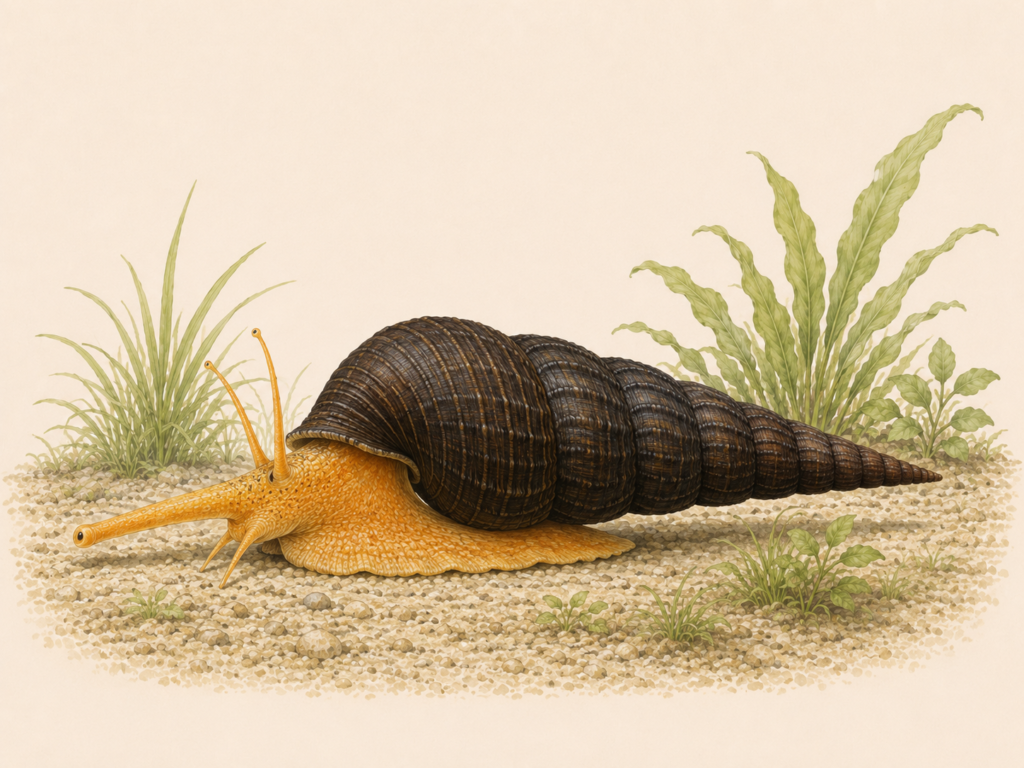
The Orange Rabbit Snail is immediately recognisable for the vivid orange pigmentation of its body, which ranges from a deep tangerine to a lighter golden-orange depending on the individual, its diet, and overall condition. The skin texture is characteristically wrinkled and leathery, with the mantle and foot displaying a uniformly warm tone that stands in bold contrast to the dark brown or near-black shell. The head features a distinctively elongated snout, sometimes described as trunk-like, which the snail uses to probe the substrate for food. Two long, drooping antennae extend from the head, lending the animal its rabbit-like appearance.
The shell of Tylomelania gemmifera is conical and turreted, spiralling to a pointed apex. In healthy adults the shell typically reaches 7 to 10 centimetres in length, though some particularly well-kept specimens may slightly exceed this range. The shell surface is adorned with prominent ridges and a textured, almost gem-like pattern of bumps and nodules, which is reflected in the species epithet “gemmifera,” derived from the Latin for “gem-bearing.” Shell colouration tends to be dark chocolate brown to black, though older shells may develop a slightly lighter patina or show minor erosion at the apex, which is normal and not necessarily a sign of poor health.
Juvenile Orange Rabbit Snails are born as miniature versions of the adults, already displaying the orange body colouration, though it may intensify with age and proper nutrition. Males and females are virtually indistinguishable externally, making sexing by visual inspection alone unreliable. The operculum, a hard plate attached to the foot that seals the shell opening when the snail retracts, is visible as a dark, oval structure at the rear of the foot.
Natural Habitat
Tylomelania gemmifera originates from the ancient Malili lake system on the island of Sulawesi in Indonesia. This system comprises several interconnected tectonic lakes, including Lake Towuti, Lake Matano, Lake Mahalona, and Lake Poso, each of which harbours its own suite of endemic species. These lakes are among the oldest in the world, estimated to be between one and four million years old, and their long geological history has allowed extraordinary levels of speciation to occur in isolation.
The waters of the Malili lakes are characteristically warm, alkaline, and moderately hard. Lake Towuti, for example, has a surface temperature consistently above 27 °C and a pH typically ranging from 7.5 to 8.5. The mineral content is influenced by the surrounding laterite soils and ultrabasic rock formations, contributing to a unique water chemistry that is relatively high in iron and nickel but low in calcium compared to many other tropical freshwater systems. Despite this, the carbonate hardness is sufficient to support healthy shell growth in the native gastropod fauna.
In the wild, Orange Rabbit Snails are found on a variety of substrates including sandy lake floors, rocky outcrops, submerged logs, and leaf litter. They are typically encountered at moderate depths in areas with gentle water movement rather than exposed, wave-battered shorelines. The lakes are notably clear, with relatively low nutrient levels and limited algal growth, which means these snails are adapted to grazing on biofilm, decaying organic matter, and thin coatings of microalgae rather than dense algal mats. Understanding this natural habitat is key to replicating suitable conditions in captivity and avoiding common pitfalls such as overly soft or acidic water.
Tank Size and Setup
A minimum aquarium volume of 60 litres is recommended for a small group of Orange Rabbit Snails. While a single specimen could technically survive in a smaller tank, these are relatively large snails with an active, exploratory nature, and they benefit from ample floor space to roam. A standard 60-to-80-litre rectangular aquarium provides a good footprint for two to four individuals. If you wish to keep a larger group or house them alongside fish, a tank of 100 litres or more is preferable.
Substrate choice is important. Fine sand is the ideal substrate for rabbit snails, as they spend a great deal of time burrowing partially into the substrate to forage and rest. Coarse gravel can damage their soft bodies and make burrowing difficult, so it should be avoided. A layer of fine, smooth sand at least three to four centimetres deep allows them to exhibit natural behaviour. Some keepers use a dark sand substrate, which provides an attractive visual contrast against the snails’ orange bodies.
Decor should include pieces of driftwood, smooth rocks, and leaf litter, all of which provide surfaces for biofilm growth and hiding spots. Rabbit snails are not aggressive plant eaters under normal circumstances, though they have been known to nibble on softer-leaved plants when hungry or when biofilm and supplementary food are insufficient. Hardy plants such as Anubias, Java Fern, and Bucephalandra are generally safe choices, as their tougher leaves are less appealing. Floating plants can be used to diffuse lighting, which these snails seem to appreciate given their preference for slightly shaded environments in the wild.
Ensure the tank has a secure lid or a minimal gap between the water surface and the tank rim. While rabbit snails are not prolific escape artists compared to some nerite species, they do occasionally explore above the waterline, and a determined individual can find its way out of an uncovered tank. A tight-fitting lid also helps maintain the warm, humid air layer above the water that supports the snail’s respiratory function.
Water Parameters
Maintaining stable, appropriate water chemistry is arguably the single most important aspect of rabbit snail care. Tylomelania gemmifera evolved in warm, alkaline, moderately hard water, and it does not tolerate prolonged exposure to soft, acidic, or cool conditions. The following parameters represent the ideal range for captive care.
| Temperature | 26–30 °C |
| pH | 7.5–8.5 |
| General hardness (GH) | 4–12 dGH |
| Carbonate hardness (KH) | 4–8 dKH |
| Ammonia | 0 ppm |
| Nitrite | 0 ppm |
| Nitrate | Below 20 ppm |
Temperature is a critical factor. The Sulawesi lakes remain consistently warm year-round, and these snails are poorly adapted to cooler conditions. Temperatures below 24 °C can slow metabolism, reduce feeding, and compromise the immune system. A reliable aquarium heater with a thermostat is essential, and the temperature should be maintained at or above 26 °C at all times. The upper end of the range, around 28–30 °C, is well tolerated and mimics their natural environment closely.
The pH should be kept firmly on the alkaline side. Acidic water is damaging to the shell and stressful to the animal. If your tap water is naturally soft and acidic, you will need to buffer it using crushed coral, limestone, or a commercial remineralising product to achieve and maintain a pH above 7.5. Carbonate hardness acts as a buffer against pH swings, so maintaining a KH of at least 4 dGH is advisable. Regular water testing is important, particularly in the first few months of establishing a tank, to ensure that conditions remain stable.
Like all aquatic invertebrates, rabbit snails are highly sensitive to ammonia and nitrite, both of which must be kept at zero. Nitrate should be kept below 20 ppm through regular partial water changes, typically 15–25% weekly. Copper is toxic to invertebrates even in trace amounts, so always check that any water conditioners, medications, or fertilisers used in the tank are copper-free. If medicating fish in a tank containing rabbit snails, exercise extreme caution and research each product’s invertebrate safety beforehand.
Filtration and Equipment
Efficient biological filtration is essential for maintaining the pristine water quality that rabbit snails require. A hang-on-back filter, internal filter, or canister filter rated for the tank volume will all work well. Sponge filters are another excellent option, particularly for smaller setups or breeding tanks, as they provide gentle water movement and a large surface area for beneficial bacteria without any risk of trapping small snails in an intake.
Water flow should be gentle to moderate. In their native lakes, Orange Rabbit Snails inhabit areas with calm conditions rather than fast-flowing currents. Excessive flow can stress them and make it difficult to move around and feed comfortably. If your filter produces a strong output, consider using a spray bar or directing the outflow against the glass to diffuse the current.
A reliable heater is non-negotiable for this tropical species. Choose a heater with an accurate thermostat and consider using a separate aquarium thermometer to verify the temperature independently. In larger tanks, two smaller heaters placed at opposite ends can provide more even heat distribution. A thermometer with a digital readout makes it easy to spot any temperature fluctuations at a glance.
Lighting requirements are modest. Rabbit snails do not have specific lighting needs, but moderate lighting that supports biofilm and some algae growth on surfaces is beneficial, as it supplements their diet. If keeping live plants, choose lighting appropriate for the plant species. Very intense lighting is unnecessary and may encourage excessive algae growth that, while not harmful to the snails, can be aesthetically undesirable.
Diet and Feeding
Orange Rabbit Snails are omnivorous detritivores with a preference for decaying organic matter, biofilm, and soft plant material. In the wild they graze continuously across the substrate and hard surfaces, consuming the thin layer of microalgae, bacteria, and decomposing matter that coats virtually every surface in the lake. In captivity, they readily accept a wide range of foods, making them straightforward to feed.
A high-quality sinking food should form the staple of their diet. Algae wafers, spirulina tablets, and sinking pellets designed for bottom-dwelling fish or invertebrates are all well accepted. Supplement these with blanched vegetables such as courgette (zucchini), cucumber, spinach, kale, and green beans. Vegetables should be blanched briefly to soften them and then weighted down or attached to a clip so they sink. Remove any uneaten portions within 24 hours to prevent fouling the water.
Calcium-rich foods are particularly important for maintaining healthy shell growth and repair. Cuttlebone is an excellent calcium source and can be left in the tank permanently; the snails will rasp at it as needed, and it slowly dissolves to supplement the water’s mineral content. Calcium-enriched snail foods, available from specialist aquarium suppliers, are another useful addition. Some keepers also offer small amounts of crushed eggshell or calcium carbonate powder mixed into homemade gel foods.
Protein should be offered occasionally but not in excess. Small amounts of frozen or freeze-dried bloodworm, brine shrimp, or high-quality fish food pellets provide a useful protein boost, particularly for growing juveniles and gravid females. Leaf litter from Indian almond leaves, oak leaves, or beech leaves serves a dual purpose: it provides a natural food source as it decomposes and promotes the growth of biofilm and beneficial microorganisms that the snails graze on.
Feed once daily or every other day, adjusting the amount based on how quickly the food is consumed. Rabbit snails are slow eaters, so it is better to offer modest portions and observe consumption rather than overfeeding, which can degrade water quality.
Behaviour and Temperament
Orange Rabbit Snails are among the most docile and inoffensive creatures you can keep in a freshwater aquarium. They move at a characteristically unhurried pace, extending their long snout to probe the substrate as they glide forward on a broad, muscular foot. Their movements are deliberate and methodical, and watching them explore the tank can be surprisingly engaging. They are often most active during the evening and night, though they will also emerge and feed during the day, especially once they become accustomed to a regular feeding schedule.
Burrowing is a natural and frequently observed behaviour. Rabbit snails will often partially bury themselves in the substrate, sometimes remaining motionless for hours with only the tip of the shell visible. This is entirely normal resting behaviour and not a cause for concern. They tend to burrow more frequently after eating or when the lights are bright, emerging again in dimmer conditions to resume grazing.
These snails are not territorial and coexist peacefully with their own kind and with other species. They do not compete aggressively for food and are rarely involved in any form of conflict. Their primary response to perceived threat is to retract into the shell and close the operculum, waiting patiently until the disturbance passes. They are entirely harmless to fish, shrimp, and other invertebrates, making them ideal community tank residents.
One behaviour that sometimes alarms new keepers is the occasional tendency for a rabbit snail to remain retracted for an extended period. While this can indicate stress or poor water conditions, it is also a normal response to environmental changes such as a water change or the introduction to a new tank. If a snail remains inactive for more than a day or two and does not respond to the smell of food, water parameters should be tested immediately.
Tank Mates
Orange Rabbit Snails are peaceful invertebrates that coexist well with a wide range of similarly tempered tank mates. The key considerations when choosing companions are to avoid species that prey on snails, nip at antennae, or require water conditions incompatible with the warm, alkaline parameters that rabbit snails need.
Good tank mates
- Cardinal Sulawesi Shrimp (Caridina dennerli), these shrimp share the same native habitat and thrive in identical warm, alkaline water conditions.
- Celestial Pearl Danio (Danio margaritatus), a small, peaceful fish that occupies the upper water column and poses no threat to snails.
- Endler’s Livebearer (Poecilia wingei), a tiny, colourful livebearer that tolerates the warm, hard water conditions rabbit snails require.
- Kuhli Loach (Pangio kuhlii), a peaceful bottom-dweller that is too small to harm rabbit snails and coexists well in sandy substrates.
- Otocinclus Catfish (Otocinclus vittatus), a gentle algae grazer that shares similar dietary habits without competing aggressively for food.
- Cherry Shrimp (Neocaridina davidi), Hardy, peaceful shrimp that thrive alongside snails and add colour and activity to the tank.
- Nerite Snail (Neritina spp.), another peaceful gastropod that helps manage algae and cohabits without conflict.
- Harlequin Rasbora (Trigonostigma heteromorpha), a calm, schooling fish that stays in the middle water column and ignores invertebrates entirely.
- Bristlenose Pleco (Ancistrus spp.), a peaceful algae-eating catfish that can share space with rabbit snails without aggression, provided the tank is large enough.
Fish to avoid
- Clown Loach (Chromobotia macracanthus), a well-known snail predator that will actively hunt and consume rabbit snails.
- Yoyo Loach (Botia almorhae), another loach species with a strong instinct to prey on snails of all sizes.
- Assassin Snail (Clea helena), a carnivorous snail that targets other gastropods and can injure or kill juvenile rabbit snails.
- Green Spotted Puffer (Dichotomyctere nigroviridis), Pufferfish are specialised snail predators with powerful beaks capable of crushing shells.
- Oscar (Astronotus ocellatus), a large, predatory cichlid that will readily eat snails and other invertebrates.
- Convict Cichlid (Amatitlania nigrofasciata), an aggressive cichlid that may harass, attack, or consume snails.
- Jack Dempsey (Rocio octofasciata), a large, territorial cichlid that poses a serious predation risk to slow-moving snails.
- Common Goldfish (Carassius auratus), Requires much cooler water than rabbit snails and may also nip at antennae and soft tissue.
Breeding
One of the most fascinating aspects of Tylomelania biology is their reproductive strategy. Unlike many freshwater snails that reproduce prolifically through egg masses, rabbit snails are live-bearers that produce a single, fully-formed juvenile at a time. This makes population control in the home aquarium very straightforward, as you will never experience the kind of population explosions associated with pest snails such as bladder snails or Malaysian trumpet snails.
Rabbit snails are gonochoric, meaning they have distinct sexes, though as noted earlier it is virtually impossible to determine sex externally. To breed them, the simplest approach is to maintain a group of at least four to six individuals, which statistically increases the likelihood of having both males and females present. Mating typically occurs at night and may go unobserved by the keeper.
After a gestation period of approximately four to six weeks, the female gives birth to a single juvenile enclosed in a small, milky-white egg sac. The baby snail emerges from this sac within a few hours and is immediately independent, crawling away to begin grazing on biofilm and detritus. Newborn rabbit snails are remarkably large relative to their parents, typically measuring around 5 to 8 millimetres in shell length at birth, which gives them a significant survival advantage over the microscopic larvae produced by many other snail species.
Breeding frequency varies but is generally slow, with a female producing one offspring every four to eight weeks under optimal conditions. Warm temperatures at the upper end of the recommended range, a calcium-rich diet, and stable water parameters all encourage reproductive activity. Rearing the juveniles requires no special effort beyond ensuring that the tank is mature with plenty of biofilm and that supplementary food is available. The young snails grow steadily but not rapidly, typically reaching adult size within 12 to 18 months.
Because of their low reproductive rate, rabbit snails are not bred commercially on a large scale in the same way as Neocaridina shrimp or common aquarium snails. Many specimens in the trade are still wild-caught, which underscores the importance of maintaining healthy captive populations and breeding them when possible to reduce pressure on wild stocks.
Common Diseases
Orange Rabbit Snails are generally hardy when kept in appropriate conditions, but they are susceptible to a number of health issues, most of which are directly linked to poor water quality or unsuitable parameters.
Shell erosion is the most commonly observed problem. This manifests as pitting, thinning, or whitening of the shell, particularly at the apex, which is the oldest and most vulnerable part of the structure. While some degree of apex erosion is normal in older individuals, even wild specimens show it, progressive erosion affecting larger areas of the shell indicates insufficient calcium availability, overly acidic water, or both. Maintaining a pH above 7.5, a KH above 4, and providing dietary calcium through cuttlebone or calcium supplements will help prevent and slow shell deterioration. Once eroded, shell material cannot regenerate, but the snail can lay down new, healthy shell growth at the aperture if conditions are corrected.
Bacterial and fungal infections can occur, typically appearing as white or grey patches on the body tissue, or as unusual swelling. These infections most often take hold when the snail’s immune system is compromised by stress, poor water quality, or physical injury. Treatment is difficult, as many common aquarium medications are toxic to invertebrates. The best approach is prevention through maintaining excellent water quality, and if an infection is suspected, isolating the affected individual in a clean hospital tank with pristine, well-oxygenated water and allowing natural recovery.
Parasitic infections, though uncommon in captive-bred specimens, can be introduced with wild-caught individuals. Internal parasites may cause lethargy, reduced feeding, and weight loss. Quarantining new arrivals for at least two to four weeks before introducing them to the main tank is strongly advisable.
Copper toxicity is a serious and frequently fatal risk. Even trace amounts of copper, whether from medications, fertilisers, or contaminated tap water, can kill invertebrates. Always verify that any product added to a tank containing rabbit snails is explicitly labelled as safe for invertebrates. If you suspect copper contamination, immediate large water changes with dechlorinated, copper-free water are essential.
Stress-related inactivity, where the snail remains retracted for prolonged periods, can result from sudden changes in temperature, pH, or water chemistry. Acclimatise new snails slowly using a drip method over at least one to two hours, and avoid large, abrupt water changes that could cause parameter swings.
FAQs
Are Orange Rabbit Snails safe to keep with live plants?
Orange Rabbit Snails are not considered significant plant pests. While they may occasionally nibble on softer-leaved plants, this behaviour is typically only observed when their primary food sources are insufficient. Providing regular supplementary feeding with algae wafers, blanched vegetables, and leaf litter will greatly reduce any interest in living plants. Hardy species such as Anubias, Java Fern, and Bucephalandra are the safest choices for a planted tank containing rabbit snails.
How many Orange Rabbit Snails can I keep in my tank?
A general guideline is one rabbit snail per 15 to 20 litres of aquarium volume, though this depends on the tank’s filtration capacity and bioload from other inhabitants. In a 60-litre tank, two to three individuals is a comfortable number. In a 100-litre or larger aquarium, a group of five to six can be maintained without issues, provided water quality is well managed. Their low reproductive rate means overpopulation is rarely a concern.
Why is my rabbit snail not moving?
Extended periods of inactivity are not always cause for alarm. Rabbit snails frequently rest for hours at a time, especially after feeding or when buried in the substrate. However, if a snail has been completely retracted and unresponsive for more than 48 hours, it may be stressed or unwell. Test water parameters immediately, paying particular attention to ammonia, nitrite, temperature, and pH. Gently placing a piece of food near the snail can sometimes elicit a feeding response. If the snail emits a foul odour, it has unfortunately died and should be removed promptly to avoid polluting the water.
Do Orange Rabbit Snails breed quickly?
No. Unlike pest snail species, rabbit snails reproduce very slowly. Each female produces only a single baby at a time after a gestation period of several weeks. This means that even in a tank with multiple adults, population growth is gradual and easily manageable. Most hobbyists actively welcome rabbit snail babies rather than needing to control their numbers.
Can I keep Orange Rabbit Snails in soft, acidic water?
This is strongly discouraged. Orange Rabbit Snails evolved in the alkaline, moderately hard waters of the Sulawesi lakes and are poorly adapted to soft, acidic conditions. Water with a pH below 7.0 will gradually dissolve and erode the shell, leading to serious health problems and a shortened lifespan. If your tap water is naturally soft and acidic, you will need to use buffers such as crushed coral, limestone, or commercial remineralisers to achieve a pH of at least 7.5 and a KH of at least 4 dGH before adding rabbit snails to the tank.
Related Guides
- Yellow Rabbit Snail (Tylomelania sp.), a closely related Sulawesi species with similar care requirements and a bright yellow body, making it an excellent companion or alternative.
- Nerite Snail Care Guide, another popular ornamental snail that thrives in similar alkaline conditions and makes a good tank mate for rabbit snails.
- Cardinal Sulawesi Shrimp Care Guide, a guide to keeping these stunning shrimp from the same Sulawesi lakes, covering the specialised water parameters they share with rabbit snails.
- Mystery Snail Care Guide, a comparison species that is widely available and beginner-friendly, useful for understanding the broader world of ornamental freshwater snails.
- Freshwater Snail Feeding Guide, a comprehensive overview of diet and nutrition for aquarium gastropods, including calcium supplementation strategies relevant to rabbit snails.