Quick summary
The Wabenmuster Honeycomb Bristlenose is a moderately easy, peaceful catfish best suited to hobbyists with some experience, needing a 100+ litre tank, soft to moderately hard slightly acidic water, plenty of driftwood and caves, and a mostly vegetable-based diet. It’s a good fit if you want an attractive, low-aggression pleco for a South American community setup, but be aware it can be harder to source than common bristlenose plecos since it’s typically sold by specialist breeders.
🐠 Build a tank around this fish
In this guide:
- Introduction
- Quick Stats
- Appearance
- Natural Habitat
- Tank Size and Setup
- Water Parameters
- Filtration and Equipment
- Diet and Feeding
- Behaviour and Temperament
- Tank Mates
- Breeding
- Common Diseases
- FAQs
Introduction
The Wabenmuster Honeycomb Bristlenose, traded under the scientific designation Ancistrus sp. “Wabenmuster”, is a visually striking undescribed species or trade form within the genus Ancistrus. The common name derives from the German word “Wabenmuster”, meaning honeycomb pattern, which aptly describes the distinctive reticulated scale markings that set this fish apart from more commonly available bristlenose plecos. Like its better-known relatives, this catfish hails from South America and belongs to the family Loricariidae, the armoured catfishes that have become staples of the freshwater aquarium hobby worldwide.
Although the Wabenmuster Honeycomb Bristlenose has not been formally described by taxonomists and remains an undescribed species or trade form, it has gained a dedicated following among pleco enthusiasts and collectors of unusual Ancistrus variants. Its care requirements are broadly similar to those of other small to medium-sized Ancistrus species, making it accessible to hobbyists with moderate experience. However, sourcing this fish can be more challenging than finding the ubiquitous Common Bristlenose, as it tends to appear in specialist shops and through dedicated breeders rather than in mainstream aquatic retail outlets.
This care guide covers everything you need to know to keep and breed Ancistrus sp. “Wabenmuster” successfully in a home aquarium, from water parameters and tank setup to diet, behaviour, and compatible tank mates. Whether you are an experienced pleco keeper looking to add a new species to your collection or a relative newcomer drawn in by the honeycomb patterning, the information below will help you provide optimal conditions for this attractive catfish.
Quick Stats
| Scientific name | Ancistrus sp. “Wabenmuster” |
|---|---|
| Common names | Honeycomb Bristlenose Pleco, Wabenmuster Ancistrus |
| Family | Loricariidae |
| Origin | South America, likely Amazon or Orinoco basin |
| Adult size | 11.5 cm |
| Lifespan | 8–12 years |
| Difficulty | Intermediate |
| Breeding difficulty | Moderate |
| Temperature | 24–28 °C |
| pH | 5.5–7.5 |
| GH | 2–15 dGH |
| KH | 1–10 dKH |
| Minimum tank size | 100 L |
| Conservation status | Not evaluated |
Appearance
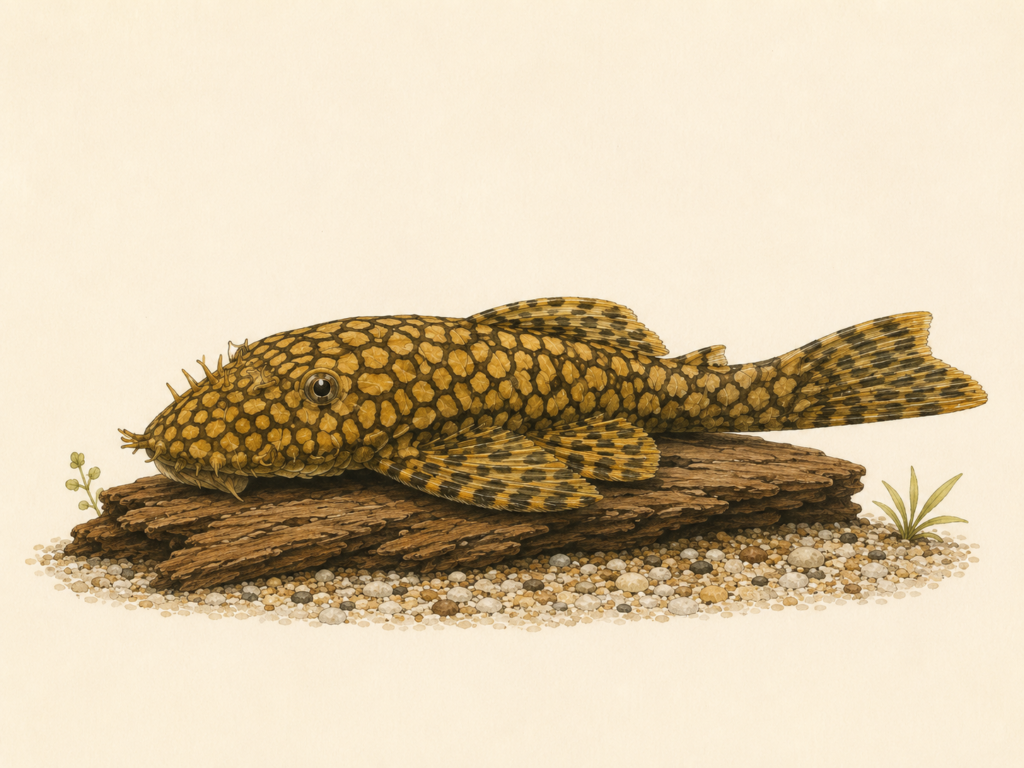
The defining feature of Ancistrus sp. “Wabenmuster” is, unsurprisingly, its honeycomb-like patterning. The body is covered in a network of lighter-coloured lines or ridges that trace the edges of the bony scutes, creating a pronounced reticulated or net-like appearance against a darker base colour. This pattern is most evident on the flanks and dorsal surface, where the contrast between the dark centres of each scute and the paler margins gives the impression of a honeycomb viewed from above. The base colour typically ranges from dark brown to charcoal grey, while the honeycomb lines can appear as tan, golden-brown, or pale cream depending on the individual and its environment.
In terms of overall body shape, the Wabenmuster Honeycomb Bristlenose conforms to the typical Ancistrus blueprint. It has a dorsoventrally flattened body, a broad head, and a prominent suckermouthused for rasping algae and clinging to surfaces. The pectoral and pelvic fins are large and fan-like, while the dorsal fin is tall and sail-shaped when fully erect. The caudal fin is broad and slightly forked. All fins may display some degree of the honeycomb patterning or, more commonly, rows of dark spots against a semi-translucent background.
Sexual dimorphism becomes apparent as the fish mature. Males develop the characteristic fleshy tentacles, or bristles, on the upper surface of the snout that give the genus its common name. In mature males, these bristles can be quite elaborate, branching and extending well above the lip line. Females either lack bristles entirely or develop only a small fringe of very short tentacles along the edge of the snout. Males also tend to be slightly larger and broader-headed than females of the same age.
Juvenile specimens may display the honeycomb pattern in a less pronounced form, with the contrast intensifying as the fish grows. Some individuals may also show subtle variations in pattern density or colour warmth, which can be influenced by diet, water chemistry, and the colour of the substrate. Against a dark substrate and with a varied diet rich in carotenoids, the honeycomb markings tend to appear at their most vivid.
Natural Habitat
As an undescribed species or trade form, the precise collection locality of Ancistrus sp. “Wabenmuster” is not definitively documented in the scientific literature. However, it is believed to originate from river systems in South America, most likely within the Amazon or Orinoco basin regions where the majority of Ancistrus species are found. Hobbyist accounts and specialist importer records suggest it may come from clear or blackwater tributaries in Brazil or possibly Venezuela, though this remains unconfirmed.
In its presumed natural habitat, the Wabenmuster Honeycomb Bristlenose would inhabit shallow to moderately deep stretches of rivers and streams characterised by rocky substrates, submerged wood, and leaf litter. Ancistrus species are typically found in areas with moderate to strong current, where they cling to rocks and driftwood using their suckermouths. The water in these environments is often soft and slightly acidic, stained with tannins from decaying vegetation, and relatively warm year-round.
The riverbed in such habitats tends to be strewn with smooth rocks, pebbles, and fallen branches, offering abundant surfaces for biofilm and algae growth – the primary food source for wild Ancistrus. Overhanging vegetation and submerged root tangles provide shelter from predators and strong currents, and caves formed between rocks serve as spawning sites. Replicating these conditions as closely as possible in the aquarium will help ensure the Wabenmuster Honeycomb Bristlenose feels secure and displays its best colouration and natural behaviours.
Tank Size and Setup
A minimum tank size of 100 litres is recommended for a single Wabenmuster Honeycomb Bristlenose or a pair. If you plan to keep a small group or house them alongside other bottom-dwelling species, a tank of 150-200 litres or more is preferable to reduce territorial disputes and ensure each fish has access to adequate hiding spots and grazing surfaces.
The aquascape should prioritise structure and shelter. Driftwood is arguably the single most important decor element, as Ancistrus species rasp on wood to aid digestion and obtain lignin and other dietary components. Include several pieces of bogwood, mopani wood, or Malaysian driftwood of varying sizes. These will also leach tannins into the water, gently lowering the pH and creating conditions closer to the fish’s natural environment.
Caves are essential, particularly if you intend to breed this species. Purpose-made ceramic or slate breeding caves sized appropriately for Ancistrus (with an opening just large enough for the male to enter and defend) are ideal. Alternatively, you can create natural cave structures from stacked rocks or coconut shells. Provide at least one cave per male, plus a few extras, to minimise aggression over territory.
The substrate can be fine gravel, sand, or a mixture of both. Sand is often preferred as it is gentler on the fish’s underside and allows for more natural foraging behaviour. Avoid sharp-edged substrates that could damage the fish’s ventral surface or barbels.
Live plants are not strictly necessary but are beneficial. Hardy species such as Anubias, Java Fern, and Vallisneria can withstand the occasional rasping attention of a bristlenose and contribute to water quality. Attach Anubias and Java Fern to driftwood or rocks rather than planting them in the substrate, as this also prevents them from being uprooted.
Lighting should be moderate. Ancistrus species are largely nocturnal or crepuscular, becoming most active during twilight hours and at night. Subdued lighting, or the dappled shade created by floating plants and overhanging wood, will encourage the fish to emerge during the day and exhibit more natural behaviour. If you use brighter lighting for plant growth, ensure there are shaded retreats available.
Water Parameters
| Temperature | 24-28 °C |
| pH | 5.5-7.5 |
| General hardness (GH) | 2-15 dGH |
| Carbonate hardness (KH) | 1-10 dKH |
| Ammonia | 0 ppm |
| Nitrite | 0 ppm |
| Nitrate | Below 20 ppm |
The Wabenmuster Honeycomb Bristlenose is reasonably adaptable when it comes to water chemistry, but it thrives in soft to moderately hard, slightly acidic to neutral water. A pH in the range of 6.0-7.0 is ideal, though the fish will tolerate values slightly outside this range provided they remain stable. Sudden fluctuations in pH or hardness are far more harmful than a reading that sits a little above or below the optimum.
Water quality is paramount. Like all Ancistrus species, the Wabenmuster Honeycomb Bristlenose produces a significant amount of waste relative to its size, largely because of its herbivorous diet and constant grazing. Ammonia and nitrite must always read zero, and nitrate should be kept below 20 ppm through regular partial water changes. A weekly water change of 25-30% is a good baseline, though tanks with heavier stocking may require more frequent changes.
Temperature stability is also important. Aim for a consistent 25-27 °C for general maintenance. Slightly cooler temperatures at the lower end of the range can be used to simulate seasonal changes when conditioning fish for breeding, followed by a gradual increase back to the upper end.
If your tap water is particularly hard or alkaline, consider using a blend of reverse osmosis (RO) water and tap water to achieve the desired softness and pH. Adding Indian almond leaves, alder cones, or peat to the filter can also help to naturally lower pH and introduce beneficial tannins.
Filtration and Equipment
Effective filtration is essential for keeping Ancistrus species healthy, given their relatively high waste output. An external canister filter rated for your tank volume – or slightly above – is the best choice for most setups. Canister filters provide excellent mechanical, biological, and chemical filtration, and their intake and output can be positioned to create a moderate flow across the tank, mimicking the gentle to moderate currents these fish experience in the wild.
If a canister filter is not an option, a large internal filter or a hang-on-back filter with supplementary sponge filtration can work well. Sponge filters are also a useful addition in breeding tanks, as they provide gentle water movement without posing a risk to fry.
Ensure the filter media includes ample biological filtration capacity. Ceramic rings, bio-balls, or sintered glass media provide the surface area needed for beneficial bacteria colonies to process ammonia and nitrite efficiently. A pre-filter sponge on the intake will prevent small fry or shrimp from being drawn in and will also extend the life of your main filter media by trapping larger debris.
A reliable heater is necessary to maintain stable tropical temperatures. Choose a heater rated for your tank volume and consider using a separate thermometer to verify accuracy, as built-in thermostats can sometimes drift. In larger tanks, two smaller heaters placed at opposite ends provide more even heat distribution and offer a safety net if one unit fails.
An air pump with an airstone or sponge filter can be beneficial, particularly in warmer weather or densely stocked tanks, as increased surface agitation helps maintain dissolved oxygen levels. Ancistrus species are sensitive to low oxygen, especially at higher temperatures where oxygen solubility decreases.
Lighting equipment should be chosen primarily based on plant requirements if live plants are used. For a fish-only setup, a basic LED light on a timer set to 8-10 hours per day is sufficient. Avoid leaving lights on for extended periods, as this encourages excessive algae growth beyond what the fish can consume and disrupts the natural photoperiod.
Diet and Feeding
The Wabenmuster Honeycomb Bristlenose is primarily herbivorous, with a diet in the wild consisting mainly of algae, biofilm, and decaying plant matter, supplemented by small amounts of animal protein from microorganisms consumed incidentally during grazing. In captivity, providing a varied diet that reflects this natural balance is key to maintaining health, vibrant colouration, and successful breeding.
High-quality sinking algae wafers or tablets should form the staple of the diet. Look for products with spirulina or other algae as the primary ingredient rather than those heavily padded with fillers. These wafers can be offered daily, with the amount adjusted based on how quickly they are consumed – uneaten food should be removed after a few hours to prevent water quality issues.
Fresh vegetables are an important dietary supplement. Blanched courgette (zucchini), cucumber, spinach, kale, sweet potato, and peas are all readily accepted. Simply blanch the vegetable briefly to soften it, allow it to cool, and weight it down in the tank with a fork or vegetable clip. Remove any uneaten portions after 12-24 hours. Many keepers find that courgette and cucumber are the most enthusiastically consumed options.
Driftwood must be present in the tank at all times, as Ancistrus species rasp on wood as part of their digestive process. The cellulose and lignin obtained from wood are believed to play an important role in gut health and may contribute to the breakdown of other dietary components.
Occasional protein-rich foods should be offered once or twice a week. Frozen or freeze-dried bloodworms, daphnia, brine shrimp, and high-quality sinking pellets with a higher protein content are all suitable. These are particularly useful when conditioning fish for breeding. However, protein should remain a minor component of the overall diet – an excessively protein-heavy diet can lead to digestive issues and may shorten the fish’s lifespan.
Feeding is best done in the evening or shortly before lights-out, aligning with the fish’s natural crepuscular and nocturnal activity patterns. You may notice that the fish are reluctant to feed during the day, particularly in brightly lit tanks, but become enthusiastic grazers once the lights dim.
Behaviour and Temperament
The Wabenmuster Honeycomb Bristlenose is generally a peaceful and retiring species, spending much of the daylight hours hidden within caves, under driftwood, or pressed against shaded surfaces. As evening approaches, it becomes noticeably more active, venturing out to graze on algae-covered surfaces, driftwood, and any vegetable or wafer offerings placed in the tank.
While peaceful towards most other species, males can be territorial towards one another, particularly in confined spaces or when breeding caves are in short supply. Territorial disputes between males typically involve posturing, flaring of the gill covers and pectoral fins, and attempts to lock interopercular spines. These confrontations are usually brief and rarely result in serious injury, but they can be stressful in small tanks without adequate hiding spots. Providing multiple caves and visual barriers helps to diffuse aggression significantly.
Females are considerably less territorial and can usually coexist peacefully, though minor squabbles over prime hiding spots may occur. A ratio of one male to two or three females works well in community setups, reducing the pressure on any single female while giving the male a choice of potential mates.
Towards other species, the Wabenmuster Honeycomb Bristlenose is almost entirely non-aggressive. It will happily share the tank with a wide range of community fish, ignoring them completely in most cases. The main exception is other bottom-dwelling species that might compete for the same caves and territory, such as other pleco species or certain cichlids. In these cases, ensuring there is sufficient space and an abundance of hiding spots is the key to peaceful coexistence.
This species is an avid grazer and will systematically work its way across glass, rocks, wood, and even broad-leaved plants in search of algae and biofilm. While it can help control algae to some extent, it should not be relied upon as the sole means of algae management in a tank, and it must be fed supplementary foods regardless of how much algae is present.
Tank Mates
The Wabenmuster Honeycomb Bristlenose is well suited to community aquariums housing peaceful to moderately active species. Its nocturnal habits and bottom-dwelling lifestyle mean it occupies a different niche from most mid-water and surface-dwelling fish, reducing competition and the potential for conflict. When selecting tank mates, consider species that share similar water parameter preferences – soft to moderately hard, slightly acidic to neutral, and warm – and avoid anything large or aggressive enough to harass or predate on the bristlenose.
Good tank mates
- Cardinal Tetra – A classic South American tetra that thrives in the same soft, acidic water and occupies the mid-water column, well away from the bristlenose’s territory.
- Rummy-Nose Tetra – A peaceful schooling fish that prefers similar warm, soft water conditions and adds dynamic movement to the upper levels of the tank.
- Corydoras sterbai – A sociable bottom-dweller that coexists well with Ancistrus species, as it tends to forage in open sandy areas rather than competing for caves.
- Ember Tetra – A tiny, peaceful nano tetra that poses no threat and appreciates the same warm, slightly acidic water parameters.
- Harlequin Rasbora – An easy-going schooling fish that stays in the mid-water zone and tolerates a wide range of compatible water conditions.
- Kuhli Loach – A slender, non-competitive bottom-dweller that hides in different microhabitats and shares a preference for soft, warm water.
- German Blue Ram – A small South American cichlid that pairs well with bristlenose plecos in warm, soft water setups, provided the tank is spacious enough for both to establish territories.
- Otocinclus – A gentle algae-grazing catfish that occupies different surfaces and rarely competes directly with the larger Ancistrus for food or territory.
Fish to avoid
- Oscar – A large, predatory cichlid that will view a bristlenose as a potential meal or target it with persistent aggression.
- Jaguar Cichlid – An aggressive, territorial Central American cichlid far too large and combative to house with a peaceful pleco of this size.
- Common Pleco – Grows far too large and may bully or outcompete the smaller Ancistrus for food and hiding spots as it matures.
- Red-Tail Catfish – A massive predatory catfish entirely unsuitable for community tanks and capable of swallowing an Ancistrus whole.
- Tiger Barb – A notorious fin-nipper that may harass the bristlenose, particularly when it is resting or exposed on open surfaces.
- African Cichlids (Mbuna) – Require hard, alkaline water incompatible with the bristlenose’s preferred parameters, and many species are highly territorial and aggressive.
- Green Terror – A large, aggressive South American cichlid that will dominate the tank and may injure or kill smaller tank mates.
- Flowerhorn – An extremely aggressive hybrid cichlid that is best kept alone and will almost certainly attack a bristlenose pleco.
Breeding
Breeding the Wabenmuster Honeycomb Bristlenose in captivity is achievable and follows the general Ancistrus breeding pattern, which is centred on cave spawning with paternal care. With the right conditions and a well-conditioned pair, spawning can occur relatively readily, making this species a rewarding project for hobbyists interested in breeding plecos.
To condition a pair for breeding, provide a high-quality diet rich in both vegetable matter and occasional protein-rich foods for several weeks beforehand. Slightly cooler water changes – replacing a portion of the tank water with water a few degrees cooler than the tank temperature – can simulate the onset of the rainy season and trigger spawning behaviour. Gradually raising the temperature back to the upper end of the preferred range over the following days reinforces this environmental cue.
The male will select and prepare a cave, cleaning it meticulously and then attempting to attract a female by fanning his fins at the entrance. A receptive female will enter the cave, and the pair will spawn, with the female depositing a clutch of adhesive eggs on the cave ceiling or walls. Clutch sizes in Ancistrus species typically range from 30 to over 100 eggs, depending on the size and condition of the female.
After spawning, the female leaves the cave and takes no further part in parental care. The male assumes sole responsibility for guarding and aerating the eggs, fanning them with his pectoral fins to maintain water flow and removing any that become infertile or develop fungus. During this period, the male may refuse food entirely and will aggressively defend the cave entrance against all intruders.
Eggs typically hatch within 4-7 days, depending on temperature. The newly hatched fry remain in the cave for several more days, absorbing their yolk sacs. Once the yolk sac is fully absorbed, the fry begin to venture out of the cave and can be seen clinging to nearby surfaces. At this stage, they can be fed finely crushed algae wafers, spirulina powder, or specialised fry foods. Blanched and finely chopped vegetables can also be offered as the fry grow.
Fry grow relatively quickly on a good diet and will begin to develop the honeycomb patterning within a few weeks, though it may take several months for the pattern to reach its full definition. Maintaining excellent water quality through frequent small water changes is critical during the rearing period, as fry are more sensitive to poor conditions than adults.
Common Diseases
The Wabenmuster Honeycomb Bristlenose is a reasonably hardy species, but like all aquarium fish it is susceptible to a range of health issues, particularly when water quality is suboptimal or the fish is stressed by inappropriate conditions.
White spot disease, or ich (Ichthyophthirius multifiliis), is one of the most common ailments seen in freshwater aquaria. It presents as small white spots across the body and fins, accompanied by flashing (rubbing against surfaces) and increased respiratory rate. Treatment involves raising the temperature gradually to around 30 °C and administering a suitable ich medication. Note that many pleco species, including Ancistrus, are sensitive to certain medications, particularly those containing copper or malachite green at full strength. Always use medications at half dose or choose formulations specifically labelled as safe for scaleless or armoured catfish, and follow the manufacturer’s instructions carefully.
Bacterial infections can manifest as fin rot, body ulcers, or cloudy eyes. These are almost always secondary to poor water quality or physical injury. Addressing the underlying cause – typically by improving water quality through increased water changes and reviewing filtration – is the first and most important step. Antibacterial treatments may be necessary in severe cases.
Fungal infections appear as cotton-like white or grey growths on the body, fins, or around wounds. They often develop on damaged tissue or in tanks with poor hygiene. Treatment with an anti-fungal medication, combined with improved husbandry, usually resolves the issue.
Bloating and digestive problems can occur if the diet is inappropriately high in protein or if the fish lacks access to driftwood for rasping. Ensuring a predominantly vegetable-based diet and the constant presence of wood in the tank helps prevent these issues. A bloated or lethargic fish that is not responding to dietary adjustments may have an internal parasitic infection, which requires targeted treatment with an appropriate anti-parasitic medication.
Starvation is a surprisingly common issue with bristlenose plecos in community tanks. Because they are nocturnal and retiring, they may not receive enough food if diurnal tank mates consume wafers and vegetables before the pleco has a chance to feed. Feeding after lights-out and monitoring the fish’s body condition regularly helps prevent this problem. A healthy Ancistrus should have a gently rounded belly – a concave or sunken abdomen is a sign of underfeeding.
FAQs
How can I tell the difference between a Wabenmuster Honeycomb Bristlenose and a regular Bristlenose Pleco?
The most obvious distinguishing feature is the honeycomb-like reticulated pattern on the body. Regular common bristlenose plecos (Ancistrus cf. cirrhosus) typically display a more uniform spotted or mottled pattern, whereas the Wabenmuster form shows clearly defined lighter lines tracing the edges of each bony scute, creating a net or honeycomb effect. The overall body shape and care requirements are very similar between the two, so the pattern is the primary visual identifier.
Will the Wabenmuster Honeycomb Bristlenose eat all the algae in my tank?
While this species is an enthusiastic algae grazer, it is unlikely to eliminate all algae from a tank, particularly if algae growth is driven by excess light or nutrients. It will help manage algae on glass, rocks, and wood, but it should be viewed as a helpful contributor to algae control rather than a complete solution. You will still need to supplement its diet with wafers, vegetables, and driftwood regardless of how much algae is present.
Can I keep more than one male in the same tank?
Yes, multiple males can be kept together provided the tank is large enough and offers an abundance of caves and hiding spots. In a 200-litre or larger tank with plenty of visual barriers and at least one cave per male plus extras, territorial aggression is usually manageable. In smaller tanks, however, a single male with one or more females is a more harmonious arrangement.
Is the Wabenmuster Honeycomb Bristlenose safe with live plants?
Generally, yes. Ancistrus species may occasionally rasp on the surfaces of broad-leaved plants such as Anubias and Amazon Swords, but significant plant damage is uncommon if the fish is well fed. Ensuring the diet includes sufficient vegetable matter and algae wafers reduces the likelihood of the fish turning to live plants as a food source. Delicate or soft-leaved plants may be more vulnerable than tougher species.
How long does it take for fry to develop the honeycomb pattern?
Fry are born with relatively nondescript colouration, and the characteristic honeycomb patterning begins to emerge gradually over the first few weeks to months of life. The pattern typically becomes clearly recognisable by the time the fish reaches around 3-4 cm in length, though it may continue to refine and intensify as the fish grows towards adult size. Individual variation means some fry may develop the pattern more quickly or prominently than others.
Related Guides
- Common Bristlenose Pleco – The most widely kept Ancistrus species and a close relative, sharing nearly identical care requirements with the Wabenmuster form.
- Super Red Bristlenose – A popular colour morph of Ancistrus that appeals to the same audience and can be kept under the same conditions.
- Clown Pleco – Another small, wood-rasping pleco species that makes an interesting comparison and potential tank mate for the Wabenmuster Honeycomb Bristlenose.
- Corydoras sterbai – A complementary bottom-dwelling species often kept alongside bristlenose plecos in South American biotope setups.
- Otocinclus – A tiny algae-eating catfish that pairs well with Ancistrus species and shares similar water parameter preferences.