Quick Summary
The Swamp Barb is a hardy, peaceful shoaling fish that tolerates a broad range of water conditions, making it an excellent choice for beginners or anyone seeking a robust, low-maintenance species for a medium-sized community aquarium. Keep them in groups of six or more in a tank of at least 150 litres for best results.
🐠 Build a tank around this species
In this guide:
- Introduction
- Quick Stats
- Appearance
- Natural Habitat
- Tank Size and Setup
- Water Parameters
- Diet and Feeding
- Tank Mates
Introduction
The Swamp Barb (Puntius chola) is one of the unsung workhorses of the freshwater aquarium hobby. Native to the sluggish swamps, floodplains, and ditches of South Asia, this cyprinid has evolved to cope with fluctuating water quality, seasonal temperature swings, and variable food availability – traits that translate directly into an exceptionally forgiving aquarium resident. While it may lack the headline colour of some of its smaller barb relatives, the Swamp Barb more than compensates with its robust constitution, peaceful disposition, and engaging shoaling behaviour.
Despite being widely distributed across its native range and readily available in the South Asian aquarium trade, Puntius chola remains relatively underappreciated in Western fishkeeping circles. This is a shame, because it occupies a useful niche: it is large enough to hold its own with medium-bodied community fish, yet peaceful enough not to bully smaller tank mates. For aquarists who want an active, sociable mid-water swimmer that does not demand soft acidic water or pristine conditions, the Swamp Barb deserves serious consideration.
In this guide we cover everything you need to know to keep Swamp Barbs healthy and content – from tank dimensions and water chemistry through to diet, compatible tank mates, and breeding. Whether you are setting up your first community tank or looking for a resilient species to fill the middle layers of a well-established aquarium, read on to find out if Puntius chola is the right fish for you.
Quick Stats
| Scientific name | Puntius chola |
|---|---|
| Common names | Chola Barb, Fat-lipped Barb |
| Family | Cyprinidae |
| Origin | South Asia (India, Bangladesh, Nepal, Pakistan, Sri Lanka, Myanmar) |
| Adult size | 12 cm |
| Lifespan | 5–8 years |
| Difficulty | Easy |
| Breeding difficulty | Moderate |
| Temperature | 18–28 °C |
| pH | 6–8 |
| GH | 5–20 dGH |
| KH | 4–15 dKH |
| Minimum tank size | 150 L |
| Conservation status | Least Concern (IUCN) |
Appearance
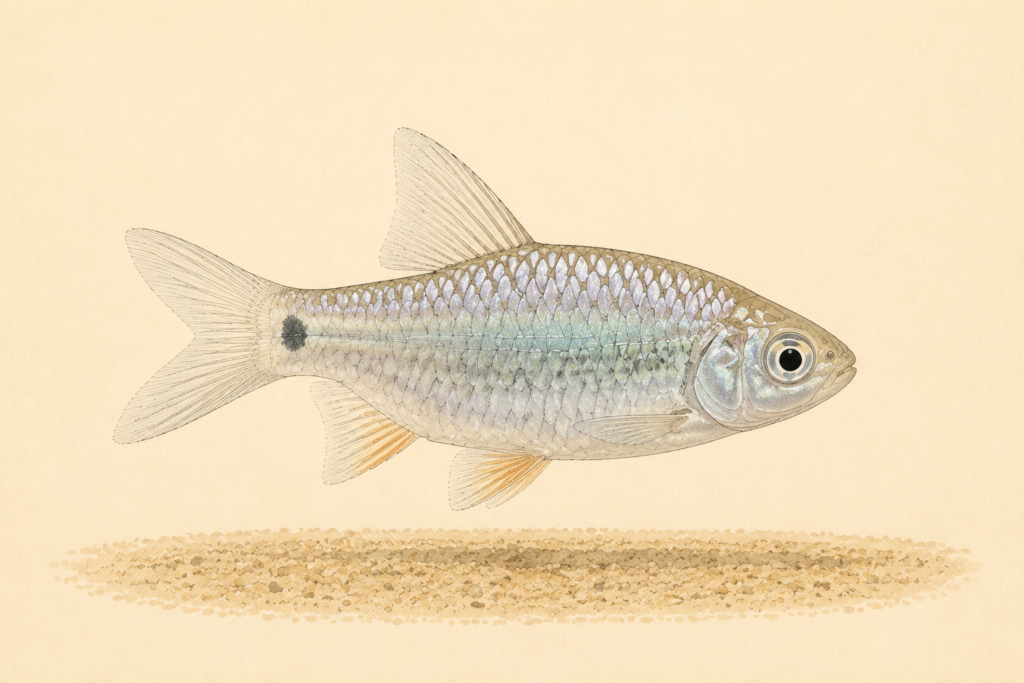
At first glance the Swamp Barb might be dismissed as “just another silvery barb,” but a closer look reveals subtle beauty. The body is moderately deep and laterally compressed, giving the fish a stocky, powerful silhouette compared with slimmer barb species. The base colour is a bright olive-silver that catches the light as the shoal moves, overlaid with large, well-defined scales that create a faintly reticulated pattern. Each scale often carries a darker edge, producing a delicate net-like effect along the flanks.
One of the most distinguishing features is a prominent dark blotch at the base of the caudal peduncle. This spot is usually round to oval and bordered by a faint golden or brassy halo, particularly in well-conditioned adults. A second, less conspicuous dark mark may appear behind the gill cover in some populations. The dorsal fin is tall and often carries a dusky or reddish tinge, while the pelvic and anal fins may flush orange or red in breeding males. The lips are noticeably fleshy – hence one of its alternative trade names, Fat-lipped Barb – and the mouth is subterminal, reflecting the species’ habit of foraging along the substrate.
Males tend to be slimmer and slightly smaller than females, with more intense finnage colouration during spawning condition. Females are deeper-bodied, particularly when carrying eggs, and generally display paler fins. Juveniles are less distinctive, appearing mostly silver with a faint caudal spot, but they develop their full patterning and finnage colour as they mature over six to twelve months.
Adult Swamp Barbs typically reach 10-13 cm in total length in captivity, with occasional specimens pushing slightly beyond that in spacious tanks with excellent nutrition. This makes them noticeably larger than popular small barbs such as Cherry Barbs or Tiger Barbs, and keepers should plan tank space accordingly.
Natural Habitat
Puntius chola is widely distributed across the Indian subcontinent and into Myanmar. It has been recorded from the Ganges, Brahmaputra, Indus, and Irrawaddy river basins, as well as numerous smaller drainages and coastal plain systems in peninsular India and Sri Lanka. This extensive range is a testament to the species’ adaptability.
As its common name implies, the Swamp Barb favours slow-moving or standing waters. Typical habitats include seasonal floodplain pools, marshy lowland swamps, irrigation ditches, rice paddies, reservoir margins, and the sluggish backwaters of medium-sized rivers. The substrate in these environments is usually soft mud or silt, often covered with decaying plant matter. Vegetation can range from sparse to dense, with emergent grasses, floating plants such as water hyacinth, and submerged macrophytes all providing cover and foraging grounds.
Water quality in these habitats varies enormously with the seasons. During the monsoon, waters are warm (26-30 C), turbid, and mildly acidic to neutral. In the dry season, pools can shrink dramatically, temperatures may drop to 18 C or below overnight in northern parts of the range, dissolved solids concentrate, and pH can swing towards the alkaline side. This seasonal cycling has equipped Puntius chola with a physiological tolerance that few small aquarium barbs can match, and it is one of the primary reasons the species is so easy to maintain in captivity.
The Swamp Barb is an omnivorous opportunist in the wild. It grazes on algae, detritus, small invertebrates, insect larvae, zooplankton, and plant matter. Its fleshy, subterminal mouth is well suited to picking through soft substrates and sifting food particles from mud. Predators in its natural environment include snakeheads, catfishes, wading birds, and water snakes, and the species relies on shoaling behaviour and dense vegetation for protection.
Tank Size and Setup
A group of six Swamp Barbs requires a minimum aquarium volume of 150 litres, with a tank length of at least 90 cm. If you plan to keep a larger shoal or house them alongside other community species – which is strongly recommended for a more natural display – aim for 200-300 litres. The emphasis should be on horizontal swimming space rather than height; a standard rectangular tank is ideal.
Substrate choice is flexible. Fine gravel or sand both work well and allow the fish to engage in their natural substrate-sifting behaviour. A dark-coloured substrate will help bring out the best in the fishes’ colouration, as pale substrates tend to wash out their silver and gold tones. If using sand, opt for a rounded, non-sharp grade to protect the barbels and fleshy lips.
Planting is beneficial but not essential. In the wild, Swamp Barbs associate with vegetation for cover, so providing areas of dense planting along the back and sides of the tank, with open swimming space in the centre, closely replicates their natural environment. Hardy, robust plant species are the best choice – Vallisneria, Java Fern, Anubias, and Cryptocoryne species all tolerate the slightly alkaline water that Swamp Barbs are perfectly happy in. Floating plants such as Amazon Frogbit or Water Lettuce are excellent additions, as they diffuse overhead lighting and give the fish a greater sense of security.
Include some driftwood, smooth rocks, or root structures to break up sightlines and provide additional refuges. While Swamp Barbs are not shy fish once settled, visual barriers reduce stress in any community tank and give subordinate individuals somewhere to retreat during occasional squabbles within the shoal.
A secure, well-fitting lid is advisable. Barbs in general can be jumpy when startled, and Swamp Barbs are no exception – especially during the first few days after introduction or if water quality deteriorates.
Lighting can be moderate. The species comes from environments that are often shaded by floating vegetation or turbid water, so very intense lighting is unnecessary and may cause the fish to appear washed out or spend more time hiding. If you are growing live plants that demand stronger light, balance this with floating plant cover to create dappled shade below.
Water Parameters
One of the Swamp Barb’s greatest assets is its tolerance of a wide range of water conditions. It is comfortable in soft, slightly acidic water and equally at home in moderately hard, alkaline water – a flexibility that makes it suitable for almost any tap water supply in the United Kingdom without the need for remineralisation or RO water.
| Temperature | 18-28 C |
| pH | 6.0-8.0 |
| General hardness (GH) | 5-20 dGH |
| Carbonate hardness (KH) | 4-15 dKH |
| Ammonia | 0 ppm |
| Nitrite | 0 ppm |
| Nitrate | Below 40 ppm |
While the species can survive brief excursions outside these ranges, long-term health and colour are best maintained within the values given above. The ideal temperature for day-to-day keeping sits around 22-26 C. At the lower end of its range (18-20 C), the Swamp Barb can be kept in unheated indoor aquaria in warmer climates or during summer months in temperate regions, but a heater set to the low twenties is recommended for year-round stability in most UK households.
Ammonia and nitrite must always read zero in a cycled aquarium. Swamp Barbs are tougher than many tropical fish in this regard, but chronic low-level exposure to nitrogenous waste will still compromise their immune system and shorten their lifespan. Perform weekly water changes of 25-30% to keep nitrate levels comfortably below 40 ppm. In heavily stocked tanks or those without live plants, more frequent or larger water changes may be necessary.
Stability matters more than hitting a precise number. Avoid sudden swings in temperature or pH – for example, by matching the temperature and chemistry of replacement water during water changes and by not adding untreated chemicals directly to the tank. Use a quality dechlorinator whenever topping up with tap water.
Filtration and Equipment
Because Swamp Barbs are medium-sized, active fish that produce a moderate bioload, reliable filtration is important. An external canister filter rated for the total volume of the tank (or slightly above) is the best option for tanks of 150 litres and upward. Internal power filters or hang-on-back models can also work well, particularly in tanks at the lower end of the size range.
Aim for a turnover rate of roughly four to six times the tank volume per hour. The Swamp Barb comes from slow-moving waters, so avoid creating a strong current across the entire tank. Position the filter outlet to generate gentle flow at one end while leaving calmer areas at the other. A spray bar or lily pipe can help diffuse the output and reduce surface agitation.
Biological filtration media – ceramic rings, sintered glass, or sponge – should form the core of your filter. Supplement with mechanical media (filter floss or fine pads) to keep the water clear, and consider adding a small amount of activated carbon if you struggle with tannin staining from driftwood or notice any odour. Clean mechanical media regularly (every two to four weeks) and rinse biological media only in old tank water to preserve beneficial bacteria.
A heater is recommended for most setups. A standard submersible aquarium heater set to 24 C provides a comfortable, stable baseline. In tanks above 200 litres, two smaller heaters placed at opposite ends of the tank offer more even heat distribution and provide a safety net if one unit fails.
An air pump is not strictly necessary if your filter provides adequate surface agitation for gas exchange, but a small air stone can be beneficial in warmer weather when dissolved oxygen levels drop. Swamp Barbs tolerate lower oxygen levels better than many species, but good oxygenation is always preferable for long-term health.
Standard aquarium lighting on a timer set for 8-10 hours per day is sufficient. If you are growing live plants, choose a light appropriate for the plant species you have selected. The fish themselves have no special lighting requirements.
Diet and Feeding
Swamp Barbs are true omnivores and enthusiastic eaters that rarely refuse any food offered. In the wild they graze on algae, detritus, small crustaceans, insect larvae, and aquatic plant matter. Replicating this varied diet in captivity is straightforward and important for maintaining good colour, condition, and immune function.
A high-quality flake or small pellet food should form the staple diet. Choose a product with a balanced protein-to-vegetable ratio – ideally around 35-45% crude protein – and avoid foods that list fillers such as wheat flour as the primary ingredient. Sinking granules or small pellets are often preferable to flakes for this species, as the subterminal mouth is naturally designed for feeding at or below mid-water level.
Supplement the staple with regular offerings of live or frozen foods. Bloodworm, daphnia, brine shrimp, mosquito larvae, and tubifex are all eagerly consumed and help condition the fish. Aim to provide these two to three times per week. Blanched vegetables – courgette slices, shelled peas, spinach leaves, or cucumber – add valuable fibre and plant matter. Many keepers find that a small amount of spirulina-based flake or algae wafer rounds out the vegetable component of the diet nicely.
Feed once or twice daily, offering only as much as the shoal can consume within two to three minutes. Swamp Barbs are not fussy, and their willingness to eat can lead to overfeeding if the keeper is not disciplined. Uneaten food should be removed promptly to avoid water quality issues. One fasting day per week is beneficial for adult fish and mirrors the natural irregularity of food availability in their wild habitat.
Juvenile Swamp Barbs grow quickly and benefit from more frequent feeding – three small meals per day – using finely crushed flake, micro pellets, and baby brine shrimp or microworms.
Behaviour and Temperament
The Swamp Barb is a peaceful, sociable species that thrives in the company of its own kind. In the wild it forms loose shoals that may number in the dozens or hundreds, moving together through shallow, vegetated waters to forage and avoid predators. In the aquarium, a minimum group of six is essential; smaller groups result in stressed, skittish fish that may hide constantly or, conversely, direct mild aggression at unrelated tank mates.
Within a well-sized group, Swamp Barbs display a lively, constantly shifting social dynamic. Males will occasionally spar with each other – circling, flaring fins, and chasing briefly – but these interactions are ritualised and rarely result in injury. A larger group of eight to twelve individuals distributes this social sparring more evenly and produces a more natural, relaxed shoal.
The species primarily occupies the mid-water column but frequently descends to the substrate to forage, sifting through sand or gravel with its fleshy lips. It is also not uncommon to see Swamp Barbs at the surface, particularly at feeding time. They are active during the day and tend to rest quietly among vegetation or near the substrate at night.
Swamp Barbs are not fin-nippers under normal circumstances. Unlike Tiger Barbs, which have a well-earned reputation for harassing long-finned tank mates, the Swamp Barb is far more restrained. That said, any barb kept in too-small a group or in an overcrowded, under-decorated tank may resort to fin-nipping, so providing adequate numbers and space remains important.
They are not territorial and do not defend fixed areas of the tank. This makes them easy to integrate into community setups with other peaceful to moderately active species.
Tank Mates
The Swamp Barb’s peaceful nature, medium size, and tolerance of a wide range of water conditions make it compatible with a broad selection of community fish. The best tank mates are species that share its preference for moderate temperatures and gentle to moderate flow, and that are neither so small as to be intimidated by its size nor so aggressive as to bully it. Avoid pairing Swamp Barbs with very slow-moving, long-finned species that might attract unwanted attention, and steer clear of large predatory fish that could view them as food.
Good tank mates
- Rosy Barb – Similar size, temperament, and water parameter requirements make this an ideal companion barb species.
- Cherry Barb – Peaceful and small enough to coexist without competition, adds a splash of colour to the lower levels.
- Zebra Danio – Hardy, active upper-water swimmer that complements the Swamp Barb’s mid-water activity without overlap or conflict.
- Bronze Corydoras – Peaceful bottom-dweller that occupies a different niche and thrives in the same temperature range.
- Bristlenose Pleco – A calm algae-eating catfish that stays out of the Swamp Barb’s way and appreciates similar water conditions.
- Pearl Gourami – Gentle, mid-to-upper-water species that pairs well in a planted community with barbs.
- Yoyo Loach – Active bottom-dweller from overlapping South Asian habitats; similar hardiness and temperament.
- Giant Danio – Robust, fast-swimming shoaling fish that matches the Swamp Barb’s size and energy level.
Fish to avoid
- Siamese Fighting Fish – Slow-moving and long-finned, likely to be stressed or nipped by any barb species in a community setting.
- Fancy Guppy – Flowing finnage and small size make it a potential target; best kept in species-only or nano setups.
- Oscar – A large, predatory cichlid that would view Swamp Barbs as food once it reaches adult size.
- Red-bellied Piranha – Aggressive predator entirely incompatible with any small to medium community fish.
- Flowerhorn – Highly territorial and aggressive cichlid that will attack and kill barbs.
- Angelfish – While borderline in some setups, the combination of slow movement and trailing fins can invite unwanted attention from active barbs.
Breeding
Breeding Swamp Barbs in captivity is achievable for the hobbyist willing to set up a dedicated spawning tank, though it is not as straightforward as breeding some of the smaller, more commonly spawned barb species. The fish are egg scatterers with no parental care, and adults will readily consume their own eggs if given the opportunity.
Begin by conditioning a group of mature fish with frequent offerings of high-protein live or frozen foods – bloodworm, daphnia, and brine shrimp – for two to three weeks. During this period, females will become noticeably rounder as they fill with eggs, and males may display intensified fin colouration.
Set up a separate spawning tank of at least 60 litres. Fill it with water from the main tank, slightly warmer than usual (26-28 C), and slightly softer if your tap water is hard. A pH around 6.5-7.0 seems to encourage spawning. Cover the bottom with a layer of glass marbles or a mesh grid that allows eggs to fall through but prevents the adults from reaching them. Alternatively, dense clumps of fine-leaved plants such as Java Moss or spawning mops can serve as egg-catching substrate.
Introduce one or two conditioned pairs in the evening. Spawning typically occurs in the early morning hours. The male will chase the female through the vegetation or across the spawning substrate, and she will scatter several hundred small, adhesive eggs. Once spawning activity ceases, remove the adults immediately to prevent egg predation.
Eggs hatch in approximately 24-36 hours at 27 C. The fry are tiny and will absorb their yolk sacs over the next two to three days. Once free-swimming, they can be fed infusoria or liquid fry food for the first week, graduating to newly hatched brine shrimp (Artemia nauplii) and finely powdered fry food as they grow. Maintain excellent water quality in the fry tank with gentle sponge filtration and small daily water changes.
Growth is relatively rapid. Under good conditions, fry reach around 2-3 cm within two months and can be moved to the main tank or a grow-out tank once they are large enough not to be eaten by adult fish.
Common Diseases
Swamp Barbs are among the hardier freshwater aquarium fish and are not especially prone to disease when kept in appropriate conditions. However, they are susceptible to the same common ailments that affect most tropical freshwater species, particularly when stressed by poor water quality, overcrowding, or sudden environmental changes.
White spot disease (Ichthyophthirius multifiliis) is perhaps the most frequently encountered illness. It presents as small white cysts on the fins and body, accompanied by flashing (rubbing against objects) and clamped fins. Treatment involves raising the temperature gradually to 28-30 C and administering a proprietary white spot remedy containing malachite green or formalin. Swamp Barbs tolerate the elevated temperatures well.
Fin rot, caused by bacterial infection (often Aeromonas or Pseudomonas species), can occur when water quality declines. Symptoms include frayed, disintegrating fin edges that may develop a white or reddish margin. Improving water quality through increased water changes is the first and most important step; in persistent cases, a broad-spectrum antibacterial treatment may be needed.
Columnaris (cotton-mouth disease) is another bacterial infection that Swamp Barbs can contract, presenting as greyish-white patches around the mouth, body, or gills. It progresses rapidly and requires prompt treatment with antibacterial medication and improved water conditions.
Internal parasites may occasionally affect wild-caught specimens or fish that have been exposed to live foods from questionable sources. Symptoms include weight loss despite normal feeding, white stringy faeces, and lethargy. Anti-parasitic foods or treatments containing praziquantel or levamisole are effective.
Prevention is always preferable to cure. Quarantine all new fish for at least two weeks before introducing them to the main tank. Maintain stable water parameters, avoid overfeeding, and ensure the tank is not overcrowded. A well-fed Swamp Barb with a functioning immune system is remarkably resistant to opportunistic pathogens.
FAQs
How many Swamp Barbs should I keep together?
A minimum of six is recommended, but groups of eight to twelve produce the most natural, relaxed behaviour. In smaller groups, individuals may become stressed, hide excessively, or direct minor aggression at other tank mates. A larger shoal also creates a more impressive visual display as the fish move together through the aquarium.
Can Swamp Barbs live in an unheated aquarium?
Yes, in certain circumstances. Swamp Barbs tolerate temperatures as low as 18 C, so they can be kept without a heater in rooms that remain consistently above this threshold. In the UK, most indoor rooms stay warm enough during summer but can dip below 18 C in winter, so a heater set to a modest 20-22 C is a sensible precaution for year-round stability.
Are Swamp Barbs fin-nippers?
Generally, no. Swamp Barbs are considerably less nippy than species such as Tiger Barbs. However, like all barbs, they may occasionally nip at very slow-moving, long-finned fish – particularly if kept in an undersized group or an overcrowded tank. Keeping them in an adequate shoal and avoiding tank mates with trailing finnage eliminates this risk almost entirely.
What is the difference between Puntius chola and other similar barbs?
Puntius chola is larger and stockier than most commonly kept ornamental barbs, reaching 10-13 cm compared with 4-6 cm for species such as Cherry Barbs or Tiger Barbs. It also has noticeably fleshy lips and a prominent dark caudal spot. Its exceptional tolerance of a wide range of water hardness and pH further distinguishes it from many of its relatives.
Do Swamp Barbs eat live plants?
Swamp Barbs may nibble on very soft or delicate plant species, but they are not dedicated plant eaters. Hardy species such as Anubias, Java Fern, Vallisneria, and Cryptocorynes are generally left alone. Providing a balanced diet with adequate vegetable matter – blanched vegetables, spirulina flakes – helps reduce any inclination to graze on live plants.
Related Guides
- Rosy Barb Care Guide – Another hardy, medium-sized South Asian barb that pairs well with the Swamp Barb and enjoys similar conditions.
- Cherry Barb Care Guide – A popular smaller barb species ideal for those who want a similar temperament in a smaller tank.
- Zebra Danio Care Guide – A classic community fish from overlapping South Asian habitats that thrives alongside Swamp Barbs.
- Bronze Corydoras Care Guide – An excellent bottom-dwelling companion for any barb community setup.
- Pearl Gourami Care Guide – A peaceful gourami that complements mid-water barb species in planted tanks.