
Quick summary
Angelfish are striking but not truly beginner fish, needing a tall tank of at least 200 litres, stable warm and soft-to-moderate water, and thoughtful tank mate choices since they can turn territorial once paired off for breeding, despite being generally peaceful cichlids. If you can provide ample space and are prepared for territorial behaviour, especially from mated pairs, they make a rewarding, long-lived centerpiece fish.
🐠 Build a tank around this species
In this guide:
- Introduction
- Quick Stats
- Appearance
- Varieties and Morphs
- Natural Habitat
- Tank Size and Setup
- Water Parameters
- Filtration and Equipment
- Diet and Feeding
- Behaviour and Temperament
- Tank Mates
- Breeding
- Common Diseases
- FAQs
Introduction
The Angelfish is one of the most iconic and widely recognised freshwater aquarium fish in the world. With its tall, laterally compressed body, elegant trailing fins, and graceful swimming style, Pterophyllum scalare has captivated aquarists since it first entered the hobby in the early twentieth century. Native to the slow-moving rivers and floodplain lakes of the Amazon Basin, this cichlid has been selectively bred into a dazzling array of colour morphs and fin types, making it a centrepiece fish for countless community aquariums.
Despite its popularity, the Angelfish is not quite the beginner fish that some retailers suggest. It grows considerably larger than many new keepers expect, reaching up to 15 cm in body length and as much as 20 cm or more in vertical height from dorsal to anal fin tip. It is a cichlid at heart, meaning it possesses a degree of intelligence, territorial drive, and predatory instinct that must be respected when planning tank mates and aquarium size. Provided its needs are met, however, the Angelfish rewards its keeper with years of engaging behaviour, impressive appearance, and even the possibility of witnessing attentive parental care during breeding.
This guide covers everything you need to know to keep Pterophyllum scalare successfully, from water parameters and diet through to breeding and disease prevention.
Quick Stats
| Scientific name | Pterophyllum scalare |
|---|---|
| Common names | Freshwater Angelfish, Common Angelfish, Silver Angelfish |
| Family | Cichlidae |
| Origin | Amazon Basin, Peru, Colombia, Brazil, French Guiana, Guyana |
| Adult size | 15 cm |
| Difficulty | Easy |
| Breeding difficulty | Moderate |
| Temperature | 24–30 °C |
| pH | 6–7.5 |
| GH | 3–10 dGH |
| Minimum tank size | 200 L |
| Conservation status | Least Concern (IUCN, assessed 2020) |
Appearance
The wild-type Angelfish has a tall, diamond-shaped body that is strongly compressed laterally. This body shape is an adaptation to life among dense vegetation and submerged root tangles, allowing the fish to slip between obstacles with minimal resistance. The dorsal and anal fins are dramatically elongated, giving the fish its characteristic arrow or sail-like silhouette, while the pelvic fins have evolved into long, thread-like filaments that trail beneath the body and are believed to serve a sensory function among plant stems.
In its natural form, P. scalare is predominantly silver with three bold, dark vertical bars running from the dorsal fin down through the body and into the anal fin. A fourth bar runs through the eye, serving as camouflage by breaking up the head profile. Additional faint bars may be visible depending on the fish’s mood, health, and environment. The caudal fin is fan-shaped and may show faint barring or spotting. Wild-caught specimens often display a subtle greenish or brownish iridescence on the flanks, which is largely absent in domestic strains.
Males and females are notoriously difficult to distinguish outside of breeding condition. Mature males sometimes develop a slightly more pronounced nuchal hump on the forehead and may have a marginally steeper head profile above the eyes. The most reliable method of sexing remains observation of the breeding tubes, or papillae, which become visible just before spawning, the female’s is broader and blunter, while the male’s is narrower and more pointed.

Varieties and Morphs
Decades of selective breeding have produced a remarkable range of Angelfish colour morphs and fin types. These are all the same species, Pterophyllum scalare, and their care requirements are identical, though some heavily inbred strains may be slightly less robust than wild-type fish. The following are among the most commonly encountered varieties in the aquarium trade.
The Silver Angelfish is the closest domestic form to the wild type, retaining the characteristic silver body and dark vertical bars. It is generally considered the hardiest variety and an excellent starting point for keepers new to Angelfish. The Gold Angelfish lacks the dark vertical barring and displays a warm golden-yellow body, sometimes with a faint orange flush on the forehead. It carries a recessive gene that suppresses melanin production in the bars while retaining yellow and silver pigments.
The Marble Angelfish exhibits an irregular pattern of black blotches and streaks across a silver or white base, with no two individuals looking exactly alike. This variety is extremely popular and widely available. The Black Angelfish, sometimes referred to as the Double Dark Black, carries two copies of the dark gene, resulting in a fish that is almost entirely velvety black, though some may lighten slightly with age or stress. The closely related Black Lace Angelfish carries only a single copy of the dark gene, producing a silver fish with heavily darkened fins and intensified barring that creates an attractive lace-like pattern.
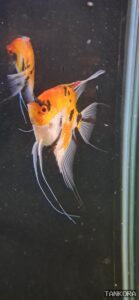
The Koi Angelfish is one of the most striking morphs, featuring a white or silver base overlaid with patches of orange, gold, and black in a pattern reminiscent of ornamental koi carp. Colouration in Koi Angels tends to change and develop as the fish matures, with the orange pigment often intensifying over time. The Platinum Angelfish displays a uniform, almost metallic silver-white body with minimal or no barring, giving it a clean, luminous appearance. The Zebra Angelfish is similar to the Silver but with additional dark vertical bars, typically four to six, creating a bolder striped pattern.
The Blushing Angelfish has a largely unpigmented body with a translucent, pearlescent quality, and its common name comes from the visible red gill covers that show through the pale skin, giving it a perpetual blush. Finally, the Veil Tail is not a colour morph but a fin type that can appear in combination with any colour variety. Veil Tail Angelfish have dramatically elongated dorsal, anal, and caudal fins that flow behind them like trailing fabric. While undeniably beautiful, Veil Tails are somewhat more prone to fin damage and may be less agile swimmers, so tank mates should be chosen with extra care.
Natural Habitat
Pterophyllum scalare is found across a vast area of the Amazon River Basin and its tributaries, including the Ucayali, Solimões, and Essequibo river systems. Its range extends through Peru, Colombia, Brazil, French Guiana, Guyana, and Suriname. Within this range, it inhabits a variety of slow-moving or still water bodies including floodplain lakes, quiet tributaries, oxbow lagoons, and inundated forest areas during the wet season.
The typical environment is characterised by warm, soft, and slightly acidic water with temperatures often between 26 and 30 °C. The substrate is usually fine sand or mud, overlain with a deep layer of decomposing leaf litter that stains the water a dark tea colour through the release of tannins and humic acids. This blackwater environment reduces light penetration and creates the subdued, dimly lit conditions in which Angelfish feel most secure. Dense tangles of submerged roots, fallen branches, and aquatic vegetation provide shelter and serve as spawning sites.
In these habitats, Angelfish are found in small groups or loose shoals, drifting among vertical plant stems and root structures where their body shape and barred patterning provide effective camouflage against predators. They feed opportunistically on small invertebrates, insect larvae, and small fish fry. Understanding this natural environment is key to replicating appropriate conditions in captivity and bringing out the best in these fish.
Tank Size and Setup
Given the adult size and body height of the Angelfish, a minimum tank volume of 200 litres is recommended for a small group. Crucially, tank height matters as much as length for this species; aquariums of at least 50 cm in height are necessary, and taller tanks of 50–60 cm are preferable to allow the fish to display their full finnage without restriction. A standard 200-litre tank measuring approximately 100 cm long, 40 cm deep, and 50 cm tall is a suitable starting point for four to six juveniles, though larger tanks of 300 litres or more are ideal for keeping a group into adulthood, when pairs may establish territories.
The aquascape should draw inspiration from the Angelfish’s natural habitat. A fine sand substrate works well as a base, and the addition of driftwood and bogwood pieces creates natural visual barriers and territorial boundaries. Tall plants such as Amazon Sword (Echinodorus species), Vallisneria, and Cryptocoryne are excellent choices, as they provide cover and replicate the vertical structures among which wild Angelfish navigate. Floating plants help diffuse overhead light and create the shaded conditions the fish prefers. Avoid sharp or abrasive decorations that could tear the delicate trailing fins.
Moderate lighting is generally best. Angelfish can appear washed out and stressed under very bright illumination, whereas subdued or partially shaded lighting encourages natural colouration and confident behaviour. If using strong LED lighting for plant growth, floating plants or tall background plants can be used to create shaded refuge areas. A dark substrate and background further help the fish feel secure and display their colours to best effect.
Water Parameters
| Temperature | 24–30 °C |
| pH | 6.0–7.5 |
| General hardness (GH) | 3–10 dGH |
| Ammonia | 0 ppm |
| Nitrite | 0 ppm |
| Nitrate | Below 20 ppm |
The most important aspect of water quality for Angelfish is stability. While domestically bred Angelfish are considerably more adaptable than wild-caught specimens and can tolerate a wider pH range than their blackwater origins might suggest, they are sensitive to sudden swings in temperature, pH, or hardness. A target temperature of around 26–28 °C suits most situations, balancing metabolic health with dissolved oxygen levels. Keeping the pH stable within the 6.5–7.0 range is ideal for most captive-bred strains, though fish from established local breeding lines may be well-adapted to slightly harder, more alkaline water.
Regular partial water changes of approximately 25–30% per week are essential for maintaining low nitrate levels and replenishing trace minerals. Angelfish are particularly susceptible to the effects of accumulated organic waste, and elevated nitrate levels above 40 ppm have been associated with increased disease susceptibility, reduced colouration, and poor breeding outcomes. If keeping wild-caught specimens or attempting to breed, using reverse osmosis water remineralised to achieve very soft, acidic conditions may be beneficial.
Filtration and Equipment
Angelfish require efficient biological filtration but do not appreciate strong currents. In their natural habitat, they occupy still or very gently moving water, and powerful flow from filter outlets can cause chronic stress, exhaustion, and fin damage, particularly in Veil Tail varieties. An external canister filter is generally the best choice for an Angelfish tank, as it provides excellent biological and mechanical filtration capacity while allowing the output to be diffused through a spray bar or lily pipe positioned to minimise direct current in the main swimming area.
A reliable heater rated appropriately for the tank volume is essential, as Angelfish are tropical fish that require consistently warm water. For larger aquariums, two smaller heaters placed at opposite ends of the tank can provide more even heat distribution and offer redundancy in case one unit fails. A thermometer, ideally a digital one, should be used to monitor temperature regularly.
An air pump is not strictly necessary if surface agitation from the filter provides adequate gas exchange, but gentle aeration can be beneficial in warmer tanks where dissolved oxygen levels naturally decrease. Avoid vigorous bubble streams directly in the Angelfish’s swimming space. A timer-controlled lighting system helps establish a consistent photoperiod, which supports both plant growth and the fish’s natural behavioural rhythms.
Diet and Feeding
Pterophyllum scalare is an omnivore with a strong predatory streak. In the wild, its diet consists primarily of small invertebrates, insect larvae, worms, and small fish, supplemented with some plant matter and algae. In captivity, a varied diet is the key to vibrant colouration, robust health, and successful breeding.
A high-quality flake or pellet food formulated for cichlids or tropical fish should form the staple diet. Look for products with whole fish or insect meal listed as the primary ingredient rather than grain fillers. This staple should be supplemented regularly with frozen or live foods such as bloodworm, brine shrimp, daphnia, and mosquito larvae. These protein-rich foods closely mirror the Angelfish’s natural prey and are particularly valuable when conditioning pairs for breeding.
Feed adult Angelfish two to three times per day, offering only as much as they can consume within two to three minutes. Juveniles benefit from more frequent feeding, up to four times daily, to support their rapid growth rate. Overfeeding is a common mistake that leads to poor water quality and obesity, both of which can significantly shorten the fish’s lifespan. One fasting day per week can be beneficial for adult fish, allowing the digestive system to clear.
It is worth noting that Angelfish are perfectly capable of eating very small tank mates such as Neon Tetras once they reach adult size. This predatory capability should be taken into account when planning both diet and community composition.
Behaviour and Temperament
Angelfish are generally peaceful fish, though as cichlids they may squabble with their own kind from time to time, and aggression should be expected once a pair has formed for breeding. Juveniles are sociable and shoal readily, but as they mature and pair off, their behaviour changes noticeably. Mated pairs can become fiercely territorial, particularly during spawning, and may aggressively chase other fish away from their chosen breeding site.
Within a group of Angelfish, a distinct pecking order develops. Dominant individuals may bully subordinates, especially in tanks that are too small or lack sufficient visual barriers. Keeping Angelfish in groups of six or more can help diffuse aggression by spreading dominant attention across multiple targets, though this requires a suitably large tank. Keeping just two or three can result in relentless bullying of the weakest individual.
Angelfish are diurnal and spend their active hours patrolling their territory, investigating their surroundings, and foraging. They are surprisingly aware of activity outside the tank and quickly learn to recognise their keeper, often approaching the glass in anticipation of feeding. This intelligence and responsiveness are part of what makes them such rewarding fish to keep. They can, however, be somewhat skittish and may panic when startled by sudden movements or loud noises. A tank placed in a calm area of the home with a predictable daily routine will produce the most relaxed, confident fish.
Tank Mates
Choosing appropriate tank mates for Angelfish requires balancing several factors. The ideal companion is peaceful but not so small as to become a meal, does not nip fins, tolerates the same warm, soft water conditions, and does not outcompete the Angelfish at feeding time. Mid-level and bottom-dwelling species that do not encroach heavily on the Angelfish’s preferred swimming space tend to work best.
Good tank mates
- Rummy Nose Tetra, a tight-schooling tetra that is large enough to avoid predation and thrives in the same warm, soft water conditions.
- Cardinal Tetra, a classic Amazonian companion that does well alongside Angelfish provided it is kept in a large shoal and introduced when the Angelfish are still small.
- Corydoras sterbai, a bottom-dwelling catfish that tolerates the warmer temperatures Angelfish prefer, unlike some other Corydoras species.
- Bristlenose Pleco, a peaceful algae-eating catfish that stays small enough to coexist without territorial conflict.
- Kuhli Loach, a shy, bottom-dwelling species that occupies a completely different niche and rarely interacts with Angelfish.
- Harlequin Rasbora, a robust, peaceable schooling fish that is generally too large for adult Angelfish to consume.
- German Blue Ram, a fellow South American cichlid that shares water parameter preferences and occupies the lower levels of the tank.
- Cherry Barb, a mild-mannered barb that lacks the fin-nipping tendencies of its more boisterous relatives.
- Clown Loach, a sociable bottom dweller that complements Angelfish well in larger aquariums, though it requires a very large tank at maturity.
- Dwarf Gourami, a generally peaceful surface dweller that occupies a different water column level, though occasional territorial posturing may occur between males.
Fish to avoid
- Tiger Barb, a notorious fin nipper that will relentlessly target the Angelfish’s long trailing fins, causing stress and injury.
- Serpae Tetra, another species with a strong tendency to nip fins, especially when kept in insufficient numbers.
- Oscar, far too large and aggressive to coexist with Angelfish; an adult Oscar would likely kill or seriously injure them.
- Convict Cichlid, an extremely territorial and aggressive cichlid that will dominate and harass Angelfish, particularly during breeding.
- Neon Tetra, while often recommended, adult Angelfish frequently prey on Neon Tetras due to their small size, making this a risky combination.
- Chinese Algae Eater, becomes increasingly aggressive and territorial with age and may harass or attach itself to the Angelfish’s flat body.
- Betta, the Angelfish may bully a Betta, and the similar body shapes can trigger territorial aggression in both species.
- Red Tail Shark, a highly territorial bottom dweller that becomes increasingly aggressive as it matures and may chase Angelfish relentlessly.
- African Cichlids, require hard, alkaline water that is incompatible with Angelfish, and most species are far too aggressive for cohabitation.
- Guppy, small enough to be eaten by adult Angelfish, and the long, colourful tails of male guppies may provoke aggression.
Breeding
Angelfish are one of the more readily bred cichlids in the home aquarium, and witnessing their dedicated parental care is one of the genuine highlights of fishkeeping. They are substrate spawners that form monogamous pairs, with the pair bond well documented through a breeding cycle, though lifelong pairing is not established. The most reliable way to obtain a breeding pair is to raise a group of six or more juveniles together and allow them to pair off naturally as they mature, which typically occurs between eight and twelve months of age.
A pair preparing to spawn will select and vigorously clean a flat vertical surface, commonly a broad leaf of an Amazon Sword plant, a piece of slate, a filter intake tube, or even the aquarium glass. Both fish will repeatedly pass over the surface, cleaning it meticulously for several hours or even days before spawning begins. During this period, the breeding tubes of both fish become visibly extended, which is the most reliable way to confirm their sexes.
Spawning itself involves the female making repeated passes over the chosen surface, depositing neat rows of small, adhesive, translucent eggs, with the male following closely behind to fertilise each row. A typical clutch contains between 100 and 400 eggs, though experienced pairs may produce larger spawns. After spawning is complete, both parents take turns fanning the eggs with their pectoral fins to maintain water flow and prevent fungal growth, and they will diligently remove any eggs that turn white and become infertile.
The eggs hatch in approximately 48 to 72 hours at 28 °C, producing tiny, wriggling larvae that remain attached to the spawning surface by adhesive threads on their heads. The parents may move the larvae to different locations during this stage. After a further four to five days, the fry become free-swimming and begin to venture out in a tight cloud, closely guarded by both parents. At this point, they should be fed freshly hatched brine shrimp nauplii or a high-quality liquid fry food several times per day.
First-time parents frequently eat their own eggs or fry, which can be frustrating but is a common behaviour that usually resolves after a few spawning attempts. If the goal is to maximise fry survival, the eggs can be removed to a separate hatching tank with gentle aeration and a few drops of methylene blue to inhibit fungal growth, though this means losing the opportunity to observe natural parental behaviour. Raising fry in a dedicated grow-out tank with frequent water changes and abundant food will produce the healthiest, most vigorous young fish.
Common Diseases
Angelfish are unfortunately susceptible to several diseases, some of which are particularly prevalent in this species. Maintaining excellent water quality, avoiding overcrowding, quarantining new additions, and providing a nutritious diet are the most effective preventive measures.
Ich, or white spot disease, caused by the protozoan parasite Ichthyophthirius multifiliis, is one of the most frequently encountered illnesses. It presents as small white spots resembling grains of salt scattered across the body and fins, often accompanied by flashing, clamped fins, and lethargy. Treatment involves raising the temperature gradually to 30 °C to accelerate the parasite’s life cycle and administering an appropriate white spot medication according to the manufacturer’s instructions.
Angelfish Virus, sometimes referred to as Angelfish Plague, is a poorly understood but devastating condition that primarily affects Pterophyllum species. Symptoms include excess mucus production, clamped fins, loss of appetite, and rapid death, often within 24 to 72 hours. There is no known cure, and outbreaks can wipe out an entire group. Strict quarantine of all new Angelfish for a minimum of four weeks is the best defence against introducing this disease.
Hole-in-the-head disease and lateral line erosion are associated with poor water quality, inadequate diet, and stress; the exact cause is debated, though the flagellate Spironucleus is often implicated alongside these environmental factors. It manifests as pitting erosions on the head and lateral line, often accompanied by white, stringy faeces and loss of appetite. Treatment typically involves improving water quality, enriching the diet, and administering metronidazole.
Fin rot, a bacterial infection that erodes the edges of the fins, is common in tanks with poor water quality or after fin damage from nipping tank mates. It usually responds well to improved water conditions and, in more severe cases, antibacterial treatments. Velvet disease, caused by the dinoflagellate Piscinoodinium, can also affect Angelfish and appears as a fine, golden or rust-coloured dusting on the skin, often most visible under torchlight. Treatment involves dimming the lights, raising the temperature slightly, and using a copper-based medication.
Internal parasites, including intestinal worms and flagellates, can be a concern particularly in wild-caught specimens. Symptoms include weight loss despite a good appetite, white or stringy faeces, and a hollow or pinched belly. Antiparasitic foods or medications containing praziquantel or levamisole can be effective, but treatment should be guided by an accurate diagnosis of the parasite involved, since these target different organisms and aren’t interchangeable.
FAQs
How many Angelfish should I keep together?
Ideally, keep Angelfish in groups of six or more if your tank is large enough, as this helps distribute aggression and allows natural social hierarchies to form. In a 200-litre tank, a group of four to six works well, though you should be prepared to rehome individuals if a dominant pair becomes excessively aggressive toward the others. Keeping just two or three often results in persistent bullying of the weakest fish.
Can Angelfish live in a planted tank?
Absolutely. Angelfish are excellent inhabitants for planted aquariums and genuinely benefit from the cover, shade, and natural environment that live plants provide. They rarely damage robust plant species, though they may occasionally nibble on very soft or delicate leaves. Tall-growing species such as Amazon Swords, Vallisneria, and Echinodorus are particularly well-suited, as they complement the Angelfish’s vertical body shape and provide potential spawning sites.
Will Angelfish eat small fish like Neon Tetras?
Yes, this is a genuine risk. While juvenile Angelfish may coexist peacefully with very small tetras, adult Angelfish are natural predators that will readily consume any fish small enough to fit in their mouths. Neon Tetras, Ember Tetras, and similarly diminutive species are frequent victims. If you wish to keep tetras alongside Angelfish, choose larger-bodied species such as Rummy Nose Tetras, Congo Tetras, or Cardinal Tetras kept in a large shoal, and ideally introduce them before the Angelfish reach full size.
How can I tell if my Angelfish are male or female?
Sexing Angelfish outside of breeding condition is extremely difficult, even for experienced keepers. Males may develop a slightly more pronounced forehead bump and a steeper head profile, but these differences are subtle and unreliable. The only definitive method is to observe the breeding tubes, or papillae, which become visible just prior to spawning. The female’s papilla is broader and rounded, while the male’s is narrower and more pointed. Venting very young fish is not practical, so most breeders simply raise a group and allow pairs to form naturally.
Why are my Angelfish fighting?
Some degree of hierarchical sparring is normal among Angelfish and typically involves lip-locking, fin flaring, and brief chases. However, persistent aggression can occur for several reasons. The most common cause is insufficient space, a tank that is too small forces fish into constant proximity with no way to establish or retreat from territories. A mated pair preparing to spawn will also become noticeably more aggressive toward all other tank inhabitants. Ensuring the tank is large enough, providing visual barriers with plants and wood, and keeping a group rather than a pair with a single subordinate are the best strategies for managing aggression.
Related Guides
- Discus Care Guide, a close relative of the Angelfish with similar water requirements, often considered the next step for keepers looking for a more challenging cichlid.
- German Blue Ram Care Guide, another popular South American dwarf cichlid that makes an excellent companion species for Angelfish in a community setup.
- Amazon Sword Plant Care Guide, one of the best plant choices for an Angelfish aquarium, providing cover, spawning sites, and a natural aesthetic.
- Cardinal Tetra Care Guide, a classic Amazonian tetra frequently kept alongside Angelfish in biotope-style community tanks.
- Corydoras sterbai Care Guide, a warm-water-tolerant Corydoras species that pairs perfectly with Angelfish as a bottom-dwelling tank mate.
- Freshwater Aquarium Cycling Guide, essential reading before adding any fish, covering the nitrogen cycle and how to establish a biologically mature filter.

