Quick summary
The Toucan Tetra is a tiny, jewel-like nano fish best suited to experienced hobbyists who can maintain soft, acidic water and enjoy the challenge of keeping delicate micro species. If you have a well-established, heavily planted nano tank and a fondness for rare South American tetras, this little gem will reward you with subtle beauty and fascinating behaviour.
🐠 Build a tank around this species
- Introduction
- Quick stats
- Appearance
- Natural habitat
- Tank size and setup
- Water parameters
- Filtration and equipment
- Diet and feeding
- Behaviour and temperament
- Tank mates
- Breeding
- Common diseases and health
- Frequently asked questions
- Related guides
Introduction
The Toucan Tetra, scientifically known as Tucanoichthys tucano, is one of the smallest and most elusive tetras in the hobby. Described relatively recently in 1997 by Géry and Römer, this micro fish hails from a very specific stretch of blackwater tributaries in Brazil’s upper Rio Negro basin. Its genus name, Tucanoichthys, pays homage to the indigenous Tukano people of the region, and the species epithet tucano reinforces that cultural connection. It is monotypic, meaning it is the only species in its genus, which makes it something of a collector’s prize.
People love the Toucan Tetra for the same reasons they love other rare nano fish: it is diminutive, subtly colourful, and carries an air of exclusivity. Unlike flashier tetras such as Cardinals or Neons, the Toucan Tetra draws you in with understated, translucent beauty and a shimmering lateral stripe that catches the light when conditions are right. Watching a small school drift through a tannin-stained nano tank is genuinely mesmerising, offering a slice of Amazonian blackwater right in your living room.
That said, this is not a beginner fish. The Toucan Tetra demands soft, acidic water with very low mineral content, and it is sensitive to fluctuations in water chemistry. It also stays incredibly small, topping out at roughly 2 cm, which limits tank mate options and means food items need to be appropriately tiny. If you are an intermediate to advanced keeper who has already mastered the basics of water chemistry, planted tanks, and micro feeding, the Toucan Tetra is an absolutely wonderful species to work with.
Quick stats
| Scientific name | Tucanoichthys tucano |
|---|---|
| Family | Acestrorhamphidae (formerly Characidae) |
| Origin | Upper Rio Negro basin, Amazonas, Brazil |
| Adult size | 1.7 cm |
| Difficulty | Advanced |
| Breeding difficulty | Challenging |
| Temperature | 20 to 28 °C |
| pH range | 4.0 to 6.5 |
| Minimum tank size | 45 L |
| Conservation status | Least Concern (IUCN, assessed 2018) |
Appearance
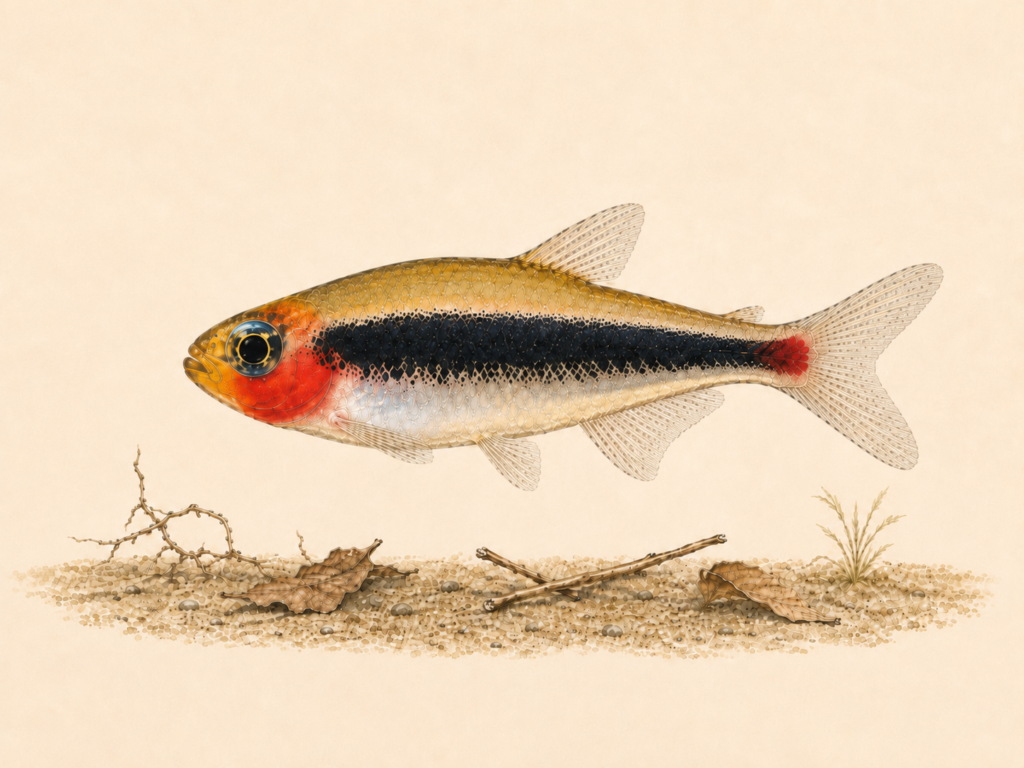
The Toucan Tetra is one of the smallest characins you will encounter in the hobby. Adults rarely exceed 2 cm in total length, and most individuals hover around 1.5 cm. The body is slender, laterally compressed, and largely translucent, allowing you to see the internal organs through the belly. A fine, golden to coppery lateral stripe runs from behind the gill cover to the base of the caudal fin, often bordered above by a faint dark line. When kept in tannin-rich water with subdued lighting, the stripe takes on a warm, luminous quality that photographs rarely do justice. The fins are mostly transparent, sometimes showing a faint yellowish tinge, and the eyes are relatively large for the body size, giving the fish a lively, alert expression.
Sexual dimorphism is subtle but discernible in mature specimens. Males tend to be slightly more intensely coloured, especially along the lateral stripe, and their bodies can appear a touch slimmer than those of females. Females, when in breeding condition, develop a noticeably rounder belly as they fill with eggs, which is often the easiest way to tell the sexes apart. There are no known colour morphs or selectively bred variants of this species, so what you see in the wild is exactly what you get in captivity.
Natural habitat
The Toucan Tetra is endemic to a very limited range in the upper Rio Negro drainage in Amazonas state, Brazil. It inhabits small, slow-flowing blackwater streams and forest creeks shaded by dense tropical canopy. These waters are stained dark brown by tannins released from decomposing leaf litter and fallen wood. The substrate is typically sand covered in a thick carpet of leaves, with submerged roots, branches, and overhanging vegetation creating a complex, dimly lit environment. The water in these habitats is extremely soft, often with negligible general hardness, and highly acidic, with pH values that can dip below 4.0.
Understanding this habitat is essential for keeping the Toucan Tetra successfully. The extreme softness and acidity of its home waters are not just preferences but genuine requirements. Fish kept in harder, more alkaline water tend to show faded colour, increased stress, and a shortened lifespan. The dim lighting, heavy leaf litter, and gentle current of its natural environment should all be replicated in captivity. Trying to keep this fish in a bright, bare, hard-water community tank would be setting it up for failure.
Tank size and setup
A group of eight to ten Toucan Tetras can be comfortably housed in a tank of 30 litres or more. Because of their tiny size, they do not need a huge footprint, but a longer, shallower tank is preferable to a tall, narrow one because it provides more horizontal swimming space and a larger surface area for gas exchange. A 45 cm cube or a 60 x 30 x 30 cm rectangular tank works beautifully for a small species-only setup.
For substrate, fine sand in a natural tan or brown colour is ideal, mimicking the sandy creek beds of the upper Rio Negro. Brands such as ADA La Plata Sand or JBL Sansibar Dark work well. Layer the bottom with a generous carpet of dried Indian almond leaves (Terminalia catappa), oak leaves, or beech leaves. These will slowly release tannins, soften the water, lower pH, and provide surfaces for biofilm and microfauna that the tetras will graze on. Driftwood, particularly smaller, branchy pieces such as spider wood or Malaysian driftwood, should be arranged to create shaded nooks and mimic fallen branches.
Plants that thrive in soft, acidic, low-light conditions are perfect companions. Consider species like Cryptocoryne parva, Bucephalandra varieties attached to wood, Java moss (Taxiphyllum barbieri), and floating plants like Salvinia minima or Amazon frogbit (Limnobium laevigatum) to dim the light from above. Lighting should be subdued. If you use a modern LED fixture, dial it down or rely on the floating plants to filter intensity. A tea-coloured tint in the water column from tannins will also naturally soften the light, which is exactly what these fish respond to best. Water flow should be very gentle, replicating the near-still creeks where this species is found.
Water parameters
| Parameter | Ideal range |
|---|---|
| Temperature | 20 to 28 °C |
| pH | 4.0 to 6.5 |
| General hardness (GH) | 1 to 8 dGH |
| Ammonia | 0 ppm |
| Nitrite | 0 ppm |
| Nitrate | Below 10 ppm |
The Toucan Tetra’s water chemistry requirements are among the most demanding you will encounter in freshwater fishkeeping. With a preferred pH well below 6.0 and near-zero hardness, you will almost certainly need to use RO (reverse osmosis) or distilled water, remineralised only very slightly if at all. Tap water in most regions is far too hard and alkaline for this species. Stability is critical. Even within the acceptable range, sudden swings in pH or temperature can be harmful. Use a reliable digital thermometer and a quality pH pen or drop test kit, and test regularly. Frequent small water changes of around 10 to 15 percent twice a week are preferable to large, infrequent changes that could destabilise chemistry.
Filtration and equipment
For a nano tank housing Toucan Tetras, a small sponge filter is often the best choice. Sponge filters provide gentle biological and mechanical filtration without generating excessive current, and they are virtually impossible to accidentally suck tiny fish or fry into. An air-driven sponge filter rated for your tank size, paired with a small adjustable air pump, gives you fine control over flow. If you prefer a power filter, a small hang-on-back model with a pre-filter sponge over the intake and the flow turned down to its lowest setting can also work. Avoid canister filters and powerheads, which tend to produce too much current for this species.
A reliable heater is essential. For tanks in the 30 to 45 litre range, a 25 to 50 watt adjustable heater is sufficient. The Eheim Jäger or Aquael Ultra Heater lines are popular choices in this wattage range and offer good temperature accuracy. Always pair your heater with a separate thermometer so you can verify the actual water temperature independently.
For water testing, the API Freshwater Master Test Kit covers ammonia, nitrite, nitrate, and pH. However, because the Toucan Tetra lives at such low pH values, you may find that standard test kits bottom out around pH 6.0. A digital pH pen such as the Hanna HI98107 will give you more precise readings in the acidic range. A TDS (total dissolved solids) meter is also a worthwhile investment when working with RO water, helping you ensure the mineral content stays consistently low.
Diet and feeding
In the wild, Toucan Tetras feed on tiny invertebrates, microorganisms, and biofilm found on leaf litter and submerged surfaces. Their mouths are very small, so all food items in captivity need to be appropriately sized. Live and frozen micro foods should form the backbone of the diet. Newly hatched baby brine shrimp (Artemia nauplii), micro worms, vinegar eels, and grindal worms are all excellent choices that the fish will eagerly chase. Frozen cyclops and daphnia are also well received, though larger daphnia may need to be crushed slightly for very small individuals.
High-quality micro pellets and crushed flake can supplement live and frozen foods but should not be the sole diet. Brands such as Hikari Micro Pellets, Sera Micron, and Fluval Bug Bites (crushed finely) have all been used successfully by keepers. Feed small amounts twice a day, only as much as the group can consume in about two minutes. Overfeeding in a small tank with soft, acidic water can quickly lead to water quality issues, so restraint is important. The leaf litter in your tank will naturally support populations of infusoria and other microfauna, providing a constant supplementary food source between meals.
Behaviour and temperament
The Toucan Tetra is a peaceful, somewhat shy fish that spends most of its time in the mid to lower water column, often hovering among leaf litter and driftwood. It is a loosely schooling species, meaning the group will generally stay in the same area of the tank but individuals do not swim in tight, synchronised formation the way some larger tetras do. Instead, they drift, explore, and occasionally chase one another in brief, harmless displays.
Keeping them in a group of at least eight is important for their comfort. In smaller numbers, they tend to hide constantly and may show stress colouring, appearing washed out and pale. In a well-sized group within a properly set up tank, they become bolder, spending more time in the open and displaying their best colour. Males will occasionally spar with one another, flaring briefly and posturing, but these interactions are entirely harmless and fun to watch. They are not aggressive toward any tank mate and pose no threat to anything, including shrimp and snails.
Tank mates
Because of the Toucan Tetra’s tiny size and very specific water requirements, tank mate selection needs careful thought. Only species that share a preference for very soft, acidic water and a peaceful disposition should be considered. In many cases, a species-only tank is the safest and most rewarding approach.
Good tank mates
- Green Neon Tetra (Paracheirodon simulans), a small, peaceful blackwater tetra that thrives in identical conditions
- Ember Tetra (Hyphessobrycon amandae), tiny and calm, tolerates soft acidic water well
- Pygmy Corydoras (Corydoras pygmaeus), a gentle bottom dweller small enough not to intimidate
- Chocolate Gourami (Sphaerichthys osphromenoides), a quiet blackwater species that appreciates the same parameters
- Coral Red Pencilfish (Nannostomus mortenthaleri), a small, peaceful surface to mid-level swimmer suited to soft, acidic tanks
- Dwarf shrimp such as Caridina species that prefer soft, acidic water, like Crystal Red Shrimp
- Otocinclus, a small, non-threatening algae grazer (ensure the tank is large enough)
Fish to avoid
- Any cichlid, even small ones like Apistogramma, as they may prey on or bully fish this small
- Tiger Barbs, boisterous fin nippers that would terrorise Toucan Tetras
- Bettas, potentially aggressive and better suited to different water chemistry
- Larger tetras such as Congo Tetras or Buenos Aires Tetras, which are too large and active
- Any fish that requires hard, alkaline water, such as livebearers (guppies, mollies, platies), as the water parameters are fundamentally incompatible
- Large or aggressive catfish, including common plecos, which are far too boisterous for a nano setup
Breeding
Breeding the Toucan Tetra in captivity is challenging but has been achieved by dedicated hobbyists. The first step is being able to sex your fish reliably. As noted earlier, females in condition are noticeably rounder in the belly, while males are slimmer and may show slightly more vivid colouration along the lateral stripe. Having a well-established group of at least eight to ten fish increases the odds of having both sexes represented.
Conditioning for spawning involves feeding a varied diet rich in live foods, particularly baby brine shrimp and micro worms, for two to three weeks. The breeding tank, or a section of the main tank, should have extremely soft, acidic water with a pH around 4.5 to 5.5, a temperature of 26 to 27 °C, and very dim lighting. A thin layer of fine-leaved moss such as Java moss or a spawning mop on the bottom provides a substrate for eggs. The fish are egg scatterers, releasing small, semi-adhesive eggs among plants and leaf litter. Spawning typically happens in the early morning.
Adults will eat their own eggs if given the opportunity, so removing the parents after spawning or using a mesh divider to protect the eggs is advisable. Eggs are tiny and hatch in roughly 24 to 36 hours at tropical temperatures. The fry are extremely small, even by tetra standards, and will initially need infusoria or commercially available liquid fry food such as Sera Micron as a first food. After a week or so, they can be transitioned to freshly hatched baby brine shrimp. Growth is slow, and maintaining pristine water quality in the fry tank is essential for survival. Keep the fry tank dimly lit and avoid any strong filtration that could trap them.
Common diseases and health
The Toucan Tetra is not especially disease-prone when kept in proper conditions, but its sensitivity to water quality means problems can escalate quickly if parameters drift. The most common issue is stress-related illness caused by inappropriate water chemistry, particularly pH that is too high or hardness that is too elevated. Stressed fish often show faded colouring, clamped fins, and loss of appetite. The remedy is straightforward but requires diligence: correct the water parameters gradually and ensure the tank is properly maintained.
Ich (white spot disease) can occasionally appear, especially after introducing new fish or following a temperature drop. The classic symptom is small white dots on the body and fins, along with flashing (rubbing against surfaces). Treatment with a half-dose of a malachite green-based medication, combined with gradually raising the temperature to 28 °C over 48 hours, is usually effective. Be cautious with medications in soft, acidic water, as the lack of buffering capacity can cause treatments to be more potent than expected. Always use reduced dosages for nano fish.
Bacterial infections, presenting as reddened patches, fin erosion, or lethargy, can occur in tanks with poor water quality. Maintaining a regular water change schedule and avoiding overfeeding are the best preventative measures. Always quarantine new fish for at least two to three weeks in a separate tank before adding them to your main setup. This is especially important with wild-caught specimens, which Toucan Tetras often are, as they may carry parasites or pathogens not immediately visible.
Frequently asked questions
How many Toucan Tetras should I keep together?
A minimum group of eight is recommended, with ten or more being even better. These are social fish that feel more secure and display better colour and behaviour in larger groups. In groups smaller than six, they tend to hide excessively and show signs of chronic stress.
Can Toucan Tetras live in a community tank?
They can, but the community must be very carefully chosen. Only small, peaceful species that thrive in extremely soft, acidic water are suitable. In practice, many keepers find a species-only nano tank the most successful and enjoyable way to keep them.
What pH do Toucan Tetras need?
They require acidic water with a pH between 3.5 and 6.0. Most keepers aim for a pH of around 4.5 to 5.5 for the best results. This is significantly lower than what most tropical fish need, so RO water and tannin sources like leaf litter and driftwood are typically essential.
Are Toucan Tetras hard to keep?
Yes, they are considered an advanced species primarily because of their strict water chemistry requirements. The fish themselves are not finicky eaters or especially fragile, but maintaining very soft, acidic water with near-zero hardness consistently is a genuine challenge that requires experience and the right equipment.
Where can I buy Toucan Tetras?
Toucan Tetras are not commonly stocked in high street pet shops. Your best bet is specialist aquarium retailers, online fish stores that focus on rare or wild-caught species, and aquarist forums or social media groups where hobbyist breeders occasionally offer captive-bred stock. Expect to pay a premium compared to common tetra species.