Quick summary
Livingston’s Cichlid is a large, predatory Lake Malawi fish that needs a 450+ litre tank, hard alkaline water, and tank mates too big to be eaten, so it suits intermediate to advanced cichlid keepers rather than beginners. If you can provide the space and a meaty diet, it rewards you with striking colours and its famous “playing dead” hunting display.
🐠 Build a tank around this species
In this guide:
- Introduction
- Quick Stats
- Appearance
- Natural Habitat
- Tank Size and Setup
- Water Parameters
- Filtration and Equipment
- Diet and Feeding
- Behaviour and Temperament
- Tank Mates
- Breeding
- Common Diseases
- FAQs
Introduction
Livingston’s Cichlid, scientifically known as Nimbochromis livingstonii, is one of the most fascinating predatory cichlids found in Lake Malawi. Named after the famous explorer David Livingstone, this species has earned a remarkable reputation in the aquarium hobby for its extraordinary hunting strategy – it plays dead. By lying motionless on its side on the substrate, often with its blotchy patterning mimicking a decomposing fish, it lures unsuspecting smaller fish close enough to ambush them with a sudden, explosive strike. This behaviour, known as thanatosis or death-feigning, makes Livingston’s Cichlid one of the most behaviourally interesting freshwater fish available to aquarists.
Despite its predatory nature, Livingston’s Cichlid is a manageable species for experienced cichlid keepers. It grows to a substantial size and requires a large aquarium, but it is relatively hardy and tolerant of a range of water conditions within the parameters typical of Lake Malawi cichlids. Its striking mottled pattern, impressive size, and unique behavioural repertoire make it a centrepiece fish for large African cichlid displays. However, prospective keepers should be fully aware that this is a piscivore – it will eat any fish small enough to fit in its surprisingly large mouth. With the right setup, appropriate tank mates, and a suitable diet, Livingston’s Cichlid can thrive in captivity for many years, rewarding its keeper with one of the most captivating displays of natural predatory behaviour available in the freshwater hobby.
Quick Stats
| Scientific name | Nimbochromis livingstonii |
|---|---|
| Common names | Livingstonii Cichlid, Livingston's Hap, Kaligono, Sleeper Cichlid |
| Family | Cichlidae |
| Origin | Lake Malawi, Lake Malombe, and upper Shire River (Malawi, Mozambique, Tanzania) |
| Adult size | 25 cm |
| Difficulty | Intermediate |
| Breeding difficulty | Moderate |
| Temperature | 24–28 °C |
| pH | 7.6–8.8 |
| GH | 10–25 dGH |
| Minimum tank size | 450 L |
| Conservation status | Least Concern (IUCN, assessed 2018) |
Appearance
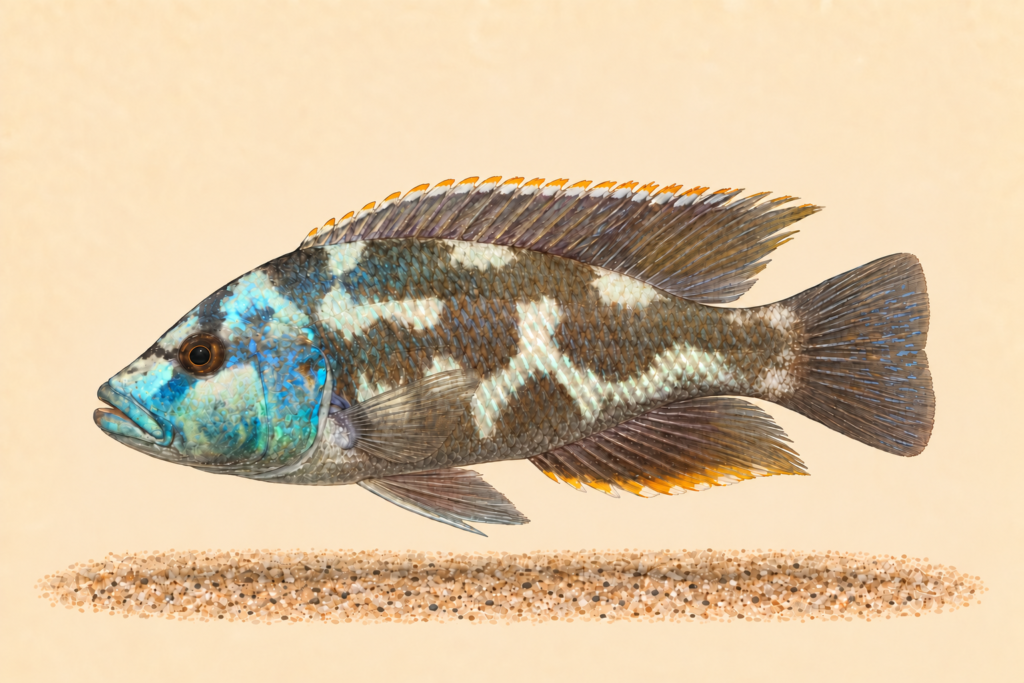
Livingston’s Cichlid possesses one of the most distinctive and functional colour patterns of any freshwater fish. Its body is robust, laterally compressed, and elongated – a typical haplochromine build designed for both power and speed. The base colour is a silvery-white to greyish tone, overlaid with large, irregular dark brown to black blotches that extend across the flanks, head, and into the fins. This mottled patterning serves a dual purpose: it provides camouflage against the sandy and rocky substrates of Lake Malawi, and it convincingly mimics the appearance of a dead or decaying fish when the cichlid lies motionless on the bottom.
Sexual dimorphism becomes apparent as the fish mature. Dominant males develop a stunning blue to blue-green metallic sheen that overlays their blotched pattern, particularly across the head, upper body, and dorsal fin. The dorsal fin in males is edged with a vivid red or orange margin, and the anal fin often displays prominent egg spots – ocelli that play a role in the species’ mouthbrooding reproductive behaviour. Females and subdominant males retain the more cryptic brown-and-white blotched pattern throughout their lives, which is arguably the more iconic look associated with the species’ death-feigning behaviour.
The mouth of Livingston’s Cichlid is notably large and protrusible, an adaptation for its ambush predatory lifestyle. When it strikes at prey, the mouth extends rapidly forward, creating a suction effect that draws the victim in. Juveniles display the blotched pattern from an early age, though it becomes more defined and contrasting as they grow. Overall, this is a large, powerfully built cichlid that commands attention in any aquarium, whether it is displaying its stunning male breeding colours or demonstrating its uncanny impression of a dead fish.
Natural Habitat
Nimbochromis livingstonii is endemic to the Lake Malawi basin in East Africa, where it is found throughout the lake as well as in the connected Lake Malombe and the upper reaches of the Shire River. It inhabits a range of environments but shows a strong preference for shallow, sandy areas and transitional zones where sand meets rocky substrates. These habitats typically feature scattered rocks, sparse vegetation, and open sandy expanses – the ideal terrain for its death-feigning hunting strategy.
In the wild, Livingston’s Cichlid is most commonly encountered at depths of 5 to 15 metres, though it has been recorded at various depths throughout the lake. The sandy and muddy substrates in these zones provide the perfect backdrop for the fish’s mottled camouflage. It often lies in areas where small cichlids, particularly juvenile mbuna and other haplochromines, congregate to forage. The clarity of Lake Malawi’s water, combined with the presence of Vallisneria and other aquatic plants in some areas, creates an environment where visual deception is a highly effective hunting technique.
Lake Malawi’s water is characteristically alkaline and hard, with a stable pH typically between 7.8 and 8.6, and water temperatures ranging from approximately 23 to 28 degrees Celsius depending on depth and season. The lake is remarkably stable in its chemistry, which is an important consideration for aquarists – Livingston’s Cichlid has evolved in an environment with minimal fluctuations in water parameters. The oxygen-rich, clear waters of the lake support a vast diversity of cichlid species, and Livingston’s Cichlid sits near the top of the food chain as one of the lake’s most effective ambush predators.
Tank Size and Setup
Given its adult size of up to 25 cm and its active, predatory nature, Livingston’s Cichlid requires a spacious aquarium. A minimum tank size of 450 litres is recommended for a single specimen or a small group, with larger tanks of 600 litres or more strongly preferred. The tank should ideally have a footprint of at least 150 cm in length and 50 cm in width to provide adequate swimming space and territory. Keeping this species in an undersized aquarium will lead to stress, increased aggression, and poor health outcomes.
The aquascape should reflect the species’ natural habitat. A sandy substrate is ideal, as Livingston’s Cichlid spends considerable time lying on the bottom during its death-feigning behaviour. Fine sand in a natural beige or light brown colour works best, as it allows the fish to display its camouflage effectively and engage in its natural behaviours. Avoid sharp-edged gravel that could damage the fish as it lies on its side.
Incorporate rock formations to create visual barriers, caves, and territories. Stacked rocks, limestone, and ocean rock are all excellent choices that also help buffer the water towards the alkaline pH preferred by Malawi cichlids. Arrange the rockwork to provide multiple hiding spots and line-of-sight breaks, as these reduce aggression between tank inhabitants. Leave substantial open sandy areas in the foreground and midground, as Livingston’s Cichlid uses these spaces for hunting and general activity.
Live plants are not essential but can be included if desired. Hardy species such as Anubias and Java Fern, which can be attached to rocks, are the best choices as they can tolerate the alkaline water conditions. Vallisneria species also work well and mimic the sparse vegetation found in some of the species’ natural habitats. Avoid delicate or soft-leaved plants, as larger cichlids may uproot or damage them.
A secure, tight-fitting lid is recommended. While Livingston’s Cichlid is not a notorious jumper, large cichlids can leap from the water when startled or during aggressive encounters. Adequate lighting is sufficient to illuminate the tank without being excessively bright – moderate lighting suits this species well and can be supplemented with floating plants to create dappled light effects if preferred.
Water Parameters
Maintaining stable, appropriate water parameters is essential for the long-term health of Livingston’s Cichlid. As a Lake Malawi species, it requires hard, alkaline water with minimal fluctuations. The table below summarises the ideal ranges.
| Temperature | 24-28 °C |
| pH | 7.6-8.8 |
| General hardness (GH) | 10-25 dGH |
| Ammonia | 0 ppm |
| Nitrite | 0 ppm |
| Nitrate | Below 20 ppm |
Consistency is paramount with Malawi cichlids. Sudden swings in pH or temperature can cause significant stress, leading to suppressed immune function and susceptibility to disease. If your tap water is naturally soft or acidic, you may need to use a Malawi buffer or mineral supplement to raise and stabilise the pH and hardness. Crusite substrates such as aragonite sand or the inclusion of limestone and coral rock in the tank decor can also help maintain alkaline conditions naturally.
Regular water changes of 25-30% per week are strongly recommended to keep nitrate levels low and maintain water quality. Livingston’s Cichlid is a large, messy eater that produces substantial waste, so diligent maintenance is essential. Use a reliable liquid test kit to monitor ammonia, nitrite, nitrate, pH, and hardness on a regular basis, particularly in the weeks following any changes to stocking or filtration.
Filtration and Equipment
Robust filtration is non-negotiable for an aquarium housing Livingston’s Cichlid. This is a large, predatory fish that produces significant biological waste, and the typically overstocked nature of many Malawi cichlid communities places additional demands on the filtration system. An external canister filter rated for at least 1.5 to 2 times the total tank volume per hour is the minimum recommendation. Many experienced keepers opt for two canister filters or supplement a primary canister with a large internal or hang-on-back filter for redundancy and enhanced mechanical filtration.
Biological filtration is the most critical component. Ensure the filter media includes a generous quantity of high-surface-area biological media such as ceramic rings, sintered glass, or bio-balls. Mechanical filtration through filter floss and foam pads will handle the particulate waste produced by messy feeding, and these should be rinsed or replaced regularly to prevent clogging and maintain flow rates. Chemical filtration with activated carbon can be used periodically to polish the water and remove dissolved organic compounds, though it is not strictly necessary for ongoing operation.
Water movement should be moderate to strong. Livingston’s Cichlid comes from a large lake with gentle to moderate currents, and good water circulation helps maintain oxygen levels and distribute heat evenly. A powerhead or wave maker can supplement the filter’s output if needed. Avoid creating excessively turbulent flow in the areas where the fish likes to rest on the substrate, as this could interfere with its natural behaviour.
A reliable heater rated appropriately for the tank volume is essential to maintain a stable temperature. For tanks of 450 litres or more, consider using two heaters at opposite ends of the tank to ensure even heat distribution and provide a backup in case one unit fails. A heater guard is advisable to prevent the fish from burning itself against the element, particularly as Livingston’s Cichlid spends time resting directly on the substrate near equipment.
Diet and Feeding
In the wild, Livingston’s Cichlid is primarily a piscivore – a fish eater. Its entire behavioural repertoire, from the death-feigning hunting strategy to its large, protrusible mouth, is adapted for capturing and consuming smaller fish. However, it is also an opportunistic feeder that will take invertebrates, insects, and other protein-rich food items when available.
In captivity, a varied, high-protein diet is essential for maintaining health and colour. A quality cichlid pellet formulated for large carnivorous or piscivorous species should form the staple diet. Look for pellets with fish meal, shrimp meal, or other animal proteins listed as the primary ingredients. The pellet size should be appropriate for the fish’s mouth – medium to large pellets work well for adults.
Supplement the staple pellets with a variety of protein-rich foods. Frozen or freeze-dried prawns, krill, silversides, and lance fish are all excellent choices. Earthworms, mealworms, and crickets can also be offered occasionally as enrichment. Some keepers include occasional offerings of mussel, cockle, or squid. Avoid feeding live feeder fish, particularly goldfish or rosy red minnows, as these carry a high risk of introducing parasites and diseases, and they offer poor nutritional value. If you wish to observe the fish’s natural predatory behaviour, gut-loaded live river shrimp or small invertebrates are a safer alternative.
Feed adults once or twice daily, offering only what can be consumed within a few minutes. Juveniles benefit from more frequent feedings of three to four times per day to support their rapid growth. Overfeeding should be avoided, as uneaten food rapidly degrades water quality in alkaline conditions. One fasting day per week can be beneficial for adult fish, mimicking the intermittent feeding patterns they would experience in the wild.
While Livingston’s Cichlid is primarily carnivorous, small amounts of vegetable matter such as spirulina-enriched foods can be included in the diet for variety. However, this species does not require the herbivorous diet associated with many mbuna cichlids, and its dietary needs lean heavily towards animal protein.
Behaviour and Temperament
The behaviour of Livingston’s Cichlid is its most captivating feature. The death-feigning or thanatosis behaviour for which it is famous is truly remarkable to observe in an aquarium setting. The fish will sink to the substrate, turn onto its side, and remain completely motionless. Its blotched colour pattern convincingly mimics a dead or dying fish. In the wild, small cichlids and other fish are attracted to what appears to be an easy scavenging opportunity, only to be engulfed when the “corpse” suddenly springs to life with a rapid, powerful strike. While this behaviour may be less frequently observed in captivity when the fish is well-fed and there are no suitable prey items, many keepers report seeing it regularly, particularly in the presence of smaller fish.
Outside of its predatory behaviour, Livingston’s Cichlid is a moderately aggressive species by Malawi cichlid standards. It is not as relentlessly territorial or combative as many mbuna species, but it is still a large, assertive cichlid that will establish and defend a territory. Males in particular can become aggressive towards conspecifics and other similarly shaped or coloured fish, especially during breeding periods. Keeping a single male with multiple females (a ratio of one male to two or three females) helps distribute aggression and reduces stress on any single individual.
This species is generally more laid-back than many other large haplochromines, spending considerable time resting on the substrate or slowly cruising the lower and middle levels of the tank. It can appear almost lethargic at times, which is entirely normal for an ambush predator that conserves energy between strikes. However, it is capable of sudden bursts of speed when feeding or during territorial disputes. Keepers should be aware that despite its seemingly placid demeanour, this fish is always aware of its surroundings and will attempt to eat any tank mate small enough to fit in its mouth.
Livingston’s Cichlid is an intelligent fish that quickly learns to associate its keeper with food. It will often approach the front of the tank during feeding times and can become quite interactive. Some keepers report that their fish recognise individual people and respond differently to different family members. This combination of intelligence, unique predatory behaviour, and striking appearance makes it one of the most rewarding large cichlids to keep.
Tank Mates
Selecting appropriate tank mates for Livingston’s Cichlid requires careful consideration of size, temperament, and ecological niche. The golden rule is simple: any fish small enough to fit in Livingston’s Cichlid’s mouth will eventually be eaten. This rules out most small to medium-sized species. Ideal companions are other large, robust Malawi cichlids that can hold their own without being overly aggressive. Avoid keeping Livingston’s Cichlid with very aggressive mbuna species that may harass it relentlessly, and avoid timid or slow-moving species that will be stressed by its presence. A well-stocked tank with appropriate species helps distribute aggression and creates a more natural social dynamic.
Good tank mates
- Nimbochromis venustus – A closely related species of similar size and temperament that coexists naturally in Lake Malawi.
- Red Fin Kadango Cichlid – A peaceful, open-water haplochromine large enough to avoid predation and unlikely to provoke aggression.
- Sciaenochromis fryeri – The Electric Blue Hap is similarly sized and occupies a comparable ecological niche without excessive territorial conflict.
- Red Empress Cichlid – A colourful, moderately assertive haplochromine that pairs well in large Malawi community setups.
- Aulonocara stuartgranti – Larger peacock cichlid species can work if the tank is spacious enough and hiding spots are plentiful.
- Dimidiochromis compressiceps – The Malawi Eye-Biter is another large predatory haplochromine that matches Livingston’s Cichlid in size and assertiveness.
- Synodontis multipunctatus – A robust African catfish that occupies the bottom of the tank and is too spiny and large to be considered prey.
- Fossorochromis rostratus – A large, sand-sifting haplochromine that coexists peacefully due to differing feeding strategies.
Fish to avoid
- Pseudotropheus demasoni – Far too small and would be quickly consumed; also overly aggressive for its size, creating constant tension.
- Labidochromis caeruleus – The Yellow Lab is too small and docile to safely coexist with a large piscivorous predator.
- Neon Tetra – Tiny tropical species from entirely different water parameters that would serve only as an expensive live food.
- White Spotted Cichlid – A Tanganyikan species with incompatible dietary and social requirements that would also face predation risk.
- Metriaclima estherae – Highly aggressive mbuna that would relentlessly harass Livingston’s Cichlid while being small enough to risk predation.
- Auratus Cichlid – One of the most aggressive mbuna species, known for terrorising tank mates far larger than itself.
- Apistogramma cacatuoides – A dwarf cichlid from South America with completely incompatible water requirements and size.
- Corydoras sterbai – A small, soft-water catfish that would be entirely unsuitable in terms of both water parameters and predation risk.
Breeding
Livingston’s Cichlid is a maternal mouthbrooder, following the reproductive strategy typical of many Lake Malawi haplochromine cichlids. Breeding in captivity is achievable and is rated as moderately difficult, primarily because it requires a sufficiently large tank, a well-conditioned group, and careful management of aggression.
To encourage breeding, maintain a group with a ratio of one male to two or three females. The male will establish a territory, often centred around a flat rock or a cleared area of sand, and will display intensely to attract females. His colouration intensifies dramatically during courtship, with the blue-green metallic sheen becoming particularly vivid. The male performs a characteristic quivering display, spreading his fins and circling the female to guide her towards his chosen spawning site.
Spawning follows the typical haplochromine pattern. The female deposits a small number of eggs on the substrate, then immediately picks them up in her mouth. She then mouths at the egg spots on the male’s anal fin, stimulating him to release sperm, which she inhales to fertilise the eggs within her buccal cavity. This sequence is repeated multiple times until the female has collected all her eggs – typically between 30 and 100 depending on her size and condition.
The female incubates the eggs in her mouth for approximately 21 to 28 days, during which time she does not eat. It is important not to disturb or stress a holding female, as she may spit out or swallow the eggs prematurely. Some breeders opt to strip the fry from the mother’s mouth at around day 18 to 21 and raise them artificially in a separate tumbler or grow-out tank, which can improve survival rates but requires experience and careful technique.
Newly released fry are relatively large and can immediately accept crushed flake food, baby brine shrimp, and finely ground cichlid pellets. They grow quickly when well-fed and kept in clean water. The fry display the characteristic blotched pattern from an early age. It is advisable to raise the fry in a separate tank to prevent predation by the adults, including the mother. Sexing young fish is difficult until they begin to show male colouration at around 6 to 8 cm in length.
Common Diseases
Livingston’s Cichlid is a hardy species that is not particularly prone to disease when kept in appropriate conditions. However, like all aquarium fish, it can be affected by a range of common ailments, particularly when water quality is poor or the fish is stressed.
Malawi bloat is perhaps the most significant disease concern for this species and other large Malawi cichlids. This condition, characterised by abdominal swelling, loss of appetite, lethargy, and rapid breathing, is often associated with poor diet, overfeeding, or deteriorating water quality. It can progress rapidly and be fatal if not addressed promptly. Treatment involves improving water quality immediately, ceasing feeding temporarily, and administering metronidazole-based medication. Prevention through proper diet and maintenance is far more effective than treatment.
Ich (white spot disease), caused by the protozoan parasite Ichthyophthirius multifiliis, can affect Livingston’s Cichlid, particularly during periods of temperature instability or when new fish are introduced without quarantine. The characteristic white spots on the body and fins are usually the first visible sign. Treatment involves raising the temperature gradually to 28-30 degrees Celsius and administering a copper-based or formalin-based ich medication according to the manufacturer’s instructions.
Bacterial infections, including fin rot and body ulcers, can occur in fish that are stressed, injured during territorial disputes, or kept in water with elevated ammonia or nitrite levels. Maintaining pristine water quality is the best prevention. Affected fish should be treated with a broad-spectrum antibacterial medication, and the underlying cause of stress should be identified and resolved.
Internal parasites, including tapeworms and roundworms, can be introduced through live food or infected new additions. Symptoms include weight loss despite a good appetite, white stringy faeces, and general lethargy. Treatment with praziquantel or levamisole is usually effective. Quarantining all new fish for a minimum of two to four weeks before introducing them to the main display is a highly recommended practice that significantly reduces the risk of introducing both parasites and infectious diseases.
Hole-in-the-head disease (HITH or HLLE – Head and Lateral Line Erosion) is occasionally seen in large cichlids, including Livingston’s Cichlid. It presents as pitting and erosion of the skin around the head and along the lateral line. The exact cause is debated, but it is strongly associated with poor water quality, inadequate diet (particularly vitamin and mineral deficiencies), and the overuse of activated carbon in filtration. Improving diet, water quality, and removing carbon from the filter typically leads to gradual recovery.
FAQs
Does Livingston’s Cichlid really play dead?
Yes, this behaviour is well-documented both in the wild and in captivity. Nimbochromis livingstonii will lie motionless on its side on the substrate, mimicking a dead fish with its mottled colouration. In the wild, this lures small fish close enough to be ambushed. In aquaria, the behaviour is most commonly observed when the fish is hungry or when smaller fish are present. Even well-fed specimens may occasionally exhibit the behaviour, as it appears to be deeply ingrained and instinctive rather than solely driven by hunger.
Can I keep Livingston’s Cichlid with mbuna?
This combination is generally not recommended. Most mbuna species are too small and risk being eaten, and the more aggressive mbuna species such as Melanochromis auratus or Metriaclima species can harass Livingston’s Cichlid relentlessly. The dietary requirements also differ significantly, with mbuna needing a primarily herbivorous diet. If you must mix them, choose only the largest mbuna species and ensure the tank is very large with ample hiding spots, but even then, success is not guaranteed.
How fast does Livingston’s Cichlid grow?
Growth rate depends heavily on diet, water quality, and tank size. Under optimal conditions with a high-protein diet and spacious tank, juveniles can grow from 5 cm to 15 cm within their first year. Full adult size of 20-25 cm is typically reached within 18 to 24 months. Males tend to grow slightly larger than females. Stunting can occur in undersized aquariums, so providing adequate space from the outset is important for healthy development.
Is Livingston’s Cichlid suitable for beginners?
While Livingston’s Cichlid is hardy and relatively easy to care for in terms of its basic requirements, it is best suited to aquarists who have some experience with large cichlids or African cichlid communities. The need for a large tank, careful tank mate selection, appropriate diet, and management of aggression makes it more suitable for intermediate to advanced keepers. Beginners interested in Malawi cichlids would benefit from starting with smaller, more forgiving species before progressing to large predatory haplochromines.
How many Livingston’s Cichlids can I keep together?
In a tank of 450 litres, a single male with two to three females is a comfortable group. In larger systems of 600 litres or more, you could potentially keep a slightly larger group, but multiple males in the same tank will often result in intense aggression unless the tank is very large with numerous visual barriers. Some keepers successfully maintain a single specimen as a centrepiece in a mixed haplochromine community. The key is ensuring that each fish has sufficient space to establish a territory without being in constant conflict with its neighbours.
Related Guides
- Nimbochromis venustus Care Guide – A closely related ambush predator from Lake Malawi with similar care requirements and compatible temperament.
- Dimidiochromis compressiceps Care Guide – Another large predatory Malawi haplochromine that makes an excellent companion species in spacious setups.
- Sciaenochromis fryeri Care Guide – The Electric Blue Hap is a popular large haplochromine that pairs well with Livingston’s Cichlid in community tanks.
- Aulonocara stuartgranti Care Guide – A colourful peacock cichlid suitable for large Malawi community aquariums alongside appropriately sized haplochromines.
- Synodontis multipunctatus Care Guide – A robust African catfish that serves as an excellent bottom-dwelling companion for large Malawi cichlid setups.