Cuckoo Catfish Care Guide — Tank Setup, Feeding and Breeding
Quick summary
The Cuckoo Catfish suits aquarists who can provide a large, well established Lake Tanganyika style tank with hard, alkaline water and a group of at least four to six fish, and it is best appreciated alongside compatible Tanganyikan cichlids. It is moderately easy to keep given correct water chemistry, but breeding it via its natural brood-parasitic behavior is difficult and requires actively spawning mouthbrooding cichlid hosts.
🐠 Build a tank around this fish
In this guide:
- Introduction
- Quick Stats
- Appearance
- Natural Habitat
- Tank Size and Setup
- Water Parameters
- Filtration and Equipment
- Diet and Feeding
- Behaviour and Temperament
- Tank Mates
- Breeding
- Common Diseases
- FAQs
Introduction
The Cuckoo Catfish (Synodontis multipunctatus) is one of the most fascinating freshwater fish available to the aquarium hobby, owing its common name to a remarkable reproductive strategy that mirrors that of the European cuckoo bird. Native exclusively to Lake Tanganyika in East Africa, this catfish is a brood parasite, it cunningly deposits its eggs among those of mouthbrooding cichlids, tricking the host mother into incubating the catfish fry alongside, or even instead of, her own young. This extraordinary behaviour has captivated aquarists and biologists alike since it was first documented in the wild, and it remains one of the most compelling examples of reproductive parasitism in the fish world.
Beyond its behavioural intrigue, the Cuckoo Catfish is an attractive and relatively hardy species that adapts well to aquarium life when its environmental needs are met. Its striking spotted pattern, active disposition, and sociable nature make it a rewarding addition to a Lake Tanganyika biotope or any alkaline community setup of appropriate size. While not especially difficult to keep, understanding its specific water chemistry requirements and social needs is essential for long-term success. This guide covers everything you need to know to provide excellent care for Synodontis multipunctatus in the home aquarium.
Quick Stats
| Scientific name | Synodontis multipunctatus |
| Common names | Cuckoo Catfish, Cuckoo Squeaker, Multi-Spotted Synodontis, Multi Catfish |
| Family | Mochokidae |
| Origin | Lake Tanganyika, East Africa (Burundi, Democratic Republic of the Congo, Tanzania, Zambia) |
| Adult size | 12–15 cm (5–6 inches) |
| Lifespan | 15–20 years |
| Difficulty | Moderate |
| Breeding difficulty | Difficult |
| Temperature | 24–27 °C |
| pH range | 7.8–9.0 |
| General hardness (GH) | 10–25 dGH |
| Carbonate hardness (KH) | 10–20 dKH |
| Minimum tank size | 200 litres |
| Conservation status | Least Concern (IUCN) |
Appearance
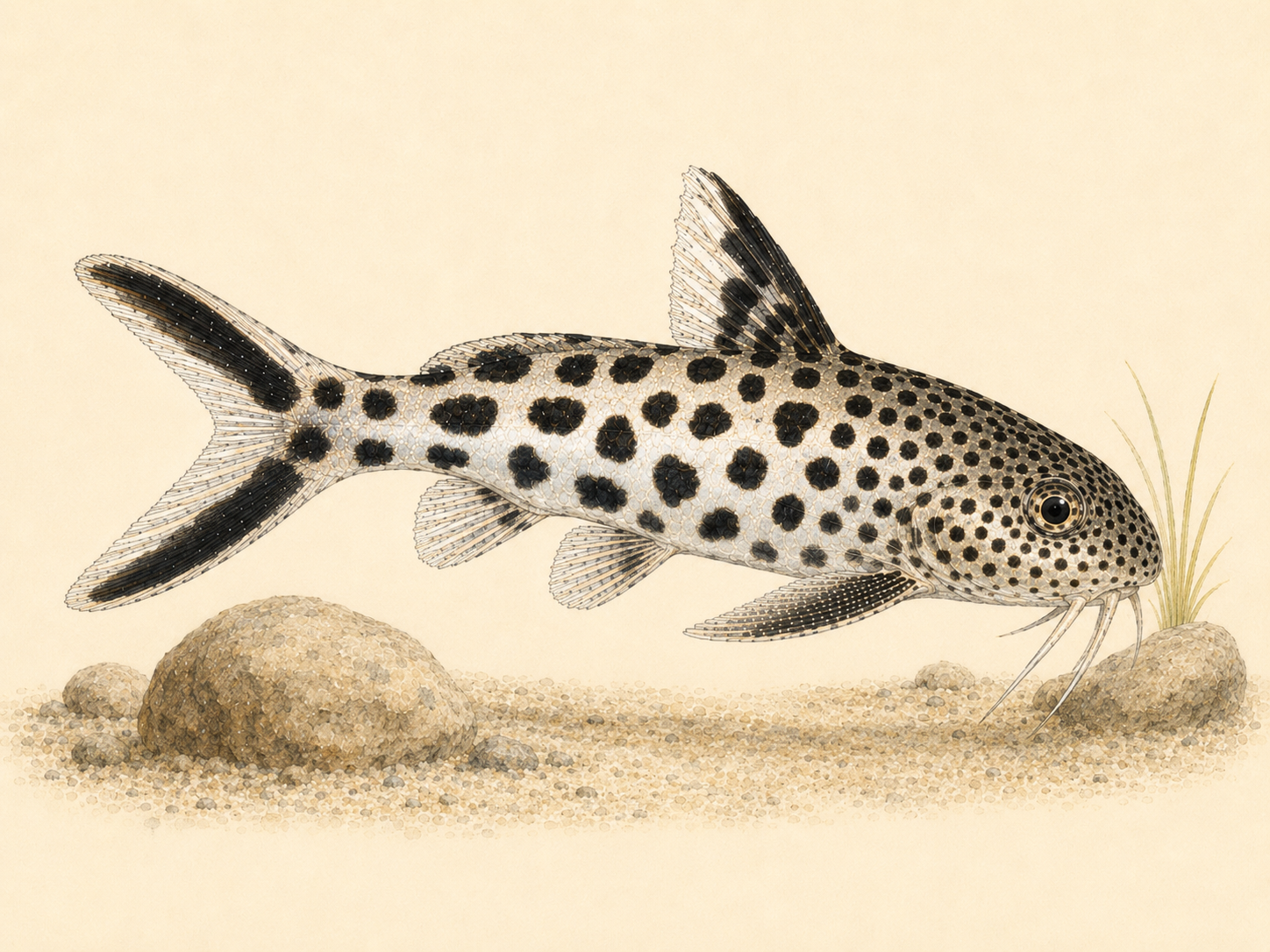
Synodontis multipunctatus is a handsome catfish with a robust, laterally compressed body that tapers toward a deeply forked caudal fin, a shape that hints at its active swimming lifestyle. The base body colour is a warm golden-tan to pale bronze, overlaid with a dense scattering of dark brown to black spots that extend across the flanks, head, and fins. The density and size of these spots vary between individuals, giving each fish a somewhat unique pattern. Juveniles tend to display larger, more distinct spots that may merge or multiply as the fish matures.
The head is broad and slightly flattened, bearing three pairs of barbels, one pair of maxillary barbels that are prominent and often held forward or swept back against the body, and two pairs of shorter mandibular barbels beneath the chin. The dorsal fin is tall and triangular, featuring a stout, serrated leading spine that the fish can lock into an erect position as a defensive measure. The adipose fin is moderately large and also bears spotting. The pectoral fins likewise possess strong, lockable spines, a characteristic feature of the Mochokidae family. Handle this species with extreme care when netting, as the spines can easily become entangled in fine mesh nets and can inflict a painful, mildly venomous puncture wound.
Both sexes appear broadly similar, though mature females tend to be slightly plumper and larger in overall body mass compared to males. Males may exhibit a marginally more angular body profile and, in breeding condition, a more pronounced genital papilla. The eyes are large and expressive, well-adapted to the species’ preference for crepuscular and nocturnal activity periods, though in aquaria they often become bolder and more visible during daylight hours, particularly around feeding times.
Natural Habitat
Synodontis multipunctatus is endemic to Lake Tanganyika, the second oldest, second largest, and second deepest freshwater lake in the world. This vast rift lake sits along the borders of Burundi, the Democratic Republic of the Congo, Tanzania, and Zambia, and is renowned for its exceptional biodiversity and remarkably stable water chemistry. The lake’s water is warm, highly alkaline, and mineral-rich, conditions that have remained broadly consistent for millions of years and to which the Cuckoo Catfish is precisely adapted.
Within the lake, S. multipunctatus inhabits rocky shorelines and substrates at moderate depths, typically ranging from around 5 to 40 metres. It frequents areas where tumbled boulders and rock formations create an abundance of caves, crevices, and overhangs, using these features as shelter during the day and emerging to forage over sandy substrates and among the rocks at dusk and during the night. The substrate in these zones is typically composed of fine sand interspersed with shell debris and scattered rock.
The species shares its habitat with a rich community of cichlids, including many mouthbrooding species from the genera Tropheus, Ctenochromis, and various other haplochromines and lamprologines. It is this close ecological association with mouthbrooding cichlids that has driven the evolution of its extraordinary brood-parasitic reproductive strategy. The water in Lake Tanganyika is characterised by its high pH (typically 8.6–9.2), substantial carbonate hardness, and exceptional clarity. Temperature at the depths inhabited by the Cuckoo Catfish generally sits between 24 and 27 °C with minimal seasonal variation.
Tank Size and Setup
A minimum tank size of 200 litres is recommended for a small group of Cuckoo Catfish, though larger aquaria of 300 litres or more are strongly preferred, particularly if the fish are to be housed alongside Tanganyikan cichlid tank mates. These are active, social catfish that should ideally be kept in groups of at least four to six individuals; a larger tank allows for a more stable social dynamic and reduces the likelihood of any single fish being bullied.
The aquascape should aim to replicate the rocky shoreline habitat of Lake Tanganyika. Use a combination of rounded rocks, cobbles, and stacked stone formations to create plenty of caves, tunnels, and crevices where the catfish can shelter during the day. Ensure that all rockwork is stable and securely placed, Synodontis species are powerful fish that can dislodge poorly arranged stones, with potentially catastrophic consequences for tank inhabitants and glass panels. Silicone adhesive or aquarium-safe rock supports can be used for added security.
The substrate should consist of fine to medium-grade sand, ideally in a natural tan or buff colour to complement the Tanganyikan biotope aesthetic. Avoid sharp or coarse gravel, as the catfish’s barbels are sensitive and can be damaged by abrasive substrates. A thin layer of crushed coral or aragonite sand can be mixed in to help buffer the water’s pH and hardness, which is particularly useful in areas with naturally soft tap water.
Live plants are not typically found in the rocky littoral zone of Lake Tanganyika, but hardy species such as Anubias and Vallisneria can be incorporated if desired, they will tolerate the high pH and provide additional visual interest. Attach Anubias to rocks rather than planting in the substrate, as the catfish may uproot loosely planted specimens during their nocturnal foraging. Driftwood is not a natural feature of Lake Tanganyika habitats and may leach tannins that lower pH, so it is generally best avoided or used only in small, well-seasoned pieces.
Lighting can be moderate; the Cuckoo Catfish is most active in subdued lighting conditions and will appreciate areas of shade created by overhanging rock formations. A standard LED lighting unit suitable for the tank’s dimensions will suffice. Ensuring adequate horizontal swimming space is important, as these catfish are not purely bottom-dwellers and will use the mid-water column freely, especially at feeding time.
Water Parameters
Maintaining the correct water chemistry is one of the most important aspects of Cuckoo Catfish care. As a Lake Tanganyika endemic, Synodontis multipunctatus requires hard, alkaline water with a high and stable pH. Sudden fluctuations in water chemistry can cause stress and increase susceptibility to disease, so consistency is paramount. Regular water changes of 20–25% weekly are recommended to maintain water quality and replenish mineral content.
| Temperature | 24–27 °C |
| pH | 7.8–9.0 |
| General hardness (GH) | 10–25 dGH |
| Carbonate hardness (KH) | 10–20 dKH |
| Ammonia | 0 ppm |
| Nitrite | 0 ppm |
| Nitrate | Below 20 ppm |
If your tap water is naturally soft and acidic, you will need to use a Tanganyika salt mix or buffer (commercially available from most aquarium suppliers) to raise and stabilise the pH, GH, and KH to appropriate levels. Crushed coral, aragonite substrate, or limestone rocks within the aquarium also contribute to buffering capacity. Never add the Cuckoo Catfish to a tank with a pH below 7.5 or in soft, acidic water, as this will compromise the fish’s health and longevity. Test water parameters regularly with a reliable liquid test kit, paying particular attention to pH stability and nitrate accumulation.
Filtration and Equipment
Effective filtration is essential for maintaining the pristine water quality that Synodontis multipunctatus demands. Lake Tanganyika is an oxygen-rich environment with minimal organic pollution, so the aquarium filter must provide excellent biological, mechanical, and chemical filtration capacity. A canister filter rated for at least 1.5 times the tank’s volume per hour is ideal; for example, a 200-litre tank should be paired with a filter offering a flow rate of at least 300 litres per hour, and ideally more. For larger setups, consider running two filters for redundancy and improved water circulation.
Biological filtration media, such as ceramic rings, sintered glass, or purpose-made bio-media, should form the bulk of the filter’s media basket, supporting the large colony of nitrifying bacteria needed to handle the bioload of a Tanganyikan community tank. A layer of fine mechanical media or filter floss helps to polish the water and trap fine particulate matter. Activated carbon can be used periodically to remove dissolved organics and maintain water clarity, though it is not strictly necessary on a permanent basis.
Good water movement and surface agitation are important for maintaining high dissolved oxygen levels. Supplementary aeration via an air pump and airstone, or a powerhead directed toward the surface, can be beneficial, particularly in warmer weather or densely stocked tanks. The Cuckoo Catfish appreciates moderate flow but does not require the intense currents associated with riverine species.
A reliable heater rated for the tank’s volume, ideally with a guard to prevent contact burns, should be used to maintain a stable temperature within the 24–27 °C range. In tanks with boisterous cichlid tank mates, an inline heater installed on the canister filter outlet is a safer alternative. A thermometer should be visible at all times to allow quick detection of any temperature fluctuations.
Diet and Feeding
In the wild, Synodontis multipunctatus is an opportunistic omnivore with a diet that includes invertebrates, small crustaceans, insect larvae, algae, and organic detritus foraged from the rocky substrate. In captivity, this species is refreshingly unfussy and will accept a wide variety of prepared and live foods, making it easy to provide a balanced and nutritious diet.
A high-quality sinking pellet or wafer designed for omnivorous catfish should form the staple diet. Choose products with a balanced ratio of animal and plant-based proteins. Supplement this with regular offerings of frozen or live foods such as bloodworm, brine shrimp, daphnia, and mysis shrimp. These protein-rich treats help to promote optimal condition, enhance colouration, and can play a role in conditioning fish for breeding.
Vegetable matter should also be included in the diet. Blanched courgette (zucchini), cucumber, spinach, and shelled peas are all readily accepted and provide valuable fibre and micronutrients. Spirulina-based flakes or wafers are another convenient way to ensure adequate plant-based nutrition. Avoid overfeeding, as Cuckoo Catfish are enthusiastic eaters and will readily consume more than they need, leading to obesity and water quality issues.
Feed once or twice daily, offering only as much food as the fish can consume within a few minutes. Because the species is naturally most active at dusk and dawn, offering the main feed shortly after the lights are dimmed in the evening often results in the most natural feeding behaviour. In community tanks with diurnal cichlids, ensure that the catfish are receiving their share, sinking foods offered after lights-out can help guarantee this.
Behaviour and Temperament
Synodontis multipunctatus is a sociable and generally peaceful catfish that does best when kept in groups. Solitary individuals may become shy, retiring, and stressed, whereas a group of four or more will display far bolder behaviour, often venturing out in the open during the daytime and interacting freely with one another. Within the group, a loose hierarchy may establish itself, with occasional, generally harmless chasing and posturing, this is normal social behaviour and rarely results in injury.
While broadly peaceful, the Cuckoo Catfish is not entirely without aggression. It can be assertive during feeding and may compete vigorously for preferred shelter spots, particularly if cave space is limited. Providing an excess of hiding places relative to the number of fish is the simplest way to prevent territorial disputes from escalating. Towards other species, S. multipunctatus is typically indifferent, though very small fish (under 2–3 cm) may occasionally be consumed, as the catfish is an opportunistic feeder.
The species is primarily crepuscular and nocturnal in its natural habitat, but captive specimens frequently adapt to daytime activity, especially in tanks with subdued lighting and a secure, well-structured environment. During the day, fish may rest in caves or wedge themselves into rock crevices, often in physical contact with conspecifics, a behaviour that appears to provide a degree of social comfort. At feeding time, they become highly active, swimming rapidly through the water column and displaying surprising agility for a catfish.
The Cuckoo Catfish is capable of producing audible squeaking or grunting sounds by locking and vibrating its pectoral fin spines, a characteristic of the Mochokidae family. These sounds are most often heard when the fish is handled or stressed, but may also occur during social interactions within the tank. The fin-locking mechanism also serves as a potent defence against predation; once the spines are locked erect, the fish becomes extremely difficult for a predator to swallow.
Tank Mates
The ideal community for the Cuckoo Catfish is a Lake Tanganyika biotope, housed alongside cichlids and other species native to the same lake. This ensures compatible water chemistry requirements and creates a natural, aesthetically pleasing display. When selecting tank mates, choose species of a similar size and temperament. Avoid very small species that could be viewed as food, and extremely aggressive species that might bully or injure the catfish. If you intend to breed the Cuckoo Catfish using its natural brood-parasitic strategy, you will, of course, need to include mouthbrooding cichlids in the tank.
Good tank mates
- Frontosa Cichlid, a large, slow-moving Tanganyikan cichlid that coexists peacefully with S. multipunctatus in tanks of appropriate size.
- Neolamprologus brichardi, a graceful, relatively peaceful Tanganyikan cichlid that shares similar water requirements and habitat preferences.
- Tropheus moorii, a mouthbrooding cichlid from Lake Tanganyika that can serve as a natural brood host and makes a visually striking companion.
- Julidochromis marlieri, a small, cave-dwelling Tanganyikan cichlid that occupies a different ecological niche and rarely conflicts with Synodontis.
- Neolamprologus leleupi, a colourful lemon-yellow cichlid that thrives in the same rocky, alkaline environment.
- Altolamprologus calvus, a laterally compressed predator that is generally too slow and specialised to trouble the agile Cuckoo Catfish.
- Cyprichromis leptosoma, an open-water, schooling Tanganyikan cichlid that provides movement in the upper water column without competing for bottom territory.
- Synodontis petricola, a closely related, smaller Tanganyikan Synodontis that mixes well and shares the same environmental needs.
Fish to avoid
- Neon Tetra, far too small and requires soft, acidic water that is completely incompatible with Tanganyikan conditions.
- Oscar Cichlid, a large, aggressive South American cichlid that requires different water chemistry and would likely bully or consume the catfish.
- Discus, Requires warm, soft, acidic water and a calm environment entirely at odds with a Tanganyikan setup.
- Tiger Barb, an active fin-nipper from Southeast Asia with incompatible water chemistry requirements.
- Common Pleco, Grows excessively large, produces a heavy bioload, and originates from South American soft-water habitats.
- Betta, Requires soft, warm, still water and would be stressed by the boisterous activity and high pH of a Tanganyikan tank.
- Aggressive Mbuna Cichlids, while from a similar rift lake environment, highly aggressive Mbuna species from Lake Malawi may harass the catfish and may have subtly different water chemistry preferences.
- Red-Tail Catfish, a massive predatory catfish that would view the Cuckoo Catfish as prey and requires a vastly larger aquarium.
Breeding
The breeding behaviour of Synodontis multipunctatus is among the most remarkable in the freshwater aquarium hobby. This species is an obligate brood parasite: in the wild, it relies entirely on mouthbrooding cichlids to incubate and rear its young. Replicating this behaviour in captivity is challenging but achievable, and successfully raising Cuckoo Catfish fry through this natural method is a highly rewarding experience.
To breed S. multipunctatus, you will need a group of sexually mature catfish (ideally six or more to ensure both sexes are represented) housed alongside a breeding colony of mouthbrooding cichlids. Suitable host species include Tropheus, Ctenochromis horei, and various Haplochromis-type Tanganyikan cichlids. The catfish are stimulated to spawn by the spawning activity of the cichlids, they are remarkably attuned to the behavioural cues and pheromones released during cichlid courtship.
When a pair of mouthbrooding cichlids begins to spawn, the Cuckoo Catfish moves in with split-second timing. As the female cichlid turns to collect her freshly laid eggs in her mouth, the catfish darts into the spawning site and simultaneously releases its own eggs and milt. The host female, in the midst of her egg-collecting behaviour, inadvertently scoops up the catfish eggs along with, or instead of, her own. The catfish eggs develop rapidly within the safety of the cichlid’s buccal cavity, and the catfish fry typically hatch and develop faster than the cichlid’s own offspring, often consuming the host’s eggs or fry in the process.
After approximately 14–18 days, the host female releases the fry, which by this stage are predominantly or entirely Cuckoo Catfish. The fry are relatively large and well-developed at release and can be fed on freshly hatched brine shrimp, microworms, and finely crushed high-quality flake food. Growth is steady, and the young catfish quickly develop the characteristic spotted patterning of the adults.
Conditioning the catfish for breeding involves providing a varied, protein-rich diet and maintaining optimal water quality. Regular water changes with slightly cooler water can sometimes simulate the subtle environmental triggers that encourage spawning activity. It is essential that the mouthbrooding host cichlids are healthy, well-established, and actively breeding for the parasitic strategy to succeed. Without active cichlid spawning in the tank, S. multipunctatus is unlikely to reproduce. There are occasional reports of the species spawning without a host, but survival of fry under these circumstances is negligible.
Sexing adult Cuckoo Catfish is difficult without close examination. Males may be slightly slimmer and exhibit a more pointed genital papilla, while females are typically fuller-bodied when gravid. Venting (examining the genital papilla under close inspection) is the most reliable method of sex determination, though this should be performed carefully to avoid stressing the fish or being injured by the pectoral spines.
Common Diseases
Synodontis multipunctatus is a reasonably hardy species, but it is not immune to the diseases that affect freshwater aquarium fish. As a scaleless catfish with sensitive skin and barbels, it can be more susceptible to certain conditions and may react poorly to some medications. Prevention through excellent water quality, a balanced diet, and a stress-free environment is always the best strategy.
White spot disease (Ichthyophthirius multifiliis, commonly known as ich) is one of the most frequently encountered ailments. It presents as small white cysts on the body, fins, and gills, and is typically triggered by sudden temperature drops, poor water quality, or the introduction of infected new stock. When treating ich in a tank containing Synodontis, use medications at half the recommended dose, as scaleless fish are highly sensitive to many chemical treatments, particularly those containing copper or malachite green. Raising the temperature to 28–30 °C and adding aquarium salt (in low concentrations compatible with the existing tank mates) can serve as a gentler alternative or supplementary treatment.
Bacterial infections, including fin rot and body ulcers, may occur in fish subjected to chronic stress, physical injury, or poor water conditions. These typically present as frayed or eroding fins, reddened areas on the body, or open sores. Treatment involves identifying and correcting the underlying environmental cause, followed by the use of a broad-spectrum antibacterial medication safe for scaleless fish. Maintaining pristine water quality is often sufficient to resolve mild cases without chemical intervention.
Fungal infections (Saprolegnia and related genera) appear as white, cotton-like growths, usually on areas of damaged tissue. These are secondary infections that colonise wounds or areas weakened by bacterial disease. Treatment with antifungal medications, again at reduced doses, combined with improved water quality, is usually effective.
Bloat and internal parasites can occasionally affect Cuckoo Catfish, particularly wild-caught specimens or those fed a monotonous diet. Symptoms include a swollen abdomen, loss of appetite, and abnormal faeces. A varied diet, quarantine of new arrivals, and periodic use of anti-parasitic foods can help prevent these issues. If internal parasites are suspected, treatment with a suitable antiparasitic medication under veterinary guidance is recommended.
Barbel erosion is a condition specific to catfish and is almost always caused by abrasive substrates (sharp gravel), poor water quality, or bacterial infection. Affected barbels become shortened, ragged, or completely eroded. Prevention is straightforward: use smooth sand substrate, maintain excellent water quality, and avoid overcrowding. Healthy barbels will regenerate slowly once conditions are improved.
FAQs
Can Cuckoo Catfish be kept without mouthbrooding cichlids?
Yes, absolutely. Synodontis multipunctatus does not require mouthbrooding cichlids to survive or thrive, the host cichlids are only necessary if you wish to breed the catfish using its natural brood-parasitic strategy. In a non-breeding setup, the Cuckoo Catfish can be kept in any appropriately sized aquarium with compatible water chemistry and peaceful to moderately robust tank mates.
How many Cuckoo Catfish should I keep together?
A group of at least four to six is strongly recommended. Synodontis multipunctatus is a social species that displays far more natural, confident behaviour when kept with conspecifics. Solitary individuals often become chronically shy and may spend nearly all of their time hidden. Larger groups also help to distribute any minor social aggression and result in a more dynamic, engaging display.
Are Cuckoo Catfish nocturnal?
In the wild, they are primarily crepuscular and nocturnal, meaning they are most active around dawn and dusk and during the night. However, in captivity, they frequently adapt to daytime activity, especially once they become accustomed to the aquarium environment and regular feeding routines. Providing adequate shelter and subdued lighting encourages daytime boldness, and most established specimens will readily emerge during the day, particularly at feeding time.
Is the Cuckoo Catfish the same as Synodontis petricola?
No, although the two species are closely related, both hail from Lake Tanganyika, and they are frequently confused in the aquarium trade. Synodontis petricola is a smaller species (typically reaching 10–12 cm) with finer, more numerous spots and a more delicate build. S. multipunctatus is larger, with bolder spotting and a broader head. Both species exhibit brood-parasitic behaviour, but they are distinct species with subtle differences in appearance and adult size. Always purchase from a reputable supplier to ensure correct identification.
Can Cuckoo Catfish be kept with Malawi cichlids?
They can, with caution. The water chemistry of Lake Malawi is broadly similar to that of Lake Tanganyika, hard and alkaline, so there is a reasonable degree of overlap. Many aquarists successfully keep S. multipunctatus in Malawi cichlid community tanks. However, care must be taken to select less aggressive Malawi species, as highly territorial mbuna can harass the catfish. Additionally, the catfish may attempt to parasitise the broods of mouthbrooding Malawi cichlids, which is a consideration if you are trying to breed your cichlids.
Related Guides
- Synodontis petricola Care Guide, a closely related and often confused Tanganyikan catfish with similar care requirements and brood-parasitic behaviour.
- Tropheus moorii Care Guide, one of the most popular mouthbrooding cichlids from Lake Tanganyika and a potential brood host for the Cuckoo Catfish.
- Frontosa Cichlid Care Guide, an iconic Lake Tanganyika species and excellent companion for a Tanganyikan biotope community.
- Neolamprologus brichardi Care Guide, a graceful Tanganyikan cichlid that complements the Cuckoo Catfish in both temperament and habitat preferences.
- Julidochromis marlieri Care Guide, a charming, cave-dwelling Tanganyikan cichlid suitable for the same rocky biotope setup.