Red Empress Cichlid Care Guide – Tank Setup, Feeding and Breeding
Quick summary
The Red Empress Cichlid is a moderately difficult, strikingly colourful Lake Malawi cichlid best suited to aquarists who can provide a 300+ litre tank with stable, hard, alkaline water and careful attention to water quality. It’s more peaceful than many African cichlids, making it a good centrepiece for a mixed Malawi community, but it’s still not ideal for absolute beginners due to its specific water chemistry and dietary needs.
🐠 Build a tank around this fish
In this guide:
- Introduction
- Quick Stats
- Appearance
- Varieties and Morphs
- Natural Habitat
- Tank Size and Setup
- Water Parameters
- Filtration and Equipment
- Diet and Feeding
- Behaviour and Temperament
- Tank Mates
- Breeding
- Common Diseases
- FAQs
Introduction
The Red Empress Cichlid (Protomelas taeniolatus) is one of the most visually stunning freshwater fish available in the aquarium hobby. Native to Lake Malawi in East Africa, this haplochromine cichlid has earned its regal name through the breathtaking iridescent blue and fiery orange-red colouration displayed by mature males. Few freshwater species can rival the Red Empress for sheer chromatic impact, and it has become a cornerstone species in many Malawi cichlid communities.
Unlike many of the more boisterous mbuna species from the same lake, the Red Empress is considered one of the more peaceable haplochromines. It is a maternal mouthbrooder with fascinating reproductive behaviour, and its relatively tolerant disposition makes it an excellent choice for aquarists looking to build a mixed Malawi community without the intense aggression that some African cichlids are notorious for. That said, it is still a cichlid, and proper tank sizing, appropriate stocking, and careful attention to water quality are essential to keep this species thriving.
First described scientifically by Trewavas in 1935, Protomelas taeniolatus is found across a wide range of rocky and intermediate habitats around Lake Malawi. Its popularity in the hobby has ensured a healthy supply of captive-bred specimens, making it readily available in most specialist cichlid shops and online retailers. Whether you are an experienced African cichlid keeper or a newcomer with a suitably sized tank, the Red Empress is a rewarding species that will become the centrepiece of any display aquarium.
Quick Stats
| Scientific name | Protomelas taeniolatus |
| Common names | Red Empress Cichlid, Red Empress, Spindle Hap, Super Red Empress |
| Family | Cichlidae |
| Origin | Lake Malawi, East Africa (Malawi, Mozambique, Tanzania) |
| Adult size | 12-15 cm (up to 18 cm for large males) |
| Lifespan | 7-10 years |
| Difficulty | Moderate |
| Breeding difficulty | Moderate |
| Temperature | 24-28 °C |
| pH range | 7.5-8.8 |
| General hardness (GH) | 6-18 dGH |
| Carbonate hardness (KH) | 6-12 dKH |
| Minimum tank size | 300 litres |
| Conservation status | Least Concern (IUCN) |
Appearance
The Red Empress Cichlid is a sexually dimorphic species, meaning males and females look dramatically different from one another once they reach maturity. This dimorphism is one of the most pronounced among the Lake Malawi haplochromines and is a significant part of the species’ appeal to aquarists.
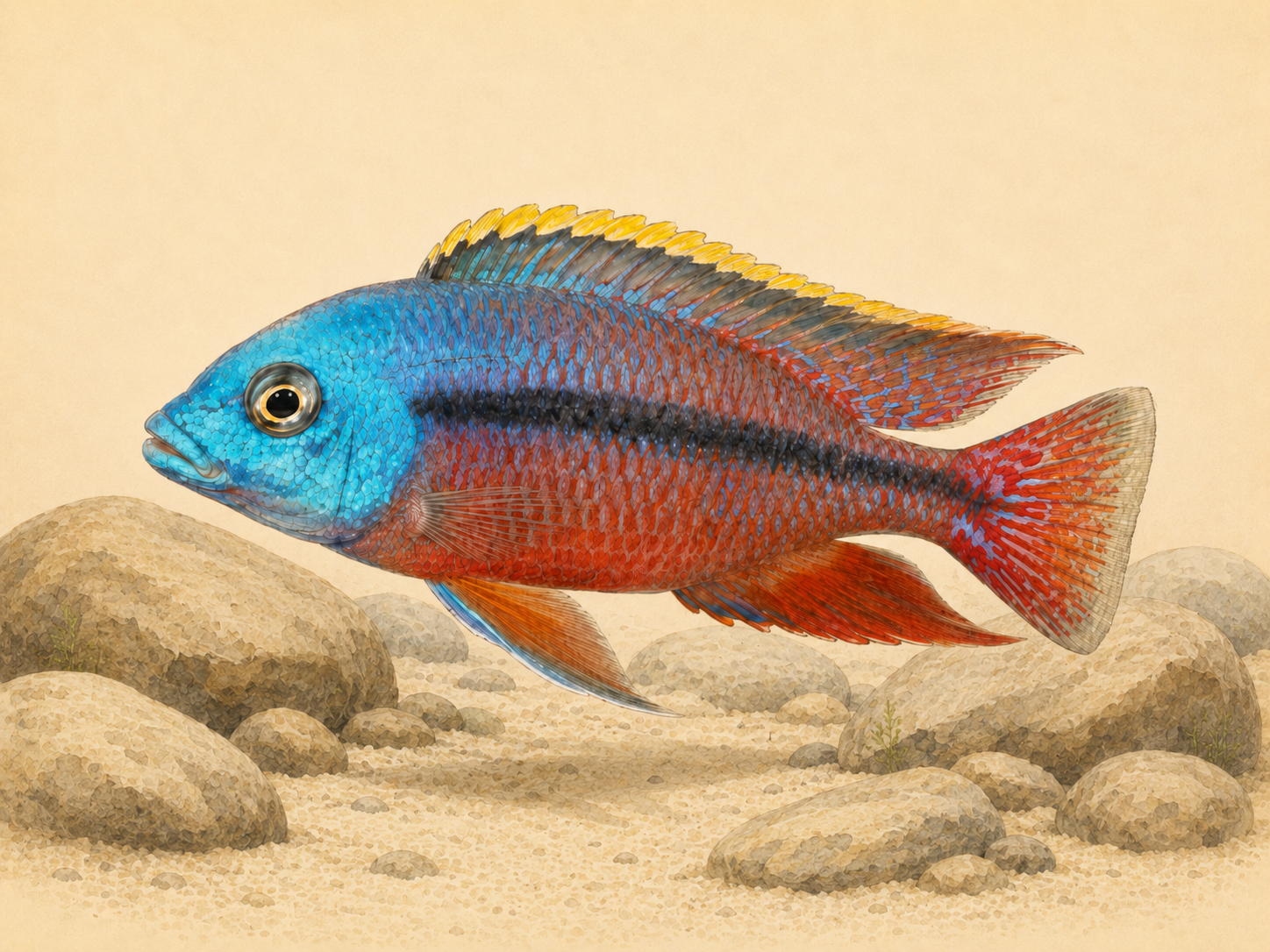
Mature males are nothing short of spectacular. The body is elongated and laterally compressed, with a gently sloping forehead and a moderately sized mouth. The base colour of the flanks shifts between electric blue and deep royal blue, overlaid with a wash of iridescent orange-red that intensifies with age, dominance, and good health. A bold dark lateral stripe, often black or very dark brown, runs horizontally from behind the eye to the caudal peduncle. This stripe can appear continuous or broken into a series of blotches, depending on the fish’s mood, stress level, and social position. The dorsal fin is typically edged in a brilliant blue or electric blue, while the anal fin often displays egg spots – small ocelli that play a role in the species’ mouthbrooding reproductive strategy. The tail fin may show a combination of red, orange, and blue hues, completing an overall appearance that is genuinely breathtaking under good aquarium lighting.
Females and juveniles are considerably more subdued in colouration. They tend to display a silvery-grey to brownish base colour with a more visible series of dark vertical bars and the same lateral stripe, though it is generally less contrasting against the muted background colour. Female fins are largely transparent to lightly tinted, lacking the vivid pigmentation of males. Juvenile males begin to show hints of colour from around 5-7 cm, with full adult colouration typically developing by 8-10 cm, though environmental factors, diet, and social dynamics can influence the speed and intensity of colour development.
The body shape is typical of the Protomelas genus – somewhat deeper-bodied than many other haplochromines but still streamlined. Adults typically reach 12-15 cm in aquaria, with particularly well-kept males occasionally exceeding this and reaching up to 18 cm. The overall impression is of a robust, medium-sized cichlid that carries itself with a confident, almost stately demeanour in the aquarium.
Varieties and Morphs
Protomelas taeniolatus occurs across a wide geographic range within Lake Malawi, and several distinct location variants are recognised in the hobby. These geographic morphs differ primarily in the intensity and distribution of red, orange, and blue colouration on the males. Captive breeding programmes have further refined and selected for specific colour traits, resulting in several trade names that aquarists should be aware of.
The most commonly encountered variant in the trade is often simply sold as “Red Empress” and is typically derived from fish originally collected near Namalenje Island. Males of this form display the classic combination of electric blue flanks with a strong orange-red overlay, particularly across the mid-body and into the dorsal region. This is the standard against which other morphs are usually compared.
The “Super Red Empress” is a selectively bred line in which breeders have enhanced the extent and saturation of the red-orange colouration. Males of this line often show red pigmentation extending further across the body, sometimes covering most of the flank below the dorsal fin. The blue iridescence remains but may appear somewhat secondary to the dominant warm tones. This morph commands a premium price and is highly sought after by enthusiasts.
The “Nkata Bay” variant refers to fish originating from the Nkata Bay area of Lake Malawi. Males of this form tend to show a slightly different balance of colouration, often with more pronounced blue tones on the head and a somewhat more golden-orange rather than deep red on the body. The lateral stripe may also appear slightly more fragmented in this population.
Other location variants occasionally appear in specialist dealers’ stock lists, including fish from Chizumulu Island, Likoma Island, and various points along the Malawian and Mozambican shorelines. Each may show subtle differences in colour pattern, but all are unmistakably Protomelas taeniolatus. When purchasing, it is good practice to ask about the provenance of the fish and to avoid mixing location variants in the same tank to prevent hybridisation and preserve the genetic integrity of these distinct populations.
Natural Habitat
Lake Malawi, the third-largest lake in Africa and the ninth-largest in the world, is the sole natural home of Protomelas taeniolatus. This ancient rift valley lake stretches approximately 580 kilometres in length and reaches depths exceeding 700 metres. It is renowned as one of the most biodiverse freshwater ecosystems on Earth, harbouring an estimated 800 or more species of cichlid, the vast majority of which are endemic.
The Red Empress inhabits the intermediate zones of the lake, typically found where rocky shorelines transition into sandy substrates. This species is not a strict rock-dweller like the mbuna, nor is it purely a sand-dwelling species. Instead, it occupies the ecotone between these two habitats, foraging along the algae-covered surfaces of rocks and boulders while also venturing over sandy patches. It is most commonly encountered at depths of 5 to 15 metres, though it can be found both shallower and deeper depending on local conditions.
In the wild, Protomelas taeniolatus is primarily an herbivore and aufwuchs grazer, scraping the biofilm of algae, microorganisms, and tiny invertebrates from rock surfaces using its specialised jaw structure. The water in Lake Malawi is characteristically alkaline, hard, and remarkably clear, with very stable parameters year-round. The lake maintains a pH typically between 7.7 and 8.6, with temperatures ranging from approximately 24 to 28 degrees Celsius depending on depth and season. These conditions should be replicated as closely as possible in the home aquarium.
The lake’s waters are notably low in dissolved nutrients and pollutants, which is an important consideration for aquarists. The Red Empress, like most Lake Malawi cichlids, has evolved in pristine conditions and is sensitive to poor water quality, particularly elevated levels of nitrogenous waste. Regular water changes and efficient filtration are therefore non-negotiable aspects of keeping this species successfully.
Tank Size and Setup
A minimum tank size of 300 litres is recommended for a small group of Red Empress Cichlids. This provides sufficient swimming space and allows for the establishment of territories without excessive conflict. If you intend to keep Protomelas taeniolatus in a mixed Malawi community – which is the most common and arguably the best approach – a tank of 400 litres or more is strongly advisable. Larger volumes not only offer more territory and visual barriers but also dilute aggression and maintain more stable water parameters.
The ideal aquascape for Red Empress Cichlids reflects their natural intermediate habitat. Create a layout that combines rocky structures with open sandy areas. Use a fine sand substrate, ideally in a pale colour such as silver sand or aragonite sand, which not only looks natural but also helps to buffer the pH and hardness. Build rock formations using inert materials such as ocean rock, limestone, lava rock, or slate, creating caves, overhangs, and crevices that provide shelter and territorial markers. Ensure that rock structures are stable and securely placed – either resting directly on the glass base before the substrate is added, or siliconed together – to prevent toppling.
Leave a significant amount of open swimming space in the mid-water and foreground areas. Red Empress Cichlids are active swimmers that appreciate room to cruise, and cramming the tank entirely full of rockwork is both unnecessary and counterproductive. A layout that provides approximately 40-50 per cent open water and 50-60 per cent structured hardscape tends to work well.
Live plants are generally not recommended in a Red Empress tank, as these fish will graze on softer-leaved species and may uproot others. However, robust species such as Anubias and Java Fern, which can be attached to rocks and have tough, unpalatable leaves, may survive. Vallisneria is another option that sometimes persists in Malawi setups, though results vary.
Lighting should be moderate to bright, which will both show off the fish’s stunning colouration and encourage the growth of a natural biofilm on rocks – something the fish will appreciate as a supplementary food source. A tight-fitting lid is advisable, as cichlids can occasionally jump, particularly when startled or during aggressive encounters.
Water Parameters
Maintaining appropriate water parameters is one of the most critical aspects of Red Empress care. Lake Malawi cichlids have evolved in remarkably stable, clean, alkaline water, and replicating these conditions in the home aquarium is essential for the long-term health and vibrant colouration of this species.
| Temperature | 24-28 °C |
| pH | 7.5-8.8 |
| General hardness (GH) | 6-18 dGH |
| Carbonate hardness (KH) | 6-12 dKH |
| Ammonia | 0 ppm |
| Nitrite | 0 ppm |
| Nitrate | Below 20 ppm |
A temperature of 25-26 degrees Celsius is a good target for most setups. Consistency is more important than hitting an exact number, so invest in a reliable heater with an accurate thermostat. Sudden temperature fluctuations can stress the fish and make them susceptible to disease.
Ammonia and nitrite must always read zero. Even trace levels of these compounds are harmful to Lake Malawi cichlids, which have not evolved any tolerance for nitrogenous waste. Nitrate should be kept as low as possible, ideally below 20 ppm, through regular water changes and efficient biological filtration. Weekly water changes of 25-30 per cent are a sensible baseline, though heavily stocked tanks may require larger or more frequent changes.
If your tap water is naturally soft and acidic, you will need to buffer it to achieve the appropriate hardness and pH. Crushed coral or aragonite in the substrate or filter media can help raise and maintain KH and pH. Commercially available Malawi buffer salts are also an option, though they should be used carefully and consistently. Always test your water regularly with a reliable test kit.
Filtration and Equipment
Given the sensitivity of Lake Malawi cichlids to poor water quality and the substantial bioload that a community of medium-sized cichlids produces, robust filtration is absolutely essential. For a 300-400 litre Red Empress setup, a large external canister filter is the best choice. Aim for a total filtration turnover rate of at least 8-10 times the tank volume per hour. For a 400-litre tank, this means a filter (or combination of filters) rated at 3,200-4,000 litres per hour. This may seem excessive, but Red Empress Cichlids are messy eaters and produce a significant amount of waste.
Biological filtration media should form the bulk of your filter media setup. Sintered glass media, ceramic rings, or bio-balls provide the surface area needed for beneficial bacteria colonies to process ammonia and nitrite efficiently. Mechanical filtration in the form of filter floss or sponge pads should be placed before the biological media to catch particulate waste and prevent it from clogging the bio-media. Chemical filtration, such as activated carbon, is optional and generally not necessary in a well-maintained Malawi setup unless you are removing medication or dealing with a specific water quality issue.
A reliable heater is essential. For tanks in the 300-400 litre range, consider using two heaters of moderate wattage rather than a single high-powered unit. This provides redundancy – if one heater fails, the other will prevent a catastrophic temperature drop – and distributes heat more evenly throughout the tank. An inline heater connected to the canister filter return is another excellent option that keeps equipment out of the display tank and away from curious cichlids.
An air pump with a large air stone or sponge filter can provide supplementary oxygenation and surface agitation, which is beneficial in a tank with a high stocking density. Lake Malawi is a well-oxygenated body of water, and maintaining high dissolved oxygen levels in the aquarium promotes the health and activity of these fish.
A quality aquarium thermometer, placed away from the heater for an accurate independent reading, is a small but important piece of equipment. Digital thermometers with external probes tend to be more accurate than stick-on strip thermometers.
Diet and Feeding
In the wild, Protomelas taeniolatus is primarily an herbivore and aufwuchs grazer, feeding on the biofilm of algae, diatoms, and associated microorganisms that coat rock surfaces. In the aquarium, this dietary preference should inform your feeding strategy, though the species is adaptable and will accept a wide range of foods.
A high-quality cichlid pellet or flake formulated for herbivorous or omnivorous African cichlids should form the staple diet. Look for foods with spirulina, algae meal, or similar plant-based ingredients listed prominently in the ingredients. Avoid foods that are excessively high in animal protein or fat, as these can lead to digestive issues and the potentially fatal condition known as Malawi bloat. Specifically, avoid feeding mammalian-derived proteins such as beefheart, which are difficult for herbivorous cichlids to digest.
Supplement the staple diet with blanched vegetables such as courgette (zucchini), spinach, peas (shelled), and cucumber. These provide additional fibre and micronutrients. Spirulina-based foods, whether in flake, pellet, or wafer form, are an excellent addition and will help enhance the vivid red and blue colouration of males.
Occasional treats of frozen or live foods such as brine shrimp, daphnia, mysis shrimp, and cyclops can be offered once or twice a week. These are particularly useful for conditioning breeding adults. Avoid bloodworms or tubifex worms as regular fare, as these have been associated with digestive problems in herbivorous Malawi cichlids, though occasional use is unlikely to cause issues.
Feed two to three small meals per day rather than one large feeding. This more closely mimics the natural grazing behaviour of the species and reduces waste. Each feeding should provide only as much food as the fish can consume within two to three minutes. Remove any uneaten food promptly to prevent it from decomposing and degrading water quality.
Behaviour and Temperament
The Red Empress Cichlid is widely regarded as one of the more peaceful haplochromine cichlids from Lake Malawi. Compared to the often-aggressive mbuna, Protomelas taeniolatus is relatively laid-back, spending much of its time cruising the open water, grazing on rocks, and displaying to conspecifics. However, it is still a cichlid, and a degree of territorial behaviour and aggression should be expected, particularly from dominant males.
Male Red Empress Cichlids will establish territories, typically centred around a favoured rock formation or area of the tank. They will defend this territory against rivals, particularly other males of the same species, using displays of colour, fin-flaring, and lateral displays. Physical confrontations do occur but are generally less violent than those seen in mbuna species, and serious injuries are uncommon in a properly sized and decorated tank.
The best approach to managing aggression is to keep either a single male with multiple females (a ratio of one male to three or four females is ideal) or to keep Red Empress Cichlids in a larger community where aggression is diffused across multiple species. Keeping two males of the same species together in a small tank is a recipe for constant harassment of the subordinate male, which will lose colour, become stressed, and may eventually succumb to disease.
Females are generally peaceful towards one another and towards other species. They tend to form loose social groups and will occupy areas of the tank away from the dominant male’s territory except during breeding interactions.
Red Empress Cichlids are diurnal, meaning they are active during the day and rest at night. They are generally bold and personable fish that quickly learn to associate their keeper with food. Many aquarists report that their Red Empress will come to the front of the tank when they approach and will readily feed from the surface or even from their keeper’s hand.
Tank Mates
The Red Empress Cichlid is best kept in a Lake Malawi community alongside other peaceful to moderately aggressive haplochromine and peacock cichlids of similar size. The key to a successful community is to avoid species that are too aggressive (which will bully the Red Empress), too similar in appearance (which can provoke territorial disputes and hybridisation), or too small (which may be harassed or eaten). It is generally advisable to avoid mixing Red Empress Cichlids with mbuna, as most mbuna species are too aggressive and territorial for comfortable cohabitation in all but the largest tanks.
Good tank mates
- Yellow Lab Cichlid (Labidochromis caeruleus) – One of the few mbuna species peaceful enough to coexist with haplochromines, and its bright yellow colour contrasts beautifully without provoking territorial aggression.
- Flavescent Peacock (Aulonocara stuartgranti) – A similarly sized and temperamentally compatible peacock cichlid that occupies slightly different niches in the tank.
- Blue Dolphin Cichlid (Cyrtocara moorii) – A gentle, deep-bodied haplochromine that is an excellent community companion due to its peaceful nature and distinct appearance.
- Red Fin Kadango Cichlid – A similarly coloured but distinct species that generally coexists well with Red Empress Cichlids in spacious tanks.
- Eureka Red Peacock (Aulonocara jacobfreibergi) – A stunning peacock cichlid with a compatible temperament and different enough colouration to minimise conflict.
- Synodontis multipunctatus – A Lake Tanganyika catfish that adapts well to Malawi conditions and provides useful bottom-dwelling activity without competing with cichlids.
- Deep Water Hap (Placidochromis electra) – A peaceful haplochromine with electric blue colouration that complements the Red Empress without directly competing for territory.
- Otopharynx lithobates – A moderately peaceful hap with a contrasting colour pattern that integrates well into mixed haplochromine communities.
Fish to avoid
- Auratus Cichlid – Extremely aggressive mbuna that will relentlessly harass the more peaceable Red Empress.
- Kenyi Cichlid (Maylandia lombardoi) – Another highly aggressive mbuna that dominates tankmates and causes chronic stress in haplochromine communities.
- Venustus Cichlid (Nimbochromis venustus) – Grows considerably larger than the Red Empress and is a predatory species that may attack or consume smaller tankmates.
- Malawi Eye-Biter (Dimidiochromis compressiceps) – A predatory haplochromine with a reputation for targeting the eyes of tankmates, making it wholly unsuitable.
- Demasoni Cichlid (Pseudotropheus demasoni) – A small but intensely aggressive mbuna that creates constant territorial disputes in mixed setups.
- Oscar (Astronotus ocellatus) – A South American cichlid with completely incompatible water parameter requirements and a predatory size advantage.
- White Spotted Cichlid – A Lake Tanganyika species with different water chemistry needs and an aggressive, highly territorial temperament.
- Livingston’s Cichlid – A large predatory species that uses ambush hunting tactics and will readily consume smaller cichlids.
Breeding
Breeding the Red Empress Cichlid in captivity is an achievable goal for hobbyists with a properly set up tank and a healthy group of adults. Like all haplochromine cichlids from Lake Malawi, Protomelas taeniolatus is a maternal mouthbrooder, meaning the female incubates the fertilised eggs in her buccal cavity (mouth) until the fry are fully developed and ready for independent life.
To encourage breeding, maintain a group consisting of one male and three to four females. This ratio ensures that the male’s courtship attention is spread across multiple females, reducing the stress on any single individual. The male will select a spawning site, typically a flat rock surface or a cleared area of substrate, and will display vigorously to attract a receptive female. His colouration will intensify dramatically during courtship, reaching its most vivid state as he performs lateral displays, quivering motions, and leads the female towards the spawning site.
Spawning follows the typical haplochromine pattern. The female deposits a small number of eggs on the substrate, then immediately picks them up in her mouth. The male presents his anal fin, which bears egg spots – small circular markings that resemble eggs. As the female attempts to pick up these “dummy eggs,” the male releases sperm, which is drawn into the female’s mouth and fertilises the real eggs she is already holding. This process is repeated multiple times until the female has a full clutch, typically between 20 and 60 eggs depending on her size and condition.
The female will carry the developing eggs and larvae in her mouth for approximately 21 to 28 days. During this period, she will not eat and will become noticeably thinner. She will typically retreat to a quiet area of the tank and should not be disturbed unnecessarily. Her buccal cavity will appear visibly distended as the fry grow.
If you wish to maximise fry survival, consider gently stripping the fry from the female’s mouth at around day 18-21 and transferring them to a separate rearing tank. Alternatively, the female can be moved to a separate tank a few days before she is due to release the fry. If left in the main tank, some fry will inevitably be consumed by other fish, though a few may survive in a well-decorated tank with plenty of hiding spots.
Fry can be fed on crushed high-quality cichlid flake, baby brine shrimp (Artemia nauplii), or commercial fry food from the moment they are released. They grow relatively quickly with regular small feedings and good water quality. Juvenile colouration is similar to adult females, with males beginning to show colour at around 5-7 cm.
Common Diseases
The Red Empress Cichlid is a generally hardy species when kept in appropriate conditions, but like all aquarium fish, it is susceptible to a number of diseases, particularly when water quality deteriorates or the fish is subjected to chronic stress.
Malawi bloat is arguably the most significant disease concern for keepers of Lake Malawi cichlids. This condition, which manifests as abdominal swelling, loss of appetite, lethargy, and rapid breathing, is believed to be linked to dietary issues, particularly the consumption of inappropriate high-protein or high-fat foods. It may also be associated with intestinal parasites, specifically the protozoan Cryptobia. Malawi bloat can progress rapidly and is often fatal if not caught early. Prevention through proper diet (high in vegetable matter, low in animal fat) and excellent water quality is far more effective than treatment, though metronidazole is the most commonly recommended medication for affected fish.
Ich (white spot disease), caused by the protozoan Ichthyophthirius multifiliis, is another common ailment. It presents as small white spots scattered across the body and fins, often accompanied by flashing (rubbing against surfaces) and clamped fins. Raising the water temperature to 28-30 degrees Celsius and treating with a proprietary white spot remedy or a salt-based treatment is generally effective, though care should be taken with salt concentrations.
Bacterial infections can occur, often secondary to physical injury from aggression or poor water quality. Symptoms include fin rot, ulceration, reddening of the skin, and pop-eye (exophthalmia). Treatment typically involves improving water quality, isolating the affected fish, and administering an appropriate antibacterial medication.
Internal parasites, including various species of nematodes and tapeworms, can be present in both wild-caught and captive-bred fish. Symptoms may include weight loss despite normal feeding, white stringy faeces, and general lethargy. Antiparasitic medications containing praziquantel or levamisole are commonly used treatments.
Hole-in-the-head disease (HITH or HLLE – head and lateral line erosion) is occasionally seen in cichlids kept in suboptimal conditions. It manifests as pitting and erosion of the skin on the head and along the lateral line. The exact cause is debated, but poor water quality, nutritional deficiencies (particularly a lack of vitamins and minerals), and the presence of the flagellate Hexamita are all considered contributing factors. Improving water quality, diversifying the diet, and treating with metronidazole are the standard approaches.
FAQs
How can I tell the difference between male and female Red Empress Cichlids?
Sexing Red Empress Cichlids is straightforward once the fish reach maturity at around 7-10 cm. Males develop the spectacular iridescent blue and orange-red colouration that the species is famous for, along with prominent egg spots on the anal fin. Females remain a relatively plain silvery-grey to brownish colour with dark barring and a visible lateral stripe. Juveniles of both sexes resemble females, so purchasing a group of six or more young fish and allowing them to grow out is the best way to obtain both sexes if you cannot find already sexed adults.
Can Red Empress Cichlids be kept with mbuna?
In most cases, this is not recommended. The majority of mbuna species are significantly more aggressive and territorial than the Red Empress, and they will dominate food sources and harass the more peaceful haplochromine. The main exception is Labidochromis caeruleus (Yellow Lab), which is one of the least aggressive mbuna and generally coexists well with haplochromines and peacocks. If you do attempt to mix mbuna and haplochromines, use a large tank of 500 litres or more with ample rock cover and be prepared to intervene if aggression becomes problematic.
Why has my male Red Empress lost his colour?
Colour loss in male Red Empress Cichlids is almost always a sign of stress, subordination, or illness. The most common cause is social stress – if the male is being dominated by a more aggressive tankmate, he will suppress his colouration to appear less threatening. Poor water quality, inappropriate diet, and disease can also cause colour fading. Check your water parameters, review your stocking list for overly aggressive species, and ensure the fish is eating a varied, appropriate diet. Colour should return once the underlying stressor is addressed.
How many Red Empress Cichlids should I keep together?
The ideal grouping is one male with three to four females in a tank of at least 300 litres. Keeping multiple males together in a small tank leads to relentless aggression from the dominant male towards subordinates. In very large tanks of 600 litres or more, it may be possible to keep two males with a larger group of females, provided there are sufficient visual barriers and territories. Keeping a single specimen is possible but means you will miss out on the fascinating social and breeding behaviours that make this species so engaging.
Do Red Empress Cichlids need a sandy substrate?
While not strictly essential, a sandy substrate is strongly recommended. Sand most closely replicates the natural habitat of Protomelas taeniolatus, allows the fish to exhibit