Quick summary
Betta brownorum is a demanding, uncommon wild betta suited only to experienced aquarists who can maintain very soft, highly acidic blackwater conditions, so it’s a poor choice for beginners. If you can commit to RO water, tannin-rich biotope setups and careful feeding, it’s a rewarding species to keep and even breed.
🐠 Build a tank around this species
In this guide:
- Introduction
- Quick Stats
- Appearance
- Natural Habitat
- Tank Size and Setup
- Water Parameters
- Filtration and Equipment
- Diet and Feeding
- Behaviour and Temperament
- Tank Mates
- Breeding
- Common Diseases
- FAQs
Introduction
Betta brownorum is a small, jewel-like wild betta species that belongs to the coccina complex, a group of closely related species native to the acidic peat swamp forests of Southeast Asia. First described by Witte and Schmidt in 1992, this species is named after Barbara and Allan Brown, who were instrumental in collecting specimens from the wild. Unlike the ubiquitous Betta splendens found in nearly every pet shop, Betta brownorum is a genuinely uncommon species in the aquarium hobby, sought after primarily by dedicated wild betta enthusiasts and blackwater specialists.
This species is a true peat swamp specialist, naturally occurring in some of the most extreme freshwater environments on earth – waters so acidic and tannin-stained that they appear the colour of strong tea. Replicating these conditions in captivity is essential to keeping Betta brownorum healthy and displaying its best colour, which makes this species a poor choice for beginners but a deeply rewarding one for experienced aquarists willing to meet its specific requirements. The fish is a bubble-nester, building small nests at the water’s surface or beneath overhanging leaves and structures, and pairs can be bred in captivity with patience and careful attention to water chemistry.
Betta brownorum occupies a special niche in the hobby. It is not a fish you will stumble upon in a general aquatics shop; rather, it tends to appear through specialist breeders, wild betta forums, and occasionally through importers who deal in rare and wild-type species. For those who appreciate the subtle, intricate beauty of wild bettas and who enjoy the challenge of creating a faithful biotope aquarium, Betta brownorum is one of the most captivating species the coccina group has to offer.
Quick Stats
| Scientific name | Betta brownorum |
|---|---|
| Common names | Brown's Betta |
| Family | Osphronemidae |
| Origin | Borneo (Sarawak, Malaysia and West Kalimantan, Indonesia) |
| Adult size | 3 cm |
| Difficulty | Advanced |
| Breeding difficulty | Advanced |
| Temperature | 22–26 °C |
| pH | 3–6 |
| GH | 1–5 dGH |
| Minimum tank size | 41 L |
| Conservation status | Vulnerable (IUCN, assessed 2018) |
Appearance
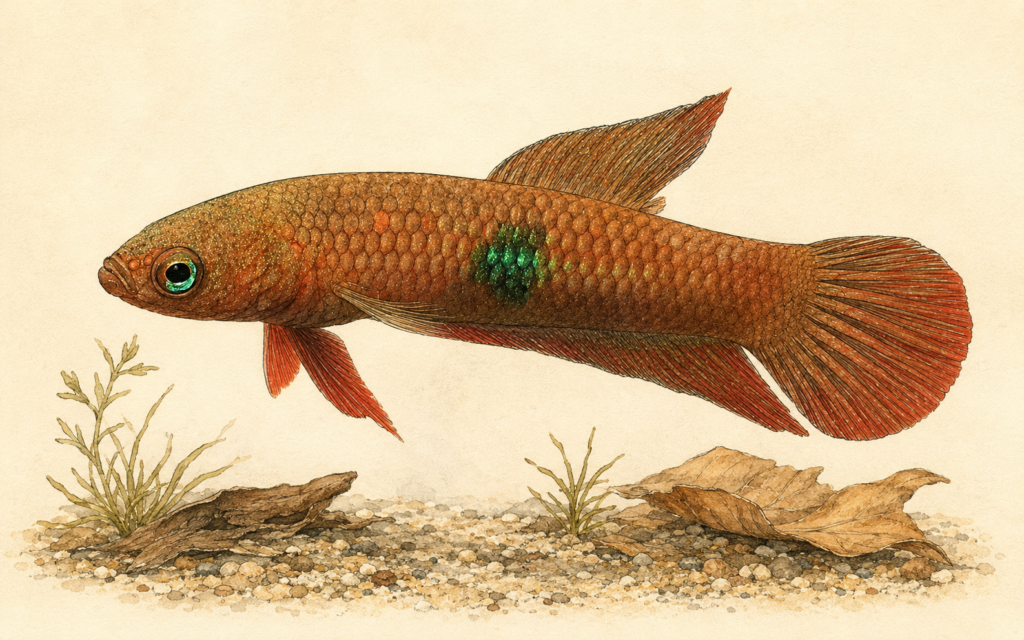
Betta brownorum is a small, slender betta with an appearance that is understated at first glance but becomes truly striking under the right conditions. The body is a deep, rich brownish-red to wine-red colour, and in well-conditioned specimens kept in appropriate blackwater environments, this darkens to a sumptuous crimson. The flanks typically display a vivid, iridescent green or blue-green spot situated roughly at the midpoint of the body, which is a hallmark feature of many coccina complex species. This spot appears to glow against the dark body, particularly when the fish is viewed under subdued lighting against a dark substrate – exactly the kind of conditions that mimic its natural habitat.
The fins are relatively rounded and modest compared to the elaborate finnage of domestic Betta splendens. The caudal fin is rounded to slightly spatulate, and the anal fin extends gently along the ventral profile. Both unpaired fins carry a dark base colour with subtle red or blue-green edging, though the exact intensity varies between individuals and is strongly influenced by mood, health, and water conditions. The ventral fins are narrow and elongated, often tipped with white or pale blue, which provides an attractive contrast against the dark body.
Males are generally more intensely coloured than females, displaying deeper reds and a more prominent iridescent flank spot. Males also tend to have slightly more extended unpaired fins. Females are typically lighter, often appearing more brownish with less vivid iridescence, though well-conditioned females can still be quite attractive. Both sexes are small, with adults typically reaching only 3 to 4 centimetres in total length, making this one of the smaller betta species available in the hobby. Juveniles are pale and relatively nondescript, and it can take several months of careful husbandry before young fish begin to develop their adult colouration.
One of the most appealing aspects of Betta brownorum’s appearance is how dramatically it can change depending on environment and mood. A stressed fish in clear, hard water may appear washed out and dull, while the same individual settled into soft, acidic blackwater with abundant tannins will transform into a deeply coloured gem. This responsiveness to water conditions is one of the reasons the species is so satisfying to keep for aquarists who invest the effort in creating optimal conditions.
Natural Habitat
Betta brownorum is native to the island of Borneo, with confirmed populations in Sarawak (the Malaysian portion of Borneo) and West Kalimantan (the Indonesian portion). Its habitat is the lowland peat swamp forest, one of the most distinctive and threatened freshwater environments in Southeast Asia. These swamps form in areas where thick layers of decomposing organic matter – primarily leaf litter, fallen wood, and other plant debris – accumulate over centuries, creating waterlogged, acidic peat deposits.
The water in these habitats is extremely soft and acidic, often measuring below pH 4.0 and sometimes dropping as low as pH 3.0 in the most pristine areas. The water is stained an intense brown or black by humic acids and tannins leaching from the decomposing organic matter, giving rise to the term “blackwater.” Dissolved mineral content is virtually nil, with general hardness and carbonate hardness both effectively at zero. These are nutrient-poor, low-conductivity waters with very little dissolved oxygen compared to flowing streams or rivers.
The physical environment consists of shallow, still or very slow-moving water, often only a few centimetres to a few tens of centimetres deep, shaded by dense forest canopy above. The substrate is a thick layer of waterlogged leaves and peat, with submerged roots, fallen branches, and emergent vegetation providing structure. Aquatic plants are relatively sparse due to the extreme acidity and low light, though some specialised species such as Cryptocoryne may be present. The overall impression is of a dim, tannin-rich world with an abundance of hiding places and very little open water.
Peat swamp forests are among the most threatened habitats on earth, subject to massive destruction through logging, drainage for agriculture (particularly palm oil plantations), and peat fires. Many populations of coccina complex species, including Betta brownorum, occupy ranges that are small and increasingly fragmented. While this species has not been formally assessed by the IUCN, there is genuine concern among ichthyologists and hobbyists about the long-term survival of wild populations. Responsible captive breeding within the hobby may play a role in maintaining genetic diversity for this and related species.
Tank Size and Setup
Despite its small size, Betta brownorum benefits from a thoughtfully designed aquarium that faithfully replicates the conditions of its natural habitat. An aquarium with a base of 45 x 30 cm or equivalent, around 41 litres, can house a pair or small group. Larger tanks of 60 to 80 litres are preferable if keeping a small group, though the species is not strongly social and males in particular will establish territories.
The tank should be set up as a blackwater biotope. Begin with a dark substrate – fine, dark sand or a thin layer of peat works well. Avoid substrates that buffer water hardness upwards, such as crushed coral or limestone-based gravels, as these will work against the soft, acidic conditions this species requires. On top of the substrate, add a generous layer of dried leaf litter. Indian almond leaves (Terminalia catappa) are the classic choice, but oak leaves, beech leaves, and other botanicals are also suitable. This leaf litter serves multiple purposes: it releases tannins that stain the water and lower pH, it provides infusoria and biofilm as a supplementary food source, and it creates a naturalistic floor covering that the fish feel secure over.
Driftwood should feature prominently in the aquascape. Pieces of Malaysian driftwood, mopani wood, or small branches and twigs create the tangle of submerged roots and fallen timber that characterises peat swamp habitats. These also contribute to tannin release. Some aquarists add alder cones, seed pods, and other botanical elements to further enrich the blackwater environment. The water should ideally be stained to a deep amber or brown colour – this is not merely aesthetic but is genuinely important for the fish’s wellbeing, reducing stress and encouraging natural behaviour and colouration.
Lighting should be subdued. Betta brownorum comes from a dim, heavily shaded environment, and bright aquarium lighting will cause stress and washed-out colouration. Floating plants such as Salvinia, Riccia, or red root floaters can be used to diffuse light from above. If live plants are desired below the waterline, choose species tolerant of very soft, acidic water and low light, such as certain Cryptocoryne species, Java fern (Microsorum pteropus), or Java moss (Taxiphyllum barbieri). However, many specialist keepers opt for a purely botanical setup with no rooted plants, relying on leaf litter, wood, and floating plants alone.
A tight-fitting lid is essential. Like all bettas, Betta brownorum is a labyrinth fish that breathes atmospheric air, and it needs access to the water’s surface. However, these small fish are capable jumpers, especially when startled, and an uncovered tank risks losses. The layer of humid air between the water surface and the lid also helps protect the labyrinth organ from cold, dry air, which is particularly important in cooler rooms.
Water Parameters
Water chemistry is the single most critical factor in keeping Betta brownorum successfully. This species comes from some of the softest, most acidic freshwater habitats on the planet, and it genuinely requires these conditions in captivity. Attempting to keep this fish in standard tap water – which in most of the United Kingdom is moderately hard and alkaline – will lead to chronic stress, poor colouration, disease susceptibility, and shortened lifespan.
| Temperature | 22–26 °C |
| pH | 3.0–6.0 |
| General hardness (GH) | 1–5 dGH |
| Ammonia | 0 ppm |
| Nitrite | 0 ppm |
| Nitrate | Below 10 ppm |
Achieving these parameters typically requires the use of reverse osmosis (RO) water or rainwater. Tap water, even in soft water areas, is usually too hard and too alkaline for this species. RO water should be remineralised very lightly – just enough to provide a trace of minerals for biological stability – or used pure with tannins and humic substances providing what little buffering is needed. Many experienced keepers use a combination of RO water and peat filtration to achieve the desired pH and tannin levels.
Temperature requirements are moderate, and Betta brownorum does not need tropical heat. A range of 22 to 27 degrees Celsius is suitable, with 24 to 26 degrees being an ideal everyday range. Avoid sustained temperatures above 28 degrees, as this can reduce dissolved oxygen and stress the fish. In well-insulated homes, a small heater set to 24 or 25 degrees Celsius is usually sufficient, though in warmer months, the fish may do fine without supplemental heating.
It is worth noting that at very low pH values (below 4.0), the traditional nitrogen cycle becomes less efficient, as the bacteria responsible for nitrification function poorly in highly acidic conditions. This means that in a true blackwater tank set up for coccina complex species, the aquarist cannot rely solely on biological filtration to manage waste. Instead, a combination of low stocking density, generous leaf litter (which hosts beneficial microbial communities), and regular small water changes with appropriately prepared water is the best approach to maintaining water quality.
Filtration and Equipment
Filtration for Betta brownorum should be gentle and unobtrusive. These fish come from still or virtually still water, and strong currents will cause stress and exhaust the fish. An air-driven sponge filter is the most commonly recommended option and is the workhorse of serious wild betta keeping. A small sponge filter provides adequate biological and mechanical filtration while creating only a very gentle water movement. The air pump should be fitted with an adjustable valve or a gang valve so that flow can be reduced to a bare minimum – just enough to keep water circulating slowly through the sponge.
Some keepers use small internal filters or hang-on-back filters with the flow turned down to its lowest setting, but care must be taken that the outflow does not create a current that disturbs the fish. If using a hang-on-back filter, directing the outflow against the glass or baffling it with sponge or a piece of filter floss can reduce surface agitation. Canister filters are generally unnecessary for the small tanks typically used with this species and tend to create more flow than is desirable.
Peat filtration can be a valuable addition. Placing aquarium-grade peat (free from fertilisers or additives) in a filter bag within the filter, or in a small mesh bag placed directly in the tank, will leach humic acids and tannins into the water, helping to lower pH and create the blackwater conditions this species thrives in. This should be seen as a supplement to, rather than a replacement for, the use of RO water and botanical additions.
A small, reliable heater is recommended unless the room temperature consistently remains within the fish’s preferred range. Adjustable heaters are preferable to preset models, as they allow fine-tuning. In a 30 to 40 litre tank, a 25 to 50 watt heater is usually sufficient. An accurate thermometer – digital or glass – should be used to monitor temperature, as small tanks can experience temperature swings more quickly than larger ones.
Lighting should be kept dim. A low-wattage LED light on a timer, providing perhaps 6 to 8 hours of subdued illumination per day, is ideal. Many blackwater keepers use warm-toned LEDs to complement the amber hue of the tannin-stained water. Avoid high-intensity planted tank lighting, which will stress the fish and encourage unwanted algae growth in the absence of fast-growing plants to compete for nutrients.
Diet and Feeding
Betta brownorum is a micro-predator in the wild, feeding on tiny invertebrates, insect larvae, zooplankton, and other small organisms found among the leaf litter and submerged vegetation of its peat swamp habitat. In captivity, the species can be somewhat finicky about accepting prepared foods, particularly when newly acquired, and a diet based heavily on live and frozen foods is strongly recommended.
Live foods are the gold standard for this species. Daphnia, baby brine shrimp (Artemia nauplii), micro worms, grindal worms, and vinegar eels are all excellent choices and are readily accepted. Culturing one or more of these live foods at home is a valuable skill for anyone keeping wild bettas, as a consistent supply of live food will keep the fish in peak condition and is often essential for conditioning breeding pairs. Mosquito larvae, where legally and practically obtainable, are another superb food source that closely mirrors the fish’s natural diet.
Frozen foods are a practical alternative and are accepted by most individuals once they have settled into the aquarium. Frozen daphnia, frozen baby brine shrimp, and frozen cyclops are all suitable. Frozen bloodworm can be offered occasionally but should not form the staple diet, as it is relatively rich and has been associated with digestive issues in some small betta species when fed excessively.
High-quality micro pellets or crushed flake food may be accepted by some individuals, particularly those that have been raised in captivity on prepared foods. However, many wild-caught or freshly imported specimens will refuse dried foods entirely, and even tank-bred fish tend to show better health and colouration on a diet dominated by live and frozen offerings. If using prepared foods, choose those designed for small carnivorous fish, with high protein content and minimal fillers.
Feed small amounts once or twice daily, offering only as much as the fish will consume within a few minutes. Overfeeding is a common mistake in small tanks, as uneaten food decomposes quickly and fouls the already delicate water chemistry. In a well-established blackwater tank with abundant leaf litter, the fish will also graze on biofilm and infusoria that develop naturally on decomposing leaves and botanicals, supplementing their diet between feedings.
Behaviour and Temperament
Betta brownorum is a relatively peaceful and shy species, quite unlike the aggressive reputation of its domesticated cousin, Betta splendens. In the wild, these fish live at low densities among dense cover, and their behaviour in captivity reflects this preference for a quiet, sheltered existence. They spend much of their time hovering near the surface or moving slowly through the leaf litter and around driftwood, investigating their surroundings with a calm, deliberate manner.
Males will establish small territories, particularly around potential bubble nest sites, and will display to one another with flared gills, intensified colouration, and lateral posturing. However, these displays rarely escalate to serious aggression, especially in a well-structured tank with plenty of visual barriers and hiding spots. In tanks of 60 litres or more, it is often possible to keep a small group consisting of one or two males and several females, provided there is sufficient cover to break up lines of sight. In smaller tanks, a single pair is the safest approach.
This species is naturally retiring and can be easily intimidated by larger, more boisterous tank mates or by disturbances outside the tank. Placement of the aquarium in a calm area of the home, away from heavy foot traffic and loud noises, will help the fish feel secure. When first introduced to a new tank, Betta brownorum may hide extensively for several days or even weeks before gaining confidence. Patience is key – rushing the acclimatisation process or disturbing the tank to try to see the fish will only prolong the settling-in period.
One of the most engaging behaviours to observe is the male’s bubble nest construction. Males will select a site – often beneath a floating leaf, a piece of Indian almond leaf curled at the surface, or the underside of a low-hanging piece of driftwood – and begin assembling a small, delicate nest of bubbles. This behaviour indicates that the fish is comfortable and in breeding condition, and it is a gratifying sign for the dedicated keeper.
Betta brownorum is also a labyrinth fish, meaning it possesses a specialised organ that allows it to breathe atmospheric air. You will regularly see the fish rise to the surface to gulp air, which is entirely normal. This adaptation allows wild populations to survive in the oxygen-poor waters of peat swamps.
Tank Mates
Choosing tank mates for Betta brownorum requires careful consideration. This is a small, shy, slow-moving species with very specific water chemistry requirements, and any potential companions must share both its temperament and its tolerance for extremely soft, acidic blackwater conditions. Many commonly kept aquarium fish simply cannot thrive in pH values below 5.0 and near-zero hardness, which immediately narrows the field. In truth, many experienced keepers choose to maintain Betta brownorum in a species-only setup, which is the safest and simplest approach. However, a few compatible species do exist for those wishing to create a community blackwater biotope.
Good tank mates
- Boraras brigittae (Chili Rasbora) – A tiny, peaceful rasbora that thrives in soft, acidic blackwater and occupies the mid-water column without bothering bettas.
- Boraras maculatus (Dwarf Rasbora) – Another small Boraras species well suited to the same extreme water conditions and too small to pose any threat.
- Boraras merah (Phoenix Rasbora) – A gentle micro rasbora from similar peat swamp habitats in Borneo, making it an excellent biotope companion.
- Sundadanio axelrodi – A tiny, jewel-like cyprinid from Bornean blackwater habitats that shares identical water chemistry requirements.
- Pangio shelfordii (Shelford’s Kuhli Loach) – A small, peaceful loach from Bornean peat swamps that stays on the bottom and does not compete with surface-dwelling bettas.
- Sphaerichthys osphromenoides (Chocolate Gourami) – A fellow blackwater labyrinth fish with similar requirements, though tank size should be generous to avoid territorial overlap.
- Pangio kuhlii (Kuhli Loach) – A peaceful bottom-dweller that can adapt to soft, acidic conditions and occupies a different niche in the tank.
Fish to avoid
- Betta splendens (Siamese Fighting Fish) – Larger, more aggressive, and likely to bully or attack the smaller, gentler Betta brownorum.
- Paracheirodon innesi (Neon Tetra) – While often suggested for community tanks, neon tetras prefer less extreme water conditions and can be nippy enough to stress a shy wild betta.
- Poecilia reticulata (Guppy) – Livebearers require hard, alkaline water and are entirely incompatible with the extreme blackwater conditions Betta brownorum needs.
- Puntigrus tetrazona (Tiger Barb) – An active, nippy species that would harass and stress Betta brownorum relentlessly.
- Trichogaster lalius (Dwarf Gourami) – Too large, too territorial at the surface, and not suited to the extreme acidity required by Betta brownorum.
- Neocaridina davidi (Cherry Shrimp) – While peaceful, cherry shrimp cannot survive in the very low pH and near-zero hardness this species requires.
- Corydoras paleatus (Peppered Cory) – Prefers cooler, harder water and would not thrive in the extreme blackwater conditions needed.
Breeding
Breeding Betta brownorum is achievable for experienced aquarists but requires patience, careful preparation, and close attention to water conditions. As a bubble-nesting species, the male constructs a small nest of bubbles at the water’s surface, typically beneath a sheltering structure such as a floating leaf, the underside of a piece of driftwood, or even a film canister placed at the surface for this purpose. Breeding behaviour generally follows the pattern seen in other coccina complex species.
To condition a pair for breeding, provide an excellent diet of live foods – daphnia, baby brine shrimp, and micro worms – for at least two to three weeks prior to introducing them to the breeding setup. The female will begin to show a fuller abdomen as she develops eggs, and the male’s colouration will intensify. Water parameters should be at their most optimal: very soft (0 to 1 dGH), highly acidic (pH 4.0 to 5.0), and at a temperature of around 25 to 26 degrees Celsius. Heavy tannin staining from Indian almond leaves and other botanicals is beneficial.
The breeding tank can be small – 15 to 20 litres is sufficient – and should be set up as a miniature blackwater environment with leaf litter, a small sponge filter on very low flow, and floating plants or leaves to provide nest sites. Introduce the female to the tank first and allow her to settle for a day or two before adding the male, or introduce both simultaneously with plenty of cover available.
When ready to spawn, the male will display beneath his bubble nest, flaring and posturing to attract the female. If she is receptive, the pair will engage in a nuptial embrace beneath the nest, with the male wrapping his body around the female in the typical anabantoid fashion. Eggs are released and fertilised during these embraces, and the male collects them in his mouth, spitting them into the bubble nest. Spawns are typically small, often numbering between 20 and 50 eggs.
After spawning, the male assumes sole responsibility for guarding and tending the nest. He will retrieve fallen eggs, repair the nest, and fan the eggs to ensure adequate oxygenation. The female should be removed after spawning is complete, as the male may become aggressive towards her in his role as nest guardian. The eggs typically hatch within 24 to 48 hours, and the fry become free-swimming approximately two to three days after hatching.
Fry are extremely small and require microscopic first foods. Infusoria, paramecium cultures, and vinegar eels are suitable initial foods, followed by freshly hatched baby brine shrimp once the fry are large enough to accept them (usually after one to two weeks). Growth is slow, and maintaining pristine water quality in the fry tank is critical. Very gentle water changes with identically prepared water should be performed regularly, being extremely careful not to disturb the tiny fry. Rearing Betta brownorum fry to adulthood is a genuine accomplishment and contributes to the captive population of this uncommon species.
Common Diseases
Betta brownorum is generally a hardy species when kept in appropriate water conditions, but it can be susceptible to several common ailments, particularly when environmental parameters are not optimal. The most frequent health issues stem from poor water quality or incorrect water chemistry rather than from specific pathogens unique to the species.
Velvet disease (Oodinium) is one of the most common and dangerous diseases encountered in wild bettas, including Betta brownorum. This parasitic infection causes a fine, dusty, gold or rust-coloured coating on the skin and fins, and affected fish often become lethargic, clamp their fins, and lose appetite. Velvet thrives in warm, still water, making labyrinth fish particularly vulnerable. Treatment involves raising the temperature slightly, dimming the lights (Oodinium is partly photosynthetic), and using a copper-based medication, though care must be taken with dosing in the very soft, acidic water this species requires, as medications can behave differently at low pH.
Fin rot can occur when water quality deteriorates, manifesting as ragged, disintegrating fin edges that may become reddened or inflamed. Maintaining excellent water quality through regular water changes with properly prepared RO water is both the best prevention and the first line of treatment. In mild cases, simply improving conditions may be sufficient for recovery. More severe cases may require antibacterial treatment.
Bacterial infections, including columnaris and various systemic infections, can affect stressed or immunocompromised fish. Symptoms vary but may include lethargy, loss of appetite, unusual skin patches, or rapid breathing. Stress from inappropriate water parameters, aggressive tank mates, or poor diet are common predisposing factors.
Internal parasites can be present in wild-caught specimens. Newly acquired wild fish may benefit from a quarantine period and, if symptoms such as weight loss despite good appetite or white, stringy faeces are observed, treatment with an appropriate anti-parasitic medication may be necessary.
Prevention is always preferable to treatment with Betta brownorum. Maintaining stable, soft, acidic blackwater conditions, avoiding overstocking, providing a varied diet of high-quality live and frozen foods, and minimising stress through appropriate tank setup and placement will go a long way towards keeping this species healthy. It is also worth noting that the very low pH and tannin-rich environment preferred by this species is naturally somewhat antimicrobial, which provides a degree of protection against many pathogens.
FAQs
Can I keep Betta brownorum in tap water?
In the vast majority of cases, no. Betta brownorum requires extremely soft, acidic water with a pH typically between 3.0 and 6.0 and a general hardness near zero. Most tap water, particularly in the United Kingdom, is far too hard and alkaline for this species. You will almost certainly need to use reverse osmosis (RO) water, remineralised very lightly or used pure, along with tannin-producing botanicals such as Indian almond leaves, driftwood, and peat to achieve appropriate conditions.
Is Betta brownorum aggressive like Betta splendens?
No, Betta brownorum is a much more peaceful and retiring species than the domesticated Siamese fighting fish. Males will display to one another and establish small territories, particularly around bubble nest sites, but serious aggression is rare, especially in a well-planted tank with plenty of cover. This species is far more likely to hide than to fight, and it can be kept in pairs or small groups in appropriately sized tanks.
How can I tell males from females?
Males are typically more intensely coloured, displaying deeper reds and a more prominent iridescent green or blue-green flank spot. Males also tend to have slightly more extended and pointed unpaired fins. Females are generally paler, with a more brownish body tone and less vivid iridescence. When in breeding condition, females will appear noticeably rounder in the abdomen. Sexing juveniles is very difficult and usually becomes reliable only as the fish approach maturity.
Can Betta brownorum be kept with shrimp?
The extreme water conditions required by Betta brownorum rule out most commonly kept ornamental shrimp species. Neocaridina and Caridina cantonensis varieties generally cannot survive in pH below 5.0 and near-zero hardness. Some wild shrimp species from similar blackwater habitats may theoretically be compatible, but these are rarely available in the hobby. In practice, most keepers maintain this species without shrimp.
Where can I buy Betta brownorum?
Betta brownorum is not typically available in general pet shops or chain aquatics stores. Your best sources are specialist wild betta breeders, dedicated aquarist forums and groups (particularly those focused on wild bettas or blackwater species), specialist importers, and occasionally aquatic auctions or society events. Online communities for wild betta enthusiasts are an excellent starting point for locating reputable sellers. Expect to pay a premium compared to common aquarium species, reflecting the fish’s rarity and the expertise required to breed it.