Quick summary
The Rummy Nose Tetra is a peaceful, tightly shoaling fish that reaches about 5 cm and needs a group of 10 or more.
🐠 Build a tank around this species
In this guide:
- Introduction
- Quick Stats
- Appearance
- Varieties and Morphs
- Natural Habitat
- Tank Size and Setup
- Water Parameters
- Filtration and Equipment
- Diet and Feeding
- Behaviour and Temperament
- Tank Mates
- Breeding
- Common Diseases
- FAQs
- Related Guides
Introduction
The Rummy Nose Tetra is a tropical freshwater fish that is sold commercially as an ornamental aquarium fish. Adults reach about 5 cm in length. The species was first described scientifically in 1924.
Its genus currently serves as a catch all for more than 70 small characin species, and most experts agree a full revision is needed. A 2020 study proposed moving the rummy nose tetras into a different genus, using molecular data as well as physical features. Older references place it in the genus Hemigrammus, while newer ones use Petitella. The current family is given as Acestrorhamphidae, formerly Characidae.
Quick Stats
| Scientific name | Petitella rhodostoma |
|---|---|
| Family | Acestrorhamphidae (formerly Characidae) |
| Origin | South America: lower Amazon and Orinoco river basins, in Brazil and Venezuela |
| Adult size | 5 cm |
| Difficulty | Intermediate |
| Breeding difficulty | Advanced |
| Temperature | 24–27 °C |
| pH | 5.5–7 |
| GH | 2–15 dGH |
| Minimum tank size | 75 L |
| Conservation status | Least Concern (IUCN, assessed 2022, as Hemigrammus rhodostomus) |
Appearance
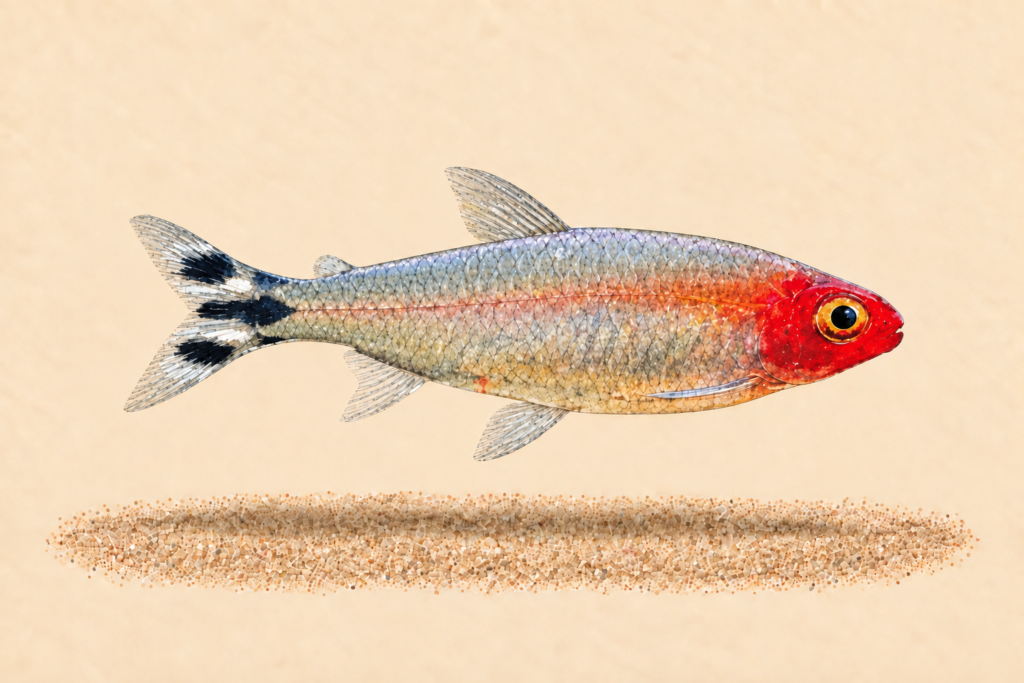
The red colouring around the nose and mouth gives the Rummy Nose Tetra its name. The body is compressed in cross section. Mature females look noticeably rounder than males. Because the fish shoals so tightly, a group looks far more effective than a few individuals.
Colour fades when the tank conditions are unfavourable, so the fish needs good, regular maintenance. Alkaline water also leaves the colours looking faded. Housed in a biotope style tank with dim lighting, the fish shows its true beauty.
Varieties and Morphs
Two other fish look very similar to it: the firehead tetra, which is the one most often sold as a rummy nose, and the false rummy nose, Petitella georgiae. All three look very alike, so a few details help you tell them apart.
Start with the head. Only the firehead has red stretching further back than the gill covers. The false rummy nose has a similar amount of red to the Rummy Nose Tetra, although its tone tends to look a little paler. Head colour alone cannot settle the question, because the red can fade a great deal in fish that are not in good condition.
Next, check the tail stalk. All three have a dark blotch on the upper part of it, but only the Rummy Nose Tetra and the firehead also have one on the lower part. If the lower blotch is missing, you are probably looking at a false rummy nose instead. Check the line running from the central tail band into the body: it is almost absent in the firehead, narrower in the Rummy Nose Tetra, and quite broad in the false rummy nose.
Natural Habitat
The Rummy Nose Tetra comes from South America, where it occurs in the lower Amazon basin and the Orinoco basin, with records from Brazil, Colombia and Venezuela. The type locality is the Rio Tapajoz, near Santarem in Pará, Brazil. It is found in blackwater rivers as well as their tributaries. The water there is usually stained brown by tannins released as organic material decays, and the same tannins leave it very acidic. Plants growing in the water are not part of its natural habitat.
Tank Size and Setup
A group of 10 or preferably more is the right number to keep. Because the fish swims actively, the tank needs to be at least 90 cm (36 inches) long, and 75 litres is the minimum volume. Recreating its natural biotope should be simple. River sand makes a good substrate, with a few driftwood branches and twisted roots on top. If you cannot source driftwood in the shape you want, beech wood is a safe substitute provided it has been dried right through and the bark removed.
Scatter a small quantity of dried leaves to round off the natural look, since beech leaves and oak leaves are both suitable. Let the wood and leaves colour the water until it looks like weak tea. Swap out the old leaves every few weeks before they rot and spoil the water. A standard, well planted tank is an alternative that the fish also does well in.
Water Parameters
The Rummy Nose Tetra suits temperatures of 24 to 27 °C, a pH of 5.5 to 7 and hardness of 2 to 15 dGH.
| Temperature | 24–27 °C |
| pH | 5.5–7.0 |
| General hardness (GH) | 2–15 dGH |
| Ammonia | 0 ppm |
| Nitrite | 0 ppm |
| Nitrate | Below 20 ppm |
Plan on a partial water change every week, because the fish loses its colour when conditions slip.
Filtration and Equipment
Hanging a little aquarium-safe peat in a net bag inside the filter can help recreate blackwater conditions.
Diet and Feeding
The Rummy Nose Tetra is omnivorous and will eat nearly anything on offer. Its small mouth means you should choose small foods. Feed flakes or granules, together with tiny live and frozen items. Feeding a varied diet is essential if you want the colour to develop at its best.
Behaviour and Temperament
The Rummy Nose Tetra is very peaceful, so it can lose out to rowdy fish or to tank mates that are much bigger. Among small tetras it is one of the tighter shoalers, and it does poorly when there are too few of them. A number of discus keepers choose a shoal of these tetras for their show tanks.
The best companions are other South American fish, such as pencil fish, Apistogramma dwarf cichlids, Corydoras and small loricariids, or related tetras such as Hyphessobrycon species. For a wider community, you can pair rummy noses with barbs, anabantoids, small rasboras, or Pelvicachromis dwarf cichlids from West Africa.
Tank Mates
Rummy Nose Tetras are ideal community fish, but their tank mates should be chosen with care to avoid pairing them with species that are too boisterous, aggressive, or large enough to view them as food. The best companions are other peaceful, similarly sized fish that share a preference for soft, acidic water conditions.
Good tank mates
- Cardinal Tetra, shares identical water chemistry preferences and occupies the same mid-water zone without conflict, creating a stunning multi-species display.
- Ember Tetra, a small, gentle tetra that thrives in the same warm, soft water conditions and adds a complementary splash of orange to the aquarium.
- Harlequin Rasbora, a peaceful, hardy shoaling fish that enjoys similar water parameters and coexists without any territorial behaviour.
- Corydoras sterbai, a bottom-dwelling catfish that tolerates the warmer temperatures preferred by Rummy Nose Tetras and poses no threat to mid-water companions.
- Otocinclus, a diminutive algae-eating catfish that is entirely peaceful and benefits from the same soft, clean water conditions.
- Kuhli Loach, a gentle, nocturnal bottom-dweller that occupies a completely different niche in the tank and shares a preference for soft substrates.
- Dwarf Gourami, a calm, surface-oriented labyrinth fish that generally ignores small tetras and appreciates similar water temperatures.
- Cherry Shrimp, adult shrimp coexist peacefully with Rummy Nose Tetras, though very small shrimplets may occasionally be predated upon.
- Bristlenose Pleco, a hardy, algae-eating catfish that keeps to the substrate and lower levels of the tank, well away from the tetras’ swimming zone.
- Celestial Pearl Danio, a small, peaceful micro fish that thrives in planted setups and will not compete aggressively for food or space.
Fish to avoid
- Oscar, a large, predatory cichlid that will readily consume any fish small enough to fit in its mouth, including Rummy Nose Tetras.
- Tiger Barb, a notorious fin-nipper that can harass and stress slower-moving, peaceful species like Rummy Nose Tetras.
- Jack Dempsey, an aggressive, territorial cichlid that is far too large and combative to house with small tetras.
- Convict Cichlid, a highly territorial species, especially when breeding, that will aggressively defend space and may injure or kill small tank mates.
- Red Tail Catfish, a massive predatory catfish that grows far too large and will consume any fish it can swallow.
- Green Terror, a large, aggressive South American cichlid that is wholly incompatible with small, peaceful schooling fish.
- African Rift Lake Cichlids, require hard, alkaline water that is fundamentally incompatible with the soft, acidic conditions Rummy Nose Tetras need.
- Flowerhorn, an extremely aggressive hybrid cichlid that is best kept alone and would view small tetras as food.
Breeding
The Rummy Nose Tetra can be bred much like its close relatives in the same genus, but raising a good number of fry requires a separate tank. A tank of around 18 by 10 by 10 inches is fine. Keep it very dimly lit and add bunches of fine leaved plants, java moss for instance, or spawning mops, so the fish have a place to lay eggs. Alternatively, mesh over the base works if the grade is large enough for eggs to fall through but too small for adults to reach them.
The breeding water should be soft and acidic, at pH 5.5 to 6.5 and gH 1 to 5. You can condition a spawning group, with half a dozen of each sex a good number, by feeding generously on tiny live foods, and spawning should not cause too many problems. Pair spawning is the alternative, in which males and females are conditioned in separate tanks. Once females are clearly carrying plenty of eggs and the males show their best colours, move the roundest female and the male with the finest colours into the spawning tank.
Despite what many accounts claim, spawning happens only in the evening. Adults eat their own eggs if they get the opportunity, so remove them once you spot eggs. Eggs hatch in 24 to 36 hours, and the fry swim freely 3 to 4 days after that. Eggs and fry are sensitive to light in their early life, so keep the breeding tank dark if you can. For their first days, offer the fry an infusoria type food, then microworm or brine shrimp nauplii once they are big enough.
Common Diseases
The Rummy Nose Tetra can be affected by white spot, bacterial infections and nematode infection. Keeping a proper group matters too, since the fish does not do well in insufficient numbers.
FAQs
How many Rummy Nose Tetras should I keep together?
Aim for 10 or preferably more. They are tightly shoaling fish that do poorly in small numbers. Because they swim actively, the tank should be at least 90 cm long, and 75 litres is the minimum.
What water conditions suit them?
Aim for 24 to 27 °C, a pH of 5.5 to 7 and hardness of 2 to 15 dGH. Their wild waters are brown and very acidic. A small net bag of peat in the filter can help mimic those blackwater conditions.
Is the Rummy Nose Tetra the same as the firehead tetra?
No, the firehead tetra is a different fish, though it is the one often sold under the rummy nose name. You can separate them by the red on the head, since only the firehead has it reaching further back than the gill covers. The Rummy Nose Tetra also has a dark blotch on the lower part of the tail stalk, which a false rummy nose probably lacks.
What do Rummy Nose Tetras eat?
They are omnivores and take almost any food you offer. Their small mouths suit small foods. A mix of flakes, granules and small live or frozen foods works well.
Can I keep them with other fish?
Yes, they are very peaceful, but rowdy or much larger tank mates may outcompete them. South American companions such as pencil fish and Corydoras are the ideal choice. In a general community they can also live with smaller rasboras and barbs.
Related Guides
- Cardinal Tetra Care Guide, another iconic South American tetra with very similar water chemistry requirements, making it a natural companion species.
- Neon Tetra Care Guide, a closely related and popular tetra species that shares many care considerations, useful for comparing difficulty levels.
- Ember Tetra Care Guide, a smaller tetra that thrives in similar soft, warm water conditions and makes an excellent complementary schooling species.
- Corydoras sterbai Care Guide, one of the best bottom-dwelling companions for Rummy Nose Tetras due to its tolerance of warmer water temperatures.
- Blackwater Aquarium Setup Guide, a comprehensive guide to creating the tannin-rich, soft-water environment in which Rummy Nose Tetras truly thrive.
- Freshwater Aquarium Cycling Guide, essential reading before introducing any sensitive species, covering the nitrogen cycle and how to establish stable biological filtration.