Quick summary
The Panda Garra is a hardy, active algae-eater with striking banded markings that thrives in well-oxygenated tanks with moderate to strong flow, making it an excellent choice for community setups aimed at intermediate and even confident beginner fishkeepers.
🐠 Build a tank around this species
- Introduction
- Quick stats
- Appearance
- Natural habitat
- Tank size and setup
- Water parameters
- Filtration and equipment
- Diet and feeding
- Behaviour and temperament
- Tank mates
- Breeding
- Common diseases and health
- Frequently asked questions
- Related guides
Introduction
If you have ever wanted a fish that looks genuinely unusual, works hard to keep your rocks and glass clean, and has enough personality to make you stop and watch, the Panda Garra (Garra flavatra) deserves a spot near the top of your shortlist. Originally described from the Rakhine State in western Myanmar, this small cyprinid burst onto the aquarium scene in the mid-2000s and quickly earned a loyal following among planted-tank enthusiasts and hillstream biotope fans alike. Its bold dark and pale banding, reminiscent of a panda’s markings, gives it instant visual appeal, while its tireless grazing behaviour means it actually earns its keep in the tank.
What makes the Panda Garra especially endearing is its temperament. Unlike some algae-eating species that hide all day and only emerge at lights-out, Garra flavatra is conspicuously active during daylight hours. It will cling to rocks, shimmy across driftwood, and even rest upside down on the underside of broad leaves, seemingly unbothered by the audience. Groups tend to develop a loose but entertaining social hierarchy, with individuals chasing each other briefly before going straight back to grazing. It is the kind of fish that adds life and movement to the lower third of a tank without causing real stress to its neighbours.
The Panda Garra suits fishkeepers who can provide clean, oxygen-rich water and a degree of current. It is not especially demanding in terms of water chemistry, but it does best when its hillstream origins are respected. If you already keep a mature tank with decent filtration and enjoy watching natural behaviour unfold, this species will reward you handsomely. Beginners with a cycled tank and a willingness to maintain stable conditions will also do well.
Quick stats
| Scientific name | Garra flavatra |
| Family | Cyprinidae |
| Origin | Rakhine State, western Myanmar |
| Adult size | 6 to 8 cm |
| Lifespan | 5 to 8 years |
| Difficulty | Beginner to intermediate |
| Breeding difficulty | Moderate |
| Temperature | 18 to 26 °C |
| pH range | 6.5 to 7.5 |
| Minimum tank size | 80 litres |
Appearance
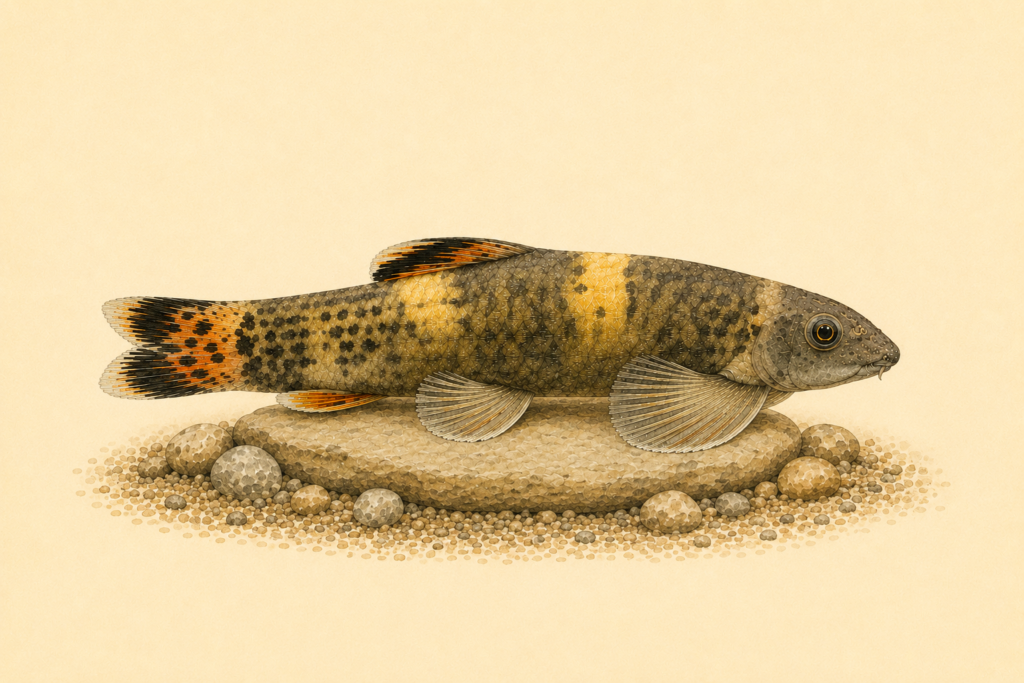
The Panda Garra’s common name is well earned. Its body is marked by alternating bands of dark brown to black and creamy gold, creating a pattern that is both distinctive and surprisingly effective as camouflage over mottled stones. The fins carry the same banding, and the dorsal fin in particular often shows a crisp black edge that gives it a polished look. The body shape is torpedo-like and slightly flattened on the underside, a clear adaptation for clinging to rocks in flowing water. The mouth is positioned ventrally and equipped with a sucker disc, which it uses to attach to hard surfaces while grazing on biofilm and algae.
Males and females are not dramatically different, but there are some reliable markers once fish are mature. Males tend to be slightly slimmer and may develop more prominent tubercles, small raised bumps, on the head and snout during breeding condition. Females are often a touch rounder in the belly when viewed from above, particularly when carrying eggs. Colour intensity can vary between individuals and is influenced heavily by mood, diet, and environment. A Panda Garra in a well-set-up tank with plenty of grazing surfaces will almost always show bolder, richer contrast than one kept in a bare or stressful environment.
Natural habitat
Garra flavatra is found in shallow, fast-flowing streams and tributaries in the Rakhine hills of western Myanmar. These waterways typically run through forested or semi-forested terrain with substrates composed of smooth cobbles, gravel, and boulders. The water is well-oxygenated, relatively cool compared to lowland tropical rivers, and often slightly soft to neutral in chemistry. Algae and biofilm grow prolifically on the sunlit surfaces of rocks, providing the primary food source for Garra species and other periphyton grazers that share these habitats.
Understanding this environment is the single most useful thing you can do when setting up a tank for Panda Garras. They evolved to cling to rocks in current, rasp at biofilm, and interact with conspecifics in complex rocky landscapes. A tank that mimics even a fraction of this, with good flow, rounded stones, and plenty of surface area for biofilm to develop, will bring out the best behaviour and colouration. Conversely, a slow, still tank with no hardscape will leave these fish looking washed out and behaving abnormally.
Tank size and setup
A single Panda Garra can technically survive in a 60-litre tank, but a group of four to six, which is really the way to keep them, calls for at least 80 litres. A 100 to 120 litre setup gives you more room for aquascaping and helps maintain stable water quality. Longer tanks are preferable to tall ones because Panda Garras spend most of their time on or near the substrate and hardscape rather than swimming in open water columns.
For substrate, a mix of smooth river gravel and fine sand works well. Avoid anything sharp-edged, as these fish spend a lot of time pressing their bellies and mouths against surfaces. Rounded cobbles and river stones in a range of sizes should form the backbone of the hardscape. Arrange them to create small caves, overhangs, and channels. Driftwood, particularly pieces of Mopani or Malaysian driftwood, adds variety and gives biofilm another surface to colonise.
Planting is entirely compatible with Panda Garras. They may rasp lightly at broad leaves, but they rarely cause real damage to healthy plants. Good choices include Anubias barteri, Java Fern (Microsorum pteropus), Bucephalandra species, and Vallisneria spiralis for background height. Epiphytic plants attached to rocks and wood complement the hillstream aesthetic nicely. Lighting should be moderate, enough to promote a thin layer of algae and biofilm growth on rocks without triggering nuisance algae blooms. A standard LED fixture on a timer set for 8 to 10 hours daily is ideal.
Water flow is important. A current-generating powerhead or a spray bar angled along the length of the tank will keep these fish active and comfortable. You do not need to replicate a whitewater torrent, but a noticeable directional flow across the rockwork is strongly recommended.
Water parameters
| Parameter | Recommended range |
|---|---|
| Temperature | 18 to 26 °C |
| pH | 6.5 to 7.5 |
| General hardness (GH) | 2 to 12 dGH |
| Ammonia | 0 ppm |
| Nitrite | 0 ppm |
| Nitrate | Below 20 ppm |
Panda Garras are reasonably adaptable in terms of water chemistry, but they are sensitive to accumulated waste. High nitrate levels or any detectable ammonia and nitrite will stress them quickly, often leading to colour loss and lethargy before more serious health problems set in. Weekly water changes of 25 to 30 percent are a sensible baseline. If your tap water is very hard or alkaline, blending it with RO water can help you hit a comfortable middle ground. Consistency matters more than hitting a perfect number, so pick a target and stick to it.
Filtration and equipment
Because Panda Garras naturally inhabit well-oxygenated streams, effective filtration pulling double duty for both mechanical cleaning and oxygenation is essential. A canister filter rated for your tank size, or slightly above it, is the best option. Models such as the Fluval 207 or the Eheim Classic 250 work well for tanks in the 80 to 150 litre range. Position the outlet as a spray bar along the back wall to generate a gentle but consistent current across the aquascape.
A heater is necessary unless your home stays reliably within the species’ comfort range year-round. An adjustable heater like the Eheim Jager or Fluval M series gives you precise control. Set it towards the lower to middle end of the range, around 22 to 24 °C, which mirrors the subtropical conditions these fish prefer. An air stone is optional if your filter already provides good surface agitation, but it can be a worthwhile addition during warmer months when dissolved oxygen levels tend to drop.
Keep a reliable liquid test kit on hand. The API Freshwater Master Test Kit remains a solid all-rounder for monitoring ammonia, nitrite, nitrate, and pH. Test weekly during the first few months, then fortnightly once parameters are stable.
Diet and feeding
In the wild, Panda Garras feed almost exclusively on biofilm, aufwuchs (the mixed community of algae, microorganisms, and detritus growing on rock surfaces), and small invertebrates they encounter while grazing. In captivity they remain primarily herbivorous grazers, but they are true omnivores and will happily accept a range of foods.
A good daily staple is a high-quality sinking algae wafer or vegetable-based tablet. Hikari Algae Wafers and Repashy Soilent Green gel food are both excellent choices that Panda Garras devour readily. Supplement these with blanched vegetables such as courgette (zucchini) slices, spinach leaves, or shelled peas once or twice a week. For protein, offer frozen or live foods like bloodworm, daphnia, or brine shrimp once or twice a week. These protein boosts are especially important for conditioning fish prior to breeding.
Feed once or twice daily, offering only what the group can consume within a few minutes. Remove uneaten vegetable matter after 12 hours to prevent it from fouling the water. One of the joys of keeping Panda Garras is watching them graze naturally on the biofilm that develops across rocks and wood. Resist the urge to scrub every surface spotless, because that film is an important part of their diet and natural behaviour.
Behaviour and temperament
Panda Garras are lively, confident fish that rarely hide for long. They spend the vast majority of their time attached to hard surfaces, methodically working their way across rocks, glass, and driftwood with a rasping, side-to-side motion. They are not schooling fish in the tight, synchronised sense, but they are social and clearly benefit from the company of their own kind. A group of four to six individuals will establish a loose pecking order, with occasional brief chases and posturing, but these interactions are harmless and part of normal social communication.
One of the most charming quirks of Garra flavatra is its tendency to rest in odd positions. You may find one stuck upside down under a leaf, wedged vertically in a crevice, or sitting perfectly still on the front glass at eye level, apparently staring back at you. They are also surprisingly aware of their keeper. Many owners report that their Panda Garras swim to the front of the tank at feeding time and even follow a finger moving along the glass. This level of engagement is unusual for a bottom-dwelling species and is a big part of why people fall for them.
Aggression is minimal. Individuals may squabble briefly over a prime grazing spot, but injuries are virtually unheard of. Providing plenty of surface area and hiding spots minimises even these mild disputes.
Tank mates
Good tank mates
- Cherry Barb – peaceful, occupies mid-water, tolerates similar temperatures
- Harlequin Rasbora – calm schooling fish that stays out of the Garra’s territory
- Celestial Pearl Danio – small, gentle, and thrives in cooler subtropical setups
- Panda Corydoras – another peaceful bottom dweller with compatible water needs
- Kuhli Loach – occupies a different niche among the substrate, rarely competes for the same surfaces
- White Cloud Mountain Minnow – excellent subtropical companion that enjoys similar flow and temperatures
- Bristlenose Pleco – compatible in larger tanks, though monitor for territorial overlap on grazing surfaces
- Amano Shrimp – robust shrimp that coexists well and shares cleanup duties
Fish to avoid
- Tiger Barb – boisterous fin nippers that may harass slower-moving garras
- Oscar – far too large and predatory, would see Panda Garras as food
- Chinese Algae Eater – aggressive as adults, likely to bully and compete for grazing territory
- Betta (male) – prefers still water, and the Garra’s active nature may stress a slow-moving betta
- Large cichlids such as Jack Dempsey or Green Terror – territorial and predatory, completely incompatible
Breeding
Breeding Panda Garras in captivity is achievable but not routine. It falls into the moderate category, meaning it requires deliberate effort rather than happening by accident. Start by sexing your group. Mature males are typically slimmer and may show small white tubercles on the snout and head when in breeding condition. Females tend to be plumper, especially when full of eggs, and have a slightly rounder profile when viewed from above.
To condition a breeding group, increase the proportion of protein-rich foods such as live or frozen bloodworm, daphnia, and brine shrimp over a period of two to three weeks. Slightly cooler water, around 20 to 22 °C, followed by a gradual increase to 24 to 26 °C combined with a partial water change using slightly softer water can simulate the onset of the rainy season and trigger spawning behaviour. Spawning usually takes place among rocks and gravel, with the female scattering adhesive eggs across hard surfaces.
The adults do not guard the eggs and may eat them if given the opportunity, so removing the adults or moving the eggs to a separate hatching tank is advisable. Eggs typically hatch in 24 to 48 hours depending on temperature. The fry are tiny and will initially feed on their yolk sacs before moving on to infusoria and liquid fry food. After a week or so, they can take newly hatched brine shrimp (Artemia nauplii) and finely powdered spirulina. Growth is steady but not fast, and maintaining excellent water quality in the fry tank is critical during the first few weeks.
Common diseases and health
Panda Garras are generally robust fish, but they are not immune to the usual freshwater ailments. Ich (white spot disease) is probably the most common issue, recognisable by small white cysts scattered across the body and fins. It is usually triggered by temperature fluctuations or stress from transport. Treatment involves raising the tank temperature gradually to 28 °C and dosing with a proprietary ich medication such as eSHa Exit or API Super Ick Cure.
Bacterial infections can arise from poor water quality or physical injuries. Watch for reddened patches on the body, frayed fins, or unusual lethargy. A broad-spectrum antibacterial treatment and an immediate review of water parameters will usually resolve early-stage infections. Internal parasites, while less common, can cause weight loss and pale, stringy faeces. Treatments containing praziquantel or levamisole are effective against most freshwater parasites.
Quarantining new fish before adding them to your main display tank is always a wise practice. A simple 30 to 40 litre quarantine tank with a sponge filter, heater, and a few hiding spots is all you need. Keep new arrivals in quarantine for at least two weeks, observing for signs of disease, before making the introduction. This one habit can save your entire community tank from an avoidable outbreak.
Frequently asked questions
How many Panda Garras should I keep together?
A group of four to six is ideal. They are social fish that display more natural behaviour and bolder colouration when kept in a group. Keeping a single specimen is not recommended, as lone individuals tend to be more reclusive and can become stressed. In tanks of 100 litres or more, a group of six is a great target.
Do Panda Garras eat plants?
They graze constantly on biofilm and algae, but they rarely damage healthy aquarium plants. You might occasionally see them rasping at a broad Anubias leaf, but this is usually them eating the film growing on the leaf surface rather than the plant tissue itself. Soft, delicate species are generally safe alongside them.
Can Panda Garras live with shrimp?
Yes, they coexist well with larger shrimp species like Amano Shrimp and adult Cherry Shrimp. Very small shrimplets may occasionally be eaten, but this is not a significant concern in a well-planted tank with plenty of cover. Panda Garras are not active hunters and pose minimal threat to established shrimp colonies.
Why is my Panda Garra losing its colour?
Colour loss is usually a sign of stress, poor water quality, or an inadequate diet. Check your water parameters for elevated nitrates or ammonia. Ensure the tank has sufficient current and plenty of grazing surfaces. Feeding a varied diet rich in spirulina and supplemented with occasional protein foods helps maintain vivid banding. Colour can also fade temporarily during acclimatisation to a new tank.
Do Panda Garras need a heater?
In most homes, yes. While they tolerate a broad temperature range of 18 to 26 °C, fluctuating room temperatures, especially overnight or in winter, can stress them. An adjustable heater set to around 22 to 24 °C provides the stability they need. If your home naturally stays within this range year-round, a heater may not be strictly necessary, but it is still good insurance.