Quick summary
Yes, the White Cloud Mountain Minnow is one of the best fish for beginners: it’s hardy, peaceful, easy to feed, and thrives in cool water without a heater, making it low-cost and low-maintenance. Just keep them in groups of eight or more in a tank of at least 40 litres, and avoid warm tropical setups above 24 °C, which shorten their lifespan.
🐠 Build a tank around this species
In this guide:
- Introduction
- Quick Stats
- Appearance
- Varieties and Morphs
- Natural Habitat
- Tank Size and Setup
- Water Parameters
- Filtration and Equipment
- Diet and Feeding
- Behaviour and Temperament
- Tank Mates
- Breeding
- Common Diseases
- FAQs
Introduction
The White Cloud Mountain Minnow is one of the most enduringly popular freshwater fish in the aquarium hobby, and for good reason. Hardy, peaceful, beautifully coloured, and remarkably easy to breed, this diminutive cyprinid has earned a loyal following among beginners and experienced fishkeepers alike since its discovery in the 1930s. Often referred to simply as the White Cloud, it was once so widely available and inexpensive that it earned the somewhat unflattering nickname “the poor man’s neon tetra.” In truth, this little fish deserves far more respect than that moniker implies. Its iridescent lateral stripe, warm fin colouration, and lively schooling behaviour make it a genuinely attractive addition to any appropriately stocked aquarium.
What makes the White Cloud Mountain Minnow particularly appealing is its adaptability. Unlike many tropical species that demand narrow water parameter ranges and elevated temperatures, Tanichthys albonubes thrives in cooler water and tolerates a broad spectrum of conditions. This makes it an ideal candidate for unheated indoor aquaria, subtropical setups, and even outdoor ponds and tub gardens in temperate climates during the warmer months. Its peaceful disposition, small adult size, and willingness to accept virtually any food offered make it one of the finest choices for newcomers to the hobby, whilst its breeding behaviour and subtle beauty continue to captivate seasoned aquarists.
This care guide covers everything you need to know to keep White Cloud Mountain Minnows healthy and thriving, from tank setup and water parameters to diet, breeding, and compatible tank mates.
Quick Stats
| Scientific name | Tanichthys albonubes |
|---|---|
| Common names | White Cloud, Canton Minnow, Chinese Danio, Poor Man's Neon Tetra |
| Family | Cyprinidae |
| Origin | White Cloud Mountain, Guangdong Province, southern China; also Vietnam |
| Adult size | 4 cm |
| Lifespan | 3–5 years |
| Difficulty | Easy |
| Breeding difficulty | Easy |
| Temperature | 14–22 °C |
| pH | 6–8 |
| GH | 5–19 dGH |
| KH | 2–15 dKH |
| Minimum tank size | 40 L |
| Conservation status | Data Deficient (IUCN) |
Appearance
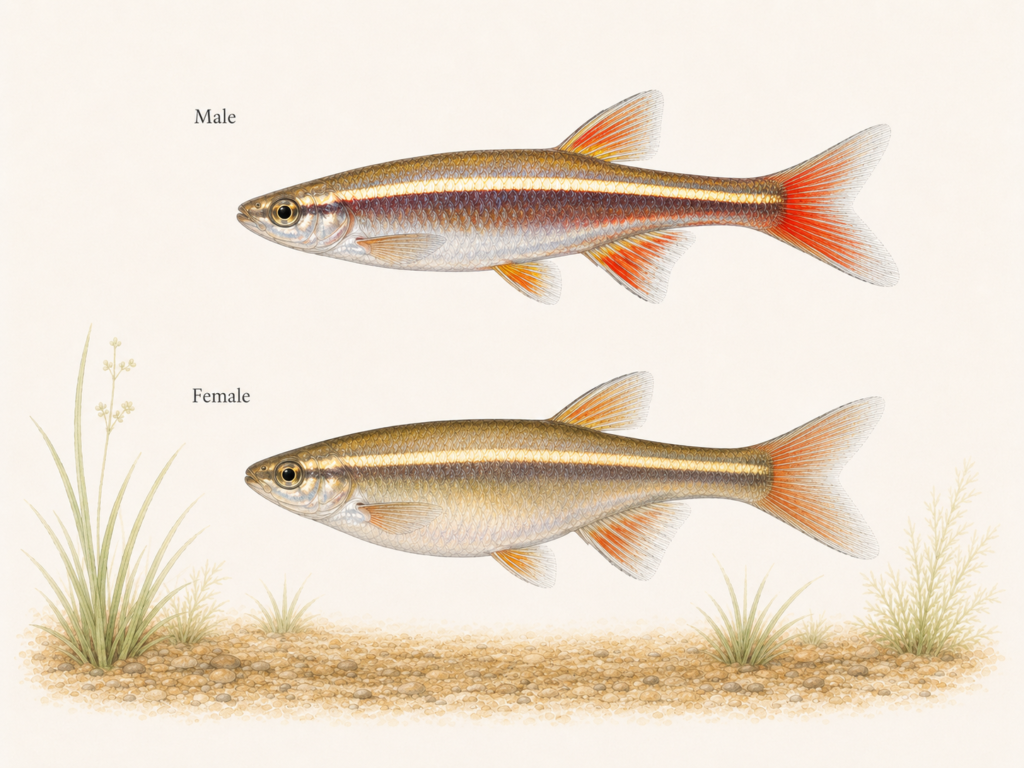
The White Cloud Mountain Minnow is a slender, streamlined fish that reaches an adult length of approximately 3 to 4 centimetres. Its body is elongated and slightly laterally compressed, with a profile reminiscent of small danios and rasboras. The base body colour is a warm bronze to olive-green on the dorsal surface, fading to a lighter silvery or cream hue on the belly. The most striking feature is a brilliant iridescent lateral stripe that runs from behind the eye to the base of the caudal fin. In juveniles, this stripe shimmers with an intense electric blue or greenish-blue hue that is often compared to the stripe of the neon tetra. As the fish matures, the stripe tends to become somewhat more subdued, taking on a golden or coppery tone, though it remains clearly visible.
The fins of the wild-type White Cloud are particularly attractive. The dorsal and anal fins are edged in red and white, whilst the caudal fin displays a conspicuous red patch at its centre, bordered by clear or lightly pigmented margins. The pectoral and ventral fins are generally translucent with a faint yellowish or reddish wash. Males tend to be slimmer and more vividly coloured than females, especially when in breeding condition, at which point their reds intensify and their bodies take on a deeper, more saturated tone. Females are slightly plumper, particularly when gravid, and their colouration is somewhat paler by comparison. There is a small dark spot at the base of the tail and often a corresponding dark marking near the operculum.
Varieties and Morphs
Over the decades, selective breeding has produced several distinct varieties of the White Cloud Mountain Minnow that are regularly available in the aquarium trade. While all share the same fundamental care requirements as the wild-type form, their appearances can differ quite markedly.
The Golden White Cloud is perhaps the most widely encountered variant. This morph lacks much of the darker pigmentation of the wild type, resulting in a pale golden to peachy body colour. The iridescent lateral stripe is still present but appears more silvery against the lighter background. The red colouration in the fins remains and can be especially vivid, giving the golden form an almost luminous quality under good aquarium lighting.
The Long-finned White Cloud, sometimes sold as the Meteor Minnow, features dramatically elongated dorsal, anal, and caudal fins that trail elegantly as the fish swims. This variety is available in both the standard wild-type colouration and the golden form. The extended finnage does reduce the fish’s swimming speed somewhat, so keepers should be mindful of potential fin-nipping tank mates when housing this morph.
The Long-finned Golden White Cloud combines both traits, pairing the flowing fins of the Meteor Minnow with the pale golden body of the golden variant. This is a particularly striking fish that works beautifully in densely planted aquaria where its warm tones contrast against lush greenery.
A Vietnamese variant, sometimes referred to as Tanichthys micagemmae or the Vietnamese White Cloud, is occasionally encountered in specialist shops. Though technically a separate species, it is frequently discussed alongside T. albonubes due to its similar care requirements and close relationship. It is slightly smaller and features a more pronounced red and blue colouration. Aquarists should take care not to hybridise these two species if keeping them together.
Natural Habitat
Tanichthys albonubes was first collected in 1932 by a Chinese boy scout leader named Tan Kam Fei on White Cloud Mountain (Baiyun Shan), located near Guangzhou (formerly Canton) in Guangdong Province, southern China. The species was described scientifically by Lin Shu-Yen in the same year, with the genus name Tanichthys honouring its discoverer. The specific epithet albonubes translates to “white cloud,” a direct reference to the mountain where it was found.
In its native habitat, the White Cloud Mountain Minnow inhabits clear, slow-moving to moderately flowing mountain streams and brooks at elevations of around 300 to 600 metres. These are typically shallow, well-oxygenated waterways with rocky or gravelly substrates, bordered by dense vegetation. The water is generally clean and cool, with temperatures that can fluctuate considerably between seasons, dropping as low as 5 °C in winter and rising to the low twenties in summer. This natural exposure to seasonal temperature variation is a key reason for the species’ remarkable hardiness in captivity.
For many years, the White Cloud Mountain Minnow was feared extinct in the wild. Urban development, pollution, and habitat destruction around Guangzhou appeared to have eliminated the original wild populations by the 1980s. However, small populations were subsequently rediscovered in isolated streams in Guangdong Province and, more recently, in parts of northern Vietnam. Despite these rediscoveries, wild populations remain fragile and localised. The vast majority of White Cloud Mountain Minnows in the aquarium trade are commercially bred, which is a positive development for the conservation of remaining wild stocks.
Tank Size and Setup
A group of White Cloud Mountain Minnows can be comfortably housed in an aquarium of 40 litres or more. This minimum is suitable for a group of eight to ten fish, which is the recommended minimum shoal size for this gregarious species. Larger tanks of 60 to 100 litres are preferable, as they provide more swimming space and allow for a larger group, which in turn encourages more natural and confident behaviour. These fish are active swimmers and appreciate a tank that offers length over height, with a footprint of at least 60 centimetres being ideal.
The aquascape should aim to replicate the species’ natural stream habitat whilst also providing areas of cover and open swimming space. A substrate of fine gravel or sand works well and looks natural. Smooth river pebbles and small stones can be arranged to create a stream-like aesthetic. Driftwood and bogwood are excellent additions, both for visual appeal and for the mild tannins they release, which can benefit the fish’s overall wellbeing.
Live plants are highly recommended and serve multiple purposes in the White Cloud aquarium. They provide cover, help maintain water quality by absorbing nitrates, and create a more natural and visually pleasing environment. Hardy, cool-tolerant species such as Java fern, Anubias, Java moss, Vallisneria, and Cryptocoryne are all excellent choices. Floating plants can be used to diffuse overhead light and give the fish a greater sense of security. Dense plantings along the back and sides of the tank, with open areas towards the centre and front for swimming, make for an ideal layout.
A secure lid is advisable, as White Cloud Mountain Minnows can be surprisingly adept jumpers, particularly when startled. Lighting should be moderate; these fish do not require intense illumination and may appear washed out under very bright light. A standard LED fixture suitable for planted tanks is more than adequate.
Water Parameters
One of the greatest strengths of the White Cloud Mountain Minnow as an aquarium fish is its tolerance of a wide range of water conditions. It is fundamentally a subtropical to temperate species and does best in cooler water than many commonly kept tropical fish. Maintaining the correct temperature range is arguably more important than any other single parameter for long-term health and longevity. Keeping these fish at consistently tropical temperatures of 26 °C and above will stress them, shorten their lifespan, and make them more susceptible to disease.
| Temperature | 14–22 °C |
| pH | 6.0–8.0 |
| General hardness (GH) | 5–19 dGH |
| Carbonate hardness (KH) | 2–15 dKH |
| Ammonia | 0 ppm |
| Nitrite | 0 ppm |
| Nitrate | Below 20 ppm |
The ideal temperature range sits between 16 and 20 °C for everyday keeping, though the fish will comfortably tolerate brief excursions outside this range. They can withstand temperatures as low as 5 °C for short periods, making them suitable for unheated outdoor containers during British summers and even mild winters in sheltered locations. At the upper end, temperatures above 24 °C should be avoided wherever possible. Weekly water changes of 20 to 30 per cent will help keep nitrate levels low and maintain overall water quality. Consistency is more important than hitting exact numbers; White Clouds are forgiving fish, but they thrive best in stable conditions with clean, well-maintained water.
Filtration and Equipment
White Cloud Mountain Minnows do not require powerful filtration, and indeed excessively strong flow can be stressful for these small fish. A gentle sponge filter is an excellent choice, particularly in smaller aquaria and breeding setups. Sponge filters provide effective biological filtration, gentle water movement, and aeration without creating currents strong enough to exhaust the fish. They also have the advantage of being safe for fry, as there is no intake to trap tiny fish.
For larger or more heavily stocked tanks, a small hang-on-back filter or a compact internal canister filter will work well. If the outflow creates too much current, it can be baffled using a sponge, a piece of filter media attached to the outlet, or by directing the flow against the aquarium glass. The key is to ensure adequate oxygenation and biological filtration without creating a torrent that the fish must constantly battle against.
A heater is generally unnecessary for this species, which is one of the practical benefits of keeping White Clouds. In most homes in the United Kingdom, ambient room temperature will keep the aquarium within the preferred range for much of the year. If the room temperature is likely to drop below 12 °C for extended periods, a low-wattage heater set to 15 or 16 °C can serve as a safety net. Conversely, during summer heatwaves, measures may need to be taken to prevent the tank from overheating. Increasing surface agitation, using a small clip-on fan, or positioning the tank away from direct sunlight can all help manage elevated temperatures.
Standard aquarium lighting is more than sufficient. A timer set to provide 8 to 10 hours of light per day will support healthy plant growth and provide a natural day-night cycle for the fish. An air pump is a worthwhile addition if not using a sponge filter, as White Clouds appreciate well-oxygenated water. A reliable thermometer should be considered essential for monitoring conditions, even in unheated setups.
Diet and Feeding
The White Cloud Mountain Minnow is an omnivorous and thoroughly undemanding feeder that will accept virtually any food small enough to fit in its mouth. In the wild, it feeds primarily on small invertebrates, insect larvae, algae, and organic detritus. In captivity, a varied diet will promote the best health and colouration.
A high-quality micro pellet or crushed flake food should form the staple of the diet. Choose a product formulated for small tropical or coldwater fish, with a good balance of protein and vegetable matter. Supplement this with regular offerings of live or frozen foods such as daphnia, baby brine shrimp, cyclops, micro worms, and bloodworm. These protein-rich foods are particularly valuable for conditioning fish for breeding and for encouraging vibrant colouration. Freeze-dried foods can also be offered but are generally less nutritionally complete than their live or frozen counterparts.
Feed small amounts once or twice daily, offering only as much as the fish can consume within two to three minutes. White Clouds are enthusiastic feeders and will readily come to the surface at feeding time once they learn the routine. Be cautious of overfeeding, as uneaten food will decay and compromise water quality in smaller tanks. A regular fasting day once a week is beneficial and mirrors the natural pattern of food availability in the wild.
Behaviour and Temperament
White Cloud Mountain Minnows are peaceful, active, and sociable fish that are best kept in groups of at least eight to ten individuals. In a sufficiently sized shoal, they exhibit fascinating social dynamics. Males will frequently display to one another, flaring their fins and intensifying their colours in low-level sparring matches that are entirely harmless. These interactions are a delight to observe and bring out the best colouration in the males as they compete for the attention of females.
The species occupies primarily the middle and upper levels of the water column, though individuals will explore all areas of the tank throughout the day. They are confident swimmers and tend not to hide excessively, provided they feel secure in their environment. A well-planted tank with a suitably sized group will produce a display of near-constant activity, with the shoal moving through the aquascape in loose formation, individuals periodically breaking away to investigate or display before rejoining the group.
Aggression is virtually nonexistent in this species. The minor squabbles between males are ritualistic and never result in injury. White Clouds pose no threat to other fish, invertebrates, or plants. They are occasionally accused of being fin nippers, but this behaviour is extremely rare and typically only occurs when the fish are kept in insufficient numbers, causing stress and abnormal behaviour. In a properly maintained group, nipping is simply not an issue.
Their confident and active nature makes them excellent dither fish for more timid species. Their willingness to swim openly in the water column signals to shyer tank mates that the environment is safe, encouraging them to emerge from hiding more frequently.
Tank Mates
The White Cloud Mountain Minnow’s peaceful nature and preference for cooler water are the two key factors to consider when selecting tank mates. The most important compatibility criterion is temperature tolerance; any potential companion must be comfortable in the same 14 to 22 °C range. This immediately rules out many popular tropical species that require temperatures above 24 °C.
Good tank mates
- Zebra Danio (Danio rerio), a similarly hardy and active shoaling species that thrives in the same cooler temperature range and makes an energetic companion.
- Celestial Pearl Danio (Danio margaritatus), a small, peaceful species that appreciates densely planted tanks and overlaps well in terms of water parameters and temperament.
- Rosy Barb (Pethia conchonius), a colourful and robust coldwater-tolerant barb that coexists peacefully with White Clouds in larger aquaria.
- Cherry Shrimp (Neocaridina davidi), an excellent invertebrate companion that adds colour and helps with algae control, posing no threat and facing minimal predation risk from adult White Clouds.
- Amano Shrimp (Caridina multidentata), a larger shrimp species that is entirely peaceful and serves as an outstanding algae-eating clean-up crew member.
- Bristlenose Pleco (Ancistrus sp.), a peaceful bottom-dweller that tolerates cooler temperatures well and occupies a completely different ecological niche in the tank.
- Weather Loach (Misgurnus anguillicaudatus), a sociable, cool-water bottom-dweller that makes a charming and compatible companion in larger setups.
- Peppered Corydoras (Corydoras paleatus), one of the more cold-tolerant Corydoras species, it peacefully scavenges the substrate without bothering mid-water swimmers.
- Variatus Platy (Xiphophorus variatus), a hardy livebearer that does well in cooler subtropical conditions and is entirely peaceful towards small shoaling fish.
- Nerite Snail (Neritina sp.), an excellent algae-eating snail that is completely harmless and adds a useful cleaning function to the aquarium.
Fish to avoid
- Oscar (Astronotus ocellatus), a large, predatory cichlid that would readily consume White Cloud Mountain Minnows and requires far warmer water.
- Angelfish (Pterophyllum scalare), a tropical cichlid that requires higher temperatures and will prey upon small fish that fit in its mouth.
- Tiger Barb (Puntigrus tetrazona), a notorious fin nipper that would harass White Clouds, particularly long-finned varieties, and prefers warmer tropical conditions.
- Betta (Betta splendens), Requires consistently warm tropical temperatures and may show aggression in confined spaces, making it an incompatible choice.
- Discus (Symphysodon spp.), Demands very warm, soft, acidic water and an extremely stable environment that is fundamentally incompatible with White Cloud requirements.
- Jack Dempsey (Rocio octofasciata), an aggressive, territorial cichlid that would view White Clouds as prey items rather than tank mates.
- Red-bellied Piranha (Pygocentrus nattereri), an obvious predator that would make short work of any small fish sharing its tank.
- Green Terror (Andinoacara rivulatus), a large, aggressive South American cichlid entirely unsuitable for community life with small, peaceful species.
Breeding
Breeding White Cloud Mountain Minnows is straightforward and is often recommended as an ideal first breeding project for newcomers to fishkeeping. These are egg-scattering fish that do not practise parental care, and under the right conditions they will spawn readily and repeatedly without significant intervention from the aquarist.
To condition a group for breeding, provide a varied diet rich in live and frozen foods for one to two weeks. Daphnia, baby brine shrimp, and micro worms are all excellent conditioning foods. Males will begin to display more intensely, spreading their fins and showing off their deepened colours to passing females. Gravid females can be identified by their noticeably rounder bellies when viewed from above.
A dedicated breeding tank of 20 to 30 litres is ideal, though spawning will also occur in a well-maintained community tank. The breeding tank should be set up with a thin layer of fine-leaved plants or spawning mops on the bottom, as the female will scatter her adhesive eggs amongst fine plant material. Java moss is particularly effective as a spawning medium. A gentle sponge filter should provide filtration and aeration. The water temperature should be at the warmer end of the species’ range, around 20 to 22 °C, to stimulate spawning activity.
Spawning typically occurs in the early morning. The male will court the female with an elaborate fin-flaring display, and the pair will swim side by side through the vegetation, with the female releasing small batches of eggs that the male simultaneously fertilises. A single spawning event may produce anywhere from 50 to 300 eggs, depending on the size and condition of the female. The eggs are tiny, clear to slightly amber, and adhesive, sticking to plant leaves and moss fronds.
Adults should ideally be removed after spawning, as they may eat the eggs if given the opportunity, although White Clouds are generally less cannibalistic towards their own eggs and fry than many egg-scattering species. In a densely planted community tank, some fry will often survive without any intervention at all.
The eggs hatch in approximately 48 to 72 hours at 20 °C. The newly hatched fry are tiny and will initially feed on their yolk sacs for a day or two before becoming free-swimming. First foods should include infusoria, commercially available liquid fry food, or very finely powdered fry food. After a week or so, the fry will be large enough to accept freshly hatched baby brine shrimp, which is the single best food for promoting rapid and healthy growth. Growth is steady, and the fry will begin to show their characteristic lateral stripe within a few weeks. They typically reach a sellable size within two to three months.
Common Diseases
White Cloud Mountain Minnows are robust fish that are not particularly prone to any species-specific ailments. The vast majority of health problems encountered are the result of environmental factors, particularly being kept at inappropriately high temperatures. When housed in warm tropical tanks above 24 °C, their metabolic rate increases unnaturally, their immune function becomes compromised, and their lifespan is significantly shortened. Maintaining proper cool-water conditions is the single most effective disease prevention strategy.
White spot disease, commonly known as ich, is the most frequently encountered illness. It manifests as small white cysts on the body and fins and is typically triggered by sudden temperature fluctuations or the introduction of new, unquarantined fish. Treatment involves raising the temperature slightly (to around 22 °C for White Clouds, rather than the higher temperatures recommended for tropical species) and administering a proprietary white spot remedy according to the manufacturer’s instructions.
Fin rot can occur in fish stressed by poor water quality, overcrowding, or persistent fin nipping. It presents as ragged, disintegrating fin edges, sometimes with a whitish or reddish margin. Improving water quality through more frequent water changes is the first line of treatment, and antibacterial medications may be necessary in advanced cases.
Velvet disease, caused by the parasite Piscinoodinium, occasionally affects White Clouds. It produces a fine, gold-dusted appearance on the skin and fins. Affected fish may clamp their fins, scratch against surfaces, and lose appetite. Copper-based medications are effective, though care must be taken with dosing in tanks containing invertebrates, as copper is lethal to shrimp and snails.
Internal parasites can occasionally be an issue, particularly in wild-caught or poorly maintained fish. Symptoms include weight loss despite a healthy appetite, pale or stringy faeces, and general lethargy. Anti-parasitic foods or medications can be used to treat affected individuals. Quarantining new arrivals for two to four weeks before adding them to an established tank is a sensible precaution that can prevent the introduction of parasites and other pathogens to your main display.
FAQs
Do White Cloud Mountain Minnows need a heater?
In most homes in the United Kingdom, a heater is unnecessary for White Cloud Mountain Minnows. They are a subtropical to temperate species that thrives at room temperature, typically between 16 and 20 °C. A heater is only required if the room temperature is likely to drop below 12 °C for sustained periods, such as in an unheated garage or outbuilding during winter. In fact, keeping them at consistently tropical temperatures above 24 °C is detrimental to their health and significantly reduces their lifespan.
How many White Cloud Mountain Minnows should I keep together?
A minimum group of eight to ten is recommended, though larger shoals of fifteen or more are even better if your tank can accommodate them. White Clouds are social fish that feel more secure, behave more naturally, and display more vivid colouration when kept in appropriately sized groups. Keeping fewer than six individuals can result in stressed, skittish fish that may hide excessively or exhibit abnormal behaviour such as fin nipping.
Can White Cloud Mountain Minnows live in an outdoor pond?
Yes, White Cloud Mountain Minnows can be kept in outdoor ponds, tub water gardens, and container ponds, particularly during the warmer months. In the United Kingdom, they can live outdoors from late spring through to early autumn without issue. They can tolerate brief dips to temperatures as low as 5 °C, but prolonged exposure to near-freezing conditions is risky. Most keepers bring them indoors for the winter or provide a deep enough pond with adequate insulation to prevent the water from freezing solid.
Are White Cloud Mountain Minnows good for beginners?
White Cloud Mountain Minnows are one of the very best fish for beginners. They are hardy, tolerant of a wide range of water conditions, peaceful, inexpensive, and easy to feed. Their ability to thrive without a heater reduces equipment costs. They are also excellent for learning about fish behaviour and breeding, as they will often spawn in a well-maintained community tank with minimal effort from the keeper. They make a superb first fish for anyone new to the hobby.
Will White Cloud Mountain Minnows eat shrimp?
Adult White Cloud Mountain Minnows are generally safe to keep with adult dwarf shrimp such as Cherry Shrimp and Amano Shrimp. However, they may prey upon very small shrimplets if they encounter them in open water. In a densely planted tank with plenty of moss and hiding spots, a self-sustaining shrimp colony can usually coexist successfully with a group of White Clouds, as enough shrimplets will survive to adulthood. If maximising shrimp reproduction is a priority, a dedicated shrimp-only tank is the safer option.
Related Guides
- Celestial Pearl Danio Care Guide, another small, peaceful species that thrives in cooler planted aquaria and makes an excellent companion for White Clouds.
- Zebra Danio Care Guide, a similarly hardy and active cyprinid that shares the White Cloud’s tolerance for a broad range of water conditions.
- Cherry Shrimp Care Guide, a popular invertebrate that pairs beautifully with White Cloud Mountain Minnows in planted community setups.
- Coldwater Aquarium Setup Guide, a comprehensive guide to establishing and maintaining an unheated freshwater aquarium suitable for subtropical species.
- Rosy Barb Care Guide, a colourful, cool-water barb that makes an active and compatible addition to larger White Cloud community tanks.