Quick Summary
The Black Banded Rainbowfish is a hardy, peaceful shoaling species that suits community aquariums of 150 litres or more, making it an excellent choice for keepers who want an active, easy-to-care-for rainbowfish without the space demands of its larger relatives.
🐠 Build a tank around this species
In this guide:
- Introduction
- Quick Stats
- Appearance
- Natural Habitat
- Tank Size and Setup
- Water Parameters
- Diet and Feeding
- Behaviour and Temperament
- Tank Mates
- Breeding
- Common Diseases
- FAQs
Introduction
Melanotaenia nigrans, commonly known as the Black Banded Rainbowfish, is one of northern Australia’s most widespread rainbowfish species. Found across a vast range of river systems from Western Australia through the Northern Territory and into Queensland, it has earned a reputation among aquarists as a reliable, undemanding community fish. While it may lack the vivid neon hues of some of its more celebrated relatives – such as the Boesemani or Turquoise Rainbowfish – it more than compensates with lively shoaling behaviour, subtle iridescence, and a distinctive dark lateral band that gives the species its common name.
For hobbyists in search of a rainbowfish that thrives in a moderately sized tank, tolerates a reasonably broad range of water conditions, and gets along well with a variety of tank mates, Melanotaenia nigrans is an outstanding candidate. It is often recommended as an introductory species for those new to the Melanotaeniidae family, though it is equally valued by experienced keepers who appreciate its understated elegance and natural vigour.
In the wild, populations of M. nigrans inhabit everything from clear, fast-flowing streams to slower billabongs fringed with aquatic vegetation. This ecological flexibility translates directly into the aquarium hobby: the species adapts readily to different setups, provided the water is kept clean and the tank offers sufficient swimming room for a group of at least six individuals.
Quick Stats
| Scientific name | Melanotaenia nigrans |
|---|---|
| Common names | Black Banded Rainbowfish, Dark Australian Rainbowfish |
| Family | Melanotaeniidae |
| Origin | Northern Australia (Western Australia, Northern Territory, Queensland) |
| Adult size | 9 cm |
| Lifespan | 5–8 years |
| Difficulty | Easy |
| Breeding difficulty | Moderate |
| Temperature | 22–30 °C |
| pH | 6–8 |
| GH | 5–15 dGH |
| KH | 4–10 dKH |
| Minimum tank size | 150 L |
| Conservation status | Least Concern (IUCN) |
Appearance
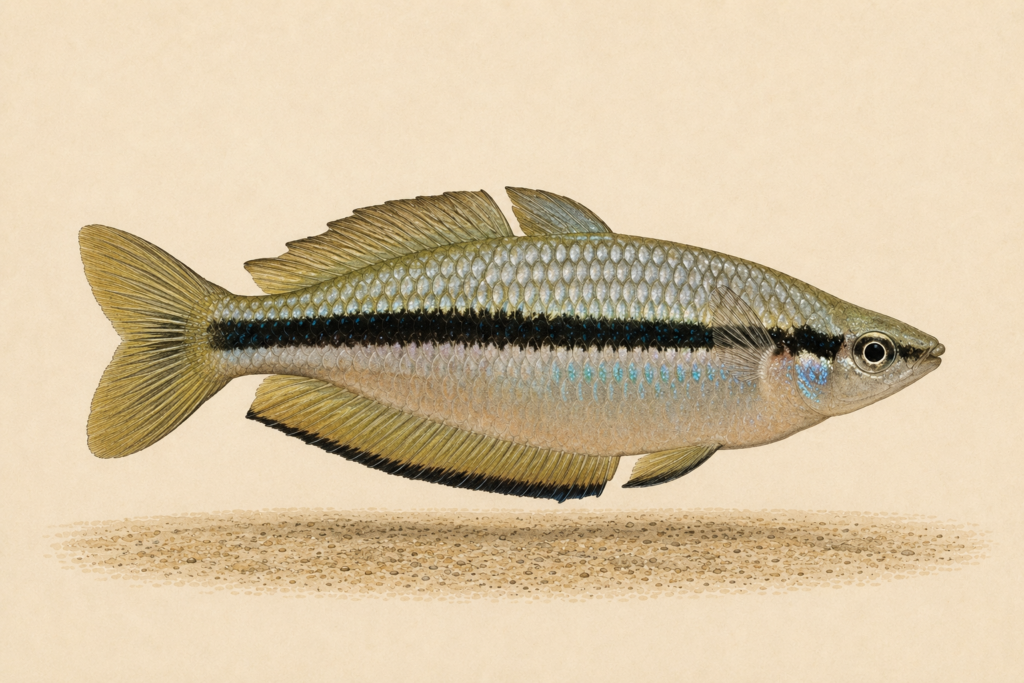
At first glance, the Black Banded Rainbowfish appears more subdued than many of the showpiece rainbowfish species popular in the hobby. Adult fish reach approximately 8 to 10 cm in total length, with males typically growing slightly larger and deeper-bodied than females. The body shape follows the classic Melanotaenia profile: laterally compressed, moderately deep, and torpedo-like, with a relatively small head and a forked caudal fin.
The defining feature is the dark mid-lateral band that runs horizontally from behind the gill cover to the base of the caudal fin. This band varies in intensity depending on the fish’s mood, condition, and the lighting in the aquarium, sometimes appearing as a bold, near-black stripe and at other times fading to a subtle dusky shadow. In dominant or displaying males, the band tends to be most pronounced, particularly during early-morning courtship displays.
The base body colour ranges from olive-green to silvery-gold, with a subtle iridescent sheen that catches the light as the fish moves. Scales along the upper half of the body often show fine dark edges, creating a delicate reticulated pattern. The fins are generally translucent to pale yellow, with males sometimes developing a deeper amber or orange tint in the dorsal and anal fins as they mature. A faint secondary stripe may be visible above or below the primary lateral band, particularly in well-conditioned specimens under good lighting.
Sexual dimorphism is moderate. Males are deeper-bodied, more intensely coloured, and develop slightly more elongated dorsal and anal fins compared to females. Females tend to be slimmer, paler, and lack the extended finnage. In a well-maintained shoal, the contrast between the sexes becomes apparent as the fish reach full maturity at around 12 to 18 months of age.
Coloration can vary noticeably between populations from different river systems across northern Australia. Some populations display a warmer, more golden-brown base, while others lean towards cooler olive or silvery tones. Hobbyists who source their fish from specialist breeders may encounter locality variants that, while all classified as M. nigrans, offer subtly different aesthetics.
Natural Habitat
Melanotaenia nigrans is one of the most geographically widespread rainbowfish on the Australian continent, found across the top end of the country from the Kimberley region of Western Australia through the Northern Territory and into the rivers and streams of far north Queensland. Its range encompasses a remarkable diversity of aquatic environments, which goes a long way towards explaining the species’ adaptability in captivity.
Typical habitats include clear, moderately flowing streams and creeks with sandy or rocky substrates, as well as slower-moving pools, billabongs, and the margins of larger rivers. Vegetation is often present in the form of submerged grasses, emergent reeds, and overhanging riparian plants that provide dappled shade. Water clarity varies seasonally – during the tropical dry season, streams may be crystal clear, while the wet season brings turbid, sediment-laden flows that temporarily transform the landscape.
Water temperatures in these habitats can fluctuate considerably. In the tropical dry season, daytime temperatures in shallow streams may exceed 30 C, while cooler periods – particularly overnight or during the early dry season – can see temperatures drop to the low twenties. The pH of these waters generally ranges from slightly acidic to mildly alkaline, depending on geology and seasonal conditions. Substrates are typically a mix of sand, gravel, and scattered rock, with patches of leaf litter and fallen timber providing additional cover.
In the wild, M. nigrans is a gregarious species found in loose shoals, often in the company of other small fish species. It occupies the mid-water column and tends to be most active in areas where gentle current meets calm eddies – a pattern worth replicating in the home aquarium. Predators include larger fish, freshwater turtles, and various bird species, so the fish’s natural instinct is to stay within the security of the group and near cover.
Tank Size and Setup
A minimum tank volume of 150 litres is recommended for a group of six Black Banded Rainbowfish. However, because this species is an active and enthusiastic swimmer, a longer tank is always preferable to a taller one. A standard 120 cm (four-foot) tank is ideal, providing the horizontal swimming space that allows the fish to display their natural shoaling behaviour. If you plan to keep a larger group – which is always encouraged, as it produces more natural behaviour and better colour from the males – consider 200 litres or more.
The aquascape should balance open swimming space with planted margins and areas of cover. Leave the centre and front of the tank relatively uncluttered so the shoal can cruise freely, and use taller stem plants, Vallisneria, or similar species along the sides and back to create a sense of security. Floating plants are a welcome addition, as they diffuse overhead light and replicate the dappled conditions found under riparian vegetation in the wild.
Substrate choice is flexible. Fine gravel or sand works well and provides a natural-looking base. If you intend to grow live plants, a nutrient-rich planted substrate or root tabs beneath a sand cap will support healthy growth. Driftwood and smooth river stones can be used to add visual interest and create micro-habitats, though these fish do not rely on caves or tight hiding spots the way many cichlids or catfish do.
Good water movement is appreciated. In the wild, M. nigrans frequents areas with gentle to moderate flow, so a filter output or a small powerhead positioned to create a gentle current across the length of the tank will encourage natural swimming behaviour. Avoid excessive turbulence, however, as prolonged exposure to very strong currents can stress the fish and reduce feeding efficiency.
A secure lid or cover slides are essential. Like most rainbowfish, M. nigrans can be an accomplished jumper, particularly when startled or during vigorous male displays. Even a small gap in the tank’s cover can provide an escape route for a determined fish. Ensure all openings around filter pipes and heater cables are adequately blocked.
Lighting should be moderate. Standard LED aquarium lighting is perfectly adequate, and if you are growing live plants, adjust the photoperiod to around 8 to 10 hours per day. The fish’s iridescent colours tend to show best under full-spectrum lighting that includes some blue and white channels, though they are not demanding in this regard.
Water Parameters
One of the great strengths of Melanotaenia nigrans as an aquarium species is its tolerance of a broad range of water conditions. This adaptability reflects the variable environments it encounters across its extensive natural range. Nevertheless, maintaining stable, clean water within the recommended parameters will promote the best health, colour, and longevity.
| Temperature | 22-30 C |
| pH | 6.0-8.0 |
| General hardness (GH) | 5-15 dGH |
| Carbonate hardness (KH) | 4-10 dKH |
| Ammonia | 0 ppm |
| Nitrite | 0 ppm |
| Nitrate | Below 30 ppm |
For everyday keeping, a temperature of around 24-26 C is a comfortable midpoint that suits both the fish and the majority of potential tank mates. The species tolerates higher temperatures well, which can be useful if you need to raise the heat temporarily to treat certain diseases, but prolonged exposure above 30 C is best avoided as it reduces dissolved oxygen levels and can stress the fish.
The pH sweet spot for most community setups falls between 6.5 and 7.5, though M. nigrans will happily live in mildly alkaline water up to pH 8.0. If your tap water is naturally hard and alkaline, this species is a far more forgiving choice than many soft-water-loving fish. Conversely, it also does well in slightly acidic conditions, making it compatible with a wide variety of community setups.
Regular water changes are essential. Aim for 25-30% weekly, using dechlorinated water matched to the tank’s temperature. Consistent water quality is more important than hitting a precise pH or hardness number – sudden swings in parameters are far more harmful than a reading that sits slightly outside the ideal range.
Test your water regularly, particularly during the first few months after setting up a new tank or adding new stock. A reliable liquid test kit for ammonia, nitrite, nitrate, and pH is a worthwhile investment and will help you catch problems before they escalate.
Filtration and Equipment
Effective filtration is the backbone of any successful rainbowfish aquarium. Because M. nigrans is an active, relatively messy eater that produces a moderate bioload, you should aim for a filter rated for at least the full volume of your tank, and ideally somewhat higher. For a 150-litre setup, a filter rated for 200 litres or more provides a comfortable margin.
External canister filters are an excellent choice for tanks of 150 litres and above. They offer generous media capacity for biological, mechanical, and chemical filtration, and the spray bar or lily pipe outlet can be positioned to create the gentle flow that this species enjoys. Internal power filters or hang-on-back filters are also suitable, particularly for smaller setups, though they may require more frequent maintenance to sustain adequate biological filtration.
Biological filtration media – such as ceramic rings, sintered glass, or bio balls – should make up the bulk of your filter media. Mechanical filtration (sponge or filter floss) traps particulate waste and should be rinsed in old tank water every few weeks to prevent clogging. Activated carbon can be used periodically to polish the water or remove medication residues but is not strictly necessary for day-to-day operation.
A quality heater with a thermostat is required to maintain a stable temperature, particularly in cooler climates or in homes where room temperature fluctuates. For a 150-litre tank, a heater in the 150-200 watt range is typically sufficient. Position it near the filter outlet to ensure even heat distribution. Consider a heater guard if you keep the fish with boisterous tank mates that might knock or damage the heater.
An air pump with an airstone is optional but beneficial, particularly in warmer months when dissolved oxygen levels naturally drop. Good surface agitation from the filter outlet usually provides adequate oxygenation, but an airstone adds a safety margin and many rainbowfish seem to enjoy swimming through the rising bubbles.
Diet and Feeding
Melanotaenia nigrans is an omnivore with a healthy appetite and a willingness to accept virtually any aquarium food offered. In the wild, its diet consists of small aquatic invertebrates, insect larvae, algae, and plant matter. Replicating this variety in captivity is straightforward and will reward you with better colour, condition, and breeding readiness.
A high-quality flake or micro-pellet food formulated for tropical or omnivorous fish should form the dietary staple. Look for products that list whole fish meal, spirulina, or similar ingredients high on the ingredients list, and avoid those padded out with excessive fillers. Feed a quantity that the fish can consume within two to three minutes, once or twice daily.
Supplement the staple diet with regular offerings of live or frozen foods. Daphnia, brine shrimp, bloodworm, mosquito larvae, and cyclops are all eagerly accepted and provide essential proteins and fats that support growth and reproductive health. Live foods, in particular, stimulate the fish’s natural foraging instincts and produce some of the most animated feeding behaviour you will see in the aquarium.
Vegetable matter should not be overlooked. Blanched spinach, spirulina flakes, or algae wafers broken into small pieces offer the plant-based component that rounds out a balanced diet. Some keepers also provide occasional small portions of blanched courgette or cucumber, which the fish will nibble at throughout the day.
Avoid overfeeding. Rainbowfish are enthusiastic eaters and will readily consume more than they need, which leads to obesity, poor water quality, and increased disease susceptibility. If uneaten food is accumulating on the substrate after feeding, reduce the quantity at the next meal. One fasting day per week is a practice many experienced keepers follow to keep their fish lean and healthy.
Behaviour and Temperament
The Black Banded Rainbowfish is a peaceful, active, and highly social species that thrives when kept in groups. A minimum group of six is essential, and larger groups of ten or more will produce far more natural and visually appealing behaviour. Solitary individuals or pairs kept in isolation tend to become shy, stressed, and pale – a stark contrast to the confident, colour-rich fish seen in a well-stocked shoal.
Within the group, males establish a loose social hierarchy through frequent, harmless display bouts. These displays are one of the highlights of keeping rainbowfish. Males intensify their colours, flare their fins, and swim alongside rivals in a shimmering parallel dance, often during the first hour or two after the lights come on in the morning. These interactions rarely escalate beyond posturing and are a sign of healthy social dynamics rather than aggression.
The species occupies the mid-water column for most of the day, cruising back and forth across the length of the tank in a characteristic undulating swimming pattern. It is an inquisitive fish that quickly learns to associate the keeper’s approach with feeding time and will come to the front of the tank in anticipation. Despite this boldness, it can be startled by sudden movements or loud noises, occasionally jumping – another reason to keep the tank securely covered.
Aggression towards other species is essentially non-existent. M. nigrans is one of the more gentle community fish available, posing no threat to similarly sized or smaller tank mates. The only caveat is that very small fry or tiny shrimp may be seen as food, but this is opportunistic predation rather than active hunting, and adult shrimp are generally left alone.
Keeping a balanced sex ratio helps distribute male display energy and prevents any single female from being harassed. A ratio of roughly two males to three females, or similar, works well in most community setups.
Tank Mates
Melanotaenia nigrans is one of the more accommodating community fish in the hobby, compatible with a wide range of peaceful to moderately active species. When selecting tank mates, prioritise fish that share similar water parameter preferences and temperament. Avoid anything large or aggressive enough to bully or eat the rainbowfish, and be cautious with extremely small or delicate species that might be outcompeted at feeding time by the rainbowfish’s enthusiastic appetite.
Good tank mates
- Crimson Spotted Rainbowfish – A fellow Australian rainbowfish with overlapping water parameter needs and a similarly peaceful temperament.
- Celebes Rainbowfish – A smaller, delicate rainbowfish that mixes well in a calm community with gentle water flow.
- Bristlenose Pleco – A peaceful bottom-dweller that occupies a different zone in the tank and helps manage algae.
- Corydoras sterbai – A hardy, sociable catfish that thrives in the same temperature range and adds activity to the lower levels.
- Cherry Barb – A peaceful, colourful barb that coexists happily without competing aggressively for food.
- Kuhli Loach – A shy, nocturnal bottom-dweller that stays out of the rainbowfish’s way and benefits from the same clean water conditions.
- Rummy Nose Tetra – A tight-schooling tetra that complements the rainbowfish’s mid-water activity with its own striking visual display.
- Amano Shrimp – Hardy enough to coexist with rainbowfish and an excellent algae-eating addition to a planted setup.
Fish to avoid
- Oscar – A large, predatory cichlid that will quickly outgrow and eat Black Banded Rainbowfish.
- Red Tail Black Shark – Territorial and aggressive, particularly towards mid-water swimmers, leading to stress and fin damage.
- Jaguar Cichlid – A highly aggressive predator entirely unsuitable for a peaceful community tank.
- Green Terror – An aggressive cichlid that will dominate the tank and attack smaller species.
- Tiger Barb – Notorious fin nippers that can harass rainbowfish, particularly during their display behaviour.
- African Cichlids (Mbuna) – Require very different water conditions and exhibit territorial aggression incompatible with peaceful rainbowfish.
Breeding
Breeding Melanotaenia nigrans in the home aquarium is achievable for hobbyists with a little patience and preparation. The species is an egg scatterer, depositing adhesive eggs among fine-leaved plants or synthetic spawning mops. While spontaneous spawning will often occur in a well-maintained community tank, raising the fry to a viable size requires a more deliberate approach.
Begin by conditioning a group of healthy adults with a diet rich in live and frozen foods for two to three weeks. This mimics the seasonal abundance of food that triggers breeding activity in the wild. Gradually increase the protein content of the diet, offering foods such as live daphnia, brine shrimp nauplii, and bloodworm alongside the regular staple.
Set up a separate breeding tank of around 40 to 60 litres, filled with water from the main tank and furnished with several spawning mops or dense clumps of fine-leaved plants such as Java Moss or Cabomba. A small sponge filter provides gentle filtration without endangering eggs or fry. Maintain the temperature at around 26-28 C and the pH between 7.0 and 7.5.
Introduce a well-conditioned pair or trio (one male, two females) to the breeding tank in the evening. Spawning typically occurs at first light, with the male displaying intensely beside the female before the pair dives into the spawning medium to release and fertilise a small batch of eggs. This process may repeat over several days, with a small number of eggs deposited each morning.
The eggs are small, roughly 1 mm in diameter, and have fine adhesive threads that anchor them to the spawning substrate. They are semi-transparent and can be difficult to spot among dense plant material. Incubation takes approximately 7 to 10 days at 26 C, depending on temperature. The newly hatched fry are tiny and require infusoria or commercially available liquid fry food for the first few days before graduating to freshly hatched brine shrimp nauplii.
Remove the adults after spawning is complete, as they will readily eat their own eggs and fry if given the opportunity. This is the single most common cause of failed breeding attempts. If you are using spawning mops, you can simply transfer the mops to a separate rearing container and leave the adults in the breeding tank to spawn again the following morning.
Fry growth is steady but not rapid. With regular small feeds several times a day and diligent water changes, the young fish should reach a recognisable rainbowfish shape within six to eight weeks. The characteristic lateral band typically becomes visible at around three to four months of age.
Common Diseases
Melanotaenia nigrans is a robust species that, under good husbandry, is not particularly susceptible to disease. Most health problems encountered in captivity are the result of poor water quality, inadequate diet, or the introduction of infected stock without proper quarantine procedures.
White spot disease (Ichthyophthirius multifiliis), commonly known as ich, is the most frequently encountered ailment across all freshwater aquarium fish, and rainbowfish are no exception. It presents as small white cysts on the body and fins, often accompanied by flashing (rubbing against surfaces) and clamped fins. Treatment involves gradually raising the temperature to 28-30 C and administering a copper-based or malachite green medication according to the manufacturer’s instructions. Caught early, ich is highly treatable.
Fin rot is another condition that may arise, particularly in tanks with elevated nitrate levels or where fin-nipping tank mates are present. Symptoms include fraying, discolouration, or erosion of the fin edges. Improving water quality through increased water changes is often sufficient to resolve mild cases, while more advanced infections may require antibacterial medication.
Rainbowfish can occasionally be affected by Mycobacterium infections, sometimes referred to as fish tuberculosis. This is a chronic, often fatal bacterial disease that causes wasting, spinal deformities, and lethargy. It is difficult to treat and can spread to other fish in the tank. Quarantining new arrivals for a minimum of two to four weeks before adding them to an established tank is the best preventative measure against this and many other diseases.
Internal parasites, while less common in captive-bred stock, can affect wild-caught or poorly maintained fish. Symptoms include weight loss despite a normal appetite, stringy white faeces, and a general decline in condition. Anti-parasitic foods or dedicated internal parasite treatments are available from aquarium suppliers.
Prevention is always preferable to cure. Maintaining stable water parameters, performing regular water changes, feeding a varied and nutritious diet, and avoiding overstocking will keep your Black Banded Rainbowfish in excellent health for the duration of their lifespan.
FAQs
How many Black Banded Rainbowfish should I keep together?
A minimum group of six is recommended, but eight to ten or more will produce far more natural shoaling behaviour, better colour from the males, and a more visually striking display overall. In groups smaller than six, individuals tend to become shy, stressed, and less active, which detracts from the species’ appeal and can lead to health problems over time.
Can Black Banded Rainbowfish live with shrimp?
Adult shrimp of a reasonable size, such as Amano Shrimp or adult Cherry Shrimp, are generally safe with M. nigrans. However, very small shrimp and shrimplets may be eaten opportunistically. If you are breeding shrimp in the same tank, provide dense plant cover or moss to give the young shrimp hiding spots. A dedicated shrimp-only tank is always the safest option for maximising shrimp survival.
Are Black Banded Rainbowfish jumpers?
Yes, like most rainbowfish, M. nigrans is capable of jumping, particularly when startled, during vigorous male displays, or when being chased. A well-fitting lid or cover slides are essential. Even small gaps around filter pipes or heater cables should be blocked, as a motivated rainbowfish can find surprisingly narrow escape routes.
Why are my Black Banded Rainbowfish pale and not showing their colours?
Pale coloration in rainbowfish is usually a sign of stress, poor diet, insufficient group size, or suboptimal water conditions. Ensure you are keeping them in a group of at least six, providing a varied diet that includes live or frozen foods, and maintaining clean water with regular changes. Adequate tank length, gentle current, and some planted cover also help the fish feel secure enough to display their full coloration. Males often look their best during morning display periods and may appear paler at other times of day, which is normal.
Do Black Banded Rainbowfish need a planted tank?
While a fully planted aquascape is not strictly necessary, live plants are highly beneficial and strongly recommended. Plants along the margins and back of the tank provide a sense of security, reduce stress, help maintain water quality by absorbing nitrates, and offer spawning sites for breeding fish. Floating plants are particularly useful for diffusing light and mimicking the natural habitat. The key requirement is to leave ample open swimming space in the centre of the tank so the shoal can move freely.
Related Guides
- Crimson Spotted Rainbowfish Care Guide – Another Australian native rainbowfish with similar care requirements, ideal for a biotope pairing.
- Boesemani Rainbowfish Care Guide – A larger, more colourful relative for keepers interested in exploring the wider Melanotaeniidae family.
- Dwarf Neon Rainbowfish Care Guide – A smaller rainbowfish species suited to nano and medium-sized planted tanks.
- Corydoras sterbai Care Guide – An excellent bottom-dwelling companion species that shares the same temperature preferences.
- Bristlenose Pleco Care Guide – A popular algae-eating catfish that pairs well with rainbowfish in community setups.