Quick Summary
The Blue Flash Glass Tetra reaches about 4.9 cm and is reported to swim in tight schools.
🐠 Build a tank around this species
In this guide:
- Introduction
- Quick Stats
- Appearance
- Natural Habitat
- Tank Size and Setup
- Water Parameters
- Filtration and Equipment
- Diet and Feeding
- Behaviour and Temperament
- Tank Mates
- Breeding
- Common Diseases
- FAQs
- Related Guides
Introduction
The Blue Flash Glass Tetra is a tropical freshwater fish from South America. The species was first described in 2000. Its conservation status is Least Concern, assessed in 2020. The importer and wholesaler Aquarium Glaser reported bringing it in from Venezuela for the first time.
Quick Stats
| Scientific name | Heterocharax virgulatus |
|---|---|
| Common names | Glass Tetra |
| Family | Acestrorhynchidae (formerly Characidae) |
| Origin | South America: Amazon and Orinoco River basins (Brazil, Colombia and Venezuela) |
| Adult size | 4.9 cm |
| Difficulty | Intermediate |
| Breeding difficulty | Unknown |
| Temperature | 23–27 °C |
| pH | 4.5–6.5 |
| GH | 2–8 dGH |
| Minimum tank size | 75 L |
| Conservation status | Least Concern (IUCN, assessed 2020) |
Appearance
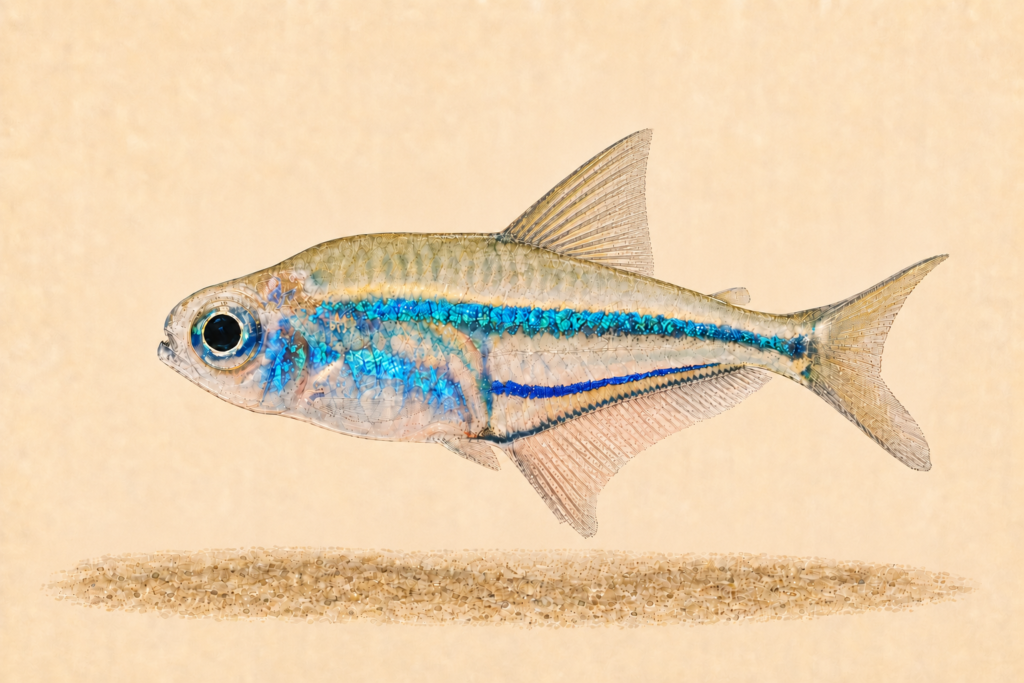
Aquarium Glaser describes the fish as about 4 cm long, with blue, green and violet colours that can disappear under a flashlight.
Natural Habitat
Records of the Blue Flash Glass Tetra come from the Amazon and Orinoco river basins in Brazil, Colombia and Venezuela. The type locality is the Río Negro where it meets the Río Urubaxi, in Amazonas, Brazil.
Tank Size and Setup
We recommend a tank of at least 75 litres. Aquarium Glaser reports that the fish settled into its tanks without problems.
Water Parameters
| Temperature | 23-27 C |
| pH | 4.5-6.5 |
| General hardness (GH) | 2-8 dGH |
| Ammonia | 0 ppm |
| Nitrite | 0 ppm |
| Nitrate | Below 20 ppm |
No published source yet gives water figures for the Blue Flash Glass Tetra; the values in the table are our current working guide.
Filtration and Equipment
We recommend a filter that turns the water over four to five times an hour for a tank of at least 75 litres, and a heater to hold the temperature within 23 to 27 degrees Celsius.
Diet and Feeding
We do not yet have reliable feeding information for the Blue Flash Glass Tetra.
Behaviour and Temperament
Aquarium Glaser reports that the fish stay bunched together as a school.
Tank Mates
Choosing tank mates for the Blue Flash Glass Tetra requires careful consideration of its small size, peaceful nature, and preference for soft, acidic water. Ideal companions are other small, non-aggressive species from similar blackwater habitats that will not outcompete Heterocharax virgulatus for food or harass it. Avoid anything large enough to eat it, anything territorial or aggressive, and anything that requires significantly different water parameters.
Good tank mates
- Cardinal Tetra – A classic blackwater companion that shares identical water chemistry requirements and is completely peaceful.
- Green Neon Tetra – Another small, soft-water tetra that thrives in the same dimly lit, acidic conditions.
- Ember Tetra – A tiny, gentle tetra that adds a warm colour contrast without posing any threat.
- Pygmy Corydoras – Peaceful bottom-dwelling catfish that occupy a different zone of the tank and enjoy soft water.
- Otocinclus – Gentle algae-eating catfish that coexist peacefully and appreciate similar water conditions.
- Chocolate Gourami – A soft-water labyrinth fish that is calm and slow-moving, making it an excellent mid-water companion.
- Apistogramma cacatuoides – A dwarf cichlid that shares the same biotope and is generally peaceful towards small tetras, provided the tank offers adequate space.
- Pencilfish (Nannostomus spp.) – Slender, peaceful surface-dwellers from similar blackwater habitats that complement the Blue Flash Glass Tetra beautifully.
Fish to avoid
- Oscar – A large, predatory cichlid that would quickly consume any Blue Flash Glass Tetra.
- Tiger Barb – An active, nippy species whose boisterous behaviour would stress and potentially injure these delicate tetras.
- Convict Cichlid – Aggressive and territorial, especially when breeding, and far too rough for this species.
- African Cichlids (Malawi/Tanganyikan) – Require hard, alkaline water that is entirely incompatible with Heterocharax virgulatus.
- Angelfish – Adults are large enough to eat small tetras, and they can be territorial in planted setups.
- Red Tail Shark – Territorial and aggressive towards small, passive fish sharing its lower and mid-water space.
- Common Pleco – Grows far too large for the tank sizes suitable for Blue Flash Glass Tetras and produces excessive waste.
Breeding
We do not yet have reliable breeding information for the Blue Flash Glass Tetra.
Common Diseases
White spot (ich) can turn up in any freshwater fish, especially when a fish is stressed or when a newly added fish brings it into the tank.
FAQs
How big does the Blue Flash Glass Tetra get?
Adults reach about 4.9 cm.
Where does the Blue Flash Glass Tetra come from?
The fish comes from the Amazon and Orinoco river basins, with records from Brazil, Colombia and Venezuela.
Is the Blue Flash Glass Tetra endangered?
The Blue Flash Glass Tetra is listed as Least Concern, with an assessment dated 2020.
Related Guides
- Cardinal Tetra Care Guide – A staple blackwater tetra that shares the same habitat requirements and makes an ideal companion species.
- Green Neon Tetra Care Guide – Another small, soft-water tetra with similar care needs and a complementary appearance.
- Apistogramma cacatuoides Care Guide – A popular dwarf cichlid from overlapping habitats that pairs well in a blackwater community tank.
- Pygmy Corydoras Care Guide – A tiny, peaceful catfish perfect for the bottom layer of a small soft-water community.
- Pencilfish (Nannostomus) Care Guide – Elegant surface-dwelling characins from similar South American blackwater environments.