Quick Summary
The Broken-Line Tetra is a peaceful, hardy and undemanding shoaling fish that makes an excellent choice for beginners and community aquariums alike. Keep them in groups of at least six in a well-planted tank and they will reward you with subtle beauty and lively behaviour.
🐠 Build a tank around this species
In this guide:
- Introduction
- Quick Stats
- Appearance
- Natural Habitat
- Tank Size and Setup
- Water Parameters
- Diet and Feeding
- Behaviour and Temperament
- Tank Mates
- Breeding
Introduction
The Broken-Line Tetra (Hemigrammus ulreyi) is a small, peaceful characin originating from the river systems of South America. Despite being less flashy than some of its more famous relatives, this tetra has earned a loyal following among community aquarium enthusiasts thanks to its easy-going temperament, attractive lateral stripe markings and remarkable hardiness. It is sometimes seen under the common name Ulrey’s Tetra in the trade, though Broken-Line Tetra remains the most widely used label.
First described by the ichthyologist George S. Myers in 1936, Hemigrammus ulreyi belongs to the large and diverse family Characidae, which includes hundreds of tetra species spread across Central and South America. Within the genus Hemigrammus, the Broken-Line Tetra sits alongside popular aquarium staples such as the Rummy-Nose Tetra and the Head-and-Taillight Tetra, sharing their general body plan and shoaling instincts but distinguished by its own unique patterning.
One of the great appeals of this species is its suitability for newcomers to the hobby. It tolerates a fairly wide range of water conditions, accepts virtually any commercially available fish food, and rarely causes problems with tank mates. At the same time, experienced aquarists appreciate its understated elegance when kept in larger groups in a planted aquarium. A shoal of Broken-Line Tetras drifting through a backdrop of green foliage is a quietly captivating sight that never gets old.
In this guide, we cover everything you need to know to keep Hemigrammus ulreyi healthy and thriving – from setting up their tank and dialling in water parameters to selecting compatible companions and encouraging breeding behaviour. Whether you are stocking your first community aquarium or looking for a reliable addition to an established set-up, the Broken-Line Tetra deserves your consideration.
Quick Stats
| Scientific name | Hemigrammus ulreyi |
|---|---|
| Common names | Ulrey's Tetra |
| Family | Acestrorhamphidae (formerly Characidae) |
| Origin | South America, Paraguay River basin (Brazil and Paraguay) |
| Adult size | 5 cm |
| Difficulty | Easy |
| Breeding difficulty | Moderate |
| Temperature | 23–27 °C |
| pH | 6–7 |
| GH | 5–12 dGH |
| Minimum tank size | 70 L |
| Conservation status | Least Concern (IUCN, assessed 2021) |
Appearance
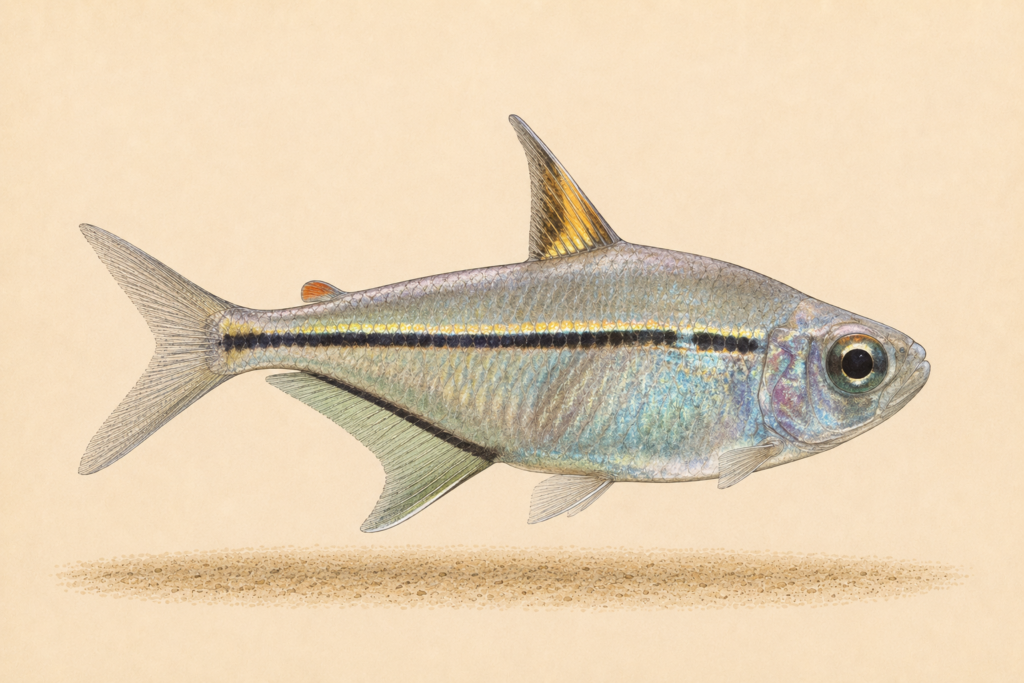
At first glance the Broken-Line Tetra may seem unremarkable compared to the vivid reds and blues of some other characins, but a closer look reveals a fish of quiet, refined beauty. The body is a typical elongated tetra shape – moderately compressed laterally and reaching a maximum length of around 5 cm in well-maintained aquarium conditions. The overall base colour is a soft silvery-olive that can shift from pale gold to greenish depending on lighting and background colour.
The defining feature is the dark lateral stripe that runs from behind the gill cover towards the caudal peduncle. Unlike the solid, unbroken stripe seen on species such as the Black Neon Tetra, this line is fragmented or “broken” – hence the common name. The stripe may appear as a series of dashes or as a line that fades and reappears along the flank. Above this broken line sits a thinner, iridescent gold or coppery stripe that catches the light beautifully when the fish swims at certain angles.
The fins are largely transparent to very faintly yellowish, with no bold markings. The caudal fin is forked and uncoloured or only lightly tinged. The eye is relatively large, typical of Hemigrammus species, with a reddish or orange upper iris that adds a subtle pop of colour to the face. Males tend to be slightly slimmer and can show marginally more intense iridescence along the lateral stripe, while females are fuller-bodied, particularly when carrying eggs. However, sexual dimorphism is modest and can be difficult to discern outside of breeding condition.
When kept in optimal conditions – soft, slightly acidic water, dark substrate and subdued lighting – the Broken-Line Tetra’s colours intensify noticeably. The gold lateral highlight becomes more vivid, and the overall body tone deepens. In a well-planted tank with a dark background, a shoal of these fish can look remarkably handsome despite their reputation as a “plain” tetra.
Natural Habitat
Hemigrammus ulreyi is native to the Paraguay River basin in South America, with populations documented in both Brazil and Paraguay. The Paraguay River and its tributaries flow through the Pantanal region, one of the world’s largest tropical wetlands, and it is in the quieter tributaries, flooded marginal zones and slow-moving backwaters of this vast system that the Broken-Line Tetra is most commonly found.
In the wild, these tetras inhabit waters that are typically warm, soft and slightly acidic to neutral. The riverbeds and floodplain waterways they favour tend to have sandy or muddy substrates, sometimes covered in a layer of leaf litter. Overhanging vegetation, submerged roots and fallen branches provide shelter and create dappled light conditions. The water itself can range from clear to lightly tannin-stained depending on the season and the amount of organic material present.
Seasonal flooding plays a significant role in the ecology of these fish. During the wet season, the Pantanal’s rivers overflow their banks and create vast, shallow flooded areas rich in invertebrate life and decomposing plant matter. Broken-Line Tetras take advantage of these temporary habitats to feed and breed. When waters recede in the dry season, the fish retreat to permanent streams and deeper pools.
Understanding this natural habitat helps aquarists replicate conditions that bring out the best in captive Broken-Line Tetras. Soft, slightly acidic water, gentle flow, subdued lighting and plenty of cover from plants and driftwood all echo the environment these fish have evolved to thrive in. While they are adaptable enough to tolerate a range of aquarium conditions, a set-up that mimics their wild habitat will reward you with more natural behaviour and the best colouration.
Tank Size and Setup
The Broken-Line Tetra is a small fish with modest space requirements, but as an active shoaling species it needs enough room to swim freely in a group. A minimum of 60 litres is recommended for a shoal of six to eight fish. If you plan to keep a larger group – which is always preferable for shoaling tetras – or wish to house them alongside other species in a community, aim for 80 litres or more. A standard 60 cm aquarium is an ideal starting point.
Tank dimensions matter as much as volume. These tetras spend most of their time in the middle water column, so a tank with a decent horizontal footprint is more useful than a tall, narrow design. A longer tank allows them to swim back and forth naturally and gives each fish in the group enough personal space to reduce any minor fin-nipping or squabbling.
For the substrate, fine sand or smooth gravel in a dark colour is ideal. A dark substrate not only looks attractive against the silvery-gold bodies of these tetras but also helps bring out their best colouration. Pale, bright substrates can wash out the fish’s tones and make them appear nervous.
Planting the tank generously is one of the best things you can do for Broken-Line Tetras. They appreciate the security of dense vegetation along the sides and back of the aquarium, with open swimming space left in the centre and front. Hardy, low-maintenance plants such as Java Fern, Anubias, Cryptocoryne species and Vallisneria all work well and are in keeping with the South American biotope aesthetic. Floating plants like Amazon Frogbit or Water Lettuce are an excellent addition because they diffuse overhead light and create the dappled, shaded conditions these fish prefer.
Driftwood and bogwood are valuable for both aesthetics and function. They release tannins into the water, gently lowering pH and staining it a light amber – conditions that mirror the Broken-Line Tetra’s natural habitat. Dried Indian Almond leaves (Catappa leaves) placed on the substrate serve the same purpose and provide surfaces for beneficial biofilm to grow, which fry and shrimp can graze on.
Lighting should be moderate to subdued. If you are growing live plants that need stronger light, ensure there are shaded areas created by floating plants or tall stem plants. Overly bright, unshaded lighting can make these tetras skittish and washed out in appearance.
A secure lid is advisable. Like many small tetras, Broken-Line Tetras are capable of jumping, particularly if startled or during the initial settling-in period after being added to a new tank.
Water Parameters
One of the Broken-Line Tetra’s greatest assets is its adaptability. While it has preferences rooted in the soft, slightly acidic waters of its native habitat, it will tolerate a reasonably broad range of conditions as long as they remain stable. Sudden swings in temperature, pH or hardness are far more dangerous than keeping the fish at slightly sub-optimal but consistent values.
| Temperature | 23-27 C |
| pH | 6.0-7.0 |
| General hardness (GH) | 5-12 dGH |
| Ammonia | 0 ppm |
| Nitrite | 0 ppm |
| Nitrate | Below 20 ppm |
For the best colour and long-term health, aim for the softer, slightly acidic end of the ranges above – a pH of around 6.5-7.0 and a GH of 4-8 dGH is the sweet spot for most hobbyists. Temperature around 25-26 C is a comfortable middle ground that also suits the majority of tropical community tank mates.
Ammonia and nitrite must always read zero in a cycled aquarium. Even brief spikes of either compound can cause gill damage and stress-related disease in small tetras. Nitrate should be kept below 20 ppm through regular partial water changes – a 25-30% water change weekly is a good baseline schedule. If your tank is heavily stocked or you notice nitrate creeping above 20 ppm, increase the frequency or volume of changes accordingly.
Invest in a reliable liquid test kit so you can monitor these parameters regularly. Strip tests can give a rough indication but are often less accurate. Testing weekly, especially during the first few months of a new set-up, will help you catch any issues before they escalate.
Filtration and Equipment
The Broken-Line Tetra does not require any exotic or specialised equipment. A standard internal filter or hang-on-back filter rated for your tank’s volume will provide adequate mechanical and biological filtration. Canister filters are an excellent choice for larger set-ups and offer superior biological capacity, but they are by no means essential for a small tetra community.
Flow rate is worth paying attention to. In the wild, Broken-Line Tetras inhabit slow-moving or still waters, and they are not strong swimmers built for battling currents. If your filter produces a strong outflow, use a spray bar, baffle or lily pipe to diffuse the flow and create calmer conditions in the main swimming area. A gentle turnover of approximately four to six times the tank volume per hour is sufficient.
A reliable aquarium heater with a thermostat is essential unless you live in a consistently warm climate. Choose a heater rated for your tank size and set it to around 25-26 C. Placing the heater near the filter outflow helps distribute warmth evenly throughout the aquarium. A separate thermometer – either a digital probe or a simple glass stick-on type – allows you to verify the heater’s accuracy.
Lighting requirements are modest. If you are growing live plants, a standard LED aquarium light on a timer set for 8-10 hours per day will support healthy plant growth without stressing the fish. If you have no live plants, even a basic low-intensity light will suffice. The key is to avoid harsh, unshaded lighting that makes the fish feel exposed.
An air stone connected to a small air pump can be a useful addition, particularly in warmer weather when dissolved oxygen levels drop. However, it is not strictly necessary in a well-filtered, moderately stocked tank with live plants that produce oxygen during the photoperiod.
Diet and Feeding
Feeding the Broken-Line Tetra is refreshingly straightforward. This species is an omnivore with an unfussy appetite that will accept virtually any appropriately sized aquarium food. In the wild, its diet consists of small invertebrates, insect larvae, tiny crustaceans, algae and organic detritus – a varied menu that is easy to replicate in captivity.
A high-quality micro-pellet or flake food designed for tropical fish should form the staple of the diet. Look for products with whole fish or insect meal listed as the first ingredient rather than fillers like wheat or soy. Feeding a small pinch once or twice daily is sufficient – offer only as much as the fish can consume within two to three minutes. Overfeeding is one of the most common mistakes in fish keeping and leads to water quality problems far more quickly than underfeeding.
Supplement the staple diet with regular offerings of frozen or live foods. Baby brine shrimp, daphnia, cyclops, micro-worms and bloodworms are all eagerly accepted and provide essential nutrients that dry foods alone cannot fully deliver. Frozen foods are widely available, convenient to store and carry a lower risk of introducing parasites than live cultures sourced from the wild. Aim to offer these treats two to three times per week.
Blanched vegetable matter – tiny pieces of courgette, spinach or cucumber – can be offered occasionally, though most Broken-Line Tetras get sufficient plant-based nutrition from high-quality flakes that already contain spirulina or similar algae ingredients.
Variety is the key to a balanced diet. Rotating between two or three different dry foods and supplementing with frozen or live prey ensures the fish receive a full spectrum of vitamins, minerals, proteins and fats. Well-fed Broken-Line Tetras display better colour, stronger immune responses and are more likely to enter breeding condition.
Behaviour and Temperament
The Broken-Line Tetra is a quintessential peaceful community fish. It spends the majority of its time in the mid-water column, gently swimming in loose formation with its shoal mates. When feeling secure, the group often spreads out across the tank, with individuals drifting apart and reuniting in a relaxed, natural rhythm. When startled or in the presence of a perceived threat, the shoal tightens dramatically and the fish may dart into plant cover.
Keeping a minimum group of six is essential. Broken-Line Tetras kept in smaller numbers or alone become visibly stressed, often hiding, losing colour and sometimes developing nipping behaviours directed at other fish. In a group of six or more, these problems largely disappear. Larger groups of ten to fifteen or more produce the most impressive displays and the most confident, well-coloured individuals.
Aggression is virtually unheard of in this species. Males may occasionally engage in brief, harmless sparring displays – flaring fins and circling one another – particularly in the presence of females. These interactions are normal social behaviour and never result in injury. There is no territorial aggression towards other species.
Broken-Line Tetras are active during daylight hours and tend to settle into quieter areas of the tank when the lights go off. They are not nocturnal and do not require special night-time provisions. Their activity level is moderate – livelier than a Pencilfish but calmer than a Danio – making them a pleasant, non-disruptive addition to a community set-up.
One behaviour worth noting is their tendency to be initially shy when first introduced to a new aquarium. They may hide behind plants and decor for the first few days, especially if the tank is brightly lit or sparsely decorated. Patience, subdued lighting and the presence of dither fish that are already swimming confidently in the open can help new arrivals settle in more quickly.
Tank Mates
Choosing companions for the Broken-Line Tetra is one of the easier tasks in fish keeping. Their gentle temperament and preference for the mid-water column make them compatible with a vast range of similarly peaceful tropical species. The main considerations are to avoid anything large enough to eat them, anything aggressive or territorial enough to bully them, and anything that requires drastically different water conditions.
Good tank mates
- Neon Tetra – A classic companion; similar size, temperament and water requirements make these two an ideal pairing.
- Ember Tetra – Tiny and completely non-aggressive, Ember Tetras add a warm splash of colour without any compatibility concerns.
- Rummy-Nose Tetra – A fellow Hemigrammus species that shares identical care needs and creates a striking multi-species shoaling display.
- Panda Corydoras – Peaceful bottom-dwellers that occupy a different zone of the tank and help clean up uneaten food.
- Otocinclus – Gentle algae grazers that stay small and pose no threat whatsoever to tetras.
- Harlequin Rasbora – Another calm, similarly sized shoaling species that coexists beautifully with small tetras.
- Honey Gourami – A mild-mannered surface dweller that adds variety without introducing aggression.
- Cherry Shrimp – Adult shrimp are safe with Broken-Line Tetras; the fish may eat very young shrimplets but generally coexist well in a planted tank.
- Kuhli Loach – A quirky, nocturnal bottom-dweller that is entirely peaceful and occupies the substrate level the tetras ignore.
Fish to avoid
- Oscar – Far too large and predatory; Broken-Line Tetras would be seen as food.
- Tiger Barb – Notorious fin nippers that can relentlessly harass slower, gentler tetras.
- Convict Cichlid – Highly territorial, especially when breeding, and will bully or kill small tetras.
- Red-Tail Catfish – Grows enormous and is a voracious predator of small fish.
- Jaguar Cichlid – An aggressive, large cichlid that is wholly incompatible with any small tetra.
- Betta – While sometimes kept with tetras, the Betta’s flowing fins and territorial tendencies can lead to stress for both parties; best avoided in smaller tanks.
Breeding
Breeding the Broken-Line Tetra in captivity is achievable but requires a degree of preparation and attention to detail. Like most Hemigrammus species, they are egg scatterers that offer no parental care, and the adults will readily eat their own eggs and fry if given the opportunity.
To encourage spawning, set up a separate breeding tank of approximately 20-30 litres. Keep the water soft (GH 2-5 dGH), slightly acidic (pH 6.0-6.5) and warm (26-28 C). Use a sponge filter set to a very gentle flow to avoid sucking up eggs or fry. The tank should be dimly lit, as eggs and young fry are sensitive to strong light.
Cover the bottom of the breeding tank with a layer of fine-leaved plants such as Java Moss or spawning mops. These give the eggs somewhere to fall and lodge, making it harder for the adults to find and consume them. Alternatively, a mesh or grid placed above the substrate can serve the same purpose – eggs fall through the mesh while the parents are kept above it.
Condition a pair or a small group (two males and three females works well) with frequent feedings of high-quality live or frozen foods for one to two weeks before introducing them to the breeding tank. Females in breeding condition will appear noticeably plumper around the belly. Males will show more intense coloration and become more active in displaying to females.
Spawning usually occurs in the early morning. The male courts the female with rapid darting and fin-flaring displays, and the pair eventually aligns side by side among the plants. The female releases a batch of small, adhesive or semi-adhesive eggs while the male fertilises them. A typical spawn can number anywhere from 50 to over 200 eggs, though smaller spawns are common with less experienced pairs.
Remove the adults immediately after spawning to prevent egg predation. The eggs are tiny and translucent, hatching in approximately 24-36 hours depending on temperature. The resulting fry are extremely small and will absorb their yolk sacs over the next two to three days before becoming free-swimming.
First foods for the fry should be infusoria or a commercial liquid fry food. After a week or so, they can graduate to freshly hatched baby brine shrimp (Artemia nauplii) and micro-worms. Growth is steady but not rapid – expect the fry to take several months to reach a size where they can be safely introduced to a community tank.
Keep the breeding and rearing tank scrupulously clean with small, daily water changes using water of the same temperature and chemistry. Fry are highly sensitive to poor water quality, and even low levels of ammonia or nitrite can be fatal at this stage.
Common Diseases
The Broken-Line Tetra is a hardy species that is not especially prone to any unique diseases. However, like all aquarium fish, it can be affected by the common ailments that arise from suboptimal water quality, stress or the introduction of pathogens from new fish or live food.
Ich (White Spot Disease) is perhaps the most frequently encountered problem. It presents as tiny white spots covering the body and fins, accompanied by flashing (rubbing against objects) and lethargy. Ich is usually triggered by temperature fluctuations or the introduction of infected fish. Treatment involves gradually raising the temperature to 28-30 C and dosing with a proprietary ich medication containing malachite green or formalin. Caught early, ich is very treatable.
Fin rot is another condition that can affect Broken-Line Tetras, particularly in tanks with poor water quality. The edges of the fins become ragged, discoloured and progressively erode. Improving water quality through more frequent water changes is the first and most important step. Antibacterial medications may be needed in severe cases.
Neon Tetra Disease (Pleistophora hyphessobryconis) can occasionally affect Hemigrammus species despite its misleading name. Symptoms include loss of colour, a faded or white patch beneath the skin, erratic swimming and wasting. Unfortunately, there is no reliable cure, and affected fish should be isolated to prevent the spread of spores to other tank mates. Quarantining new fish for two to three weeks before adding them to the main tank is the best preventive measure.
Internal parasites and bacterial infections can occur but are relatively uncommon in well-maintained aquariums. Signs to watch for include bloating, stringy white faeces, loss of appetite and lethargy. A broad-spectrum anti-parasitic or antibacterial treatment, combined with improved husbandry, usually resolves these issues.
Prevention is always better than cure. Maintaining stable, clean water; avoiding overfeeding; quarantining new arrivals; and sourcing fish from reputable suppliers are the most effective ways to keep your Broken-Line Tetras healthy throughout their lives.
FAQs
How many Broken-Line Tetras should I keep together?
A minimum group of six is strongly recommended, but eight to ten or more is preferable. Larger groups result in more confident, less skittish fish that display their natural shoaling behaviour and colouration to the fullest. Keeping fewer than six often leads to stress, hiding and potential nipping issues.
Can I keep Broken-Line Tetras in a planted tank?
Absolutely – in fact, a planted tank is the ideal environment for this species. They do not eat or uproot live plants and benefit enormously from the cover, shade and natural water-quality support that healthy plant growth provides. Java Fern, Anubias, Cryptocoryne and floating plants are all excellent choices.
Are Broken-Line Tetras suitable for a beginner?
Yes. Their hardiness, tolerance of a range of water conditions, peaceful nature and unfussy appetite make them one of the easier tetra species to care for. As long as the aquarium is fully cycled before they are introduced and basic maintenance is kept up, beginners should have no trouble with this species.
Do Broken-Line Tetras nip fins?
Fin nipping is not a characteristic behaviour of this species when kept in appropriate group sizes. Isolated individuals or pairs may occasionally nip at slow-moving or long-finned tank mates out of stress, but this behaviour is rare in a well-stocked shoal of six or more. Providing plenty of swimming space and plant cover further reduces any risk.
What is the difference between the Broken-Line Tetra and similar Hemigrammus species?
The most distinguishing feature is the broken or fragmented dark lateral stripe that gives the fish its common name. The closely related Head-and-Taillight Tetra (Hemigrammus ocellifer) has a solid lateral stripe and distinctive reflective spots near the eye and tail base, while the Rummy-Nose Tetra (Hemigrammus rhodostomus/bleheri) is easily identified by its vivid red face. Body shape and general care requirements are very similar across these species, but their markings make identification straightforward once you know what to look for.
Related Guides
- Rummy-Nose Tetra Care Guide – A closely related Hemigrammus species with similar care needs and excellent community compatibility.
- Head-and-Taillight Tetra Care Guide – Another Hemigrammus tetra that makes a fine companion and shares almost identical requirements.
- Neon Tetra Care Guide – The most popular small tetra in the hobby, often kept alongside Broken-Line Tetras in community set-ups.
- Panda Corydoras Care Guide – A peaceful bottom-dwelling catfish that pairs beautifully with mid-water shoaling tetras.
- Ember Tetra Care Guide – A tiny, undemanding tetra ideal for nano and community tanks alongside other gentle species.