Quick summary
The Black Moor is one of the hardiest fancy goldfish varieties, making it a good choice for beginners moving beyond common goldfish, though its protruding eyes and poor vision mean you’ll need a spacious tank (115+ litres) with smooth substrate, hazard-free decor, gentle water flow, and slow-moving tank mates. It’s easy to care for overall, but not a fish for a small bowl or a busy community tank with fast or nippy species.
🐠 Build a tank around this species
In this guide:
- Introduction
- Quick Stats
- Appearance
- Varieties and Morphs
- Natural Habitat
- Tank Size and Setup
- Water Parameters
- Filtration and Equipment
- Diet and Feeding
- Behaviour and Temperament
- Tank Mates
- Breeding
- Common Diseases
- FAQs
Introduction
The Black Moor is one of the most instantly recognisable and beloved fancy goldfish varieties in the fishkeeping hobby. With its velvety black colouration, dramatically protruding telescope eyes, and flowing finnage, this charming fish has captivated aquarists for centuries. Originating from selective breeding programmes in China during the early 1700s, the Black Moor, sometimes known as the Dragon Eye or Black Telescope, has become a staple of the fancy goldfish world and remains one of the most popular choices for keepers looking to move beyond the common goldfish.
Despite its exotic appearance, the Black Moor is widely considered one of the hardiest fancy goldfish varieties, making it an excellent entry point for those new to keeping telescope-eyed or round-bodied goldfish. Its peaceful disposition, manageable care requirements, and endearing personality make it a rewarding fish to keep, though prospective owners should be aware that its protruding eyes and limited vision do require some specific accommodations in the aquarium. This guide covers everything you need to know to provide the best possible care for your Black Moor, from tank setup and water parameters to diet, breeding, and disease prevention.
Quick Stats
| Scientific name | Carassius auratus |
|---|---|
| Common names | Black Telescope, Dragon Eye Goldfish, Black Demekin, Black Peony Goldfish |
| Family | Cyprinidae |
| Origin | China (captive-bred variety), wild ancestor from East Asia |
| Adult size | 20 cm |
| Lifespan | 10–15 years |
| Difficulty | Easy |
| Breeding difficulty | Moderate |
| Temperature | 18–24 °C |
| pH | 6.5–7.5 |
| GH | 5–19 dGH |
| KH | 4–12 dKH |
| Minimum tank size | 115 L |
| Conservation status | Least Concern (IUCN) |
Appearance
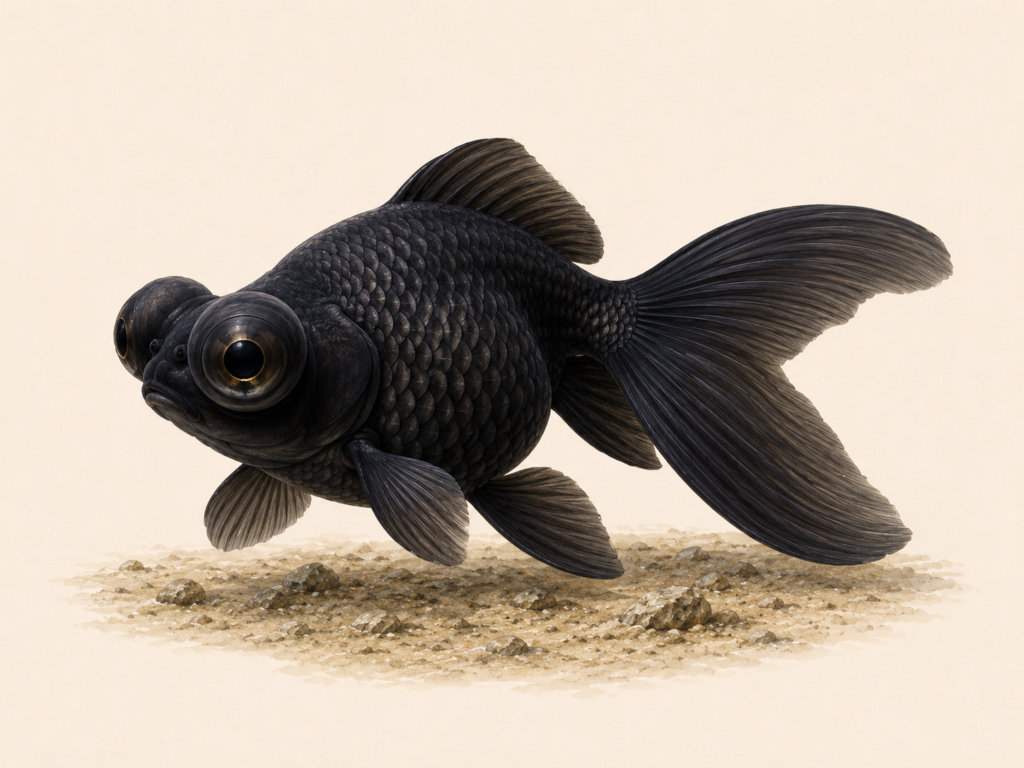
The Black Moor’s most defining feature is undoubtedly its deep, velvety black colouration, which covers the entire body, fins, and eyes. High-quality specimens display a rich, uniform black that extends across every surface with no patches of bronze, orange, or silver. The body shape is rounded and egg-like, typical of the fancy goldfish lineage, with a noticeably deep, compressed profile when viewed from the side. Adults typically reach 15 to 20 centimetres in total length, though some well-kept individuals can grow slightly larger.
The second hallmark of the variety is the protruding telescope eyes. These large, bulbous eyes extend outward from the head on short stalks and begin to develop their characteristic protrusion when the fish is around six to eight weeks old, becoming increasingly prominent as the fish matures. The degree of eye protrusion varies between individuals, with show-quality specimens displaying symmetrical, well-developed telescoping on both sides.
The finnage of the Black Moor is long, flowing, and somewhat delicate. The breed features a double anal fin and a long, forked caudal (tail) fin that drapes elegantly as the fish swims. Some specimens are bred with broadtail or butterfly-tail configurations, in which the caudal fin spreads wide when viewed from above, resembling butterfly wings. The dorsal fin is tall and upright, while the paired pectoral and pelvic fins are elongated and graceful. When healthy and well-maintained, the overall impression is one of dark, billowing elegance moving through the water.
It is worth noting that the intense black colouration can be somewhat unstable over a fish’s lifetime. As Black Moors age, particularly in warmer water, their colouration may gradually shift toward a dark bronze or even develop patches of orange and gold. This is a natural process and does not indicate poor health, though maintaining cooler water temperatures within the recommended range can help preserve the deep black pigmentation for longer.
Varieties and Morphs
While the Black Moor is itself a specific colour morph of the telescope-eyed goldfish, several related varieties and sub-types are commonly encountered in the trade. Understanding the differences can help you identify exactly what you are purchasing and set appropriate care expectations.
The standard Black Moor is the most widely available form, featuring a deep black body, flowing fins, and well-developed telescope eyes. This is the classic variety that most aquarists will encounter at their local fish shop. The Broadtail Black Moor is a particularly sought-after variation in which the caudal fin is extremely wide and fan-shaped, creating an impressive display when viewed from behind. The Butterfly Tail Black Moor takes this further, with a caudal fin that, when viewed from directly above, splays out horizontally in a distinctive butterfly wing pattern, and this variant is especially prized among show enthusiasts.
The Panda Moor, sometimes sold as a Panda Telescope, features striking black-and-white colouration rather than solid black. Typically, the body is predominantly white with black patches around the eyes and on the fins, giving the fish a panda-like appearance. It is important to note, however, that Panda Moors are somewhat colour-unstable and may shift toward mostly white or mostly orange over time. The Tri-colour Telescope is closely related and displays a patchwork of black, orange, and white across the body and fins, though it is not always marketed specifically as a Moor variant.
The Red Telescope and Orange Telescope share the same body shape and eye structure as the Black Moor but lack the melanin-heavy colouration, displaying instead vibrant reds or oranges. While technically not Black Moors, they are often sold alongside them and require identical care. The Calico Telescope is another common relative, featuring a nacreous (semi-transparent) scale type with speckled patches of red, black, blue, and white, a visually striking fish that pairs well with Black Moors in a display tank.
The Short-tail Black Moor is an occasionally encountered variant bred for a more compact, rounded tail rather than the traditional long flowing fins. This variant can be somewhat more manoeuvrable in the water due to reduced fin drag. Finally, some breeders produce Black Moors with particularly prominent eye development, sometimes referred to as Globe Eye or Dragon Eye specimens, where the telescoping is exceptionally pronounced. These fish require especially careful attention to avoid eye injuries in the aquarium.
Natural Habitat
The Black Moor, like all fancy goldfish, is an entirely captive-bred variety and does not exist in the wild. Its ancestor, the wild form of Carassius auratus, is native to the slow-moving rivers, lakes, ponds, and marshes of East Asia, particularly across China, Korea, and parts of Japan. These natural habitats are characterised by gentle currents, heavily vegetated margins, silty or muddy substrates, and relatively still or sluggish water.
Wild goldfish thrive in temperate climates, experiencing seasonal temperature fluctuations that range from near-freezing winters to warm summers. The waters they inhabit tend to be slightly alkaline to neutral, with moderate hardness, and are often turbid or rich in organic matter. This background helps explain why fancy goldfish like the Black Moor are adaptable to a wide range of water conditions but perform best in cooler, well-oxygenated water with modest flow.
Selective breeding of goldfish in China began over a thousand years ago, with the Black Moor variety emerging during the early Qing Dynasty around the 1700s. Breeders selected for the telescope eye trait and dark colouration independently before combining them into the variety we know today. The breed was subsequently refined in Japan, where it is known as the Demekin, and has since become established worldwide. Understanding this domesticated heritage is crucial, as the Black Moor’s rounded body, protruding eyes, and long fins make it entirely unsuited to survival outside of a well-maintained aquarium or pond environment.
Tank Size and Setup
A single Black Moor requires a minimum tank volume of 115 litres, with an additional 40 to 55 litres recommended for each additional goldfish. While this may seem generous for a fish that typically reaches 15 to 20 centimetres, fancy goldfish produce a significant bioload relative to their size, and the extra water volume provides critical dilution of waste products and greater stability in water parameters. A larger tank also provides the swimming space that these fish need to stay healthy and reduces the risk of stunting or chronic stress.
Tank shape matters considerably when keeping Black Moors. A long, wide aquarium is far preferable to a tall, narrow one, as the greater surface area promotes gas exchange and provides more horizontal swimming space. Avoid traditional goldfish bowls entirely, they are wholly inadequate for any goldfish, let alone a telescope-eyed variety that requires room to navigate safely. A standard rectangular aquarium of 90 centimetres or more in length is an ideal starting point for a small group.
When setting up the aquarium, the primary consideration should be protecting the Black Moor’s vulnerable eyes. The substrate should be smooth sand or fine, rounded gravel with no sharp edges. Avoid rough rocks, jagged driftwood, or any décor with pointed protrusions that could scratch or puncture the fish’s protruding eyes. If you wish to include live plants, choose robust species such as Anubias, Java fern, or Vallisneria, which can tolerate the cooler temperatures goldfish prefer and will withstand occasional nibbling. Silk or soft artificial plants can also work well, but steer clear of hard plastic plants with stiff, pointed leaves.
Open swimming space should take priority in the aquascape. Black Moors are not the most agile swimmers due to their round bodies and long fins, and their telescope eyes can impair their depth perception and peripheral vision. A layout with décor arranged around the tank’s perimeter, leaving a generous central swimming area, is ideal. Ensure that there are no tight gaps or narrow passages where a fish could become trapped or injure itself.
A secure, well-fitting lid is advisable. While Black Moors are not habitual jumpers, goldfish can occasionally leap, particularly during feeding time or if startled, and the protection of a lid also reduces evaporation and prevents foreign objects from entering the tank.
Water Parameters
Black Moors are adaptable fish, but they thrive when water parameters are kept within consistent, appropriate ranges. As temperate fish, they do not require a heater in most indoor settings, but one can be useful for maintaining stability if your home experiences significant temperature swings.
| Temperature | 18–24 °C |
| pH | 6.5–7.5 |
| General hardness (GH) | 5–19 dGH |
| Carbonate hardness (KH) | 4–12 dKH |
| Ammonia | 0 ppm |
| Nitrite | 0 ppm |
| Nitrate | Below 20 ppm |
Consistency is arguably more important than hitting a specific number within these ranges. Sudden fluctuations in temperature or pH can stress goldfish and leave them vulnerable to disease. Regular weekly water changes of 25 to 30 per cent are essential for keeping nitrate levels low and maintaining overall water quality. Always treat replacement water with a dechlorinator before adding it to the tank, and try to match the temperature of the new water to that of the aquarium to avoid thermal shock.
Investing in a reliable liquid test kit rather than relying on test strips will give you more accurate readings and help you catch water quality problems before they become serious. Pay particular attention to ammonia and nitrite levels, both of which should always read zero in an established, properly cycled aquarium.
Filtration and Equipment
Robust filtration is non-negotiable for any goldfish aquarium. Black Moors, like all goldfish, are prodigious waste producers, and their health depends on a filtration system that can handle the substantial bioload they generate. A filter rated for at least one and a half times the actual volume of your aquarium is a good baseline. Many experienced goldfish keepers opt for even more powerful filtration or run two filters simultaneously for redundancy.
Canister filters are an excellent choice for goldfish tanks, offering large media capacities and excellent mechanical, biological, and chemical filtration in a single unit. Hang-on-back filters can also work well for smaller setups, particularly higher-capacity models. Sponge filters, while gentler, are generally best used as supplementary filtration rather than the sole filter in a goldfish tank, as they may struggle to keep up with the waste output of multiple fish.
One critical consideration is water flow. Black Moors are poor swimmers compared to their slim-bodied cousins, and their long, flowing fins create considerable drag. Excessively strong currents will exhaust them and cause chronic stress. Choose a filter with an adjustable flow rate, or use a spray bar or baffle to diffuse the outlet and create a gentler current. You should observe your fish after setting up the filter, if they appear to be struggling against the flow or are being pushed around the tank, the current needs to be reduced.
An air pump with an airstone or sponge filter can provide additional oxygenation, which is beneficial given that goldfish have relatively high oxygen demands. Lighting should be moderate. Standard LED aquarium lights work well and will support live plant growth if needed, but avoid excessively bright lighting, as Black Moors may find it uncomfortable given their prominent, light-sensitive eyes. A timer set for eight to ten hours of light per day will provide a natural photoperiod and help prevent excessive algae growth.
A thermometer is essential for monitoring temperature, and if your home tends to be cold or experiences variable temperatures, a submersible aquarium heater set to around 20 °C can prevent harmful temperature drops. This is particularly relevant during winter months in unheated rooms.
Diet and Feeding
Black Moors are omnivorous and unfussy eaters, which makes feeding them relatively straightforward. However, their round body shape makes them somewhat prone to buoyancy disorders linked to diet, so a little care in food selection goes a long way toward keeping them healthy.
A high-quality sinking pellet or gel food designed specifically for fancy goldfish should form the staple of the diet. Sinking foods are preferable to floating flakes or pellets because Black Moors can gulp air at the surface when feeding, which can contribute to swim bladder problems. If you do use floating foods, pre-soaking them for a minute or two before offering them helps them sink more quickly and reduces air ingestion.
Supplement the staple diet with blanched vegetables such as shelled peas (an excellent source of fibre that aids digestion), spinach, courgette, and cucumber. Peas in particular are often recommended as a regular addition, offering them two to three times per week can help prevent constipation, which is a common issue in fancy goldfish. Protein-rich treats such as bloodworms, brine shrimp, and daphnia can be offered once or twice a week, either frozen or freeze-dried, and are enthusiastically received.
Feed small portions two to three times daily, offering only as much as the fish can consume within two to three minutes. Overfeeding is one of the most common mistakes in goldfish keeping and contributes to poor water quality, obesity, and digestive problems. Remember that Black Moors have relatively poor eyesight, so they may be slower to find food than other fish. Feeding in the same location each time and using food that sinks to an accessible area of the tank will help ensure they get their fair share, particularly in a community setting.
Behaviour and Temperament
The Black Moor is a gentle, peaceable fish with an endearing, somewhat clumsy personality. These are social animals that clearly benefit from the company of their own kind or other compatible fancy goldfish, and keeping them in groups of two or more is strongly recommended. Solitary Black Moors can become lethargic and withdrawn, while those kept with companions tend to be more active and display a wider range of natural behaviours.
Their swimming style is leisurely and somewhat ungainly, a consequence of their egg-shaped body and voluminous fins. They tend to cruise around the middle and lower levels of the aquarium at a relaxed pace, occasionally investigating the substrate for morsels of food. Their poor eyesight means they navigate partly by feel, and you may notice them gently bumping into objects or startling at sudden movements. This is entirely normal and not a cause for concern, provided the tank is set up safely.
Black Moors are not territorial or aggressive in any meaningful sense. They may engage in gentle chasing during breeding season, and males will pursue females with some persistence, but genuine aggression is extremely rare. They are curious fish that often learn to recognise their keepers, coming to the front of the glass at feeding time and following your finger along the tank wall. Many owners find that their Black Moors develop distinct individual personalities over time, with some being bolder and more interactive than others.
One behaviour to watch for is extended periods of bottom-sitting, clamped fins, or gasping at the surface, all of which can indicate stress, illness, or poor water quality. A healthy Black Moor should be active and alert during daylight hours, with fins held erect and open, and should show a keen interest in food at mealtimes.
Tank Mates
Choosing appropriate tank mates for Black Moors requires careful consideration of their limitations. Their poor eyesight, slow swimming speed, and delicate fins make them vulnerable to fast, nippy, or competitive species. The best companions are other fancy goldfish with similarly limited swimming abilities, ensuring that no fish is consistently outcompeted for food or bullied.
Good tank mates
- Fantail Goldfish, a similarly paced fancy variety that is one of the most reliable companions for Black Moors due to its comparable swimming ability and gentle temperament.
- Ryukin Goldfish, another round-bodied fancy variety whose swimming speed and feeding habits are well matched to those of the Black Moor.
- Oranda Goldfish, a peaceful and similarly sized fancy goldfish that coexists harmoniously with Black Moors in a spacious aquarium.
- Ranchu Goldfish, a slow-swimming, docile variety that shares the Black Moor’s vulnerability to fast-moving tank mates, making the two well suited to each other.
- Lionhead Goldfish, an equally placid fancy goldfish with limited vision due to its wen growth, creating a well-balanced pairing with the telescope-eyed Black Moor.
- Pearlscale Goldfish, a rotund, slow-moving fancy variety that competes for food at the same pace as the Black Moor and will not cause harassment.
- Bubble Eye Goldfish, another visually impaired fancy variety that does well alongside Black Moors in a carefully aquascaped, hazard-free environment.
- Celestial Eye Goldfish, shares the Black Moor’s limited eyesight and gentle nature, making them compatible companions provided the tank is suitably safe for both.
- Mystery Snail, a peaceful invertebrate that helps with algae control and poses absolutely no threat to a Black Moor’s fins or eyes.
- Nerite Snail, another harmless algae-eating snail that coexists perfectly with goldfish and adds useful clean-up crew functionality to the tank.
Fish to avoid
- Common Goldfish, much faster and more competitive at feeding time, common goldfish will consistently outcompete Black Moors for food and may harass them.
- Comet Goldfish, a streamlined, agile variety that is far too fast and boisterous to keep alongside slow-moving telescope-eyed fish.
- Shubunkin Goldfish, another single-tailed variety with a slim, athletic build that will easily outswim and outfeed a Black Moor.
- Tiger Barb, a notorious fin nipper that will target the Black Moor’s long, flowing fins relentlessly, causing stress and injury.
- Betta, temperature and temperament incompatibilities make this a poor pairing, and bettas may nip at trailing fins or be stressed by the goldfish’s activity.
- Chinese Algae Eater, becomes increasingly aggressive with age and has a well-documented tendency to latch onto the sides of slow-moving fish, damaging their slime coat.
- Convict Cichlid, a territorial and aggressive species that would bully and potentially injure a defenceless Black Moor.
- Common Plecostomus, grows far too large for most goldfish tanks and may rasp on the Black Moor’s body during the night, causing slime coat damage.
- Neon Tetra, requires warmer tropical temperatures than goldfish prefer and is small enough to be accidentally consumed by an adult Black Moor.
- Red-tailed Black Shark, a territorial bottom-dweller that will chase and harass slow-moving fancy goldfish persistently.
Breeding
Breeding Black Moors in captivity is entirely achievable for the dedicated hobbyist, though producing high-quality fry with consistent colouration and good telescope eye development requires patience and selective breeding over multiple generations.
Black Moors reach sexual maturity at around one to two years of age. Males can be identified during the breeding season by the appearance of small white tubercles, known as breeding stars, on the gill covers and leading rays of the pectoral fins. Females tend to be rounder and fuller in the body when viewed from above, particularly when carrying eggs. Outside of the breeding season, sexing can be difficult.
To trigger spawning behaviour, simulate the transition from winter to spring. Gradually lower the water temperature to around 14 to 16 °C over the course of a week or two, then slowly raise it back to 20 to 22 °C over a similar period. Simultaneously, increase the frequency of water changes and offer protein-rich foods such as bloodworms and brine shrimp. These environmental cues closely mimic the natural seasonal changes that prompt spawning in the wild ancestor.
When ready to spawn, males will chase females vigorously around the tank, nudging their flanks to encourage egg release. The female will scatter adhesive eggs over plants, spawning mops, or any fine-textured surface in the tank. A single spawning event can produce several hundred to over a thousand eggs. Once spawning is complete, the adults should be removed or the eggs transferred to a separate rearing tank, as goldfish are prolific egg eaters and will consume their own spawn without hesitation.
Eggs typically hatch within four to seven days at around 20 °C. The fry are tiny, dark, and initially feed on their yolk sac. Once free-swimming, they can be offered infusoria, liquid fry food, or freshly hatched brine shrimp nauplii. Growth is relatively rapid with good nutrition and clean water, but it is important to note that Black Moor fry are born bronze or olive in colour. The characteristic black pigmentation develops gradually over the first few months of life, and telescope eye protrusion becomes evident from around six to eight weeks of age. Not all fry will develop the desired traits, and culling or rehoming fish that do not meet the standard is a normal part of selective breeding.
Common Diseases
Black Moors are generally hardy fish, but their unique anatomy predisposes them to certain health issues. Being aware of these conditions and their early warning signs is essential for prompt treatment.
Eye injuries are perhaps the most significant concern specific to this variety. The protruding telescope eyes are vulnerable to abrasion, puncture, and infection if they come into contact with sharp décor, rough substrate, or aggressive tank mates. Symptoms include cloudiness, swelling, redness, or visible damage to the eye. Minor injuries often heal on their own in clean water, but bacterial infections may require treatment with a broad-spectrum antibacterial medication. In severe cases, a Black Moor may lose an eye entirely; while this is distressing to witness, the fish can generally adapt and continue to live a full life.
Swim bladder disorder is common in all round-bodied fancy goldfish. Affected fish may float uncontrollably at the surface, sink to the bottom, or swim at odd angles. The causes are varied and can include constipation, overfeeding, swallowed air, bacterial infection, or congenital swim bladder deformity. Fasting the fish for 24 to 48 hours and then offering blanched, deshelled peas often resolves cases linked to constipation. Maintaining a diet rich in fibre and avoiding exclusively floating foods can help prevent recurrences.
White spot disease, caused by the parasite Ichthyophthirius multifiliis, presents as small white spots resembling grains of salt on the body and fins. It is one of the most common parasitic infections in freshwater aquaria and is typically triggered by stress or temperature fluctuations. Treatment involves gradually raising the water temperature to 24 to 26 °C (the upper end of the Black Moor’s tolerance) and administering a proprietary white spot remedy according to the manufacturer’s instructions.
Fin rot, a bacterial infection that causes the progressive deterioration of fin tissue, is another condition to watch for. It usually results from poor water quality, physical damage to the fins, or stress. The fins appear ragged, frayed, or discoloured at the edges, sometimes with a white or reddish margin. Improving water quality through more frequent water changes is the first step in treatment, with antibacterial medications used for more advanced cases.
Dropsy, characterised by a severely bloated body and raised, pinecone-like scales, is a serious condition indicating internal organ failure, often of the kidneys. It can be caused by bacterial infection, poor water quality, or internal parasites. Treatment is difficult and not always successful, but isolating the affected fish, maintaining pristine water conditions, and administering antibacterial treatment may help in early cases. Prevention through good husbandry is far more effective than attempting to cure advanced dropsy.
Finally, velvet disease, anchor worm, and flukes are less common but can occasionally affect goldfish. Regular observation of your fish, prompt quarantine of new arrivals, and consistent maintenance of water quality are the best defences against disease in general.
FAQs
Can Black Moors live in a pond?
Black Moors can be kept in outdoor ponds in temperate climates, but this comes with significant caveats. Their poor eyesight and slow swimming speed make them vulnerable to predation by birds, cats, and other animals. They are also less competitive at feeding time than single-tailed pond goldfish. If you do keep them in a pond, it should be predator-proof, free of sharp-edged features, and stocked only with other similarly handicapped fancy varieties. In regions with harsh winters, bringing them indoors during the coldest months is advisable, as prolonged exposure to near-freezing temperatures can be more stressful for fancy varieties than for their hardier single-tailed cousins.
Why is my Black Moor turning gold or orange?
Colour change in Black Moors is a common and generally natural occurrence. As these fish age, they may gradually lose their black pigmentation and develop bronze, orange, or gold tones. This process can be accelerated by warmer water temperatures, higher light levels, and genetics. While it does not indicate illness, maintaining water temperatures toward the cooler end of the recommended range and avoiding excessively bright lighting may help slow the transition. It is worth noting that some Black Moors will retain their colour throughout their lives, while others begin to change within a year or two, this is largely down to individual genetics.
Do Black Moors need a heater?
In most indoor settings where the room temperature remains relatively stable between 18 and 24 °C, a heater is not strictly necessary. However, if your home experiences significant temperature fluctuations, for instance, if the room drops below 16 °C overnight during winter, a heater set to around 20 °C is a worthwhile investment. Stability is more important than achieving a specific temperature, and a heater can provide that consistency. It is also useful during disease treatment, when a controlled temperature increase may be required.
Can Black Moors be kept with tropical fish?
This is generally not recommended. Most tropical community fish require water temperatures of 24 to 28 °C, which is above the comfortable range for Black Moors and can accelerate colour loss, increase metabolic stress, and shorten their lifespan. Additionally, many popular tropical species are either too fast and competitive for Black Moors, prone to nipping their flowing fins, or too small and at risk of being eaten. The best tank mates for Black Moors are other fancy goldfish varieties with similar body shapes and swimming abilities.
How many Black Moors can I keep together?
Starting with a 115-litre tank for one fish, add approximately 40 to 55 litres of additional capacity for each further goldfish. A 200-litre aquarium could comfortably house three Black Moors, while a 300-litre tank could support four to five. Always err on the side of more space rather than less, as goldfish produce substantial waste and overcrowding leads to water quality problems, stress, and disease. Adequate filtration is equally important, even a large tank can become problematic if the filter cannot keep pace with the bioload.
Related Guides
- Fantail Goldfish Care Guide, an ideal companion species for Black Moors, this guide covers the care of another popular and similarly paced fancy goldfish variety.
- Oranda Goldfish Care Guide, another commonly kept fancy goldfish that shares many care requirements with the Black Moor, including sensitivity to water quality and a need for gentle tank mates.
- Ryukin Goldfish Care Guide, a robust fancy variety often kept alongside Black Moors, with detailed information on diet, setup, and breeding.
- Ranchu Goldfish Care Guide, covers the care of the popular dorsal-less Ranchu, another slow-swimming variety that pairs well with Black Moors.