Quick summary
The L260 Queen Arabesque Pleco is a small, striking, carnivorous catfish suited to moderately experienced keepers who can provide warm water (28-32°C), plenty of caves, and a protein-rich diet, and it is not a substitute for an algae-eating pleco. It is a good fit if you want a peaceful, cave-dwelling species for a warm, well-filtered tank and are willing to put in the effort, since it is considered slightly hardier and easier to breed than the closely related Zebra Pleco.
🐠 Build a tank around this species
In this guide:
- Introduction
- Quick Stats
- Appearance
- Natural Habitat
- Tank Size and Setup
- Water Parameters
- Filtration and Equipment
- Diet and Feeding
- Behaviour and Temperament
- Tank Mates
- Breeding
- Common Diseases
- FAQs
Introduction
The L260 Queen Arabesque Pleco is one of the most visually striking small plecos available in the freshwater aquarium hobby. Belonging to the genus Hypancistrus, this species is a close relative of the legendary Zebra Pleco (L046) and shares many of the same care requirements, though it is generally considered slightly hardier and more readily available. Its common name references the intricate, maze-like pattern that adorns its body – a network of fine, bright white or cream lines set against a jet-black background, reminiscent of arabesque tilework or ornamental ironwork. Each individual fish displays a unique pattern, making every specimen a one-of-a-kind addition to the aquarium.
First collected from the Rio Tapajos basin in Brazil, the L260 Queen Arabesque Pleco was assigned its L-number in the German aquarium magazine DATZ and has since become a sought-after species among pleco enthusiasts and collectors worldwide. Although it has not yet received a formal scientific description (and is therefore referred to as Hypancistrus sp. “L260”), it is well established in the hobby, with captive-bred specimens becoming increasingly common thanks to dedicated breeders. This is particularly important given that wild collection from Brazil has faced various export restrictions over the years.
Unlike the larger, algae-eating plecos that many aquarists are familiar with, the L260 is a relatively small, primarily carnivorous species. It does not serve as an efficient algae cleaner and should not be purchased with that expectation. Instead, it is best appreciated for its extraordinary appearance, fascinating behaviour, and manageable size. With proper care, a well-maintained aquarium, and a suitable diet, the L260 Queen Arabesque Pleco can thrive for many years and even be bred in captivity, rewarding dedicated keepers with one of the most satisfying breeding experiences the pleco hobby has to offer.
Quick Stats
| Scientific name | Hypancistrus sp. (L260) |
|---|---|
| Common names | Queen Arabesque Pleco, L260 Pleco |
| Family | Loricariidae |
| Origin | Rio Tapajos basin, Para, Brazil |
| Adult size | 9 cm |
| Lifespan | 10–15 years |
| Difficulty | Intermediate |
| Breeding difficulty | Moderate |
| Temperature | 28–32 °C |
| pH | 5.5–7.5 |
| GH | 2–15 dGH |
| KH | 1–10 dKH |
| Minimum tank size | 80 L |
| Conservation status | Not Evaluated |
Appearance
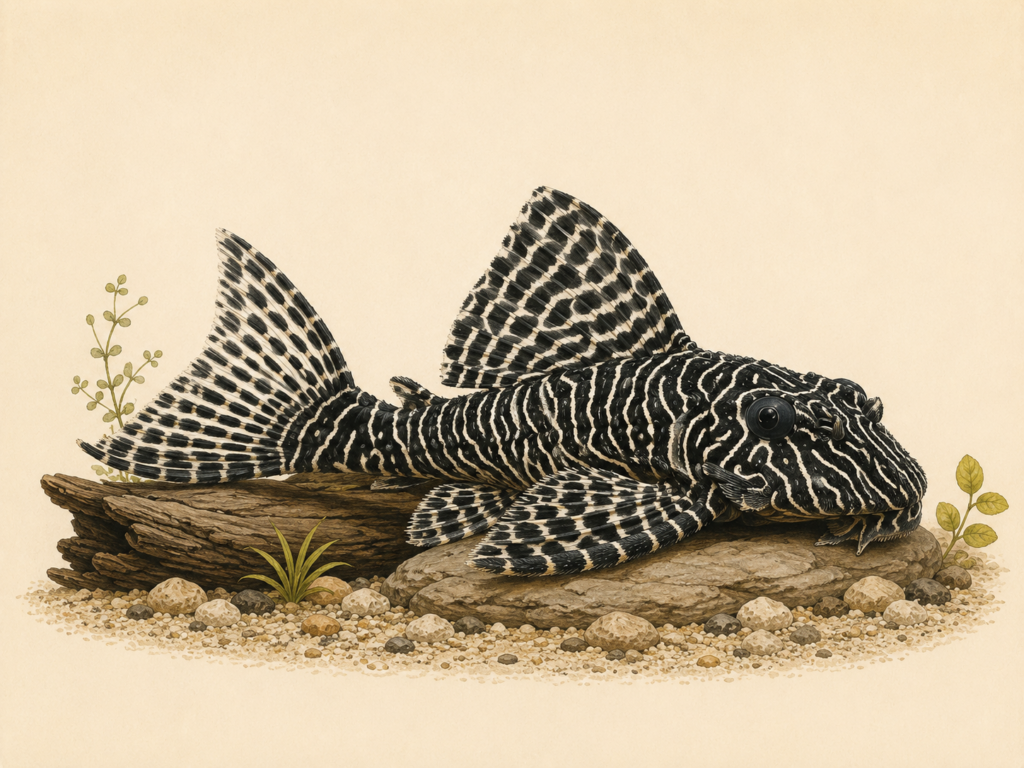
The L260 Queen Arabesque Pleco is a visually stunning fish that immediately draws attention. Its body is a deep, rich black that serves as the canvas for an elaborate pattern of bright white to cream-coloured lines. These lines form a complex, maze-like or labyrinthine network across the entire body, head, and fins, creating the “arabesque” pattern from which the fish derives its common name. No two individuals share the same pattern, and the intricacy and density of the lines can vary considerably between specimens. In some individuals, the lines are fine and tightly packed, creating an almost lace-like effect, while in others, the lines are broader and more widely spaced.
The body shape is typical of the Hypancistrus genus – dorsoventrally flattened, with a broad, slightly rounded head and a streamlined, torpedo-like profile when viewed from above. The mouth is located on the underside of the head and features a suckermouth adapted for grazing on surfaces and holding position in flowing water. The interopercular odontodes (small spines on the gill covers) are present but not particularly pronounced compared to some other loricariid species.
The dorsal fin is tall and sail-like, and the caudal (tail) fin is forked, with both fins displaying the same striking black-and-white patterning as the body. The pectoral fins are broad and well developed, bearing odontodes along the leading ray – these are typically more pronounced in mature males. The ventral fins are similarly patterned and are used by the fish to anchor itself in crevices and caves.
Sexual dimorphism is present but can be subtle, particularly in younger specimens. Mature males tend to have a broader, slightly more angular head when viewed from above, and they develop more prominent odontodes on the pectoral fin spines and along the body, giving them a slightly “bristly” appearance. Females are typically a little rounder in the body, especially when gravid, and have a smoother overall profile. When viewed from below, the genital papilla of the female is broader and more rounded compared to the narrower, more pointed papilla of the male, though this distinction requires careful observation.
Juvenile L260 specimens display the same basic pattern as adults, though the contrast may appear even more vivid in young fish. As the fish matures, the pattern generally remains stable, though the lines may thicken or shift slightly with growth. The fish does not undergo dramatic colour changes with age, which is part of its enduring appeal.
Natural Habitat
The L260 Queen Arabesque Pleco originates from the Rio Tapajos and its tributaries in the state of Para, Brazil. The Rio Tapajos is a major clearwater river system that flows northward to join the Amazon River near the city of Santarem. Clearwater rivers in the Amazon basin are characterised by relatively transparent water with low levels of dissolved organic matter, moderate acidity, and low mineral content. These rivers tend to be warmer than blackwater systems and have a sandy or rocky substrate.
In its natural habitat, the L260 inhabits areas of fast-flowing water over rocky substrates, particularly in rapids and riffles where large boulders, smaller rocks, and pebbles create a complex network of crevices, gaps, and caves. The fish is nocturnal and spends the daylight hours hidden within these rocky structures, emerging at night to feed. The water in these habitats is well oxygenated due to the strong current and surface agitation, and temperatures are consistently warm, typically ranging from 28 to 32 degrees Celsius.
The rocky rapids habitat is shared with a number of other loricariid catfish species, as well as various cichlids, characins, and other Amazonian fish. The L260 occupies a specific ecological niche as a small, crevice-dwelling omnivore with a strong preference for protein-rich foods. In the wild, its diet likely consists of small invertebrates, insect larvae, biofilm, and organic detritus found on and between the rocks.
It is worth noting that the Rio Tapajos has faced significant environmental pressures in recent decades, including the construction of hydroelectric dams, deforestation in the surrounding catchment area, and illegal gold mining, which introduces mercury and sediment into the waterways. These threats have raised conservation concerns for many species endemic to the basin, including various L-number plecos. While the L260 has not been formally assessed by the IUCN, the increasing availability of captive-bred specimens is an important step in reducing pressure on wild populations.
Tank Size and Setup
The L260 Queen Arabesque Pleco is a relatively small species, reaching a maximum adult size of around 8 to 10 centimetres. A single specimen or a pair can be comfortably housed in an aquarium of 80 litres or more, though a larger tank is always preferable, particularly if you plan to keep a group or breed the species. For a breeding colony of four to six individuals, a tank of 120 to 200 litres is recommended, as this provides sufficient space for multiple caves and reduces the potential for territorial disputes among males.
The aquascape should be designed to replicate the rocky, crevice-rich environment of the fish’s natural habitat. The substrate can be fine sand or smooth gravel – sharp or rough substrates should be avoided, as they can damage the fish’s delicate underside. The most important furnishing element is an abundance of caves and hiding places. Purpose-made ceramic or slate pleco caves in various sizes are ideal, as they provide the enclosed, secure spaces that the L260 needs to feel comfortable and, if breeding is a goal, to spawn. Each cave should ideally have only one entrance and be just large enough for a single adult to enter comfortably.
In addition to dedicated caves, the tank should include stacked rocks, driftwood, and other hardscape elements that create additional gaps and shaded areas. Ensure that all rockwork is securely positioned and cannot topple, as loricariids are surprisingly strong and may dislodge unstable structures. Silicone aquarium sealant or aquascaping glue can be used to fix rocks together if necessary.
Planting is optional. In the wild, the L260 is found in rocky, fast-flowing areas with limited plant growth. However, hardy plants such as Anubias, Java Fern (Microsorum pteropus), and Bolbitis heudelotii can be attached to rocks and driftwood to add visual interest and help maintain water quality. Floating plants can also be used to diffuse lighting, as the L260 prefers subdued illumination and is more likely to emerge during the day if the light is not overly bright.
Lighting should be moderate to low. The L260 is a nocturnal species and will spend most of the daylight hours hidden in its cave. If you wish to observe the fish more frequently, consider using a moonlight or dim blue LED setting during the evening hours, which allows you to watch the fish as it becomes active without disturbing it.
Water Parameters
The L260 Queen Arabesque Pleco requires warm, clean, well-oxygenated water. It is somewhat more tolerant of varying water chemistry than its close relative the Zebra Pleco (L046), but it still benefits from stable conditions within its preferred ranges. Consistency is more important than hitting exact numbers – sudden fluctuations in temperature, pH, or hardness are far more stressful and dangerous than slightly suboptimal but stable values.
| Temperature | 28-32 °C |
| pH | 5.5-7.5 |
| General hardness (GH) | 2-15 dGH |
| Carbonate hardness (KH) | 1-10 dKH |
| Ammonia | 0 ppm |
| Nitrite | 0 ppm |
| Nitrate | Below 20 ppm |
The higher end of the temperature range (30-32 degrees Celsius) is particularly important if you are attempting to breed the species, as warmer water helps stimulate spawning behaviour. For general maintenance, temperatures around 28 to 30 degrees Celsius are suitable. At these elevated temperatures, dissolved oxygen levels in the water are naturally lower, which makes strong aeration and water movement essential.
Regular water changes are crucial for the long-term health of this species. A weekly water change of 25 to 30 per cent is a good baseline, though more frequent changes may be necessary in smaller tanks or those with higher bioloads. When performing water changes, ensure that the replacement water is temperature-matched and dechlorinated before adding it to the tank. Some breeders use slightly cooler replacement water to simulate the effect of rainwater entering the river system, which can help trigger spawning behaviour.
Filtration and Equipment
Given the L260’s preference for clean, well-oxygenated water with moderate to strong flow, an efficient filtration system is essential. An external canister filter is the preferred choice for most keepers, as it provides excellent mechanical, biological, and chemical filtration capacity without taking up space inside the aquarium. The filter should be rated for at least the volume of the tank, and ideally oversized, particularly in smaller setups where the bioload from even a few plecos can be significant relative to the water volume.
In addition to the main filter, supplementary water movement and aeration can be provided by a powerhead, wavemaker, or airstone. The L260 naturally inhabits areas of flowing water and appreciates moderate current within the aquarium. Positioning the filter outlet to create a directional flow across the length of the tank, with the return at the opposite end, helps replicate natural conditions and ensures good water circulation throughout the aquarium.
A reliable heater capable of maintaining temperatures of 28 to 32 degrees Celsius is essential. Given the higher-than-average temperature requirements, an adjustable heater of appropriate wattage for the tank size should be selected and regularly checked for accuracy. In larger setups, two smaller heaters can be used as a safety measure – if one fails, the other will prevent the temperature from dropping too rapidly. A thermometer (ideally a digital one) should be used to monitor the temperature independently of the heater’s built-in thermostat.
A sponge pre-filter on the filter inlet is highly recommended, particularly if you are breeding the species. Sponge pre-filters prevent fry from being sucked into the filtration system and also provide additional surface area for beneficial bacteria. They do require regular cleaning to prevent clogging, which can reduce flow rates over time.
An air pump with an airstone or sponge filter can serve as both supplementary biological filtration and an additional source of oxygenation. This is especially valuable during warm weather or in tanks kept at the higher end of the temperature range, where oxygen saturation can become a concern.
Diet and Feeding
The L260 Queen Arabesque Pleco is primarily a carnivorous species, which sets it apart from many of the larger, herbivorous pleco species commonly kept in aquaria. This fish is not an efficient algae eater and should not be relied upon for algae control. Its natural diet consists mainly of small invertebrates, insect larvae, and biofilm, and its captive diet should reflect this protein-rich preference.
High-quality sinking pellets and wafers formulated for carnivorous catfish should form the staple of the diet. Products with a high protein content and minimal filler ingredients are ideal. Many dedicated pleco keepers use Repashy gel foods, particularly the “Morning Wood” and “Soilent Green” formulations, as well as custom gel food recipes that combine ingredients such as prawns, mussels, spirulina, and vitamins.
Frozen and live foods are excellent supplementary offerings that help maintain condition and encourage natural foraging behaviour. Bloodworm, brine shrimp, daphnia, and Mysis shrimp are all readily accepted. Live blackworms and tubifex worms are particularly relished and can be used to condition breeding adults. Blanched vegetables such as courgette (zucchini), cucumber, and sweet potato can be offered occasionally and are sometimes accepted, though the L260 shows a much stronger preference for meaty foods than plant-based ones.
Feeding should ideally take place in the evening or after the aquarium lights have been turned off, as the L260 is nocturnal and most active during the night. Dropping food near the entrances of caves can help ensure that the fish finds it. In a community tank, it is important to verify that the pleco is actually getting its share of food, as more active tankmates may consume sinking foods before the pleco emerges to feed.
Avoid overfeeding, as uneaten food will quickly foul the water in a warm aquarium. Remove any uneaten fresh or frozen foods within a few hours. A varied diet offered in appropriate portions will keep the L260 in optimal health and enhance the contrast and vibrancy of its striking pattern.
Behaviour and Temperament
The L260 Queen Arabesque Pleco is a peaceful, reclusive species that spends the majority of its time hidden within its chosen cave or crevice. During the day, it is uncommon to see the fish out in the open, though established, well-settled individuals may occasionally venture out, particularly in dimly lit tanks or when food is present. The fish becomes much more active after dark, emerging to forage across rocks, substrate, and driftwood.
Males can be territorial, particularly with other males of the same species, and disputes over prime cave locations can occur. These confrontations are usually limited to posturing, fin flaring, and occasional brief chases rather than serious physical aggression, but providing an abundance of caves – ideally more caves than fish – is the simplest and most effective way to prevent stress and conflict. Each male will typically claim a single cave as his territory and defend it against intruders.
Females are generally less territorial and may share hiding spots or move between caves more freely. In a well-furnished tank with plenty of hiding places, a small group of L260 plecos can coexist harmoniously. A ratio of one male to two or three females is often recommended for breeding groups, though balanced sex ratios can also work in tanks with ample cave provision.
The L260 is not a schooling or shoaling fish, but it is not strictly solitary either. In the wild, multiple individuals may inhabit the same stretch of rapids, each occupying its own crevice. In captivity, they can be kept singly, in pairs, or in small groups, depending on the tank size and setup.
Interactions with other species are minimal. The L260 is not aggressive towards tankmates and will generally ignore other fish entirely. It may compete with other bottom-dwelling species for cave space, so care should be taken when housing it with other cave-dwelling catfish or cichlids. Overall, this is a shy, unobtrusive species that adds beauty and interest to an aquarium without causing disruption.
Tank Mates
The L260 Queen Arabesque Pleco is a peaceful, non-aggressive species that can be housed with a wide range of similarly peaceful community fish. The main considerations when choosing tankmates are temperature compatibility (the L260 requires warm water of 28 to 32 degrees Celsius, which rules out many temperate and cooler-water species), aggression levels, and competition for food and hiding places. Avoid large, aggressive, or highly territorial species that might intimidate or harm the pleco, and be cautious with other bottom-dwelling cave dwellers that could compete for the same resources.
Good tank mates
- Cardinal Tetra – A peaceful, warm-water-tolerant tetra that occupies the mid-water column and will not compete with the L260 for space or food.
- Rummy-nose Tetra – Thrives in the same warm, soft-water conditions and adds lively mid-water activity without bothering bottom-dwelling plecos.
- Ember Tetra – A tiny, peaceful species that tolerates warmer temperatures well and poses no threat to a pleco of any size.
- German Blue Ram – A warm-water dwarf cichlid that shares similar parameter preferences and is generally peaceful enough to coexist, provided both species have adequate territory.
- Corydoras sterbai – One of the few Corydoras species that thrives at higher temperatures, making it an excellent bottom-dwelling companion that occupies different microhabitats.
- Otocinclus – Small, peaceful algae grazers that occupy different surfaces and do not compete with the L260 for caves or meaty foods.
- Harlequin Rasbora – A hardy, peaceful mid-water species that adapts well to warm, slightly acidic water conditions.
- Apistogramma cacatuoides – A dwarf cichlid that appreciates similar warm, soft-water conditions, though cave competition should be managed by providing ample hiding spots for both species.
Fish to avoid
- Oscar – A large, aggressive predatory cichlid that could easily injure or consume an L260 and requires a vastly different setup.
- Common Pleco – Grows far too large and can become territorial, potentially bullying the much smaller L260 out of its hiding places.
- Jack Dempsey – An aggressive, territorial cichlid that would pose a serious threat to a small, retiring pleco species.
- Tiger Barb – A nippy, boisterous species that may harass the L260 and tends to prefer slightly cooler water.
- Green Terror – A large and highly aggressive South American cichlid completely unsuitable for housing with small, peaceful plecos.
- Red Tail Catfish – An enormous predatory catfish that would readily consume any fish small enough to fit in its mouth.
- Convict Cichlid – Highly territorial, especially when breeding, and would likely harass and potentially injure a cave-dwelling pleco.
- Chinese Algae Eater – Becomes aggressive and territorial with age and has been known to attach to and damage the flanks of slow-moving fish.
Breeding
Breeding the L260 Queen Arabesque Pleco in captivity is an achievable and highly rewarding goal for the dedicated aquarist. Compared to its close relative the Zebra Pleco (L046), the L260 is generally considered somewhat easier to breed, though it still requires specific conditions and careful management. The species is a cave spawner, with the male playing the primary role in egg care and fry rearing.
To breed the L260, start by assembling a group of healthy, well-conditioned adults. A ratio of one male to two or three females is often recommended, though pairs can also breed successfully. Ensure that the breeding tank contains multiple caves of appropriate size – each cave should have an opening just large enough for a single adult to enter, and the interior should be snug enough that the male can trap the female inside and brace himself against the walls to tend the eggs. Ceramic pleco caves with a single entrance and a closed back are widely used by breeders and are available in various diameters to suit different sizes of fish.
Water temperature is a key trigger for spawning. Maintaining the tank at the upper end of the species’ range, around 30 to 32 degrees Celsius, helps encourage breeding behaviour. Some breeders also report success with simulating a dry-season-to-wet-season transition by performing a large, slightly cooler water change after a period of reduced water changes, which may mimic the onset of the rainy season in the Amazon basin.
Conditioning the adults with a protein-rich diet of live and frozen foods such as bloodworm, blackworms, and brine shrimp in the weeks leading up to a breeding attempt is essential. Well-fed, healthy fish are far more likely to spawn than underfed or stressed individuals.
When the female is ready to spawn, she will enter the male’s cave and deposit a clutch of relatively large, adhesive eggs, typically numbering between 10 and 30. The male fertilises the eggs and then assumes full responsibility for their care. He will remain inside the cave, fanning the eggs with his fins to ensure a constant supply of oxygenated water and removing any eggs that become fungused. The female takes no further part in the process and should not be disturbed.
Incubation takes approximately seven to ten days at the recommended temperature, after which the fry hatch. The newly hatched fry are relatively large and retain a sizeable yolk sac that sustains them for the first few days. The male will continue to guard the fry inside the cave until they have absorbed their yolk sacs and are ready to venture out independently.
Once free-swimming, the fry can be fed with finely crushed high-protein foods, baby brine shrimp (Artemia nauplii), and micro worms. Growth is slow but steady, and the young fish will begin to display the characteristic arabesque pattern within a few weeks. Maintaining excellent water quality during the fry-rearing phase is critical, as young plecos are sensitive to elevated nitrate levels and poor water conditions.
Common Diseases
The L260 Queen Arabesque Pleco is a generally robust species when kept in appropriate conditions, but like all aquarium fish, it can be susceptible to a range of diseases, particularly when stressed by poor water quality, inadequate diet, or unsuitable tankmates.
Ich (white spot disease), caused by the protozoan parasite Ichthyophthirius multifiliis, is one of the most common ailments encountered in freshwater aquaria. The L260 can contract ich, particularly following temperature fluctuations or the introduction of new, unquarantined fish. Treatment involves gradually raising the temperature to 30 to 32 degrees Celsius (which is within the species’ preferred range) and using a half-dose of a malachite green or formalin-based ich medication. Avoid copper-based medications, as scaleless and armoured catfish can be highly sensitive to copper.
Bacterial infections, including fin rot and body sores, can occur in tanks with poor water quality or following physical injuries. These infections typically manifest as frayed or disintegrating fins, red streaks on the body, or open wounds. Improving water quality through more frequent water changes is the first and most important step in treatment, and in more severe cases, an antibacterial medication suitable for catfish may be required.
Fungal infections can affect eggs during breeding (as noted above) and occasionally adult fish, particularly those with compromised immune systems due to stress or injury. Fungal growth typically appears as white, cotton-like patches on the body or fins. Treatment involves improving water conditions and, if necessary, using an antifungal medication at the appropriate dose for loricariids.
Internal parasites can be a concern, particularly with wild-caught specimens. Signs of internal parasites include weight loss despite adequate feeding, hollow belly, white or stringy faeces, and lethargy. Quarantining new arrivals for a minimum of two to four weeks and treating with an appropriate antiparasitic medication if symptoms are observed is strongly recommended.
Stress-related conditions, including loss of appetite, colour fading, and increased susceptibility to disease, are common when the L260 is kept in suboptimal conditions. Ensuring warm, clean water, adequate hiding places, appropriate diet, and peaceful tankmates is the best preventative measure. A healthy, well-kept L260 should display vibrant pattern contrast, good body condition, and active nocturnal behaviour.
FAQs
Is the L260 Queen Arabesque Pleco a good algae eater?
No. Despite its membership in the pleco family, the L260 is primarily a carnivore and does not graze on algae to any significant degree. It feeds on meaty foods such as bloodworm, brine shrimp, and high-protein sinking pellets. If you are looking for an algae-eating pleco, species such as the Bristlenose Pleco or Otocinclus catfish would be far more suitable choices.
Can I keep the L260 Queen Arabesque Pleco in a community tank?
Yes, provided the community tank meets the species’ requirements for warm water (28 to 32 degrees Celsius), good filtration, and an abundance of hiding places. Tankmates should be peaceful species that tolerate the same elevated temperatures. Avoid housing the L260 with large, aggressive fish or other cave-dwelling species that might compete for its hiding spots. The L260 is shy and retiring, so it will do best in a calm, well-structured environment.
How can I tell the difference between male and female L260 plecos?
Sexing can be challenging, especially with younger fish. Mature males tend to have a broader head when viewed from above and develop more prominent odontodes (small bristle-like spines) on their pectoral fins and along the body. Females are generally rounder-bodied, particularly when carrying eggs, and have a smoother profile. Examining the genital papilla (the small protrusion near the vent) can also help – it is broader and more rounded in females and narrower and more pointed in males, though this requires close observation and some experience.
What is the difference between the L260 and the Zebra Pleco (L046)?
Both species belong to the genus Hypancistrus and share similar care requirements, including warm water, a carnivorous diet, and a preference for caves. The most obvious difference is in the patterning: the Zebra Pleco displays bold, parallel black-and-white stripes, while the L260 has a more complex, maze-like or arabesque pattern. The L260 is generally considered slightly hardier, more readily available, and easier to breed than the L046, making it a popular alternative for keepers who admire the Zebra Pleco but want a species that is a little more forgiving and accessible.
How long does it take for L260 fry to grow to adult size?
Growth in Hypancistrus species is relatively slow compared to many other aquarium fish. L260 fry typically reach a sellable size of around 3 to 4 centimetres within six to nine months, but it can take 18 months to two years or more for them to reach full adult size and sexual maturity. Growth rate depends on water temperature, diet quality, water change frequency, and stocking density. Regular feeding of high-protein foods and consistent maintenance of excellent water quality will help promote the best possible growth.
Related Guides
- Zebra Pleco (L046) – The L260’s closest and most famous relative, sharing similar care requirements and breeding strategies but with a distinctive striped pattern.
- Bristlenose Pleco – A popular and hardy beginner pleco that serves as a useful point of comparison for understanding the different dietary and care needs of Hypancistrus species.
- Corydoras sterbai – A warm-water Corydoras species that makes an excellent companion for the L260 and shares similar temperature preferences.
- German Blue Ram – A stunning dwarf cichlid that thrives in the same warm, soft-water conditions as the L260, making it a natural tankmate choice.
- King Tiger Pleco (L066) – Another popular Hypancistrus species with similar husbandry requirements, useful for comparison and for aquarists considering a Hypancistrus community tank.