Quick Summary
The Arowana Tetra is a striking, predatory characin that looks far more dramatic than your average tetra – it demands a spacious tank, appropriately sized tank mates, and a protein-rich diet. It is best suited to intermediate or experienced fishkeepers who want a bold, active centrepiece fish without committing to a true monster-fish setup.
🐠 Build a tank around this species
In this guide:
- Introduction
- Quick Stats
- Appearance
- Natural Habitat
- Tank Size and Setup
- Water Parameters
- Diet and Feeding
- Behaviour and Temperament
- Tank Mates
Introduction
The Arowana Tetra (Gnathocharax steindachneri) is one of those freshwater species that catches people off guard. The name “tetra” conjures images of peaceful neon-lit schooling fish darting around a planted community tank, but this characin is a different animal altogether. With an elongated jaw, a sleek, laterally compressed body, and a distinctly predatory temperament, it has far more in common behaviourally with its distant arowana namesake than with the cardinal tetras at the local fish shop.
First described in the late 19th century, Gnathocharax steindachneri hails from slow-moving and still waters across northern South America. It belongs to the family Characidae – the same enormous family that houses piranhas, pacus, and the familiar community tetras – but it occupies a very different ecological niche. In the wild it is a surface-oriented ambush predator, using its upturned mouth and explosive acceleration to snatch small fish, large invertebrates, and terrestrial insects that fall onto the water’s surface.
Despite its predatory habits, the Arowana Tetra remains a manageable species for home aquaria. Adults typically reach around 10-12 cm (roughly 4-5 inches), making them considerably smaller than true arowanas and many other predatory characins. This means a suitably large aquarium rather than a pond-sized setup will suffice – but it does rule out the nano tanks and modest community setups that many beginner fishkeepers start with. If you are looking for a fish with genuine personality, dramatic feeding behaviour, and a silhouette unlike anything else in your tank, the Arowana Tetra is well worth considering.
Quick Stats
| Scientific name | Gnathocharax steindachneri |
|---|---|
| Common names | Steindachner's Arowana Tetra |
| Family | Acestrorhynchidae |
| Origin | South America - Venezuela, Guyana, Suriname, Amazon and Orinoco basins |
| Adult size | 6 cm |
| Difficulty | Intermediate |
| Breeding difficulty | Advanced |
| Temperature | 23–27 °C |
| pH | 5.5–7.5 |
| GH | 5–15 dGH |
| Minimum tank size | 200 L |
| Conservation status | Least Concern (IUCN, assessed 2020) |
Appearance
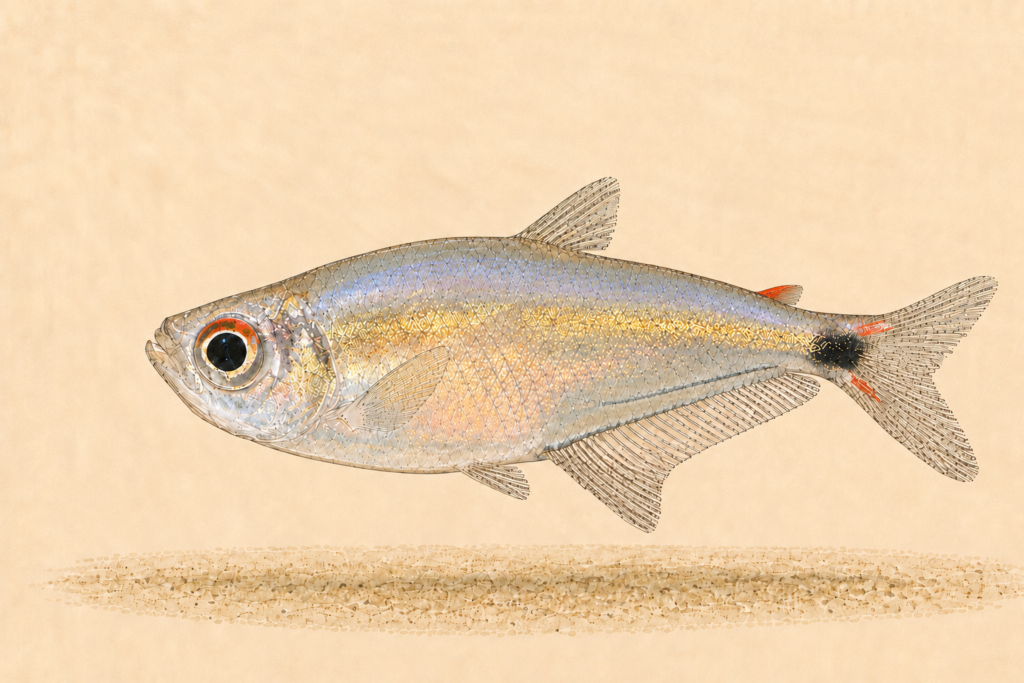
The most immediately striking feature of the Arowana Tetra is its elongated, upturned jaw. The lower mandible extends noticeably beyond the upper, giving the fish a perpetual “looking upward” posture that closely mirrors the mouth shape of true arowanas (Osteoglossidae). This morphological adaptation is no accident – it is perfectly designed for surface predation, allowing the fish to snap at prey items from below the waterline with remarkable speed.
The body is laterally compressed and somewhat elongated, tapering to a deeply forked caudal fin. In profile it has a streamlined, almost hatchet-like outline, though it is less dramatically deep-bodied than true hatchetfish. The dorsal fin sits well back on the body, a common trait among surface-hunting characins, and the pectoral fins are moderately long, giving the fish fine control during lunging strikes.
Colouration is subtle but attractive. The base tone is silver to pale gold, often with a faint greenish or bronze iridescence along the flanks when the light catches at the right angle. A dark lateral stripe runs from behind the gill cover towards the caudal peduncle, though its prominence varies between individuals and can fade or intensify depending on mood and water conditions. The fins are largely translucent with occasional yellowish or reddish tints, particularly in mature males. The eye is large and prominent – another hallmark of a visually oriented predator.
Sexual dimorphism is not especially pronounced. Males tend to be slightly slimmer and may display marginally more intense fin coloration than females. Gravid females can appear noticeably deeper-bodied when carrying eggs, but outside of breeding condition the sexes can be tricky to distinguish with confidence.
Natural Habitat
Gnathocharax steindachneri is found across a broad swathe of northern South America, with confirmed populations in the Orinoco basin of Venezuela, the coastal rivers of Guyana and Suriname, and parts of the upper Amazon drainage. It is not an open-water, fast-flowing river species; rather, it gravitates towards slow-moving tributaries, flooded forest margins (igapo and varzea habitats), backwaters, and oxbow lakes.
In these environments, the water is often stained dark with tannins released from decomposing leaf litter, fallen branches, and other organic material. The pH is typically acidic – often between 5.0 and 6.5 – and mineral hardness is extremely low. Light levels beneath the forest canopy are subdued, and the substrate is a mixture of fine sand, mud, and deep beds of decaying leaves.
The Arowana Tetra occupies the upper water column almost exclusively. It lurks just beneath the surface, often among overhanging vegetation, submerged root tangles, or floating plant mats, waiting for terrestrial insects and small fish to come within striking distance. During the wet season, when rivers burst their banks and inundate surrounding forest, the species disperses widely through newly flooded areas where food is temporarily abundant.
Understanding this natural habitat is key to providing appropriate captive care. The Arowana Tetra is accustomed to warm, soft, acidic water; dim or dappled lighting; and plenty of surface cover. Replicating even a portion of these conditions will reduce stress, encourage natural behaviour, and bring out the best colouration the species has to offer.
Tank Size and Setup
A minimum tank size of 200 litres is recommended for a small group of Arowana Tetras. This provides enough horizontal swimming space for a fish that, while not a constant open-water swimmer, does require room to cruise and strike at food. A tank measuring at least 120 cm in length is ideal – prioritise length and width over height, as the species spends the vast majority of its time in the top third of the water column and has little use for extreme depth.
If you intend to keep a group of five or more, or to house the Arowana Tetra alongside other medium-sized species, consider scaling up to 300-400 litres. Larger volumes also make water chemistry more stable and dilute waste more effectively, both of which benefit a species that is somewhat sensitive to poor water quality.
Aquascaping should aim to recreate elements of the species’ natural blackwater habitat. Start with a fine sand substrate – pale sand works well visually, but dark sand can help bring out the fish’s subtle iridescence. Add a generous scattering of driftwood, particularly branching pieces that reach towards the surface, to provide both cover and visual barriers. Indian almond leaves (Terminalia catappa), oak leaves, or other tannin-releasing botanicals are excellent additions; they tint the water, lower the pH gently, and provide surfaces for biofilm growth that supports the broader ecosystem of the tank.
Floating plants are strongly recommended. Amazon frogbit, red root floaters, Salvinia, or water lettuce all work well. They dim the lighting naturally, create the shaded surface that the Arowana Tetra prefers, and help the fish feel secure enough to display natural behaviour rather than skulking in corners. Be sure to leave some gaps in the floating plant cover for feeding and gas exchange.
A tight-fitting lid or cover glass is essential. The Arowana Tetra is a capable jumper, particularly when startled or during feeding frenzies. Gaps around filter intakes, heater cables, and airline tubing should be covered or blocked. Many keepers have lost specimens to jumping, especially in the first few days after introduction when the fish is most stressed.
Lighting should be moderate to subdued. If you are growing rooted plants beneath the floating cover, choose species tolerant of lower light – Anubias, Java fern, Cryptocoryne, and various mosses all do well under these conditions and contribute to the natural, shaded aesthetic the species thrives in.
Water Parameters
| Temperature | 23-27 C |
| pH | 5.5-7.5 |
| General hardness (GH) | 5-15 dGH |
| Ammonia | 0 ppm |
| Nitrite | 0 ppm |
| Nitrate | Below 20 ppm |
The Arowana Tetra is adaptable within a reasonably broad range, but it shows its best colour and most relaxed behaviour in soft, slightly acidic water. A pH of 6.0-7.0 and a GH of 4-10 dGH represents the sweet spot for most captive specimens. Fish imported directly from wild habitats may initially prefer even softer and more acidic conditions, though they generally adjust to moderately harder tap water over time provided the transition is gradual.
Temperature stability matters more than hitting a precise number. Aim for 25-27 C for everyday keeping. Avoid sudden swings of more than 1-2 C within a short period – these can stress the fish and suppress the immune system, making it more vulnerable to opportunistic infections.
Ammonia and nitrite must be maintained at zero at all times. As a protein-heavy feeder that produces a proportionally higher waste load than a similarly sized herbivorous fish, the Arowana Tetra can push a lightly filtered tank into trouble. Regular testing, especially in newer setups, is important. Nitrate should be kept below 20 ppm through a combination of adequate filtration, live plants, and consistent water changes.
Weekly water changes of 25-30% are a sensible baseline. If you are maintaining a tannin-rich blackwater setup, replacing all the water at once will strip out the tannins and shift the chemistry abruptly – smaller, more frequent changes are gentler. Re-dose botanicals as needed to maintain the desired level of tint and acidity.
Filtration and Equipment
Choose a filter rated for the full volume of your tank, or ideally slightly above it. External canister filters are the most popular choice for tanks of 200 litres and above – they offer excellent biological and mechanical filtration capacity, are easy to maintain, and keep the tank interior uncluttered. A canister turning over roughly four to five times the tank volume per hour provides a good balance between thorough filtration and manageable flow.
Flow direction and strength deserve attention. The Arowana Tetra does not come from rapids or fast-moving streams; it prefers calm to gently moving water. Position the filter outlet so that it creates a gentle current across the mid-level of the tank without disturbing the surface excessively. A spray bar oriented along the back glass and angled slightly downward works well. If the surface is too turbulent, the fish will be reluctant to use it – exactly where it naturally wants to spend its time.
A reliable heater – or two smaller heaters for redundancy in larger setups – is essential for maintaining tropical temperatures. An inline heater attached to the canister filter return is a tidy solution that removes equipment from the tank interior. If using a standard submersible heater, protect it with a heater guard; a startled Arowana Tetra can collide with equipment during its characteristically explosive bursts of speed.
An air pump is not strictly necessary if the filter provides adequate surface agitation for gas exchange, but it can be useful as a backup aeration source, particularly in warmer months when dissolved oxygen levels drop. If you do use an airstone, keep it gentle – a fine curtain of bubbles in one corner rather than a roaring column in the centre of the tank.
Diet and Feeding
In the wild, the Arowana Tetra is primarily piscivorous and insectivorous. Its upturned mouth and explosive strike behaviour are adaptations for snatching small fish and terrestrial insects from the water’s surface. In captivity, it retains these predatory instincts, and its diet should reflect them.
Live and frozen foods should form the core of the diet. Bloodworm, brine shrimp, daphnia, mosquito larvae, and chopped earthworms are all readily accepted. Larger specimens will also take small feeder shrimp (such as cherry shrimp or ghost shrimp) and, if offered, very small feeder fish – though live feeder fish carry a risk of introducing disease and are generally best avoided unless you are breeding your own clean stock.
Most Arowana Tetras can be trained to accept high-quality dried foods over time. Carnivore pellets, freeze-dried krill, and protein-rich flake foods may all be taken once the fish associates them with feeding time. The key is patience and variety – offer dried foods alongside familiar live or frozen items, and gradually increase the proportion of prepared foods as the fish gains confidence. Some individuals never fully accept dried food, so be prepared to maintain a live and frozen food supply long-term.
Feed once or twice daily, offering only as much as the fish can consume within a few minutes. Overfeeding is a common problem with predatory species – uneaten food decays quickly and fouls the water, and an overfed predator is more likely to become sluggish and overweight, shortening its lifespan. A fasting day once a week is a reasonable practice that mimics the natural irregularity of prey availability and helps keep the digestive system in good order.
Be mindful that the Arowana Tetra feeds primarily at the surface. Sinking pellets or bottom-dwelling live foods may be ignored entirely. Use floating pellets and drop live or frozen foods directly onto the water’s surface where the fish can detect and strike at them naturally.
Behaviour and Temperament
The Arowana Tetra is best described as semi-aggressive. It is not a fish that relentlessly harasses tank mates in the way that some cichlids do, but it is an opportunistic predator that will eat any fish small enough to fit in its mouth – and its mouth is surprisingly capacious for its body size. Any tank mate smaller than about 4 cm is at serious risk of becoming a meal.
Within its own species, Gnathocharax steindachneri can be kept singly or in small groups. Solitary specimens tend to be more reclusive but can still thrive, while groups of five or more often display more natural behaviour, including loose shoaling and competitive feeding displays. In groups, there is typically a dominance hierarchy with occasional chasing and flared fins, but outright damage is rare provided the tank is large enough and offers adequate line-of-sight breaks through driftwood and planting.
The species is most active during dawn and dusk, reflecting its crepuscular hunting habits in the wild. During brighter parts of the day it may hover motionless just beneath a floating plant or overhanging piece of wood, seemingly asleep. This is perfectly normal behaviour. As the lights dim, the fish becomes noticeably more alert and mobile, patrolling the surface and investigating anything that disturbs the water.
Jumping is a significant behavioural trait. The Arowana Tetra can launch itself out of the water with startling power and accuracy, both as a feeding strategy and as a panic response. New fish are especially prone to jumping during their first week in a tank. A secure, gapless lid is not optional – it is a requirement.
Despite its predatory nature, the Arowana Tetra can be somewhat nervous, particularly in sparsely decorated tanks or under bright lighting. Providing floating plants, surface cover, and subdued illumination does a great deal to settle the fish and encourage it to display in the open rather than hiding perpetually behind the heater.
Tank Mates
Choosing tank mates for the Arowana Tetra requires careful thought. The overriding rule is simple: nothing small enough to be eaten, nothing aggressive enough to bully or outcompete the Arowana Tetra, and nothing so boisterous that it monopolises the surface layer. Medium-sized, robust South American species are the most natural and successful companions. Avoid tiny nano fish, delicate long-finned species, and anything with a reputation for severe aggression.
Good tank mates
- Bleeding Heart Tetra – A robust, medium-sized tetra that is too large to be eaten and shares similar water chemistry preferences.
- Diamond Tetra – Another chunky tetra that reaches a safe size and adds attractive sparkle to the mid-water column.
- Congo Tetra – Large enough to coexist safely, active in the mid-water, and tolerant of similar conditions despite its African origin.
- Bristlenose Pleco – A peaceful bottom-dweller that occupies a completely different zone and is armoured enough to be ignored.
- Geophagus sveni – An eartheater cichlid that stays at the bottom, is generally peaceful, and appreciates warm, soft water.
- Black Skirt Tetra – A hardy, deep-bodied tetra that is too large and fast to be predated upon.
- Firemouth Cichlid – A moderately assertive cichlid that can hold its own without being dangerously aggressive.
- Hoplo Catfish – A tough, armoured catfish that stays near the bottom and tolerates a wide range of conditions.
Fish to avoid
- Neon Tetra – Far too small; will be eaten quickly and without hesitation.
- Cardinal Tetra – Same problem as the neon tetra – a bite-sized snack for the Arowana Tetra.
- Endler’s Livebearer – Tiny and slow enough to be easy prey.
- Celestial Pearl Danio – A nano species that would not survive alongside any piscivorous fish.
- Green Terror Cichlid – Highly aggressive and territorial; likely to dominate and injure the Arowana Tetra.
- Flowerhorn Cichlid – Extremely aggressive and far too large and combative for cohabitation.
- Cherry Shrimp – Will be hunted and consumed almost immediately.
- Common Hatchetfish – Occupies the same surface niche but is small and fragile enough to be eaten or severely stressed.
Breeding
Breeding the Arowana Tetra in captivity is challenging, and documented successes in home aquaria are rare. The species is an egg scatterer, as is typical for many characins, but the specific triggers for spawning behaviour are not fully understood and are difficult to replicate outside of their natural seasonal flood cycle.
To encourage breeding, start by conditioning a group of healthy adults with a rich, varied diet heavy in live foods for several weeks. Gradually lower the pH to around 5.5-6.0, reduce the general hardness to the softest water you can safely maintain, and raise the temperature slightly to around 28 C. Some breeders have reported that simulating the onset of a wet season – through increased water changes using very soft, slightly cooler water – can trigger spawning behaviour.
If spawning does occur, the eggs are typically scattered among fine-leaved plants or over the substrate. The parents show no brood care and will consume eggs and fry given the opportunity, so prompt removal of the adults or the eggs is necessary. Eggs are small and semi-transparent, making them easy to overlook.
Fry, if they hatch successfully, are tiny and require infusoria or liquid fry food for the first week or so before graduating to newly hatched brine shrimp nauplii. Growth can be slow, and the fry are vulnerable to water quality fluctuations, fungal infections, and predation – including from siblings as they grow at different rates. A dedicated, heavily filtered, and meticulously maintained rearing tank is essential.
Given the difficulty involved, most Arowana Tetras available in the hobby are wild-caught. If you are interested in attempting to breed this species, researching the breeding protocols used for other predatory characins – such as certain Hoplias or Acestrorhynchus species – may provide useful analogues, though direct applicability is not guaranteed.
Common Diseases
The Arowana Tetra is generally hardy once established in a suitable environment, but it is susceptible to the same common freshwater diseases that affect most tropical fish, particularly when stressed by poor water quality, sudden parameter changes, or an inadequate diet.
White spot disease (Ichthyophthirius multifiliis, commonly called ich) is the most frequently encountered ailment. It presents as small white cysts on the fins and body and is usually triggered by temperature drops or the introduction of new fish without proper quarantine. Treatment involves raising the temperature to 28-30 C and, if necessary, using a proprietary white spot treatment. The Arowana Tetra tolerates most standard ich medications well, but always check the label for any warnings regarding scaleless or sensitive species and dose accordingly.
Bacterial infections, particularly fin rot and ulcerations, can occur in tanks with elevated ammonia or nitrite levels. These typically manifest as frayed or disintegrating fin edges, reddened patches on the body, or visible lesions. Improving water quality is the first and most important step; in many cases, clean water alone is sufficient for mild infections. More advanced cases may require antibacterial treatments.
Internal parasites are a particular concern with wild-caught specimens. Signs include weight loss despite a good appetite, pale or stringy faeces, and lethargy. A quarantine period of two to four weeks for new arrivals – during which the fish can be observed, treated prophylactically if desired, and gradually acclimated to your tank’s water chemistry – is strongly recommended.
Fungal infections (Saprolegnia and similar) occasionally appear on damaged skin, often following handling stress, netting injuries, or fights. They present as white, cotton-like growths. Antifungal treatments are effective when applied promptly, and maintaining good water quality helps prevent secondary infections.
Nutritional deficiencies can arise if the fish is fed an overly monotonous diet. A varied diet including both live/frozen foods and, where accepted, high-quality prepared foods should prevent deficiency-related issues such as poor colouration, stunted growth, and weakened immunity.
FAQs
Is the Arowana Tetra actually related to arowanas?
No. The common name refers to the visual resemblance – the elongated jaw and general body profile – rather than any close taxonomic relationship. Gnathocharax steindachneri belongs to the family Characidae, while true arowanas belong to the family Osteoglossidae. The similarities are a case of convergent evolution, where unrelated species develop similar physical traits in response to similar ecological pressures, specifically surface predation.
Can I keep an Arowana Tetra in a community tank?
Yes, but with important caveats. The Arowana Tetra is a predator that will eat any fish small enough to fit in its mouth. Tank mates must be of a similar size or larger, robust enough to hold their own, and not so aggressive that they bully or injure the Arowana Tetra. A carefully chosen community of medium-sized South American species works best. Tiny fish, shrimp, and delicate nano species are not compatible.
How many Arowana Tetras should I keep together?
A single specimen can be kept successfully, but a group of five or more tends to display more natural behaviour and reduces the likelihood of any one individual being singled out for aggression. In a group, the fish will establish a loose hierarchy with occasional displays and chasing, but serious injury is uncommon in a suitably sized tank with adequate cover.
Will the Arowana Tetra eat prepared dry food?
Many individuals can be weaned onto high-quality floating pellets or freeze-dried foods over time, but some remain stubbornly reliant on live and frozen foods throughout their lives. It is best to assume that you will need to provide live or frozen food regularly and treat any acceptance of dry food as a welcome bonus rather than a guarantee.
Why does my Arowana Tetra hide all day?
This is usually a sign that the fish does not feel secure, often due to excessive lighting, insufficient surface cover, or a lack of driftwood and other visual barriers. Adding floating plants, dimming the lights, and providing more structure near the surface typically resolves the issue. The species is also naturally most active during dawn and dusk, so some daytime inactivity is perfectly normal.
Related Guides
- Bleeding Heart Tetra Care Guide – A robust, medium-sized tetra that makes an excellent tank mate for the Arowana Tetra.
- Diamond Tetra Care Guide – Another large-bodied tetra with overlapping water parameter requirements and compatible temperament.
- Bristlenose Pleco Care Guide – A popular bottom-dwelling companion for predatory characin setups.
- Bucktooth Tetra Care Guide – Another predatory South American characin with specialist care requirements that may interest keepers drawn to unusual tetras.
- Congo Tetra Care Guide – A large, showy tetra suitable for community setups with semi-aggressive species.